Stanbic Bank
Stanbic Bank
25.3 C
Kampala
Stanbic Bank
Stanbic Bank
Home Blog Page 245

Museveni signs three bills into law 

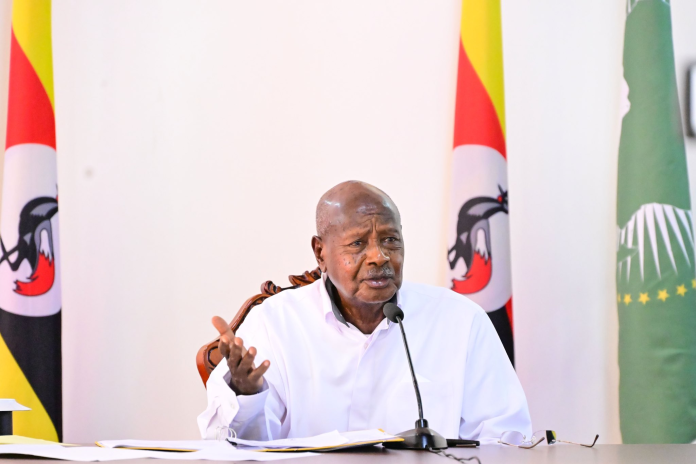
President Museveni signs the bills.

President Yoweri Museveni has signed three bills into law. The bills include; The Animal Feeds Act, 2023, The Veterinary Practitioners Act, 2023 and The National Records and Archives (Amendment) Act, 2024. The three bills were recently passed by Parliament and were awaiting President Museven’s assent.

The Animal Feeds Act, 2023 provides a legislative framework for the operationalization of the animal feeds policy by regulating the production, importation, exportation and marking of animal feeds and establishing the animal feeds committee to regulate the production, importation, exportation and marking of animal feeds.

While tabling the bill before Parliament on Wednesday 25 October 2023, the Minister for Agriculture, Animal Industry and Fisheries, Frank Tumwebaze, said: “Inadequate animal nutrition was identified as one of the factors that limit Uganda’s production of livestock products.”

He added that Animal feeds account for 70 percent of the production costs and therefore have a significant effect on production costs and the profits.

The Animal Feeds Act also provides for the application for the registration of premises and the circumstances under which a certificate of registration may be suspended or revoked.

Similarly, the Act will see the establishment of offices for animal feeds inspectors and animal feeds analysts. The animal feeds inspector shall inspect premises and seize any animal feeds that are produced contrary to the requirements of the Act.

Furthermore, the Act gives the Minister powers to make regulations, under the Act to provide for the procedures and forms to be used, for the application for registration of premises and licenses for the production, storage, transportation, or sale of animal feeds and for the fees paid under the Act.

According to the minister, productivity of livestock in Uganda is low due to the prevalence of animal diseases, inadequate nutrition for the animals, scarcity of water in the semi-arid areas, lack of facilities for the storage and processing of animal feeds, the lack of laboratory facilities and the lack of information, knowledge and skills on animal feeds production amongst other factors.

The law imposes a penalty of 7years for anyone found guilty of selling or producing adulterated animal feeds.

The Veterinary Practitioners Act 2023, giving a blanket opportunity to all veterinary practitioners from the East African Community region to register for practice in Uganda, while providing stringent requirements for those outside the bloc.

Parliament’s Agriculture Committee had protested the proposal arguing that the blanket recognition of veterinary practitioners from East African partner states will disadvantage veterinary practitioners from Uganda since the mutual recognition agreement to allow veterinary practitioners from East African member states to practice across borders is not yet in force, and instead recommended that Uganda should prioritize employment in veterinary practice for its nationals.

Stories Continues after ad

MPs direct authorities to Close Hoima City abattoir over deplorable hygienic conditions

The Health Committee of Parliament.

Parliament’s Health Committee has called for the closure of Hoima City abattoir due to deplorable hygienic conditions, after MPs found the place covered with maggots and flies, due to the absence of a drainage system, leading to the stagnation of animal blood and excreta at the facility.

The call was spearheaded by Samuel Opio, Vice Chairperson Health, who recommended for the suspension of business within Hoima City Abattoir in order to allow the responsible authorities to correct the defects cited by Parliament, warning that any delays would turn slaughter houses into disease epicenters in Uganda.

“As a Committee, we are going to make our report but here within Kyenkobe, we have asked the District Veterinary Officer that this facility be closed, until the necessary corrective action is made because we found that the area is basically not hygienic at all to facilitate the slaughter of the animals within this place. We are also finding areas where the rooms and the floors aren’t made of the right materials, they are supposed to be of terrazzo, but they are of cement and holding blood, a lot of flies and dirt that is accumulated and it is making the place very filthy,” remarked Dr. Samuel Opio.

Opio added, “We have seen that there are some practices that aren’t effected for example, where they find a liver with liver flukes, they just cut off the part where the liver flukes are, and the rest is released and that means it goes to the market and the public consumes it. Even in the internal organs, there are some internal organs like the alimentary canal where they find disease, they simply cut the part of it and then the healthy part is released. So, there are some practices that aren’t standard practices that are supposed to be followed.”

The slaughter house in Kiryateete East, Hoima City was condemned in 2006 but legislators on the Health Committee were perturbed to learn that the city authorities have permitted use of the facility despite its appalling state.

Construction works of the new modern abattoir in Kyentale Ward, Hoima West Division stands at 85 per cent completion but the Vice Chairperson of the committee, Samuel Opio recommended that authorities find an alternative temporary space in the incomplete facility.  

The Hoima City Production Officer, Swaleh Kajuma said authorities cannot sanction use of the new abattoir without an operation permit from the Ministry of Agriculture, Animal Industry and Fisheries (MAAIF).

“MAAIF officials say we cannot use the facility until works are complete. As soon as we get the operation permit, we shall shift,” said Kajuma.

Hoima City Mayor, Brian Kabuya asked the lawmakers to push for expeditious issuance of a temporary operations permit, as well as ensure funds totaling Shs1 billion are allocated towards the completion of the abattoir.

“We request you to ask MAAIF to be considerate and allow a temporary permit because the major reason as to why we cannot shift is limited funding. The contractor has been waiting for funds since January and the fact is, our budget is depleted,” he said.

In Mbarara City, the MPs also recommended closure of the government owned abattoir in Kyenkombe saying the infrastructure is inadequate to continue operations.

Nicholas Kamara (FDC, Kabale Municipality) urged the Mbarara City Veterinary Officer, Dr. Moses Amanyire to ensure that the facility stays closed until acceptable infrastructure is put in place.

“It is totally unhygienic; there are flies all over and the floor is filled with stagnant blood. We have recommended that it stays closed until hygienic conditions are restored,” Kamara said.

Amanyire acknowledged that the slaughter house is in a deplorable state but he quickly blamed it on inadequate funds for renovations and maintenance.

“When we have a broken floor and leaking roof, all that affects the operations of an abattoir,” he said.

On the contrary, the MPs were impressed with the state of the privately-owned abattoir in Mbarara City, saying that the facility has the appropriate infrastructure.

Amanyire however, urged the MPs to task government to revamp the government abattoirs saying that owners of private abattoirs often threaten to close their facilities due to low revenues collected.

“We need to seriously think of a better government owned city abattoir because these private owners complain and threaten to close and we do not have alternatives,” he said.

Meanwhile, MPs expressed dismay over the poor drainage system, lack of electricity, shortage of running water and a non-functional cold room in the Masaka City abattoir in Kirumba.

The Masaka City meat inspector, Peter Ssenabulya reported that whereas the facility generates Shs2.3 million monthly, funds are not availed for its improvement, saying that the facility has never got a facelift since it was constructed in 1959.

“The cold storage room is non-functional because the ceiling has fallen down. The original plan caters for slaughtering of fewer animals but now numbers have increased, hence the poor drainage. We requested for solar lighting, in vain and now we use torches,” said Ssenabulya.

Fort Portal City authorities on the other hand were commended for meeting most of the requirements of operating a slaughter house in Kibimba.

“The drainage is good because we have been to other places and the systems are blocked. We are happy to see the staff in uniform and appropriate work gear, and there is enough running water. The infrastructure inside the slaughter house is good,” said Opio.

The City Veterinary Officer, Fort Portal, Dr Stanley Busingye however raised concern over inadequate staff in the veterinary department, saying this affects inspection of slaughter houses and abattoirs.

“We have only one Veterinary officer who doubles as an inspector and yet we have four facilities. In the city, we require at least 13 staff,” said Busingye.

The Speaker, Anita Among tasked the Health Committee to ascertain the state of abattoirs in cities across the country during a sitting of the House on Tuesday, February 13, 2024.

Stories Continues after ad

Swiss court Jails ex-Gambian Minister Sonko for crimes against humanity  

The former Gambian Interior Minister Ousman Sonko.

A Swiss court has sentenced a former Gambian minister to 20 years in prison for crimes against humanity.

Ousman Sonko fled to Switzerland in 2016, shortly before Gambian President Yahya Jammeh was forced out of power after refusing to admit he had lost elections. His government was accused of numerous rights abuses.

After non-governmental organisations presented evidence of atrocities committed against Mr Jammeh’s political opponents, Sonko was arrested.

Sonko’s lawyers have said he was not responsible for what happened.

Despite this defence, the 55-year-old former interior minister was convicted of intentional homicide, torture and false imprisonment on Wednesday.

He was acquitted of rape.

He can appeal against the ruling, given by the Swiss Federal Criminal Court in the city of Bellinzona.

Switzerland tried the case under the principle of universal jurisdiction, which allows countries to prosecute people for crimes that took place elsewhere.

Sonko is the highest-ranking government official ever to be prosecuted under this principle in Europe.

Philip Grant, head of the organisation that filed the complaint leading to Sonko’s arrest, said the case sends a “resounding message against impunity”.

“Minister-level perpetrators are now within reach of justice,” the Trial International director added.

Swiss investigators travelled to The Gambia and interviewed dozens of alleged victims and witnesses for the trial, which began in January this year.

Under Mr Jammeh, who was in power from 1996 until 2016, The Gambia was characterised by “widespread abuses, including forced disappearances, and extrajudicial killings”, according to Human Rights Watch

Sonko was seen as Mr Jammeh’s right-hand man, his role as interior minister putting him in charge of the security services, including, allegedly, a sinister paramilitary group known as “the Junglers”.

But in 2016, shortly before Mr Jammeh lost power, Sonko fled to Switzerland, where he claimed asylum.

In January 2017, he was arrested by authorities there.

Along with Switzerland, other countries are bringing cases against former members of Mr Jammeh’s regime.

In October, Germany handed a life sentence for crimes against humanity to Bai Lowe, a one-time member of “the Junglers”.

And in September this year, a court in the US state of Colorado will try an alleged former member of the same group.

Although the Gambia has created its own transitional justice process to address abuses committed under Mr Jammeh’s rule, human rights groups say its work has so far been very slow.

Stories Continues after ad

Gov’t again requests Shs288.624b supplementary budget to purchase shares in EACOP, construct Hoima City Stadium

The government has presented a request of Shs288.624 billion supplementary budget from the 2023/24 FY for which; Shs132.634 billion is meant for purchase of shares in the East African Oil Pipeline (EACOP) by the Uganda National Oil Company (UNOC) while Shs152 billion is meant for the construction of the Hoima City Stadium by National Council of Sports in preparation for the 2027 African Cup of Nations.

Government is also seeking additional Shs1.490 billion for the Embassy in Geneva for the post NAM Summit activities, while Uganda Blood Transfusion Services has been allocated Shs2.5 billion to meet the shortfall in the operational budget for the UBTS for blood collection, processing and distribution.

Henry Musasizi, Minister of State for Finance, defended third supplementary budget request before Parliament’s Budget Committee noting that, the funding for Uganda National Oil Company (UNOC) is needed as additional equity acquisition in East African Crude Oil Pipeline to meet the cash call arising from delayed financial close by the financiers.

“This is required before July 1, 2024 in order to meet the funding obligations in the EACOP projects. This funding will be accessed from the Petroleum Fund in line with the Section 59(3) of the Public Finance Management Act 2015. Shs400 billion is currently in the petroleum Fund, I propose to utilize Shs284.634 billion in line with the Section 59(3) of the PFMA to finance the acquisition of equity in East African Crude Oil Pipeline and construction of Hoima City Stadium,” remarked Musasizi.

Minister Musasizi added that Uganda Blood Transfusion Services (UBTS) is also in need of Shs2.5 billion to meet the shortfall in the operational budget for the UBTS for blood collection, processing and distribution for this Quarter and the funds for these activities will be funded using savings from wage after the audit of the wage bill.

“To fund the construction of the Hoima City Stadium, the government has proposed to draw funds from the Petroleum Fund by proposing that the National Council of Sports is provided Shs152 billion as 30% advance payment for the construction of Hoima City Stadium in preparation for AFCON27. This funding will enable the contractor (M/S Summa) commence construction of the stadium to be ready before the deadline of December 31, 2025 required by Confederation of African Football (CAF) for Uganda to co-host the 2027 Africa Cup of Nations,” added Minister Musasizi.

Following Uganda’s assumption of Chairmanship of the Non-Aligned Movement, the Ministry of Finance has proposed to have the Uganda Embassy in Geneva be given additional Shs1.49 billion to address a funding shortfall arising from a loss of poundage.

Minister Musasizi stated, “The Mission requires funds for accumulated dues on rent, salaries, medical insurance, utilities. This needs to be settled by the end of the financial year to avoid legal action from landlords, service providers and contract staff. This will be funded using savings from wages after the Audit of the wage bill.”

According to the Ministry of Finance, the latest supplementary budget will be funded through savings from Wage following the audit report on Government’s payroll that saw Shs3.99 billion saved, while Petroleum Fund Withdrawals worth Shs284.634 billion will fund the proposed activities in the supplementary schedule.

However, Patrick Isiagi, Chairperson Budget Committee rejected the Supplementary request describing it as illegal because it didn’t follow the normal procedures of having the request tabled before Parliament before having it referred for processing by the Budget Committee.

“As such, it will be illegal for this Committee to start processing this supplementary request until it becomes business of the House and then the House will decide either to process it there or delegate it to this Committee,” remarked Isiagi.

Ibrahim Ssemujju (Kira Municipality) described the latest supplementary proposal as fraudulent, wondering how the entities seeking for extra funds will be in position to absorb the funds within 20 days ahead of the closure of the financial year in June 2024.

“It is going to be very difficult for anyone to absorb this money because the Government procedures intended to protect taxpayers’ money are too procedural, they are too many. In the remaining 20 days or one month to close the Financial Year, you can’t fulfill any of the requirements,” Ssemujju said.

“There are no procurement plans, even if the procurement plans are there, you mean these fellows are going to spend Shs288 billion in 20 days? I don’t know what has happened to Uganda that these fellows can sit every day and originate a supplementary budget. But I have been told that when they were in cabinet, the budget kept growing then they said, what do we do? You remove things that are emotional that MPs will pass without scrutiny because we have heard MPs shouting at Akii-Bua stadium so they said those ones you can smuggle them to Parliament through a supplementary budget because they know they are popular,” added Ssemujju.

Stories Continues after ad

Former Agriculture Minister Prof. Rubaihayo dead

Prof. Rubaihayo receives an award from former Agriculture Minister Vincent Ssempijja at a past event.

Professor Patrick Rubaihayo, the former State Minister of Agriculture under President Milton Obote second government has died.

Rubaihayo died at his up-country home in Rubare in Kashari County Mbarara District. According to family sources, he felt unwell after dinner before he was rushed to hospital but unfortunately, he didn’t make it.

“It is true the Congressman has passed on, he was well the whole day and we have been taken unaware but his death” a family member who preferred anonymity told Eagle Online.

Biotechnologist, Rubaihayo returned to Makerere University after the collapse of their government and has been teaching and conducting research majorly on food production at the university college of Agriculture and Environmental Sciences.

He represented Mbarara North in Parliament between 1981-1985

Mr. Peter Walubiri, a seasoned lawyer and a leader of one of the party factions of the Uganda Peoples’ Congress (UPC) under which the later Rubaihayo subscribed described him as forthright nationalist who served his country with dedication.

“He was a forthright nationalist who served as Minister, Member of Parliament and various capacities in the party. He leaves a happy legacy, he was never a pretender, he was an academic, he served Makerere and other organisations Diligently” Mr Walubiri said.

Stories Continues after ad

Eng. James Nkamwesiga appointed new Executive Director at UNBS

Eng. James Nkamwesiga Kasigwa

The Minister of Trade, Industry and Cooperatives, Hon. Francis Mwebesa has appointed Eng. James Nkamwesiga Kasigwa as the 5th Executive Director of Uganda National Bureau of Standards (UNBS) effective May 13, 2024.

Eng. James N. Kasigwa is an Electrical Engineer with an illustrious career, having worked with multinational corporations, private and public sectors, spanning over two decades in leadership and strategic management of expert teams in Science, Technology, Innovation, Standards and the Infrastructure Industry.

He holds a Bachelor’s of Science degree in Electrical Engineering from Makerere University, a Bachelor’s degree in Computer Engineering and a Master’s of Science degree in Telecommunication from London South Bank University, London, United Kingdom and a Master’s degree in Business Administration from ESAMI.

Prior to this appointment, Eng. Kasigwa has been serving as the Director Science, Technology, Innovation Regulation & Biosafety at the Ministry of Science Technology and Innovation, Uganda. He also served as the Commissioner ICT Infrastructure Development at the Ministry of ICT & National Guidance.

The National Standards Council, Management and Staff of UNBS congratulate and welcome Eng. James N. Kasigwa as its 5th Executive Director and looks forward to his dedicated service and stewardship of the UNBS’ Strategic Agenda during his term in Office

UNBS is committed to performing its mandate of developing, promoting and enforcing standards in protection of public health and safety, and the environment against dangerous substandard products as well as ensuring fair trade.

Uganda National Bureau of Standards (UNBS) is a Government Agency responsible for the Developing, Promotion and Enforcement of National Standards in order to protect the Health and Safety of the Public and the Environment against Harmful and Sub-Standard Products; as well as Promoting Fair Trade Practices and Competition.

Stories Continues after ad

Gov’t relocates final Tilenge project affected persons after court battle

Tilenga Project logo

The Tilenga Project, operated by TotalEnergies in partnership with CNOOC and UNOC have reached a significant milestone with the successful relocation of the final Project Affected Person (PAP).

This marked a crucial step in the land acquisition process for the oil and gas activities, with 99% of the approximately 5,900 PAPs 

compensated and relocated since the process began in 2017.

The relocation, which occurred on May 13, 2024, follows a comprehensive engagement process and legal proceedings. The final PAP, who had consistently refused to relocate despite multiple offers and engagement efforts, received compensation exceeding the value of their assets on 

the 0.791-acre land in Kirama Village, including structures, crops, and trees.

They were also provided with a 30% disturbance allowance, a 30% uplift, and a modern replacement house 

equipped with solar power and rainwater collection systems.

This extensive compensation package, exceeding local and international standards, demonstrates the project’s commitment to fair and transparent land acquisition practices. 

The Tilenga Project prioritizes minimizing disruption to affected communities and 

ensuring that all PAPs adequately compensate for their losses and inconveniences.

Despite the comprehensive compensation and resettlement efforts, the final PAP’s repeated 

refusal to relocate necessitated legal action by the government.

Before this action, numerous 

stakeholders were involved in discussions with the PAP, including the Chief Government Valuer, project developers, the Petroleum Authority of Uganda (PAU), the Ministry of Energy and Mineral Development (MEMD), the Ministry of Lands, Housing, and Urban Development, officials from Buliisa District Local Government, the Office of the Resident District 

Commissioner, and local clan leaders.

Following a thorough judicial process, an eviction order was granted on May 9, 2024, paving 

the way for the successful relocation four days later. The PAP’s subsequent appeal to the court for a stay of execution was dismissed.

This achievement underscores the Tilenga Project’s dedication to responsible resource development, environmental stewardship, and positive social impact. The project remains committed to engaging with local communities, ensuring their concerns are heard and 

addressed throughout development.

Stories Continues after ad

Research report shows online lending apps in Uganda illegally access customers’ call records                      

Several mobile lending apps operating in Uganda are employing illegal methods such as accessing call detail records of customers during the loan recovery, a report reveals.

According to the report, such unregulated online lending and borrowing could be a conduit through which criminals are laundering dirty money across cyberspace in Uganda.

StratEdge Consulting conducted the study in collaboration with UK-based and US-based financial crime investigation agencies and the full report will be published before the end of the week.

Unlike banks and other financial institutions that ask for collateral to acquire a loan, the instant loan app requires the applicant to have a national identity card and two guarantors.

The report states that the Apps allow for the inclusion of next of kin/emergency contacts by borrowers without the knowledge and consent of the included parties, who are later harassed and tormented by the unprofessional loan recovery agents of the lenders.

The apps are also accused of duplication.

“15 of the 16 Apps that we investigated were belonging to at least one of 5 entities, with each entity operating at least three Apps under different names contrary to the UMRA guidelines,” the report adds.

The apps are also accused of charging exorbitant interest rates ranging from 28% to 37%.

Like several other similar outfits, most apps run websites but with no known physical address as is required by law. Online lenders generally source clients either through sending out unsolicited bulk text messages with tempting offers of quick-fix unsecured loans or unregulated social media advertising, or by word of mouth.

Money is wired directly to an applicant’s mobile money account. No face-to-face contact ever occurs.

Loans between Shs30,000 and Shs150,000 must be paid within eight days, and anything between Shs160,000 and Shs290,000 in 21 days, while Shs300,000 and more are given 30 days.

There is also use of unregistered mobile phone numbers during the recovery process, which could be aided by unscrupulous individuals within the security services.

Egesa Ronald Leonard, a software engineer and CEO of Magezi Harvest Limited, who shared part of the report, said the lending apps also forged documents such as demand letters from prominent law firms and court orders during loan recovery.

“The entire business model is driven by greed and foolishness. They threaten the borrower that they will reach out to their contacts and inconvenience them in case the borrower defaults. This would imply that the borrower is using his reputation as collateral when borrowing.

Upon default, the fellows liquidate the collateral by calling the borrowers’ contacts and ‘shaming’ the borrower, going to the extent of creating WhatsApp groups for fundraising. Even after liquidating the collateral, they still continue pleading and looking for the borrower – now defaulter and pleading for them to pay,” he said.

“If the local players in the FinTech Ecosystem will not step up and organise this sector by ensuring only professional entities can access and use the Mobile Payment aggregation services, International players might need to come in,” he added.

When contacted, the Uganda Microfinance Regulatory Authority (UMRA) acknowledged that it is aware of the proliferation of illegal online money lending.

The authority’s executive director, Ms Edith Tusubira, noted that, as a result, they are “very soon” unveiling fresh measures to counter future risks envisaged in the innovation of online lending.

The Financial Intelligence Authorities (FIA) also indicated that inquiries are underway into the matter. Some of the implicated online lending apps are Mangu cash, Fair credit, Quick sente, I-sente, Chipa cash

 Other watchdog agencies in Uganda’s financial sector had earlier raised fears about unregulated online lending and borrowing.

According to the Data Protection and Privacy Act, 2019, Section 10, a data collector, data process, or data controller shall not collect, process, or hold personal data in a manner that infringes on the privacy of a data subject.

Section 13 (1) of the same act also indicates that any person collecting data must inform the data subject about the nature and category of data being collected, the name and address of the person responsible for the collection of data, and the purpose for which the data is required and whether or not the supply of data by the data subject is discretionary or mandatory.

Stories Continues after ad

Gen Bakasumba reassures citizens, foreigners of safety in Uganda

Gen. Bakasumba and Italian Ambassador to Uganda, His Excellency Mauro Massoni.

Major General Jackson Bakasumba, Chief of Joint Staff of the Uganda Peoples’ Defence Forces (UPDF), has reassured citizens and foreigners that Uganda is generally safe for business and tourism to flourish.

 “The security of the country is very peaceful, and there is no cause for alarm,” he said, speaking on behalf of Gen Muhoozi Kainerugaba, Chief of Defence Forces, during a meeting with Italian Ambassador to Uganda, His Excellency Mauro Massoni. The bilateral meeting at the Ministry of Defence and Veteran Affairs (MODVA) headquarters in Mbuya, Kampala, focused on strengthening cooperation between the two countries in training, equipment, and business. Gen Bakasumba praised the Italian government for its significant support in stabilising Uganda through various socio-economic transformation programmes. Regarding the African Transition Mission in Somalia (ATMIS), Maj Gen Bakasumba commended International Partners and Development Partners for their efforts to pacify Somalia despite Al-Shabaab threats. He acknowledged the UPDF’s efforts towards restoring peace and security in Somalia, saying, “Surely, UPDF has sacrificed a lot for the mission as if it is our own country, and yet Uganda does not share a border with Somalia,” adding that “Uganda’s commitment in Somalia is great.” Maj Gen Bakasumba emphasised that Uganda remains eager to see a stable Somalia and said, “All these years, we have been working hard to degrade Al-Shabaab so that we can go in as tourists; that is our wish.” He noted that security challenges persist in Somalia due to imminent clan clashes and urged Somalia to build a robust force to address its security challenges. Regarding the Allied Democratic Force (ADF) terrorists, Maj Gen Bakasumba stated that the group has been significantly degraded and can no longer stand to fight. “We have partnered with the DR Congo army to derail all ADF capabilities. We are doing well in the mountainous area and regret the unfortunate incident of the death of tourists in Kasese,” said Maj Gen Bakasumba. He assured the Ambassador on the safety of tourists, especially in Queen Elizabeth National Park, saying that culprits behind the death of the tourists in Kasese have been brought to book. “Don’t worry, the park is now very safe. What happened in Kasese was a wake-up call to ADF. We encourage tourists to come in big numbers,” said Maj Gen Bakasumba. However, he requested the Italian government to support the UPDF in terms of training personnel and acquisition of modern equipment. Ambassador Mauro Massoni expressed his gratitude for the opportunity to strengthen collaboration between the two countries. He pledged to consolidate the existing partnership, saying, “Our collaboration with the army is very important. We have to make our relationship with Uganda very important.” The Italian Ambassador further promised to contribute to Uganda’s development. “We are ready to help whenever you want us,” he said.  


Stories Continues after ad

Uganda Cancer Institute officials oppose offering free services to patients at private wing

Officials from Uganda Cancer Institute appearing before Parliament’s Public Accounts Committee.

The officials at Uganda Cancer Institute have opposed appeals by parliament to stop charging patients seeking services at the private wing, saying the revenue collected from these patients is used for maintenance of equipment since the money provided by the government for this activity is not enough. 

The officials made the remarks while meeting with legislators on Parliament’s Public Accounts Committee to scrutinize the December 2023 Auditor General’s report, where auditors had queried the low revenue collections in 2022/23, with the Institute having projected to collect Shs4.5 billion, but only collected Shs3.37 billion.

Dr. Jackson Orem, Executive Director, Uganda Cancer Institute noted, “Even if government gives us that Shs4.5 billion, there is still going to be need because cancer treatment is uniform internationally so that means, even if you are a rich or poor person, the standard of treatment that you are getting is the same. So even if you gave us that Shs4.5 billion, it is still not going to make a very big difference.”

Dr. Orem’s remarks were in response to a question raised by Muwanga Kivumbi (Butambala County) who questioned why Uganda Cancer Institute continues to operate a private wing, yet only Shs4.5 billion is collected in revenue, wondering if the Institute would be comfortable at having these funds incorporated within the Institute’s budget by Government, to enable the facility offer free services to all Ugandans.

Muwanga remarked, “You generate Shs4.5 billion and your budget is Shs48 billion and the services offered are a public good because my understanding is that the poor are subsidizing for the rich who go in the private wing because for the Shs48 billion, it is collected from all of us. So, my small money goes to finance the rich man and I can’t access the private wing, so, is it comfortable for you if we added the Shs4.5 billion on your budget and you say, we no longer charge anything?”

Dr. Orem highlighted that Cancer is a very impoverishing condition that majority of the people who come to the institute actually, they come when they do not have money. Even the rich and people of middle class, initially when they come, they want to be in the private services, but they cannot even last three months in the private services. They revert to the general wing.

 “All cancer patients are equal and despite the fact that we have a few people who want exclusive services, even those we subsidize them, the only thing they are getting in the private wing apart from a few investigations, is the space that has ambiance,” explained Dr. Orem.

He added, “There is a need to revisit what private service is in the Ugandan context. Although we are calling it private services, literally what we are providing is called cost sharing. So, if at all the Government is interested in investing in the Institute to provide private services, the market is immense. Because of the investment that we have, we are attracting so many people coming from the neighbouring countries. 20% of the patients who are enjoying services at the Institute are now foreigners and they get free drugs,”

Dr. Nixon Niyonzima, Head of Research and Training at the Uganda Cancer Institute said that private wing services include; Admission fees- Shs100,000 charged per night, consultation fees-Shs50,000 per visit, laboratory blood tests-Shs10,000, ultrasound-Shs10,000, X-ray-Shs30,000, CTScan-Shs200,000 to Shs300,000 and this is charged depending on the organ the patient wants, but patients in both general and private wing receive free drugs.

He also said the Institute charges for Radiotherapy services and in case a patient is doing one for the advanced techniques, the charge is Shs1.4M for the entire radiotherapy period that lasts six weeks and defended the need to charge patients.

“Part of the reason we collect NTR is to ensure that our equipment is maintained, we have a very small budget for maintenance of equipment and most of the money we get from NTR is for maintenance of equipment. We actually need more support from the Government, we still have many gaps that are unfunded,” Niyonzima defended.

Susan Amero (Amuria DWR) reacted saying, “There isn’t a single day that I have gotten a tablet outside Uganda for free, so why are these people benefitting from our taxes that we are paying, stressing the meager resources that we are having? What are you people doing? Why do you give them free treatment because that money should be the NTR spent on some other things to look after Ugandans after all, the facility is here and money is paid by Ugandans? Why should it be free for everybody and yet those who go out pay a cost, so why are you offering free services for foreigners?”

However, Dr. Orem defended the Institute noting, “The foreigners who are coming, a good number of them are members of the East African Community and we don’t have a framework within which we should charge them so that means, whatever Ugandans are getting, that is what they also get.”

Amero however, rejected Dr. Orem’s explanation saying when Ugandan MPs contracted #Covid-19, during the East African Legislative Assembly games, those without insurance would not get services from Arusha.

“If you need to subsidize East Africans, it should be clear that there is a subsidy for East Africans, but they must pay. They aren’t Ugandans, they don’t pay their taxes here. There is nothing that you get outside Uganda for free. We shouldn’t give priority to foreigners and then we stress the resources and fail to look after our own people who are suffering to pay heavy taxes here, that can’t be. Something has to be done,” added Amero.

Stories Continues after ad