Stanbic Bank
Stanbic Bank
27.3 C
Kampala
Stanbic Bank
Stanbic Bank
Home Blog Page 250

Uganda Prisons’ new headquarters takes shape; officials express satisfaction with construction progress

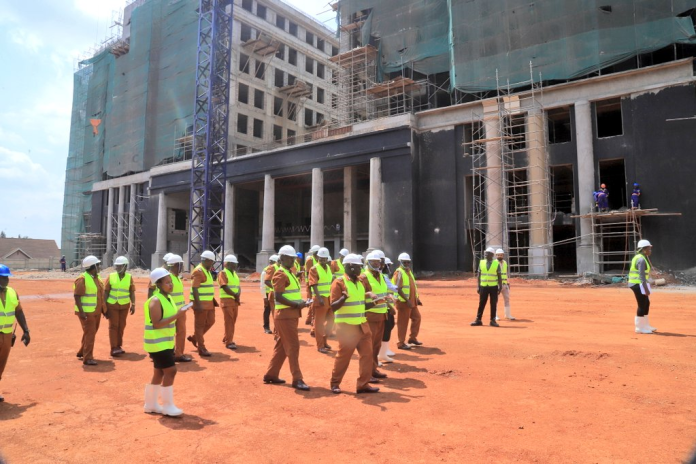
Prison officials inspecting the building.

A delegation from Uganda Prisons Service (UPS) top and senior management team, led by the Deputy Commissioner General of Prisons Samuel Akena visited the Naguru JLOS house to assess the progress of the new UPS headquarters construction. The team included heads of directorates and departments.

The visit aimed to evaluate the project’s completion timeline, inspect the allotted space, and discuss customization of UPS needs, costs associated with shared utilities and services, and other concerns.

The construction works, being done by Seyani Brothers Co. (U) Ltd, a leading construction company in the country, have reached approximately 70% completion, with the technical team optimistic about meeting the January 2025 deadline.

The state-of-the-art new JLOS house tower will accommodate all institutions in the Criminal Justice System, including the Judiciary Ministry of Internal Affairs, Uganda Prisons Service among others with a close proximity to Uganda Police head offices. The UPS office space will occupy the basement, 2nd, 3rd, and 4th floors, covering 3840 square meters.

The team identified areas requiring customization, including safety and security, ICT, and medical facilities. Heads of relevant departments will be engaged to address these needs during the partitioning phase.

During a walk around tour the facility concerns were raised regarding shared utilities, services, security, and environmental cleanliness, with questions about cost responsibilities. The team was informed that a policy is being drafted to address these concerns.

The Chairman of the Contracts Management Team, JLOS house, expressed gratitude for the UPS delegation’s visit and valuable input, which will enhance client satisfaction and customization.

The new Prisons headquarters is expected to provide a modern and secure environment for UPS operations, alleviating pressure on the current headquarters building.

Stories Continues after ad

Court remands three MPs over corruption 

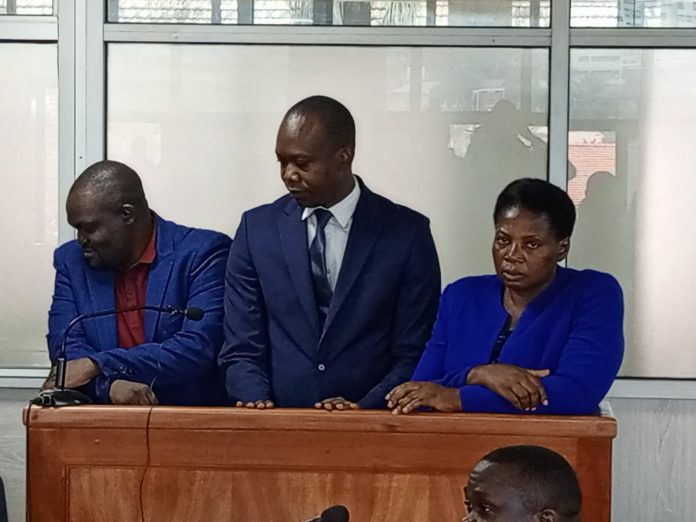
The three legislators in the dock.

Court has remanded the three legislators to Luzira Prisons until Friday June 14 when they return to court for mention of the cases.

The three are Lwengo District Woman MP, Cissy Namujju; Busiki County MP Paul Akamba and Bunyole East County MP Yusuf Mutembuli.

Appearing before the Anti-Corruption Court Chief Magistrate Joan Aciro, the three were charged with corruption. 

The three were nabbed on Monday after they had been summoned to record statements about corruption related allegations. The group was quizzed and later detained at Kira Police Divisional Headquarters, where they spent two nights. 

They were picked up yesterday from Kira Police Division Headquarters and driven to their respective homes for search. The search is aimed at gathering more evidence against bribery and corruption charges that are leveled against them. 

The development comes at a time when Parliament is at the center of controversy over corruption and bribery. 

During the State of the Nation last week, President Museveni said: “I have been getting good information about corrupt actors among public servants but also among political actors. With some evidence, we shall crush these traitors.”

“I have been hearing, but now I have proof. I have been hearing from the Ministry of Finance; they arrange for accounting officers of ministries to come to parliament. Working with some people there to provide certain funds, provided you take a share, I didn’t believe it, but now I have proof,” Museveni said.

Stories Continues after ad

Buganda Kingdom warns public against sale of land housing cultural sites and royal tombs

The Minister of lands and properties in Buganda Kingdom, David Mpanga has warned the public against the sale of all land housing cultural sites, royal tombs and known historical sites in the kingdom, citing that it belongs to the Kabaka and is managed by the Buganda Land Board on behalf of the kingdom.

“The kingdom of Buganda has received reports of unscrupulous individuals that are purporting to buy and acquire sub-dividing, selling and building on land housing cultural sites, royal tombs and known historical sites,” Mpanga reported.

Mpanga urged the public to be aware that Buganda land is not for sale and is legally not capable of sale without the consent of the Kabaka of Buganda.

“Take note that the custodians entrusted with this land have no right to sub-lease, sell, part with the possession or alienate the land in any way. Anyone who transacts on this land does so illegally and at his or her own risk,” Mpanga guided.

He therefore informed the public the section 64(2) of the Registration of Title Act protects such historical cultural sites which are found on any registered land and whoever holds or acquires title to land where there cultural sites holds the same subject to Buganda Kingdom and community cultural rights and interests on that land.

Mpanga further advises the public to be very cautious not to conduct or be involved in any transactions on such land to avoid being cheated and held liable for possession in the Courts of Law.

Stories Continues after ad

Six dead, three injured in Ntungamo road accident

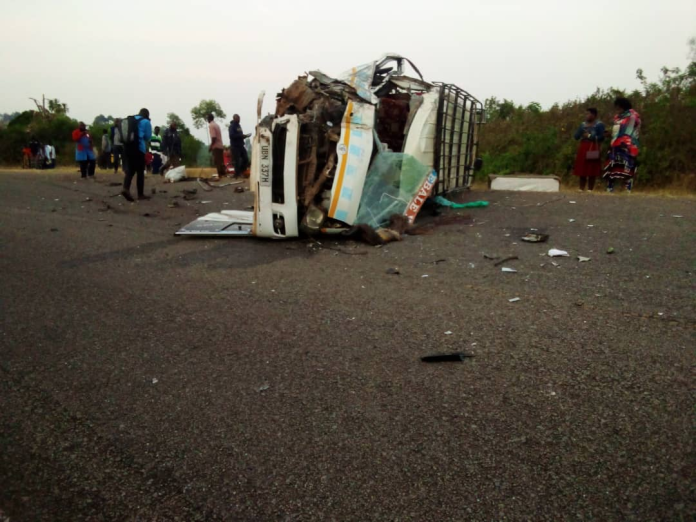
Six people have been confirmed dead, while three others sustained injuries in a road crash that occurred this morning on June 12, 2024 at Kakiika along Ntungamo-Rukungiri Road in Ntungamo District.

Michael Kananura, Public Relations Officer Directorate of Traffic and Road Safety revealed that the crash involved motor vehicles UBN 337H, a Toyota Hiace, and UAP 385U, an Isuzu bus belonging to Kasaaba Bus Company.

Kananura said that according to the initial report, motor vehicle UBN 337H, which was coming from Rukungiri to Ntungamo, got a tyre puncture and parked on the right-hand side of the road, leaving part of the vehicle on the tarmac while attempting to fix the tyre, with full lights on.

“Unfortunately, the bus, which was coming from Kampala and heading to Rukungiri, veered off the road and collided head-on with the parked omnibus, instantly killing six people, including the driver, the turn man, and a police officer attached to Nsangi Police Station, and injuring three others,” Kananura said.

He confirmed that the traffic police responded to the scene immediately and transported the victims to Devine Health and Ntungamo Specialist Medical Centres for medical attention.

He added that the dead bodies have been conveyed to Rwashameire Health Centre IV for post-mortem examination, while the motor vehicles have been towed to Ntungamo Central Police as inquiries commence.

Stories Continues after ad

World Bank report indicates Uganda’s economy to grow at 6.0% in 2024

A new World Bank report indicates that Uganda’s economy will grow at 6.0 percent in 2024, the second highest in the East African region.

According to the World Bank Global Economic Prospects, both Uganda and the Democratic Republic of Congo (DR Congo) will grow at the same rate of 6.0 percent in 2024 while Rwanda will be the fastest-growing economy in East Africa (7.6 percent) in 2024.

“In Uganda, an oil-related construction boom led to large inflows of foreign direct investment in the first quarter of 2024, supporting strong growth in the industrial sector. Increased global coffee and cocoa prices supported the agricultural sector of some economies (Côte d’Ivoire, Ethiopia, Uganda) in early 2024, although cocoa production has been disrupted by shifts in rainfall patterns and black pod disease, creating challenges for many producers (World Bank 2024w),” the report reads in part.

Tanzania’s economy will grow at 5.4 percent while Kenya is set to grow at a 5.0 percent rate. Burundi’s economy is projected to register a 3.8 percent growth with Somalia at 3.7 percent and South Sudan at 2.0 percent.

“The positive economic development in the region will lead to increased trade and improvement in people’s income arising from commodity products following the recovery Covid-19 pandemic, which affected the economic activities and people’s health at its peak in 2020, 2021, and 2022,” the report notes.

The World Bank said growth in Sub Saharan Africa (SSA) is projected to pick up from 3 percent in 2023 to 3.5 percent in 2024 and about 4 percent annually in 2025-26, as fading inflationary pressures allow for interest rate cuts, which will support private consumption and investment.

“Growth in the region’s largest three economies is expected to accelerate from 1.8 percent in 2023 to 2.4 percent in 2024 and an average of 2.6 percent in 2025-26. Yet, this is markedly below the region’s average growth,” said the World Bank.

However, SSA largest economies; Nigeria, South Africa and Angola were weak in 2023, holding back growth in the region. Growth in Nigeria is to bet at 3.3 percent, South Africa at 1.2 percent and Angola at 2.9 percent in 2024.

“In South Africa, growth weakened to 0.6 percent in 2023. Economic activity remained subdued in early 2024 as the economy continued to struggle with a broad-based deterioration in public service delivery, including electricity supply shortages, transport bottlenecks, and a high crime rate,” the report states.

“Non-resource-rich economies are forecast to maintain growth above their historical average rate, while resource-rich economies recover from their slow growth in 2023 that mainly reflected declining metal prices. Per capita GDP in SSA is expected to grow, on average, by a meager 1 percent this year and average 1.4 percent in 2025-26,” the World Bank explained.

The World Bank explains that risks to the outlook are tilted to the downside. Downside risks include increasing global geopolitical tensions, especially an escalation of the conflict in the Middle East; a further deterioration in regional political stability; increased frequency and intensity of adverse weather events.

The World Bank also pointed out that consumer price inflation could prove to be stickier than expected or pick up again driven, for example, by food price inflation caused by supply disruptions, possibly triggered by an escalation of the conflict in the Middle East.

“Furthermore, extreme weather events raise the likelihood of renewed upward pressure on food prices in affected economies. For instance, the current El Niño weather pattern has brought above average rainfall and flooding to east Africa, but severe drought to southern Africa. An increase in the frequency and severity of droughts or floods would exacerbate poverty across SSA and intensify food insecurity in many countries,” the World Bank said.

Stories Continues after ad

National Budget: CID to summon senior Finance Ministry officials over corruption allegations

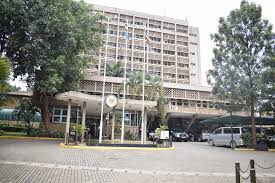
Ministry of Finance headquarters.

Police’s Criminal Investigations Department (CID) is in the final stages of summoning senior officials in the Budget Department in the Ministry of Finance over corruption allegations, this news website can reliably say.

According to our sources, among the officials lined up for summoning and statement recording with the CID include the Director of Budget. Currently, according to the ministry’s website, the Acting Director of Budget is Mr. Ishmael Magona.

The officials are said to have the habit of inflating the national budget for their own benefit. This Thursday the Minister of Finance will present a Shs 72 trillion budget for the financial year 2024/2025.

Relatedly three Members of Parliament including Cissy Dionizia (Lwengo District Woman MP), Yusuf Mutembule (Bunyole East), and Paul Akamba, the Busiki County legislator were summoned, recorded statements and detained by the police over allegations of asking money to pass the budget for the financial year 2024/2025.

The legislators’ summoning by the CID follows President Yoweri Museveni’s warning last Thursday during the State of Nation Adress (SONA) that he had corruption-related evidence against some MPs and senior officials in the Finance ministry.

According to Museveni, legislators were colluding with accounting officers to allocate public money in exchange for kickbacks. The President said the evidence confirmed the long-standing rumours of graft in the annual appropriation of public money.

He likened the corrupt officials in the ministry and the affected MPs to traitors and suggested that some of the culprits might need if their wrongdoings were unintentional.

Museveni warned the corrupt MPs and the Finance Ministry officials to desist from altering the national budget, and only make recommendations, stating that the national budget appropriation is his responsibility.

Other people talked to in the Ministry say this scandal is related to the one where some officials in the Ministry of Finance, and others in the Trade Ministry connived with some MPs to steal money meant to pay cooperatives. The public is still waiting for the police and other investigating organs of the government, to release a report on the same.

President Museveni will address Ugandans again during the Budget Speech, and his handlers say he will still talk about corruption in parliament and other agencies of government.

Corruption is one of the major obstacles, that are undermines Uganda’s social economic development. Although substantial investments have been made to combat corruption in Uganda, it continues to impose wide ranging costs on the society. Corruption leads to loss of trust in government, poor infrastructure, delays in project implementation, low investments and poor social service delivery and loss of life.

Despite being a clear challenge, there are no comprehensive estimates of the extent and cost of corruption. By failing to measure the cost of corruption and establishing the magnitude of the problem to Ugandans, adequate and appropriate anti-corruption interventions cannot be developed.

Fully eradicating corruption in Uganda is estimated to result in total societal savings of at least Shs 9.1 trillion which is equivalent to 44 percent of total government revenue in 2019. In other words, corruption cost each Ugandan in 2019 at least Shs200,000, according to a recent report from the Inspectorate of Government.

It is understood that a host of government officials mostly Accounting Officers have been conniving with some legislators and some Clerks of committees at Parliament to inflate their budgets by inserting an agreeable amount money at budgeting level and this would later be passed at budgetary level and shared amongst the officials in the concerned departments.

According to sources, the most affected departments are directory of budget at Ministry of Finance, several Permanent Secretaries, heads of government agencies, UnderSecretaries, Principal Accountants and some officials at Bank of Uganda. However, this racket is spearheaded by a former Member of Parliament from one the districts in Ankole sub-region who is a go between in negociating deal between MPs and technocrats.

Soucres further reveal that this vice has been ongoing for sometimes since tenure of the former director of budget at the same ministry. It is alleged that the former director of budget quit his post after the new firebrand permanent secretary took office and issued serious warning

Stories Continues after ad

Ssekikubo releases list of MPs who signed motion to censure commissioners 

MP Theodre Ssekikubo

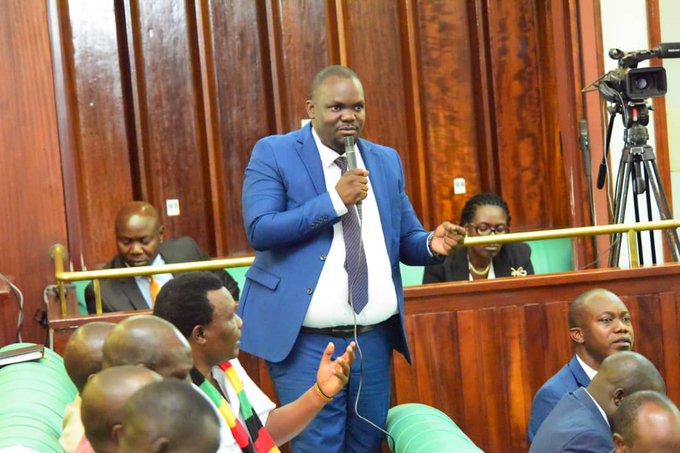
Lwemiyaga Member of Parliament Theodore Ssekikubo and Tororo Woman MP Sarah Opendi have released a list of legislators who signed the censure motion to censure four commissioners of parliament who allocated themselves Shs1.7 billion.

Last month, a section of legislators led by Ssekikubo embarked on the process of collecting signatures to censure Parliamentary Commissioners including the former Leader of the Opposition Mathias Mpuuga. 

According to the list, at least 142 MPs of the 177 needed to table the motion have appended their signatures.

The Parliamentary Commission’s leaked documents show how in May 2022 the former Leader of the Opposition (LoP), Mathias Mpuuga, commissioner Solomon Silwany, Prossy Akampurira, and Esther Afoyochan met and shared the money.

According to these documents, Mpuuga was awarded a one-off service payment of Shs500 million, while three commissioners from the National Resistance Movement each received Shs400 million. The biggest opposition party in Parliament, the National Unity Platform (NUP), resolved to recall Mpuuga as the Parliamentary Commissioner but failed because according to the parliamentary procedures, it’s majority in parliament who can censure a commissioner

The commissioners are faulted because proposal was supposed to first go through the legal and parliamentary affairs committee before it is tabled before the whole House for debate and approval. Every individual who gets retirement benefits, be it the speaker, vice president, or others, has to have it discussed and passed by parliament.

Stories Continues after ad
Among rallies girls to defy parents about teenage pregnancies, early marriages

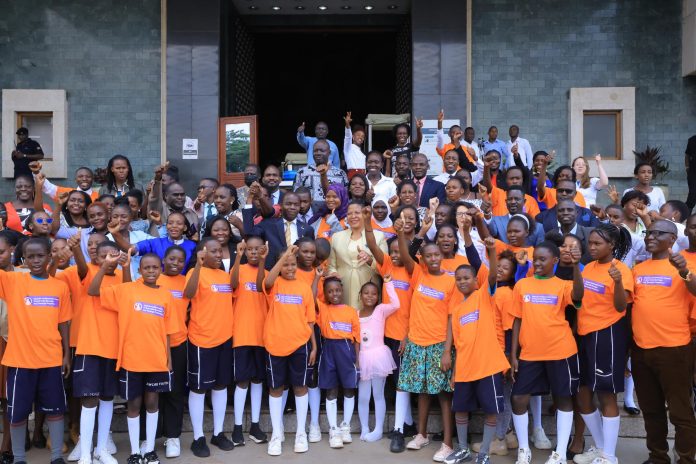
Speaker Among pose for a group photos with school children at parliament.

Speaker of Parliament Anita Among has asked parents and cultural leaders to put an end to teenage pregnancies and child marriages, saying the vice is encouraged by the unfortunate practice of viewing girls as a commodity.

Launching the Parliamentary Forum to End Child Marriages and Teenage Pregnancies, where she was named its patron, Speaker Among sounded a call to action to parents and cultural leaders, who she said carry the magic wand to end the scourge of teenage pregnancies and early marriages.

In her emotional story as someone who almost fell prey to the practice, Speaker Among said the girls, too, should put up a fight and not easily give in to early marriages.

“The issue of eliminating teenage pregnancies is a reality; I happened to be a victim of this particular practice; the challenge is that the moment a parent sees a girl developing breasts, they say she is ready for marriage,” she said.

Adding “I was going to primary seven when I almost got forced into a marriage; I took off from home, went and became a house girl, stayed in some other people’s homes, and managed to pay for my own education,” she said.

She blamed poor parenting for the increase in the vice and offered her support to the forum in creating awareness to end the practice and put the girls to school.

“One of the causes of early marriages and child pregnancy is an issue of parenting, but it also comes back to you: what do you want in life? You can be taken through all that, but the resilience to move on is very important,” she said.

Speaker Among thanked the United Nations Population Fund (UNFPA) and development partners for supporting efforts to eradicate the practice, saying it is time to take the fight to parents and cultural leaders, who should end practices that encourage the vice.

MP Ronald Olema Afidra (NRM, Lower Madi Constituency), who is the chairperson of the forum, said society should not give up on the victims but still extend to them an opportunity to go back to school.

“Let us give them [the girls] the opportunity to go back to school where they can; we need the girls growing up to be girls, not to prematurely become mothers,” he said.

He added: “The girls who get married early have limited education opportunities; they will also not be able to deliver well, which sadly contributes to maternal deaths in Uganda.”

Laura Criado Lafuente, who represented the UFPA Country Representative, Gift Malunga, pledged support for the new forum, saying their intervention will be evidence-based, using demographic statistics to mount a laser-focused challenge against teenage pregnancies and marriages.

Stories Continues after ad

Proud to be an Ally: Standing with LGBTQ+ Communities Across the World

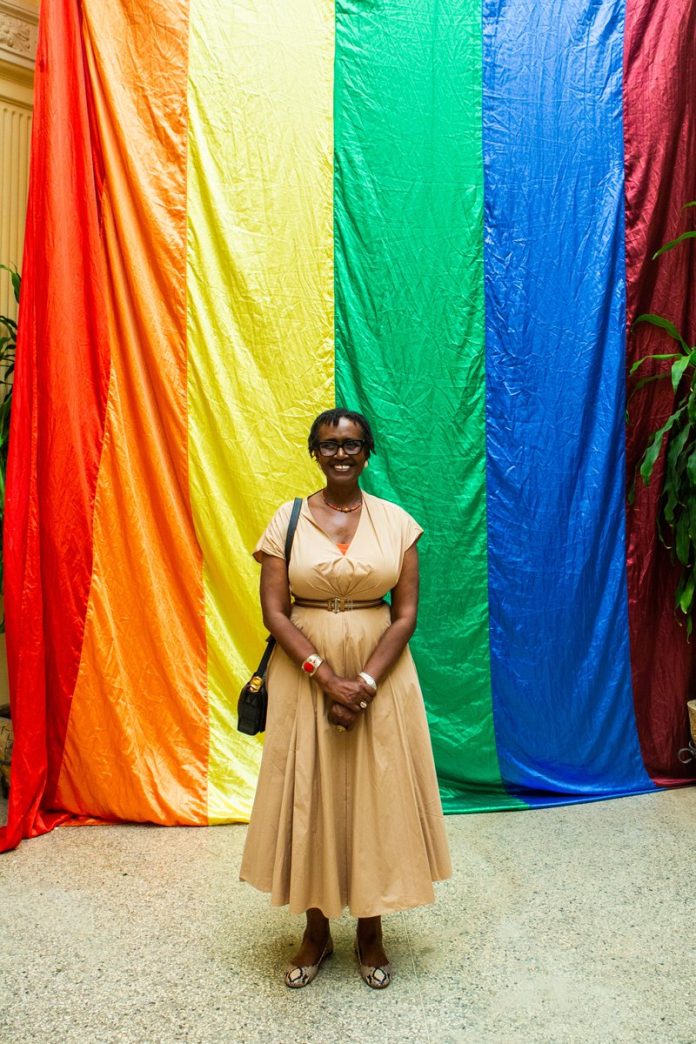
By Winnie Byanyima

The events of this year’s PRIDE month are showing the world the power of inclusivity. It is by only insisting on acceptance, and rejecting criminalization, discrimination and stigmatization, that we can ensure a fairer, safer, future for all. We are all invited to be allies.

PRIDE has always been a protest and commemoration as much as celebration. The first marchers in New York more than 50 years ago understood PRIDE as a way to reject the shame that others sought to impose on them, and to honour the memory of people who had been mistreated and defamed.

For them, defiance and joy were not opposites; their joy was defiance. The LGBTQ+ community have refused to accept subjugation and have stood in solidarity with all marginalized people.

PRIDE has always been about collective action for justice. The determination of LGBTQ+ communities and of allies to ensure inclusion for all people has been core to the advances that have been made in recent decades on human rights and in public health.

It is not a coincidence that it was the networks of gay activists built up from the late 1960s who went on to pioneer the community response to HIV at the onset of the AIDS pandemic in the 1980s. They helped mitigate the spread and impact of the virus by providing peer-to-peer information about HIV and delivering care and support at a time when no one else was willing to do so.

They reached out in partnership to defend all minorities from discrimination and violence, and they founded campaigns to overturn the laws and attitudes which violate human rights and obstruct people’s access to services.

As HIV treatment and prevention innovations expanded, it was groups spearheaded by LGBTQ+ activists including ACT UP in the United States and the Treatment Action Campaign in South Africa who drove the campaigns to break the monopoly hold on production of medicines so that all who needed medicines to treat and prevent HIV could access them.

So much has been won. At the beginning of the AIDS pandemic most countries criminalized LGBTQ+ people — but today more than two thirds of countries do not criminalize them. Since 2019 alone, Botswana, Gabon, Angola, Bhutan, Antigua and Barbuda, Barbados, Singapore, Saint Kitts and Nevis, Cook Islands, Mauritius and Dominica have all repealed laws that had criminalized LGBTQ+ people.

But the progress that has been made is in danger. LGBTQ+ people are under attack, and alongside the attacks on LGBTQ+ communities are attacks on the rights of women and girls, on migrants, and on ethnic and religious minorities.

Leaders fearful of their status and power are whipping up hatred of minorities to divert attention from economic and political woes. They are pushing for draconian laws and enabling vigilantes to follow through on their verbal violence with physical violence.

Meanwhile, at a time when solidarity with human rights defenders is vital and urgent, funding support for civil society organizations is shrinking as donor countries cut their budgets.

We are at a hinge moment, a crossroads: the end of AIDS as a public health threat is realizable in this decade, but progress is imperiled; we can win the battle for human rights for all, but only if we join together to fight for it. Our collective future will be set by what we do now. Courage and urgency in support of everyone’s human rights is essential to protect everyone’s health.

It is the people at the toughest intersections of injustice who are leading the way. But they cannot succeed alone; they need allies not only on their side but by their side. Stigma kills; solidarity saves lives.

The United Nations is clear: be proud of who you are and be proud to be an ally for the human rights of everyone.

Winnie Byanyima is Executive Director of UNAIDS and Under-Secretary-General of the United Nations.

Stories Continues after ad

Police to search homes of 3 arrested MPs

Mr Yusuf Mutembuli, MP Bunyole East.

The police are conducting a search in the respective homes of the three nabbed MPs, as Eagle Online can reliably report.

The three legalstors, who include Lwengo District Woman MP Cissy Namujju; Busiki County MP Paul Akamba; and Bunyole East county MP Yusuf Mutembuli were arrested yesterday when they went to record statements at the Criminal Investigations Directorate (CID) headquarters in Kibuli.

The MPs were quizzed and later detained at Kira Police Divisional Headquarters, where they spent a night. They were earlier today picked and driven to various locations, and according to sources, they were heading to their respective homes for a search.

The search is aimed at gathering more evidence for bribery and corruption charges that are allegedly levelled against them. The development comes at a time when Parliament is at the centre of controversy over corruption and bribery. 

During the State of the Nation last week, President Museveni said: “I have been getting good information about corrupt actors among public servants but also among political actors. With some evidence, we shall crush these traitors.”

“I have been hearing, but now I have proof. I have been hearing from the Ministry of Finance; they arrange for accounting officers of ministries to come to parliament. Working with some people there to provide certain funds, provided you take a share, I didn’t believe it, but now I have proof,” Museveni said.

On May 30, 2024, the US government sanctioned Speaker of Parliament Anita Among and four other Ugandan officials for their involvement in significant corruption or gross violations of human rights.

According to Mathew Miller, the spokesperson of the US state department, Speaker of Parliament Anita Among, is designated due to her involvement in significant corruption tied to her leadership of Uganda’s Parliament.

Former Minister of Karamoja Affairs Mary Goretti Kitutu, former Minister of State for Karamoja Affairs Agnes Nandutu, and Minister of State for Finance Amos Lugolobi are being designated due to their involvement in significant corruption related to conduct that misused public resources and diverted materials from Uganda’s neediest communities. All four officials abused their public positions for their personal benefit at the expense of Ugandans.

The leaked May 2022 resolutions of Parliament implicated the former Leader of the Opposition (LoP), Mathias Mpuuga, Commissioner Solomon Silwany, Prossy Akampurira, and Esther Afoyochan.

The document indicates that Mpuuga was awarded a one-off service payment of Shs 500 million, while three commissioners from the National Resistance Movement each received Shs 400 million. The biggest opposition party in Parliament, the National Unity Platform (NUP), resolved to recall Mpuuga as the Parliamentary Commissioner.

Stories Continues after ad