Stanbic Bank
Stanbic Bank
20.8 C
Kampala
Stanbic Bank
Stanbic Bank
Home Blog Page 286

Finance officials’ kickoff review of Uganda’s budget for FY 2024/25

The top technical team of the Ministry of Finance, Planning and Economic Development is on a three-day retreat to review the budget for FY 2024/25, re-prioritize expenditure allocations and ensure that all critical interventions of government are fully catered for under the 20 NDP III programmes.

The government of Uganda adopted a strategy to grow the economy ten-fold over the medium term effective FY2024/25.

Ramathan Ggoobi, the Permanent Secretary, in his opening remarks at the retreat, said the ministry is going to use evidence-based analysis to inform allocative efficiency.

The Finance Ministry is implementing the fiscal consolidation strategy to ensure that the budget is rationalised and the available resources are efficiently allocated to finance the critical needs of the government.

Fiscal consolidation entails stepping up domestic revenue mobilisation, continued rationalisation for improved allocative efficiency and controlled borrowing to ensure long term debt sustainability.

Parliament on January 30 gave a nod to the Budget Framework Paper, approving the Shs52.7 trillion budget for Financial Year 2024/2025.

A total of Shs30.9 trillion, which is 59 percent of the budget, will go to non-discretionary expenditure, which includes salaries and debt repayment. Nearly Shs17 trillion has been budgeted for debt repayment. A total of Shs200 billion has been allocated for domestic arrears, Shs1.3 trillion for domestic debt repayment while Shs7.6 trillion will go to interest payments.

Going by the Programme based budgeting, human capital development, governance and security, and integrated transport infrastructure and services take the lion’s share of Shs9.3 trillion, Shs7.4 trillion and Shs5.8 trillion, respectively.

Sustainable petroleum development will take Shs1.3 trillion, private sector development Shs1.8 trillion, regional development Shs1.03 trillion, community mobilisation and mindset change Shs35 billion, while tourism development has been allocated Shs248 billion.

As the headwinds of the passing of the anti-homosexuality law continue, the government has projected a Shs2.75 trillion fall in support from external partners, which has led to an increase in domestic borrowing of 21 percent.

Some sectors most affected by the fall in external funding include health, whose budget has been reduced from Shs4.86 trillion to Shs4.24 trillion.

Government in its strategy is aiming to focus on areas that will drive development, including implementation of the Parish Development Model and other programmes on wealth creation, agro-industry, oil and gas production, tourism and leveraging Internet use.

Stories Continues after ad

Uganda, Myanmar hold talks rescue Ugandans captured by rebel groups

Minister John Mulimba.

The government of Uganda is holding talks with the government of Myanmar to rescue 30 Ugandans held by the rebel groups.

The revelation was made by the State Minister for Foreign Affairs, John Mulimba.

The 30 are part of the 400 Ugandan nationals held hostage in Myanmar by rebel groups, and others were denied exiting Cairo, Egypt, and India over failure to pay immigration fines.

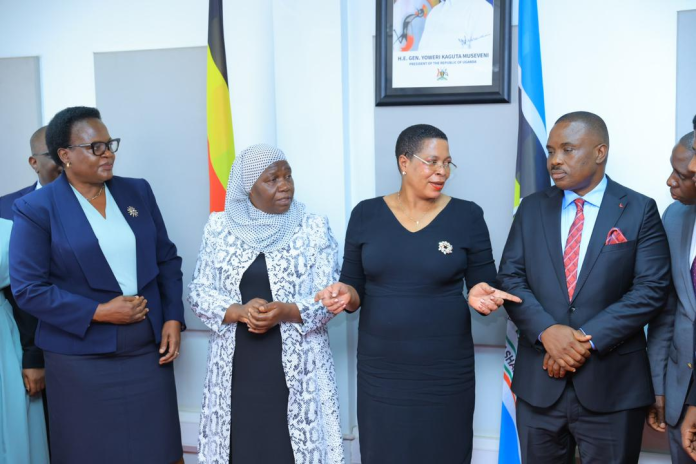
After receiving social media reports in December 2023 about Ugandans held in Myanmar, Prime Minister Robinah Nabbanja convened an inter-agency meeting on December 9, 2023 and discussed avenues of how to secure their release.

She confirmed that over 290 Ugandans are stranded in India, Egypt, and Myanmar after being trafficked out of the country, and there are fears that some of the victims have been recruited into rebel activities.

He said the government does not have the financial capacity to repatriate Ugandans who are stranded in Egypt and India, which means they should find their way home.

“I wish to emphasize that our diplomatic missions are unable to provide financial support to Ugandans abroad who find themselves in serious difficulties, but they exert all efforts to locate and provide consular assistance,” he said.

The minister said the Egyptian government, in September 2023, directed that all foreigners who were staying illegally must regularise their stay by December 2023 or else leave the country. A three-month grace period that expires on March 15, 2024, was granted.

He said they must secure an Egyptian host and pay Shs3.5 million as administrative fees to regularise their stay, or they will be jailed and fined between Shs60 million and Shs120 million.

Mulimba noted that it is imperative that in the next Financial Year Budget 2024/2025, Parliament appropriate adequate funds for supporting the consular protection of its citizens abroad.

Stories Continues after ad

Police officers live in unimaginable conditions- UHRC Boss

Mariam Wangadya, Chairperson, Uganda Human Rights Commission and Deputy Speaker Thomas Tayebwa .

The Uganda Human Rights Commission has revealed that Police Officers in Uganda are living in extremely and unimaginable deplorable living conditions, where some officers are sharing rooms that are only separated by curtains.

“The research found that generally, the living and working conditions of UPF personnel were wanting, and in some cases, it was too extreme, unimaginable levels. The situation of housing/accommodation in UPF was dire with institutional accommodation largely dilapidated; comprising shared rooms partitioned by either curtains or makeshift boards; condemned structures and uniports unfit for human habitation,” remarked Mariam Wangadya, Chairperson, Uganda Human Rights Commission.

Wangadya made the remarks while handing over a report to Deputy Speaker Tayebwa at Parliament on the research conducted on the welfare of Uganda Police Force, titled; ‘Squeezing Water out of a Stone? Working and living conditions of the Uganda Police Force personnel and their implications on observance of human rights’, Wangadya defended the title of the research paper arguing that Uganda’s police personnel were giving a lot more than they were receiving.

“It was amazing how, in their given conditions, they could still manage to provide any service. At times they had to share guns, ask complainants to transport officers, use “wanainchi” (civilians) to carry accident victims, use ropes in lieu of handcuffs, walk with suspects to court in the absence of vehicles; and use observation to detect crime in lieu of required gadgets, among others. Nevertheless, some of their strategies were found to be high risk with a likelihood of causing or promoting human rights violations,” added Wangadya.

UHRC also revealed that many Police officers lived between 3-8kms away from workstation, while 3% lived more than 8kms away even up to 14kms, yet despite this, Uganda Police administration does not facilitate their staff with organised transport to and from work yet they were on call 24 hours.

“Junior personnel were the most disadvantaged in terms of acquiring decent housing as they were often displaced from institutional accommodation by senior personnel. Some personnel opted to live in their homes or voluntarily rent outside institutional accommodation but these faced concerns about their personal security outside the barracks as well as affordability of decent housing that maintains the corporate image of UPF,” remarked Wangadya.

UHRC also revealed that during the research, 70% of Police Officers in Uganda reported unfairness in deployments, transfers and promotions, due to underhand methods, corrupt tendencies, favouritism, tribalism, nepotism, ‘technical know-who’, bribery or kickbacks and this is worsened by the poor pay.

Deputy Speaker, Thomas Tayebwa thanked Police officers for continuing to work despite the challenges they are facing and called for a deeper study on the impact of their silence of Police officers and further establish why more Ugandans are fighting to join the Force despite the current challenges the Force is facing.

 “That does not mean they should not be demanding for these services, they should be demanding for them, but I really want to thank them, no one has stopped work because they do not have housing, but now we have to go and study-what is the impact of this silence, are they finding other means, why are many people dying to join Police, despite these conditions,” Tayebwa said.

“Police put up an advert, I have received over 100 calls, help me I join Police. Is there another driving factor, is it corruption, are they finding a way of mitigating the situation? It is something we should interest ourselves as a Government and just do not say these guys are doing a great job, they are comfortable and we take it for granted,” Tayebwa added.

Stories Continues after ad

MP Begumisa calls for investigation on murders against sex workers in Sembabule Town Council

Sembabule District Woman Member of Parliament,Mary Begumisa.

Mary Begumisa (Sembabule District Woman MP) has urged government to investigate the recent spate of murders against sex workers in Sembabule Town Council, after four women were sexually violated and later killed between October 2023 and February 2024.

“Four women have been murdered between October 24, 2023 and 5th February 2024 and they are; Annet Nantingo, Madrine Nakwiya, Flavia Ajuka, Mastula Nabasirye. All of whom testifies to be sex workers in Sembabule Town Council. They are strangled, raped and murdered and it is keeping on recurring in Sembabule Town Council,” said Bagumisa.

In her prayers to Parliament, Begumisa asked for improvement in security in Sembabule and provision of funds for the other sex workers to start other entrepreneur activities remarking, “Government should quickly help us with a special fund for these women like they did for these women in Entebbe where these women claim that this is an economic activity and government should help them with an economic activity because they have children.”

Prime Minister, Robinah Nabbanja in her response said, “It is unfortunate that we have lost lives, however, before coming here, I had already got information that there are murders in Sembabule, we had a meeting with David Muhoozi, Minister of State for Internal Affairs and we have instituted a team to go to Sembabule to find out what really happened and those senior officers will be there for some time so that those criminals are arrested.”

On the establishment of a fund to provide income to the other sex workers to start other economic activities, Nabbanja said, “For our senior citizens who work at night, I can only say they can go to Parish Development Model because that time of Entebbe, there was no PDM and UWEP, so we can only see how these women can access these funds.”

Stories Continues after ad

Uganda, Algeria to sign MoU with focus on counterterrorism

Ministry of Defence and Veteran Affairs Permanent Secretary Rosette Byengoma and Secretary General of Algeria’s Ministry of National Defence, Maj Gen Mohamed Saleh Benbicha.

The Republic of Uganda and the Peoples’ Democratic Republic of Algeria will soon sign a Memorandum of Understanding aimed at opening avenues for the continued sharing of advanced technologies, training opportunities and establishing a legal framework for cooperation between the two countries.

This was disclosed during a meeting between the Ministry of Defence and Veteran Affairs/Uganda Peoples’ Defence Forces leadership and a delegation from the Ministry of National Defence of Algeria that was held at the Defence Ministry’s headquarters, Mbuya.

Mrs. Rosette Byengoma, the Permanent Secretary of the Ministry of Defence and Veteran Affairs said Uganda continues to benefit from Algeria’s experience in combating terrorism through training of Uganda’s military personnel in Algeria. She requested that Uganda be availed of more opportunities, especially in the area of advanced technology.

The Chief of Defence Forces, General Wilson Mbadi emphasised the need to have a legal framework that will guide the different areas of cooperation, especially counterterrorism. He appreciated Algeria for the donation that was extended to Uganda.

The Secretary General of Algeria’s Ministry of National Defence, Maj Gen Mohamed Saleh Benbicha expressed his country’s readiness to share their military experience with Uganda as per the Memorandum of Understanding that will be signed.

 In November 2023, a UPDF delegation was in Algeria on a benchmarking visit on the establishment of the Uganda National Military Museum.

Stories Continues after ad

European Union headed by France is fermenting a violent regime change in Zimbabwe

President Emmerson Mnangagwa of Zimbabwe.


By Dr. David Matsanga


EU sanctions are silently fermenting a violent regime Change in Zimbabwe. There are two ways for Zimbabwe to avoid violent changes- from without or within.

I must state here from the time Tony Blair bent Zimbabwe’s route of development with sanctions there have been attempts to cause violent regime Change.

Conversely, European Union has successfully forced USA to adopt their views on Zimbabwe. The USA government has worked in concert with France to destroy Zimbabwe.

So my question is this: Why is the European Union renewing sanctions against Zimbabwe at this material time? Why has Zimbabwe failed to stand firm on its feet and treated EU or some countries in EU as enemies? Why is Zimbabwe’s foreign policy waffling? These guys don’t like you and you keep smiling at them!


These new sanctions, inevitably dubbed the Popcorns of Europe, looked a lot like the latest EU ballad of dissatisfaction. This type of left-wing extremism in Europe at moment is worrying. It has become a damaging divide within the EU and made Europe wonkery on Zimbabwe.

From my own reflection, I’m not sure my questions on EU at the start were the right ones? Clearly, from an international perspective Zimbabwe I believe has not sold its international position properly. It has not

These sanctions can be challenged by friendly states in the ICJ or European courts. But there you are ..The type of ego that you see in many African countries that respect white professors than black professors is the norm. That is the danger of African foreign ministries they prefer lobbyists like Tony Blair who destroyed them to some of us who have soiled our names because of the defence of Zimbabwe. 

Writer of the article David Matsanga.


Zimbabwe has not decided on how to deal with EU and France which is at the center of renewing EU sanctions on it. But in terms of the future direction for Zimbabwe, the EU sanctions appear to be a fait accompli. Zimbabwe must stop the foreign policy of appeasement of European Union. It is not paying and has never worked. Zimbabwe must hit EU with bare knuckles not with soft gloves. No colonial master is ever happy to see colonized territory overpower them.

I predict a whole cascade of changes and hardships that are laid down for Zimbabwe’s foreign policy which faces headwinds that are caused by France’s influence in EU. The France are slowly working on sponsoring a violent regime change or the worst a coup in Zimbabwe. Just keep this article for future reference.

While reflecting on the EU relationship with Zimbabwe I know and I have a surprising similarity to what the French were doing in West Africa before the armies of Burkina Faso, Mali, Niger and Guinea Conakry kicked them out.

Zimbabwe should check out French sponsorship of opposition that causes undercurrents in its internal politics. On the surface it looks smooth diplomatically but the violent regime change mechanisms are slowly being planted by EU.

If I am Wrong time will tell!

God bless Zimbabwe
7.02.2024
ACCRA GHANA

Stories Continues after ad

Why More Ugandans Should Switch to Card Payments

Uganda’s digital payments landscape is undergoing a transformative shift, accelerated by the COVID-19 pandemic and evolving consumer preferences prioritizing convenience, speed, and security. While mobile money has seen widespread adoption, card payments have faced challenges, including merchant surcharges at point-of-sale terminals and limited awareness regarding the advantages of card transactions.

The introduction of the “Sasuza Visa” campaign in 2021, spurred by the Bank of Uganda’s directive to eliminate merchant surcharges and minimum transaction thresholds, marked a significant milestone in the adoption of card payments. This initiative, complemented by efforts from supervised financial institutions under the Uganda Bankers Association and fintechs, has led to a notable increase in card usage with active debit cards surging by 22% to 3.3 million, accompanied by a 23.5% rise in transaction volumes. Moreover, credit card transfers surged by 60.7% to UGX 66.4 billion, with a 10.4% increase in POS transactions.

Despite these advancements, there remains untapped potential in the realm of card payments. With merchants no longer imposing surcharges, the benefits of transitioning to card payments are becoming increasingly evident. In this exploration, we delve into the diverse advantages that card payments offer to Ugandans, emphasizing the ongoing significance of the second edition of the Sasuza Visa campaign.

1. Convenience

First and foremost, the convenience offered by card payments cannot be overstated. Whether it’s purchasing groceries, dining out, or refueling vehicles, the days of grappling with cash and hunting for exact change are swiftly becoming a relic of the past. Visa’s global acceptance ensures that Ugandan consumers can transact seamlessly not just locally, but also internationally, eliminating the need for cumbersome currency exchange processes.

Moreover, the advent of contactless payment technology brings in a new era of transactional efficiency. With a simple tap, consumers can expedite their purchases which in turn reduces waiting times and enhances overall convenience. This innovation aligns with the evolving needs and preferences of modern consumers, who prioritize speed and simplicity in their transactions.

2. Security

In an age marked by escalating cyber threats and financial fraud, security emerges as a paramount concern for consumers. Fortunately, card payments offer robust built-in security features, including encryption technologies and dynamic data authentication. Visa’s tap-to-pay technology, bolstered by EMV chips, provides an added layer of protection against fraudulent activities, mitigating risks associated with traditional magnetic stripe cards.

Furthermore, Visa’s zero-liability policy and cardholder protection initiatives instill confidence among consumers, assuring them of recourse in the event of unauthorized transactions. As fraudsters deploy increasingly sophisticated tactics, the security afforded by card payments becomes indispensable, safeguarding consumers’ financial interests and fostering trust in digital transactions.

3. Accountability

Beyond transactions, card payments serve as a catalyst for financial empowerment and literacy. Debit cards, in particular, offer real-time insights into individuals’ spending habits, enabling them to make informed financial decisions and exercise prudent budgeting practices. By leveraging intuitive banking apps and online platforms, consumers gain unprecedented visibility into their financial portfolios, facilitating proactive financial management.

The ability to monitor spending patterns in real-time equips consumers with the tools to track expenses, identify trends, and adjust budgets accordingly. This heightened accountability fosters a culture of financial responsibility, empowering individuals to take charge of their financial well-being and pursue long-term financial goals with confidence.

4. Building a Credit Score

Perhaps most importantly, card payments play a pivotal role in shaping individuals’ financial futures by facilitating the establishment of credit histories and scores. Prudent use of credit cards empowers individuals to seize opportunities and fortify their financial futures. Credit card usage plays a vital role in cultivating robust credit scores, facilitating access to credit from a variety of financial institutions. By extending credit for transactions, credit cards necessitate timely repayment, reflecting responsible credit management and fostering positive credit scores over time.

A strong credit score offers numerous advantages, including favorable loan terms, expanded credit limits, and lower interest rates. This bolsters individuals’ credibility as borrowers, increasing the likelihood of loan approval and smoothing financial transactions and negotiations. Ultimately, credit cards function not merely as transactional tools but as vehicles for building financial health and enhancing one’s standing in the financial landscape.

5. Rewards and Loyalty Programs

In addition to their transactional functionality, present an array of rewards and loyalty programs designed to enrich the cardholder experience. From cashback offers to travel perks and exclusive privileges, these programs incentivize continued card usage while enhancing consumer value. Tiered rewards structures encourage consumers to maximize their spending, unlocking increasingly attractive benefits and reinforcing brand loyalty in the process.

Beyond the financial incentives, credit card rewards offer access to exclusive experiences and tailored services, elevating the overall consumer experience. Whether it’s VIP treatment at airports or complimentary hotel stays, these perks cater to consumers’ diverse lifestyles and preferences, transforming mundane transactions into memorable moments.

Ultimately, the case for Ugandans to switch to card payments is compelling and multifaceted. From convenience and enhanced security to empowerment through financial literacy and access to exclusive rewards, the transition to card payments heralds a new era of financial empowerment and opportunity. 

You can join this switch by paying with your Visa card on your next shopping trip or Valentine’s gift today.

Stories Continues after ad

Invesco starts training South Sudan Revenue official on cargo tracking

Invesco trainer training South Sudan Revenue Authority staff.

Invesco Electronic cargo tracking systems has started operations in South Sudan by training revenue officials.

Invesco was given the mandate to training and handle all cargo both land and freight after government failed to hit set targets. Before Invesco, South Sudan Revenue Authority had picked K-Polygon to same work but it was phased out after failing to hit the targets given them by South Sudan Revenue Authority.

Last week government of South Sudan through its National Revenue authority (NRA) partnered with Uganda Revenue Authority to weed out smuggling and dumping.

 “Collections from customs have been low, pushing us to make tough decisions. Invesco’s services will help us improve collections said Africano Mande, Commissioner General of South Sudan Revenue Authority is quoted by The City Review newspapers.

In a December 2023, contract which Eagle Online has seen, Invesco was been given powers to train, operate and implement.

“Oegfrem’s grateful acknowledgement for the effective partnership in place between Invesco/Transcom OBO Ogefrem with URA for the purpose of enforcement of Ogefrem certification whose duties include the verification of all surface and airfreight Ogefrem certifications issued by Ogefrem appointed Agents and Ogefrem offices pertaining to exports distained to exports for DRC transiting and/or originating in Uganda” reads the letter.   

Last week, Commissioner General of South Sudan Revenue Authority (SSRA) Africano Mande paid a visit to URA Commissioner General John Musinguzi to discuss his country’s plans to apply new cargo monitoring system.

Commissioner Mande announced the collaboration between SSRA and INVESCO, Ugandan company that will provide cargo-tracking technology.

Collections from customs have been low, pushing us to make tough decisions to improve. Invesco’s services will help us improve collections and even exceed our targets’ Commissioner Mande said.

The deployment of Invesco will reduce the VAT refund racket where people claimed to heading to South Sudan and leave goods on the market while claiming for VAT refund from URA. It is estimated that Uganda has been losing about Shs10 billion a day while South Sudan could have lost more.

Stories Continues after ad

Tayebwa tasks Trade Ministry to table Consumer Protection Bill

Deputy Speaker Thomas Tayebwa.

The Deputy Speaker, Thomas Tayebwa, has tasked the Minister of State for Trade Industry and Cooperatives (Industry), David Bahati, to honour his earlier pledge and table the Consumer Protection Bill.

The Bill aims at setting standards for the quality, safety, and reliability of goods and also provides remedies in case of non-compliance with those standards as well as prohibiting unfair trade practices.

Tayebwa recalled that it was after the minister’s intervention that Parliament excluded consumer protection-related matters while processing the Competition Act, 2023, recently assented to by the President alongside four other Bills.

“Minister, remember we discussed the Consumer Protection Bill and you said it should be different from the Competition Bill – we need you to table the Bill,” Tayebwa said in his communication during the plenary sitting on Tuesday, 06 February 2024.

The Bills assented to are: The Civil Aviation (Amendment) Act, 2024; the Judicature (Amendment) Act, 2023; the Explosives Act, 2023; The Narcotics and Psychotropic Substances (Control) Act 2003; and the Competition Act, 2023.

The Deputy Speaker Commended President Yoweri Museveni for assenting to the five Bills, saying they will enable the smooth running of the country.

Nakaseke South County MP, Semakula Luttamaguzi, asked that Parliament fast-track the Minimum Wage Bill, saying it is a highly demanded legislation in his constituency.

“We appreciate the speed at which the President assented to the Bills. However, I am very concerned about the Minimum Wage Bill. What happened to Bill? The people we represent ask for it, where did it go?” asked Luttamaguzi.

In response to Luttamaguzi, the Deputy Speaker pledged to follow up on the status of the Minimum Wage Bill and chart a way forward.

Stories Continues after ad

EC Commissioners sworn in, pledge to conduct free and fair elections 

Justice Simon Byabakama swearing in for his seven year second term as EC chairman.

Electoral Commission Commissioners led by Justice Simon Byabakama have been sworn in for their second term.

They were sworn in by the chief justice, Alfonse Owiny-Dollo.

Justice Byabakama was re-appointed by President Yoweri Museveni last month following the

End of seven-year term. Justice Byabakama, who served at the Court of Appeal, was named on November 18, 2016, as the Chairman of the Electoral Commission of Uganda, replacing Engineer Badru Kiggundu, whose 14-year, two-term reign had ended.

He was sworn in alongside Hajjati Aisha Lubega, the deputy chairperson; James Emorut; Stephen Tashobya, a commissioner; Anthony Okello, the former Kyoga County Member of Parliament; Dr. Ssimba Ssali Kayunga, a lecturer at Makerere University; and Caroline Bainamaryo.

Speaking at the High Court, Justice Byabakama assured Ugandans of our unwavering commitment and resolve to execute his constitutional mandate in a transparent and impartial manner for the promotion of democracy in Uganda through the conduct of free and fair elections.

He said those who have expressed doubt about the lack of professionalism, willingness, or ability to be impartial and lead to assuage your fears that, given our respective backgrounds, the men and women have tested character and professional performance in the areas we hail from.

“I want to assure you that we have to serve our country in accordance with the law and ensure that the elections we organise preserve sanctity, unity, peace, and stability. This country is known for,” he said.

The team is scheduled to run in the 2026 elections. According to the 2026 election route, the nomination of candidates for the 2026 presidential campaigns is set to take place between October 2 and October 3, 2025.

Demarcation of the electoral areas will be done by July 2024, and a general update of the National Voters’ Register will be done by January 2025. Elections are set for January 12 to February 9, 2026.

Stories Continues after ad