Stanbic Bank
Stanbic Bank
18.1 C
Kampala
Stanbic Bank
Stanbic Bank
Home Blog Page 293

URA prioritizes community engagement to identify taxpayers’ challenges

Uganda Revenue Authority is prioritizing engagement and education as an approach that will identify the challenges taxpayers face.

“Prioritizing engagement and education, with enforcement being the last resort will help us identify the challenges taxpayers face, given that we cannot work alone without involving partners in developing the country,” said Gordon Mutungyi, URA Station head of Katuna One Stop Border Post during a Customs Cross Border Tax Baraza in Katuna.

Mutungyi said that the Baraza provides an opportunity to learn from each other.

He noted that while Katuna has the least numbers of smugglers many people are smuggling small phones and requested those involved to desist from the vice. The Kabale Resident District Commissioner, Nyakahuma Godfrey expressed his appreciation to URA’s approach of sensitizing people about taxes.

“URA should work with other government entities like the local government to provide a 360-degree understanding of taxes,” he said.

He encouraged URA to hold more talk shows on different channels to engage the people who do not attend the engagements. 

During a cross-border engagement, Kyarisiima Deborah, a business community leader requested that URA conduct more tax sensitization sessions.

“These engagements are helpful to people transitioning from smuggling to legitimate cross-border trade. I used to smuggle spaghetti and shoe cream, which were popular in Kabale’s market at the time, but I am now happily paying taxes,” revealed Kyarisiima.

She requested the government to reduce taxes so that people trade based on their capabilities. The engagement focused on smuggling, customs procedures, and processes.

The Katuna OSBP links Uganda to Rwanda and is the sixth OSBP implemented to facilitate trade in the region, promote prosperity and regional integration.

Stories Continues after ad

Mione Phone Company launches innovative smartphones to bridge digital gaps

Ministers Baryomunsi and Bahati during the launch.

Mione, a phone manufacturer, with an assembling plant based Mbale City, in Eastern Uganda has launched the first-ever Ugandan assembled smartphones branded U1 and Joy 9, to further increase the penetration of smartphones in Uganda.

The two phones were launched by the Minister of Information, Communication, Technology and National Guidance, Chris Baryomunsi, who was in the company of State Minister for Trade, Industry and Cooperatives David Bahati, at The Four Points by Sheraton in Kampala.

Announcing the phones, Ben Yu, the Mione Brand Representative in Uganda said the launch of these high-quality and pocket-friendly U1 and Joy 9, is a big step towards supporting the government’s vision of empowering millions of Ugandans to embrace technology and accomplish more in life. He also appreciated the immense support that the government has rendered to Mione to establish a phone factory in Uganda.

“These devices are a culmination of extensive research, pioneering technology, and a deep understanding of the evolving needs of our users. Our U1 phone, The U1 for You, is a testament to our commitment to affordability without compromising on quality. It is a smartphone that elevates and empowers users with essential smart features and functions giving them a new experience of connectivity, a new way to capture and celebrate the fun world around them and share with friends and family,” Yu explained.

On the other hand, he said, “The Joy 9 is designed to offer an immersive user experience, unparalleled performance, and a stunning stylish design that gives users confidence and pride.”

While unveiling the new phones, Baryomunsi appreciated the innovations being made by Mione and expressed his delight at the impact such milestones are making on the Ugandan digital growth picture by global standards. He also emphasized the government’s eagerness to continue supporting such innovations.

Baryomunsi said, “Especially, let me appreciate the growing friendship Uganda and China share, which has given birth to so many market innovations like the phones being launched today. These strides symbolize the growing spirit of what a partnership between the countries can do and also how strategic partnerships towards a common goal can be very powerful. This innovation shows how much our country is willing to embrace what is revolutionary and bring development closer to her people”.

He added, “While we pursue excellence in innovation, I urge different dreamers and innovators in Uganda to look at this as an inspiration that they too can create work that will change the world because our end goal together is to view Uganda from the world spectrums as a beam that lights technology intelligence which will bring in more investments and promise a bright future for our motherland.”

In his remarks, Bahati praised the work done by Mione by making Uganda their country of choice to showcase new creative and strong transformations in the world of science. He urged Ugandans to embrace Buy Uganda Build Uganda (BUBU) and Buy Africa Build Africa (BABA) by buying products like the Mione phones, which are assembled in Uganda.

Hon. Bahati remarked, “Let us appreciate the efforts of investors like Mione and others who have chosen us as their home for business in Africa, by buying the products they introduce. To the investors, thank you for choosing Uganda. The belief that you have in us is what inspires us to keep doing better, and we as the government of Uganda are fully committed to supporting anything that grows what science and technology we create here.”

Features of each phone

Among other features, the U1, boasts of 108MP+VGA AI Dual Rear camera and a 6.82 HD +MH Punch Hole Display that gives you breathtaking visuals. In addition, it comes with a 5,000mAh large battery, a 12GB RAM, and 256GB storage and is powered by Helio G85 MediaTek chip. Globally, it can be got at the equivalent of shs687,000.

The Joy 9 features a 50MP+VGA AI Triple Rear powerful camera, a 5000mAh battery that enables the owner to use it all day and a side-mounted fingerprint unlock to ease the lives of those who enjoy browsing with one hand. It comes with 8GB RAM and 128GB RAM and is powered by a T606 chip. Both U1 and Joy 9 are now available for purchase at all the Mione outlets across Uganda. Joy 9 can be acquired at an equivalent of shs500,000 globally.

In addition to the new smartphones, Mione is assembling feature phones branded Mione including models AB1/ AB3/ AB6 in Uganda. Over the last year, the company has sold over 500,000 of the feature phones to Ugandans, hence boosting the country’s mobile phone penetration.

“It gives me great pleasure to announce that Mione has achieved a remarkable milestone of half a million sales in the market. This achievement is a testament to the trust and loyalty that our customers, partners, and stakeholders have placed in us. We are truly grateful for your unwavering support,” Yu concluded.

Stories Continues after ad

Climate change could be the cause of third world war

Environmental degradation at one of the water bodies in Uganda.

By Nabendeh Wamoto

Sironko District has been confirmed by government to be the host for this year’s World Environment Day on June 5, 2024. We in Likono Lye Bamasaaba for Development Initiative are fully geared to plant bamboo along all rivers and stream banks and seek stake holders’ backup.

Uganda continues to be severely affected by natural and man-made disasters and conflicts which among others include; floods, landslides, droughts, earthquakes, diseases and epidemics and fire outbreaks. The country is a victim of floods that have led to the loss of lives and property, devasted infrastructure, reduced agricultural productivity, destroyed education facilities and worsened access to clean and safe water especially in the Mt. Elgon area, Northern, Eastern and recently the Central regions of the country. These natural and man-made disasters are a threat to national peace and security. Natural resources are inherently good; they can generate wealth and contribute to peace and development. To ensure that Uganda’s and global natural resource wealth serves as an engine for sustainable socio-economic development rather than a source of conflicts and under development, good political, economic and corporate governance is of paramount importance.

Throughout history, the environment has been frequently used as a weapon of war. Vegetation has been burned, soil and water supply contaminated and the air fouled as it suited a military mission. The destruction of croplands, forests, houses, towns and infrastructure among others has been commonplace. Therefore, the environment is not only a weapon of war but a victim of war as well. Climate change could be the cause of the third world war that is why there is need linking environmental sustainability to national security.

Indeed, evidence is emerging that many conflicts in the world especially in developing countries are driven by natural resources scarcity or inequitable access and benefits sharing. Oil, timber, diamond, uranium just to mention but a few have played a major role in fueling some of Africa’s most brutal wars in the recent past in such countries as the Democratic Republic of Congo (DRC), Sierra Leone, Angola, Nigeria (Niger delta) Liberia, South Sudan and Sudan. In the great lakes region, the horn of Africa and indeed the entire sub Saharan African region, the mismanagement of natural resources is at the heart of many conflicts and disasters.

The resulting environmental insecurity arising from the mismanagement of natural resources causes loss of livelihoods, which in turn leads to social tension thus causing, triggering and or aggravating armed conflicts. One clear case of insecurity driven by environmental scarcities are the conflicts between the pastoral communities such as the marauding Balaalo, Pokot and Karamojongs. The settled agricultural communities in disaster prone regions like Bududa, Namisindwa, Mbale, Sironko and Bulambuli districts are a star example. These are essentially natural resource-based conflicts arising out of access to farmland, water and pasture land. These conflicts are also transboundary and indeed spill over into Kenya and Sudan through the Pokot and the Topoth respectively. This surely can cause war if not managed carefully and cautiously.

Land which arguably is Uganda’s most important resource in increasingly becoming volatile and a source of conflicts. Indeed, most of the now millions of cases reported to police and in courts of law are land related.

One of the impacts of armed conflicts is the creation of refugees, which has significant environmental implications. Uganda has a big number of both refugees fleeing fighting in the neighboring countries and Internally Displaced Persons (IDP’s) in the case of Uganda arising out of the 20-year war in Acholi with the then Lord’s Resistance Army (LRA). Refugee settlement results into land degradation, pressure on resources such as water, forests which in turn increases human vulnerability.

Many international boundaries are marked on natural resources assets such as major rivers, lakes, hills and mountains. For instance, River Semliki defines some parts on the border with the Democratic Republic of Congo (DRC). Land degradation on the banks of river Semliki has caused a shift in the national boundary with Uganda losing territory to the DRC. Therefore, what could be role of the Army in implementing the environmental policy in Uganda

Sustainable environmental management requires partnerships to be created with all stakeholders including the Uganda People’s Defence Forces (UPDF). The army as a disciplined institution the world over plays a leading role in environmental management some of which includes the following:

Securing and protecting Uganda as a sovereign State including her international borders.

Cleaning up, removing and immobilizing hazardous substances in military installations and riding the environment of military wastes (Ordinances) such as grenades, land mines, rockets and bullet shells.

Put in place and use solid waste management systems including waste bins.

Ensure good hygiene measures by putting in place in military barracks including construction and maintenance of latrines/toilets and other sanitary concerns.

Develop waste management infrastructure such as incinerators capable of handling complex wastes such as hazardous toxic wastes.

Incorporate environment and natural resource issues into post – conflict activities including security sector reforms and reintegration of former combatants into community (civilian) life.

The army consumes a lot of energy in form of biomass (fuel wood) and oil; it is therefore advised that adoption of energy efficiency technologies and planting of trees by the army is undertaken.

Some military installations (barracks) are on bare hills where this does not compromise security, the army should be engaged in planting trees on these bare hills.

Share lessons and experiences (local and international) in environment management in operational zones or conflict areas.

Conserve biodiversity in areas of conflicts.

Spearhead campaigns aimed at maintaining a clean and healthy environment in barracks and communities.   

Support efforts aimed at enforcement of compliance to established environmental laws, regulations and standards.

Research in new technologies e.g. Geographical Information Systems (GIS) and remote sensing, satellite images etc which can also benefit the environment. Partnerships between the army and environment agencies need to be developed in these critical areas.

Monitoring and inspection of the state environment using the air force.

Reduce or minimize the use of big guns artillery etc during training which create craters, make excessive noise pollution etc and disturb the neighboring communities.

Sustainable environmental management is critical to stability, peace and tranquility, in Uganda.

Nabendeh Wamoto S.P (+256 776658433)

Email: simonwamoto@yahoo.co.uk

Stories Continues after ad

Buganda Land Board protests the gov’t decision to take over Mulungu landing site

Kabaka Mutebi inspecting the contested Mulungu landing site recently.

Buganda Land Board has protested government’s decision to take over Kabaka’s Mulungu Landing Site in Munyonyo.

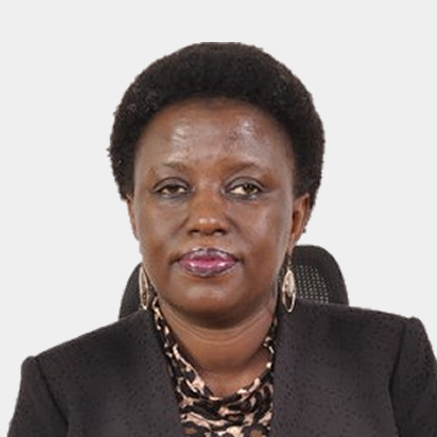
Recently, the Minister for Kampala Metropolitan Affairs, Hajjat Minsa Kabanda, wrote to Makindye Deputy Resident City Commissioner (RCC), Doreen Keita Kagabo, giving directives to allow traders and fish mongers to access the landing site, which had been closed for nearly four years due to rising water levels.

However, the move by the Kampala Minister has now come under scrutiny from the Kingdom, with BLB vehemently opposing the orders as illegal and unwarranted, which could lead to the destruction of the landing site.

Dennis Bugaya, the spokesperson and senior operations manager at the Buganda Land Board, asserts that the Mulungu landing site is one of the properties that President Museveni returned to the Buganda Kingdom, and therefore, the minister and the RCC cannot take decisions over it. He advised the kingdom’s subjects to ignore such directives and treat them as illegal.

“The Land Board has secured all the required documents showing their full ownership, and they are ready to protect it from any land grabbers. He also underscored the significance of Mulungu Port to the Kingdom, especially during events like the Boat Race, and reassured that no activities compromising the dignity of the lake would be allowed,” he said.

On whether the landing site had become a danger to the population nearby due to increasing Lake Victoria water levels, Bugaya told this said that they (BLB) made the assessment and established that the situation on the landing site was a danger to the public and agreed to close the site, and NEMA led the operation to evict people who refused to vacate the place peacefully.

Buganda Kingdom Minister of Information and Spokesperson Israel Kazibwe, in support of Mr. Bugaya’s assertions, said when we reached him that the development of Mulungu Port would bring honour to the Kingdom and boost its potential in terms of revenue collection.

Last week, the Kabaka of Buganda, His Majesty Ronald Muwenda Mutebi II, in the company of Prince Richard Ssemakookiro, made a surprise visit to the Mulungu landing site in Munyonyo-Makindye Division, where he thoroughly inspected the activities taking place to ensure that his land was intact.

This Eagle Online understands that Kabaka’s surprise visit to the site was in the wake of the orders made by the Minister for Kampala to the RCC of Makindye to implement the directive of taking over the landing site.

The Chairman of the Buganda Youth Council, Baker Ssejjengo, and Ssalongo James Wamala, an official at BLB, who together escorted the Kabaka as he toured the place, explained to him the status quo of the land and how the Buganda Land Board is protecting the area’s environment, plus plans to develop it for the good of his subjects.

The strategic move, according to them, aims to attract a diverse range of visitors, ultimately fostering prosperity within the Kingdom.

At the end of his tour, the Kabaka urged the Kingdom to actively develop the site, emphasising the importance of preventing exploitation by selfish individuals who may wish to take up land at this site. He also appreciated the work done by the Buganda Land Board to save it from degradation.

Minister Kabanda, when contacted for a comment, admitted that she wrote a letter to the IGP but said her directive was related to possible security threats in the area after the people who were evicted from the site threatened to riot and put the entire Munyonyo on fire, yet in the wake of the just concluded NAM Summit.

“As a leader, I cannot look on when people are threatening to riot; you know, visitors from other countries who came to attend the NAM Conference are still here, and you want those people to embarrass us before the international cameras,” Kabanda said.

She added that she has no intentions of grabbing Kabaka’s land or returning people to the land because she is not the owner of the land, but she wanted to lead the negotiation between the evicted people and the leadership of the Buganda Land Board to resolve the matter amicably.

Stories Continues after ad

ATMIS praises UPDF troops for their contributions to peace and security in Somalia

The African Union Transition Mission in Somalia (ATMIS) has celebrated the significant contributions of Ugandan troops to the peace and security process in Somalia.

At a colourful ceremony chaired by ATMIS Force Commander Lt. Gen. Sam Okiding, 41 soldiers from Battle Group-37 were awarded certificates and commemorative medals. The event was held at the Sector One Headquarters in Mogadishu.

Gen. Okiding commended the outgoing soldiers for their dedication in contributing to the mission’s mandate of degrading Al-Shabaab, fostering relations with the local population, and supporting the local administration through several Quick Impact projects (QIPs) and Civil-Military-Cooperation (CIMIC) initiatives.

“Battle Group-37 has proven themselves invaluable in the fight against Al-Shabaab, right from their commanders to the troops,” said Lt. Gen. Okiding in his address to the soldiers who are rotating out after completing their one-year tour of duty.

He urged the incoming contingent to remain vigilant as the AU peacekeeping mission prepares to exit Somalia at the end of this year, as mandated by UN Security Council Resolution 2687 (2023).

“You have come in when ATMIS is drawing down its troop numbers, and that calls on you to be even more vigilant and alert for any possible attempts by the Al-Shabaab,” said Lt. Gen.Okiding.

Deployed to Somalia in December 2022, Battle Group-37 advanced the ATMIS mandate, operating from various bases in Buufow, Shalambood, Ceel Jaale, Qoryooley, Janaale, Barire, as well as kilometres fifty and sixty-seven in the Lower Shabelle region of Southwest State.

Working jointly with the Somali Security Forces, ATMIS Ugandan soldiers conducted successful operations to disrupt and degrade Al-Shabaab and participated in reconciliation dialogues with local leaders and communities to foster peace in them

Area of Responsibility. The troops also cleared and secured Main Supply Routes (MSRs) linking neighbouring towns to the capital, Mogadishu, and provided security to local communities.

“We acknowledge the exceptional work they executed, including countering improvised explosive devices (IEDs), clearing main supply routes (MSRs), conducting joint patrols and ambushes with their Somali counterparts, and securing population centres,” said Sector One Commander Brig. Gen. Anthony Lukwago Mbuusi.

Uganda first deployed troops to Somalia in March 2007 and is one of the five troop-contributing countries to ATMIS, along with Burundi, Ethiopia, Djibouti, and Kenya.

Stories Continues after ad

Police recovers explosive device near Entebbe Beach

The Uganda Police’s Counter Terrorism officers in Kampala Metropolitan on Tuesday recovered a suspected explosive device near Rolex Beach within the Botanical Gardens in Entebbe, in Wakiso District.

ASP Luke Owoyesigyire, the Kampala Metropolitan Police Deputy Spokesperson confirmed the successful detonation of the handmade grenade.  This was recovered in an operation led by the Entebbe Division Police Commander at around 6 pm.

“On January 23rd, 2024, at around 6 PM, the DPC of Entebbe Police Division led a prompt response team. This was following reports of a suspected explosive device near Rolex Beach within the Botanical Gardens,” Mr Owoyesigyire stated in a statement.

According to preliminary investigations, Owoyesigyire allay the fears of the public. He said, “The item discovered was a non-spent ordnance buried underground for years, exposed due to soil erosion”. It was successfully detonated with no injuries caused.

“In the interest of public safety, meticulous inquiries were initiated, and the scene was thoroughly processed and documented. Following the guidance of bomb experts, a controlled explosion was executed on-site, resulting in zero injuries or damages,” Owoyesigyire explained.

He also urged the public to “remain vigilant and report any suspicious items promptly, facilitating swift police response and ultimately saving lives.”

“Further details will be provided at the earliest opportunity.”

It should be noted that this discovery came at a time when Uganda had just finished hosting The NAM and G77+China summits. There was heightened security all over the Kampala city and its outskirts.

Stories Continues after ad

Katanga Murder: Nakawa magistrate commits Widow to High Court for trial

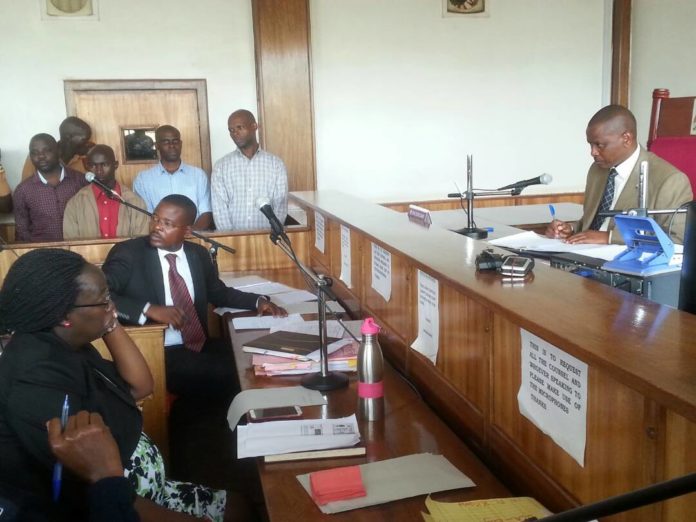
Nakawa Chief Magistrate Court has committed Molly Katanga, the prime suspect implicated in the murder of city businessman Henry Katanga, to High Court for trial.

The businessman was reportedly gunned down by his wife, Molly, on November 2, 2023, at their home in Mbuya, Nakawa Division, Kampala City.

Appearing before Chief Magistrate Elias Kakooza, Molly was committed to High Court after the prosecution said it had concluded its investigations.

Her appearance and committal to the high court followed the issuance of an arrest warrant against her on January 22, 2024. Molly, who was earlier wheeled into court, is reportedly ill after being allegedly operated on for the fifth time in a period of two months. She was hospitalised at Kampala International Hospital (IHK).

Molly joins her two daughters, Martha Nkwanzi and Patricia Kakwanza; George Amanyire, a shamba boy; and Charles Otai, a health worker, who were  committed to High Court on Monday.

Nkwanzi and Kakwanza are accused of tampering with evidence at the crime scene, rendering it unidentifiable for judicial proceedings. Amanyire and Charles Otai, a health worker, are accused of assisting others involved in the crime.

Molly Katanga’s legal team has asked the court to order the police to vacate their home in Mbuya, which has been under police surveillance and control since November 2, 2023.

Stories Continues after ad

Uganda’s Safeboda relaunches operations in Kenya

Uganda-based motorcycle ride-hailing and delivery Company SafeBoda is set to resume operations in Kenya next month, three years after it shut down its operations in the country.

“Tumerudi! (We are back),” said the firm on its official Kenyan handle on X (formerly Twitter).

“SafeBoda is coming to Nairobi,” the company said on its website on Monday, with a countdown timer that showed it would relaunch in Kenya in 13 days.

SafeBoda closed its operations in Kenya in November 2020 at the height of the Covid-19 pandemic to focus on its successful operations in Uganda.

The company had taken a major hit after the pandemic put transportation to a near halt due to movement restrictions, including the months-long dust-to-dawn curfew.

“While Nairobi is seeing some economic recovery from Covid-19, boda transportation has been hit hard. This has meant our business cannot sustainably operate in this environment and unfortunately, the timeline for a full recovery is not certain,” the firm announced at the time.

By the time of its closure, the company had a network of more than 4,000 boda boda riders.

It is estimated that there are more than 1.8 million boda boda riders in Kenya, making it a major source of livelihood.

SafeBoda first launched in Nairobi in 2018 and immediately embarked on wooing customers by offering cheap rates for rides across the city.

Before it launched in Nairobi, the firm had operated in Kampala for four years.

Yet, the market SafeBoda is coming back into is quite different from the one it exited just over three years ago.

Competition has gone a notch higher in the ride-hailing business, and as such, the Ugandan entity will have its work cut out to wrestle market share from leading players such as Bolt.

It is also coming back at a time when the government has accelerated taxation to increase revenue collection, straining firms.

Some of the increased burdens firms are having to shoulder include the enhanced National Social Security Fund (NSSF) contributions, 1.5 percent housing levy and reinstatement of turnover tax to 3 percent.

On the other hand, the number of boda boda riders has grown significantly during the period as the service increasingly becomes a go-to source of self-employment for millions of youth.

Stories Continues after ad

Makerere University lecturer to premiere her documentary film in Ugandan Cinema

Dr Cindy Evelyn Magara, Director and Executive Producer.

Tuko Pamoja (We Are One), a docuseries by Evelyn Cindy Magara (PhD) and Nyati Motion Pictures, goes to cinemas with 13 premieres starting from February to June 2024. The Tuko Pamoja documentary film (series) is about Uganda’s heroes and unity in diversity.

Written by Rogers Atukunda and directed by Dr. Magara, a Lecturer of Film and Literature at Makerere University, the film explores the unifying geopolitical and geolinguistics of 1870–1900 Uganda and the historical relationships between the peoples of the Great Lakes Region.

The segments that shall have independent premieres include Bunyoro-Kitara, Buganda, Busoga, Tooro, Ankole, Kigezi, Breakaway Kingdoms, The Luo, The Ateker, The Peoples of Rwenzori, The Peoples of Eastern Uganda, West Nile, and finally Uganda: The Making of a Nation.

Nyati Motion Pictures, a Ugandan film production company that started operating in 2006, is renowned for films such as Fate (2006), Fair Play (2010), Windows of Hope (2011), A Book for Every Child (2012), and many others. Nyati is also known for breaking ground; for instance, it produced Uganda’s first independent professional film, FATE, which was the first Ugandan film to screen at Cineplex and on DStv’s African Magic in 2007. Currently, Nyati is working on a very large project that will bring Uganda’s history on screen.

“This film aims to foster cohesion since our pre-colonial history shows that we are one” (Tuko Pamoja) and our different tribes (nations) were geographical emblems that should continue to define but not divide us. This is because our pre-colonial history shows that Uganda already existed in terms of politics and language; the people continue to propagate the division seed sown by colonialists,” said Director Dr. Cindy Magara.

“The colonialists wanted to see us divided on, for example, tribal lines, to subjugate us. When we all know this history, it will reduce ethnic tensions,” she added.

According to Dr. Magara, the story is relevant to contemporary East Africa as the region struggles to foster unity through a confederation of states such as the East African Community and Africa Union.

“By retracing the historical footsteps of Omukama Kabaleega of Bunyoro-Kitara Kingdom, King Mwanga of Buganda Kingdom, Chief Awich of Payira, and Queen Muhumuza of Kigezi, etc., as some of the major players, especially in the resistance against British imperialism from 1870s to 1900, we learn about the origin of the people of Uganda and the nations (kingdoms) they belonged to that later morphed into Uganda.”

She went on: “The film tackles key issues the continent is grappling with, including democracy, neo-colonialism, integration, peace, and stability.”

Stories Continues after ad

Kyambogo University lecturer on run after defiling 16-year-old visually impaired girl

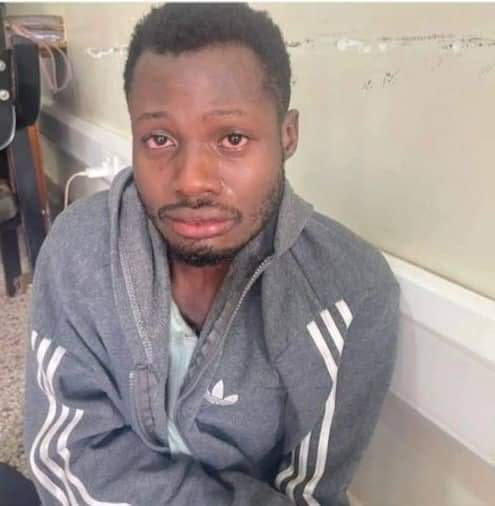
Dr. Eron Lawrence, a 56-year-old, senior lecturer at Kyambogo University and Dean of Faculty of Special needs and rehabilitation is wanted by police for disappearing and absconding a police bond on December 14, 2023. His file was sanctioned on December 13, 2023 and is being accused of aggravated defilement of a 16-year-old disabled girl .

The Directorate of Crime Investigations Directorate (CID) in coordination with the Kampala Metropolitan Police (KMP) territorial police are seeking the public’s help in locating a one, Dr. Eron Lawrence, a 56-year-old, senior lecturer at Kyambogo University and Dean of Faculty of Special needs and rehabilitation for disappearing and absconding a police bond on December 14, 2023.

Dr. Lawrence, whose case file was sanctioned on December 13, 2023 is being accused of aggravated defilement of a 16-year-old disabled girl who is a beneficiary of his project of “All we see is possibility”.

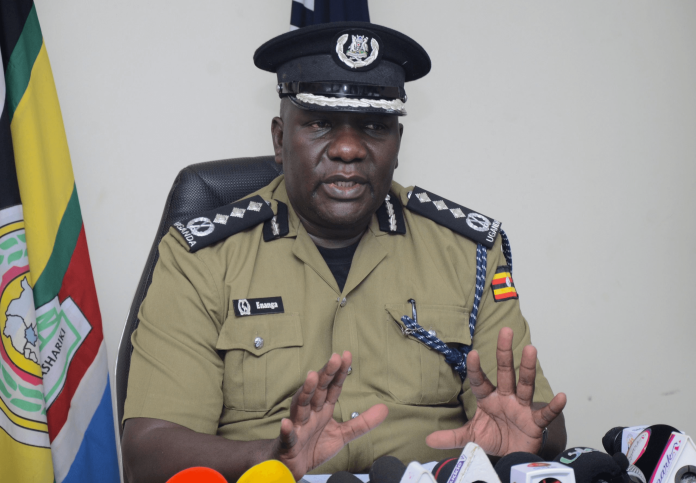
According to Police Spokesperson, Fred Enanga, Dr. Lawrence is HIV positive.

“The facts gathered indicate that the suspect travelled as a caretaker with four students including the 16-year-old, disabled victim to Nairobi-Kenya, for a conference, and returned on the December10, 2023. He picked his car that he had left at the Airport and gave a lift to the students. He first dropped two students from Gulu University at Namayiba Taxi Park, and they travelled to Gulu. And went on to drop the third student at North Hall, Kyambogo University and remained with the victim, who had a visual impairment, in the car (she can only see during day time while using glasses, but cannot see at night),” Enanga said.

Enanga added, “He drove together with the victim from around 10.20pm, up to Namugongo Nsawo village, Kira municipality. It was established that along the way, the victim requested for water, which was bought at a supermarket along Ndagire road, in Nalya. The victim fell unconscious after taking the water. Upon gaining her consciousness, she fell some pain around her private parts, and realised she had been sexually assaulted. The sexual assault took place in the car.”

Enanga added that the following morning her maternal uncle drove her back to her school in Mukono and she revealed her ordeal to the Senior Woman teacher, who alerted the school head teacher and the matter reported to Mukono police.

“The victim was immediately, put on post-rape treatment. The DNA samples that were recovered from the suspect’s car, a Toyota Wish, registration number UBA 349Z, matched with the samples found on the body of the victim,” he noted.

The police mouthpiece further disclosed that the suspect’s three sureties who include; Lawrence Olobo aged 48, Adoch Gertrude and Among Paul, aged 54, have also been tasked to produce him before the DPC at Jinja road police division.

“The CID will continue to work with crime intelligence and other law enforcement partners, to locate the suspect and bring closure to the alleged heinous crime. We appeal to the public that if you have any information regarding the investigation or believe you may have been victimised, please reach out to CID Headquarters, KMP Headquarters or call the NOCC on 0776999136.”

Stories Continues after ad