The East African Court of Justice has thrown out a petition in which lawyer Male Mabirizi was challenging a ban by the Kenyan government on Uganda’s maize and poultry products.
In a ruling delivered on Friday, the court presided over by Principal Judge Yohane Masara approved the defence filed by the Kenyan government over the matter.
Mabirizi had in his March 11, 2021, suit challenged directives by the Agriculture and Food Authority of Kenya banning the importation of maize and chicken products from Uganda over mycotoxins and aflatoxins.
He had the court to quash the directives and issue a permanent order restraining Kenya from implementing its directives on grounds of being illegal. He also claimed the Kenyan government submitted a response to the petition late. He argued that he was served on May 3, 2021, after the expiry of the 45-day timeline required by law. The court heard that the said days started to run on March 12, 2021 and expired on April 25, 2021.
But on Friday, the court ruled otherwise.
“In addition, we do not see how the applicant will be prejudiced if the respondent’s late response was to be validated in the best interest of justice. Considering the issues arising from the statement of reference, it is only fair and just that this court hears the respondent on the same before making a determination thereof,” the justices ruled.
Mabirizi had told the court that the ban on the importation of goods from EAC partner states is unlawful and infringes the operational principles of the community, which among others, encourage free movement of goods, transparency, democracy and rule of law, account and equitable distribution of benefits.
In its defence, the Kenyan government said it banned the said commodities to protect their farmers who were recovering from the effects of the #Covid-19 pandemic from competition as well as to prevent the dumping of toxic chemicals, substances and hazardous wastes within the community.
According to Kenya, Uganda also put in place tariff measures that make their poultry products uncompetitive while it enjoys unhindered access to the Kenyan market.
Commercial banks have asked all companies holding accounts with them to reveal the identities of the actual beneficiaries of the funds.
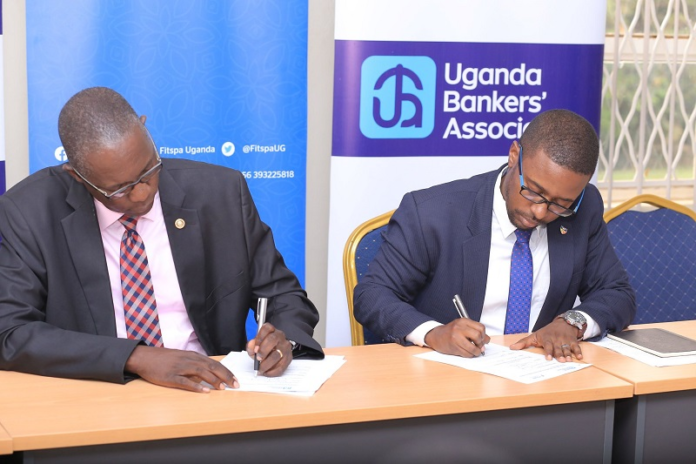
The banks under their umbrella body, the Uganda Bankers Association (UBA), say this is in line with the Companies (Amendment) Act (2022) and the Partnership (Amendment) Act (2022).
“In accordance with the Companies (Amendment) Act (2022) and the Partnership (Amendment) Act (2022), every company and Limited Liability Partnership registered in Uganda is required to keep a register of its beneficial owners,” UBA said in a statement released on Friday, 24 November 2023.
UBA defines a beneficial owner as a natural person who has final ownership or control of a company or partnership or a natural person on whose behalf a transaction is conducted in a company or partnership and includes a natural person who exercises ultimate control over a company or partnership.
“This is therefore to notify all companies and limited liability partnerships, who operate bank accounts in the UBA Member financial institutions licensed and supervised by Bank of Uganda, to provide information on the ultimate beneficial owners of their respective entities as filed with the Uganda Registration Services Bureau (URSB), not later than November 30th, 2023,” the bankers association said in the statement.
To file with URSB, companies are required to update their data on the online Business Registration System
According to UBA, after 30th November 2023, the company’s bank account may be restricted from transacting if not updated by that set date.
“Customers are therefore encouraged to contact/visit their respective financial institution for further information/clarification regarding their accounts to ensure they are updated, to avoid any inconveniences,” the statement adds.
Ugandan businessman and politician, belonging to the National Resistance Movement (NRM), Mike Mukula was reported in The Eastern African newspaper crying that the decision by Ugandan government to have Uganda National Oil Company (UNOC) as the only supplier of petroleum products in the country, in partnership with Dutch energy and commodity trading giant Vitol will leave his $270 million logistics company (Mahathi Infra Uganda) dead.
Mukula, who heads NRM in the Eastern Region said: “It is not yet very clear how we fit…All oil marketing companies, including us (Mahathi Infra Uganda), will now be buying from one supplier UNOC. We should have been given a chance to compete…,” Mukula said.
As Parliament passed the Petroleum Supply (Amendment), Bill 2023, giving UNOC monopoly advantage, Nathan Nandala-Mafabi, the Budadiri County West legislator was afraid that this is likely to enrich Vitol at the expense of Uganda.
“It would have been better that we give UNOC money to trade directly. When we bring in Vitol the shareholder of Vivo energy that trades as Shell, I can tell you we might be helping them to make more money instead of benefiting Ugandans,” Nandala-Mafabi, an economist, said.
Nandala-Mafabi, also the Forum for Democratic Change (FDC) party Secretary General added, “Vitol will now source for money all over the world to supply us oil but there will be interest, so the moment we approve a monopoly fuel prices will be high”. Nandala operates some fuel outlets in Uganda.
From the complaints of the two politicians, it appears government rushed with the deal without much preparations, especially that it did not fully scrutinise how Vitol with costly fuel deals in neighbouring Tanzania and other countries in Africa, does its business.
Another concern is that government has not yet published the deal with Vitol, for Ugandans to be sure of whether they will not be cheated, given that some of the money UNOC will be using for operations will be from taxes. A section of the public think government did not involve oil experts as it selected Vitol, which is not clean, as government would want Ugandans to believe.
For instance, in Tanzania, Vitol imported with a cartel and inflated delivered premiums vs neighbouring markets. This cost retailers millions in lost earnings. This can be shown in the analysis when compared with the Kenya OTS imports.
In Zambia, diesel they imported recently was off specification on sulphur when trucks were tested. In Bangladesh, during the gas crisis and high gas prices, they flaked on government supply, pocketing over $1 billion. Bangladesh was forced to find alternative supply to ensure 160 million people had power, but it cost the government billions of dollars.
US Department of Justice fined Vitol $164 million for bribery in Ecuador and Mexico. This was reported by Reuters and Bloomberg. The U.S. fined Vitol for market price manipulation on fuel imports for California (Bloomberg). Vitol exploited UK households of over $500 million on power prices (UK media).
The government of Uganda must take the above matters seriously as it plans to deal with Vitol. Ugandans are tired of deals that take away the little income that they can spare, especially when it comes to petroleum products.
The government must know that Ugandans have not forgotten the bad deals signed with private companies, such as the UMEME contract, of which the taxpayers are to lose money after government said it would not renew the contract after 2025. In April 2023, the Ministry of Energy and Mineral Development indicated that based on a computation made in December 2022, Government is expected to pay Umeme $215 million at the end of the concession in 2025
The citizens have not forgotten the tricky $200 million Entebbe Airport Agreement between the Government and the Export-Import Bank of China, which government tried to renegotiate as mentioned by Finance Minister Matia Kasaija not so long ago.
In addition, that Vitol will only deliver the petroleum products in Kenya, from where UNOC will pick them makes matters worse, as the latter now will have to negotiate with owners of logistics facilities in Kenya, so that Uganda’s products are stored there, and the Kenyans will dictate storage prices, which will in the end be passed on to Ugandan consumers. However, that UNOC will have to register in Kenya in order to do that business makes matters worse as issues of bureaucracy and sabotage will arise. These are some of the matters that indicate the UNOC, Vitol deal is dangerous to Ugandans, which requires government to listen.
Mary Wangari Wamae, the Group Executive Director of Kenya’s Equity Group has encouraged professionals to maintain a healthy work-life balance.
She made the remarks while launching her book titled ‘The Village Girl: My Dream, Life and Legacy’ at the Kampala Serena Hotel last evening.
The book documents her journey from her roots as a young village girl in Nyeri (south Central Kenya) to her life as a mother, and a lawyer in private practice, to joining Equity Group in 2004 and rising through the ranks to become Group Executive Director overseeing the Group’s subsidiaries – a role she took on in 2017.
She spoke to four key spheres that are supposed to be kept in balance for a healthy life as a corporate leader.
She said, “There are four spheres: The mind sphere – which is all the knowledge and intellectual work we do which has to be worked on to grow professionally; the heart sphere -which is the emotional element involving love, family, spouses and so on; the health sphere –which involves mental and physical health and; the soul sphere – which is the spiritual element.”
She advised professionals to be proactive about allocating time for each of these spheres to have them all in harmony for a well-balanced life.
She also spoke about her passion for Equity Bank, highlighting the conglomerate’s growth from a balance sheet of $30 million to $18 billion in 20 years.
She said, “We were in one country only – Kenya – with 500,000 customers. Today, we are in six countries with 18 million customers and have grown our staff from 500 to 13,000 – all this within a period of 20 years.”
Eunice Waweru, UBL’s Finance and Strategy Director, said, “As a business that prides itself on providing opportunities for women and people from diverse backgrounds to thrive, UBL is proud to be celebrating you today with a gin that is the perfect mix of ingenuity, heritage and hard work – qualities that you embody.”
While giving the foreword speech, Dr. Peter Kimbowa – the NSSF Board Chair and former member of the Equity Bank Uganda board hailed Wangari for her social evangelism where she supports young ladies to move from the lower schools of mediocrity and inadequacy to the higher universities of womanhood and achievement.
The Deputy Speakers of the Legislatures of Uganda and China have committed to continue cooperation in a bid to maintain strong relationship between the two countries.
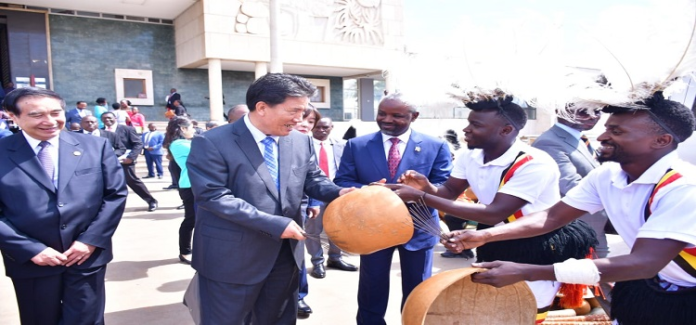
The commitment was reiterated during a meeting between the Deputy Speaker of Parliament, Thomas Tayebwa and the Deputy Chairman of the Standing Committee of the National People’s Congress of China, H.E. Luosang Gyaltsen.
Tayebwa met H.E Luosang Gyaltsen at Parliament Building on Thursday, 23 November 2023. The meeting was attended by Chairpersons of Committees of Parliament and a delegation from the Chinese Legislature.
While addressing the meeting, Tayebwa commended China for its longstanding relationship with Uganda, which he said dates back to pre-independence times.
He observed that Uganda and China have consolidated cooperation in political, security, economic, social, cultural and scientific disciplines, adding that China has supported preparations to host the Group of 77 and China meeting in Kampala, in January 2024.
“I want to appreciate President Xi Jinping for the great friendship he has exhibited towards Uganda and Africa at large. His good working relationship with President Museveni has facilitated development of our country,” said Tayebwa.
He commended China for its role in reforming the UN Security Council and committed Uganda’s efforts to push for equal representation.
“We want to assure our Chinese friends that Uganda will continue to push for reforms to ensure Africa gets two permanent seats on the UN Security Council as per the consensus of the African Union,” Tayebwa added.
He appreciated China for its support in tackling Covid-19 in Uganda as well as development of trade through preferential treatment for Uganda’s exports and setting up industrial parks.
He also committed Government’s support to the one China Policy, and wooed investors to consider Uganda’s tourism sector.
Tayebwa appreciated H.E. Luosang Gyaltsen’s visit to Uganda, saying it will strengthen bilateral relations and improve cooperation at Parliament level.
“I commit on behalf of the Parliament of Uganda to move this friendship to a higher level. I have been assigned Hon. Dicksons Kateshumbwa [MP, Sheema Munic.] to head the Uganda-China Parliamentary Friendship Group and he will contact the Ambassador on how to improve our cooperation,” said the Deputy Speaker.
H.E. Luosang Gyaltsen reiterated that the cooperation between China and Uganda has been strong, especially between the Legislatures of the two countries.
“Uganda is an important cooperative partner of the Belt and Road Initiative in Africa. I hope to establish and maintain a good working relationship that will strengthen working relations between our Legislatures,” H.E. Luosang Gyaltsen said.
He said the recent Third Belt and Road Forum for international cooperation provided opportunities for partner countries including Uganda, to improve cooperation to promote high quality development.
He also commended Uganda’s critical role in safeguarding common African position at the UN Security Council.
“We support Uganda in fully defending national sovereignty, independence and territorial integrity, and support its role in regional peace and security,” H.E. Luosang Gyaltsen added.
He said China will work with Uganda to strengthen communication and cooperation on human rights, counter-terrorism, poverty reduction, climate change, health and trade issues.
“China will continue to encourage capable Chinese companies with good desire, to invest in Uganda and create more jobs for the economy, as well as promote construction of industrial parks,” said H.E. Luosang Gyaltsen.
The Bank of Uganda has granted an operating license to Armada Credit Bureau (Armada CRB), marking it the fourth credit bureau in the country.
The other licensed credit bureaus are Compuscan, Metropole and GnuGrid CRB.
BoU Director of Communications Kenneth Egesa described the development as very positive for the industry
Armada Credit Bureau expressed joy over the licence in a statement, “This significant milestone marks the start of an exciting journey as we make our contribution to the growth and development of Uganda’s financial landscape.”
According to information on Armada’s website, the company says it has over four decades combined experience in credit bureau operations, commercial and retail banking and technology services to create your most reliable single source of actionable insight.
“We believe it is a new era for credit information reporting in Uganda,” it says.
A CRB is a company licensed by Bank of Uganda to collect and collate credit information on individuals and companies from various sources and disseminate that information in form of a credit report to authorized users.
Presently, financial institutions have the capability to extend credit to borrowers after consulting Credit Reference Bureau (CRB) reports. These reports provide crucial insights into the borrowers’ credit history, including their loan repayment records and any collateral associated with previous loans. This invaluable information aids lenders in accurately assessing their potential risk exposure when considering loan approvals.
Former State Minister for Information Technology Nyombi Tembo has been appointed as Uganda Communications Commission (UCC) Executive Director and will serve for five years.
He replaces Eng Irene Kaggwa Sewankambo who has served in the interim capacity for the last four years since the retirement of Godfrey Mutabazi in 2020.
Thembo has since 2017 been working as the director of the Rural Communications Development Fund (RCDF), a Universal Service Fund (USF), to communications in Uganda. It was established in 2003 and it is administered at arms’ length by the Uganda Communications Commission (UCC).
Nyombi holds a Bachelor of Arts degree from Makerere University and a Master of Science in Development Economics from Uganda Martyrs University (UMU). He also holds a diploma in project planning and management (Bradford University, UK) and a post-graduate diploma in financial management (UMU).
Among others, Nyombi worked as an analyst, planning officer and senior planning officer for the then Uganda Railways Corporation during the 1990s and as a Project Manager for Transport Rehabilitation Project (Railway Component), at Kampala City Council (1995-2001), when he joined politics.
Nyombi was elected to the Ugandan Parliament in 2001, representing his home constituency of Kassanda County South in Mubende District for over a decade (2001-2015). He has also held a number of posts in the Ugandan Cabinet: State Minister for primary education in the Ministry of Education and Sports (2001-2009), State Minister for Luwero Triangle in the Office of the Prime Minister (2009-2011) and then as State Minister for Information and Communications Technology (2011-15).
The Leader of Opposition Mathias Mpuuga has said that the opposition legislators shall not return to Parliament until the government responds to their demands on violation of human rights and arrests of colleagues.
“At no one time are we going to return to Parliament without our demands being responded to. All we are waiting for is the date and time the regime will be ready to respond,” Mpuuga said.
Mpuuga further said he is not shaken by Speaker Anita Among’s threats to expel the boycotting MPs after missing after 15 plenary sitting as provided for in the Ugandan constitution.
“Our absence from the House is official because it was officially communicated. It’s the duty of Parliament’s presiding officers to consider how to treat official communication,” Mpuuga said.
In an earlier meeting in the Speaker’s chambers Mpuuga tasked the regime’s Ministers of Defence, Security and Internal Affairs to make a comprehensive response to each of the issues raised. They had a time frame of 30 days which elapsed last Sunday November 19, 2023.
“We received communication last week that they were unable to come with the statement because they had travelled out of the country for a security meeting. Do they want to tell us that when they travelled, did they flee into exile? Are they dead or have disappeared?” Mpuuga worried.
Mpuuga noted, “Our demand of the Speaker is to follow up on Parliament’s instructions to the executive. We expect her to be neutral; an arbiter or referee whose duty is to demand that the executive comes and answers. Other matters short of an answer are peripheral and we are not willing to be diverted into that.”
During yesterday’s session, Among ordered the Clerk to Parliament, to impose on MPs boycotting plenary sittings not to be allowed to attend Committees, and travels abroad, wondering why these MPs should be allowed to represent Uganda at the East African games in December in Rwanda, yet they aren’t representing their voters in Parliament.
The Speaker also imposed a travel ban abroad, asking to have boycotting MPs to be deleted from the list of players for the East African games & she also barred MPs boycotting plenary sittings from attending Committee meetings.
At least 22 individuals and companies have been awarded as the most compliant taxpayers in the country. The group was awarded during the 17th Taxpayer appreciation day at the Uganda Revenue Authority (URA) headquarters.
URA has registered year on year revenue growth in tax collection. The last financial year, URA posted 16.4% year on year growth with collections of Shs25,209.05 billion compared to the financial year 2021/2022 which had a 12.14% growth with collections of Shs21.062 billion.
Recognized under; Commissioner General’s Strategic Partner of the Year, Vantage and excellent, the awardees include; Cocacola, the top taxpayer of the years; Rt Rev Assoc Professor Fred Sheldon Mwesigwa, Bishop of Ankole Diocese; Grant Thornton; Wilson Mayamba; Katch Ap Global Forwarders Limited, Richard Canopwonya Lander and others.
Speaking at the awarding ceremony, John R. Musinguzi, the Commissioner General of URA said every tax is a demonstration of citizenship, a tangible expression of your belief in the importance of a functioning society. It is through your collective contributions that we are able to bridge gaps, address challenges, and strive toward a future that is brighter and more equitable for everyone.
“Taxpayers are the unsung economic heroes of our country, contributing to the foundation upon which our shared aspirations are built. Your willingness to contribute your hard-earned income is not merely a legal obligation but a testament to your dedication to the well-being of our nation. The funds collected through taxation serve as the essence of our public services,” he said.
He urged all taxpayers with outstanding taxes to take advantage of this and pay their outstanding principal tax, which will automatically grant them a waiver of accumulated penalties and interest.
Juma Kisaame, the Chairman, Uganda Revenue Authority Board of Directors said taxpayers have spurred URA towards cementing the success registered in adoption of several innovations such as EFRIS for the VAT registered taxpayers, DTS for Local excise collections from manufacturers and importers of gazette products, BWIMS for efficient warehouse management, USSD code that is targeting improvement in the collections from the presumptive category and advanced income tax collections, and automated ledger reconciliation that improves transparency and tax compliance, among many others.
The minister of finance Matia Kasaija committed to supporting URA in its mandate fulfills the government’s objective of liberating Uganda from donor dependency.
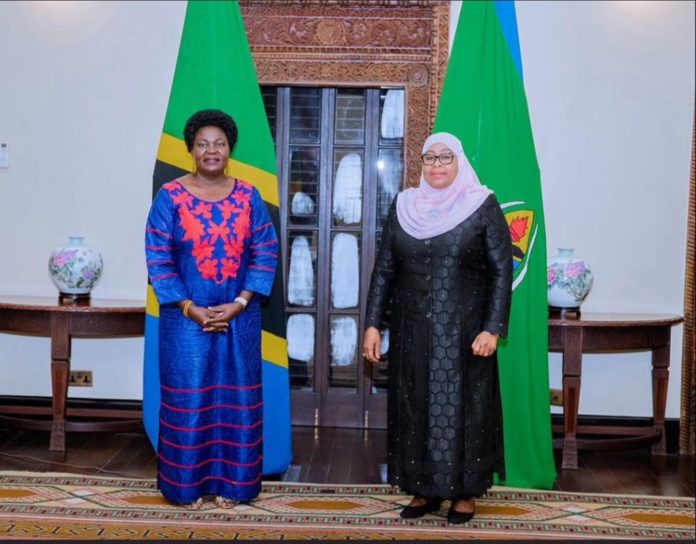
Minister Nakabirwa after briefing Tanzania President Suluhu on the oil deal.
Uganda is an interesting country and despite having several accountability institutions and agencies, it seems we still carry out business in incongruently, at times to our own detriment.
Take the example of the new oil products supply deal between the government represented by the Uganda National Oil Company (UNOC) and oil brokerage firm Vitol, a development that has seemingly caught government in the wrong lane, of course taking into consideration that the bill can be assented, nonetheless.
That notwithstanding, as the bickering over the whole deal goes on and even hits peak fever, Ugandans are wondering whether the Public Procurement and Disposal Authority (PPDA) is up to its job, or whether it is a lame duck institution waiting to rubber stamp a decision that is seemingly at odds with the procurement processes, never mind that this particular deal is worth millions of dollars, the more reason PPDA must be loud about it!
Actually, the PPDA’s loud silence on a matter that involves the procurement of a service provider of oil products to Uganda without going through the usual procedures that involve advertising through an Open Tender System (OTS), is as disturbing as the Energy Minister’s silence on the matter, save for presenting the highly secretive bill to parliament.
In fact, there is so much bickering behind the walls, but what is being said includes questions about the fate of several industry players like Captain Mike Mukula, whose business and earning is going to be affected by the new oil supply structure. Others, including industry sector players in Kenya are not just complaining but have gone a notch higher and filed a petition in the Kenya High Court, seeking to have their national regulation body deny UNOC an import license.
And here, even the Speaker gets flak on her face.
“When the Speaker presides over debate on such an issue on which the President has commented negatively, she seems to negate the importance of rules and regulations espoused by the several protocols, both regional and international, which the country is bound to respect. And to imagine that she cut short her maternity leave to ostensibly be around to pass the bill is disturbing. In fact, given the passing of the bill in its entirety, is evidence that she had not acclimatized herself with developments coming up, including knowing that some interested parties had gone to court, and that a date to hear and determine the matter had been set for December 6”, an industry source, speaking on condition of anonymity for fear of reprisals said.
He did not spare Minister Nankabirwa either.
“Natural justice demands that Minister Nankabirwa says something about the deal to the many layers of people affected by the new move, giving assurances that all was done transparently and will in the end not benefit a new set of middlemen but the general public, which is as it must.
Indeed, industry players say the issue of oil products supply is not new; there have been structures like the OTC and G2G or G2G, which have existed before which, experts say could have been improved upon in the spirit of the East African Community, instead of trying to derail the applecart.
“Any intended switch to the supply structure should have been preceded by talks on both sides, to see how to resolve the issue of overpricing caused by the layers of middlemen, taking into consideration that the switching will be fair and just, leading to a win-win situation.
” This seems to have been ignored, and the resultant effect is the court matter that seeks to deny UNOC an import license, a development that can destabilise the whole supply chain, if the Kenyan Court grants the orders so sought in the plaint before it”, the industry player says.
The source added: “Because of the high secrecy shrouding the bill before it’s presentation, it seems not enough scrutiny was carried out on some ‘lesser’ details like human rights and freedoms, which are key ingredients of carrying out big business, that are respected in countries that follow the law to the letter and spirit”.
Recently, the Parliament of Uganda passed the Petroleum Supply bill as amended in 2023, causing uproar, with many people citing mischief on the part of its proponents. It is against such a background that vitriolic banter emerged, with claims that millions of dollars exchanged hands to have the bill passed, amid claims of circumventing the laws and procedures so established.