Stanbic Bank
Stanbic Bank
27.6 C
Kampala
Stanbic Bank
Stanbic Bank
Home Blog Page 370

FDC launches Leadership Academy to train youths with party ideologies

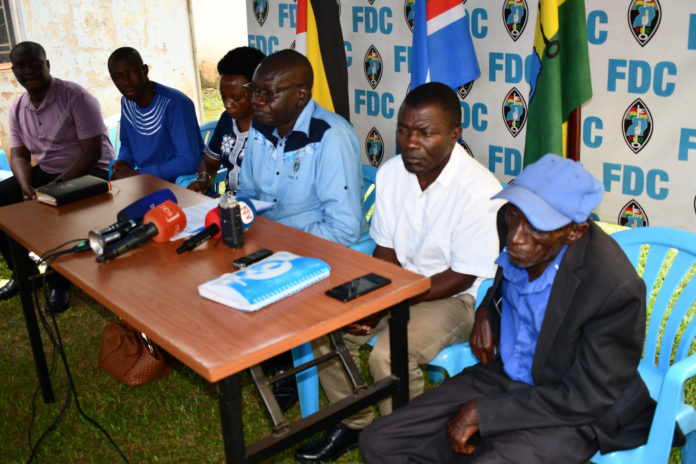
The Forum for Democratic Change (FDC) on Tuesday 20 launched a leadership academy to train party trainers from the Busoga sub-region to extend ideological messages to different parts of the region.

The event which took place at Sana country hotel at Buseyi village, Nakalama sub-county in Iganga district included passing out Trainers of trainees who were tasked to carry on training in various districts within the sub-region. The youths were selected from Iganga, Kamuli, Bugweri, Jinja, Jinja City, Namutumba, Bugiri, Mayuge, Namayingo, Luuka, Buyende, and Kaliro districts. Speaking at the event, Isabirye David Aga, the Member of Parliament for Jinja City North said they are training youth’s leadership in FDC about the ideologies and values of the party to get ready for the party structural elections and forthcoming elections of 2026 with the aim of taking power from the NRM government.

“You know very well that FDC was one of the strongest opposition parties here in Uganda and we not only want to reclaim that but also take over power from the NRM government. This is why we are imparting strategies into our youth leaders because youths constitute about 70% of Uganda and by empowering youths, you are empowering the whole society,” Hon Isabirye said. He further said the party members ought to go back to their defiance factor and exert pressure in case they cite electoral malpractices, warning police against interfering with their gatherings, something he says is unconstitutional especially when they are carrying out party activities where they should be protected by the constitution. “This time round if they cheat or steal our victory, we shall put up pressure and resort to the defiance factor to reclaim our victory. If we don’t defy, if we don’t fight, police will continue disorganizing our gatherings and rallies once we coil because many are coiling.

They need to quote any law which makes it unconstitutional for FDC to hold gatherings,” Hon Isabirye added before emphasizing the importance of leading by example and remaining steadfast in pursuing truth in all circumstances. The former contestant in the Bugiri municipality MP race, Ms Eunice Namatende revealed that they are looking at many things especially the party core values where leaders must know that seeking knowledge is key and it is why they have launched the FDC Leadership Academy to avoid producing half-baked leaders in future. “We realized that most of our leaders lack skills and we decided to launch this leadership academy where we would talk to them on how to handle them and unveil some skills to them. We need to tell them that FDC is an institution and not one’s home like others think, that it has been built on an individual,” Ms Namatende said.

The FDC secretary of publicity and mobilization in Bugweri district, who doubles as Ibulanku sub-county chairperson Mr Ndhoga Ibrahim says they desire activism where they wish to convince and sensitize people on the leakages of the current government ahead of 2026 general elections where they are aiming at the top political seat in the country. “We want to tell our people and party members that the time is now to wake up and see the inequities in the NRM government. As FDC, we have decided to follow constitutional means of taking power by training people across the country about the party ideologies and values, and we shall not initiate a bush war like the current government did in the 1980s,” Mr Ndhoga said. However, the leaders said that this is a significant step towards fulfilling and the party’s mission is developing strong, capable, and well-facilitated leaders who can make a positive impact on Uganda’s political landscape and contribute to the betterment of a progressive society for a new Uganda.

Stories Continues after ad

Gen Elwelu applauds Nigeria’s relationship with Uganda

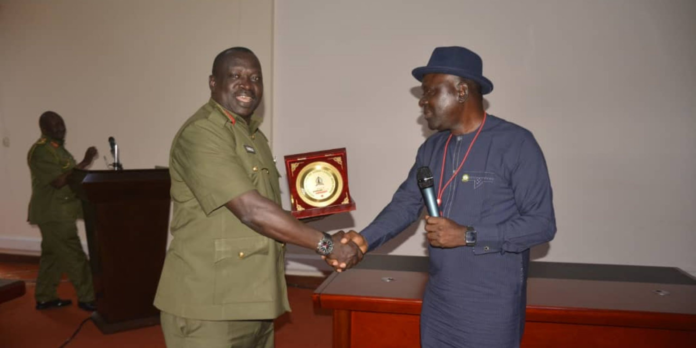
The Deputy Chief of Defence Forces, Lt. Gen. Peter Elwelu has said that the relationship between Uganda and Nigeria is not one to be taken for granted given the similar nature of threats like the Allied Democratic Forces and Boko Haram rebels faced by the two countries respectively.

Lt. Gen. Elwelu made the remarks today as he addressed participants and members of the Faculty of the Executive Intelligence Management Course from the National Institute for Security Studies, Abuja, Nigeria at the Ministry of Defence Headquarters, Mbuya.

The Deputy Chief of Defence Forces underscored that the two countries, especially the Military, enjoy a long-standing and constructive relationship through exchange of Military Courses.

“Number of UPDF officers has been training in Nigeria. We take it very seriously for you to come from Abuja to Uganda and don’t take that for granted,” said Lt Gen Elwelu

The Head of Delegation from the National Institute for Security Studies, Mr. Godwin Ometu said that it is time for Africans to promote Pan-Africanism and called for such a spirit to be taught at Universities in Africa because the challenges of Africa are unique to Africa. of the foreigners are our problems.

The Deputy Chief Political Commissar, Col Nelson Ahebwa while making a presentation to the participants said that language is a common unifying factor and Africans are not strangers to each other.

The meeting was attended by the Chief of Personnel and Administration, Brig Gen James Kinalwa, Chief of Logistics and Engineering, Brig Gen Charles Bakahumura, Defence Spokesperson, Brig Gen Felix Kulayigye, Brig Gen Alex Olupot, Director of Training, Brig Gen Fred Twinamasiko and Senior Officers.

Stories Continues after ad

The Supreme Court decision in Ham Vs DTB is against the public policy of Uganda

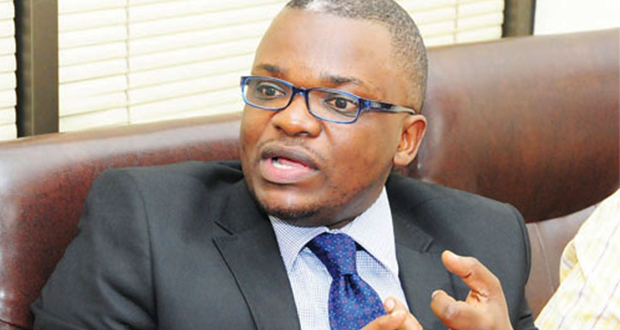
Mr. Muwema

The Supreme Court generally mishandled the Ham vs DTB Civil Appeal No. 13/2021 when it delivered its judgment on the 6th of June 2023. This judgment was against the public policy of Uganda. In the handling of the case, the Court intentionally set up its ladder against the wrong wall and it ended up resolving the wrong problem.

There are two imaginary problems which influenced the Supreme Court decision. The first imaginary problem was that Ham is using legal technicalities to avoid paying his debts said to be owed to DTB. The second imaginary problem was that the High Court decision which was made in favour of Ham outlawed syndicated lending transactions between foreign banks and Ugandans.

We note that an unusual dissonance greeted the delivery of what should have been a landmark judgment in guiding the prudential regulation of the banking sector. This muted reception of the decision is caused by the courts failure to yield to the true facts of the case. The court also completely misdirected itself on the sovereignty of the Ugandan law when it declared incredibly, that there is no law which stops a foreign bank from lending in Uganda and that any transaction it carried out was legal per excellence. By subscribing to a deregulation of foreign led financial transactions conducted in Uganda, the judgment consigned itself into an irretrievable legal absurdity.

Origin of the Dispute

Ham’s dispute with DTB Uganda started in 2019 when he conducted an Audit of his bank accounts and discovered that DTB had over a long period of time stolen the equivalent of UGX123bn from his accounts. Ham sent his audit findings to the bank in November 2019 and requested for a meeting to reconcile accounts. At that time Ham had an existing credit facility with DTB Uganda and Kenya amounting to  US$10M. This facility had been contracted between 2017/2018.  

Ham was however surprised when DTB turned down the audit meeting request and instead started taking enforcement measures to recover the US$10M facility. Ham run to Court in early 2020 to report the stealing of money from his accounts and also to raise the issue of the illegal lending transaction of DTB Kenya which was done without prior approval of the Central Bank as required by the Financial Institution Act 2004 (as amended).

The dispute would not have escalated to the courts if DTB had acted reasonably and sat down with its customer to look into the audit querries he had raised. On the facts, it is Ham who demands money from DTB, not vice versa.

Decision of the High Court

After hearing the arguments of the parties, the High Court declared that the US$ 10M credit facility was illegal for want of regulatory approval. The illegality attached to the US$ 10M credit transaction and not Hams claim of UGX123bn which Court ordered to be refunded. Secondly, Court refused to order the Audit of the US$10M credit transaction since it had already been declared to be an illegality.

The above decision gave rise to the second imaginary problem which relates to the alleged outlawing of syndicated loans by the High Court. For the record, the High Court did not make any order in its decision, outlawing syndicated lending transactions between a foreign bank and any Ugandan. The only inference which can be drawn from the High Court decision is that any lending by a foreign bank in Uganda required the prior approval of the Central Bank.

Smuggling of the Syndicated Loan Issue in the Case

The syndicated loans was never part of the DTB appeal lodged in the Court of Appeal nor was it part of Hams appeal lodged in the Supreme Court. Anyone reading the file causally would have established that there was no syndicated loan arrangement between Ham and the DTB Banks.

In simple terms, a syndicated loan is an arrangement where two or more lenders come together to raise a loan to a customer by issuing the loan under the name of one of the lenders who is licensed to operate in the territory of the borrower.

In our case, DTB Kenya issued a direct credit facility of US$4.5M by issuing offer letters on the 23rd of October 2017 and 24th of August 2018 for US$4M and US$0.5M respectively.  There was no syndicated loan offered by the DTB to Ham and each Bank made a separate loan offer.

In April 2023, the Commercial Court of Tanzania sitting at Dar es Salaam delivered an instructive judgment on the legality of a loan issued by a foreign bank and an alleged arrangement of syndication in the case of  Kilimanjaro Oil Ltd vs KCB (Tanzania) Ltd and KCB (Kenya) Ltd Commercial Case No. 7/2020.

In that case, KCB (Kenya) Ltd issued a loan of US$15M directly to the Plaintiff and KCB (Tanzania) Ltd, its subsidiary was the arranger/intermediary. The Plaintiff challenged the legality of the transaction on the ground that it was procured in contravention of the Banking and foreign exchange laws of Tanzania. The Banks plea that this was a syndicated loan was rejected and Court nullified the loan transaction for want of regulatory approval.

Sovereignty of the Ugandan Law

Under the principle of the sovereignty of laws, a country’s legislature passes laws for the governance and regulation of any matter conducted in that contrary. If any person, local or foreign is involved in any regulated matter in that country, that person is subject to the laws of that country to the extent that they are involved in the regulated activity.

It is therefore repugnant to the sovereignty of our national law for the Supreme Court to have ruled that the Financial Institutions Act, which is the substantive law regulating banking business in Uganda, does not apply to foreign banks conducting the same business in Uganda.

Under Article 79 of the Constitution, it is only Parliament which has the power to make laws on any matter for the peace, order, development and good governance of Uganda. These laws are made to govern all persons that dwell and operate in Uganda, whether local or foreign.

We take the view that the Supreme Court had no power to usurp the power of parliament and start discriminating between foreign and local banks in respect of a statute of general application relating to the banking sector.  (See Article 21 of the Constitution).

Denial of a Fair Hearing

Whereas there was no evidence of loan syndication, the Supreme Court still allowed DTB to smuggle a ground of foreign loan syndication into Hams appeal. This was allowed in violation of the rules of the Court which required DTB to have submitted a cross-appeal or notice of affirmation of the decision of the Court of Appeal before introducing new matters. (See Rules 87 and 88 of the Judicature (Supreme Court Rules) Directions S. 1 13 – 11).

Whereas the court allowed DTB to flout its rules and seek orders outside the appeal, the same court could not allow Hams request to be heard on a formal application for judgment against DTB in respect of the admitted grounds of appeal (see Order 13 r. 6 Civil Procedure Rules). It also refused to entertain an application to adduce additional evidence from the Central Bank of Kenya indicating that DTB Kenya had illegally conducted banking business in Uganda (see Rule 30 the Judicature (Supreme Court Rules) Directions (supra).

The public policy of Uganda does not allow the courts to selectively apply its rules and the law to favour one party against the other nor does it allow the courts to deny a litigant access to the courts to plead his or her case. The Supreme Court judgment in Ham vs DTB was issued in contravention of the constitution and its constitutionality shall be challenged.

Despite the court indicating that the application for judgment on admission would be considered in the final judgment, it made no mention of this application in the said judgment. What is odd is that the application to adduce additional evidence is pending ruling even if the court has issued its final judgment. This is a real mockery of the administration of justice.

The Socio-Economic Implication of the Judgment

It is ironic that the Supreme Court decision is promoting a shadow banking system at a time when Uganda is struggling to get off the grey list of the Financial Action Task Force (FTF), an International watchdog which monitors countries with significantly weak anti-money laundering and terrorist financing enforcement regimes.

Whereas supporters of the Supreme Court decision would like us to believe that the decision is endeared to international practice of foreign lending which will increase foreign cash inflows, studies show that grey-listing may lead to a decline of foreign capital inflows, downgrading of the country’s credit rating while increasing the cost of doing business in the respective country. The latter occurs partly due to the attendant high costs on electronic and financial transfers of commercial banks, large costs on processing letters of credit etc.

Logic would have dictated that allowing unregulated foreign banks to engage in predatory practices which compete against the regulated banks can only increase the fragility of the financial system. Syndicated loans are regulated financial transactions everywhere in the world. The Supreme Court had no legal basis for ruling otherwise.

The Supreme Court decision can also be used by other foreign money lenders who are not deposit-taking banks in Uganda, to cross the border and just start transacting without obtaining a license under the Tier 4 Microfinance Institutions & Money Lenders Act 2016. The decision has left the back door open to other foreign lenders to profiteer on the carte blanche offered by the Supreme Court in an apparent binge to exploit unsuspecting Ugandans whilst denying the country much needed tax revenue.

Abdication of Duty by BoU

The BoU has abdicated its statutory duty by declaring that it does not regulate lending obtained from foreign banks since they do not take deposits from the Ugandan public.  However, one of the key functions of the Bank of Uganda is to maintain monetary stability. (See S. 4 Bank of Uganda Act Cap 51). One wonders how BoU maintains the monetary stability of the country when it refuses to monitor the external cash inflows from foreign sources.

Why should BoU as a regulator of the banking industry work so hard to constantly devise means of ensuring that some players in the Banking industry operate outside the rule book? It is the duty of BoU to ensure prudence of the monetary and fiscal policy of the country. It appears however that BoU has joined hands with the Supreme Court to take us in the opposite direction.

Conclusion

In conclusion, though the Supreme Court judgment is dangerous, it will remain largely irrelevant to the gainful regulation of commercial banking and the practice of the law in Uganda. No serious Bank will be motivated to engage in illicit money transfers and come out to openly acknowledge it, because of this judgment.

Secondly, no serious court (including the Supreme Court itself) can allow to continue flouting its rules of procedure and the established principles of law. Any court which chooses to do that will cease to function as a court of law.

Thirdly, no serious lawyer in Uganda can risk his client’s case (whether local or foreign) by casually defying the court’s rules of procedure and the governing law of Uganda.

We cannot just mourn the passing of this Supreme Court decision, we shall challenge it.

DATED at Kampala this 19th day of June 2023.

____________________________

MUWEMA & CO. ADVOCATES

KIMARA ADVOCATES & CONSULTANTS

(Counsel for Ham Enterprises (U) Ltd, Kiggs International (U) Ltd &

Hamis Kiggundu)

Stories Continues after ad

How Indian fraudsters are making govt lose tax revenue

KAMPALA-A syndicate of three Indian nationals headed by Jigar Chandarana a director of Wellex Hardwar have been trading in fictitious invoices presented to Uganda Revenue Authority (URA), causing final loss to the taxpayers.  

It is said the cartel has gotten a lot of money from the new clients whom they sell the fake invoices to cheat government by asking for tax returns. One of the companies that have benefited from the syndicate is China Railway No.3 Engineering Group Limited.  Information obtained reveals that China Railway No.3 Engineering Group Ltd claimed input VAT of about Shs211. 9 million from fictitious purchases of about Shs1.1 billion, causing revenue loss to the government of Uganda.  

China Railway is a subsidiary of China Railway Group Limited, one of the biggest construction enterprises in the world. The company is also ranked among the Fortune Global 500 and is listed on the Shanghai and Hong Kong stock exchanges. Jigar and his accomplices had declared these fake invoices as output VAT between 2018-2023. Last Wednesday security raided Chandarana’s Wellex Hardware Limited and arrested him and other Indians following a probe into the tax affairs of the company after URA received information about an Indian businessman suspected of trading tax invoices among companies registered for VAT purposes.  

The Indians are said to have made sales to their clients but also generated and sold several tax invoices to their hardware clients for an illegal fee. The Anti-Corruption Court in Kololo found the Indians guilty of generating and selling fictitious invoices.  They were convicted on five counts of making false statements to a tax officer, an offense contrary to Section 58(1)(a) of the Tax Procedures Code Act, 2014. Each defendant was ordered to pay a fine of Shs20 million or face five years imprisonment in default.  URA’s lawyers were able to secure about Shs 102.9 million in taxes, which Wellex Hardware Limited agreed to pay in full as assessed.

“It should be remembered that improving domestic revenue collection is a pressing objective for the Government of Uganda, and combating the evasion of taxes is an important tool for boosting revenue collection, yet goons, like the Indians, are helping people to cheat government,” said a Kampala tax expert. This is not helped by the fact that URA may lose Shs2.8 trillion to tax exemptions, credits and deferrals for the financial year 2022/2023. This was revealed by the URA Commissioner General, John Musinguzi while presenting the entity’s Budget Framework Paper for the financial year 2023/2024 in January January 2023.
According to Musinguzi, over time they have been losing money in form of tax exemptions, allowances rate reliefs and credits and deferrals. However, this financial year 2022/23 (July 2022 to June 2023), URA is expected to collect Shs25.55 trillion.

“While mobilising Shs25.55 trillion is an uphill task, we are confident that this goal is attainable with the help of every tax-paying citizen and economic player,” says Musinguzi in a recent revenue performance brief. For the next financial year which begins on July 1, 2023, URA has a target of collecting Shs29.7 trillion.  
Stories Continues after ad
Targeted attacks on mobile money dealers, banking agents on rise – Police

THE Joint Security Agencies have registered an increase in targeted attacks on mobile money dealers and banking agents. The revelation was made by Fred Enange, spokesperson of the police.

The natures of the attacks are follow-home and front-gate attacks and physical/direct attacks at the premises, and while in transit to and from the banks. He said this call for vigilance, alteration of routine patterns, target hardening in form of guards and escort services, and a reduction or avoidance of late night movements.

Enanga said on June 13, 2023, three unknown gunmen attacked Girisa’s shop at Lodongo main market, Lodongo town council in Yumbe district, and robbed cash and a mobile phone before getting away on a motorcycle.

As police intensifies vigilance, one of the own last night in Mubende was killed by thugs as he trailed them after robbing a mobile money agent.

On June 13, 2023, Nkalubo Brian, a 31-year-old. Mobile money agent at Charles Kinawa trading centre, Bandwe cell, Kasenge ward, Kyengera town council, was attacked by 2 armed masked men, and robbed Shs1.5 million two mobile phones, and fled on a motorcycle towards Nalumunye.

On June 14, 2023, Charles Mutabazi, a 38-year-old businessman of Pece African Quarters, was attacked at around 8:30pm, while closing his place of agent banking. He resisted and fought them, to prompt the robbers to fire shots in the air and robbed 8 agent banking machines of diff banks and cash. The victim was rushed to hospital for treatment. Exhibits of a rusted AK47 were recovered, a magazine, two cartridges and a jacket recovered.

On June15, 2023, Sylivia Ndagire, a mobile money agent of Kitemu trading centre was trailed by a ride-along robbers, who attacked her immediately after she was dropped at the access road to her home in Kuminemu zone, Nsangi ward, Kyengera Town Council. They grabbed her handbag containing Shs3 million and two mobile phones. She made an alarm which prompted gunshots that partly injured her. She was rushed to Victor Medical Center Nsangi for first aid.

On June 17, 2023, Mushabe Moses, a 46-year-old businessman of Katanabirwa village, Kyenda Sub-County in Kyankwanzi district, was invited to Kampala by Muwonge Brian, a hand broker and neighbour in the village, after allegedly getting for him land to buy.

The victim set off on June 18, 2023, at around 10 am, with Shs30 million up to Nansana. Muwonge called two boda boda to take the victim to witness the land in Bweyogerere while in an isolated place in Bweyogerere, they turned against him and robbed the bag with cash. Matter was reported at Bweyogerere Police Station.

Stories Continues after ad

NSSF, UBTS partner to collect 3,000 units of rare blood types

The National Social Security Fund (NSSF) in partnership with Uganda Blood Transfusion Services (UBTS) have kicked off a blood donation drive to collect over 3,000 units of rare blood types currently in high demand in hospitals.

Barbra Arimi, NSSF Head of Marketing & Corporate Affairs, said the blood drive will take place in selected areas within Kampala, Hoima, Masaka and Jinja between 19th and 21st June. She said the initiative is part of the Fund’s corporate social responsibility agenda focusing on health.

“The drive initially in Greater Kampala, Hoima, Jinja, and Masaka, will be expanded to other parts of the country. From our discussions with UBTS, we learned that there was a scarcity of the rare blood type – the negative rhesus, in hospitals and we would therefore like to specifically scale up donors with that blood type within the next three days and beyond,” she said on Monday, 19 June 2023.

Adong Juliet, UBTS Principal Assistant Secretary, said: “We have collected less negative blood types on average, compared to the positive blood type despite the high demand of the latter. In general, patients with Rh-positive blood groups can receive blood from either RH- negative or Rh-positive blood groups while patients with Rh-negative can only receive from Rh-negative blood donors. Specifically, for O-ve blood group, which is the universal donor, we usually receive only 1% of that blood type from our collections on average. We believe that an increase in Rh-negative blood donors will help us avert death that would arise due to lack of the rare blood types.”

Arimi said the Fund has enabled UBTS to collect over 62,288 units of blood in the past ten years of the initiative, thus saving over 187,164 lives through transfusion of safe blood.

In addition, she said, the Fund donated a preservative centrifuge to UBTS in 2021 that supported Mbarara Regional Blood Bank Laboratory Services and a number of refrigerators for safe blood storage, this was for purposes of sustainability of this initiative.

A centrifuge is used for processing blood into various blood components including platelet concentrates mainly for cancer patients, red-packed cells for anaemia and fresh frozen plasma for maternal cases.

Stories Continues after ad

Top OPM Commissioner under investigation over Keith Muhakanizi’s burial funds

A Commissioner in charge of Human Resource in the Office of the Prime Minister, Patrick Okello is under investigation by Criminal Investigation Department.

It is alleged that Mr. Okello who oversees training in the OPM diverted part of the funds released for burial of form Permanent Secretary Keith Muhakanizi. Sources at CID, told this website that Mr. Okello appeared before them for questioning as police digs in.

“It is true we querying on the issue of diversion of funds that were meant for burial of PS Muhakanizi, it is at initial stage but we shall be giving you details as they unfold” the source said.

The source further revealed that Mr. Okello is also being probed for allegedly recruiting two former Members of Parliament without the necessary academic qualifications plus a host of other allegations under the refugee department.

It is alleged that Okello is untouchable because of his connection with the Prime Minister Robinah Nabanja who is said to have moved with him from Ministry of Health.

Stories Continues after ad

FDC urges UPDF to prioritize protecting Ugandan borders from rebel attacks

The Forum for Democratic Change (FDC) party has urged Uganda Peoples Defence Forces- UPDF to prioritize the protection of the country’s borders to prevent any rebel attacks from Congo into Uganda.

FDC party President Amuriat Obbo made the revelation on Monday 19 while mourning the loss of young lives at the hands of ADF rebels from the neighboring Democratic Republic of Congo (DRC).

“We stand united with the people of Kasese in their time of great grief,” Amuriat said.

“As a nation, we derive direct benefits from these continued foreign deployments, which have continued to inflict pain on Ugandans, like the recent loss of our UPDF soldiers in Somalia,” he cautioned.

Amuriat urged President Museveni to refrain from attempting to showcase military might to neighbouring countries when he has yet to secure Uganda’s borders. Adding that it is reminiscent of a man who neglects his family’s well-being but boasts to others in the village about his ability to provide for them.

Amuriat further hinted on the Uganda Peoples Defence Forces (UPDF) deployment to Congo without the approval of Parliament, under the operation named SHUJA and claimed it has not yielded tangible results. The objective of this operation was to eradicate the ADF rebels from Congo and effectively bring back the much-desired peace that has evaded us for decades.

“Despite three months passing since the deployment, there have been no tangible results. Taxpayers’ money is being spent without any visible outcomes to justify this expenditure,” he echoed.

In this particular attack where Uganda tragically lost over 40 children in a school, the rebels infiltrated Uganda from Congo, carried out their mission by harking, shooting or burning, and returned with captives and provisions like food supplies without any hindrance.

“We also curiously note that this particular attack came two days after the welcome release of the Obusinga Bwa Rwenzururu and the triumphant return of the Royal Guards to their homes,” the party noted.

The affected school is located 800m within the proximity of a police station, 1.5km of a Division Police headquarters and 2 km of a UPDF barracks.

Reports indicate that those who committed this heinous crime were noticed two days within the area they struck and had two weeks before attacking Kasinde town across the border from Mpondwe killing several people. And yet all these incidents were not enough to attract the attention of our security forces to act to protect the civilian population.

Stories Continues after ad

URA sacks 63 staff as it implements lifestyle audit

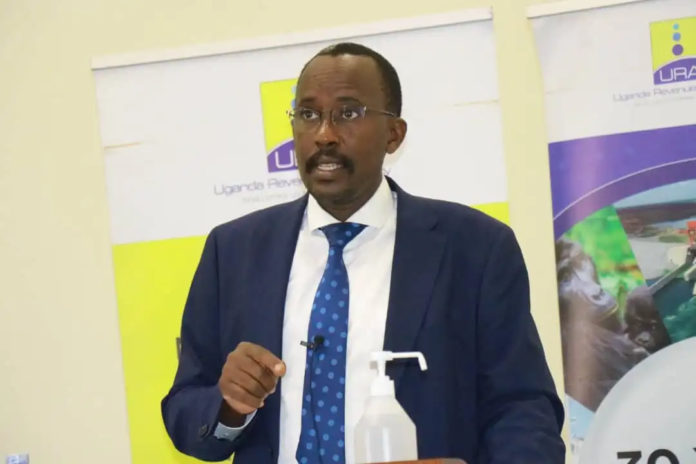
John Musinguzi Rujoki, the URA Commissioner General.

NAKAWA-The Uganda Revenue Authority (URA) has implemented a lifestyle audit policy in an effort to fight corruption within the tax body.

The revelation was made by Ibrahim Bbossa, the Assistant Commissioner, Public and Corporate at URA during a media engagement held at URA headquarters in Kampala saying that 63 URA staff members have been terminated on aspects of integrity in the last three years. URA employs over 3,000 people.

“Lifestyle audit policy is new in the institution. If somebody points a finger at you, whether it’s a taxpayer or you’re being investigated, we’ll look at what you earn, what your family earns, and what you own; we really need to check up because sometimes the devil is in the details. This is something unprecedented and it has been put in place to change people’s behaviour in the institution, especially on issues of corruption,” Bbossa said.

He added: “The fight against corruption is a big agenda. We are fighting to see that there are no [tax revenue] leakages within just like we are fighting leakages out there.”

Bbossa also blamed the politicization of revenue collection in the Ugandan public as one of the reasons affecting compliance with tax obligations, hence low revenue collections in the country.

“Tax collection is hinged on trust, and it has been evident on our part, every time the public doesn’t trust us, the numbers are just deep, just like the stock exchange. Some people will conveniently not pay their taxes, because of some political statement about URA or its personalities,” he said.

Moses Owino, the Manager for Enforcement in Kampala Metropolitan Area at the URA, said while outright smuggling has significantly reduced to about 7%, miss-classification, under-declaration, and under-valuation have gone up in recent years.

URA’s latest data shows that under declaration of goods by importers stands at 43% while miss-classification is at 15%.

Owino said engagement, education, and enforcement approaches are some of the measures out in place to reduce revenue leakages.

In the current Financial Year, URA has so far had 9,200 seizures and recovered Shs88.2 billion as of March 2023.

For strict enforcement, the authority indicated that it installed a vehicle tracking system, which is used to monitor both dry and wet cargo coming into Uganda, passing through as well as being exported.

URA recently revealed that it had so far collected Shs21.4 trillion taxes for FY 2022/2023 and was targeting to collect the Shs2.4 trillion within the two weeks before the end of this financial year on June 30.

URA is expected to collect over Shs29.3 trillion in FY2023/24, an increment of over 3.7 trillion from the current year’s target.

Stories Continues after ad

Enhancing customer experience- Uganda Baati launches showroom in Masaka

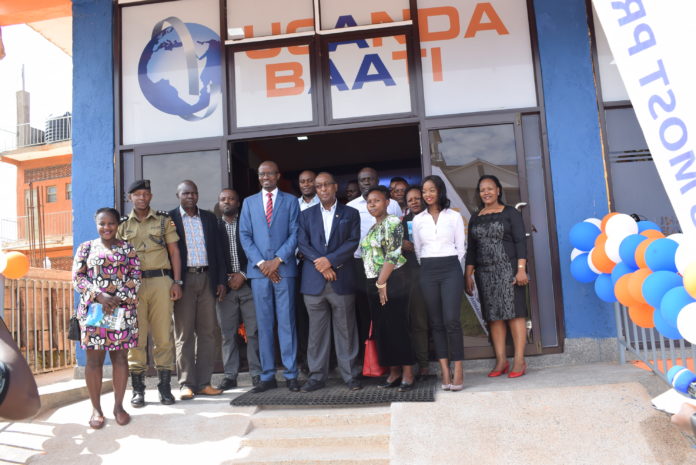
Uganda Baati staff pose for a group photo

Masaka- Uganda Baati Limited, a leading provider of top roofing products and services and a member of the Safal group, has officially launched its 13th showroom in Masaka town. This is a strategic move by the company, aiming to bring its products and services closer to customers while catering to the growing demand for long-lasting and quality building and roofing needs.

The chief guest, Huddu Hussein, the Resident City Commissioner of Masaka, thanked and congratulated Uganda Baati upon launching a showroom in Masaka town. He extended his gratitude to the company for providing reliable building solutions since 1964. He further noted that the government has provided a good business environment for business entities like Uganda Baati to thrive, which in turn creates more job opportunities for the young people in Masaka.

Speaking at the opening event, George Arodi, the Uganda Baati CEO, emphasized the efforts the company puts into promoting new, unique products as a result of innovation. “Over the years, we have been known for innovation. Later on, we brought in the colored sheets, then Cover Max, and after careful market research, we introduced Versatile, and then Lifestile in recent years. We became the first group in Africa to move customers from galvanized zinc-coated products that easily rusted to aluminum zinc products that last 4 to 5 times faster than galvanized ones.”

Arodi noted that the showrooms have proven to provide a market channel for the company’s brands and are also centers where people can seek trusted technical advice from trained staff. “Our 15 countrywide showrooms are not meant to replace hardware dealers; however, their main purpose is to help us demonstrate to our customers the uniqueness of our products and their qualities so they can know, identify, and distinguish them anywhere. We seek to improve the state of the infrastructure of our homes and businesses by bringing services and products closer to the people,” he noted.

“Recently, we launched a new premium roofing product called Lifestile in addition to the Orientile, Romantile, Covermax, and Versatile, superior-quality steel roof tiles, which is a testament to our commitment towards meeting the customers’ needs. The showroom will serve as a hub for customers, contractors, architects, and developers, offering them a comprehensive understanding of the diverse range of roofing solutions available,” Arodi remarked.

“We hope to continue working with trade partners and installers in Masaka to ensure that they deliver support in advancing the state of development in Masaka town and its neighboring towns. We have stocked our showrooms with an extensive range of high-quality roofing products to offer our customers an opportunity to explore and choose from a wide range of options,” he concluded.

Stories Continues after ad