In his first speech upon his arrival to the Democratic Republic of Congo, on Tuesday, Pope Francis decried the conflicts that continue to ravage the country, and the reckless exploitation of its immense natural resources by foreign forces.
Meeting with government authorities, civil society, and the diplomatic corps in the garden of the “Palais de la Nation” in Kinshasa, after his courtesy visit to Congolese President Felix Tshisekedi, the Pope urged the Congolese people to take their destiny into their own hands by rejecting violence and hatred.
He explained that his visit is born from his desire to bring them “the closeness, the affection and the consolation of the entire Catholic Church”, and that he is coming “as a pilgrim of reconciliation and peace”.
Likening the DRC to a diamond, one of the many riches of the country, the Pope noted that the Congolese people are “infinitely more precious than any treasure found in their fruitful soil.”
He remarked that beyond the abundance of natural resources, they also have a “spiritual wealth” to be found in their hearts from where “peace and development are born”, for which, he said, every Congolese should “feel called to do his or her part.”
Pope Francis went on to lament the exploitation that DRC and the whole African continent continue to endure today in the form of “economic colonialism” which, he said, is “equally enslaving”, making the Congolese people “foreign” to their own land.
“The poison of greed has smeared its diamonds with blood,” the Pope denounced, calling on the world acknowledge the “catastrophic” injustices committed in the past, and for an end to the ongoing plundering of its natural resources.
Pope Francis then turned to the international community which, he said, “has practically resigned itself to the violence devouring” DRC, calling for a renewed effort to support development and peace in the African nation.
“The current peace processes, which I greatly encourage, need to be sustained by concrete deeds, and commitments should be maintained,” said the Pope.
He expressed immense gratitude to the countries and the organizations that are providing substantial aid in this regard, helping to combat poverty and disease, supporting the rule of law and promoting respect for human rights.
Going back to the image of the diamond, Pope Francis noted that the richness of the Congolese society stems from its “polyhedral” character, which must be therefore preserved “avoiding any form of regression to tribalism and hostility.”
“The problem,” he remarked, recalling a Congolese proverb, “is not the nature of ethnic and social groups, but the way in which they choose to live together: their willingness or not to encounter one another, to be reconciled and to start anew makes the difference between the grimness of conflict and a radiant future of peace and prosperity.”
In this regard, Pope Francis emphasized the crucial role that religions and civil society are called to play in contributing to this richness by committing to building peace and of fraternity in DRC.
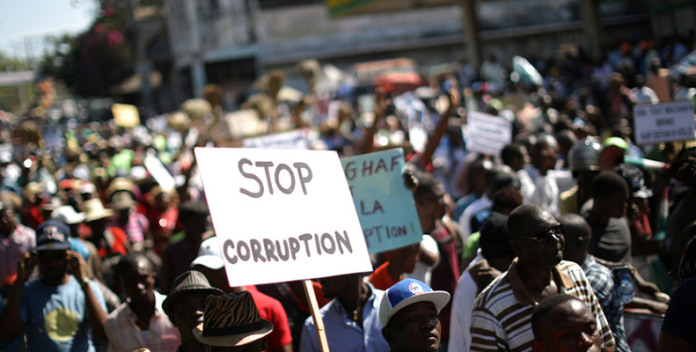
Continuing with the metaphor of the diamond, Pope Francis focused on transparency in civic and political life, noting that what “dims the light of goodness in a society is often the darkness of injustice and corruption.”
In this regard, he underscored the crucial importance of promoting transparent and credible elections and greater participation in the peace processes and of pursuing the common good and people’s security, rather than personal or group interests.
Also, he said, the presence of the State in every part of the territory should be strengthened and the many refugees and displaced persons should be cared for.
Pope Francis went on to stress the urgent need to invest in education in order to make the “its most precious diamonds shine”. He lamented in this regard that all too many Congolese children still do not attend school, and are instead exploited and subjected to servile labour in the mines.
Bringing his long address to a close, Pope Francis recalled the shared responsibility to be “good stewards of creation”, to protect the natural environment, and highlighted the need for long-term international support to improve the life of Africans, going beyond emergency interventions.
Pope Francis concluded by urging the Congolese people not to give in to “discouragement” and “resignation”, but to engage in “courageous and inclusive social renewal” of their country.
The current conflicts and challenges in DRC were also the focus of President Felix Tshisekedi’s address to the Holy Father, in which he thanked the Pope, on behalf of all the Congolese people, for the interest he has always shown for the situation in the country, and for “fervently praying for peace in its eastern provinces”. He also expressed gratitude for his willingness to meet a delegation of internally displaced persons from these provinces.