Stanbic Bank
Stanbic Bank
26.7 C
Kampala
Stanbic Bank
Stanbic Bank
Home Blog Page 492

Ugandans to own property through home and Personal Secured Loans

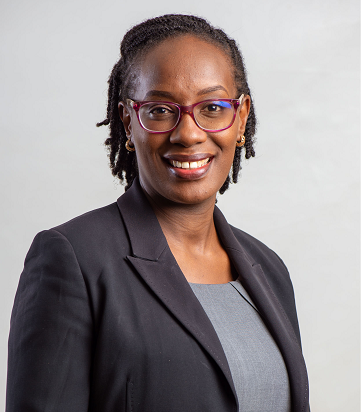
Miranda Bageine Musoke

Ugandans are set to own property through home and Personal Secured Loans. Uganda has the third-highest population growth rate in Africa and a significantly high rural to urban migration rate.

These trends underline the need for more housing units. dfcu Bank recently launched a campaign to encourage Home Ownership. 

Miranda Bageine Musoke, dfcu Bank’s Head of Personal Banking explains more about the campaign.

Please tell us about this new campaign making Home Ownership possible.

dfcu Bank launched a Home Loans campaign- aimed at driving up Home Ownership among its customer base in Uganda and the Diaspora, through provision of affordable financing solutions. Through this campaign, we are giving existing and potential customers the option to purchase Homes at an interest rate of 16% per annum for Uganda shilling denominated loans and eight percent per annum for US Dollar loans.

Customers can also access 60% of the eligible loan amount when purchasing Homes from dfcu’s known real estate development partners. 

This campaign also makes the purchase of land possible. Is this still at the same interest rate? Please share more information.

Yes. In addition to home loans, this campaign also makes it possible to purchase land. For purchase of land, the Bank is offering Personal Secured Loans at a 16.5% interest rate. 

Better yet, the Bank will not charge fees for loan buy outs and will also provide customers with a 30-day grace period for a month of their choice.

So why this campaign? What does dfcu Bank aim to achieve?

First of all, I am sure you know Uganda has the third-highest population growth rate in Africa and a significantly high rural to urban migration rate. These trends underline the need for more housing units.

As dfcu Bank, we always aim to Make More Possible. This campaign seeks to empower individuals and businesses who are keen on making Home Ownership a reality. Through this campaign, we have created options for home ownership that include access to properties purchased from our Estate Developer partners, access to Home Loans funding to purchase properties of their choice or access to a Secured Personal Loan to purchase land. 

When does it end?

The campaign will run until mid-January of next year, 2023.

Briefly explain what the “…grace period…” means, for this particular campaign.

Upon getting the dfcu Home Loan, customers will be given the opportunity to pick one month (30 days) of their choice, during which they will not pay the required instalment on their Home Loan.

How much can I borrow to buy a home? 

This is determined by a number of factors that include; your current income and debt levels, your employment status, and your credit history in comparison to the collateral value. What dfcu can promise is that we will work with you to create the best package that will make you a homeowner without causing undue pressure on your finances. 

How much money do I need to put down?  

For purposes of Purchase, the Bank shall contribute up to 85% of the market Value of the house, with the balance being the customer’s contribution. 

For Construction, the Bank shall contribute up to 100% of the forced sale value of the property, the shortfall if any, will be the customer’s contribution.

What interest rates are being offered for the dfcu Home Loans?

We offer financing in both UGX and USD, at 16%  and 8% respectively.

How long does it take to get the funding for Home Purchases or Construction?

The expected time is between 10-14 working days.

What Types of Home Loans does dfcu Bank Offer?

As a holistic product, dfcu Home Loans has four sub products i.e House construction, House purchase, Refinance and Equity release. 

Does this offer extend to those Ugandans in the diaspora?

Oh yes it does. 

We have curated multi-currency offers that cater to payments made in Ugandan Shillings (UGX) and also those in United States Dollars (USD). We are cognizant of the fact that many customers who work in the diaspora are looking for suitable and affordable properties back home. With the dfcu Home Loans campaign, we are providing specific solutions, made to meet the needs of multiple customer bases.

Any final words?

Yes. I encourage Ugandans here and those in the diaspora to take advantage of these rates to purchase homes. Let me also add that customers buying homes from vendors with whom dfcu Bank has partnerships will receive 60% of the loan amount within 24 hours, provided they submit fully executed mortgage documents, an original copy of title to the bank and a bank purchase guarantee.

Stories Continues after ad

Uganda Railways Corporation demolishes structures along reserve

Uganda Railways Corporation (URC) on Monday commenced the removal of illegal structures on their land in Portbell, Luzira.

According to URC, the structures being demolished are those constructed outside the Resettlement plan that was undertaken by the Government of Uganda.

The Railways Corporation in collaboration with Police and other relevant authorities has warned repeat encroachers that they are risking arrest and that URC will not hesitate to prosecute them.

“Today, we have commenced the removal of illegal structures on URC Land in Portbell. The structures being demolished are those constructed outside the Resettlement plan undertaken by the Government of Uganda. Repeat encroachers will be arrested and prosecuted,” URC management stated.

The management urged  that the exercise is in line with the railway corporation’s values of providing efficient and affordable cargo transport services to the Business Community in Uganda.

“Railway is one way of protecting our roads from unnecessary damages and saving the resultant cost of maintenance,” URC management added.

The corporation has on several times ordered owners of illegal structures built next to the railway line to demolish them or be evicted but most of these people have been adamant to the instruction.

In the move aimed at reducing accidents along the line, the URC management wants structures within 30 metres astride the railway line demolished or shifted.

Stories Continues after ad

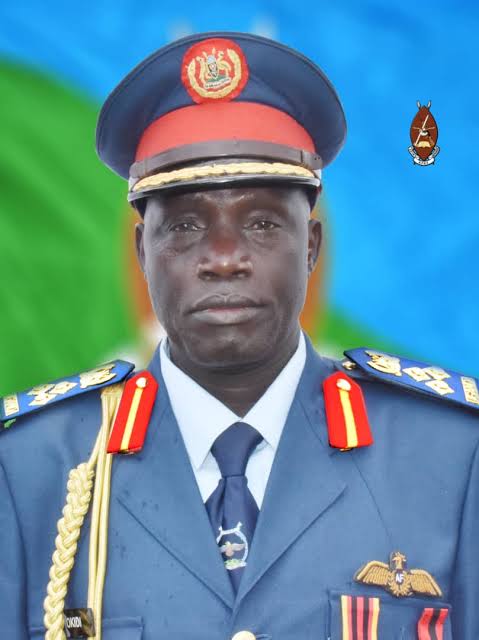
Museveni makes changes in the army, Charles Okidi promoted to Lt Gen and appointed Air force boss

Charles Okidi

President Museveni, who is the Commander-In-Chief of the armed forces has made changes in which he appointed Charles Okidi as the new Commander Air Forces.

According to the changes announced on Monday evening by army spokesperson Brig Gen Felix Kulayigye, Okidi was also promoted from the rank of Major General to the next rank of Lieutenant General.

Okidi has served as a long-term presidential pilot, concurrently with his military duties. He has previously served as the Air Force Wing Commander, Nakasongola Air Force Base.

Before that, he was the Commander of the Air Force Wing, Entebbe Air Force Base. Prior to that he was a Squadron Commander and Officer Commanding Operations at Entebbe Air Force Wing.

As Chief of Staff of the UPDF Air Force in 2019, he replaced Major General Paul Lokech, who was assigned special duties in South Sudan. On 28 March 2020, he was promoted from the rank of Brigadier to that of Major General.

In the other changes by the President, Lt Gen Charles Lutaaya has been appointed senior presidential advisor on matters of Air Forces, while Lt Col Stephen Kiggundu was promoted to Brig Gen and appointed Deputy Command Air Forces.

Stories Continues after ad

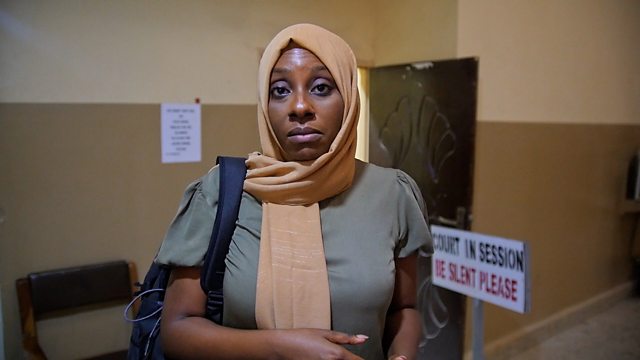
New BBC Africa documentary reveals the challenges faced by Atheists in Nigeria

Journalist Yemisi Adegoke followed the stories of those who decided to be openly atheist in Nigeria, one of the most religious countries in the world.

In April 2022, the sentencing of Mubarak Bala sent shockwaves internationally. The outspoken Nigerian atheist was sentenced to 24 years in prison after pleading guilty to charges related to blaspheming Islam. What followed is a landmark case that has placed the threats to freedom of religion and expression in Nigeria under new scrutiny.

In a new documentary from BBC Africa, ‘The Cost of Being an Atheist’, reporter,Yemisi Adegoke, explores Bala’s case, hearing first-hand from his wife, lawyer and revealing the impact his sentence has had on other atheists living in fear across Nigeria at a time when religious violence is on the rise. She also speaks to those who are offended by those who speak out against religion.

The Cost of Being An Atheist explores the legal issues surrounding blasphemy laws in Nigeria. Northern Nigeria has a dual legal system where the Penal code is implemented alongside Islamic law. 

The film features human rights lawyer, Adeola Oyinlade, who explains the uniqueness of Bala’s case. He told the BBC: “We’ve not really had cases of blasphemy going to the highest court of the land.” Mr. Oyinlade further explains the challenges around blasphemy laws. He said: “In our laws we have a Penal code that applies in the North and a Criminal code that applies in the South, that does not expressly mention blasphemy, but that looks at the ingredient of blasphemy…We don’t have a unified definition of what constitutes as blasphemy in Nigeria.”

The documentaryalso captures the shocking moment in court when Bala pleaded guilty to the charges related toblasphemy, a decision which took those in the courtroom by surprise, including his lawyer James Ibor.

Bala’s case began when he started receiving death threats for posting criticism of Islam on Facebook in April 2020. He was then arrested at his home in Kaduna State just a few days later and taken to Kano following a petition written by SS Umar, a Muslim lawyer based in the northern state. Speaking to BBC Africa, SS Umar said: “Fair comments is within the law, insult is extending boundaries…Reading all these posts make me unhappy. He (Bala) crosses the line touching someone (Prophet Muhammad) that they hold dear, more than their mothers and fathers, more than anything in the world.”

BBC Africa also spoke to a contributor who wished to remain anonymous. He said Bala’s arrest had a huge impact on other atheists in northern Nigeria and revealed his house was burnt down after he publicly defended Bala. He said “His arrest created a kind of panic amongst ex-Muslims in northern Nigeria. A lot of us decided to disengage from social media activities because the emotion and outrage was so high, that once people discovered you were not a Muslim, you are poised to be a target.”

Despite being a minority in Nigeria, many atheists face discrimination, harassment and persecution not only in the predominantly Muslim north of the country, but also in the majority Christian south.

Leo Igwe, a former Christian and founder of the Humanist Association spoke to BBC Africa about his experience of being an atheist in southern Nigeria. He said: “Religion plays a role in the everyday life of Nigerians. If you are the free thinking type, life becomes a struggle.” On his relationship with Bala he added: “Listening to him gave me hope, it let me have this sense of fulfilment… then we started working together until he was arrested in 2020.”

Another atheist and former Christian also shared her views on being vocal about atheism. She said: “You don’t have to come out, I am an advocate of that. If you’re still dependent on your boss to pay your salary why do you have to tell your boss ‘No, I won’t pray’. But for how long, and to what extent?”

Stories Continues after ad

Champions League round of 16: Liverpool face Real Madrid, PSG get Bayern

UCL-trophy

Liverpool will face Real Madrid in perhaps the pick of the 2022/23 UEFA Champions League round of 16 ties following the draw made at UEFA’s headquarters in Nyon, Switzerland, on Monday.

Fourteen-time record winners Real Madrid beat Liverpool 1-0 in last year’s final in Paris thanks to a goal from Vinicius Junior.

Manchester City face German side RB Leipzig, while Tottenham play Italian giants AC Milan.

Chelsea were drawn against Borussia Dortmund while French champions Paris St-Germain (PSG) have drawn Germany champions Bayern Munich.

The first legs are scheduled for next year on 14/15/21/22 February, with the second legs on 7/8/14/15 March.

The draw for the quarter-finals, semi-finals and final is on Friday 17 March.

A reminder that the away goals rule was removed, so ties level after 180 minutes will go to extra time irrespective of the number of goals each team has scored at home and away. If the teams still cannot be separated after the additional 30 minutes, the tie goes to a penalty shoot-out.

The 2022/23 Champions League final will take place on June 10, 2023 at Istanbul’s Atatürk Olympic Stadium, venue for Liverpool’s famous comeback victory over AC Milan in the 2005 showpiece.

Full draw

RB Leipzig vs Man City
Club Brugge vs Benfica
Liverpool vs Real Madrid
AC Milan vs Tottenham
Frankfurt vs Napoli
Dortmund vs Chelsea
Inter Milan vs FC Porto
Paris Saint-Germain vs Bayern

Stories Continues after ad

Facts about MTN Kampala Marathon

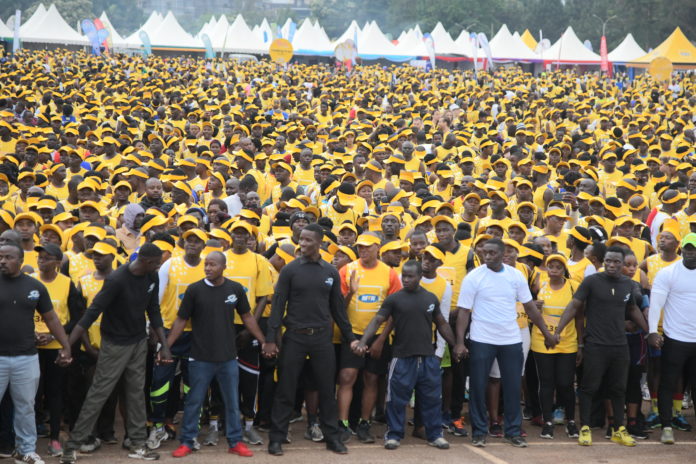
Participants at the MTN Kampala marathon

After a two-year break following the Covid-19 pandemic, the MTN Kampala Marathon is back, with 25,000 people expected to grace the 2022 edition of the biggest sports and social event in Uganda. We have compiled a list of 10 key facts you should know as you prepare to participate in the MTN Kampala Marathon wheelchair race this Sunday, 13th November, or run in this legendary marathon come 20th November.

Oldest: Now in its 19th year of existence, the MTN Kampala Marathon is the oldest and most consistent marathon in Uganda. It has stood the test of time, growing steadily over a 19-year period. Due to the two-year break following the Covid-19 outbreak, this will be the 17th edition of the public running in the MTN Kampala Marathon.

Biggest: From a humble beginning of 1500 participants in its inaugural run, the MTN Kampala Marathon has grown to become the biggest marathon in Uganda, attracting tens of thousands of runners year after year. So far, almost a quarter of a million people, 245,000 people to be exact, have participated in the MTN Kampala Marathon over the years. This year’s Marathon shall be graced by 25,000 participants.

Most Professional: Organized by MTN Uganda with technical support from the Uganda Athletics Federation, the MTN Kampala Marathon ranks as the most professional marathon in the EastAfrican region. The marathon attracts both professional and budding athletes who use the event as a launch pad for both their careers and upcoming competitions.

Nurturing Athletic Talent: It is the most professional Marathon in East Africa and it attracts international athletes from the region. It has also provided a launch pad for many elite athletes such as Stephen Kiprotich, Victor Kiplangat, and Dorcas Inzikuru, among others from outside Uganda, whose talent was identified and confidence boosted by the Kampala Marathon before they went ahead to shine internationally.

Cash Prizes: Although the MTN Kampala Marathon is a charity-driven marathon, the winners across the 42Km, 21Km, 10Km, and the wheelchair race get to walk away with cash prizes. This is in a bid to motivate the runners and to also attract professional athletes. This year, 46 individuals shall win a combined total of cash prizes worth Shs290,000,000. An additional Shs5,000,000 shall be won by a corporate team, to be donated to a charity of their choice.

Inclusive: Like many international Marathons that the MTN Kampala Marathon emulates and aspires to mirror, it is inclusive, with a wheelchair race that attracts a number of wheelchair users to be part of the Marathon. The wheelchair race kit is sold at a discount to encourage more participants. This year’s 10Km wheelchair race is happening this Sunday the 13th of November, ahead of the other races, to give it more prominence.

Charity-driven: All the proceeds from the MTN Kampala Marathon, since its inception have been used for charity activities aimed to improve the lives of thousands, if not millions of people in Uganda. The MTN Kampala Marathon has benefitted several causes such as helping expectant mothers with maternity kits, resettling people displaced by war in northern Uganda, delivering clean water and improving sanitation in communities/schools, and most recently, improving maternal health facilities.

Billions collected for charity: 4,480,000,000 (Four Billion Four Hundred and Eighty Million) shillings have so far been raised from the MTN Kampala Marathon. Worth noting is that in its initial year, the Marathon collected a total of Shs20 million but over the years, the figure has grown to hundreds of millions thanks to more individuals appreciating the good cause of the Marathon as well as partner sponsors such as Huawei, Stanbic Bank, Rwenzori, Vision Group and most recently, NBS Sport.

It happens every 3rd Sunday of November: The MTN Kampala Marathon is held every third Sunday of November since its inception. The only exception is only in 2007 when the date had to be adjusted due to the Commonwealth Heads of Government Meeting (CHOGM) held in Uganda that year. And yes, you guessed right. It will be happening on the third Sunday of this month which happens to be the 20th. Please save the date.

Maternal Health Impact: As far as Maternal health is concerned, the child and maternity wards at Kawempe Referral Hospital in Kampala, Muyembe HC IV in Bulambuli district, Pakwach HC IV in Pakwach, Kalangala HC IV in Kalangala and Karugutu HC IV in Ntoroko district have all been refurbished with the proceeds from the 2018 and 2019 MTN Kampala Marathons with a top up from MTN Uganda. This year’s Marathon will be a building block to this impact as suggested by its theme; “Run for babies” in a bid to curb neonatal mortality in the country by supporting four selected health facilities namely, Kisenyi and Kawaala Health centers in Kampala, Kaabong health center in Karamoja and Kachumbala health center in Teso region.

Stories Continues after ad

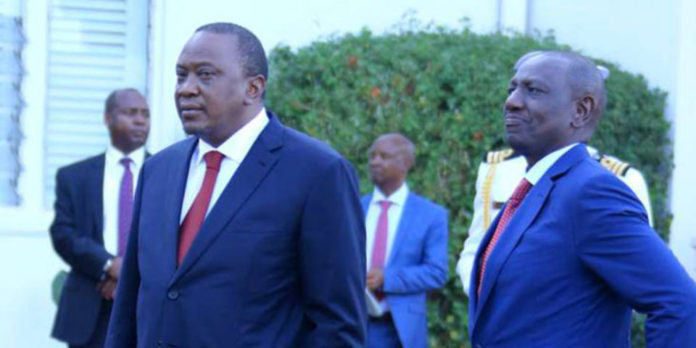
President Uhuru’s Technocratic Vs. President Ruto’s Political Cabinet

Uhuru Kenyatta with William Ruto at State House in Nairobi

The conception and design of the 2010 constitution was anchored on the historical failures, traditional and modern socio-economic, cultural, and political bottlenecks, and the prospects of a better and prosperous Kenya.

Proponents of the constitution expressed their desire for a Kenya characterized by efficient institutions that protect the inherent interests of all Kenyans. A Kenya that guarantees the separation between the three organs of the state: the Executive, Legislature, and Judiciary.

The formation of the Cabinet by Kenya’s fourth President in the first and second terms relied on the intentions, paradigms, and philosophies that guided the promulgation of the 2010 Constitution. President Uhuru Kenyatta – having worked in the private and public sectors – was very aware of the threat of politically exposed persons in the executive.

In fact, part of President Uhuru’s leadership philosophies were borrowed from the late President Mwai Kibaki, who will is remembered as one of the best leaders and heroes to lead the nation. Kenya’s third president leveraged the technical knowledge and expertise of successful leaders in the private sector to run key government ministries, state agencies, governmental departments, and policy-driven committees.

The approach borrowed by Retired President Uhuru Kenyatta was very successful in the development of important projects and programs, including the Big Four Agenda, infrastructure development programs, and education programs such as TVET, among other changes in Kenya’s social, economic, and political environment.

The ‘Technocratic Cabinet’ by President Uhuru Kenyatta enjoyed greater independence due to limited distractions from the happenings in the political underworld. The design, development, and implementation of key government policies was devoid of any future political ambitions and ensured service delivery to every Kenyan, irrespective of geographical, cultural, or ethnic differences.

Regional representation was felt across the country, and no region felt ‘outside government’ irrespective of the voting patterns witnessed in the 2012 and 2017 Presidential elections. However, this is likely to change as politicians in the cabinet are likely to change as politicians in the cabinet battle to balance national interest with their own regional political ambitions.

The appointment of politicians and politically exposed persons (PEP) into the cabinet erodes the strides and milestones achievements achieved since the promulgation and implementation of the progressive 2010 Constitution.

Proponents and champions of the 2010 constitution were well aware of the social, political, and economic impact of a politically dominated cabinet.

Policy shapers opine that the fourth administration may be shielded from some blame, considering they kicked off the first term while the new constitution was in its infancy. The first administration under the 2010 Constitution was confronted with an expanded executive, legislature, and a new wing of government: the County Government.

Despite the mishaps and the trial-and-error systems that pushed the country into debt, Retired President Uhuru Kenyatta was able to settle the ship and implement stringent public oversight policies. Among the strategies adopted was shielding the executive wing from the grip of politically exposed persons. In fact, Cabinet members that did not keep their distance from their political brothers and cousins went out of office with a bang.  

Deputy President Rigathi claimed that the previous technocratic cabinet was disconnected from the people’s interest and that most policies were implemented blindly without the “people’s touch.” Funny enough, I somehow agree with our Deputy President, Rigathi Riggz Gachagua.

While this is true, the implementation of policies must be based on rationality, realism, and sustainability rather than idealism and populism. For instance, we may decide to negate the taxation of sugar due to the current prices. Of course, all Kenyans will celebrate, but this will come back to bite KRA’s and the national government’s behind.  

Technocrats, especially those that have thrown the towel in elective politics, are the ideal batch for Cabinet Secretary and Principal Secretary positions (and if the current administration decides that the wage bill is not already overstretched and appoints Chief Administrative Secretaries).

Technocrats are more concerned with the implementation of the best policies based on the current socio-economic and political situation and in line with future goals such as Millenial Development Goals and Vision 2030. For instance, the integration of the Competency-based Curriculum (CBC) is progressive and a conduit that can help bridge the skill gap widened by the previous education system. However, populist leaders have shunned the program, leveraging misinformation and lack of public knowledge to gain political mileage at the expense of Kenya’s future.

President Ruto’s Cabinet puts Kenya’s forward thinkers in reverse gear. The governance model will erode some of the tremendous achievements achieved in promoting the independence of the government’s independent organs, enhancing accountability and transparency in governance, and tackling Kenya’s second biggest challenge (after poverty): CORRUPTION!

In fact, there is little to no distinction between the Kenyan Bicameral Legislature and the Executives. The interests of those in parliament and those in the executive are aligned, with time being the only variable. Indeed the oversight role of the 13th Parliament of Kenya will be non-existent and significantly compromised.

President Ruto’s Cabinet is merely a self-serving political move that will guarantee a win in the 2027 elections, notwithstanding that the new government is yet to settle down!

The appointment of persons with integrity issues, questionable character, and shaky intellectual and academic backgrounds sums up Kenya’s next five years of disappointment in governance and leadership.

Leadership is about placing the interests of the electorate rather than rewarding political allies and loyalists without regard for the GREATER GOOD OF THE COUNTRY.

Eng. Bernard N. Kariuki

Director, BEWA Research

Founder: Voice ya Vijanaa 

Mobile: 0728620677/ 0740835602

Email: bernardnjoroge17@gmail.com

Stories Continues after ad

Ebola: IRC calls for more funding as death toll crosses 50

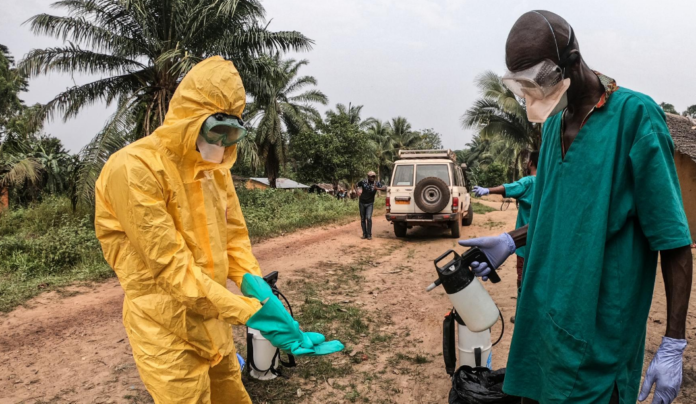
Health partners visiting Ebola-affected areas

International Rescue Committee (IRC) has called for more funding to curb the spread of Ebola. Their call came nearly 50 days after the outbreak of the Ebola Virus Disease in Uganda.

The IRC expressed its concern over the Ebola situation in the country and calls for more funding to support response efforts particularly in health systems strengthening, improving contact tracing, activating community health structures for this specific response, social mobilization and intensifying sensitization through mass media.

Recent reports from the Ministry of Health (MoH) indicate 132 cases and a death toll of 51 people including at least six health workers.

Elijah Okeyo, IRC Uganda Country Director said, “The IRC stands with the families that have lost their loved ones and pledges to continue supporting efforts to contain the outbreak. As the MoH explores treatment options and vaccines for this specific strain of Ebola, we must be cognizant of the fact that these trials take time and early detection is paramount for most of these treatments to work. To reduce the rate of infection and further loss of life, mitigation efforts including contact tracing, risk communication, intense public sensitization and engaging community health structures are vital in the interim. All these interventions require immense financial resources and expertise to effectively execute. The IRC, therefore, calls for increased funding for aid agencies to support ongoing efforts to sever the current rapid spread of this deadly disease.”

The IRC has extensive experience in Ebola virus infection prevention and control activities. IRC responded to the 2019 outbreak in Uganda as well as several outbreaks since 2018 in the Democratic Republic of Congo. The IRC works on women’s and girls’ protection and integrates Ebola-related protection concerns in areas where the IRC supports primary health care services. The IRC also worked to contain the 2014-2016 West Africa outbreaks in Liberia and Sierra Leone.

The IRC began programming in 1998 in northern Uganda in response to mass displacement wrought by the Lord’s Resistance Army. Since then, the IRC has expanded to provide critical services for refugees and vulnerable Ugandans throughout the country. The IRC started supporting refugees and vulnerable individuals in Kampala in 2012.

 As of 2019, the IRC entered the Tooro region to support refugees while also providing epidemic preparedness and response services throughout the region. In addition to emergency support, the IRC also invests in long-term stability for refugees and Ugandans through programs like immunization, family planning, legal services, women’s empowerment, education, and livelihoods. More recently, the IRC was involved in supporting Afghan evacuees in Uganda.

Stories Continues after ad

Police merge 129 police posts in the country

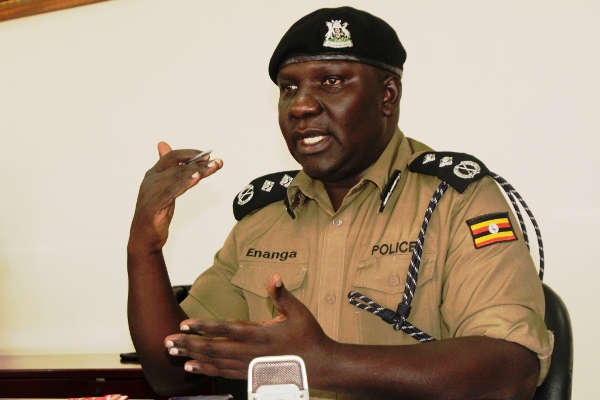
Fred Enanga, police Spokesperson.

Police are piloting 129 police posts to see the practicability of the Sub-county Policing Model. The revelation was made by Police spokesperson Fred Enanga.

The police posts include; 10 in the Sezibwa region, Seven in the Katonga region, 15 in the Savana region, 27 in Katwe,  28 in Kampala metropolitan East and another area.

The decision followed the October 31, 2022, violent attack on Busiika Police Station where armed assailants shot at and killed two police officers on duty, injured two others, one critically, and thereafter, robbed two police guns from them.

They shot and killed two officers; Alex Wagaluka, and Police Constable Ongol Moses, both attached to Busiika Police station. During the attack, the assailants also injured two other police officers, who included; PC Ochom Adrian and PC Odama Stephen, who remains in critical condition.

They also burnt several case files and attempted to burn the station. The fire was, however, successfully put off by the community at Busiika Town Council.

Enanga said the sub-county Policing Model will have units where you have traffic personnel, the so-called under forensics, crime intelligence, and other specialized units and this is going to enable the sub-county policing

“The units will have a more strengthened and unified base at that level, so this is not a new development because we’ve never tried it before. It is economical. It is also a good model because it helps also in reducing costs out of a multiplicity of police posts. So they’re still at 129,” he said.

He said the success of the pilot study will also enable police to roll out effectively to all the other regions.

Stories Continues after ad

Uganda Air Force destroys three ADF camps in DRC

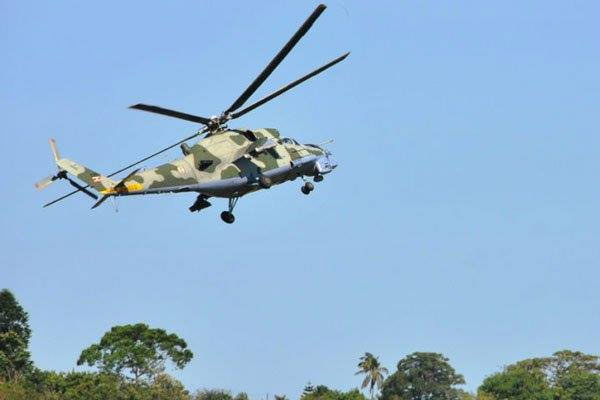
UPDF chopper

Over the weekend, the Uganda Air Force attacked and destroyed three Allied Democratic Forces (ADF) camps in the Democratic Republic of Congo (DRC). The attack on the ADF camps was confirmed by President Yoweri Museveni.

The attacks come at a time when the East African Members states gave the green light for the Joint deployment of Regional Forces in Eastern DRC, to fight the negative forces of the M23 and ADF rebel groups.

“This is  to  inform  you  that  on  Friday the  4th of  November 2022,  with  the  permission  of  the  DRC  Government,  the Uganda Air force, attacked and destroyed a big terrorist camp of ADF,” Museveni  said.

He said it is important for the  Africans and East Africans to know the capacity Africa possesses that can help it to solve these chronic security problems. This location is beyond the limit of exploitation that we had agreed with the Congo Government that runs the Beni−Mbau junction−Eoingeti−Komanda −Kasindi−Beni.

He said within the area  Ugandan forces were allowed to operate, they  destroyed all the camps the reconnaissance has identified,  killed a  lot of terrorists,  captured others, and emancipated the much-terrorized people of the area.

“In all this, we have worked with the brother Congolese Army, the FARDC. That is why the enemy, in desperation, has now fled beyond the limit of exploitation (the boundary of our operations). The ignorant terrorists do not know that within just minutes-not hours-we can reach with deadly fire, many areas, far beyond the line of the limit of exploitation. Hence, on Friday, they got their deserved reward. Wherever they go, we shall reach them as long as the Congo Government allows us to operate with them,” he said.

Since January 2022, North Kivu and Ituri provinces in the DRC have been engulfed by insecurity and unrest. The situation remains unpredictable and complex. Thousands of Congolese have since sought refuge in Uganda. 

The insecurity is being fueled by the M23 rebels and the Allied Democratic Forces (ADF). In 2021, Uganda Peoples Defence Forces (UPDF) and Armed Forces of the Democratic Republic of the Congo (FARDC) have been carrying out operations to weed out ADF terrorists in the Eastern part of the county.

Since the launch of operations in November 2021, the joint forces captured over 34 ADF terrorists and killed and injured scores of them. Last month, the DRC renewed UPDF’S contract maintaining its presence in Felix Tshekedi’s country.

The two Forces are currently engaged in road construction and rehabilitation works to facilitate and further secure the movement of soldiers and the displaced civilian population, particularly on Mbau- Kamango and Mobili axes, Kamango-Semuliki- Beni.

Since September, authorities in DRC accused Rwanda of being behind M23 operations terrorizing Congolese.

Stories Continues after ad