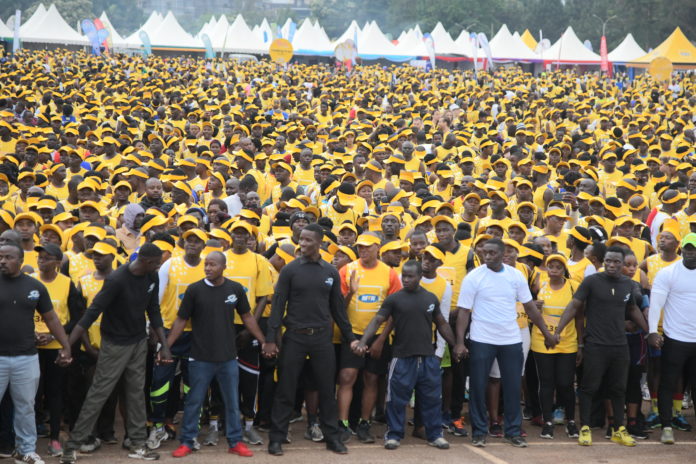
Huawei has contributed Shs 280million towards child and maternal health care in Uganda. Huawei has been a sponsoring partner of the MTN Kampala Marathon for the last eight years.
“Huawei Uganda has sponsored and participated in the MTN Marathon since 2012 under various themes from Run for Life, Run for water, Run for maternal care and this year’s run for babies where the proceeds from this year’s Marathon shall be used again to upgrade maternal and newborn facilities in health centers across Uganda,” says Mr. Gao Fei, The Managing Director of Huawei Uganda.
“We have a slogan “A BETTER U FOR A BETTER UGANDA”, this contribution aligns with our Huawei Uganda slogan because when we have a better U which includes our mothers and little infants/babies, we will all have a better Uganda. This then explains why we have come out to continue to sponsor this marathon with 280 million Uganda shillings. We are sure that with this contribution, Uganda can only be a better place for the mothers and the babies we are running for this year,” He added.
Somdev Sen, the MTN Uganda Chief Marketing Officer, hailed Huawei for its partnership and continued support for the MTN Kampala Marathon over the years, which has greatly impacted communities across the country.
“I applaud Huawei for being a true partner who works with us across all our objectives and ambitions. Not only is Huawei working with us to create amazing technology and service platforms in terms of building the best-in-class connectivity, they have also stood by us firmly in our journey to create shared value by supporting the MTN Kampala Marathon for over 8 years,” said Somdev, “I am happy to note that even this year as we run for babies, Huawei runs with us to create that shared value which we have always kept at the core of our purpose as MTN.”
The 2022 edition of the MTN Kampala Marathon will be held on Sunday 20th November at the Kololo independence grounds under the theme “Run for babies”. Runners will participate in the full marathon (42Km), half marathon (21Km), the 10Km race and 5Km races. All the proceeds from this year’s Marathon shall go towards improving child and maternal health in four selected health centers across the country. The beneficiary health facilities include Kisenyi and Kawaala health facilities in the suburbs of Kampala plus those in Kachumbala (Teso sub-region) and Kabong (Karamoja sub-region)
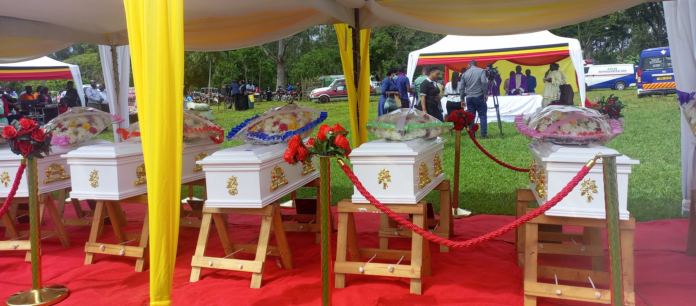
Bodies of the students who perished in Salama School of the Blind fire
The remains of the eleven students who perished in the fire which gutted a girls’ dormitory at Salama School for the Blind in Mukono have been handed over to their relatives for burial.
The eleven bodies were handed over by Dr. Joyce Moriku Kaducu, the State Minister for Primary education in Uganda. The bodies which were burnt beyond recognition were identified based on DNA test samples picked from both the deceased and parents.
The bodies will be laid to rest in different places in Mbale, Kibuku, Mbale Masaka and other places.
According to Kampala Metropolitan deputy Police spokesperson, Luke Owoyesigyire the fire incident happened on October 25, 2022, at around 1 am.
“The cause of the fire is currently unknown but so far 11 deaths as a result of the fire have been confirmed while six are in critical conditions and admitted at Herona Hospital in Kisoga,” he said.
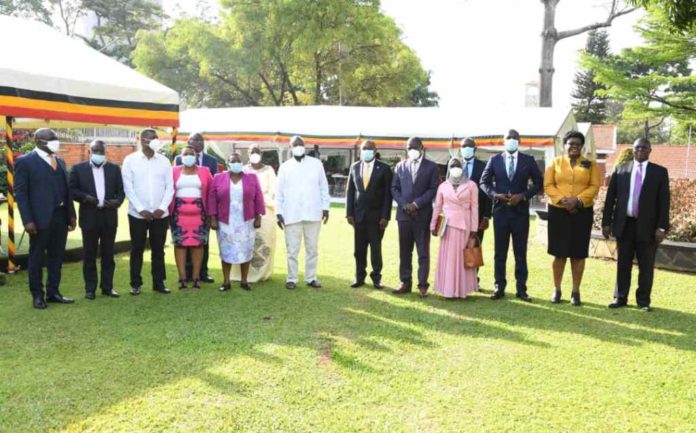
President Museveni on Tuesday met Kampala Capital City Authority (KCCA) leaders and some of the market representatives over the leadership and management of markets in Kampala and the metropolitan area.
Speaking at the meeting held at State House Nakasero, President directed that these markets should be owned and managed by the low-income earners instead of being taken by the rich who in turn charge high fees from the common people. “Let the rich go elsewhere and leave these people trying to make a living for their families to prosper peacefully,” he said.
“The common people should be the beneficiaries, let the rich not exploit our poor people in these markets by charging high/unnecessary fees. These mistakes came from past Kampala leaders, who got poor people’s markets and gave them to the rich.” the President stated.
The meeting follows Museveni’s directive on harmonisation of issues affecting the common people in the informal Sector in Kampala and surrounding areas.
Museveni also suggested to KCCA to have two government owned markets and taxi parks in each of the divisions of Kampala with an emphasis that they should be occupied and managed by the ‘wananchi’.
“The people you have been chasing off roads have been saying they have nowhere to go, so if you do not plan for them where will they go?” he wondered.
He said that both logic as well as legal standing in addressing the market challenges in the country should be applied.
In order for the government to come up with a conclusive solution to informal Sector and market challenges, the President tasked the Prime Minister to coordinate all different stakeholders and come up with a final solution in addressing the challenges.
“There have been challenges in the informal Sector stemming from mismanagement, ownership, policy and regulation among others,” he said.
Prime Minister, Robinah Nabanja thanked the President for his efforts in always fighting for the common person.
She pledged to work with all the stakeholders in finding a lasting solution to the market challenges.
The meeting was attended by the State Minister for Kampala Capital City and Metropolitan Affairs, Mr. Kabuye Kyofatogabye, the Local Government Minister Mr. Raphael Magezi, the KCCA Executive Director Dorothy Kisaka, the Kampala Resident City Commissioner Amina Lukanga and Salim Uhuru, the Kampala Central division mayor, Dr. Hillary Musoke Kisanja, Director National Youth Skilling program under the office of the President, among others.
The recent Stand-by Class 1 myth got me worried. This made me look into my small home library, and I discovered that leaders normally create myths whenever they understand that Abataka banyiivu (citizens are angry) to divert the peoples’ attention from their real problems. When power was still held by people in Northern Uganda in the 60s, 70s and early 80s, the North despised and discriminated against people from the rest of Uganda. Mr. Apollo Milton Obote more especially hated and despised his Excellency Yoweri Museveni to the marrow.
That’s why the UNLA interim leaders in Tanzania did not include a Westerner! No, not even one. The Uganda National Liberation Front (UNLF) was formed at Moshi on March 26, 1979. The front was led by a council whose members are as follows; Mr. Y.K. Lule was the Chairman, Mr. Akena p’Ojok was the Deputy Chairperson, Prof. Dani Nabudere was Secretary for Political Affairs, Mr. Semei Nyanzi was Secretary for Finance & Administration, Mr. Paul Muwanga was Chairman of the Military Committee. Other members of the council included Andrew Adimola, Mr. Martin Aliker, Mr. Mathias Ngobi, Mr. Ateker Ejalu and Mr. Sam Ssebagereka. The North was still calling the tune especially because of Obote’s relationship with Mwalimu Julius Nyerere.
Earlier in 1971, the Uganda government of President Apollo Milton Obote had been overthrown by the country’s only army on the morning of January 25, 1971 in a well-framed “bloodless coup” led by Maj. Gen. Idi Amin Dada, the Commander of the then Uganda Army (UA). There were numerous reasons that led to the overthrow of Dr. Obote’s government by Gen. Amin, although the army chose to give only 18 points.
Capt. Sam Aswa (later murdered by Idi Amin) was selected to read these 18 points to the public and the press on behalf of Gen. Amin Dada. He (Aswa) said Obote’s government was unwanted and unpopular and that the army had replaced it with what the people and the army of Uganda needed. Sam Aswa’s list went as follows;
1. The unwarranted detentions without trial and for long periods of a large number of people, many of whom are totally innocent of any charges.
2. The continuation of the State of Emergency over the whole country for an indefinite period which is unwanted by everybody.
3. The lack of freedom in the airing of different views on political and social matters.
4. The frequent loss of life and property arising from almost daily cases of robbery with violence and Kondoism without strong measures being taken to stop them. The people feel totally insecure and yet Kondoism increases every day. (Kondoism is a coinage from Luganda the local language of the majority tribe meaning theft).
5. The proposals for National Service which will take every able-bodied person from his home to work in a camp for 2 years could only lead to more robbery.
And thirteen other points which touched on the failure by the political authorities (Government and state) to organize any elections since independence. In spite of the exaggerated nature of some of the points given by the army to overthrow Obote’s civilian government, the truth of the matter was that there was indeed a general discontent among the people of Uganda especially the Baganda, towards Obote’s government. He (Obote) had frustrated and or demoralized the proud Baganda tribe by first exiling and thus speeding the death of their beloved Ssabasajja, Mpologoma,Kabaka, (King) Edward Muteesa II, abolishing their kingdom and imposing on them a perpetual state of emergency. Their jubilation in welcoming the Idi Amin takeover was thus completely understandable.
The Baganda and Ugandans discovered only late the brutal background of Idi Amin, son of a witch doctor mother, who spent a fairly eventful childhood shifting homes, selling mandazi, learning Kiswahili and Luganda by heart, forced to become a Muslim by hard circumstances later referred to as a Nubian, joined the King’s African Rifles (KAR) in 1946 first signed as a kitchen-hand because of his physique who soon joined the regular ranks as a private. He was just the type that the British liked, the type of African that they used to refer to as the “Warrior tribes” black, big, uncouth, uneducated and willing to obey orders.
The British had deployed him to bring down the Mau-Mau freedom fighters and he lynched many of them at Tuso, Kairo, Kinyona and Kangema in Muranga area.
Did the Stand-by Class 1 by any means point to an overthrow of the Uganda civilian government or was it a diversionary myth?
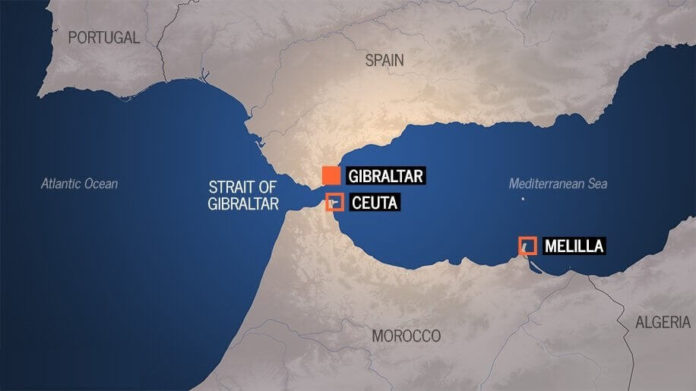
On 24 June 2022, disturbing videos started circulating online, showing violent clashes between African migrants and Moroccan border guards. The footage was filmed on a small piece of land where Morocco meets Spain – a gateway into Europe. These videos revealed shocking evidence of migrants being restrained and severely beaten. Twenty-four people died in the incident, and dozens more are still missing.
For months, BBC World Service’s award-winning investigative strand, BBC Africa Eye, has been searching for the truth. In the documentary Death on the Border, viewers are taken through the events of that deadly day in forensic detail. The BBC Africa Eye team verified and geolocated dozens of videos posted on social media and obtained from sources on the ground.
The film retraces the steps taken by migrants on the morning of 24 June 2022, when an estimated 2,000 people descended on the Moroccan border post, trying to storm the fence and cross into the enclave of Melilla, Spain.
Throughout the film, survivors share their testimonies, giving the most comprehensive account yet of what happened. They reveal how Moroccan border forces drove the group into an enclosed courtyard inside the border post, then blocked their path out. Videos show how the Moroccan border forces continued to throw teargas and smoke bombs into the enclosed space where migrants were trapped. This led to a deadly crush of people.
One anonymous survivor describes how hundreds of migrants were kept on the ground for several hours, with injured and dead people among them. He claims they received no medical care and security forces stopped medics from helping the injured.
While most migrants were detained inside the border post, hundreds did make it across into Spanish controlled territory. The investigation by BBC Africa Eye reveals new evidence of ‘pushbacks’ by Spanish security forces – a practice where migrants are taken back across the border, without being given the opportunity to claim asylum. One migrant told Africa Eye he was returned to Moroccan authorities who beat him so badly he lost consciousness for several hours.
Survivors said security forces placed them on buses and drove them to cities across Morocco, far from the border. During that journey, at least one injured migrant died. His name was Abdelnasir, and his brother reveals the impact on his family in Sudan. He said: “My mother didn’t accept the news at first when I told her. We were waiting for his body…we managed to ask the people that were with him to tell us what happened, but we couldn’t get any details.”
Several sources allege that the bodies of dozens of migrants are still being held in a morgue in Nador, the Moroccan city closest to Melilla.
Omar Naji, Vice-President of the Moroccan Association for Human Rights told BBC Africa Eye that they witnessed authorities in the cemetery of Nador digging 21 graves. He said: “The authorities wanted to bury the bodies without making the necessary investigations and without identifying them.”
The Moroccan government declined BBC Africa Eye’s request for an interview and did not respond to the allegations made in this film. The Moroccan Ministry of the Interior has publicly maintained that its security forces responded in line with legal protocols, and that all migrants received necessary medical assistance and care. They claim the huge group of migrants were armed with sticks and sharp tools and were extremely violent.
Both Morocco and Spain have since faced questions about the tragedy, and both have begun internal investigations into what happened that day. But to date, neither have released any CCTV footage or taken responsibility for the deaths.
One of the anonymous survivors in the film appeals to authorities to disclose the evidence they have. He says: “The whole border area in Melilla is covered by surveillance cameras, there are cameras along almost the entire fence and in the area where we were trapped and some of us died.”
The Spanish Ministry of Interior denied the allegations in the film, stating: “Any rejections at the border were made according to Spanish law, endorsed by the European Court of Human Rights. The claim that ‘300 migrants were forced back to Morocco from Spanish territory’ is absolutely false.” The statement added: “All CCTV recordings have been handed over to the Spanish judiciary and Ombudsman as part of their investigations.”
However, in October, the Spanish Ombudsman released the initial findings of its investigation, stating that 470 migrants were pushed back across the border, without considering the legal provisions, and that the Ministry of the Interior had not shared all available CCTV with investigators.
Death on the Border also explores the wider question of how tensions between Morocco and Spain on migration control could have contributed to the events on the 24th of June.
Uganda’s newly appointed Defence Advisors (DAs) to different missions abroad have been urged to uphold and maintain the different interests that the country has in their new areas of responsibility.
The Permanent Secretary in the Ministry of Foreign Affairs Mr. Vincent Bagire made this call while officiating at the opening of an induction workshop for DAs.
The ongoing workshop, at the Ministry of Defence and Veteran Affairs (MODVA) headquarters in Mbuya, Kampala; aims at equipping participants (DAs) with knowledge on how to conduct business as diplomats, widen their knowledge of Uganda’s foreign policy, deepen their understanding of both bilateral and multi-lateral agreements signed by Uganda, and refresh their knowledge on emerging global threats like terrorism and youth bulge, among others.
In his remarks, Mr. Vincent Bagire congratulated DAs to a new world of diplomacy and reminded them to always understand the country’s foreign policy trajectory, in terms of maintaining mechanisms that enhance peace and security for the social economic transformation of communities.
“There’s a marriage of convenience between foreign policy and the defence policy, and the reason is for the existence of sovereignty. Therefore, the Armed Forces need to secure our borders,” he observed.
He further commended UPDF for establishing and restoring peace and security in the country and beyond.
Speaking at the same induction workshop, the MoDVA Permanent Secretary Mrs. Rosette Byengoma noted that participants will have a detailed understanding of the need for diplomacy for effective service delivery at the end of the workshop.
She urged them to be sensitive to their new areas of responsibility as they fulfill the requirements of the missions.
“Timely provision of the right information to the respective authorities as you discharge your duties will make your work meaningful,” Mrs. Byengoma implored.
She further urged them to uphold the tradition of diplomacy in service delivery by remaining highly competent, disciplined and dedicated to their work.
In her concluding remarks, the Permanent Secretary called for integrity from all DAs, noting that integrity as a core value will ease their work towards fulfilling the mandate of the mission.
The ongoing workshop is being attended by the UPDF Chief of Personnel and Administration Brig Gen Eugene Ssenkumba Ssebugwawo, Assistant Director in charge of International Affairs Col Yunus Bagada, and facilitators from the Ministry of Foreign Affairs, among others.
Recently, the President and Commander-In-Chief of the UPDF H.E Gen YK Museveni appointed Brig Gen Ronald Solomon Bigirwa as a Defence Advisor to Tanzania, Brig Gen Simon Ocan as Defence Advisor to Burundi, Brig Gen Francis Chemengich Chemo as Defence Advisor to Somalia and Col Simon Peter Oyoo as Defence Advisor to India, among others.
Ambassador Henry Mayega meets Consul General of Kenya Ambassador Peter M. Mwendwa
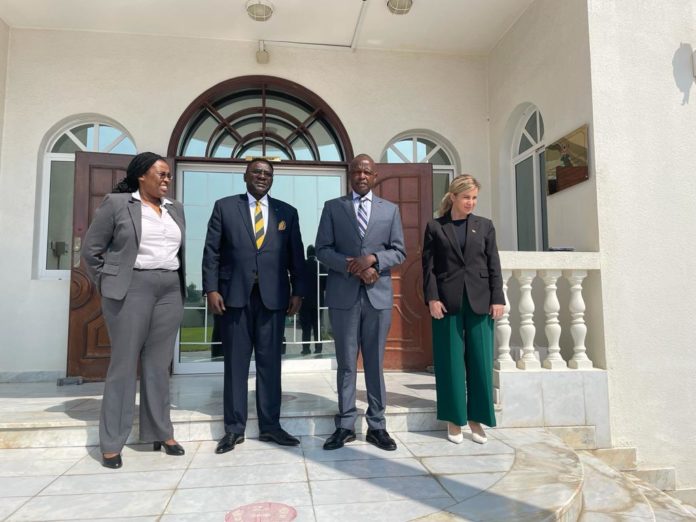
The Consul General of Uganda in Dubai Ambassador Henry Mayega and Consul General of Kenya Ambassador Peter M. Mwendwa have met and discussed how best they can upgrade the existing labor externalization Memorandum of Understandings (MoU) with the United Arab Emirates (UAE).
The two ambassadors and other East Africa Consul Generalsmet at Kenya’s consulate in Dubai where they formally introduced themselves to each other.
Speaking to Eagle Online, Ambassador Mayega said Uganda signed MoU with the brotherly UAE government to streamline labor externalization and it will soon be implemented. Under the MoU, Ugandans will be accorded more contracts for professional jobs like engineers, teachers and sundry, insurance and other benefits.
Mayega said there are 100,000 Ugandans living and working in the UAE. They remit $200 million (Shs762 billion) from UAE.
Recently, the UAE government deported over 1000 Ugandans for overstaying and accumulated fines. The group was reportedly part of the over 1000 Ugandans detained at Al Aweer immigration center and other facilities.
“We need to tighten controls on the companies that do labor externalization. The consulate is mobilizing the Diaspora to do all manner of things that contribute to the development of Uganda,” he said.
He applauded ambassador Mwendwa for supporting Uganda’s community in Dubai before the opening of Uganda’s Consulate. The consulate was opened in June this year.
“Thank you for the warm welcome and the consular support that was rendered to the Ugandan community in Dubai before the opening of Uganda’s Consulate. That was done in the spirit of humanity in particular and the East African Community in general,” Mayega said.
The two Consul Generals pledged to resuscitate the EAC Diplomatic Corps working group for better lobbying, Economic and Commercial Diplomacy.
Minister of State for Finance, Planning and Economic Development (Planning) Henry Musasizi
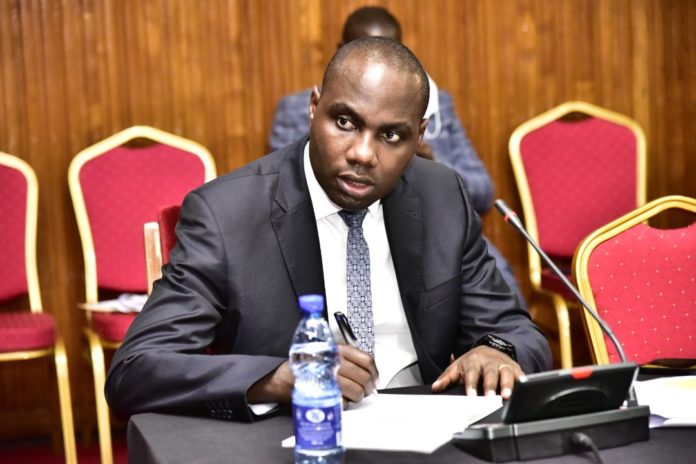
Finance State Minister, Henry Musasizi has asked Members of Parliament to approve up to Shs3.5 trillion to finance the Shs48.1 trillion budget.
The first loan request which is up to US$464 million translating to about Shs1.7 trillion, is to be sourced from the Standard Chartered Bank.
In documents which now stand referred to Parliament’s Committee on National Economy, Standard Chartered Bank will merely be an agent for two financial institutions that will actually supply the cash, should Parliament approve the loan request.
Whereas Musasizi said Standard Chartered Bank “emerged the best bidder with the lowest cost of financing provided to government,” £272 million of the loan will be sourced from Nippon Export and Investment Insurance (NEXT), a Japanese trade and investment insurance firm, while £182.7 million will be picked from the Islamic Corporation for the Insurance of Investment and Export Credits (ICIEC).
Standard Chartered Bank’s role in the borrowing will be that of “agent and mandated lead arranger for the loan.”
Musasizi defended the loan, saying it is intended to “help pay outstanding infrastructure certificates among others to avoid accumulating arrears during the financial year”.
He also said because of financial constraints, government managed to only finance seven per cent of the different votes’ development expenditure, which he said will have an effect on budget performance and economic recovery.
NEXT will charge an interest of 2.9 per cent on their facility, whereas their counterpart the ICIEC will reap 3.5 per cent from their credit. The loan’s maturity period is 10 years, with an additional grace period of four years.
Separately, Musasizi also tabled a US$140 million loan request to be picked from the International Development Association, a facility that comes with a US$60 million grant. This, he said, will finance the Uganda Digital Acceleration Project (UDAP).
Musasizi said the project is intended to “expand access to high speed internet, improve efficiency of Digital Government Services, and strengthen the digital inclusion of the host communities and refugees [where the project will be implemented]”. Another loan request to be sourced from the same agency is a US$331.5 million loan, which comes with a grant totalling to US$276.5 million.
This particular facility will be used to “finance the electricity access scale-up projects”.
Minister Musasizi said the loan is critical in electricity access expansion across the country. “[This loan facility] seeks to facilitate at least one million electricity connections covering households, commercial enterprises, industrial parks, mining centres and public institutions,” said Musasizi.
The two facilities together add up to US$471 million, which is merged with the US$464 Standard Chartered Bank arranged facility totals up to about Shs3.5 trillion.
The committee will be expeditiously processing the requests to inform Parliament’s decision to approve or reject the loan requests.
Jumia has launched one Month-Long Black Friday Shopping Promotion. The promotion will run from the 4th and 25th of November 2022 and coincides with Black Friday; a global shopping phenomenon that falls on the fourth Friday of November, except when the first Friday falls on the 1st of November.
Under the new promotion, Jumia partnered with dfcu Bank where the Bank’s Visa Debit and Credit Card holders will enjoy discounts of up to 20 percent when they use their cards to purchase items off the Jumia shopping platform.
The announcement was made at the Jumia Uganda Offices, where dfcu was also announced as the Platinum Sponsor for this year’s Jumia Uganda Black Friday 21-day promotion. For a limited time, several brands, and stores in the FMCG, automobile and technology industry will offer buyers discounts on a selection of items.
According to Jude Kansiime, dfcu’s Head of Marketing, this partnership is an opportunity for the Bank’s customers to enjoy guaranteed discounts on the wide range of products sold on Jumia’s shopping platform. Jumia’s wide range of products as they kick off their end-of-year festivities.
“One of the major outcomes of the Covid-19 pandemic was a global shift from physical to online shopping, and Uganda was no exception. We are excited to partner with a credible online shopping platform such as Jumia to give our Visa Card holders an opportunity to enjoy Black Friday discounts throughout the month of November,” he noted.
“This campaign also comes at a time when the year is coming to a close. It offers the opportunity to stock up for the festive season, with discounted prices on various items including household goods. We are excited that our customers will enjoy reduced prices, shopping convenience and an early festive season with dfcu and Jumia,” he commented.
Ron Kawamara, Jumia Uganda’s Chief Executive Officer said, “This year’s Jumia Black Friday campaign is important to us and our customers now more than ever. We considered the challenging economic times we all faced owing to the pandemic, especially increased commodity prices. We are grateful to the thousands of Ugandan businesses participating in this campaign and their efforts to offer the best deals to our consumers. This is a reaffirmation of the unified commitment from the private sector and by extension the public sector, to the bright future of e-commerce in this country.”
Faridah Nalubega, Manager of Cards & Money Transfers at dfcu Bank noted that the Bank’s existing Visa Debit and Credit Customers will all benefit from the promotion.
“Throughout this year, we have run a number of customer-centered campaigns which are in line with the Bank’s vision to transform lives through the provision of innovative solutions. Combining the convenience of our Debit and Credit Cards, the excitement of discounted prices and the overall value of Black Friday, the Ugandan way.”
Characterized as one of the busiest shopping seasons, Black Friday marks the beginning of the end-of-year festive season that includes Christmas and New Year’s celebrations. As part of the partnership, dfcu Bank customers will enjoy discounts on different categories including Electronics & Accessories, Home and Kitchen, Clothing and Accessories as well as Food and Beverages.
Discounts will be immediate upon checkout and customers will be able to take part in promotions and limited-time sales such as treasure hunts.
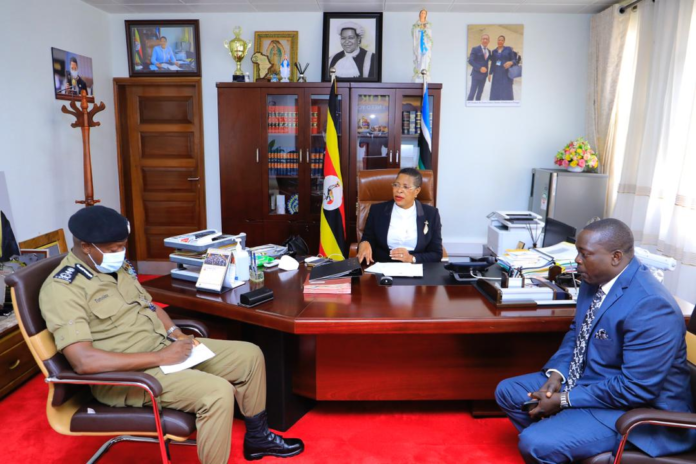
Speaker of Parliament Anita Among meeting Deputy Inspector General of Police Maj Gen Tumusiime Katsigazi.
The Speaker of Parliament Anita Among has this morning told Deputy Inspector General of Police Maj Gen Tumusiime Katsigazi to solve the boda-boda accidents crisis that continues to claim innocent lives.
In a meeting, convened following the release of a CCTV video by police, in which graphic details show accidents involving boda-bodas during October, Among told Maj Gen Katsigazi that the country faces a crisis that must be addressed immediately.
“We face a crisis, especially on Kampala roads as a result of reckless boda-boda riders. We must address it forthwith. You need to take critical steps to reverse this devastating trend and save lives on our roads,” she said, noting that police should also find long-term solutions to solve the issue of road carnage, through tightening enforcement and traffic guidelines to curb errant road users.
Boda-boda accidents remain the largest contributor to fatal accidents, in which at least an average of 1,918 people are killed annually, according to the 2021 Annual Crime and Traffic/Road Safety report.
Maj Gen Katsigazi said that it was true the recent spate of accidents had been a result of reckless road users, noting that police will come up with measures to address the matter.
On Saturday, State Minister for Lands Sam Mayanja’s daughter Belinda Birungi was reportedly knocked while riding on a boda-boda along Stretcher Road, Ntinda.
The boda-boda rider whose particulars were not readily available by the time of filing this report died on the spot while Birungi was rushed to hospital in critical condition before she was pronounced dead moments later.