Stanbic Bank
Stanbic Bank
28.6 C
Kampala
Stanbic Bank
Stanbic Bank
Home Blog Page 526

Understanding the Genesis of Muhammad Nsereko’s Law

David Lewis Rubongoya

By David Lewis Rubongoya

Following the 2009 Kayunga protests, the regime banned public meetings popularly known as Bimeeza and withdrew licences from several radio stations, including CBS. That opened a new phase of repression using the law. 

In 2013, they passed the Uganda Communications Commission Act which gave UCC sweeping powers to withdraw licences for media stations that will be deemed troublesome, in the name of enforcing minimum broadcasting standards. And since then, media houses have been treading cautiously. Many are apparently operating on provisional licenses. They will remind us whenever a guest goes bare knuckles, that the views expressed are not of the station, but those of the guests. The fear is apparent.

EFFECTIVELY THEY HAD FOUND A WAY OF CONTROLLING MAINSTREAM MEDIA. 

The next problem was how to deal with public gatherings. 

Following the 2011 Walk to Work Protests, the regime became desperate to ban all public gatherings of a political nature. 

In 2013, they enacted the Public Order Management Act (POMA) which effectively required every citizen to get police permission before organising or participating in any demonstration. How the POMA has been used to crack down dissent since then is well known world over. To date, there are people rotting at Kitalya, Luzira and other prisons for several years for going against this draconian law. The very mover and arch-defender of the law, Amama Mbabazi faced its wrath at some point, just like the present law is bound to catch its mover and supporters. 

AND SO, THROUGH THE PUBLIC MANAGEMENT ACT, THE REGIME EFFECTIVELY BANNED PUBLIC GATHERINGS AND DEMONSTRATIONS. 

The next challenge for the regime was social media! 

With public gatherings banned and media stations severely restricted, the regime thought it would have a smooth sail. But since the advent of the People Power Movement in 2018, the regime found itself with a new problem to deal with, and that was social media! As more and more young people expressed contrary views on social media, the regime felt threatened. 

They immediately introduced a daily social media tax of 200 UgX called OTT. That did not deter people. Those who had the means paid it, while others bypassed it using VPN. Frustrated and desperate, they decided to ban Facebook in Uganda, which remains banned to-date. 

But the people still by-passed the ban using VPN networks. And so it has been a huge challenge to them. They could rig elections with impunity, carry out abductions and illegal arrests and exercise all manner of illegalities, but they couldn’t prevent citizens from expressing their disgust and discontent with the corrupt and inept regime via Facebook, tiktok, twitter, etc. 

In between, a new problem emerged for the regime. That was in form of the People Power dresscode comprised of red berets, red overalls, etc. These dressings emboldened the people and are a symbol of resistance! As they became widespread all over the country, the regime immediately gazetted them in accordance with the UPDF Act, and said they belong to the military henceforth. This has since been used to abduct, torture and detain thousands and charge them before the military court. 

But the social media problem persisted for the regime. They have been relying on Section 25 of the Computer Misuse Act to abduct, arrest, torture and detain several social media users for being so critical to the regime or exposing its dark side. As we speak, several journalists and online activists are on the run or in exile for fear of being abducted or violently arrested over their publications on social media. 

But it is now clear that according to the regime, that provision was not enough for repressive purposes, because the highest punishment is 480,000/= and/or imprisonment for one year or less. Secondly, it requires the offended person to come and testify that their peace has been disturbed or their privacy infringed upon. Of course no regime official wants to embarrass themselves testifying how they want to muzzle criticism. 

That is how the regime decided to enlist Muhammad Nsereko’s services! His law effectively bans the use of social media and other electronic mechanisms to criticise the regime and its officials. Under that law, 

1. You cannot record someone’s voice or video without authorisation.

2. You cannot share information about or that relates to another person without authorisation. 

3. You cannot write, share or send information about anyone which is likely to demean, ridicule or degrade another person.

4. You cannot share unsolicited information with anyone. 

5. The punishment for doing any of these things will range from paying fines of up to fifteen million shillings,  and imprisonment of up to 7 or 10 years, depending on which section you have violated. In addition, a person convicted under Nsereko’s law will not be allowed to hold public office for 10 years. You can see who the target is! 

You can imagine what the military regime can use this law for! If Gen. Museveni has been using a knife to deal with the threat of social media, Nsereko has now handed him a machete. If he has been using a stone, he now has a hammer. In terms of unconstitutionality, this law goes far beyond all the repressive laws highlighted above. 

History will be harsh not only to the oppressors, but mostly to those who aided the oppressors in oppressing the people.

The beauty is that repressive laws have never stopped any regime from falling. No single law has ever stopped the people from eventually reclaiming their power and sovereignty. They could have since forgotten, but this fact was captured aptly by the NRA while in the bush, in their book Mission to Freedom, Page 2. “The right of rebellion against tyranny has been recognised from the ancient days to the present day by men of all creeds…..It transcends any narrow laws enacted by petty dictators and despots.”

Our struggle will end in victory!

Stories Continues after ad

Bunyoro youth ask Museveni to give Muhoozi mantle

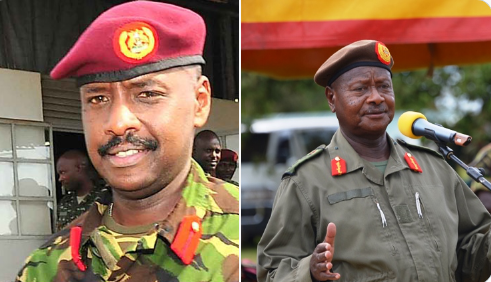
First son Gen Muhoozi Kainerugaba, President Museveni

Youth in Bunyoro sub-region have asked President Yoweri Museveni to give Commander of Land Forces Lt. Gen. Muhoozi Kainerugaba mantle to succeed him.

Speaking at the opening of Radio 7 owned by City events guru Balaam Barugahara, the youth led by the district Female Youth Councillor Ayebazibwe Evelyn, thanked Museveni for the good leaders but asked him to give Gen. Muhoozi room so as he get time to interact with the populationand also give him leadership mantle.

“We are really appreciative for the peace you fought for and we are also requesting you to allow your son Muhoozi come and interact with the youth because we really love him so much and also allow him succeed you,” Ayebazibwe said.

Muhoozi first signalled his desire to go public about his presidential ambitions when he turned his 48th birthday celebrations this year into a national event.

In May, he informally announced his retirement from the army on Twitter, fuelling speculations that he intended to leave the army and launch a political career.

Across the country and online, multiple ‘Team MK’ or ‘MK 2026’ support groupa are popping up to support his future presidential run.

Stories Continues after ad

Ghana declares end of Marburg virus disease outbreak

Health workers

Ghana has declared the end of the Marburg virus disease outbreak that was confirmed nearly two months ago. It was the first time the highly infectious haemorrhagic fever was detected in the West African country.

Ghana’s Ministry of Health made the declaration after no new cases were reported over the past 42 days, or two incubation periods—the time between infection and the onset of symptoms. In total, three confirmed cases, including two deaths were recorded in the outbreak declared on 7 July 2022 after laboratory confirmation of the virus that affected the country’s Ashanti, Savannah and Western regions. A total of 198 contacts were identified, monitored and completed their recommended initial 21-day observation period which was then extended for another 21 days out of an abundance of caution by the

The health authorities, with support from World Health Organization (WHO) and other health partners, swiftly rolled out outbreak control measures, stepping up disease surveillance, testing, contact-tracing, clinical care as well as raising public awareness and working with communities to support disease prevention efforts. Marburg is a highly infectious disease in the same family as Ebola and has a high fatality rate of between 24% and 88%.

 “Marburg is a frightening disease as it is highly infectious and lethal. There are no vaccines or antiviral treatments. Any outbreak of Marburg is a major concern,” said Dr Matshidiso Moeti, WHO Regional Director for Africa. “Despite having no previous experience with the disease, Ghana’s response has been rapid and robust. Lives have been saved and people’s health protected thanks to an effective disease detection system that helped to quickly identify the virus and enabled prompt response to curb the spread of infection.”

The Marburg outbreak in Ghana was the second of its kind in West Africa. Guinea reported a single case in an outbreak that was declared over in September 2021. In Africa, previous outbreaks and sporadic cases have been reported in Angola, the Democratic Republic of the Congo, Kenya, South Africa and Uganda.

Genomic sequence analyses of the Marburg virus by Senegal’s Institut Pasteur and the Noguchi Memorial Institute for Medical Research in Ghana suggest that this latest outbreak is related to the case reported in Guinea in 2021. However, further investigations are needed to fully understand the origin of the outbreak, which may be due to a shared animal reservoir or to population movements between the two countries. WHO is supporting the health authorities to carry out ecological studies to increase understanding of the disease and help anticipate and prevent future outbreaks.

Resurgence of Marburg can occur and WHO is working with Ghana’s health authorities to maintain surveillance and improve detection and response to potential flare-up of the virus. Marburg is transmitted to people from fruit bats and spreads among humans through direct contact with the bodily fluids of infected people, surfaces and materials. Illness begins abruptly, with high fever, severe headache and malaise. Many patients develop severe haemorrhagic signs within seven days.

Stories Continues after ad

Climate activist Vanessa Nakate named UNICEF Goodwill Ambassador

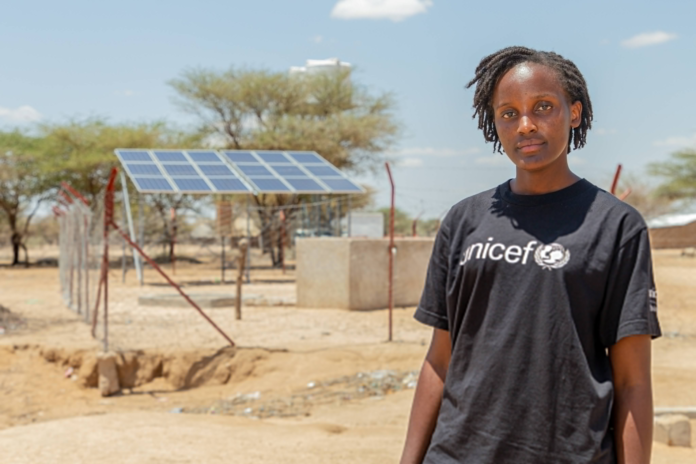
Vanessa Nakate

25-year-old Ugandan climate activist Vanessa Nakate has been appointed as the newest UNICEF Goodwill Ambassador, affirming her collaboration with the organization and recognizing her outstanding global advocacy for climate justice for current and future generations.

Nakate traveled last week with UNICEF to Turkana Country in north-western Kenya to see firsthand the impacts of water and food insecurity caused by the worst drought in the Horn of Africa in 40 years. On her first trip with UNICEF, she met with communities on the frontlines of the climate crisis, including mothers and babies receiving lifesaving treatment for severe acute malnutrition and families benefiting from solar-powered water supply systems.

“As a UNICEF Goodwill Ambassador, it will be my first responsibility to bring the voices of children and marginalized people into conversations where they were previously excluded. This role with UNICEF will provide me with more opportunities to meet children and young people in the places most affected by climate change and an expanded platform to advocate on their behalf,” Nakate said.

“In Kenya, the people I met told me about the impact of climate change and drought on their lives, with four consecutive failed rainy seasons depriving children of their most basic rights. One community had not received any rainfall for over two years. This is more than a food and nutrition crisis, it is yet another dimension of our worsening climate crisis.”

UNICEF’s appeal to improve families’ long-term resilience in the Horn of Africa region – and therefore help stop drought devastating lives for years to come – is currently just 3 percent funded.

Nakate began her activism in January 2019 with a protest with her siblings and cousins on the streets of Kampala, inspired by Greta Thunberg. She continued to protest every week, becoming a well-known face in a movement of young people “striking” for the climate around the world. In 2020 she came to further global prominence when she was cropped out of a news photo she appeared in alongside Thunberg and other white climate activists. Nakate’s response to the incident, in which she said the news outlet “didn’t just erase a photo, you erased a continent”, made international headlines.

“As a young African woman, I have had to fight to be heard by the media and decision-makers. While I am fortunate to have a platform now, I intend to continue fighting for others. The children on the frontlines of the climate crisis, like those I just met in Turkana, Kenya, are the people for whom I will fight in my new role with UNICEF,” said Nakate.

Nakate has since used her platform to advocate for climate justice to include every community, especially those from the most affected places. She founded the Rise Up Movement, a platform to elevate the voices of African climate activists, as well as a project to install solar panels in rural Ugandan schools. She has addressed world leaders at the COP25 and COP26 climate summits and appeared on the cover of TIME magazine.

“I am excited to welcome Vanessa Nakate to the UNICEF family as our newest Global Goodwill Ambassador,” said UNICEF Executive Director Catherine Russell. “Vanessa’s work to drive climate action that benefits the communities most affected by the climate crisis aligns directly with UNICEF’s mission to drive change for every child. We hope her appointment as a UNICEF Global Goodwill Ambassador will help ensure that the voices of children and young people are never cut out of the conversation on climate change  and always included in decisions that affect their lives.”

Globally, approximately 1 billion children – nearly half the world’s 2.2 billion children – live in one of the 33 countries classified by UNICEF’s Children’s Climate Risk Index as at “extremely high risk” of the impacts of climate change, threatening their health, education, and protection, and exposing them to deadly diseases. The top ten countries are all in Africa.

Nakate joins the ranks of other recent high-profile supporters such as actor Priyanka Chopra Jonas, recording artists Katy Perry and Angelique Kidjo, Syrian refugee, and education activist Muzoon Almellehan, and, most recently, UNICEF’s youngest-ever Goodwill Ambassador actress Millie Bobby Brown.

Stories Continues after ad

Bernard Oundo swears in as President of Uganda Law Society

Bernard Oundo has this morning been sworn in as the president of Uganda Law Society. He was sworn in at Kampala Serena Hotel along with eight members of the council who were elected on the 10th Sept 2022.

Oundo defeated five candidates in a hotly contested election. He garnered 1056 votes as his closet rival Diana Ninsiima Kibuuka who polled 723 votes.

Other candidates who were in the race included; Diana Angwech (151 votes), Chemisto Shuib Kubai (133votes) Olyvia Kyalimpa(52 votes), and Mugagga Mukuve Karemire (15 votes).

He will serve along with Diana Angwech (Vice president), Isaac Atukunda (Secretary), Isaac Newton Kyagaba (Treasurer), Obedo Deo Gracious (Executive Council Representative Eastern region), and other members.

Speaking after swearing in Oundo said he will be a President for all. “It doesn’t matter whether you voted for me or not, I won’t even remember if you didn’t vote for me, am here to serve. Let’s commit to supporting each other and achieving our common goals for our society.”

He applauded the outgoing Executive Council for all the work they have done and pledged to continue to build on the foundation they have laid.

“We commit to deliver on our pledge to promote the rule of law and good governance as well as members’ welfare and legal aid services. To government we pledge to be a constructive partner to advise, guide, and work with you in line with our mandate as a society,” he said.

He said as Uganda Law Society’s commitment to protecting the Rule of law, to promote access to justice for all Ugandans is paramount he committed to the public that ULS will stay true to its mandate and we shall do our job as required.

The former president Pheona Wall said, “I want to celebrate all the council members that I have served with during my time as Outgoing ULS president.”

“Thank you to the ULS Membership, you have been with us, you have built the ULS House during the Covid-19 period, and you responded when we wanted to rescue our members, Thank you all,” she said.

Stories Continues after ad

Sand Cranes draw Senegal, Egypt in 2022 Beach Soccer AFCON

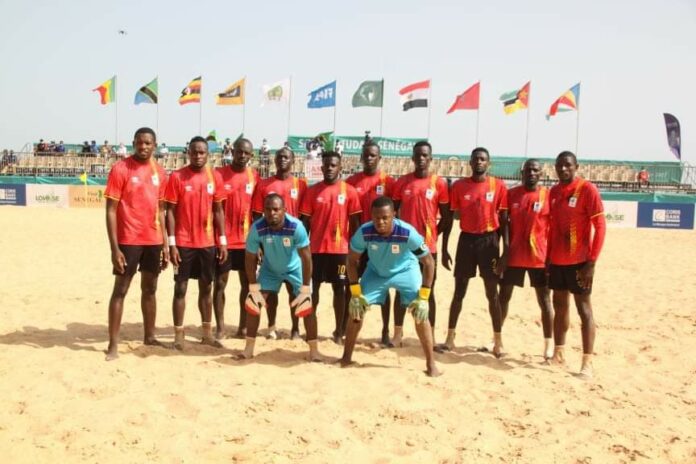
Sand-Cranes team

The first round of the Beach Soccer Africa Cup of Nations Mozambique 2022, scheduled for 21-28 October, will be hotly contested.

Defending champion Senegal will share the stage with Uganda Sand Cranes, who participate in their second Beach Soccer AFCON after having been semi-finalists in 2021, Madagascar, winner of the tournament organized in 2015 in the Seychelles and also Egypt, bronze medalists in 2016 and 2018.

The Sand Cranes will be managed by Swiss legendary beach soccer coach Angelo Schirinzi.

Hosts Mozambique have been placed in group A. They are joined by Malawi, who will be taking part in their first Beach Soccer AFCON, Nigeria who were bronze medalists in 2015 and finalists in 2016 and 2018, and also Morocco, regular participants in the finals and bronze medalists in the last edition.

The groups of the final tournament were revealed on Friday following the draw held in the Mozambican capital Maputo.

The tournament will take place in the town of Vilankulo, known for its seaside resort and picturesque landscape, an enchanting tourist spot.

Group A: Mozambique, Malawi, Nigeria, Morocco

Group B: Senegal, Uganda, Madagascar, Egypt.

Stories Continues after ad

14 held for electricity infrastructure vandalism in Mityana

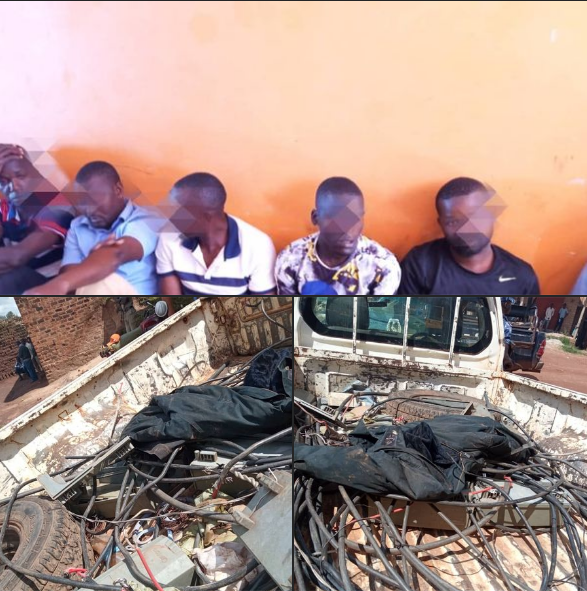
Police in Mityana are holding 14 suspects in connection to the vandalism of electricity infrastructure. The suspects were arrested in a joint intelligence-led operation with the Ministry of Energy on Thursday.

They were arrested at Suremax guesthouse where they have allegedly been keeping the stolen electricity property.

ASP Racheal Kawala, the PRO Wamala region police said they recovered exhibits including; 20 Stayrodes, Conductor wires of 5mtrs, Stay wire of 100mtrs, 10 Umeme overcoats and 18 Stay insulators.

Other exhibits 30 dead ends, 20 Turn tackles, 1 Umeme safety boot and 1 Umeme disconnection book. A CIU (yaka meter), Single cabin UAT 124H amongst other properties all belonging to UMEME.

The suspects have been identified as Mpungu Robert 41yrs, Kasuja Peter, Bitamuzi Richard  Kampala association advocates and Nangobi Lydia all alleged employees of Kampala associated advocates.

Other suspects are Nsamba Charles a Boda boda cyclist, Damba Joshua a staff of UMEME, Bogere Becker unemployed, Sakwa Benard 24 unemployed, Bonny Joseph 37-year-old formerly UMEME staff, Katongole Bruno electrician, Sebyooto Muwanga Ignatius 48yrs UMEME driver, Nakiboneka Grace 30yrs manager Suremax, Golooba Edward a farmer and the owner of SureMax guesthouse.

“They will be charged with interference with meters, works or public lamps section 85A of electricity Amendment act 2022 among other charges. We are currently interrogating the suspects and inquiries are ongoing,” Kawala said.

A Shs1 billion fine or a 15 years jail term awaits anyone who is found guilty of vandalising electricity infrastructure following the passing of the Electricity (Amendment) Bill, 2022. MPs passed the bill on Wednesday, 13 April 2022.

Stories Continues after ad

KCCA begins engagements with leaders on voluntary provision of land

Kampala Capital City Authority (KCCA) has started engagements with community leaders and affected persons to voluntarily provide the right of way for the construction of 69.70km of roads in the city.

Under the Kampala Roads Rehabilitation Project (KRRP), which is a $288m African Development Bank project, KCCA is to begin the rehabilitation of 29 roads and junctions in the city.

The roads will be complete with associated drainage works including improvement to 22 traffic junctions, 123km of Non-Motorised Traffic facilities, commercial vehicles parking places, Bus depots, public toilets, markets along project roads for women vendors, installation of 1,600 energy efficient streetlights, and tree planting.

On Thursday, the KCCA Safeguards team led by Gerald Ahabwe, the Project Social Development Specialist held an engagement with LCI leaders of the affected areas in Nakawa division.

“This is not the first time for, land and property owners around Kampala to be asked to provide space on their land for road construction. We hope you will support this project and make it a success,” Ahabwe said.

Under the KIIDP Project, land owners voluntarily provided right of way which led to the success of the project.

Ahabwe explained that government secured funds for the road construction but it is constrained on resources to fully finance and compensate land owners within a given timeframe.

“Before construction starts, each property owner assents by signing a Consent Agreement. Discussions and further negotiations for severely impacted properties is also carried out,” Ahabwe said. 

It should be noted that people who will sign voluntary consent forms allowing road construction through their land at zero compensation are eligible for compensation for their developments on the affected land.

This is to mitigate acute loss of individual income and well-being.  Residents with minimal impact on their properties such as moving of a perimeter wall, fences or driveways will have the affected development re-instated by the project.

The affected areas in Nakawa Division are along, Old Portbell road, Spring road and New Portbell roads which are all under Lot II of the KRRP.

Nakawa Division Mayor Paul Mugambe commended KCCA for considering improving roads in Nakawa but challenged the Authority to be transparent in delivery of services.

“Compensation is not possible, that is why KCCA is calling upon us to voluntarily give land for the right of way. This is our road, and this is our city let us support the initiative. But KCCA must come clean,” Mugambe said.

The project is aimed at tackling congestion in the city of Kampala through improvement of road network, upgrading of traffic junctions, and enhanced drainage capacity to mitigate flooding on the streets.

Ben Kalinda, the LCI Bugolobi rallied fellow leaders and affected persons to be patriotic and offer KCCA the land.

“We should all love our country, and any development that comes we should support it as patriotic citizens. The issue of compensation is political, they need to be handled in a transparent way,” Kalinda said.

The Public consultations are aimed at sharing information about the project, obtaining information about the concerns, needs and priorities of the affected persons, obtaining cooperation and participation of the affected persons, ensuring transparency while carrying out the land acquisition activities.

The KRRP is expected to benefit at least 1.6 million people including: commuters, businesses and transporters passing through the city regularly, poised to experience improved transport efficiency.

Some targeted roads include;
Lot I: Wamala road Lubaga, Luwafu road Makindye, Kabega  Makindye, Muteesa1 Lubaga, Old Mubende Lubaga, Kigala Lubaga, Kayemba road Lubaga

Lot II – Nakawa, Old Portbell and, Spring road, New Portbell road.

Lot III: 5th Street, 6th Street Central division, 7th Street Central division, 8th street Central division, Sir Apollo Kaggwa road Central, Muzito road Lubaga, Suuna 1 & Ssuuna2 Lubaga, Kabalagala Junction Makindye

Lot IV: Kasubi Northern bypass Lubaga, Queens way Central, Salama Munyonyo Makindye, Kyebando ringII Kawempe, Kisasi ring Nakawa

Lot V: Mugema road Lubaga, Masiiro road Lubaga, Ssentema road Lubaga, Nsambya Halton Makindye​.

Stories Continues after ad

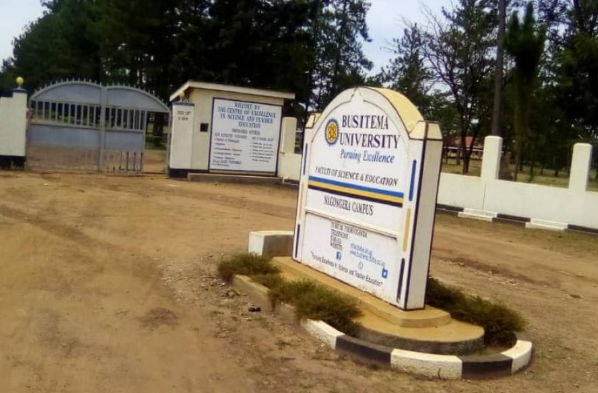
Busitema University’s under staffing shocks MPs

Legislators sitting on the Public Accounts Committee (PAC) – Central Government were stunned to learn that Busitema University is operating with 29 percent of the requisite academic staff.

The top management team of the university were on Thursday, 15 September 2022 appearing before the committee presided over by the vice-chairperson, Sarah Opendi, over queries from the Auditor General’s report for financial year ended 2021.

University Secretary, Abert Mutungwire, told the committee that they are understaffed despite being a science-based institution, adding that there are only 99 academic staff, translating into 29 percent of the required minimum of 50 percent.

To cover up the manpower gap, Mutungwire said that they straightway required 150 staff, especially lecturers and senior lecturers to properly cover their six campuses.

“We need them across the board but more specifically in the Faculty of Engineering, Faculty of Medicine, Faculty of Agriculture, and Faculty of Natural Resources and Education and Science,” he said, adding that that several staff were due for promotion after attaining PhDs.

“We have 20 cases of those who are senior lecturers but now qualify to be associate professors. We have 10 cases of professors and 30 cases of lecturers who want to be promoted to senior lecturers,” he said.

He further revealed that they had been subdued by the finance ministry’s instruction to only recruit to replace departing staff.

However, Members of Parliament on the committee questioned how the university was operating with 400 staff across all the six campuses and also raised concern over the quality of graduates being produced.

The committee tasked the team to produce evidence of their request to add more staff and the ministry letters on new recruitment.

Michael Mawanda, the Igara County East MP, said that the core mandate for the university is teaching and learning but he is shocked that the university has a 29 percent staffing level.

“This is the area we would like to interest ourselves in, because the knowledge you impact on students will have a far reaching consequence on the people. When you have a 29 percent staffing, then the output will be lacking and more so, you have separate campuses,” he said.

Isaac Modoi, the Lutseshe County MP, said that understaffing may compromise on the quality of the graduates.

The university also decried underfunding of the capital budget to support infrastructure expansion, saying that only Shs2.3 billion of Shs9.6 billion is given to them annually. As a result of the COVID-19 pandemic, the entity only collected Shs4.9 billion as Non-Tax Revenue of the anticipated Shs6.5 billion.

Stories Continues after ad

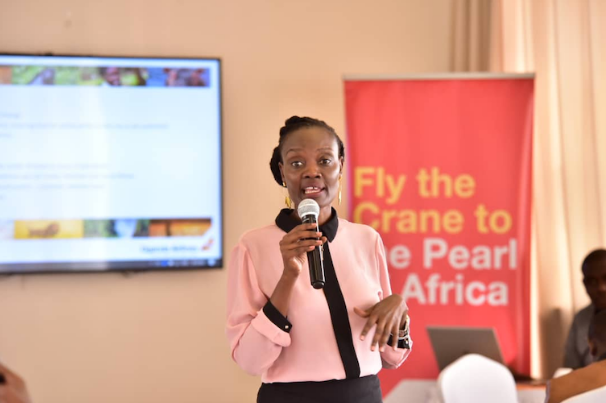
Uganda Airlines: MPs should blame the law, not Museveni and Bamuturaki

Jennifer Bamuturaki

MPs on Parliament’s COSASE continue to harass Uganda Airlines CEO Jennifer Bamuturaki Abwooli on allegations that she fraudulently got that posting.

Bamuturaki was appointed by President Museveni based on the existing law that may not discriminate when it comes to such appointments. The president has been appointing executives for government agencies over three decades now.

The Uganda Airlines Act of 1976, Chapter 323 [8], which commenced on May 17 1976, rests the powers to appoint the CEO of the national airliner into the hands of the reigning president. 

COSASE MPs led by Joel Ssenyonyi seem to have ignored this legislation, which reads, “The Corporation shall have a general manager, who shall be appointed by the President for such period and upon such terms and conditions as the President may determine. The general manager shall be the chief executive officer of the corporation and shall devote the whole of his or her time to the duties of his or her office.”

The Act gives the CEO of the airline powers to control funds generated. The general manager shall be responsible for the management of the funds, property and business of the corporation and for the administration, organization and control of the staff of the corporation.

The law does not call for advertising the job of the airlines’ CEO in the local or international newspapers. So, according to watchers following the interface between COSASE, and Bamuturaki and others at Uganda Airlines, the issue of Bamuturaki not sitting for an interview before getting the job does not rise, but her appointment was boosted by the fact that she had been serving at the same company in a senior position and therefore was expected to deliver, and sources say she was on the right track.

Museveni, it is said, based on the same law governing the local airline Zambian Cornwell Muleya, who unfortunately left the company unceremoniously, and fighting government in court.

There is concern that Museveni’s letter of appointing Bamuturaki was hidden for some good time, meaning there are people who did not want Museveni’s choice, which is illegal because the law gives the president the liberty to appoint whoever he is pleased with. The Headquarters of Ministry of Works and Transport might have mafias who were thinking otherwise, but it said Museveni who now is not happy with COSASE wants those bad people revealed.

Writing to works minister Gen. Katumba Wamala, Museveni said he appointed Bamuturaki based on reports of her good performance in the previous position at the same company.

“According to my intelligence, Jennifer Bamuturaki has performed well in quite a hostile environment. I, myself, was flown by the new CRJ-900 to Nairobi and back the other day by the very able young pilots from Soroti with the capable air-hostesses. I direct that you give Jennifer Bamuturaki a substantive appointment for 3 years,” reads part of the president’s letter to Gen. Katumba.

Now, instead of implementing the president’s directive, a clique of mafias at the works ministry hid this letter from Jennifer for three months and used that time to instead contract, very fast a consultancy firm to conduct a search for a new CEO! PWC was paid a whooping Shs98.1 million for the job.

Someone was trying to disregard Museveni’s appointment  by advertising for a job in an advert ran on June 24, 2022, almost three months after Museveni had already directed, in writing, that Jennifer be confirmed.

All in all COSASE, is not fair and now trying to find fault in anything that Bamuturaki has done in her new post. Watch this space, Museveni will retain Bamuturaki as Uganda Airlines CEO.

Stories Continues after ad