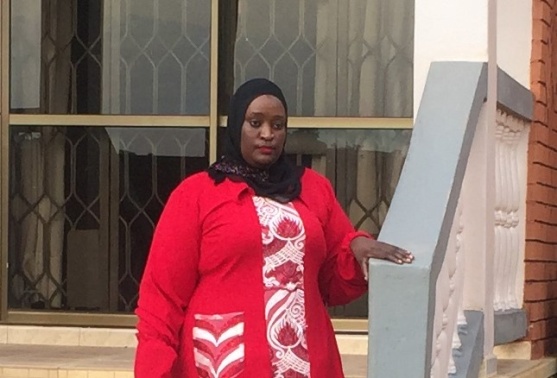
Katwe Police Station has summoned singer Namukwaya Hajjara aka Spice Diana over the murder of a 27-year-old casual labourer.
According to Kampala metropolitan police spokesperson Luke Owoyesigyire, the victim who was identified as Nsamba Henry was beaten to pulp in her home and later died at Mulago Hospital.
It is averred that on 30th june 2022, the deceased climbed a perimeter wall at the home of Spice Diana with intention to steal. He was arrested, beaten up by the mob and later died at the hospital.
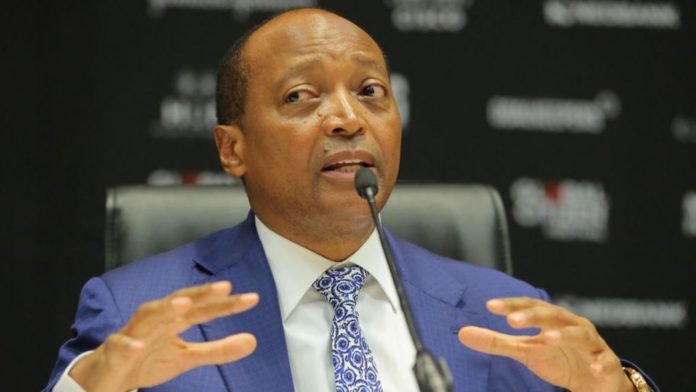
The President of CAF Patrice Motsepe on Sunday 3rd July 2022 announced that the Executive Committee resolved that the African Super League will kick off in August 2023 and will be launched in Tanzania in August 2022.
During last year’s Extraordinary General Assembly in Egypt, the 54 Member Associations unanimously voted to go-ahead with the competition and gave a mandate to the President and the Executive Committee to lead the implementation of the competition.
Motsepe said: “The decision has now been taken to implement the CAF Super League. It will start in August 2023 and we will launch it during CAF’s 44th Ordinary Assembly in Tanzania on August 10. We have been inundated with investors and sponsors, who are anxious to partner with us on the CAF Super League. It has huge potential to significantly uplift African football and to make it even more powerful.”
Details, including the official name, will be unveiled at the launch event.
“The competition will breathe new life into African club competition. Winners and participants of the inaugural African Super League will receive significant prize monies and the proceeds from the tournament will include substantial solidarity payments to all 54 CAF Member Associations,” Motsepe said.
FIFA President, Gianni Infantino, attended the CAF Executive Committee and Motsepe thanked the FIFA President for his support with the establishment of the African Super League.
“We will be engaging with stakeholders over the next few weeks to discuss the mechanics of the tournament and will release further details shortly. A significant amount of the money from the CAF Super League will be invested back into African football and part of the process involves giving $1 million every year to every one of CAF’s 54 Member Associations as a contribution to football and youth development. We also want to look to increase the prize money for the men’s and women’s CAF Champions Leagues,” said Dr Motsepe.
This competition will feature twenty-four of the elite African teams.
The teams will be taken from the best-ranked African clubs over the past few years, with groups to be played on a regional basis (North, Central/West, South/East). All participants will be required to have a youth academy and a women’s team as part of their club licensing criteria.
The clubs will feature in three groups of eight teams ahead of a knockout stage starting at the Round of 16.
By creating the Super League, CAF will have to consider the future of its two club competitions: the CAF Champions League and the Confederation Cup.
Bank of Uganda (BoU) has revealed that WorldRemit Money Transfer (U) Limited voluntarily ceased to carry on money remittance business in the country.
On June 6, 2022 WorldRemit ceased facilitating any new transactions sent from Uganda. According to the company, customers receiving funds in Uganda were not affected by their decision and they will be able to continue to receive funds via the WorldRemit service without disruption.
“Pursuant to regulation 19(3) of the Foreign Exchange (Forex Bureaus and Money Remittance) Regulations, 2006, the Bank of Uganda hereby informs the public that WorldRemit Money Transfer (U) Limited voluntarily ceased to carry on money remittance business.”
“The public is notified that the closure of WorldRemit Money Transfer (U) Limited as a company will not affect WorldRemit money remittance products offered by several supervised financial institutions in Uganda,” BoU said in a statement.
BoU urged customers with outstanding claims for monies given to WorldRemit Money Transfer (U) Limited for remittance purposes to submit their claims, with evidence, to the office of the Director Non-Bank Financial Institutions Department at Bank of Uganda by July 18, 2022.
“Bank of Uganda assures the public that it will continue to safeguard the stability and integrity of the financial sector.”
President Yoweri Museveni is set to meet Arts teachers under their umbrella body, Uganda National Teachers Union (UNATU) today at Kololo Ceremonial Ground to pave ways towards the ending of the industrial action.
On June 15, 2022, teachers under UNATU staged industrial action citing discriminatory salary enhancement and government’s failure to honour collective bargaining agreement signed in 2018.
Yesterday, National Executive Committee (NEC) Members and Branch Chairperson of UNATU met and resolved that they will not return to classes unless the government harmonizes their salaries.
Next Financial year, the Government allocated Shs 735 billion towards enhancement of Science teachers’ salaries. According to the proposed salary scale, a science teacher who holds a degree will earn Shs 4 million from Shs 1.1million. A grade five teacher will earn Shs 3 million from Shs 796,000.
Last month Mrs. Catherine Bitarakwate Musingwiire, the permanent secretary to the ministry of public service, ordered teachers to resume their duties at their respective work station by 24th July 2022 and any teacher who doesn’t comply with this call will be regarded as having absconded from duty and resigned from public service in accordance with section A-N of the public service Standing orders 2021.
Zadock Tumuhimbise, the chairperson of UNATU has since urged teachers to go on with the strike till the enhancement of their salaries.
“We have received the intimidating letter as expected. Whatever we are doing is within the provisions of the law. We are very safe. Our legal teams are on course to make a response to the letter. Soon our official spokesperson will give us a detailed update. Otherwise; the Industrial Action is still on course. Keep consistent,” he said.
Bitarakwate petitioned the secretary of UNATU Filbert Baguma calling for a meeting over the staged industrial action.
“We invite you and four members of the Union executive for a meeting with the ministry of public service on Friday July 1, 2022,” Bitarakwate said.
On June 29, 2022, the Vice President Jessica Alupo met UNATU leaders and urged them to return to their places of work however her plea was not heeded to.
The Chief Registrar, HW Sarah Langa Siu held an all Registrars meeting geared at sharing information, reorganizing coordination activities and improve performance through sharing updates from different circuits.
She used the platform to inform members of the approved standardization of courthouse that was passed by the Top Management of the Judiciary to help create uniform court structures. “The Top Management approved the standardizing of court structures which will inform the technical drawings with a particular standard of buildings that are worthy of dispensation of Justice,” she said.
HW Langa thanked Registrars for improved working relations with Judges evident in the decline of complaints registered. She also noted the need to collaborate on supervision and mentorship for the new magistrates recruited. “With the many magistrates, we all have a role in supervising these young people that have joined us. My call is that, as you sit in your circuits take interest in them, guide them on what to do, be their mentors and impact them so that they may become the officers that we all want,” she said.
The Chief Registrar called upon members to be supportive of the newly elevated Judges so that they can meet their current KPIs of disposing 400 cases per year. She said this will enable them to compile a report that will gear confirmation of their appointments.
She reminded Registrars to submit their appraisals alongside those of their support staff calling for honesty and objectivity to help address the challenges faced immediately.
The Chief Registrar also called for collective involvement in the new Judiciary initiatives, innovations and activities. “Being part of the process might help you in the future. Let us take some little time to show input.”
The Chief Registrar shared that following a benchmarking trip to Kenya and Tanzania, there are hopes for proper transformation in the current Judiciary Training Institute with better facilities and thorough research conducted. “We are looking forward to having a school where you go and study with a whole range of facilities. Let us transform our Judiciary to what we want it to be. We decided that the Minimum induction of magistrates will be two weeks, residential such that the appointed can come out as better Judicial Officers,” she said.
Registrars produce four judges
The outgoing Inspector of Courts HW Flavia Matovu Nassuna (Judge Designate) thanked the Registrars for upholding high standards of discipline that eased her workload. “I am delighted and humbled upon this achievement. It’s been a journey of 20 years, and it’s by God’s grace and mercy. With hard work and patience you can make it. All is well and at the right time things can happen. None of you has appeared before the disciplinary committee and I thank you for making my work easy,” she said.
The outgoing Registrar High Court and Judge Designate, HW Samuel Emokor, said he was only successful after three attempts. “Eighteen years later I can finally say that I made the right choice. It is because I had a good team that made me shine, thank you for making us who we are. I am looking forward to continue working with all of you. God’s timing is best,” he said.
Their Lordships in waiting, Susan Kanyange and Ikit Mary expressed their excitement for the Judgeship position, accrediting their achievements to hard work, good working environment with colleagues and advocates, and the work executed within the various areas of deployments.
Among the challenges noted were the technical hiccups on the Electronic Court Case Management Information System, the need to customize daily hearings in other circuits that handle different matters, mishandling of records, need to create space for the Supreme Court at High Court and how to balance the number of court rooms, imbalance of support staff especially local interpreters.
As a way forward, it was agreed that there was need to constantly modify ECCMIS, Registrars were called upon to open up where one is failing/ facing difficulties, a need to agree on the time to allocate to Supreme Court sessions, Judiciary’s plan to conduct massive recruitment of support staff to fill in the gaps, a need to fill in the response form on the nature of staff needed in different areas to help inform on recruitment processes.
Tour the Appellate Courts
At the end of the meeting, the Registrars were led on a guided tour of the construction site of the appellate courts building by the Permanent Secretary/Secretary to the Judiciary, Dr Pius Bigirimana.
He shared a brief background of the construction of appellate courts saying although the construction started in May2020, so far both towers are at 70 per cent and 60 per cent completion. The PS/SJ expressed his optimism to have both projects completed by the end of the year.
The twin appellate courts building will host customized courthouses for both the Supreme Court and Court of Appeal with modern courtrooms, chambers for the Justices and Registrars, boardrooms, a gym and a restaurant, two basement floor parking for 226 vehicles among other amenities. The construction project executed by Seyani Brothers and is fully funded by the Government of Uganda.
The PS/SJ said the project was billed at Shs63.9 billion and has incurred an additional Shs7 billion for the two extension floors added.
The meeting was moderated by the Judiciary Public Relations Officer, HW Jamson Karemani.
The next edition of the Africa Cup of Nations will be played in Ivory Coast in 2024, and not 2023, Confederation of African Football (Caf) president Patrice Motsepe said on Sunday.
Initially scheduled from 23 June to 23 July 2023, Motsepe said the postponement is as a direct and sole result of the adverse weather conditions in the country and after also having received further technical opinion from experts on adverse effects of staging the matches in that period.
June and July are rainy seasons in Côte d’Ivoire.
The tournament has now been postponed to the months of January and February 2024.
It means the Nations Cup will be held in January and February for the second time in a row, after this year’s tournament in Cameroon.
In 2017, Caf announced that it would move the finals from their traditional January-February slot to June-July in a bid to avoid repeated disputes with European clubs forced to release players in the middle of the season.
“January is not the ideal time because of the European clubs, but it is the only choice we have,” Motsepe added.
He also announced the creation of an African Super League next season, which will be formally launched on August 10.
Dr Motsepe said: “The decision has now been taken to implement the CAF Super League. It will start in August 2023 and we will launch it during CAF’s 44th Ordinary Assembly in Tanzania on August 10. We have been inundated with investors and sponsors, who are anxious to partner with us on the CAF Super League. It has huge potential to significantly uplift African football and to make it even more powerful.”
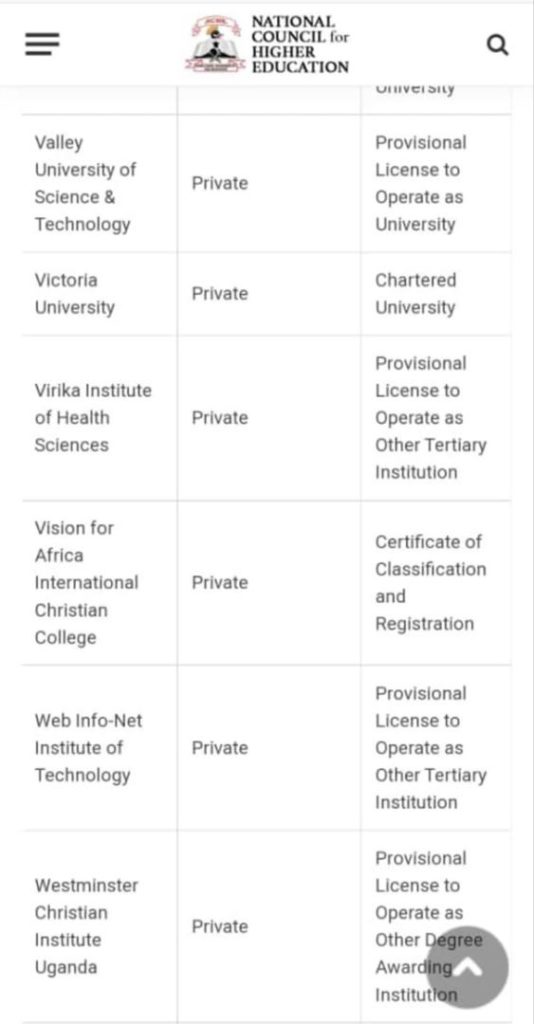
Victoria University has been certified to be a Chartered university.
A Charter is issued by a recognised authority to recognise University and in this case, it is National Council for Higher Education (NCHE)
According to the Universities and other Tertiary Institutions Act, a charter is “granted by the President as evidence that the university meets the requirements and standards of academic excellence set by the NCHE.”
Furthermore, according to section 103(a) of the same Act 2001 as amended; a chartered university means a university that is comparable to a public university.
For any private university, getting a charter means, therefore, that it lays out guidelines for; establishment, control, management and administration of the institution.
Currently, Uganda has more than 60 universities, according to the National Council for Higher Education (NCHE). Whereas eight of these are public universities run by the government, almost 45 of these are private, military and the others in the category of degree awarding institutions.
Of the private universities, only about more than 10 had charter status, which is the highest license from the universities regulator, only granted by the Head of State.
Victoria University, is one of the best universities in Uganda, and stands out as a centre of academic excellence. It offers a fresh and intellectually stimulating environment that nurtures critical thinkers.
The university was opened in August 2010 and has the capacity, the facilities and determination to revitalize higher education in Uganda and in the region.
It is committed to playing a leading role in bringing and developing high quality, student–centered learning opportunities based on standards of excellence that are unique, innovative and difficult to match.
It is centrally located in the heart of Kampala City and on the main public transportation routes coupled with ample parking space.
Former Uganda Cranes captain Ibrahim Sekagya has been named the interim head coach of New York Red Bulls II for the remainder of the season following the sacking of Gary Lewis.
“Ibrahim Sekagya has been named the Interim Head Coach of New York Red Bulls II for the remainder of the 2022 United Soccer League (USL) Championship season,” the club said in a statement.
Sekagya is in his eighth season as an Assistant Coach with Red Bulls II and has filled in as Head Coach for three matches during that span.
The former New York Red Bulls defender retired in 2015 after making 33 appearances with the club.
Prior to that, he spent six seasons playing for Red Bull Salzburg, where he won three Austrian Bundesliga titles and an Austrian Cup championship.
New York Red Bulls II is home to Ugandan midfielder Steven Sserwadda.
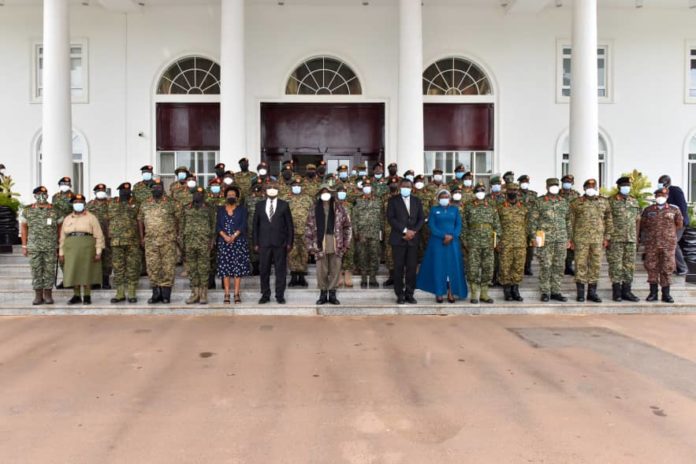
During the previous High Command meeting which took place at Entebbe State House on 26th May 2022.
The Uganda People’s Defence Forces highest decision-making organ will meet next week at Entebbe State House.
After the High Command meeting, the UPDF Army Council which is bigger in size will also meet. According to security sources, the meetings will be at State House Entebbe and will be chaired by President Yoweri Museveni.
The sources say the meetings will discuss the upcoming retirement of the top UPDF generals who are retiring this month.
Generals like Elly Tumwine will be attending their last meeting as active officers.
Among other top generals to retire include the four-star Gen David Sejusa, Lt.Gen. Prossy Nalweyiso and Lt. Gen. Andrew Gutti among others.
The meeting will also discuss the plan to increase the soldier’s salaries who have been among the poorly paid government workers.
The plan to increase the soldier’s salaries was reached during the previous High Command meeting which took place at Entebbe State House in May.
There have been media reports of internal fights within UPDF which the army leadership has dismissed.
The High Command meeting will also discuss the ongoing mass recruitment which has been ongoing since June 18th.
The UPDF is expected to recruit 10,000 soldiers by the end of this week.
According to the UPDF Act, the High Command is composed of:
The High Command is chaired by the President, defence minister, the original members of the High Command as at the 26th day of January, 1986.
Others are Chief of Defence Forces (CDF), the deputy CDF, the permanent secretary, joint chief of staff, service chiefs, heads of chieftaincies and division commanders.
The UPDF Council has all members of the High Command and officers at the lower level of directors of departments, brigade and battalion commanders.
Kuruthum Nabunya Muzaata says that losing her husband is one of the worst nightmares she has encountered in life.
She was only 30 years old when she was met with the sudden loss of her husband, Sheik Nuhu Muzaata in 2020 due to the coronavirus. Soon after her husband’s death, she was confronted with a myriad of misfortunes.
“First, my husband’s relatives didn’t believe that he died of #Covid-19,” she said, “just like the narratives I had heard before in the community, they accused me of having a hand in his death.”
Nabunya narrates that these accusations spiked a lot of chaos in her life, to a point that she and her child were chased away by her husband’s relatives from her home.
Picture of the home Kuruthum almost lost.
“I had seen this happening in many homes but I never understood their pain until it happened to me. It was very painful to see my son go through such trauma,” she said.
Narrating how she struggled to be back on her feet after the loss of her husband and property, Nabunya expressed that she took up the initiative of promoting a feeling of togetherness among widows.
“Losing a husband isn’t easy. We lack access to emotional and psychological help and constantly fall into hands of predators who take advantage of our vulnerability,” she said, “I thought about my experience of losing my husband and decided to fill a void in people’s lives.”
During the Ramadan of 2021, Nabunya and her family felt compelled to donate food to the widows within her home region of Bwaise and Kawempe.
“I could see delight in the hearts of the widows, this simple food donation scenario pushed me into starting the Nuhu Muzaata foundation that is in memory of my late husband and caters for the needs of widows and orphans,” she said.
Being a teacher by profession who holds a doctorate in Education and management, Nabunya also constructed a private school that generates income, which is essential in providing scholarships to over one hundred underprivileged children primarily from the slums of Kawempe and Bwaise to date.
Explaining that she attends to the widows through referrals, Nabunya notes that she caters for about 100 widows and orphans, who are very appreciative.
“Widows and orphans battle with inequality and under representation everywhere. We have been excluded in many socio-economic activities,” said Nabunya, “Through our togetherness in the foundation, a little glimmer of hope is seen and I hope we can come up with a long term solution that cares for the widows.” Nabunya however thinks that men should empower their wives such that in case the husband dies then the family is able to go on without any setbacks.
Janet Namutebi is a beneficiary of Nabunya’s charity services. She notes that the foundation has been very instrumental in supporting her as a widow who is HIV positive. “I got to know about the Foundation at the hospital where I get my Antiretrovirals from. My fellow women introduced me to this foundation and requested that I be part of it,” she said.
One of the widows benefiting from the Muzaata Foundation.
“I did not think twice about joining the foundation because of my struggles to get school fees and food for my children.”
According to Namutebi, ever since she joined Nuhu Muzaata foundation, she has been receiving food donations twice a month.
She said, “this has helped me a lot. Before I could even fail to take my treatment due to a lack of food.”
13-year-old Edonyu Jeremiah from Bukasa studies at Anwar primary school on full bursary. Ebonyu lost his parents in a car accident and he narrated that life without his parents is very difficult because people consider him a burden. When I see other children with their parents I put my hands up and pray to God to protect them,” Edonyu said.
Edonyu Jeremiah
“I used to fear going to school due to lack of school fees, but I have been greatly favored by the foundation and now, I dream of being a pilot,” he said.
Besides giving bursaries in her school Nabunya also sources half bursaries for girls in high school using her connections in the education sector.
A glimpse into culture
Augustin Kizito Mutumba, the Kobe clan leader in Buganda kingdom stated that a lot of things have gone off the rails as far as humanity and personality are concerned; people forging titles deeds on people’s land, a vice which has not spared the widows and orphans.
“Opportunists take advantage of the vacuum left by the deceased, they hide behind culture to grab property,” he said.
Augustine Kizito Mutumba the convener of clan heads in Buganda Kingdom.
And when asked about the factors fueling property grabbing, Mutumba responded, “all these things happen due to absence of a will. People fear drafting them but every household head male or female must have one as it is beneficial in preventing family feuds and tarnishing the image of a deceased person, most importantly it guides distribution of estates.”
Reports by the International Justice Mission show that for many women in Uganda property grabbing is a common experience following the loss of a husband, where nearly 40% of widows faced an attempt or experienced property grabbing. Then a poor woman is left to contend against the challenges of eking out a living in harsh conditions also with the threat of abuse against her children if she attempts to stand up for her rights.
Kuruthum says that you do not need to have a lot of fortune to help people. “Even with the little you have, you can put a smile on someone’s face, for those chasing women out of their homes please try to wear the shoes of a widow and orphan because tomorrow it could be you my you dying and your wife might surfer the same.”
Anwar Baby School.
With hope of changing society’s perspective of widows and orphans Nabunya in her means continues to empower them through education.
This publication was produced with the financial support of the European Union. Its contents are the sole responsibility of Wesibade Halima and do not necessarily reflect the views of the European Union.