Stanbic Bank
Stanbic Bank
18.8 C
Kampala
Stanbic Bank
Stanbic Bank
Home Blog Page 622

Centenary Bank hits a record Shs4.8 trillion in assets and Shs211.5 billion net profit in 2021

1. Mapeera House, Centenary Bank’s home rises tall on Kampala Road. The 2021 performance is the bank’s record highest in the bank’s 39-year history. This also comfortably seals the bank’s position as the second-biggest bank by deposits, lending assets and profitability.

Innovation, largely driven by investments in financial technologies, coupled with prudent credit management, enabled Centenary Bank to fend off a tough 2021 to not only remain growing but reach record highs in its 39-year history.

While prolonged lockdowns significantly affected the education sector- one of the bank’s major sources of vital customer deposits, the bank, literally banked on its prior investments into a vast agency banking network as well as CenteMobile, its mobile banking platform, to keep deposits growing- albeit slower than usual.

Moderate growth in deposits, from Shs3.137 trillion in 2020 to Shs3.181 trillion in 2021 (a 1.4 per cent increase) together with a growing loan book, helped to bolster the bank’s earnings, allowing it to set new record highs, on all key fundamentals.

In results announced today, the bank reported that even amidst a tight economy, its lending purses were open in 2021, and it lent out Shs318.8 billion more than it did in 2020. The bank’s loan book at the end of 2021 was Shs2.277 trillion, compared to Shs1.958 trillion- an increase of 16.3 per cent.

As a result, total income grew by 19.9 per cent from Shs 720.5 billion in 2020 to Shs 864.0 billion in 2021.

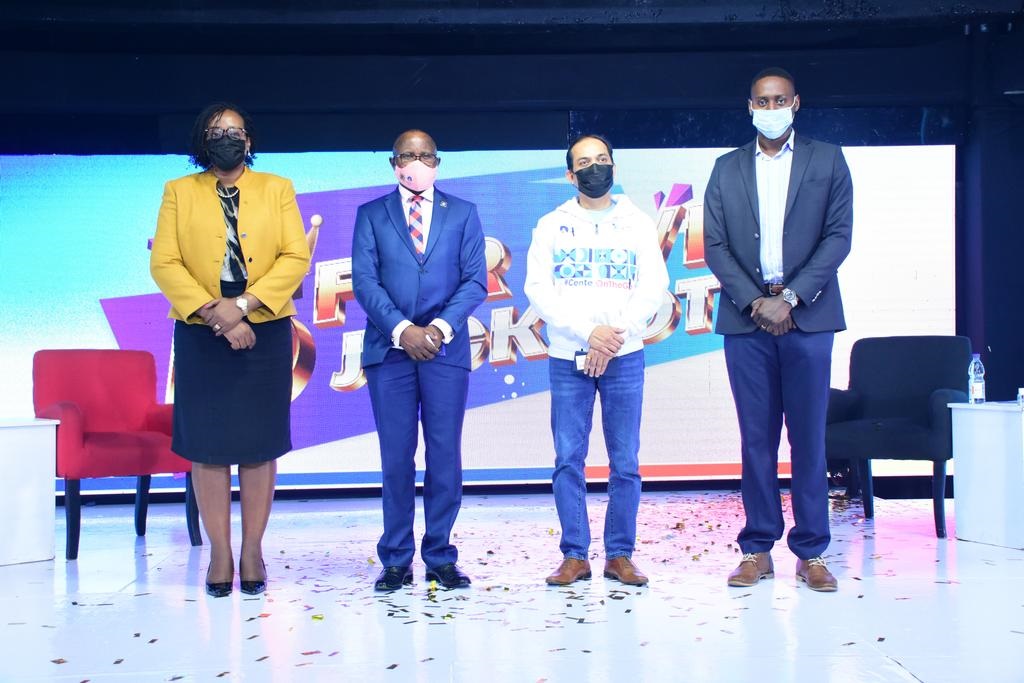
1. Left-Right: Beatrice Lugalambi, the Centenary Bank General Manager Corporate Communications and Marketing, Mr. Fabian Kasi the Centenary Bank Managing Director, Mr. Dhimant Shah the Craft Silicone CEO, and Mr Ron Kawamara the Jumia Uganda CEO pose for a photo at the launch of the 5 for Five Jackpot campaign. Fabian says the bank’s winning streak is rooted in the bank’s strategic resolve to continuously deliver value to customers and all other stakeholders.

This was largely driven by a 17 per cent rise in earnings from interest on loans and advances (Shs428.2 billion to Shs500.7 billion); an 18 per cent rise in interest earnings from investment securities, (Shs78 billion to Shs92 billion), as well as a 43 per cent rise in fee and commission income from Shs130.4 billion to Shs187.1 billion.

As a result, profit after tax increased from Shs 161.2 billion in 2020 to Shs 211.5 billion in 2021 registering an increase of 31.2 per cent.

The 2021 performance is the bank’s record highest in the bank’s 29-year history. This also comfortably seals the bank’s position as the second-biggest bank by deposits, lending assets and profitability.

However, Centenary Bank is the largest indigenously majority-owned bank—the Registered Trustees of the 19 Catholic Dioceses in Uganda own 41 per cent of the bank, while The Registered Trustees of the Uganda Episcopal Conference, own 31.7 per cent. Other major shareholders are: Solidarite Internationale pour le Development et l’Investissement (SIDI) 10.5% and Triodos Sicav II-Triodos Microfinance Fund (7.5%) and Triodos Custody BV (7.5%).

Facts Behind the Figures

In a media commentary accompanying the results, Fabian Kasi, the Managing Director of the bank attributed the firm growth to a “resolve in continuously delivering value to our customers and all stakeholders. 

“We leveraged technology, people and good relationships, to deliver good performance, despite the year’s challenging operating environment,” he said, referring largely to the COVID-19 pandemic which was prevalent during the first half of 2021 and the economic and social lockdown which followed.  

“The registered growth in 2021 in profits and total assets amidst slackness in the Economy reflects our customer-centric value proposition delivery. This was guided by the Bank’s Strategy, supported by investment in technology, lean processes and Risk Management,” he added.  

Digital Advancements, Widening Agent Banking Network and Innovations

Fabian, said that in 2021, the bank had revamped its CenteMobile, and its mobile banking proposition, adding to it the CenteOnTheGo function, a self-service solution which enables customers to open savings accounts for themselves anywhere through a less tedious process with minimum requirements. Other additions to the CenteMobile platform include a service for direct data purchase for MTN customers, as well as fundraising and collection services, that allows customers to make direct contributions to registered causes for organizations, associations, churches, and communities.

“Centenary Bank is leading on Mobile banking connections, at 41.6% of industry connections. We closed the year with over a quarter of customer transactions being carried out on the mobile banking platform i.e., CenteMobile,” revealed Fabian. `

Fabian Kasi, the bank’s Managing Director since 2010 has presided over the bank’s rosiest years in its 29-year history. During his time, the bank, with deep roots in the Catholic Church, has prospered to become the second-biggest bank in the country and the No.1 indigenously owned.

Fabian said the bank had introduced CenteMobile enabled withdraws via Cente Agents as well as Digital Access for the elderly receiving funds from the Government of Uganda’s Social Assistance Grant for Empowerment (SAGE) program. Funds can easily be accessed by the elderly, through any of Centenary Bank’s 5,500 agents around the country. Agent Banking.

On the Agent Banking platform, he said, Visa Cardholders were now able to withdraw cash, check balances and mini statements via banking agents. Customers are also now able to deposit cash on their Pre-Paid Visa card.

“Centenary Bank is leading on Agent Banking with 42.3% of the agents in the industry. We closed the year with a third of customer transactions being carried out through agent banking,” Fabian reiterated.

On the cards front, Centenary Bank, in 2021 introduced the Mastercard Platinum Card to further enable high-network customers to enjoy local and international transactions as well as e-commerce inclusive services.

He said the bank controls 31.5% of the Mastercard Platinum Cards on the market.

Increased footprint, innovations, social investments and peer recognition

Fabian also said that the bank had expanded its branch and ATM spread, closing 2021 with 77 branches.

“In 2022, we added 3 more branches in Gayaza, Kabwohe and Kihihi bringing the total to 80 Branches. The number of ATMs has also grown from 188 to 191,” he intimated.

He also said that reaching out to the underserved remains fundamental to Centenary Bank.

“In 2021, we increased the number of youths, women, refugees and customers in the rural areas. The youth increased by 15%, women by 21% and customers in rural areas by 19%; refugees by 23% and the number of accounts by 15%,” he said.

In 2021, Centenary bank, working together with Prudential Uganda, introduced the Diaspora Funeral Cover- a Funeral and Repatriation Insurance cover that provides financial support to the families living and working in the diaspora, in the event of the untimely demise of a customer.

The bank had also introduced the CenteYouth Loan, a special loan product that targets the youth with special benefits for youth in business.

“Our mandate to make banking a one-stop-shop remains. We’ve invested in research and made innovations in response to customer expectations and the changing times,” said Fabian.

 All these innovations attracted a number of industry and peer accolades such as The Financial Reporting Awards 2021 where the bank was honoured with 3 accolades, namely: Silver Award – Integrated Report of the Year; Winner of the Presentation & Communication Award as well as 2nd Runner Up – Commercial Banking Services category.

In the Digital Impact Awards Africa, the bank walked away with the Best Banking Innovation Excellence for the CenteOntheGo Service; Best Community / MFI Banking Innovation Excellence and Silver Award as the Digital Brand of the Year.

Brand Africa recognized the bank with two awards, namely: The Most Admired Ugandan Financial Services Brand and One of the most helpful brands during the COVID-19 pandemic.

Sustainability and the future

Fabian said that moving forward the bank would steady execution of its strategy, which focuses on innovation, digitization, managing risk, embracing change and sustainability will be key for our future.

“Our 2022 Strategic Objectives are focused on customer centricity, efficiency, process automation, sustainability, learning and growth. In the pursuit of the above, we are desirous to provide a nurturing environment for our employees to enhance their productivity,” he said.

“I extend my appreciation to all stakeholders for their confidence and trust bestowed in Centenary Bank. Thank you for being part of Our Bank in 2021. With our strategy, investment and relationship with you, we believe 2022 will be a better year,” he concluded.

Stories Continues after ad

When a state-owned dev’t bank turns into a vampire and receivers/managers turn into villains — the story of Mubende Parents School, UDB and receivers, Kabiito Karamagi and Joshua Ogwal

Court Hammer

How Uganda Development Bank and its appointed receivers, Kabiito Karamagi and Joshua Ogwal, illegally dispossessed Edward Kasole Bwerere Lwanga of his money and school in Mubende town. CEO Magazine analyses the case;

Justice Richard Wejuli Wabwire, of the Commercial Court, has found that Uganda Development Bank (UDB), unlawfully sold the property of their client, Mubende Parents School; illegally appointed Kabiito Karamagi and Joshua Ogwal of Ligomarc Advocates as receivers/managers, to recover a debt that did not exist. Their unlawful appointment aside, the two receiver/managers, according to court, also went ahead to unlawfully attach monies on the school’s bank accounts as well as unlawfully dispose of the remaining properties of the school and as if that was not enough, they misused and failed to properly account for the funds ‘grabbed’ from Mubende Parents School.

For this, the Ugandan taxpayers who own UDB as well as the two lawyers have been ordered to compensate the owners of Mubende Parents School, the equivalent of the current market value of the properties they illegally sold, less the Shs 716,384,349 that the school owed Uganda Development Bank.

Given that the school was valued at Shs1,270,000,000 in 2011 at the time of borrowing, and thereafter, the dispossessed owners had invested in the Shs620,000,000 they borrowed from the bank, the current value of the school could have since tripled, putting the value of the compensation at anywhere around Shs2 billion.

Court also dismissed a claim of Shs116,384,349 by UDB on the school, which claim had been used as a basis to appoint the receivers and managers to recover the said claim and associated costs and fees and said that in the first place, the Shs116,384,349 was overstated by at least Shs60 million and secondly the said claim would not have arisen if UDB had not deliberately underpriced the mortgaged property by at least Shs129 million. Justice Wejuli Wabwire then proceeded to declare that since there was no money owed by Mubende Parents School, the decision to progress the school into receivership and therefore the appointment of the two Ligomarc lawyers, Kabiito Karamagi and Joshua Ogwal, as receivers/managers, was unlawful. 

The Judge, therefore, ordered the lawyers to refund the Shs150,000,000 that they transferred from the school’s account in Equity Bank Limited, as well as the UGX22,500,000 that they transferred from the school’s account in Centenary Bank, to purportedly pay for a debt that has now been found by the court to be non-existent. The judge also faulted the two lawyers for misusing the money and failing to account for it appropriately both to court and to Mubende Parents School, the owners of the money and to whom they owed a fiduciary duty as receivers/managers.

To ‘atone’ for their unlawful misconduct, over and above compensating the school owners the value of their illegally sold building, UDB and its wrongfully appointed receivers/managers- Kabiito Karamagi and Joshua Ogwal, have been ordered to pay Mubende Parents School Shs 50,000,000/= in general damages and Shs10,000,000 in exemplary damages. The damages will be charged interest, at 8% per annum from the date of judgment till payment in full.

However, in a comment to CEO East Africa Magazine, both UDB and the lawyers said they will appeal the ruling.

“Uganda Development Bank Limited (UDBL) is in receipt of the Judgement in the Matter of Mubende Parents School Ltd Vs UDB and 2 others. As one of the Defendants, UDBL is dissatisfied with the judgment of the High Court and is preparing an appeal to the Court of Appeal,” UDB said in an emailed statement on April 1st 2022.

“We will be appealing the decision in the Mubende parents case,” Kabiito Karamagi, wrote in an email to CEO East Africa Magazine.

Mubende Parents School was owned by Edward Kasole Bwerere Lwanga the former founder and proprietor of Kampala Parents School.

Background: How it all started

Mubende Parent’s School on 28th March 2011, applied for a loan facility of Shs620,000,000 from UDB, a government-owned bank and offered as security, land and buildings comprised in leasehold Register 3071, Folio 12 Plot M46; Leasehold Register 3071, Folio 13 Plot M47 and Leasehold Register 3071, Folio 14 Plot M48 at  Mubende. A legal mortgage was executed and a collateral debenture was also signed and executed in favour of UDB.   

At the time of the Mubende Parents School applying for the loan, the property was valued by CB Richard Ellis (CBRE) as having an open market value of Shs1,270,000,000 and a forced sale value at Shs740,000,000.  Around 2015, the loan went bad and UDB advertised the properties for sale, prompting Mubende Parents School to file suit CS No. 59/2015 at Nakawa against UDB stopping the sale.

The suit was resolved via a consent judgement dated 15th May 2015 wherein Mubende Parents School agreed to pay UDB a sum of Shs 766,384,349/= within four months. Thereafter, Mubende Parents School paid UGX50,000,000/ vide cheques dated 14th May 2015, leaving an outstanding balance of Shs 716,384,349/= and failed to pay the remaining balance within the stipulated time.

Curiously, upon Mubende Parents School’s default on the Consent Judgment, UDB through SM Calhan Ltd revalued the school, but this time around, the open market value had gone down to Shs930,000,000 with a forced sale value of Shs605,000,000!

On the 26th of August 2015, UDB, without readvertising, sold the school’s land and buildings to a one, Muramira Alexander for a mere Shs610,000,000.

The sale agreement, on behalf of UDB, was singularly signed by a one  Patrick Oketta, instead of the required two signatories, leaving out the second signatory, a one Millie Kasozi, something that the judge says made the agreement and the sale invalid. 

As if undervaluing Mubende Parents School’s property was not enough, UDB was not satisfied and still went after Mubende Parents School’s remaining properties and cash at the bank, claiming that even after selling the school, there was an unpaid balance of Shs225,093,907, being a balance on the loan (Shs11 6,384,349) as well as auctioneer’s fees and security charges.

To collect this allegedly outstanding balance, on 25th September 2015, UDB further issued a Notice of Appointment of Joshua Ogwal and Kabiito Karamagi as receivers/managers of the school. The notice was signed by UDB’s Bank Secretary, Dorothy Ochola and registered with the Registrar of Companies on the 5th of October 2015. The deed poll appointing the receivers/managers was again unlawfully singularly signed by a one Patrick Oketta, which practically made the appointment illegal as well.

The illegality of their appointment notwithstanding, the court found out that, the receivers/managers, Kabiito Karamagi and Joshua Ogwal- collected a total of Shs182,5000,000 in cash held at the bank amounting to Shs172,500,000) and Shs10,000,000 from underpricing other movable assets, but only used 19% of this money to settle the debt. The rest was used for other expenses that the court said were wasteful.

Mubende Parents School challenges indebtedness and the appointment and conduct of the receivers

After the sale of the school and appointment of receivers/managers, Mubende Parents School went to court vide Civil Suit No. 662 of 2015) seeking the court to declare that the sale of Mubende Parents School’s mortgaged property by UDB was done unlawfully.   

The school also asked the court to declare that Mubende Parents School was not indebted to UDB and therefore the progression of the school into receivership and the appointment of the receivers/managers was unlawful. The school also challenged the conduct of the receivers/managers, whom they say underpriced their assets, misused and failed to account for the realised funds, amongst other misconducts.

The court was also asked to declare that cash held on Mubende Parents School’s Bank accounts in equity Bank Limited vide account No. 103020044187 and Centenary Bank Ltd vide account No. 901600785 belonged to Mubende Parents School and should never have been attached by the receivers. 

They also asked Court for  General, special, punitive and aggravated damages, interest and costs.

Mubende Parents Schools were represented by Kaggwa & Kaggwa Advocates while UDB and the receivers were represented by Kalenge, Bwanika, Kisubi & Co. Advocates.

Mubende Parents School filed two witness statements deponed by Edward Kasole Bwerere Lwanga, a director of Mubende Parents School and Adam Kakande, the Mubende Parents School’s auditor.

The defendants also filed two witness statements deponed by Emmanuel Kwihangana, the Senior Monitoring and Recoveries Officer with UDB and Joshua Ogwal, the 2nd Defendant. All the witness statements were admitted on the Court record. The defendants called a third witness whose evidence was admitted orally. All the witnesses were accordingly cross-examined. The Parties all filed written submissions. 

Court makes its rulings, finds UDB and its receivers guilty of negligent and unlawful misconduct

In preliminary objections, the defendants said that since the matter being raised by Mubende Parents School had been raised in an earlier suit (HCCS No. 59 of 2015) which matter was resolved by mutual consent, which among others meant that Mubende Parents School had lost the right to re-litigate the case. The judge however dismissed the preliminary objections, saying they lacked merit as what was at trial was not the indebtedness but rather the illegal sale, the illegal appointment of the receivers and their subsequent negligent and unlawful misconduct.    

“I find no merit in the preliminary objections raised by the defendant and they are accordingly dismissed,” Justice Wabwire ruled.

On whether the sale of Mubende Parents School’s property was lawful, the judge agreed with the school’s lawyers that the omission to re-advertise after the initial intended sale had been stayed and instead, selling by private treaty combined with the sale at what was an undervalued price and the improperly executed Sale Agreement, all made the sale illegal.  

Justice Wabwire ruled that while by consent Judgment, Mubende Parents School agreed to pay UDB a sum of Shs766,384,349/= within four months and that since pursuant to paragraph 2 of that Consent, Mubende Parents School had paid, Shs50,000,000,  leaving an outstanding balance of Shs716,384,349, this amounted to rectification of the default and therefore, fresh notices in terms of section 19 of the Mortgage Act ought to have to be served.

“Section 28(1)d) of the Mortgage Act, 2009, provides that where a mortgagee becomes entitled to exercise the power of sale, that sale may be by public auction, unless the mortgagor consents to a sale by private treaty,” ruled Court, adding: “ It is this Court’s finding and conclusion that the omission by the 1st defendant (UDB) to comply with the procedural requirements stipulated under S.19 of the Mortgage Act, after a stay of the initial sale had been granted, invalidated the purported sale.”

Court also agreed with Mubende Parents School’s lawyers that while Mubende Parent’s School was valued at Shs1,270,000,000 with a forced sale value of Shs740,000,000 in 2011, nearly 5 years later the same property couldn’t be assigned a forced sale value of Shs605,000,000, yet the school had undergone expansion. 

“From the evidence and submissions on record for Mubende Parents School, I am convinced that the value of Mubende Parents Schools property was understated. The shortfall of Shs129m between the 2011 forced sale value and the price at which the property was sold is significantly out of an acceptable margin of error. The possibility of getting a better price was not adequately explored. The sale at Shs610, 000,000 was indeed an understatement of the prevailing market and forced sale value of the property,” ruled the judge.

Court also voided the sale, saying that Patrick Oketta, who signed the Sale Agreement which concluded the purported sale, did not have the power to sign the Sale Agreement alone without another signatory, Millie Kasozi, named in the bank’s Power of Attorney, contrary to Article 89 of UDB’s Articles of Association which required that at all times, instruments with seals shall be signed by two individuals on behalf of the Bank. As such, the Sale Agreement was not properly executed by those mandated to do so, which made the sale unlawful. 

“In the instant case, there was a deviation from the mandate of the Power of Attorney when Oketta executed the Sale Agreement alone without Millie Kasozi the second donee. This was a fatal irregularity which renders his actions null, void and ineffectual and the Agreement unlawful. Premised on all the foregoing findings, this Court finds that the sale of Mubende Parents School’s mortgaged property by UDB was unlawful,” ruled Justice Wejuli Wabwire. Issue No.1 is answered in the affirmative.” 

Was Mubende indebted to UDB and if so, by how much?  

While UDB and its lawyers contended that even after the sale of the school’s properties, Mubende was still indebted to the bank to the of Shs225,093,907, which indebtedness led to the appointment of the receivers/managers to recover the said sum, the court established that the alleged indebtedness had been overstated by Shs60 million. 

Court agreed with Mubende Parents School’s lawyers that, had the sale of the mortgaged property been properly advertised and sold to the highest bidder and had UDB’s deliberate actions that resulted in the lapse of time, eventually gave rise to the claimed interest and costs of security, the said indebtedness would not have arisen.  

“Since there was no re-advertisement after the stay of the initial recovery process, the possibility of getting better value propositions was lost,” ruled the judge, adding that had the receivers/managers properly utilized the school’s money held in the bank accounts, all indebtedness would have been settled.

“According to clause 4 of DEX27, the Receiver’s Preliminary Report on the state of affairs of Mubende Parents School in Receivership, Joshua Ogwal stated that Mubende Parents School had cash at bank totalling Shs150,000,000/. The cash in Bank of Shs150,000,000/ and the sum of Ugx. 10,000,000/ from the sale of business assets received by the receivers made a total of Ugx. 160,000,000/ which the Receivers never accounted for. This was enough money to clear the outstanding balance of 106,384, 349,” the court further said.

Court also said that UDB and the receivers/managers failed to adduce evidence that Shs118, 709,558/ was spent as additional costs as Auctioneer’s fees and security charges.

“The defendants never adduced any evidence to show how much fees were paid to the auctioneers. Premised on the foregoing, all efforts by the defendants to prove a claim against Mubende Parents Schools come to nought. The Defendants have not been able to prove that they were entitled to the sum claimed in their counterclaim,” Justice Wejuli Wabwire ruled, adding: “The finding and conclusion of this Court, based on the foregoing, is that Mubende Parents School is not indebted to the defendants at all.”

The judge also ruled that the appointment of Joshua Ogwal and Kabiito Karamagis as receivers was unlawful because, among others, there was no debt to recover hence no default to warrant the appointment of the Receiver.

“The conclusion that Mubende Parents School was not indebted to the defendants is a foregone conclusion of this Court. Had the Defendants (UDB) been diligent in managing Mubende Parents School’s matters, it would have been apparent that when they decided to appoint a Receiver, there was actually no debt to recover and hence no justification for their action in appointing the Receiver. In consequence, Court finds the appointment of Joshua Ogwal and Kabiito Karamagis as Receivers was unlawful since there was no debt to recover given that the money on Mubende Parents School’s Bank account exceeded what would have been required to clear the outstanding obligation after the sale of his property,” the judge reiterated.

Curiously, according to the ruling, Joshua Ogwal, one of the lawyers had a difficult time trying to explain how the money attached from the school’s accounts and transferred to Ligomarc Advocates bank accounts was used, often tripping himself on record, leading the judge to conclude that the receivers had neglected their fiduciary duty. 

“According to clause 4 of DEX27 (Defence Exhibit 27), the Receiver’s Preliminary Report on the state of affairs of Mubende Parents School in Receivership, the 2nd defendant (Joshua Ogwal) stated that Mubende Parents School had cash at Bank totalling to UGX150,000,000. This cash in Bank and the sum of UGX10,000,000/from the sale of business assets received by the Receivers made a total of UGX 160,000,000,” observed the judge, adding: “DW1 (Joshua Ogwal) contradicted himself by stating that the only money they received from Mubende Parents School was a total of Ugx. 160,000,000 and again stated that it did not get to UGX160,000,000 but rather was UGX121,710,663. Out of that, UGX13,783,000 was sent to UDB leaving a balance of Ugx. 107,288,663.”

“The 2nd defendant (Joshua Ogwal) and the 3rd defendant (Kabiito Karamagi)  as Receivers had a duty to exercise their powers in the best interests of Mubende Parents School for whom they were appointed. As noted earlier, upon the sale of Mubende Parents School’s mortgaged property at a sum of UGX 610,000,000l there was an outstanding balance of UGX106,384,349. The Receivers’ fundamental duty should have been to clear that outstanding balance. No convincing explanation was proffered as to why the Receivers only sent a sum of UGX13,783,000 to the 1st defendant (UDB), leaving a balance of UGX107,288,6631 yet the same amount would have cleared all Mubende Parents School’s indebtedness to UDB. The choice to spend the sum of UGX 107,288,663 on the above expenses instead of first clearing Mubende Parents School’s indebtedness was in total disregard of Mubende Parents School’s plight and prejudicial to Mubende Parents Schools’ interest. The defendants breached this duty, the duty to act in the best interests of Mubende Parents School to apply his assets towards resolving the indebtedness. The Receivers’ actions transcended mere negligence and were unlawful,” he concluded.

Final orders and remedies for Mubende Parents School

Justice Wejuli ruled that the “the appointment of Joshua Ogwal and Kabiito Karamagi as Receivers was unlawful since there was no debt to recover, given that the money on Mubende Parents School’s Bank account exceeded what would have been required to clear the outstanding obligation after the sale of his property.”

He also ruled that the “advertisement of Mubende Parents School’s business as under Receivership was unlawful because, upon sale of the mortgaged property, the amount from the sale was sufficient to extinguish the whole debt.”

He also ruled that the 2nd defendant’ (Joshua Ogwal) and 3rd defendant’ (Kabiito Karamagi) actions as Receivers/Managers of the Mubende Parents School’s business were laced with illegalities and therefore unlawful.

He also ordered that the 2nd defendant (Joshua Ogwal) and 3rd defendant (Kabiito Karamagi) as Receivers, the illegality of their appointment notwithstanding, have since completed their tasks and the receivership is extinguished, but that their actions, together with those of UDB, had “disposed of Mubende Parents School’s property without following the proper procedure as stipulated under the Mortgage Act and the Regulations.”

“The defendants are in consequence jointly and severally ordered to compensate Mubende Parents Schools, the equivalent of the current market value of the property comprised in Leasehold Register Volume 3071, Folio 12, Plot M 46, Leasehold Register Volume 3071, Folio 1 3, Plot M47, Leasehold Register Volume 3071, Folio 14, Plot 48 land at Mubende illegally sold by UDB less the money agreed under the consent,” he ordered.

“Mubende Parents School is not indebted to the 1st Defendant at all,” he further ordered.

He also ruled that the prayer for a permanent injunction against the Defendants restraining them from taking over Mubende Parents Schools Bank Accounts and Assets was overtaken by events because the Receivers already took over Mubende Parents School’s Bank accounts and disposed of the assets. Nonetheless, the court granted Mubende Parents School UGX50,000,000 in general damages as well as UGX10,000,000 in exemplary damages at an interest rate of 8% per annum from the date of judgment till payment in full and costs to the suit.

He also ordered that “all the money held on Mubende Parents Schools Bank accounts in equity Bank Limited vide account No. 103020044187 and Centenary Bank Ltd vide account No. 901600785 belongs to Mubende Parents School” and should therefore be refunded.  

“Having found that the sale was unlawful, I find no good reason to deny Mubende Parents School costs of the suit and I accordingly award the costs of this suit to Mubende Parents School,” concluded Justice Wejuli Wabwire.

Source: CEO Magazine

Stories Continues after ad

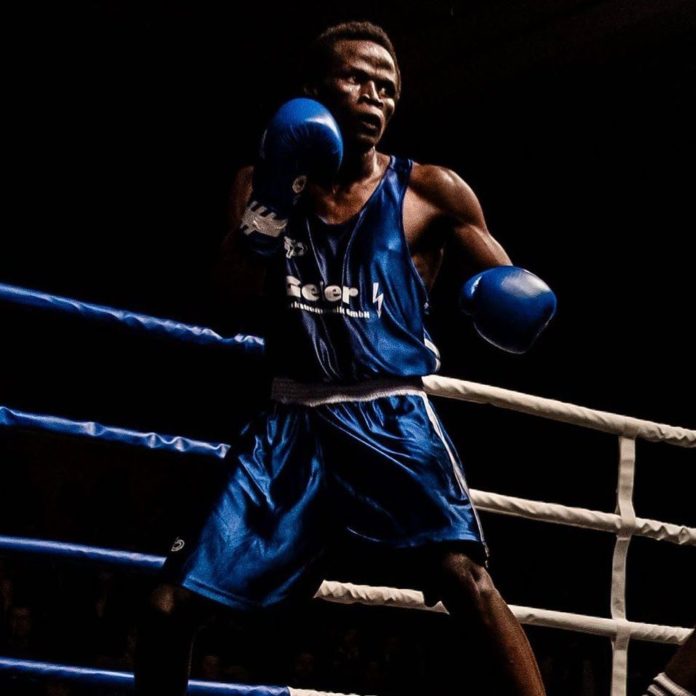
Meet Ugandan boxer Odoch John Fisher

Odoch John Fisher is a professional boxer who started his career in the UPDF boxing side.

He represented Uganda in the African Boxing Championship where he displayed a high performance at the quarter finals to achieve a world card from International boxing organization to represent the country in World Youth Boxing Championship with Musoke Regan and Mazida Bunya.

Currently he is boxing for Team Hessen where he participated in Germany championships winning silver medal at national games and excelled to Bundesliga boxing in Team Hessen at the age of 18.

Odoch is born to Oroma Jesca and Oyoo Samuel, who was also a boxer at UPDF boxing clubs in the late 90s. He was brought to boxing by his uncle while he was 8 years old.

He was to represent Uganda in the 2017 youth common wealth games in Bahamas but because of financial stabilities he couldn’t go for the games.

The young German-based boxer fought at the 97th German Championships U22 with a brilliant performance and won the silver medal.

From October 29th, 2019 to November 2nd, 2019 the Germany boxing elite of state associations met and showed the audience top class sport and exciting fights. Also present was 18-year old Odoch John with his trainer Jakob Sawazki.

With a record of 13 wins in 37 fights so far, John traveled to Rostock as part of the Hessian boxing association.

Stories Continues after ad

Gilly Mu set to drop a new video ‘Waragi’

Gilly Muwanga who is known by his stage name as Gilly Mu is a Ugandan Dancer, music artist, singer and songwriter who is one of the fast rising music artists in Diaspora representing Uganda.

He was born in the south region of United Kingdom in capital city of London on the 16th of January in the year 1990. 

He studied at Italia conti and British school where he was pursuing a Bachelors of Arts in Arts degree majoring in Music and Literature and later graduated successfully after completing the course.

He started his music career a few years ago and since then he has never stopped releasing songs that are dominating the airwaves both on television stations and also the radio stations.

He said that he started doing music simply because he had a lot of passion for it and he has been inspired by T-Pain, Micheal Jackson and James Brown.

Gilly Mu is currently signed to GMM which is a management company for music artists. 

GILLY MU came into the limelight after releasing his hit song called ‘Waragi’ which went viral and has been played by several television and radio stations many times.

He has released songs with Pallaso, Durdemdartune and many others out there. Gilly Mu is an inspiration to all the youths especially young boys out there who would love to join the entertainment industry but most especially the music industry or dance industry

Stories Continues after ad
MPs oppose funding for Presidential Initiative on Model Villages

Hon. Ignatius Wamakuyu Mudimi was not pleased with the proposal, saying it is a duplication of programmes

Legislators on the Budget Committee have opposed a proposal to provide additional funding to facilitate the presidential model villages’ project in the next financial year.  

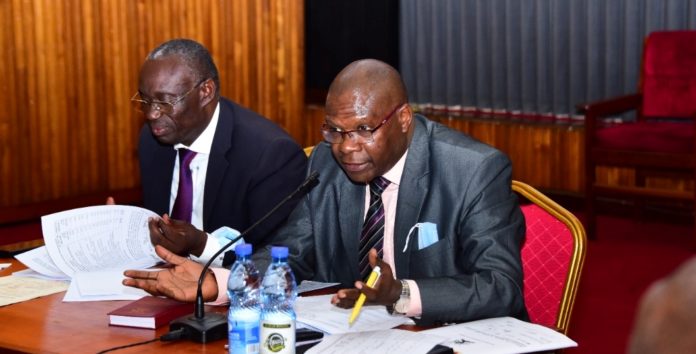
The chairperson of the Committee on Presidential Affairs, Jesca Ababiku, who had on Thursday, 28 April 2022 appeared before the Budget Committee to defend the proposed sectoral budget estimates and unfunded priorities for FY2022/23, laid a request seeking for an additional Shs14.2 billion to effectively facilitate the 27 model villages in the country.

However, the Budget Committee that was chaired by Hon. Ignatius Wamakuyu Mudimi was not pleased with the proposal, saying it is a duplication of programmes, considering that government is in the pipeline to implement the Parish Development Model (PDM). 

“The committee wants us to allocate more money to State House to facilitate the 27 presidential model villages, yet the President is implementing the Parish Development Model. Let us not contradict our policies; we cannot be talking about PDM and model villages,” Amolatar Woman MP, Agnes Atim Apea, said.

The Presidential Initiative on Model Villages is a project under the poverty alleviation initiatives in State House, which started in 2004 with the objective of creating model farms in various districts. This was in a bid to transform poor communities into self-sustaining communities through best practices of agriculture, market-led production and value addition.

According to the Medium-Term Expenditure Framework (MTEF) for FY 2022/23, Vote 002 (State House) has been allocated Shs 2 billion out of the required Shs 16.2 billion to facilitate the 27 model villages, leaving a funding gap of Shs 14.2 million.

In defence of the project, the Presidential Affairs committee chairperson, Ababiku, said there is need to ensure continued sustainability of the model villages because they are tested and have proved successful.

“These are presidential demonstration learning centres and anyone can access these centres. So, we cannot kill this initiative because of PDM which is still a new initiative and whose success has not yet been measured,” Ababiku said.

Her efforts, however, fell on deaf ears as MPs on the Budget Committee remained opposed to her request.

West Budama North East MP, Fox Odoi-Oywelowo, who rejected the proposal, said there was equally no need to provide Shs 3 billion to the Directorate of Ethics and Integrity under the Office of the President to develop anti-corruption laws, policies and instill morals in the citizenry.

“This country does not need more money to form more laws to fight corruption; the laws we have are enough. If a person is asking for more money to form laws and policies, then that person is corrupt. This money should be reallocated to another sector,” Odoi said.

Whereas the Office of the President is seeking Shs 3 billion to mitigate corruption under the Directorate, only Shs 500 million has been allocated in the FY 2022/23, leaving a funding gap of Shs 2.85 billion.

Stories Continues after ad
Blacks Power, Maroons, Kyetume promoted to Uganda Premier League

Uganda Premier League logo

Blacks Power FC, Maroons FC and Kyetume FC are the three teams that have been promoted to next season’s StarTimes Uganda Premier League.

The aforementioned teams won their respective games on the final day of the 2021/22 StarTimes FUFA Big League season to attain the ultimate target.

In Lira, Blacks Power FC needed to come from a goal down to edge Luweero United FC at a soggy Akiibua Stadium following a heavy downpour on Thursday afternoon.

Brian Kone fired Luweero United into the lead a few minutes into the second half but a double from Michael Siwu ensured Blacks Power staged a comeback to eventually claim maximum points.

The win meant Blacks Power topped the log on 39 points after 20 games, finishing a point above Maroons FC who won 5-0 away to Nyamityobora FC.

The Prison Warders survived an early scare when goalkeeper Emmanuel Akol saved a penalty before Fred Amaku, Belmos Opio, Solomon Walusimbi, Hadadi Kambugu and Bruno scored a goal apiece.

The third promotion slot was taken by Kyetume FC who defeated Kataka FC 3-2 at Mbale Municipal Stadium.

Kyetume led 3-0 at the break with goals coming from Ezra Bida, Ezra Kaye Kizito and Sharif Ssaka scored a goal apiece.

However, Kataka FC attempted to mount a comeback but could only score two goals in the second half through Emmanuel Mukisa and Francis Odongo. Kataka finished the season in 4th place on 36 points.

In the relegation mix, Ndejje University won 5-0 at home against Kitara FC to survive relegation. The win lifted them to 26 points, one above Proline FC who got relegated.

Luweero United despite losing 2-1 did not get relegated because of a superior goal difference. They had (-4) compared to Proline’s (-7).

The game between Calvary FC and MYDA FC slated to take place at Greenlight Stadium in Arua did not take place because the latter did not show up.

Proline therefore joined MYDA FC and Nyamityobora FC as the three teams relegated to respective regional Leagues.

Stories Continues after ad

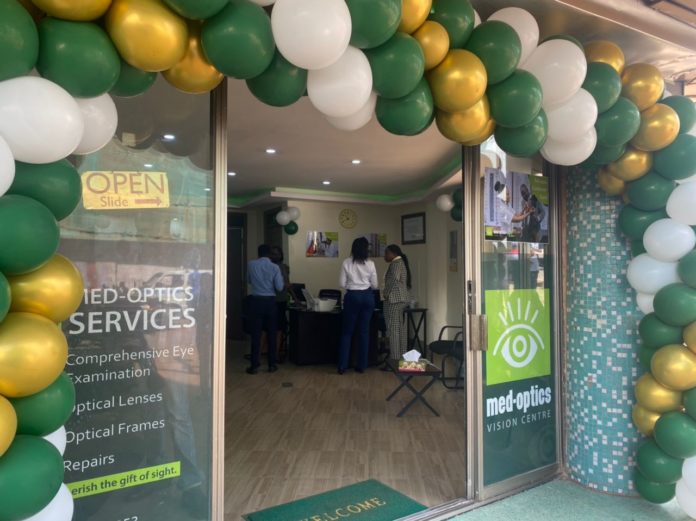
Med-Optics re-launches its branch on Kampala Road

As a part of celebrations to mark 20 years of optical service, Med-Optics Ltd has re-launched its newly refurbished branch on Mabirizi, Kampala road.

Established in 2002, Med-Optics remains the preferred optical centre for many clients in the central business district. The Branch has qualified optometrists registered with the Ministry of Health’s Allied Health Professionals Council. Med Optics has received over 70,000 patients from various parts of the Country.

Med-Optics Managing Director Anguyo Dralega, an optometrist who practiced in the UK for several years before returning to Uganda in 2001, said this of the new-look centre.

“At Med-Optics, we believe that our clients deserve the best optical care available, so we invest in optical instruments to provide accurate and reliable prescriptions, we invest in our people through ongoing professional development and training, and we carefully select high quality lenses and frames to maximize the clients’ vision and comfort. It is important to us,” he said.

Med-Optics is able to achieve all of this at a low cost because it has grown over the previous two decades to become Uganda’s largest optical health firm, with nine locations and an optical laboratory that produces a variety of bifocal and progressive lenses. In addition, the organization imports a wide range of lenses to meet every optical demand, even those for complex cases that require specialized solutions.

The refurbished branch provides clients with comfort and professionalism, as well as the same value for money options, with single vision lenses starting at Shs 62,000.

Stories Continues after ad

Standard Chartered Bank, Salam Charity donate to underprivileged communities during Ramadan

Stanchart and Salaam Charity representatives pose for a photo with Home of Joy (Salvation Army) beneficiaries after making a donation

Standard Chartered Bank Uganda together with Salaam Charity have made donations of an assortment of items including food items to support underprivileged communities as they seek to give back during the holy month of Ramadhan.

The four beneficiary communities include UGANET in Ntinda, Naguru Remand Home, Home of Joy (Salvation Army) located at Katanga and UMCA at Mengo.

In line with the Bank’s brand promise “Here for good” and STAND to ‘Lift participation’, the Bank is committed to improve the lives of people and their communities. This assistance is earmarked to help meet the needs of the underprivileged children and their caretakers.

Standard Chartered Bank has over the past 10 years joined the Muslim community to celebrate Ramadhan by hosting iftar dinners and having its employees volunteer to support several initiatives.

While handing over the donation, Margaret Kigozi, the Head, Corporate Affairs, Brand and Marketing Standard Chartered Bank Uganda said: “Standard Chartered Bank Uganda is very pleased to extend this donation to these organizations. Ramadan holds a unique position in our community as it is a special time of the year where believers undertake generous deeds.”

She said the Bank believes in the principles this holy month advances and we recognize our responsibility and role to support the communities where we do business and therefore committed to supporting various communities by living up to our Brand Promise ‘Here for good’, which is hinged on the strong belief ‘that only by doing good can we as a Bank become truly great’.

“We will continue to seek to be a force for good by being a responsible company, promoting and investing in the sustainable socio economic development in the community.” She said

Mrs. Zipula Wasike, the head of Home of Joy applauded the bank and Salam Charity for thinking about this in this critical period where prices of essential commodities have gone high.

The organisation looks after disable children from all over the country in a bid to see them become self reliant.

Dr. Karim Kaliisa, the Managing Director Salam TV Uganda said that was the third time that they were visiting the organisation.

“It is our role to point where there is need as Salam Charity. These Children are under privileged and therefore need attention every other time and you are not getting tire,” he said.

Stories Continues after ad

Earth Day: Tackling the Plastic Crisis Together

Earth Day Clean up

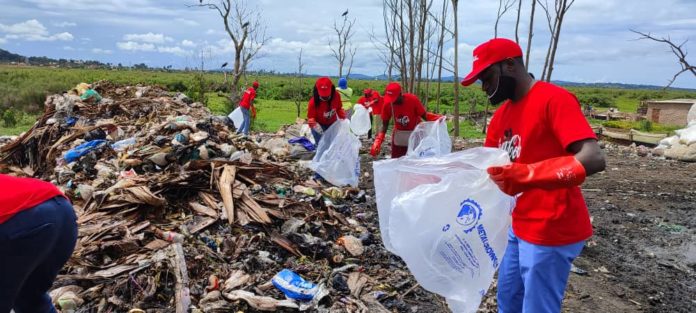
A Public-Private coalition made Ugandan history on Earth Day 2022 by collecting over16.26tonnes of plastic waste in one day, in an environmental cleanup that covered five districts countrywide.

The partnership consisted of Kampala Capital City Authority (KCCA), Coca-Cola Beverages Africa in Uganda through Plastic Recycling Industries, and Global Living Institute through its Kabale Recycling Centre.

Together, the coalition organized a series of cleanup activities to celebrate Earth Day by practically cleaning up the earth under the theme ‘Invest in our Planet’. The coalition focused on PET waste collection in Kampala, Kabale, Mbarara, Masaka and Gulu districts.

“Our ethos as a company is to do the right things as we refresh our consumers and make the community a better place for all. Our communities will unquestionably be better if we embed a culture of proper disposal of waste such as PET. At Coca-Cola Beverages Africa we are committed to encouraging this proper disposal by supporting collection through recycling,” said General Manager Melkamu Abebe.

Moses Twahirwa, Director of Community Action at Global Living Institute, said that for the last four years, the Institute has worked with Entusi Resort & Center, the Kabale Municipal Council and partners like Plastic Recycling Industries to set up plastic waste and recycling centres in the heart of Kabale town.

“As a result, close to 10 tons of plastic waste are collected in the town by unemployed youth and poor women – mainly those who have been able to earn a living and support their families because of selling the waste plastic. The town has been rid of unnecessary plastic waste, as the locals earned cash in turn, coupled with the collection centre providing employment for the youth and women,” Twahirwa said.

“According to the Uganda Bureau of Statistics report, youth unemployment in Uganda, stands at 64% and 70%, a thing that presents a big challenge to the government. This recycling venture therefore is a solution for youth especially in urban areas since many of the plastics are in town areas,” he added.

Commenting on the exercise, Samuel Kangave, Manager of Plastic Recycling Industries reiterated the Coca-Cola Beverage group’s commitment to its global World Without Waste initiative, which aims to recover the equivalent of every can and every bottle that is sold to be recycled and reused by 2030. 

“We have already made significant progress towards our collection and recycling rate of polyethylene terephthalate (PET) bottles. Our biggest challenge on recycling is accelerating the collection of plastic to increase PET bottles feedstock for recycled PET supply to enable higher recycled content in our bottles,” he said.

Coca-Cola Beverages in Africa (CCBA) has made sustainability integral to its business strategy, therefore, investing in long long-term and short-term incentives to achieve it throughout the system.

Stories Continues after ad

Vaccine preventable disease outbreaks on the rise in Africa

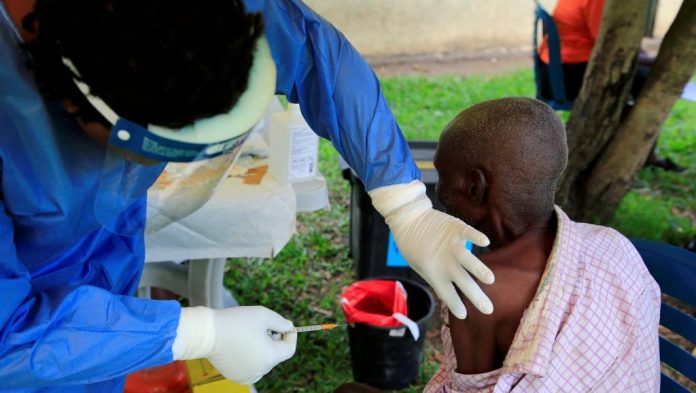
A health worker administers a vaccine to a man

Africa is witnessing a surge in outbreaks of vaccine-preventable diseases over the past year.

Almost 17,500 cases of measles were recorded in the African region between January and March 2022, marking a 400% increase compared with the same period in 2021. Twenty African countries reported measles outbreaks in the first quarter of this year, eight more than that in the first three months of 2021.

Outbreaks of other vaccine-preventable diseases have also become more common. Twenty-four countries confirmed outbreaks of a variant of polio in 2021, which is four more than in 2020. In 2021, 13 countries reported new yellow fever outbreaks in the African region, compared to nine in 2020 and three in 2019.

Inequalities in accessing vaccines, disruptions by the COVID-19 pandemic including a huge strain on health system capacities impaired routine immunization services in many African countries and forced the suspension of vaccination drives.

“The rise in outbreaks of other vaccine-preventable diseases is a warning sign. As Africa works hard to defeat COVID-19, we must not forget other health threats. Health systems could be severely strained not only by COVID-19 but by other diseases,” said Dr Matshidiso Moeti, the WHO Regional Director for Africa. “Vaccines are at the heart of a successful public health response, and as countries restore services, routine immunization must be at the core of revived and resilient health systems.”

Two doses of the measles vaccine provided on schedule results in long lasting protection against the potentially deadly disease. Countries are expected to attain and maintain measles vaccination coverage of 95% with two doses to reach measles elimination. In 2019, six countries in the African region attained 95% coverage with first dose measles vaccination, while only three met this target in 2020, according to estimates by WHO and UNICEF.

To urgently scale up coverage and protect children, WHO and partners are supporting African countries to carry out catch-up routine vaccination campaigns, with more than 90% of the 38 African countries responding to a global survey reporting that they implemented at least one routine catch-up immunization campaign in the second half of 2021.

Some countries have successfully integrated other critical immunization campaigns with COVID-19 vaccination. For example, Ghana integrated COVID-19 vaccination with yellow fever campaigns in December 2021 to curb an outbreak that erupted a month earlier. Nigeria recently launched a vaccine scale-up strategy which guides the integration of routine immunization with COVID-19 vaccination for mothers and their babies.

Mass vaccination campaigns are also boosting COVID-19 vaccine uptake. Between January and April, the percentage of Africans fully vaccinated against the virus rose to 17.1% from 11.1%.

While mass vaccination campaigns are the quickest way to administer a large volume of vaccines, WHO is committed to supporting countries to strengthen essential, primary health care services to deliver COVID-19 vaccines. The longer-term solutions will likely see benefits to communities beyond COVID-19.

“Routine immunization, a long-established practice in many African countries, has been severely strained by the impact of COVID-19. In the wake of this pandemic, we are committed to supporting countries devise smart approaches to scale up both COVID-19 vaccination and restore and expand routine immunization services,” said Dr Benido Impouma, Director, Communicable and Noncommunicable Diseases Cluster at WHO Regional Office for Africa.

WHO held a virtual press conference today led by Dr Impouma and facilitated by APO Group. He was joined by Hon Dr Kailash Jagutpal, Minister of Health and Wellness, Government of Mauritius, and Professor Helen Rees, Executive Director, Wits Reproductive Health and HIV Institute, University of Witwatersrand, South Africa.

Also on hand from the WHO Regional Office for Africa to respond to questions were Dr Thierno Balde, Regional COVID-19 Incident Manager, Dr Messeret Shibeshi, Immunization Officer, Dr Richelot Ayangma Mouko, Medical Officer for the Polio Eradication Programme, and Dr Mory Keita, Incident Manager for Ebola outbreak response in the Democratic Republic of the Congo.

Stories Continues after ad