The National Unity Platform (NUP) has fronted Former FDC member Tolit Akecha Simon as its flag-bearer in the upcoming Omoro County by-election.
The NUP Election Management Committee yesterday vetted candidates who expressed interest in carrying the Party’s flag for the Omoro County by-election. The candidates who were vetted are; Alison Ramto Flavia, Kizza Oscar, Ochola Charles, Simon Tolit Akecha, and Secondo Okoth Abok.
Akecha previously contested for the same seat in the 2016 elections on the Forum for Democratic Change (FDC) ticket but lost to Oulanyah.
Last week, the ruling party National Resistance Movement-NRM declared the son of late Jacob Oulanyah, Mr Andrew Ojok as the party’s sole candidate.
Others who have declared interest in the seat are; Godwin Okello (Independent), Julius Okello Opira (ANT), and Hillary Olweny (Independent).
The seat fell vacant on March 20 following the death of former Speaker of Parliament Jacob Oulanyah in Seattle, USA. Oulanyah was the Omoro County MP from 2001 to 2005 and then from 2011 until his death.
The Electoral Commission has since set May 26, as the date for the by-election.
Fitch, the international credit rating agency has affirmed Stanbic Bank Uganda Limited’s (SBU) Long-Term Issuer Default Rating (IDR) at ‘B+’ while it also maintains its ‘AAA’ rating in Uganda.
According to Fitch, SBU’s National Ratings reflect its creditworthiness relative to other issuers in Uganda. SBU’s ‘AAA (uga)’ National Long-Term Rating is the highest possible on Uganda’s national scale and considers potential support available from Standard Bank Group. SBU’s Long-Term IDR is one notch below that of SBG, reflecting SBU’s strategically important role in the group’s regional operations.
SBU is Uganda’s largest bank accounting for 22% of banking sector assets as at the end of December 2021.
Its leading domestic franchise is underpinned on a strong corporate and investment banking (CIB) business, relationships with the leading corporate companies operating in Uganda and other benefits derived from being part of the Standard Bank Group (SBG), which is Africa’s biggest lender by assets.
Fitch regularly generates IDRs for a range of business sectors. An ‘issuer’ may be a financial or nonfinancial corporation, a sovereign company, or an insurance company. A ‘Default Rating’ is the measure of an institution’s credit risk.
Risk is defined by a company’s threat of becoming defunct or entering into bankruptcy, administration, receivership, liquidation, or other formal winding-up procedures. Fitch relies on independent auditors and other experts to produce IDRs.
Fitch states that SBU’s regulatory capital ratios have healthy buffers above the new minimum requirements. ‘The Stable Outlook reflects our view that SBU’s creditworthiness compared to other domestic issuers is unlikely to change over a one- to two-year period.SBU’s profitability is expected to further recover in 2022 resulting from a likely rise in Uganda’s interest rates and stronger loan growth’.
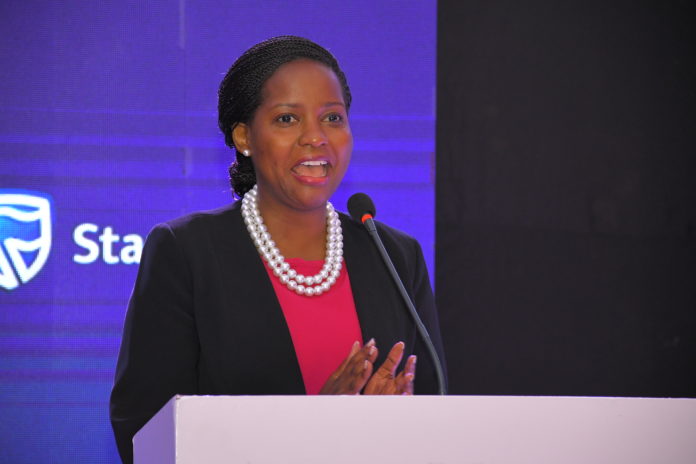
“We welcome the positive rating by Fitch which speaks to the stability of our business and ability to support Uganda’s economic growth in a challenging operating environment,” said Anne Juuko, Stanbic Bank Chief Executive.
Caution
However, Fitch cautions that this projection could be partially offset by a rise in write offs of non-performing loans and the expiry of debt relief measures first announced by Bank of Uganda during 2020 to help soften the impact of the Covid-19 pandemic on both borrowers and the banks.
Loans under repayment moratoria, mainly in the real estate, education, and industrial sectors, increased to 8% of gross loans at end-2021 and may pressure asset quality when remaining credit relief measures expire at end-September 2022.
Another factor relates to the effects from the Russia-Ukraine conflict and lingering pandemic risks that could negatively impact the economic recovery given Uganda’s small and undiversified economy, low vaccination rates and oil import reliance.
However, the Bank’s funding profile, Fitch noted, is dominated by current and savings accounts (end-2021: 96% of deposits), supporting an inexpensive and stable deposit base. SBU’s balance sheet is structurally liquid, helping to mitigate high single-depositor concentration.
President Yoweri Museveni yesterday told his ministers that the Coffee deal signed between the government and Uganda Vinci Coffee Company Limited (UVCC) is good for the development of coffee and capable of expanding the economy as it will widen the coffee market in Europe and other western capitals.
According to sources that attended cabinet and couldn’t speak freely as they lack authority to do so, a combative Museveni said he was briefing his minister on the deal for the first time and therefore, he expected no minister to oppose it.
“I want you to know that this is a good deal as it will increase our coffee export to the European markets but also it will increase its consumption here locally to about 30%,” the source quoted the president.
In the same meeting, the president is said to have turned to Evelyn Anite, the State Minister for Finance in charge of Investment and Privatization accusing of usurping his powers and asking “Do you know the value of that factory to Uganda and who told you that the agreement has been recalled?”
The president is said to have warned Ms Anite further that he would crush her before she went on knees apologizing.
“I will crush you, I will crush you, I will crush you and your Monitor newspaper.”
The revelation about his brief to cabinet about the deal coincided with the ongoing meeting with Members of Parliament at Kololo this afternoon. A section of legislators across party inclinations are opposed to the deal and have since teamed up with lawyers in dragging the government to court over the deal.
The Parliamentary Committee on Trade, Tourism and Industry on Monday, April 25 2022 commenced investigations into the controversial coffee deal signed between the Government and UVCC.
Chaired by Mr Mwine Mpaka, the committee interrogated officials from UVCC led by the company secretary, Moses Matovu where they unearthed several irregularities regarding the coffee deal.
During the meeting, MPs on the committee were dismayed to learn how the Italian investor, Enrica Pinetti, the director, UVCC reportedly mortgaged 25 acres of government land in Namanve given to them to secure a loan from a commercial bank in order to set up the coffee processing plant.
Ms Pinetti is also reported to have signed as a witness instead of a director during the signing of the agreement between her on behalf of UVCC and government.
PostBank Uganda Chief Executive Officer/Managing Director Julius Kakeeto
PostBank Uganda Limited, the Government of Uganda owned bank has announced its 2021 financials posting yet another year of healthy growth.
In the results released on 25th April 2022, the bank reported, that customer deposits, the lifeblood of every bank, had grown by Shs58.3 billion – a growth of 13% from Shs449 billion in 2020 to Shs507.2 billion.
The double-digit growth in customer deposits enabled the bank to boost its lending book by an impressive 35.9% – from Shs334.7 billion to Shs454.9 billion – a growth of Shs120.2 billion.
Burgeoning lending saw a 20.9% growth in total income – from Shs119.5 billion to Shs144.5 billion.
Despite increased investment especially into new technology, that pushed expenditure, upwards from Shs104.3 billion to Shs126.9 billion, the bank still reported a healthy 21.5% growth in net profit – from Shs10.1 billion to Shs12.2 billion.
Shareholder Funds also grew by 15.5% from Shs101.4 billion to Shs117.1 billion.
The 2021 results are Julius Kakeeto’s second full-year results since he joined the bank in October 2019 and the first since the bank got a Tier One Commercial banking licence in December 2021. The impact of the licence is however expected to start bearing fruits in 2022.
Commenting on the results, Mr. Kakeeto said that the 2021 strong performance was underpinned by the continued steady execution of the bank’s transformation agenda – which seeks to shape the bank into a market leader in financial inclusion and a pacesetter in economically transforming the lives and livelihoods of its customers.
“2021 was a tough year owing to the COVID-19 pandemic. Many customers were still suffering from the effects of the 2020 lockdown and then they had to deal with another lockdown in 2021. At PostBank, we focused on supporting the adversely affected businesses to survive and recover through restructuring of facilities and providing working capital support,” he said, adding: “The Bank continued with its strategy of revamping and widening its distribution channels to enable access to its products and services while improving customer experience.”
He also said that the bank, in line with its strategic intent of being a people’s bank focused more on impact lending to key sectors of the economy.
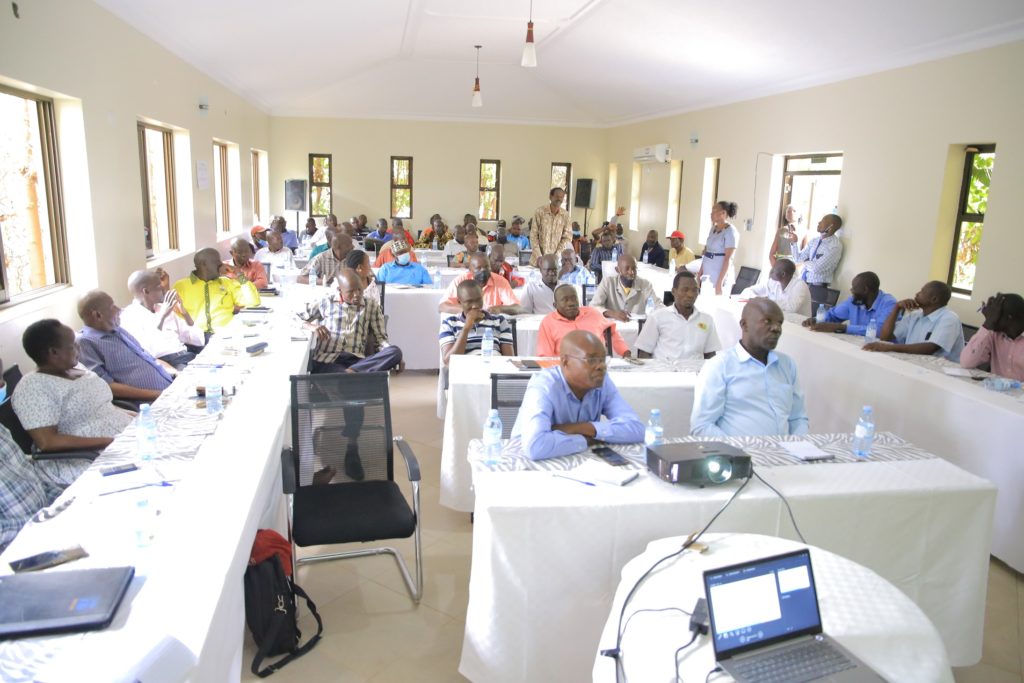
Over 70 farmers dealing in crop production, poultry and cattle fattening pose for a picture, at the close of a PostBank organized agriculture forum. The bank which a leading agriculture lender, by number of loans, uses the forums to empower and upskill farmers for the growth of their agribusinesses.
“PostBank prides itself in offering affordable and sustainable financial services to the masses. Last year’s earnings underpin our commitment to supporting Micro Small and Medium-Sized Enterprises (MSMEs) with agriculture being one of our core areas. Considering most of these MSMEs are involved in the agriculture value chain – production, trade, processing, distribution, storage, and logistics, PostBank will remain an MSME bank,” he said.
“We shall continue to innovate tailor-made products that support the entire value chain and deepen our coverage and outreach using our robust financial literacy programs,” he said.
Leveraging the tier-one licence for mutual bank and customer growth
Kakeeto said that the acquisition of the Tier One operating licence in December 2021, would enable the bank to unlock opportunities that would fully optimize PostBank’s potential.
“We are in a stronger position to mobilize deposits which are the heartbeat of a bank. Our customers are also set to enjoy a new and wider variety of products and services that come with being a fully-fledged commercial bank,” he said, adding: “The Bank will ensure that it continues to improve the customer experience for its target market – the masses, MSMEs and agro-businesses on a wider scale. We also intend to scale up our existing partnerships with both Government and Development Partners to extend financial services to Ugandans, especially the underserved.”
Over the last two years, the bank has been undergoing transformation, heavily investing in new technologies, revamping its digital banking platforms, revamping the branch network as well as opening new outlets.
To take services to the people, the bank opened new branches in 2021 starting with Mukono, Kamdini, Rushere, Butogota and Kyazanga. The bank also opened a Corporate Branch at Forest Mall, Kampala to cater for the high net worth and corporate customers.
The bank also upgraded its PostApp and PostMobile *263# to ease transactions, as well as replaced half of its fleet of ATM dispensers with recycler/intelligent ATMs that support instant cash deposits, and cardless transactions, and a wide range of other services.
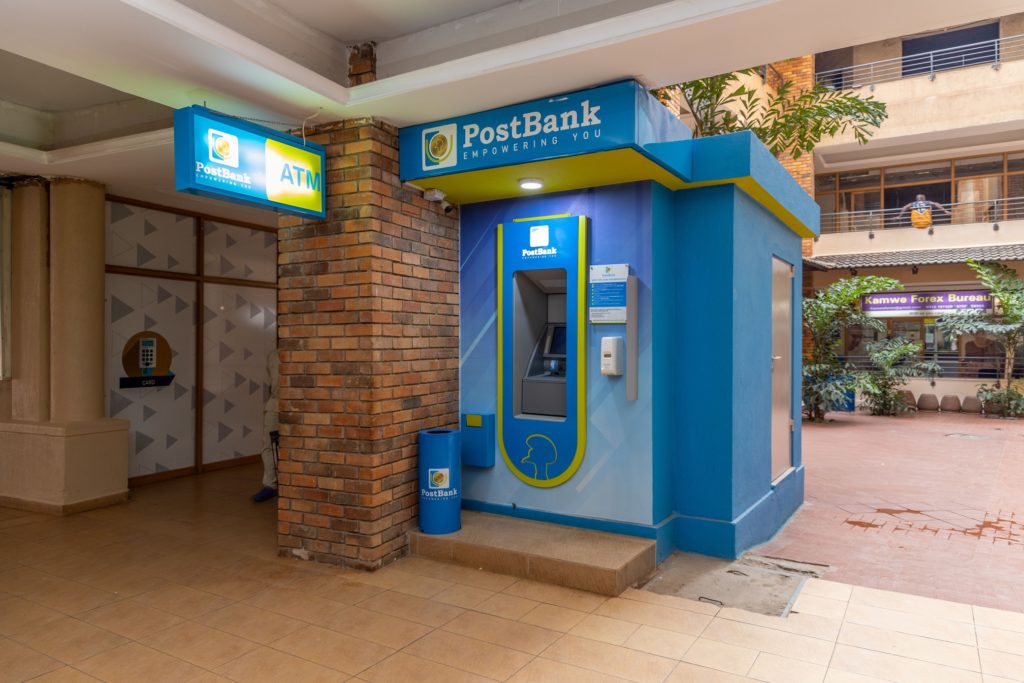
One of PostBank’s intelligent ATMs at the Forest Mall Branch. In 2021, the bank replaced half of its fleet of ATM dispensers with recycler/intelligent ATMs that support instant cash deposits, cardless transactions, and a wide range of other services. The rest of the ATM fleet will be replaced this 2022.
“We are planning on replacing the rest of the ATM fleet during this year, 2022. Last year, we also embarked on upgrading our core banking system which has been completed,” Kakeeto said.
He also noted that the bank continues to support its clients recover from the effects of the pandemic.
“We are the people’s bank, providing opportunities for financial growth to Ugandans countrywide. Through our competent staff, we are in constant engagement with borrowers to support them to pay back their debts,” Kakeeto emphasized.
“We also set in motion the Small Business Recovery Loan which is complemented by the Uganda Development Bank-PBU partnership low-rate loan for value addition to further support financially distressed businesses and individuals. The goal is to avail capital that borrowers can be able to pay back under flexible repayment terms,” he added.
“This year, we shall continue to provide affordable and sustainable banking services that drive the social and economic transformation of our customers. We also plan on continuing with our digital journey that will further improve the customer experience at all touchpoints of interaction with the Bank,” Kakeeto concluded.
The Uganda’s Women national rugby Sevens team, the Lady Cranes 7s, has been flagged off to Tunisia by the General Secretary of the Uganda Rugby Union Peter Odong.
The team will be participating in the Rugby Africa Women’s 7s tournament scheduled for 29th-30th April.
The tournament will also act as qualifiers for the World Cup and Commonwealth.
Uganda is grouped in Pool B alongside neighbors Kenya and Zambia.
Pool A has South Africa, Senegal and Zimbabwe while C has hosts Tunisia, Madagascar and Ghana.
Besides South Africa who qualified as hosts, the other eight teams will compete for the only spot at the 2022 Rugby Women World Cup.
The Lady Cranes are targeting a return to the Women Rugby 7s World Cup after their maiden appearance in 2009 in New Zealand and Australia.
The Directorate of Criminal Investigations has intensified its operations against acts of sabotage, vandalism and theft of electric wires and cables, with successful raids at two locations in Namugongo and Katwe that led to the arrest of 3 UMEME workers and an assortment of exhibits.
According to the police spokesperson, Fred Enanga, the task team arrested two suspected vandals identified as Kalumba James, aged 33 and Semuyaba Joseph, aged 28 in Namugongo. Both suspects are electrical engineers at the UMEME, Banda branch and residents of Nsawo LCI in Namugongo.
Upon a search at their known premises, drums of black cables, power connectors and UMEME equipment were recovered.
The task team conducted another operation at Ndejje-Mirimu zone, and arrested Ezra Kimiah Mudhimbwa, a 36year old, electrician, and a sub-contractor of Komolo Co. Ltd. The search led to the recovery of 3 drums of electric wire cables and electricity connectors.
“Such criminal acts do negatively impact our economy through vandalism of critical infrastructure, loss of electricity which affects businesses and communities within the affected areas.” Enanga said.
Enanga added that due to the collaborative efforts by CID, other stakeholders and the local community, several suspects involved in cable theft and vandalism have been arrested and recoveries of exhibits made. “The operations aimed at solving this senseless and destructive type of crime are continuing.”
“We also call upon the public to share any information that will assist our officers in fighting this crime and bring those who destroy critical infrastructure to book,” Enanga said.
Coffee farmers from different cooperatives have called for cancelation of Uganda's coffee agreement with Vinci Coffee Company saying it is exploitative & discriminative.
The Parliamentary Committee on Trade, Tourism and Industry on Monday, April 25 2022 commenced investigations into the controversial coffee deal signed between Government and Uganda Vinci Coffee Company Limited (UVCC).
Chaired by Hon. Mwine Mpaka, the committee interrogated officials from UVCC led by the company secretary, Moses Matovu where they unearthed several irregularities regarding the coffee deal.
During the meeting, MPs on the committee were dismayed to learn how the Italian investor, Enrica Pinetti, the director, UVCC reportedly mortgaged 25 acres of government land in Namanve given to them to secure a loan from a commercial bank in order to set up the coffee processing plant.
Jinja North County Member of Parliament, Hon. David Isabirye told the committee how UVCC reportedly wrote to Uganda Investment Authority (UIA) seeking permission to use the land titles for the said land to acquire a loan. According to Isabirye, the request was hastily granted by UIA in the wee hours of the night.
“This email was written on 01 September 2018 to the acting board chairperson of Uganda Investment Authority and it was replied at 2:36 am in the morning. The acting executive director of UIA acknowledged and gave a no objection at 7:59 am when offices were closed. I really want to applaud them for working trans-night,” Isabirye said.
However, the company secretary Matovu vehemently denied the allegations saying that UVCC has neither borrowed any money nor mortgaged the title of the said land in Namanve.
“UVCC has never borrowed any money or mortgaged the titles of the land in Namanve. I also heard that UIA is in the [committee] room; they are the leaser in respect to that land, if they have information that this land has been mortgaged, I would like to see that information. But as Company Secretary, I can confirm to you that we have never borrowed, we don’t have any loan,” Matovu who had already been put on oath said.
To his surprise, Bwamba County MP, Hon. Richard Muhumuza Gafabusa tabled before the committee an email in which Pinetti wrote to UIA Acting Director, Basil Aja seeking authorisation to use the land title to secure a loan.
“We were awarded a lease in favour of the land measuring 25 acres comprising of Kyangwe block 113 plot 738, Namanve, Mukono District. We took possession of the land and have started development of our site. We intend to mortgage the land to secure a credit facility to enable us establish and operate an integrated roasting, grinding and instant coffee processing plant in our industrial site mentioned above. I hereby seek your approval for the facility,” Muhumuza reads Pinetti’s letter.
Matovu later acknowledged the correspondences but insisted that the request to mortgage government land did not materialize, prompting the committee chairperson, Hon. Mwine Mpaka to demand for the copy of the land titles.
“Your director, Pinetti requested for a mortgage and when you look at the speed for acquiring the mortgage, it means it was of urgent importance. Now you cannot come to this committee and say you have never mortgaged; but the intention was to mortgage and when you look at these documents, you can see there was so much speed,” Mpaka said.
Kaberamaido County MP, Hon. Alfred Edakasi wondered why UVCC was mortgaging land yet they are not even paying premium to the Government of Uganda.
“UIA gave all this land to the company and waived off the premium which would amount to about US$2 million. Why would this company want to mortgage the land which they have not paid premium for? And why would UIA allow them to mortgage it when even the premium which would have been the basic gain for government has not been paid?” Edakasi questioned.
Matovu was later handed over to the police Criminal Investigation Department (CID) for further inquiries after presenting to the committee contradictory statements in regards to the said land. Mpaka demanded that the company secretary produces the said land title to prove that the land has not been mortgaged.
UIA Executive Director, Robert Mukiza said that for a foreign investor to be allowed to mortgage the land title to acquire a loan, they are required to have constructed the factory to 60 per cent completion while the local investors are expected to fulfill the construction to 30 per cent.
On 10 February2022, the Minister of Finance, Hon. Matia Kasaija signed an agreement with Pinetti to allow her company establish a coffee processing plant worth US$80 million. According to the deal, the coffee company would retain exclusive rights to buy all Uganda’s coffee.
According to Kimanya-Kabonera Division MP, Hon. Abed Bwanika who raised the matter on the floor of Parliament on Tuesday, 12 April 2022, the agreement alienates Ugandans from the coffee business as it gives monopoly of purchase and export of coffee to only one organization.
Apparently, the agreement exempts the coffee company from paying all the taxes, including Income Tax, Pay As You Earn, Excise Duty and National Social Security Fund and also seeks to subsidize the company, giving them a special tariff in terms of electricity contrary to the Coffee Act.
Out of the desire to increase a longer shelf life for fruits, Lynette Akol started Krystal Ice Limited. Her vision was clear vision – to provide market for the fruit produce of smallholder farmers by using them as raw materials for frozen fruit ice pops.The business owner understood that the linkages along the agricultural value chain would be instrumental for the growth of her Company but also play a role in cementing Uganda’s vision of Buy Uganda, Build Uganda.
For the past five years, dfcu Bank in partnership with Daily Monitor and Uganda Investment Authority (UIA) have run a program dubbed ‘Rising Woman’ which is aimed at recognizing, celebrating, and promoting a culture of mentorship among women in business in Uganda.
In 2018, Lynette Akol participated in the Rising Woman proposal writing competition and emerged the overall winner. In an interview, she shares her experience then and the current standing of her business.
1. Tell us about yourself and the business you do
My name is Lynette Akol, the Managing Director of Krystal Ice Limited, a food processing company. I am a woman entrepreneur and a mother. At Krystal Ice, we produce ice pops which are made from fruits sourced from small holder farmers.
2. What was your experience participating in the Rising Woman competition?
I remain grateful that the Rising Woman experience was as transparent and fair as it was rigorous. Being the pioneer winner was humbling, educational and it gave my business the opportunity to achieve more success.
3. What was your key highlight participating in the Rising Woman competition?
The night when I was announced the overall winner was my highlight. It was a very ceremonious event with high profile guests! Achieving that level of and receiving the award and cheque was a reaffirmation that I was on the right path.
4. Looking back to when you started, how did the Rising Woman program/competition change you/impact on you?
Before becoming a part of the Rising Woman program, I wasn’t quite sure that I was taking the right direction so the opportunity to test my will, determination and belief in my business came at the right time. It was also a learning and empowering journey; the program helped me to become more efficient and effective in the way I manage the business.Now I have more confidence in what I do. And thanks to the training we received in Nairobi, Kenya, interacting with the other businesswomen in Nairobi helped me to build my confidence in the way I was doing business.After listening to their stories, I was sure I too, could reach the summits of entrepreneurial success.
5. If you were to go back in time, what would you have done differently?
Honestly, I don’t think I would change anything, the whole process was transparent and well organized. I also believe that the different partners did well to have women involved at each step of the competition. Representation matters because there are unique challenges faced by women in entrepreneurship that can best be understood by other women.
6. What progress have you registered as a business and as an individual?
It has been and still is quite the journey! It has enabled me to develop growth strategies for what I believe is a strong brand; giving us more ground to succeed. The competition also helped me understand my business better by making me write a business proposal. That forces you to think and dig deep.
7. What opportunities have you received because of your participation in the Rising Woman competition?
The exposure and visibility created by dfcu Bank, Daily Monitor and Uganda Investment Authority helped me position my business better. When customers have read your story and believe in it, you have to deliver well, consistently.
I was a recipient of the GroWe Award, the business received a business development service from Feed the Future who helped us design marketing and distribution strategies.
8. What advice would you give to a woman entrepreneur who is still undecided about joining this year’s Rising Woman Initiative on joining the Rising woman competition?
Overall, you have to believe in yourself and your dreams because no one will do that for you. It is important to leverage your social networks, be resilient and have passion for what you are doing because without passion, it’s easy to throw in the towel.
9. Please share some tips for anyone planning to join the competition
I would just tell them to submit their proposals because everyone is a winner, in the long run.
10. Where do you see your business heading?
It’s been tough, many businesses have been affected by Covid-19, but now we have started to see light at the end of the tunnel. I see my products being available everywhere and accessible in supermarkets throughout Uganda, East Africa and beyond. I would like to have a strong, socially responsible brand that is internationally recognized.
Monitor Publications Limited’s (MPL) flagship brand Daily Monitor in partnership with dfcu Women in Business Program and Uganda Investment Authority-UIA are running the fifth season of the Rising Woman campaign. The objectives of the campaign include; recognizing, celebrating, and promoting a culture of mentorship among women in business in Uganda.An all-expenses paid study trip to Nairobi for the top 10 winners and cash prizes of up to Shs 30 million are up for grabs for the top three winners.
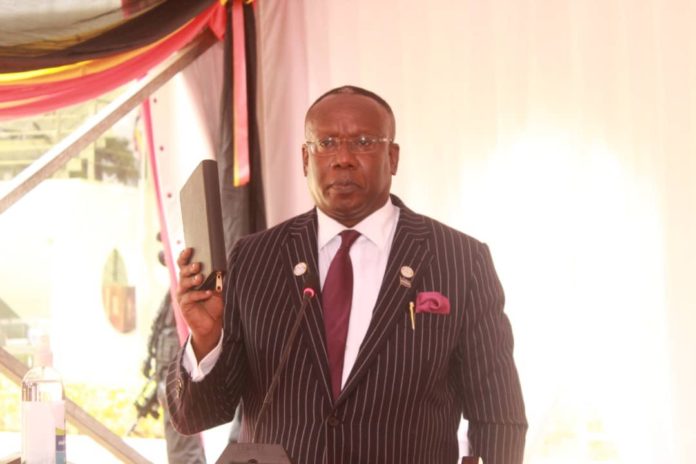
Chairperson of the Judicial Service Commission - Justice Benjamin Kabiito
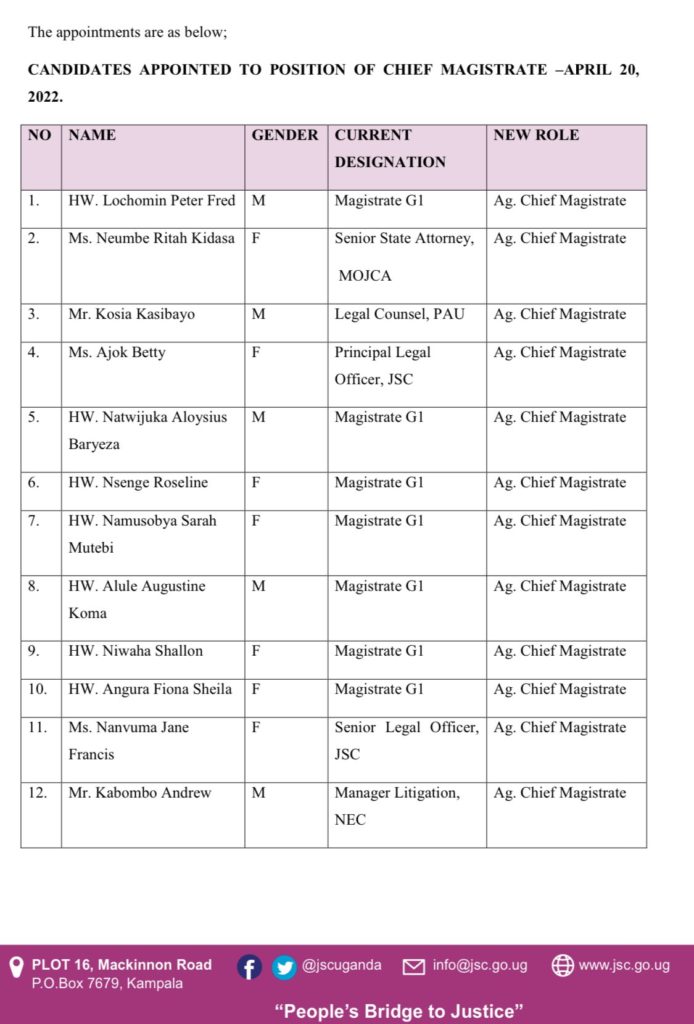
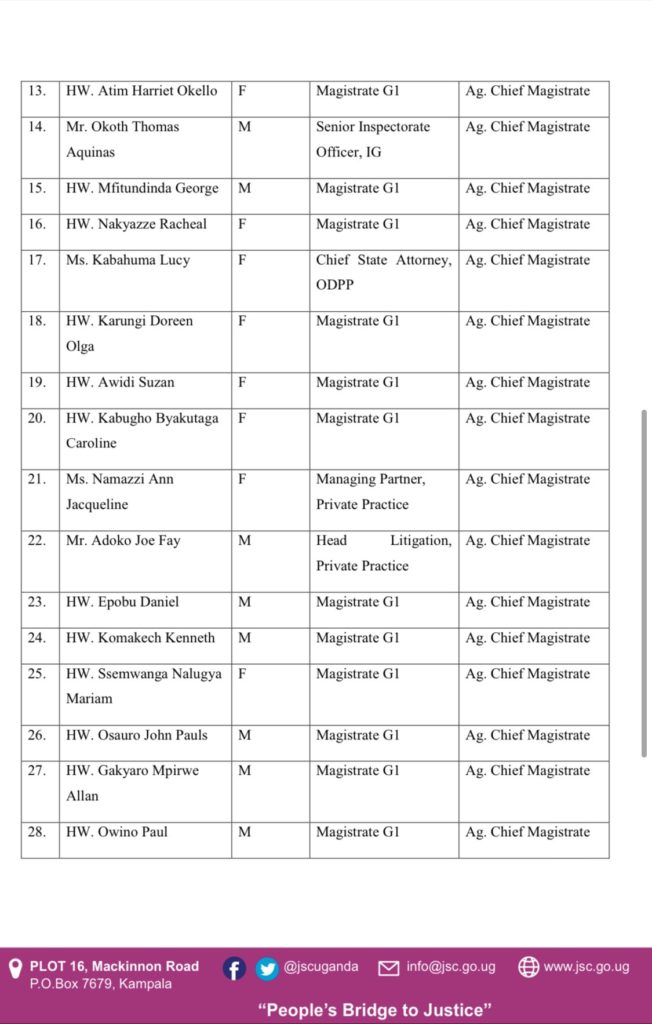
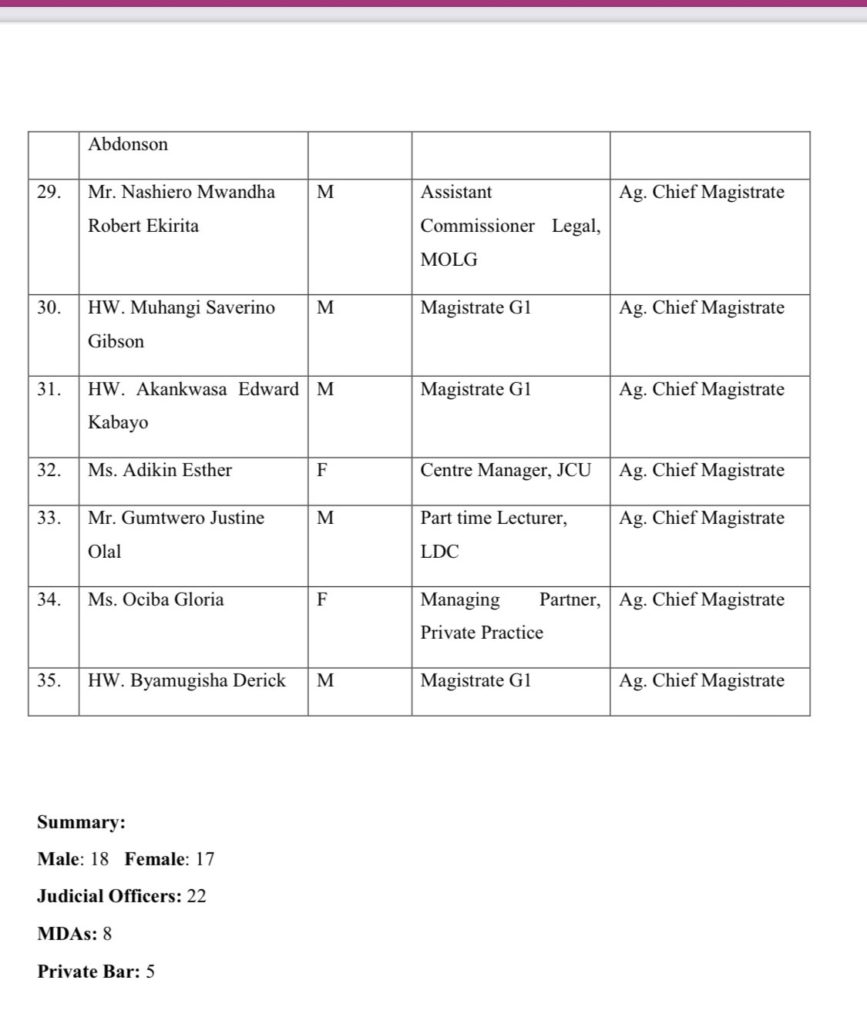
The Judicial Service Commission has appointed 35 officers to the office of Chief Magistrate in acting capacity in the Judiciary Service.
The appointment of these 35 Chief Magistrates brings the total number of Judicial Officers in this category to 74. This appointment constitutes the largest number of Judicial Officers ever appointed in this category by the Commission in one go.
The recruitment is in fulfillment of the expanded Judiciary structure whose goal is to have Chief Magistrates deployed at every District in the Country, to improve access to Justice to the people.
The appointed Chief Magistrates will work in acting capacity for a period of one year during which they will be appraised on a set of Key Performance Indicators (KPI s) set by the Commission and the Judiciary to assess their performance before confirmation into the Judiciary Service on permanent and pensionable basis for this position.
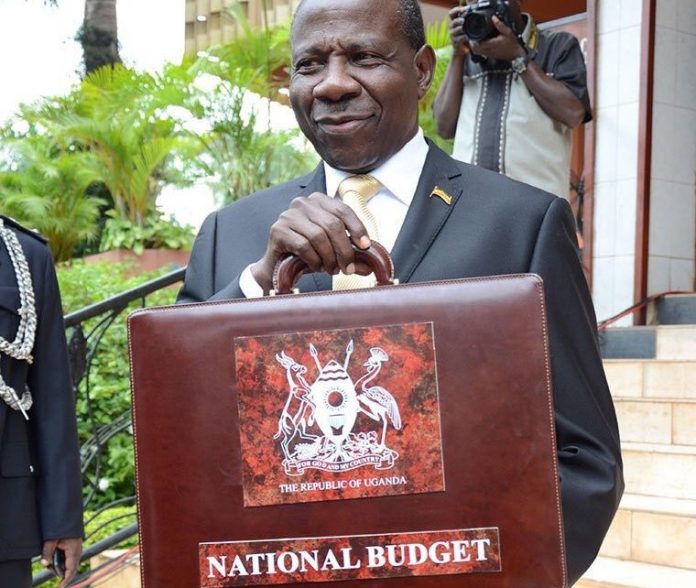
In June 2022, as has been the norm, the Minister of Finance Matia Kasaijja will read the national budget to Ugandans who will be hooked to their radio and television sets, as well as social media platforms to know what is in store for them in the financial year 2020/2023 as the country prepares to spend over Shs45 trillion.
The national budget is an amalgamation of the money that each sector of government intends to spend in the given financial year. Ministries, departments, agencies, and local governments prepare their budgets earlier so as to fit in the budget cycle that runs from July to June.
However, it has become known that not all the votes that officials budget for are genuine. Falsehoods seem to be a parcel and part of the budgeting process in Uganda.
Uganda is on record for losing trillions of shillings every year to corruption. The budgeting process is one of the avenues that public officials use to siphon taxpayers’ money.
Though not clearly spelled out, Members of Parliament scrutinize budgets for different ministries and departments to catch officials who steal public money through budgeting.
For instance for the coming financial year, we have seen MPs on different committees decline to approve the money for some votes. This is because the planned expenditures are questionable and put taxpayers’ money at risk.
Planning activities not in mandate
For instance, MPs on Parliament’s Committee on Tourism Trade and Industry did not approve Shs10.5 billion asked by Uganda Warehouse Receipt System Authority (UWRSA) to repair storage facilities. According to the MPs, this activity does not fall under the mandate of UWRS. So why did the officials at UWRS ask for that money?
Concealing information on dead, retired or transferred workers
In the education and health sectors, accounting officers continue to use numbers of retired or dead employees in their budgeting process. A recent research done in certain secondary schools established that problem. This problem, according to the researchers, is a result of cliques, right from the lower district to the ministries.
Refusal to transfer balances to consolidated fund
Some of the government officials intentionally refuse to transfer funds to consolidated funds at the end of the financial year as required by the Public Finance management Act. The officials want to withhold that money for their own selfish interests. An official from the Finance ministry says they have on several occasions reminded officials in different ministries and departments to transfer the money to the consolidated fund. “Can you imagine some tables for the next budgets without telling us how they used the money in the previous financial year,” the official from the ministry said.
Unnecessary procurement
Yet some government officials have found another way of cheating the public of their money. It is through unnecessary procurement where they budget for certain items and services, well knowing they don’t need them that much. “Remember those in procurement departments secretly get commission on the items and services ordered,” said a young procurement officer in one of the ministries, who says his seniors in the department are very rich because of procurement.
Fixing workers’ salaries on fixed bank accounts
Further, some officials, especially district local governments, have the habit of holding workers’ salaries in fixed bank accounts in order to earn interest on it. When you move around villages in Uganda you will find newly recruited teachers and health workers complaining of nonpayment of their salaries for three or more months. “Sometimes sharp teachers have had to call Kampala to have the money released.
Hiding budget information
It is not a secret that some officials, especially those in districts, hide budget information from colleagues with the intention to cheat. Some of the activities they appropriate, especially in local governments, are questionable. Not long ago it was established that a district in the Sebei region was given over Shs50 million to construct a bridge but it would only spend less than a million on the same facility. This is the kind of example where some officials hid budget information.
Some agencies’ top executives make it hard have governing boards, it is for a reason
In the on-going scrutiny of the budget of 2022/2033 budget frameworks, MPs have had to bitterly ask why some agencies don’t have governing boards. Boards are meant to check excesses of the executives of agencies, for example by questioning their expenditures. This is how important the boards are. Just days ago, Uganda Export Promotion Board was almost denied funds for the next financial year due to lack of a governing board. It was saved by the Speaker of Parliament.
These are some of the reasons why some Ugandans don’t have interest in their national budget. “That one is for government people. They are the ones who benefit from it,” said a trader in Kampala, when asked to comment about the upcoming budget.