Stanbic Bank
Stanbic Bank
24.9 C
Kampala
Stanbic Bank
Stanbic Bank
Home Blog Page 807

Sudhir unveils Kampala Pearl Business Park project as he expands empire

East Africa’s richest tycoon Sudhir Ruparelia has finalised plans to construct Kampala Pearl  Business Park project, a multi purpose business park that will host office space, health, leisure amenities and shopping centre among others.

The said project will be situated on Yusuf Lule Road formerly Kitante Road. According to tycoon Sudhir, the project will be one of its kind in the region.

“The latest project is one of several a  dozen of greenfield projects, and one of very many to come in the near future largely to feed Uganda’s growing demand for high quality and sustainable retail, residential, office and industrial solutions” he said.

He added “Uganda is very special to us because, it is our home, where it all started. Uganda is our home and we are proud to share in and participate in her dreams and aspirations. Every developing country needs a matching stock of high quality real estate infrastructure to fuel further growth and you can always count on us to play that role, so you can be able to focus on your core business” .

Pearl Business Park  is an 18-acre mixed use facility that will host a five-star hotel, a Shopping Mall and a modern hospital when complete.

The Ruparelia Group aims at completing the project within 15 months and will be completed by 2023.

Rajiv Ruparelia, the Managing Director of the Group invited members of the public and other national and international organisation to chose Pearl Business Park for its unique environment to do business.

“It is essentially a green office, sustainably  designed to minimise the negative impact on the environment, while enhancing the health and comfort of the building’s occupants.Amenities such as thriving pedestrian and people space, ample parking as well as rich and vast landscapes as well as the buildings layout design have been sustainably designed to optimise daylight b and air quality”. Rajiv said.


Stories Continues after ad
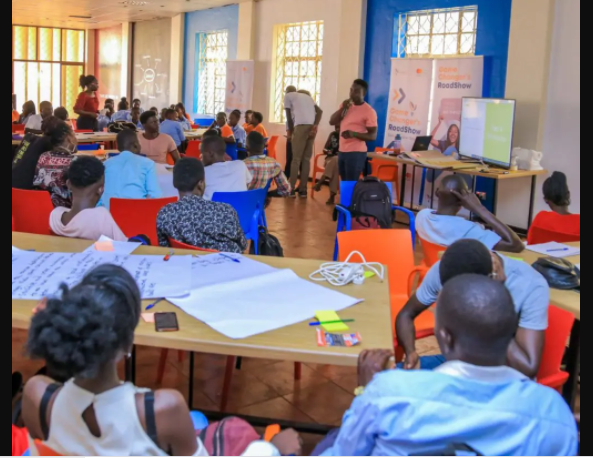
Startups need support to rise from this pandemic

Startup business


In May 2020, the United Nations Capital Development Fund (UNCDF) compiled its findings on the impact of #Covid-19 on Ugandan Small and Medium Enterprises (SMEs). The report indicated that only about 15 per cent of surveyed companies could sustain more than three months of operation on their cash flow at the time. The report further indicated that 85 per cent of all Ugandan businesses would be in financial distress after three months of lockdown measures while 50 per cent of informal businesses would be out of business or fall below the poverty line after just one month.

In the same year, The innovation village carried out a survey to find out the impact of #Covid-19 on the SMEs within its ecosystem and made the following discoveries. Up to 79 per cent of the businesses that participated in the survey projected that their revenues would decrease in 2020 compared to 2019. Of those, 57 per cent indicated that their revenues would decrease by more than 25 per cent while 22 per cent projected their revenues would decrease by less than 25 per cent. These findings were published in The Innovation Village Impact Report, this year.

There is a general assumption that the lockdown restrictions, limiting contact and movement created a fertile ground for the growth of startups working in Fintech. However, the engagement partner of Financial Technologies Service Providers Association (FITSPA), Zianah Muddu says that the flourishing of Fintechs has not been a given. This is due to the fact that even though other sectors are going digital, Fintechs support various sectors like tourism, education, e-commerce platforms and various kinds of trade. If other sectors are being affected, Fintechs still suffer the brunt since consumers barely have money to transact.

FITSPA, where Muddu works, is a non-profit association that aims to support Uganda’s vision to become a leading Fintech destination. In this period, efforts towards supporting the startups in the financial sector are very crucial.

To encourage startup recovery and prevent the economic gap from widening due to #Covid-19, organisations are lobbying on behalf of startups for support in terms of contract financing and speaking to other organisations with relief packages like the #Covid-19 relief fund.

Muddu says feedback from Fintechs echoes one common goal, that is, to “survive” the season. At this moment, FITSPA is harnessing the power of community care where they follow up on how they are coping, finding out their needs and then supporting them by seeking options on how to revamp their businesses to full operation.

While FITSPA is doing work to support Fintechs, Startup Uganda is also adding similar efforts in the larger sector of startups.

Startup Uganda, is currently harnessing on Innovation and Entrepreneurship Support Organisations (IESOs) to work together with its members to improve capacities, influence, impact, and create a more enabling environment for innovators and businesses that in turn will drive development across Uganda.

Dona Sava, project coordinator at Startup Uganda says, the lockdown has affected many startups gravely while for others it has only provided a launchpad. Sava points out startups that are using digital platforms such as e-learning, e-payments, healthtech, agritech and those using e-commerce to trade have managed to grow their businesses especially during this lockdown period.

With 30 IESO’s under their umbrella, Startup Uganda went into a partnership with the Innovation Village under the Resilience and Recovery Program (RRP). This is a fully-funded program by Mastercard Foundation to support the various startups to continue working despite the disruption. The support ranged from training to digital support, e-commerce platforms, transport among other things.

This is supplemented by providing investment platforms where they are able to pitch and find funding for their businesses. Depending on their needs, Sava says some startups are only looking for seed funding, while others are looking for funds to scale their businesses. To cater to this, Startup Uganda conducts activities like the Kampala Innovation week, innovation challenges and holds investor days where they have been able to provide these platforms for them.

As businesses go through another rough patch due to the lockdown, all across the board, there is a need to contribute towards ecosystem efforts towards the survival of MSMEs in every sector.

Once again, The Innovation Village is taking a lead on building resilience among entrepreneurs through working with entrepreneurs in cities across central, east, north and Western regions of the country. The work involves providing support in form of funding, mentorship, skilling and digital markets to entities that are leveraging technology to solve critical problems in agriculture, health, education, tourism, media, supply chain, energy, finance and manufacturing.


Stories Continues after ad
Museveni eulogizes Awori, says he was a distinguished leader

President Yoweri K. Museveni
President Yoweri Museveni has joined other leaders in the region to eulogies former presidential candidate Aggrey Awori describing him as a distinguished leader.
Museveni further described Awori as a talented sportsman who represented Uganda at 1960 Olympics.
“Saddened by Aggrey Awori’s untimely demise. He was a talented sportsman and a distinguished leader who joined me in the NRM to serve the country despite our prior political differences. My thoughts go out to the family, well-wishers, and the Samia Bagwe Community. Mabi muno!” President Museveni tweeted.


Yesterday Kenyan strongman and former Prime Minister Raila Odinga said he was saddened by the passing on of his longtime friend Aggrey Awori describing the late as a true manifestation of the spirit of East African integration and Pan-Africanism.

Through a letter he wrote to former Kenya Vice President Moody Awori who doubles as elder brother of  the late  Aggrey Awori, Odinga says “We join the Awori family and the people from all around the region in giving thanks for Aggrey’s remarkable life  of service particularly to Kenya and Uganda. Our two families have a long history of friendship that started with our parents, Jaramogi Ogingi Odinga and Jeremiah Musungu Awori, the pioneer African Canon of Anglican Church in Kenya. As a young boy, I witnessed Canon Awori as a constant presence at our home to offer prayers whenever Jaramogi had a function. Out of the large Awori family, Aggrey  became my closest friend out of these initial ties”

Awori contested against Mr. Museveni in 2001 presidential election where he came third with got 1.41 votes.

Mr Awori died on Monday in a Kampala hospital where he was admitted for sometime. He has been battling sickness related to old age. He was 82 years.

Stories Continues after ad

Haiti President Jovenel Moise assassinated

President Moise

Haiti’s President Jovenel Moïse has been killed in an attack on his home in the nation’s capital, according to the country’s interim prime minister.

Claude Joseph said the president’s home in Port-au-Prince was stormed by unidentified armed men at 01:00 local time (05:00 GMT).

First Lady Martine Moïse was also injured in the attack.

Mr Joseph said that “all measures had been taken to guarantee the continuance of the state”.

He said the president was fatally shot in the “heinous, inhuman and barbaric act” and called for the public to remain calm.

Jovenel Moïse, 53, had been in power since February 2017, after his predecessor, Michel Martelly stepped down.

Mr Moïse’s time in office was rocky as he faced accusations of corruption and was challenged by waves of often violent anti-government protests.

There were widespread protests in the capital and other cities earlier this year, as people demanded his resignation.

Haiti’s opposition said that Mr Moïse’s five-year term should have ended on 7 February 2021, five years to the day since Mr Martelly stepped down.

Mr Moïse, however, insisted he had one more year to serve as he did not take office until 7 February 2017.

The year-long delay was caused by allegations of electoral fraud which eventually saw the result of the 2015 election being annulled and fresh polls being held, which were won by Mr Moïse.

On 7 February, the day his opponents said his term should have ended, he said that a “coup to overthrow his government and assassinate him” had been foiled.

Chronic instability, dictatorships and natural disasters have left Haiti as one of the poorest nations in the Americas.

An earthquake in 2010 killed more than 200,000 people and caused extensive damage to infrastructure and the economy.

A UN peacekeeping force was put in place in 2004 to help stabilise the country, and only withdrew in 2017.

Stories Continues after ad

Absa Uganda introduces MTN MoMoPay payments on point-of-sale terminals

Managing Director Absa Bank Uganda, Mumba Kalifungwa

Absa Bank Uganda and MTN Mobile Money Uganda Limited have announced the introduction of mobile money payment functionality, dubbed MTN MoMoPay on Absa Point of Sale (POS) machines/terminals.

The service is open to all MTN Uganda mobile money account holders, who can now make payments on any Absa POS machine, regardless of whether they hold an account with the bank.

Announcing the partnership, Absa’s Managing Director, Mr. Mumba Kalifungwa noted that the new functionality makes it even more convenient for customers to pay for goods and services directly from their MTN mobile money account to the Absa device. “Wherever there is an Absa POS machine in a supermarket, shops or pharmacy among others, you can easily pay for goods and services directly using MTN MoMoPay at no extra cost. This service will help drive cashless transactions and the benefits that come with it.”

Mumba explained that the payment system would provide convenience to customers as well as support financial inclusion by accelerating access to formal financial services.

According to data from the Uganda Communications Commission, as at December 2020, the penetration of mobile connections in Uganda was equivalent to 67 per cent of the total population. Financial inclusion indicators by Bank of Uganda indicate that whereas only 43 per cent of Uganda’s adult population own a bank account, 77 per cent have active mobile money accounts.

“We are pleased to partner with Absa to offer this service which makes it easier for our customers to make payments using MTN MoMoPay on their phones. Cashless transactions are the future given the trends and increased mobile phone coverage in the country. Factors such as a youthful tech-savvy population coupled with MTN Mobile Money’s digitalization agenda will continue to propel the adoption of digital services like MTN MoMo and MTN MoMoPay,” said Wim Vanhelleputte, Chief Executive Officer, MTN Uganda

“This is yet another digital innovation from Absa as we accelerate our ambition to become a digitally led bank. I urge our customers who are in possession of these machines to provide this payment option to their customers. It not only offers convenience but also has a direct benefit to businesses that do not need to hold onto large amounts of cash waiting to be banked at the end of the day, and in turn mitigating security risks,” Mr. Kalifungwa added.

Statistics from the Uganda Communications Commission indicate that there was growth in the number of mobile money accepting businesses to 32,000 in 2020 from 26,000 in September 2020. Under the national financial inclusion strategy (2017-22), Bank of Uganda has set out to achieve a cashless economy by 2022 which involves building digital infrastructure, implementing the strategy for financial literacy (2019/24) and making payment services affordable.

Stories Continues after ad

Aggrey Awori was a true manifestation of East African integration-Raila Odinga

RIP Aggrey Awori

Kenya strongman and former Prime Minister Raila Odinga says he saddened by the passing on of his longtime friend Aggrey Awori describing the late as a true manifestation of the spirit of East African integration and Pan-Africanism.

Through a letter he wrote to former Kenya Vice President Moody Awori who doubles as elder brother of  the late  Aggrey Awori, Odinga says “We join the Awori family and the people from all around the region in giving thanks for Aggrey’s remarkable life  of service particularly to Kenya and Uganda. Our two families have a long history of friendship that started with our parents, Jaramogi Ogingi Odinga and Jeremiah Musungu Awori, the pioneer African Canon of Anglican Church in Kenya. As a young boy, I witnessed Canon Awori as a constant presence at our home to offer prayers whenever Jaramogi had a function. Out of the large Awori family, Aggrey  became my closest friend out of these initial ties”

Mr Odinga says as a son of the region, Aggrey Awori served both Kenya and Uganda equally. He cited 1960 Rome Olympics when he represented Uganda but at the same time both were working together at the University of Nairobi and “witnessed him (Aggrey Awori) start the now famous School of Journalism from scratch”.

“At the University of Nairobi, he was an avid debater on issues of the day in Kenya and Uganda.Stronger believer in strong political parties. Aggrey returned to Uganda  in the 1980s following Amin’s ouster and embarked on the reorganisation and strengthening of Milton Obote’s Uganda People’s Congress party. His activities encouraged us back in Kenya to organise and push for change.Aggrey later became a strong supporter of President Yoweri Museveni and became a member of parliament” Odinga wrote.

He further continued “I enjoyed every opportunity I had with him through the years and will always be deeply grateful for his kindness and inspiration he offered. Please accept our personal condolences, as well as those of the entire Jaramogi’s family. Our prayers are with you at this moment of sorrow”.

Mr Awori died yesterday in a Kampala hospital where he was admitted for sometime. He has been battling sickness related to old age. He was 82 years.

Stories Continues after ad

Ruto, Museveni lay foundation stone for Biological Drugs factory

President Museveni and DP Ruto.


The Kenyan Deputy Minister William Ruto and President Yoweri Museveni have this morning laid a foundation stone for the Biological Drugs and mRNA vaccine facility under Dei Group.

The two leaders laid the foundation stone in Kungu village, Matuga town council on Gulu High.

The Biological Drug factory is owned by Mathias Magoola and others. Mr. Magoola is a gentleman former Speaker Rebecca Kadaga briefed parliament about his intentions of making a ‘#Covid-19″ drug.

present to witness the function were Health Minister, Minister in charge of Science, Technology and Innovation in the Office of the President, Dr Monica Musenero

WHO country Representative Dr Yonas Tegegn Woldemariam and Dei Bio Pharmacy Managing Director Mathias Magoola. also present was Professor Sarfaraz Niaz.
Stories Continues after ad

RIP Aggrey Awori, the master of parliamentary politics

RIP: Aggrey Awori Siryoyi.

Former Minister Information and Communication Technology and long time Samia Bugwe Nouth Member of Parliament Aggrey Siryoyi Awori is dead.

He was born in February 1939 and so he died aged 83.

Awori died today in a Naalya Hospital where he has been battle sickness related with old age. He has been in and out of hospital for the last two years.

Awori’s oratory and understanding of the political landscape will be missed especially at the time the country seem to be at the crossroads between the old and young generations.

He represented Samia-Bugwe North in parliament from 2001 until 2006. Awori was an outspoken opposition on the Uganda People’s Congress ticket before switching to National Resistance Movement in 2007 where he was appointed a Minister of Information and  Communications Technology.

Awori was born on 23 February 1939 at Budimo Village, in  Bukedi district that later became Tororo before Buisa district was carved out Tororo near the Ugandan/Kenyan border as the tenth of seventeen children. His parents were Canon Jeremiah Musungu Awori, a pioneer African priest of the Anglican Church in East Africa and Mrs. Mariamu Odongo Awori, a nurse and community teacher.

After his primary education in his home area, he attended Nabumali High School for his O level and  King’s College Budo for A level. While at Kings College Budo (1959 to 1961), Awori was selected among a few others for elite military officers training at Sandhurst Military College in the United Kingdom. His father Canon Awori, however, rejected the idea of his talented son joining the military.

 From 1961 to 1965, he studied at  Harvard University on a scholarship. The first year he took  nuclear physics  but then switched over to political economics.

While at Harvard, Aggrey became the first person in heptagonal track history to win three events – the long jump, high hurdles, and 60-yard dash, tying the heps record in the hurdles and setting the mark in the dash. He also ran on the victorious mile relay team that tied the heptagonal record. By the time he graduated from Harvard, Awori held three outdoor and five indoor school records. He also represented Uganda in the 110 meters hurdles  at the  1960 Summer Olympics  and the 1964 Summer Olympics, but failed to win any medals.

In 1967, he was appointed director of Uganda Television but was jailed after Idi Amin took over in 1971, after Amin’s downfall, he returned to Uganda and ran for Nakawa National Assembly seat in 1980 elections but lost and was subsequently appointed Uganda’s Ambassador to the US. He was transferred and posted  Belgium in 1985 by the new regime of Tito Okello but was dropped in 1987 by Yoweri Museveni who had just captured power from Okello.

Awori returned to Uganda and  started to build up a rebel group operating from Eastern Uganda named Force Obote Back Again (FOBA). In 1992, he dissolved his rebel group, which had consisted mainly of young fighters. In 1993.

He was elected a member of the Constituent Assembly to make the Constitution and in 2001 contested for presidency were he got 1.14 per cent. Awori used his parliamentary seat to unearth corruption and other ills in government. It is during his time with others like late Patrick Mwondha, Ben Wacha late Ekuulo Epark and others in parliament that President Museveni still talks about how parliament gave him hard time, but the fact is that they didn’t give him hard time but rather they were doing their work of checking the excesses of the executive.


Stories Continues after ad

Uganda to host Group C Rugby Africa games

Rugby Crane team
Uganda will hold the group C Rugby Africa games featuring Ghana, Zimbabwe and Algeria  on 10th, 14th and 18th July 2021. All the games will take place at Kyadondo Rugby Club.
The Rugby Africa Cup is an annual rugby union tournament involving African nations, organised by Rugby Africa. The tournament was first held in 2000 and has since been contested on an annual basis.
The tournament will be the first for the Rugby Cranes XV and Lady Cranes since 2019 due to the pandemic. While fans won’t  be allowed at Kyadondo Rugby Grounds, the games will be streamed on a platform to be communicated soon.
All Standard Operating Procedures are to be followed.
The theme this year is “AFRICA AS ONE”. These games will also double as the World Rugby 2023 qualifiers.
Fixtures
10th July 2021
3:00pm-Uganda Vs Ghana
14th July 2021
3:00pm- Ghana Vs Algeria
1:00pm-Uganda vs Zimbabwe (Women)
18th July 2021
1:00pm- Zimbabwe vs Uganda (women)
3:00pm-Uganda Vs Algeria
Stories Continues after ad

It is criminal for hospitals to detain patients over unpaid medical bills

Mr Fred Muwema


A #Covid-19 patient who needs to acquire hospital care in Uganda must now employ a triple strategy to survive. The first strategy is to fight the virulent virus in your body. The second strategy involves fighting the high cost of treatment which may await you at the hospital. The third strategy involves praying that both the virulent virus and the astronomical cost of treating it, do not kill you sooner. One thing for sure is that whether you survive or die from the virus, you may not survive the high cost of the treatment unless you are lucky to be admitted in a public hospital like Mulago, Entebbe Grade B or Arua where you will be charged an average of Shs1 million per day in the Intensive Care Unit. The only private hospital which keeps its charges aligned to the public hospitals is Lacor hospital in Gulu.

The constant reports in Uganda of patients or dead bodies being held by hospitals as security for payment of outstanding medical bills, is turning the #Covid-19 pandemic into a real horror. Matters have been made worse by further reports that some patients have been denied emergency medical treatment which includes oxygen therapy or support because they cannot make an advance payment. This offends Section 8 of the Uganda Medical and Dental Practitioners Council Code 2013 which provides that a practitioner shall not deny emergency treatment or health care to a patient. Everyone knows that #Covid-19 presents a health emergency. Why should any medical practitioner of goodwill deny any #Covid-19 victim treatment especially if they are in a critical condition? Sadly, many patients have died in the process of being denied much needed emergence treatment. There is no doubt in my mind that the concerned hospitals bear legal responsibility for such deaths!

The Government response to the public outcry over the high cost of treating #Covid-19 patients has been and is still largely on the way. This kind of underwhelming attention to such an acute health risk may actually speak to a misdiagnosis of the problem. The misdiagnosis can be blamed on the apparent categorisation of the question of the cost of treatment of #Covid-19 patients in ICUs as a purely medical issue.

The above approach is what the RT. Hon. Prime Minister Hon. Robinah Nabbanja and Col. Edith Nakalema, head of the State House Anti-Corruption Unit, appear to have adopted. On the 24th June 2021, the duo convened a meeting with proprietors of private hospitals after they received more than 500 complaints from the public about the high charges of treating #Covid-19 patients at private health facilities. Through the said meeting, they had promised to deliver a solution by the 28th June 2021. The solution has not been delivered and it may not be delivered any time soon because they are using political hand gloves to solve the problem. In the meantime, many private hospitals are continuing to squeeze desperate patients and their families for more money.
In my considered view, the issue of the cost of medical treatment and the provision of medical services in general is anchored in the law. Therefore, if there is any issue arising with the cost of medical services, it may not be possible to ignore the law if you want to address the issue comprehensively. This is because to everything, there is a legal nexus.

It is the Medical and Dental Practitioner’s Act in Section 42 thereof which grants a medical practitioner the right to demand reasonable charges for any medical services rendered. The import of this provision is that any medical charges levied must be shown to be reasonably incurred within the prevailing market conditions. The law envisages that the medical service provider must not operate at a loss. They must recoup the input cost of providing the service and remain with a reasonable markup to sustain and grow the business. The law may view it as extortion and profiteering if some private hospitals charge Shs5 million for the same #Covid-19 treatment offered by public hospitals in the same market.

Medical services fall in the category of basic essential services because they sustain the most fundamental human right, which is the right to life. Medical services are not goods of ostentation like most luxury items where price madness is the norm. Goods of ostentation are an exception to the law of demand since demand is high when the price is high. People who buy ostentatious goods think that if it is more expensive, it must be of better quality. But if the price is high and there is a public outcry as with the case of #Covid-19 treatment, it ceases to be a price of ostentation. This should make out a case of insidious extortion.

Why is it that we have not had a similar public outcry with the treatment of other life threatening diseases like cancer or heart disease which affect many people and are also expensive to treat? The fact that there is a public outcry now over the cost of treating #Covid-19 means that there is a leveraged distortion of the market which cannot be taken by the consumer anymore!

It is important to note that the law also provides that the medical practitioner shall be entitled to sue for recovery of his or her reasonable charges in any court of competent jurisdiction if they are not paid. A hospital faced with an unpaid medical bill should endeavor to collect all receipts before discharge or obtain an undertaking to pay the debt at the point of discharging the patient. The hospital can be able to sue for recovery if there is a default on payment. If the patient dies before the bill is paid, the hospital should be able to follow the same procedure and recover from the estate of the deceased. However, convenient it may be, a hospital is not permitted by law to detain the physical person of the patient neither is it permitted by law to hold onto the dead body of a patient to secure payment of medical bills.

Retaining the dead body hinders the burial of the deceased and this amounts to a criminal offence under Section 121 of the Penal Code Act. This is punishable on conviction by a custodial sentence of two years in prison. Hospitals must also realise that they are not gazetted detention centres under the law to enable them legally detain any wrong doers whether dead or alive. Hospitals may attract legal liability for false imprisonment and unlawful restriction of a person’s liberty if they do not desist from detaining indigent patients who are unable to pay their bills at the material time of asking or dead bodies which are not even aware of the bills they have left behind.

The above postulation of the law was borne out of the English Common law case of R Vs Fox (1841) 2 QB 246 where it was held that a creditor is not entitled to retain the dead body of his debtor as a security for his debt. There is abundant jurisprudence from Kenya on this subject which has followed the decision in R Vs Fox ibid and which can be followed in Uganda as well. The Kenyan cases of Jackson Damian Msacha Vs Pandya Memorial Hospital c/s no. 63/1998 and Mary Nyanga’anyi Nyaigero and Anor Vs The Karen Hospital Ltd and Montezuma Monalisa Funeral Home Ltd c/s no. 448/ 205 are very instructive.

It is clear from the above legal discourse that the practice of detaining patients in hospital as a means of enforcing recovery of unpaid medical bills is not authorized under the law. Since this practice was outlawed more than 180 years ago for being immoral and repugnant to decent human behaviour, we should not allow it to take root in Uganda.

In conclusion therefore, I would suggest that any Government efforts to tackle the problem of the exorbitant cost of treating #Covid-19 patients must be fashioned under a legal context. I take the view that the Attorney General who is the legal advisor to Government is well placed to give guidance to the office of the Rt. Hon Prime Minister and the Minister of Health on this matter. The Attorney General might also want to guide the Medical and Dental Practitioners Council to exercise its legal mandate under the law to sanction its errant members who may be philandering and profiteering from this #Covid-19 crisis.

To remain relevant, the Uganda Law Society should also invite itself to any meeting called to discuss this important issue in the public realm, if it cannot call the matter to attention by itself. Alternatively the Uganda Law Society which has a statutory duty to protect and assist the public in Uganda in all matters touching, ancillary and incidental to the law must force the issue by prompting Government to act swiftly or otherwise take the necessary legal action to protect the public.
On the part of the Health care providers, they are appreciated and encouraged to continue providing services ethically and within the confines of the law. They should take independent legal advice on how to be compliant with the law.

So if anyone out there still doubts that lawyers are part of the essential services during this #Covid 19 lockdown, they should think again.

By Fred Muwema
Managing Partner
Muwema and Co. Advocates
2nd July 2021

Stories Continues after ad