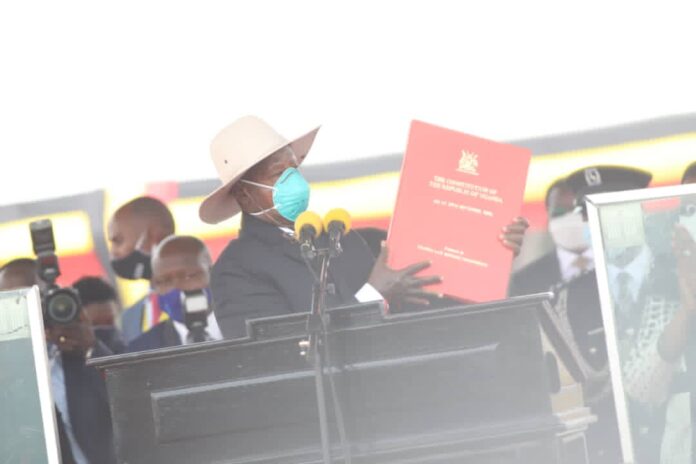
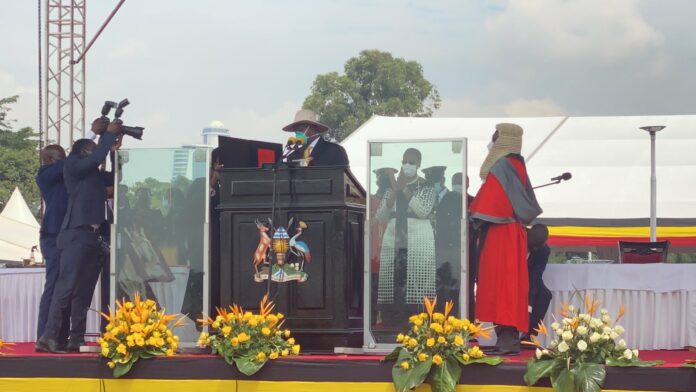
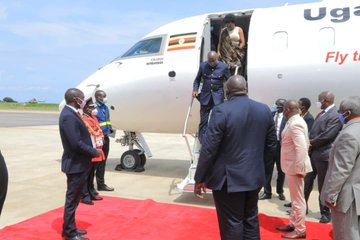
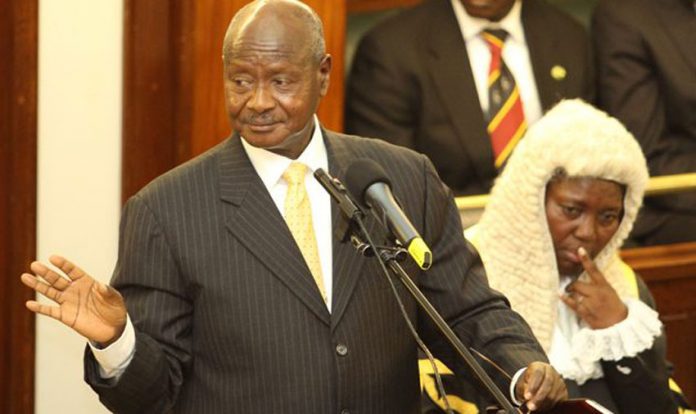
Today, Yoweri Tibuharwa Museveni was sworn in for the sixth consecutive term in office. By 2026, Mr. Museveni will have ruled Uganda for four decades.
Mr. Museveni was sworn by the Chief justice Alfonso Owiny-Dollo at Kololo Independence grounds and handed the instruments of power which included the National anthem, Coat of arm, seal and others.
“I, Yoweri Tibuhaburwa Kaguta Museveni, swear in the name of the Almighty God that I shall faithfully exercise the functions of the President of the Republic of Uganda,” he swore
At the swearing in ceremony which was flanked by among others the President of Burundi Évariste Ndayishimiye, Somalia Mohamed Abdullahi Mohamed, Kenyan President Uhuru Kenyatta, Museveni scoffed at the European countries which have continued to interface into African politics.
“It is quite laughable to try to give lectures about democracy to architects of such a system. We built this system for our people. We neither seek nor need any approbation from anybody outside Uganda, except our peers in the AU to whom we are linked by African brotherhood, solidarity and shared values, based on mutual respect.” Museveni said shortly after swearing in.
“When some actors started attacking Libya against the decision of the African Union, I contacted Jacob Zuma of South Africa for African Armies, who decided to intervene in Libya and confront and teach a lesson to those aggressors. We were let down by Muammar Gaddaffi who abandoned Tripoli without a fight.” he said
Museveni said this financial year and the next financial year, Shs464billion has been set aside to boost hotels, the performing arts, the boda- boda and the sportsmen sectors which were hit by Covid-19 lockdown.
“The UDB will be further empowered to give low-interest loans to manufacturers, agricultural entrepreneurs and some actors in the services sector tourism,” he said.
Below is Museveni’s speech
SPEECH
BY H.E. YOWERI KAGUTA MUSEVENI
PRESIDENT OF THE REPUBLIC OF UGANDA
AT THE SWEARING-IN CEREMONY
12TTH MAY, 2021 – KOLOLO CEREMONIAL GROUNDS
Your Excellencies, The visiting Heads of State and Their Excellencies the First Ladies;
Your Excellencies Heads of Delegation;
The Honourable Members of visiting delegations;
H.E. The Vice President of Uganda;
Rt. Hon. Speaker of Parliament;
His Lordship the Chief Justice;
Rt. Hon. Deputy Speaker;
His Lordship the Deputy Chief Justice;
Rt. Hon. Speaker of the East African Legislative Assembly;
The Rt. Hon. Prime Minister;
Their Highnesses the Cultural Leaders;
The Religious Leaders;
All the other Leaders of the State and the NRM Party;
Your Excellencies High Commissioners and Ambassadors;
The NRM fraternity;
Leaders and Members of other Parties;
Distinguished Guests;
All the Wanainchi;
Ladies and Gentlemen.
Your Excellencies,
The people of Uganda and myself, welcome you to Uganda. I thank you for coming to show solidarity with us on this joyful occasion.
By 1900, the whole of Africa had been colonized, except for Ethiopia. This was a big shame to Africa and it was all due to the political fragmentation of Africa into small kingdoms and chiefdoms. Some of the traditional leaders tried to fight to preserve their independence. They were, however, not coordinated and they were defeated one by one. Taking Uganda as an example, our society was, that time, a pre-capitalist, mainly non-money one, using barter trade (kuchurika) and comprised of 3 social classes: the feudalists; the artisans (black-smiths, carpenters, potters, etc.); and the peasants (agriculturalists, pastoralists and fishermen).
By 1962, at independence, this pre-capitalist economy and society had, somewhat, metamorphosed into a typical enclave colonial economy with a small island of modernity that had entered the money economy, surrounded by a sea of backward subsistence economic activities, that only catered for food and no cash. The small monetary enclave economy left by the British, was described as the economy of the 3Cs and the 3Ts. The 3Cs being: Coffee, Cotton and Copper and the 3Ts being: Tobacco, Tea and Tourism. This little enclave was growing well. In 1969, it grew at the rate of 11%. When the illiterate Idi Amin came in, in 1971, the small enclave collapsed, almost completely. By 1986, sixteen years after the onset of the Idi Amin regime, two of the 3Cs (cotton and copper) had disappeared and two of the 3Ts (Tourism and Tea), had either disappeared or radically shrank. Tea exports had gone from 23 million kgs in 1969 to only 3 million kgs. Hence, it was only coffee and tobacco that were still limping on.
Abandoned Tea plantation – 1976-1985
Pruned Tea plantation ─ eshariire, ensarire
With the clear-headed ideology of the NRM, we had correctly diagnosed the problem of Uganda. Philosophically and strategically, the main mistake was to emphasize identity (of religion, tribe and gender chauvinism), instead of emphasizing interests (markets, security, infrastructure, etc). Accordingly, we distilled the four (4) principles of NRM:
(i) Patriotism ─ loving Uganda and rejecting sectarianism of religion or tribe as well as gender chauvinism; this is, among other things, to ensure, that the united market of Uganda is available to our producers without any hindrances (multiple taxation by local governments, etc).
(ii) Realizing that the internal market of Uganda is not enough; in order to support our producers of goods and services, we saw that Pan-Africanism was a necessity for the prosperity of our society.
(iii) Ugandans could not, however, benefit fully from the Ugandan market, the African market or, indeed, the global market, unless they underwent social-economic transformation ─ changing from the pre-capitalist traditional culture of only working for the stomach or engaging in uneconomic colonially demanded cash-crops production, to producing remunerative products and services that are market-driven.
While joining the money-economy is one of the stimuli for social-economic transformation, we cannot also forget the other one ─ the development of the human resource through education and improved health.
(iv) The fourth principle of the NRM’s diagnosis and prescription for Uganda’s society, is democracy. The Ugandans had not known democracy during the time of the pre-colonial kings and chiefs, during the time of colonialism and during much of the post-colonial time, except for the four years between 1962 and 1966. That is how and why we designed a most elaborate democratic structure involving 96,860 elective positions in the whole country. In Parliament, we have 353 directly elective constituencies, open for all Ugandans that have A-level education and are above the age of 18 years old. On account of the reasons for our culture, out of this number, only a small number of women always make it through this “law of survival of the fittest”. In the outgoing Parliament, such women were only 19 and in the incoming, such women were only 14. At Independence in 1962, out of a Parliament of 92 MPs, only 2 were women ─ Florence Alice Lubega and Sugra Visram (an Indian lady). It is on account of this structural marginalization of some sectors of our society, that we added special seats for: women ─ one per district; youth ─ 1 per region; disabled ─ 1 per region; workers ─ 5 seats; the Liberation Army (UPDF) ─ 10; and, recently, 5 for the older persons ─ those above 65 years ─ 1 per region. I doubt very much that there are many comparable pro-people democratic structures in the World. That is how, we end up with an additional: 146 women MPs; 10 MPs for the Liberation Army; 5 for the workers; 5 for the youth (between 18years and 30years); 5 for the disabled (numbering 4.5millions); and, recently, 5 for the older persons. It is, therefore, quite comic to hear of some actors in the World, giving us lectures about democracy!! We designed this system, not from air-conditioned rooms, but, from the jungles of our country where we lived with the people ─ in their huts in those days ─ for much of the 16 years of the Resistance (1971-1986), if you discount the student years where, again, we interacted closely with the masses.
What is needed is to expunge the corruption of the use of money that has been creeping-in ─ brought in by the opportunist careerists ─ looking for jobs and not service.
The 4 principles have served us well. In the last 35 years, the economy has been growing at the rate of 6.2% per annum. It now stands at US$40.5billion if you use the exchange rate method and US$116billion, if you use the PPP method. With the activation of the oil sector, which has been dormant ever since 2006 when we discovered the petroleum and if you add the expected average growth rate of 6% per annum post covid-19, the combination will expand the economy to an estimated US$67billion by 2026 using the exchange rate method and US$193billion, using the PPP method; meaning that the economy will be growing at the rate of between 9-10% in the initial years of oil production. This rate of growth, although reasonable, is not what I want. With the rise of the literacy rate from 43% in 1986 to now 76.53%, we can achieve much-faster rates of growth and I will see to that. We have achieved rapid rates of growth in some sectors. These isolated positive rapid rates of growth, can be generalized throughout the whole economy.
There is a French phrase that I have never forgotten since my aborted attempt to learn French, 59 years ago, in 1962 at Ntare. Apart from femme la Porte, auvir la Porte, Jene comproper etc., I will never forget, the phrase dolmir bouk. Certainly in Uganda, I do not know about the other parts of Africa, there has been alot of dolmir bouk (kulambaala, nino-matek, okwebaka, kugwejegyera, kulaala saana, too much sleep). In Uganda, one of the phenomena that we have had to deal with, has been the dolmir bouk. That is how you would get poverty with people who have good land with fresh water but only working for the stomach (okukolera ekidda kyoonka, tic me ic keken) and no effort at all for the pocket.
Sleeping is, however, also good in its own paradoxical way. There are so many things, you do not worry about, because you are asleep. A snake can come and enter the bedroom when you are asleep and it will bite you and you die peacefully, because you did not have time to worry.
When you are awake, however, you worry about so many realities that you continue to face.
The NRM has been able to wake-up sections of the population of Uganda. In 1986, Uganda was a land of shortages ─ no sugar, no soap, no paraffin, no textiles, no sodas, no salt, no beer, no petrol, etc. With the limited waking up of some sections of the population, Uganda now is a country of surpluses: maize, where we produce 5 million tonnes per year, but consume only 1 million tonne within Uganda; milk where we produce 2.6billion litres, but consume only 800million litres; bananas; beef; sugar where we produce 600,000 tonnes, but consume only 380,000 tonnes; cement; steel bars (mitayiimbwa); tyres and tubes for motor-cycles; textiles; ceramic tiles; coffee – 7million bags; tea – 60million kgs; etc.
Therefore, the small colonial enclave economy of 1971 that had been wiped out by the Amin regime, has been restored, greatly expanded and totally new products have been added. This has now vindicated the stand of the NRM ever since 1965, encapsulated in the 4 principles ─ one of which is Pan-Africanism.
The question is: “When all the Ugandans wake up and start using their assets fully ─ land, labour, capital ─ to create more wealth in the four sectors of commercial agriculture, industry, services and ICT, who will buy or utilize all those products? Will the internal market of Uganda be enough? The answer is a clear: “No”. The internal market, cannot be enough, if serious production takes off in Uganda and, may be, in the other African countries. Do we need examples? Look at China and India. Each of them, has an internal market of 1.4billion people. Yet, they have been greatly assisted by exporting to other countries, including the African ones. How could, then, the population of Uganda of 46million people, be considered enough to sustainably stimulate and absorb the enhanced products of the Ugandans that have woken from the sleep of ignorance about modern opportunities?
This is the moment the Ugandans and the other Africans need to answer the question: “Is this generation of the African leaders, determined to build a Latin America in Africa or a United States of Africa in Africa?” In 1776, when the British settlers in North America got independence, they wisely decided to unite the 13 colonies of the British of: Virginia, New York, New Hampshire, Massachusetts, Maryland, Connecticut, Rhode Island, Delaware, North Carolina, South Carolina, New Jersey, Pennsylvania and Georgia. They have been adding other States ever since; that is how, you now have the mighty USA.
The Spanish colonies, in South America, on the other hand, decided to remain scattered into the 18 countries of Latin America of: Mexico, Guatemala, Honduras, El Salvador, Nicaragua, Costa Rica, Panama, Colombia, Venezuela, Ecuador, Peru, Bolivia, Brazil, French Guiana, Paraguay, Chille, Argentina and Uraguay.
What is the result after 246 years? Prosperity in the USA and misery in Latin America ─ almost universally. How will a big business enterprise in Honduras (population 9.904million), Guatemala (17.915million), Costa Rica (5.094million), Panama (4.314million), etc., succeed? Even bigger countries like Brazil (population 212million), may not easily succeed for the reason that even bigger countries like China and India, still need additional markets. By 1900, Argentina was the 10th richest country in the World. What, then, happened? It was the biggest exporter of beef in the World. That is what we were taught in P.3, in 1955. What, then, happened? It seems the emergence of the protected beef market of the EU, may have been the cause of Argentina’s decline.
I would, therefore, like to use this occasion to remind the African fraternity, that economic and, where possible, political integration in Africa, is a sine qua non of the success for Africa, if we are to address the issue of the prosperity of our people and strategic security of Africa, apart from other considerations.
I am glad we are working on the CFTA for the common market of the whole of Africa and on the confederation of East Africa as a first step to the East African Political Federation. In East Africa, we should not repeat the mistake of 1963, when some actors made us miss our objective of the Political Federation.
East African Leaders call for Kenya Independence now and…. Federation this Year…..
Top-level Talks end in Nairobi – 3/6/1963
The founding Presidents of the East African Federation
We must, where we can, build a centre of gravity for the African race. There are some small countries in the World. However, many of them, have centres of gravity: USA for the Europeans; Russia for the Balkans; China for the Far East; India for South Asia.
Where is the economic and strategic centre of gravity for the African race? When you see black people suffering almost everywhere ─ in Africa, the USA, Brazil, etc., it is partly on account of lacking this centre of gravity.
In order, therefore, to solve the problem of the new happy phenomenon of surpluses in Uganda, we need to deal, along with our brothers and sisters in Africa, with 3 issues: regional and continental integration to unite the regional and continental markets to support production of goods and services better; higher purchasing power in Uganda so that the Ugandans can buy more; and good quality products at comparative costs that can be accepted in national, regional, continental and international markets.
To intensify the struggle for social-economic transformation, we shall aggressively and without compromise, deal with some obstacles. There was some resistance by some parasite groups to our policies of creating and properly using the wealth funds (OWC, Youth, Women, Emyooga, etc.); implementing free education in Government Primary and Secondary Schools; providing free vaccines and therapeutic drugs in Government health centres; protecting bibanja (tenants) owners on the iniquitous mailo land system; ensuring that the feeder roads are in good condition following the provision of good road equipment to all the districts; fighting corruption of Government officials including magistrates and the Policemen; and dealing decisively with the cattle thieves and those who steal crops from the gardens. The wealth funds will be concentrated at the Parish (Muruka), in the Parish Model, except for the myooga (specializations) funds that will remain at the constituency.
The wealth funds, unlike in the past, will be controlled by the members and not by Government officials (CAO, OWC, etc). These funds will, henceforth, be members-owned and run. The only prohibition will be to divert the money to the non-mission areas. The allocations will be grants to the Parish SACCOs. In the past, it was Government officials to select beneficiaries. The members will now prioritize the allocations themselves.
With free education, after due considerations, there will be no head-teacher, that will be tolerated if he/she re-imposes school charges. Dealing with corruption and stealing drugs, part of the solution, will be E-Government. All Government transactions, will be computer-based; no more human to human contact. This will be easier to monitor even for remote supervisions.
The corona pandemic hit some sectors badly, especially the hotels, the performing arts, the boda bodas, the sportsmen, etc. This financial year and the next financial year, we have put aside Shs464billion (about US$130million) to help these groups as soon as the residual lockdown is removed. The UDB will be further empowered to give low-interest loans to manufacturers, agricultural entrepreneurs and some actors in the services sector ─ tourism, etc.
As far as corona-19 virus is concerned, we shall open up once we have vaccinated fully 4.8million people as follows:
(a)Population over 50years (8%) – 3,348,500
(b)Health Workers (Public & Private) – 150,000
(c)Teachers, Lectures, etc – 550,000
(d)Security Personnel – 250,000
(e)Those with Comorbidities – 500,000
Below 50 years (estimate) TOTAL – 4,798,500
We have so far vaccinated 375,283 people. Apart from importing vaccines from others, we are developing our own vaccine, able to deal with all the known variants. We have also been trying, in humans, some therapeutics, which seem to be effective. Our diagnostics are reaching industrial level and we have finalized the construction plans for the diagnostics factory. Construction should commence soon. On prevention, the tough measures we took, limited the damage. Until today, we have had 42,226 infections, 41,652 recoveries and 346 deaths.
Finally, I thank Their Excellencies that have honoured us with their presence on this occasion. This is real brotherhood. We also appreciate the delegations that came from all the other countries.
I need to express my concern to the African brothers and sisters that are here today and those that are not here, that the situation in a number of points in Africa does not give credit to the African people. The security situations in: Libya; Mali; Niger; some parts of Nigeria; Chad; Central African Republic; some parts of Cameroon; Eastern Congo; Somalia; recently, Northern Mozambique; etc., must be addressed and can be addressed.
First of all, the situation in Libya, was created by the arrogant and irresponsible actions of some actors that took actions that were against the express position of the African Union. I can reveal to you now, that those actors, had a narrow escape.
When some actors started attacking Libya against the decision of the African Union, I contacted H.E. Jacob Zuma of South Africa for African Armies, that so decided, to intervene in Libya and confront and teach a lesson to those aggressors. We were let down by Muammar Gaddaffi who abandoned Tripoli without a fight. Although, at that time, I did not have direct link with Muammar Gaddaffi, I advised his envoy who came to see me, to turn Tripoli into a Stalingrad. With H.E. Jacob Zuma, we had to work out a solution for the air-craft and cruise missiles that attack defenceless people from far away, so that if the aggressors so wished, could come on the ground and we fight man to man. Such a confrontation would, of course, have been imposed on us unnecessarily. We have, since long time ago, stated that African patriots, like we in the NRM, are neither pro-West nor pro-East. We are, first and foremost, pro-Africa. It is on account of that, that good friends should only deal with contentious strategic African issues via the African Union. By-passing the African Union, is not acceptable when it comes to dangerous strategic African issues. We have no interest in fighting anybody except poverty and under-development in Africa, starting with Uganda. However, some actors are always “in search of enemies”. Our role there, is to advise those who are advisable, but also do our patriotic duty if unavoidable.
Unfortunately, the Libyans collapsed quickly. On account of that, much of North West Africa, has been with security problems that were not there before: Libya, Chad, Mali, Niger, parts of Nigeria, Central African Republic and Cameroon. Who is responsible for this haemorrhage? Of course, Muammar Gaddaffi had his own problems. I had had the task of fighting him twice ─ 1972 and 1979 ─ as he intervened in Uganda on the side of Idi Amin because he was a Moslem. However, foreign armies attacking an African country against the express objection of the African Union, is not the solution. The huge concomitant suffering of the Africans in Libya and the surrounding countries, has proven that, if any proof was needed.
Africa can defend itself against any and all aggressors if we co-ordinate. In 1963, our leaders met in Addis Ababa (only 36 of them at that time) and declared that the rest of Africa must be freed peacefully or Africa will use force.
That time, some actors thought, as they seem to think now, that this was just idle talk. Exactly 11 years later, in 1974, the African Armies, of Mozambique, Angola and Guinnea-Bissau, supported by the courageous Mwalimu Nyerere, Kenneth Kaunda, Sekou Toure, Boumeddiene, Nasser and briefly Nkrumah and the socialist countries, had defeated the Portuguese African Armies, totaling almost 200,000 soldiers. Just before this victory, there had been the 1973 Arab-Israeli war, where the Egyptian Army put up a better performance and quite bled the Israelis before the latter crossed the canal and surrounded the Egyptian 2nd and 3rd Armies in Suez and Port Said. They (the Israelis) badly needed resupplies by the USA. However, the USA had a problem because many of the European countries did not want to refuel the American transport planes in fear of the Arab anger.
The Arabs had announced the 1973 oil boycott against those that they saw as their enemies. That left the Portuguese Islands of the Azores. In the USA National Security Council meeting of 1974, the issue of using the Azores came up. Somebody in the meeting, pointed out that Africans will be very annoyed. Henry Kissinger, who was said to be a very clever man, is said to have said that African anger does not matter because they have no capacity to enforce it. Exactly 5 months from the date of that meeting, the Africans who did not matter, defeated the Portuguese who mattered.
I am told Kissinger is still alive. It would be good for his record, if he cleared up this allegation. It is up to us to show all and sundry, that we matter and we have the capacity. We defeated the Islamic hoodlums in Somalia; we defeated the racist Whites in Southern Africa. We can defend Africa, if we act together and act right.
Back to Uganda, the elections are over. Let us get down to work. The four (4) economic sectors where there are jobs and wealth are: commercial agriculture with ekibaro, cura, aimair, otita; ─ counting profitability; industries; services; and ICT.
With your individual savings, collective savings by groups, borrowing from banks, or with Government support, you should enter one or more of these sectors so as to chase poverty from your homesteads, create wealth and jobs for some of your family and also for others.
I thank you.
12th May, 2021 – Kololo Ceremonial Grounds
Stories Continues after ad