Stanbic Bank
Stanbic Bank
18.6 C
Kampala
Stanbic Bank
Stanbic Bank
Home Blog Page 844

Japan commits Shs35b to support refugees and host communities in Uganda

Refugees in Uganda

Japan has committed Shs35 billion (US $9.8 million) to support refugees and host communities in Uganda.  The funds are peddled at mitigating the #Covid-19 impacts, over a period of one year from April 2021 to March 2022.

The support has been channeled through the United Nations and International Organizations: the United Nations High Commissioner for Refugees (UNHCR), the United Nations Population Fund (UNFPA), the United Nations Entity for the Gender Equality and the empowerment of Women (UN Women), the United Nations Children’s Fund (UNICEF), the United Nations World Food Programme (WFP), the United Nations Development Programme (UNDP), the International Organization for Migration (IOM), and the International Food Policy Research Institute (IFPRI).

“Japan recognizes that the humanitarian situation in refugee-hosting areas is devastating, especially under the spread of the #Covid-19. Therefore, the 2021’s contribution has been made with a specific focus on mitigating the impacts of the #Covid-19 to the vulnerable population, including refugees, host community members, women and children in Uganda. Acknowledging Uganda’s generous progressive refugee policy and needs for humanitarian–development supports, the Government of Japan is determined to continue to support Uganda’s solidarity with refugees and host communities,” said Ambassador Fukuzawa.

Minister of Relief, Disaster Preparedness and Refugees, Hilary Onek said, “On behalf of the Government of Uganda I would like to take this opportunity to thank the Government of Japan through the Ambassador of Japan in Uganda for the generosity exhibited towards the refugee community.The Government of Uganda commends the Government of Japan for their tireless efforts and support to Uganda, indeed Japan will always remain a true partner to Uganda. I am here to emphasize to the world Uganda’s generosity despite the scarcity of resources and to retaliate Uganda’s open door policy. Uganda, as a country, holds a special place on the world stage when it comes to refugees. ”

The UN Resident Coordinator, said Rosa Malango, “I would like to applaud the government and people of Japan for this valuable contribution to the global efforts in the fight against the #Covid-19 pandemic as well as to the advancement of the human security in Uganda.”

The assistance has been provided to help meet the objectives the Global Compact on Refugees (GRC) through the implementation of the Comprehensive Refugee Response Framework (CRRF) in Uganda, a whole-of-society approach which, under the Government’s leadership, rallies support among a wide range of stakeholders including UN agencies, International Financial Institutions, development and humanitarian partners and the private sector to improve delivery of services for refugees and the communities hosting them.

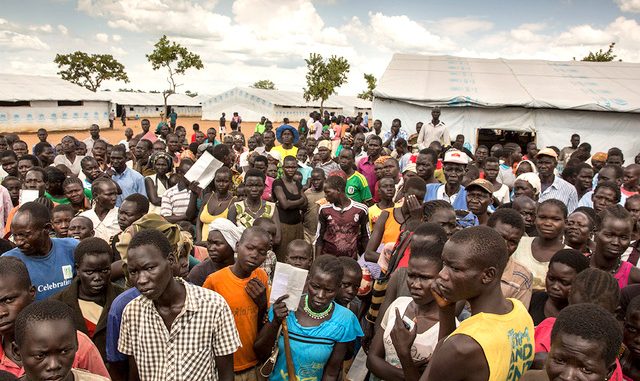
Uganda is the largest refugee hosting country in Africa with more than 1.45 million refugees and asylum-seekers, including 83 percent women and children. Majority of the refugees and asylum seekers in Uganda originate from South Sudan, the Democratic Republic of Congo and Burundi. Uganda’s refugee laws and policies are among the most progressive in the world. Refugees and asylum seekers are entitled to work, have freedom of movement and can access social services.

UNHCR; Has received Shs9 billion (US$2.5m) towards the provision of minimum health care package in Bidibidi refugee settlement, protection services in several settlements in northern Uganda and promotion of livelihood opportunities for refugee and host communities through UNHCR-JICA cooperation on rice promotion in Rwamwanja, Rhino Camp and Adjumani settlements. The project is implemented within the context of the CRRF. The fund specifically supports the continuation and expansion of UNHCR-JICA cooperation on rice promotion and farming for refugees and their hosts; access to primary health care for over 232,000 refugee and host communities in Bidibidi as well as preparedness and response for outbreak of epidemics; community-based protection interventions to improve prevention and response to gender-based violence, child protection and mental health and psychosocial support.

UNFPA Has received Shs 5.4 Billion ( $1,515,918) to increase availability and utilization of integrated sexual reproductive health and rights (SRHR) and gender based violence (GBV) services among refugees and host communities in target refugee hosting districts in South-Western and Northern Uganda during the #Covid-19 pandemic. UNFPA will support the strengthening of the functionality of Health Centers IVs in refugee hosting districts and support community demand creation to reduce maternal mortality among refugees and host communities. In addition, survivors of GBV will be provided with preventive prophylaxis, treatment and referrals for psychosocial support and information, and community mechanisms for early identification of SGBV victims, referral pathways and psychosocial support systems will be strengthened. The refugee response part of the project will be implemented in the refugee hosting districts of Isingiro, Kamwenge, Kyegegwa, Kikuube and Lamwo.

UN Women Has received Shs 4.1 billion ($ 1,154,817) to empower over 4,000 women and girl refugees and hosts (direct) and 8,000 (indirect) to mitigate the impact of multiple crises on their livelihoods, protect themselves from exposure to gender-based violence, and participate in decision-making processes within their communities in 3 refugee hosting districts of Adjumani, Yumbe and Terego. The proposed project builds on UN Women’s experience and achievement in promoting the resilience, self-reliance, leadership, and protection of refugee women achieved in the last four years in Uganda’s refugee hosting districts. Key strategies will involve support to women farmers to engage in Climate Smart Agriculture; women and youth increased access to second chance education livelihood initiatives; access to ICT facilities and equipment, digitalised Village Savings and Loan Associations and cash for work opportunities. Transformational leadership skills, legal aid, psychosocial support as well as positive gender norms will be promoted in support of women’s leadership and protection from violence.

UNICEF has received Shs 4.1 billion ($1,146,981) for emergency assistance for the prevention of further spread of #Covid-19 Infection. With the funds received, UNICEF will play a key role in the #Covid-19 health response, including risk communication action in 3 refugee hosting districts and the #Covid-19 high-risk districts of Karamoja sub-region including: Isingiro, Kikuube, Kyegegwa, Abim, Amudat, Kaabong, Karenga, Napak, Nabilatuk, Nakapiripirit, Moroto and Kotido. In addition, UNICEF aims to improve the nutrition status of children and mothers in the districts of: Abim, Amudat, Kaabong, Karenga, Napak, Nabilatuk, Nakapiripirit, Moroto and Kotido. UNICEF will also undertake key WASH interventions in Kikuube and Kamwenge Districts. Finally, UNICEF will support emergency preparedness and response capacity building of Disaster Management committees in Koboko, Obongi, Kasese, Bundibugyo, Karenga, and Nakapiripirit districts.

WFP Has received Shs3.6 billion ($1,000,000) to introduce a programme that will improve access to nutritious food among refugees and Ugandans in host communities. WFP will provide fresh-food vouchers to cover critical food needs of pregnant and nursing women and children aged 6-23 months while promoting social behavioural change. In addition, the organization will provide seed vouchers to promote the production of fast-maturing nutritious foods. WFP will stimulate demand for nutritious foods while causing households to produce and consume more high-value crops throughout the value chain.

UNDP: Has received Shs 3.1 billion ($880,000) to support and mitigate the effects of #Covid-19 on household food security and environmental restoration. This proposed project will bridge the Humanitarian-Development-Peace nexus by providing green livelihoods options for resilience-building for refugees and host communities with a focus on women and youth. This will include vocational skills-building, MSME development and access to finance, clean energy solutions to provide energy access to health facilities to selected refugee hosting districts, while providing peace education for peaceful co-existence between refugee and host communities.

IOM: Has received Shs1.3 billion ($ 375,000) to contribute to strengthening border management to mitigate risk of terrorism from land and maritime borders in the context of #Covid-19 in Uganda. IOM is working with the Ministry of Internal Affairs through the Directorate of Citizenship and Immigration Control (DCIC), and other relevant partners, to improve capacity and preparedness of border management agencies to identify and respond to terrorist groups at ports of entry through provision of specialized trainings and development of inter-agency data sharing Standard Operating Procedures (SOP), as well as enhancement of critical infrastructure against terrorist attacks by the provision of maritime security counterterrorism response equipment to DCIC.

IFPRI: Has received Shs4.4 billion ($1,224,290) to vitalize rural livelihoods in the northern region that is hosting a large influx of refugees by introducing a program, SHEP promoted by Japan, that aims to improve the market profitability of horticulture and thus increase incomes and employment for small farmers. In collaboration with Sasakawa Africa Association (SAA), the intervention adopts an innovative method of training local farmers under the concept of “produce strategically to sell.” The project will contribute to stabilizing and boosting farm incomes in vulnerable, refugee-hosting communities and will build resilience of local livelihoods to #Covid-19.

Stories Continues after ad

Cipla to manufacture lifesaving medicines for the ECOWAS and ZAZIBONA regions

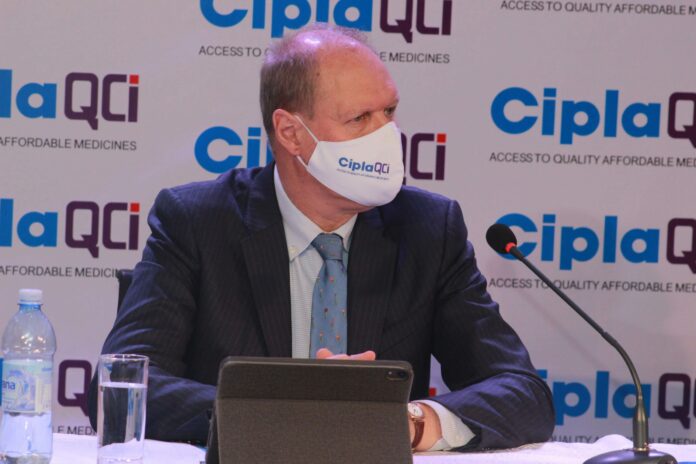
CiplaQCIL’s Chief Executive Officer, Nevin Bradford

Cipla Quality Chemical Industries Limited (CiplaQCIL) recently acquired approval to manufacture and distribute lifesaving medicines to the ECOWAS and ZAZIBONA regions in Africa.

The company was approved to market antiretrovirals and malaria medicines such as efavirenz 600 mg; lamivudine 300 mg; tenofovir 300 mg Artemether 20 mg; lumefantrine 120 mg tablets, and tenofovir 300mg/lamivudine 300mg/dolutegravir 50mg (TLD) tablets.

The medicines will be manufactured and delivered to the region effective immediately.

CiplaQCIL’s Chief Executive Officer, Nevin Bradford said: “For the first time, a manufacturer from East Africa has received approval to supply lifesaving medicines to the ECOWAS regulatory authority. The approval from the regulatory authority not only bestows a vote of confidence in CiplaQCIL but also in Uganda’s pharmaceutical industry as a whole.”

The approval opens doors for CiplaQCIL to gain entry into new markets such as Benin, Burkina Faso, Cabo Verde, Cote d’Ivoire, The Gambia, Guinea, Guinea Bissau, Mali, Niger, Nigeria, Ghana, Senegal, Sierra Leone, Togo, Liberia, Namibia, Malawi, Zambia, Zimbabwe, Mozambique, Botswana, the Democratic Republic of the Congo, Tanzania and South Africa.

“We recently upgraded our manufacturing facility which will be able to meet the increased volumes following this approval and hence making CiplaQCIL into one of the largest pharmaceutical in Africa. We are proud to be able to produce quality, affordable medicine in Africa, for Africa in line with our ethos of ‘caring for life,” said Bradford.

Stories Continues after ad

NRM social media activist collapses, dies in Abu Dhabi

Late Ben Rwamugita.


A National Resistance Movement social media activist who has been working in Abu Dhabi fainted last week and died before he was rushed to hospital Abu Dhabi where he had been working for over 10 years.

Ben Ahimbisibwe Rwamugita had been working as a security officer in Abu Dhabi fainted and died on April 16, morning as he prepared to go to work in the morning.

According to the family sources, his relatives have been meeting to fundraise the money to bring the back home for burial in Rubaya, Kashari, Mbarara district.

The deceased had served as a soldier and deployed in northern Uganda to fight the Lord’s Resistance Army rebels.


Stories Continues after ad

Mike Mutyaba petitions State House Anti-Corruption Unit over mismanagement of funds by FUFA

Mike Mutyaba

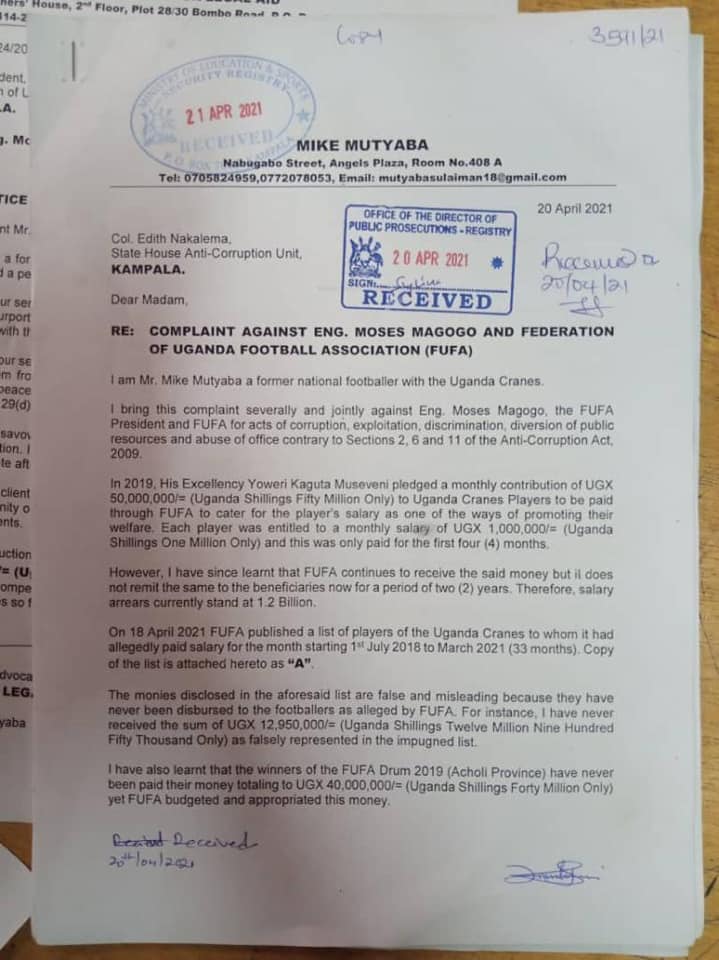
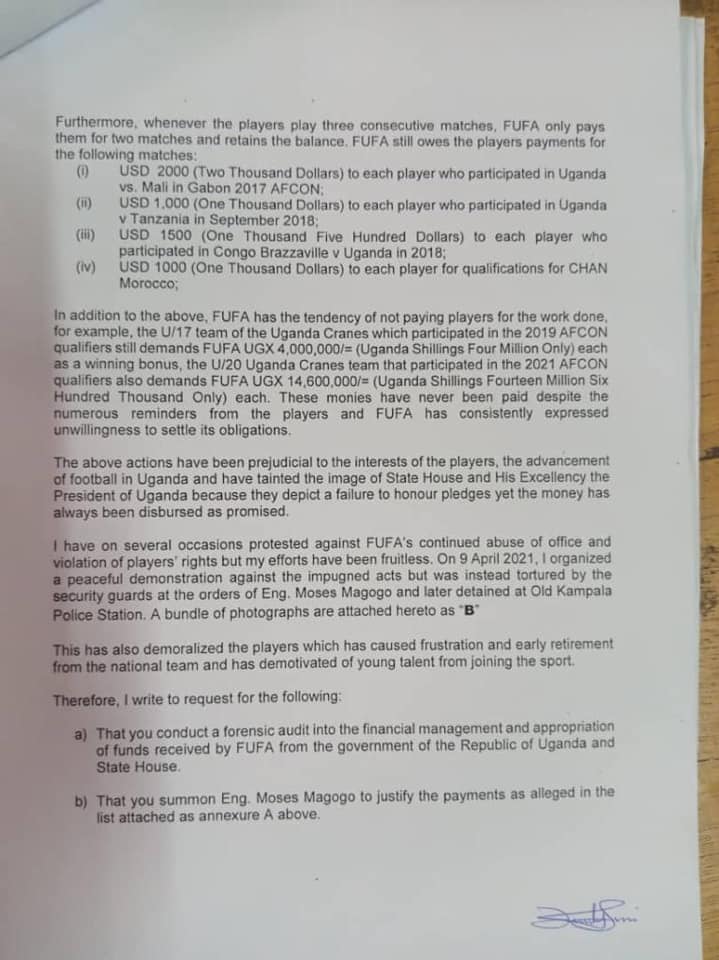
Former Uganda Cranes midfielder Mike Sulaiman Mutyaba has petitioned the State House Anti-Corruption Unit over alleged mismanagement of funds meant for the Uganda Cranes players by FUFA president Moses Magogo.

While addressing the media in Kamwokya, Mutyaba together with his lawyers Byansi Henry and Jumba Anthony of Center for Legal Aid, said he has now resorted to legal action.

Early this month, the retired KCCA player held a peaceful demonstration at the FUFA House in Mengo calling for Magogo’s resignation but was beaten by the security guards and detained at Old Kampala police station.

“I bring this complaint severally and jointly against Eng Moses Magogo, the FUFA President and FUFA for acts of corruption, exploitation, discrimination, diversion of public resources and abuse of office contrary to Sections 2, 6 and 11 of the Anti-Corruption Act 2009,” reads part of the petition.

In 2019, Museveni pledged a monthly contribution of 50 million shillings to be paid to fifty Uganda Cranes players (each player entitled to one million shillings) every month but according to Mutyaba, this was paid for only the first four months.

“I have since learnt that FUFA continues to receive the said money but it doesn’t remit the same to the beneficiaries now for a period of two years. Therefore salary arrears currently stand at 1.2 billion,” the petition reads.

Mutyaba says such FUFA’s acts demoralize the players which has caused frustration and early retirement from the national team and demotivated young players from joining the sport.

Stories Continues after ad

Chief Justice engages two Parliamentary Committees over need for Judiciary’s enhanced budget

Chief Justice engages two Parliamentary Committees over need for Judiciary's enhanced budget

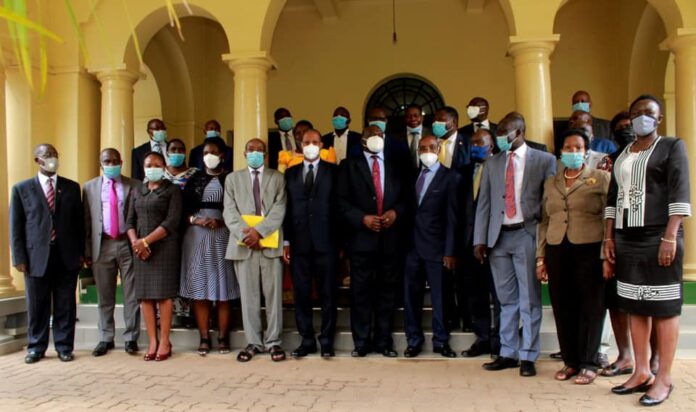
Barely a week after he engaged the Legal and Parliamentary Affairs Committee of Parliament, the Chief Justice on Wednesday met two Committees of Parliament over the need for Judiciary’s enhanced budget.

This time around, Parliament’s Budget Committee and the Legal Committee pitched camp at the Judiciary headquarters in Kampala to appreciate Judiciary’s plan for the next Financial Year and the resources required for the Judiciary to operate equitably.

“For the longest time, the Judiciary has been treated as though it is a department under the Ministry of Justice, yet it is a whole arm of the state,” the Chief Justice, Alfonse C. Owiny – Dollo. “For almost five years, the Judiciary has been allocated the same budget, which is actually way below that of some ministries.”

He said the Judiciary deserves an enhanced budget similar to that of Parliament to hire more Judicial officers and staff so that Ugandans can access justice from Courts in every constituency and district.

“We need to recruit more judicial officers and staff into the Judiciary and properly equip them to dispense justice to Ugandans. You need to know that it is not our desire to have many unresolved cases in our Courts for five to 10 years. Give us the resources to do a decent job,” added Justice Dollo.

The Permanent Secretary/Secretary to the Judiciary, Pius Bigirimana, said the funding proposal that is now before Parliament for approval is seeking to improve funding to the Judiciary from 0.5 per cent of the national budget 1.9 per cent.

Mr Jacob Oboth-Oboth, the chairperson of the Parliamentary Legal Committee, said his committee fully supports Judiciary’s new push for better funding. “What we need to check out is why the Ministry of Finance insists that it lacks resources to fund Judiciary’s budget proposal,” he said.

His counterpart from the Budget Committee, Mr Amos Lugoloobi, said his Committee was willing to do all it takes to ensure that the Judiciary secures adequate funding to implement the new Administration of the Judiciary Act.

The Legislators concurred to set up a meeting within the course of next week with key players within the government so that a position is taken at a high level on the resourcing of the Judiciary.

The Deputy Chief Justice, Richard Buteera, noted that adequate resourcing of the Judiciary is long overdue. “It is the ordinary Ugandans out there who suffer whenever the Judiciary is not given the tools to do its work,” he said.

The Principal Judge, Dr Flavian Zeija; Chief Registrar, Sarah Langa Siu, several registrars and senior administrators attended the high-level engagement.

Stories Continues after ad

Parliament approves $65 million loan for farmers

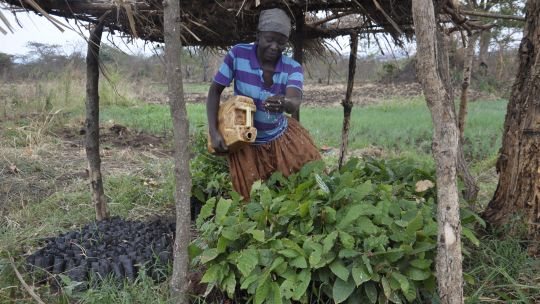
A farmer waters her nursery tree in Hoima, Uganda

Ugandans engaged in the agricultural sector are poised to receive stimulus packages following the approval of a request authorising government to guarantee Uganda Development Bank (UDB) to borrow US $65 million.

Parliament approved a request to authorize government to guarantee UDB to borrow $15 million from the European Investment Bank, $10 million from Islamic Trade Finance Corporation, $20 million from OPEC fund for International Development and $20 million from the Arab Bank for Economic Development.

Presenting the report on the request, during the plenary sitting on  April 12, 2021, the Chairperson of the Committee on National Economy, Syda Bbumba said the funds are being deployed in the agriculture, manufacturing and agro-industrial sectors.

She added that the bank only received funding to implement a component of the government stimulus package which was specifically to mitigate and support the faster recovery of the economy from the negative impacts caused by the #Covid-19 pandemic.

“UDB has not received any funding to bail out struggling businesses and funding received was not meant to be given out as package or grant to struggling businesses,” she said.

MPs welcomed the loan but raised concern over the high interest rate of 13 per cent arguing that it is not favourable for farmers who are already struggling to stay in the sector.

“If I can borrow an example from the agricultural banks in Thailand, if you are a community and you are borrowing, the interest is 0.01 per cent and if you are an individual, maximum interest rate is 6 per cent. These are factors we need to consider if we want to empower our people,” said Hon. Lawrence Songa (NRM, Ora County).

Adjumani District Woman Representative, Hon Jessica Ababiku, said that while Ugandans have been yearning for such a loan to boost farmers, majority of the borrowers will be constrained to borrow because of the high interest rate.

“The interest rate needs to be reduced because majority of borrowers are constrained by capital. If we say interest rate is at 13 per cent, it will not help the small borrowers; it will only be advantageous to huge borrowers,” said Ababiku.

Hon Jack Wamanga-Wamai (FDC, Mbale Municipality) said that the high interest rates demotivate Ugandans from venturing into the agricultural sector.

“Government should attract people to engage in agriculture by giving loans with low interest rates. When you keep interest rates high, people will shun agriculture and come to the city to look for white collar jobs,” said Wamanga-Wamai.

The Leader of the Opposition, Betty Aol Ocan expressed concern about local farmers who cannot afford loans with high interest rates.

“These loans go to those who are already established and yet majority of our farmers are still in subsistence farming. They cannot access loans with high interest rates,” Aol Ocansaid.

Gilbert Olanya (FDC, Kilak South County) asked government to ease accessibility of the loan to farmers upcountry by opening branches countrywide.

“UDB should liaise with other banks in the districts because it becomes difficult for farmers upcountry to travel to the city to process the loan,” said Olanya.

Hon Syda Bbumba said that the high interest rate is attributed to the cost of borrowing the loan. She also told the MPs that UDB does not work directly with consumers but through government owned banks including Pride Microfinance, Housing Finance and Post Bank.

Stories Continues after ad

Museveni urges NRM MPs-elect to support gov’t in boosting industries for economic growth

Museveni during NRM MPs-Elect’s retreat at National Leadership Institute in Kyankwanzi District.

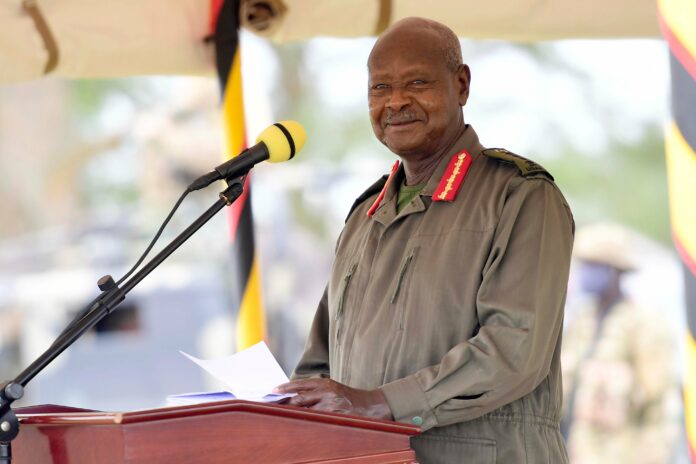
President Yoweri Museveni has urged National Resistance Movement (NRM) MPs-Elect to support the government in boosting industries for growth of the country’s economy.

Museveni said during NRM MPs-Elect’s retreat at National Leadership Institute in Kyankwanzi District. According to Museveni, industrialisation is a very fundamental sector in fostering social economic Transformation and better lives of every Ugandan.

“I therefore request you while in Parliament to support me in attracting investment for industries especially for those dealing in final products that can be consumed locally or be exported to other countries,” Museveni requested MPs.

This according to Museveni will help to improve balance of trade with other countries as well as create more employment opportunities for the youths.

Museveni also hinted on efforts by the government to get rid of subsistence agriculture where homesteads only grow for the stomach instead of money as his biggest problem so far. Once subsistence is dealt with, President Museveni believes that lives of ordinary Ugandans will improve.

In the 2021/26 manifesto, President Museveni and his new government have promised to focus on four big sectors which include services, Commercial agriculture, industrialisation and Information Communication Technology (ICT).

Museveni says that mentioned sectors are interconnected and should not be fragmented. He implored MPs to plan and implement them to attain social Economic Transformation.

“I am convinced that unlike other countries that are constrained to engage in some sectors like agriculture, Uganda has all favourable conditions to engage in the four sectors,” Museveni said.

Last week, President Museveni told MPs that the government has so far established more than 20 industrial parks in various parts of the country and thousands of industries are already manufacturing several products.

According to an economic Expert from Makerere University, Dr. Ramadhan Ggoobi, the government should interest itself in protecting local industries by reducing taxes on ICT infrastructure since this seems a new normal especially after the covid-19 pandemic.

Dr Josephine Nabukenya, an ICT expert while delivering a paper to the MPs said that ICT is the answer to  most of the problems in Uganda citing how it is serving the world amidst the pandemic.

“ICT is the brain of development that can stimulate the economy  because it helps to link the rest of the sectors,” Dr. Nabukenya emphasized.

Notwithstanding the recent achievements, there are challenges that continue to affect the adoption of ICTs and industrialisation both at individual and government level, that may impede the industrial Vision of Uganda. These include; high electricity expenses, low internet penetration for innovation, corruption and bureaucratic tendencies among others.

Stories Continues after ad

Over 200 police officers receive training in the fight against pornography

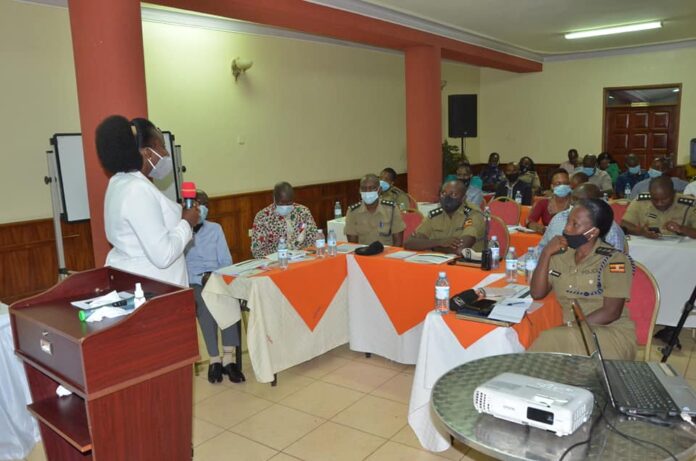
Dr. Annette K. Kezaabu, chairperson to the Pornography Control Committee talking to police officers

The Pornography Control Committee (PCC) has trained over 200 police officers in the Kampala Metropolitan area since the start of the year 2021.

The PCC is comprised of officials from various key government departments including but not limited to the following; Ministry of Gender, Labour & Social Development, Ministry of Health, Ministry of Education, the Creative Arts Industry and representatives from the cultural Institutions in Uganda.

There is a Multi-Sectoral Task Team where other stakeholders are incorporated and as a result, join hands with the others to deliver this service of fighting and eradicating pornography in Uganda. The Uganda Police Force is part of this team.

The PCC has systematically carried out sensitization and awareness programs on the Anti-Pornography Act, 2014 using various community-based initiatives as well as media programs.

However, the team found it appropriate to give strategic and focused training to police officers. It started with the following areas; Mukono and Naggalama, Kira Road, CID Headquarters Kibuli and Kampala North based at Kawempe plus officers from Savanah region, in Luwero District.

In total, over 200 police officers have received this training and pledged to be ambassadors in the fight against the vice. They were armed with the contents of the law, supplied with copies of the Ant-Pornography Act 2014, and mobilized to fight pornography with the same zeal they apply fighting against other crimes.

It was rightly noted that many people naively watch pornography thinking that it is an act of passing time, or, an avenue that will help them to improve their sex life yet it cripples it as it is addictive, depressing, destructive, and deadly most of the time.

It could be a source of many other heinous crimes including rape and defilement, drug use and abuse, and murder. Officers, especially those from CID were guided to look beyond the crime being investigated to incorporate a possibility of porn involved.

The SOCOs, CID, and Crime Intelligence officers were to take kin interest in their respective roles of administering justice. Therefore, police officers trained in the fight against pornography included Unit Commanders (Uniformed and territorial commanders), CID officers, Community Liaison Officers (CLOs) and Child and Family Protection Officers (CFPUs).

The intention was clear; to create awareness among the rank and file and among the communities police interface with daily, each in their respective capacities. Obviously, Police conduct hundreds of thousands of community-based programs in schools, in communities like markets, the transport industry, and many others.

Similarly, Police interface with many people including clients that visit us at the office, and those they meet as we transact normal policing activities. They also have families that are fertile grounds for mobilization.

It was therefore clear that pornography as a crime entails the production of pornographic materials, trafficking in the same, publishing and broadcasting such materials and procuring them, exporting and importing, selling and abetting.

Police officers appreciated the contents of the Anti-Pornography Act 2014 and vowed to aggressively support the fight against the crime that is right amidst us all.

“Families and communities are faced with many crimes and rarely do we connect the dots to find the role pornography is playing in this. The heart and soul of any nation must never be destroyed by challenges we have come to know their grave effects like pornography….” said Dr. Annette K. Kezaabu, chairperson to the PCC.

The Committee was hosted by the Directorate of Ethics and Integrity from the Office of the President. PCC recently paid a courtesy call on AIGP Edward Ochom, Director Operations, UPF who was happy to receive them. In that meeting; he pledged total support of the activities of the Committee.

The Uganda Police was represented by SSP Emilian Kayima, who is a member of the Multi-Sectoral Task Team, linking police to the PCC and their operations.

Stories Continues after ad

Buganda Kingdom warns of misleading social media posts about Kabaka’s health

Kabaka

Buganda Kingdom has warned against the misleading social media messages and posts peddled by various propagandists to destroy Kabaka and Buganda.

There has been an outpouring of concern and well wishes for the health and wellbeing of Kabaka Ronald Mutebi II since the celebration of his 66th birthday on the 13th April 2021. During celebrations Kabaka’s subjects were outraged by his health condition in that he could easily breathe and on a sad note, he didn’t address them.

Katikkiro Charles Peter Mayiga has since come out to say that Kabaka is suffering from an allergic health condition caused by pollen, animal dander, dust mites and mold.

According to a press statement released by the press secretary to Kabaka, Dick Kasolo, the malicious falsehoods ranges from an allegations that the Kabaka had passed away last year or that he was admitted on an emergency basis to Nakasero Hospital a few days ago.

Kasolo said; “The falsehoods and malicious allegations are being instigated and spread by people who claim to love and be concerned about the Kabaka, whereas they are not.”

He said there are also pointed attacks against senior members of the Royal Family, the Katikkiro and officials of the Kabaka’s government as well as against eminent Buganda personalities.

“In fact there is a clear and discernible plot by those enemies of Buganda to use this opportunity to weaken the Kingdom by creating rifts amongst the people of Buganda and undermining the Kabaka’s officials, especially the Katikkiro, Charles Peter Mayiga and other Kabaka’s strong supporters,” Kasolo said.

“Do not lend a hand to the enemies of Buganda and Uganda by spreading false information which is intended to cause fear, alarm and undue excitement. The effort to weaken the Kingdom shall not succeed. The disguised, concern for the Kingdom should not deceive anyone,” he added.

Stories Continues after ad

Emirates commences IATA Travel Pass trials simplifying #Covid-19 related travel requirements

Emirates commences IATA Travel Pass trials simplifying #Covid-19 related travel requirements

Emirates today commenced trials of the International Air Transport Association (IATA) Travel Pass– a mobile app to help passengers easily and securely manage their travel in line with any government requirements for COVID-19 testing or vaccine information.

The first passengers travelling from Dubai to Barcelona on EK 185 today trialed the ‘digital passport’ to verify and share their pre-travel COVID-19 test status with Emirates.

The trials are a step towards making travel more convenient, enabling travelers to manage COVID-19 related documentation digitally, safely and seamlessly throughout the travel experience. In the future, travelers will also be able to share vaccination certificates with authorities and airlines to facilitate travel.

Adel Al Redha, Emirates’ Chief Operating Officer said: “The ability to process passengers’ COVID-19 relevant data for travel digitally will be the way forward. We are pleased to have been pioneers and partner with IATA in trialing this initiative in real time and soon will be launching other initiatives to further enhance our customer experience.”

The trial is being done on selected Emirates flights from Dubai to Barcelona and London Heathrow to Dubai; and will soon be expanded to include other routes. Eligible passengers are being personally invited to download the app and enrol for the digital travel pass ahead of their travels. In Dubai, Emirates has partnered with select Prime Health Care labs which are authorised to securely send test results to passengers via the app. Those travelling from the UK, can get their test done at select Screen4 labs.

The IATA Travel Pass app will have an integrated registry of travel requirements to enable passengers to find accurate information on travel and entry requirements for all destinations regardless of their itinerary. Eventually it will also include a registry of labs – making it more convenient for passengers to find testing centres and labs at their departure location which meet the standards for testing and vaccination requirements of their destination.

The global registry, managed by IATA, will manage and allow the secure flow of necessary information amongst all stakeholders and to provide a seamless passenger experience.

Emirates has been making travel safe and convenient with its latest initiatives like the IATA Travel Pass trials. Its latest policy updates also offer customers even more confidence and flexibility to make their travel plans. Emirates has the industry’s most generous ticket validity, giving customers the ability and flexibility to hold or use their ticket anytime for up to 36 months.

Emirates was also the first airline to provide global multi-risk travel insurance including COVID-19 cover with every flight. Throughout the journey, the airline has also implemented a comprehensive set of measures at every step to ensure the safety of its customers and employees.

Stories Continues after ad