Stanbic Bank
Stanbic Bank
16.2 C
Kampala
Stanbic Bank
Stanbic Bank
Home Blog Page 921

Kyambogo University to engage hostel owners on fees hike

Kyambogo University

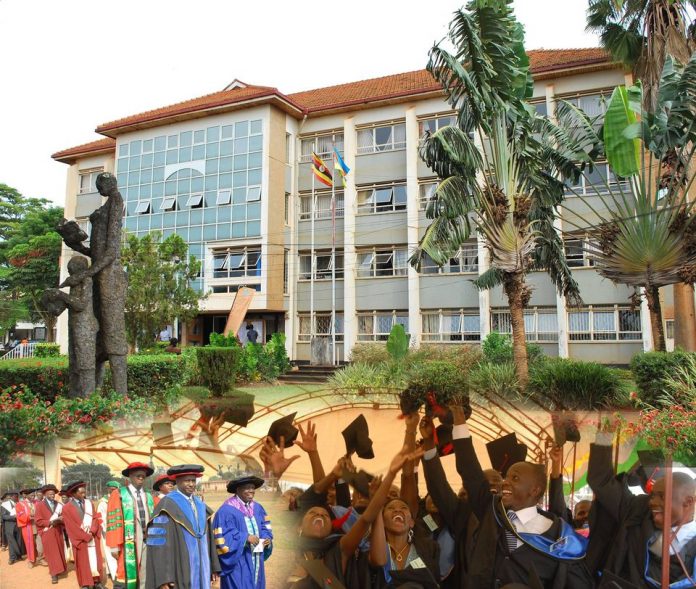
Kyambogo University has made it clear that they will deal with hostel owners that have deviated from what they had agreed and hiked the accommodation fees.

Mildred Tibananuka, the Dean of students Kyambogo University says they will not sit and look at their students being charged unfairly yet everything was agreed upon.

This comes after final year students have started complaining that hostel owners have charged them much money compared to what they negotiated with them.

When we visited some hostels, we learnt that there are hostels like Bavana, choice among others which are charging shillings 400,000 to each student for a period of six weeks.

According to Tibananuka, when they met with hostel owners, they agreed that students should be charged not more than shillings 200,000 for only utilities which the hostel owners accepted.

However, Tibananuka told us that it was unfortunate to learn that most hostel owners had deviated from what they had negotiated and agreed on.

She says that they will engage all the hostels that they have learnt that they are over charging students.

Tibananuka urges all the students to remain calm because the matter shall be handled.

Kyambogo University has over 11,943 final year students and the majority of these students stay in private hostels around the University.

Stories Continues after ad

U.S Embassy develops COVID-19 Resource Toolkit for Uganda

COVID-19 Structure

The U.S. Embassy in Uganda developed a ‘COVID-19 Resource Toolkit’ in collaboration with Uganda’s Ministry of Health and other partners in order to expand access to key COVID-19 information and resources across Ugandan society.

The toolkit includes links to videos, public service announcements, posters and other information on COVID-19 signs and symptoms, prevention and care, mask wearing, social distancing, hand hygiene and other health-related information.

“The more people who know how to keep themselves and their families safe, know the appropriate symptoms for which to look, and know how to seek the care and treatment they need, the greater the success we will have in beating COVID-19 together,” U.S. Embassy Chargé d’Affaires Christopher Krafft said on the release of the COVID-19 Resource Toolkit.

He asked community leaders in Uganda to take the COVID-19 communications resources in this toolkit and utilize, implement, and most importantly share them as extensively as possible.

To date, the cumulative COVID-19 cases in Uganda stand at 10,788 with 7,066 having recovered and recorded 97 deaths.

Stories Continues after ad

Nigeria: Protesters ‘shot dead’ by security forces in Lagos

protesters in Nigeria

Nigeria’s security forces have reportedly shot dead demonstrators protesting against police brutality in Lagos, according to several witnesses, as authorities imposed a curfew and promised an investigation.

Four witnesses told Reuters news agency that soldiers fired at the protesters who had gathered in the Lekki district of Nigeria’s largest city in defiance of an indefinite curfew imposed hours earlier by the authorities.

Hundreds of people were at the site at the time of the shooting, which witnesses said took place around 7pm local time (18:00 GMT).

“They started firing ammunition toward the crowd. They were firing into the crowd,” said Alfred Ononugbo, 55, a security officer. “I saw the bullet hit one or two persons,” he said.

Inyene Akpan, 26, a photographer, said more than 20 soldiers arrived at the toll gate in Lekki and opened fire. He said he saw two people being shot. Akinbosola Ogunsanya, a third witness, also told Reuters he saw soldiers remove bodies.

Scenes of protesters removing a bullet from someone’s wound and pleading for help were broadcast in a live video on Instagram by DJ Switch, a popular disc jockey.

Amnesty International said it had received “credible but disturbing evidence of excessive use of force occasioning deaths of protesters at Lekki toll gate in Lagos”, adding that it was investigating “the killings”.

Another witness, Chika Dibia, said soldiers hemmed in people as they shot at them.

Video verified by Reuters showed men walking slowly in formation toward demonstrators, followed by trucks with flashing lights, and the sound of gunfire popping. Another video showed the toll gate itself, with a protester waving a Nigerian flag, as people ran amid the sound of gunfire.

In a Twitter post, the Nigerian Army said no soldiers were at the scene of the shooting on Tuesday night.

Lagos State Governor Babajide Sanwo-Olu tweeted pictures of him visiting people in hospital who were victims of what he referred to as the “unfortunate shooting incident at Lekki”.

He said 25 people were being treated for mild to moderate injuries, two were receiving intensive care and three had been discharged.

“As the Governor of our state, I recognise the buck stops at my table and I will work with the FG (federal government) to get to the root of this unfortunate incident and stabilise all security operations to protect the lives of our residents,” Sanwo-Olu said, adding that he would give a state broadcast on Wednesday morning.

Earlier, Sanwo-Olu alleged that criminals had hijacked the protest movement “to unleash mayhem” and announced a curfew in the city.

The state government earlier said it would open an investigation into the shooting. A Nigerian army spokesman did not immediately respond to requests for comment.

Lagos is one of five of Nigeria’s 36 states to have announced movement restrictions in the last two days. Protesters pledged to remain on Lagos’s streets regardless.

“Are you afraid?” a man shouted to the flag-waving crowd from a stage. “We will stay here peacefully,” 32-year-old demonstrator Akin told AFP. “This is our new home.”

Separately on Tuesday, the national police chief ordered the immediate deployment of anti-riot forces nationwide following increased attacks on police facilities, according to a police spokesman.

Tens of thousands of people have been taking to the streets every day for nearly two weeks across Nigeria to demand an end to police violence.

The protests, organised under the #EndSARS hashtag, began with calls to scrap a notorious police unit, the Special Anti-Robbery Squad (SARS), which has long been accused of extortion, torture and extrajudicial killings.

After days of widespread demonstrations, the authorities announced SARS would be disbanded, ordering all personnel to report to the police headquarters in Abuja for debriefing and psychological and medical examinations.

Officials said SARS would be replaced by a Special Weapons and Tactics (SWAT) team.

The announcements have not satisfied the protesters, who see the changes as nothing but a renaming exercise. On Monday, Amnesty said at least 15 people have been killed since the demonstrations began.

Stories Continues after ad

University finalists ask for lowered pass mark

Students in class at Kyambogo university.(photo by Ronard Shabomwe)

Final year students in different universities are requesting the university authorities to lower the grading system in order to enable them pass their examinations.

Universities reopened for final year students last week for a period of not more than six weeks. Four weeks for class work and two weeks for examinations.

The students say that before the closure of the university, they still had course work and tests to do which they are going to do in this remaining period. Therefore, for the shortest period they have, they argue that they should be favored by lowering the marking grades to help pass.

According to Kellen Munguleni a finalist of Kyambogo University, if they are marked and graded as usual, it will be a great challenge for many students since they cannot handle the entire work load in the shortest time given.

She says, if this is impossible, then they should add more weeks to enable them to have enough preparations for examinations.

In universities, a student now needs to score 70-74% and 69-65% to qualify for upper and lower second class degrees respectively. Marks for a pass degree were also raised to 2.9-2.0 from 2.5-1.5. Such a degree now requires a student to score 50-59% marks, while 49% and below is a fail.

The pass mark for each course unit is at 50 percent. Students say this is high now that education is affected by the closure of learning institutions.

Rashid Aluma a finalist from Makerere University explains that as a student he has nothing to do other than reading and getting prepared for anything that shall come on their way.

Aluma says that the university should look into this issue of favoring them by lowering the pass mark from 50 percent to at least 40 percent.

Unlike other universities, Makerere University pass mark for postgraduate students is standing at 60 percent. And the undergraduate student is still at 50 percent. On this, the students say, it is high at this time when everything is affected by the COVID-19.

Peace Twikirize a final year student of Kampala international university notes that this was supposed to be a dead year. She says it will be hard to accomplish all the tests had to finish.

However, Dr Anne Begumisa, the academic registrar of Kyambogo University says the university regulations are not going to change because of the pandemic. Therefore, students should read and prepare enough in this remaining period to pass examinations.

Stories Continues after ad

 ADF rebels’ free 1,300 inmates in Beni

Captured ADF leader Jamil Mukulu being led from the special police detention facility at Nalufenya in Jinja to court .

More than 1,300 prisoners have escaped from a jail in eastern Democratic Republic of Congo’s Beni city after suspected Islamist rebels attacked the facility, officials have said.

The Allied Defence Forces (ADF) was thought to have launched the assault to free its members, the mayor said.

Only about 100 inmates remained in Kangbayi prison, the mayor said.

The ADF was formed more than 20 years ago in neighbouring Uganda to fight alleged discrimination against Muslims

The group has not yet commented on whether it was behind the attack.

Beni’s mayor Modeste

Police managed to capture 14 escapees, UN-backed Radio Okapi reported.

Two inmates were shot dead during the raid, which started at around 04:30 local time, police said on Twitter.

The army spokesman in Beni, Lt Anthony Malushay, told the BBC that an operation to capture the prisoners who escaped was under way.

In 2017, hundreds of prisoners escaped from the same jail, which holds a variety of militiamen – including ADF fighters.

The ADF is one of many rebel groups operating in eastern DR Congo, a mineral-rich area where government and UN forces have long battled to bring stability.

The group has been accused of widespread atrocities in the region.

The ADF has reportedly killed 570 civilians since the Congolese army launched an operation against them in November last year.

told Reuters news agency that the attackers came in large numbers and managed to break the jail’s door using electric equipment.

“We believe it was the ADF who did this,” he was quoted as saying.

It relocated to eastern DR Congo after being driven out by the Ugandan military from its bases.


Stories Continues after ad

Emirates expands reach in Southern Africa via interline agreement with Airlink

emirates plane

Emirates and Airlink have announced an interline agreement, widening Emirates’ reach into Southern Africa as countries begin opening their borders for travelers.

Emirates’ agreement with Airlink will provide its customers enhanced connectivity via its gateways Johannesburg and Cape Town to more than 25 domestic destinations in South Africa and more than 20 regional destinations in Southern Africa. The unique connections enabled by this new partnership provide customers onward travel options not offered by other airlines.

Both Emirates and Airlink will offer the ease of single-ticket travel and one-stop baggage check-in for customers transferring from Johannesburg and Cape Town to domestic points including Bloemfontein, George, Upington, Nelspruit, Hoedspruit and Port Elizabeth, as well as points across Southern Africa.

Sir Tim Clark, President Emirates Airline commented on the newly formed partnership: “Emirates is pleased to partner with Airlink on a new interline agreement that will help us strengthen our presence and give customers more choice, flexibility and enhanced connections across 45 cities in Southern Africa. We are committed to our operations in South Africa, as we continue to look at ways to build our extended network for customers and help them benefit with diverse travel options.

“The interline agreement that has gone into effect with Airlink is only the start of further collaboration, and we are looking forward to exploring more opportunities to widen the scope of our partnership in the future.”

Airlink CEO, Mr. Rodger Foster added: “We are proud and excited about our new interline commercial agreement with Emirates. We have a deep respect for the airline, its values and its global reach. We are confident that the relationship will deliver enhanced travel options to customers given the designed interconnectivity that will be enabled at OR Tambo International Airport and Cape Town International Airport. Airlink’s offering of connectable destinations includes most key points within Southern Africa such as; Cape Town, Durban, Port Elizabeth, East London, Bloemfontein, Harare, Lusaka, Maputo, Gaborone, Windhoek, amongst many others.”

Emirates resumed its operations into Johannesburg and Cape Town on 1 October, and Durban on 8 October, with enhanced safety measures in place across all of its onboard and on ground touchpoints. The airline continues to build market demand through connecting customers via Dubai from close to 100 destinations, as well as building more connection opportunities in South Africa and beyond through partnerships with airlines like Airlink that drive value for its customers.

Stories Continues after ad

ACME to conduct study on state of the Ugandan newsroom

ACME ED Dr. Peter G. Mwesige

The African Centre for Media Excellence (ACME) has announced that it has commenced a national project that will examine the state of the news media in Uganda.

Based on two national surveys — one of practicing journalists across all media, and the second of newsroom managers — the research project will examine shifts in the media landscape over the past decade or so and their impact on the practice of journalism in the country.

These shifts include an almost tenfold growth in internet usage, driven by mobile broadband subscriptions, and broadcast digital migration, which was achieved in 2015.

These technological developments have transformed the news media business, operational structures, and the practice of journalism. Contemporaneously, the disruptions caused by the Covid-19 pandemic have forced media companies to cut wages, lay off workers, and close some business segments.

Supported by the European Union Delegation to Uganda, the project will focus on journalists’ demographics, skills, their perceptions on roles, ethics, and influences, as well as working conditions, among others.

It will reach close to 400 journalists from 48 media houses selected from all parts of the country. The last such national survey of Ugandan journalists was carried out in 2001 and provided “a demographic and attitudinal profile of Ugandan journalists”. This project will build on that, showing how much has changed between 2001 and 2020.

In addition to profiling the Ugandan journalist, they will also map out the Ugandan newsroom, looking at important metrics such as the number of employees in media companies, the proportion of staff vis-à-vis freelance journalists, revenue sources, on-the-job training for reporters, editorial policies, among others.

“The study is in line with our strategic aims of supporting journalistic excellence, promoting an enabling media environment and improving media literacy,” said Dr Peter G. Mwesige, ACME’s executive Director. “We hope it will stimulate public debate on the state of journalism and the media in Uganda at this critical time.”

African Centre for Media Excellence is a Kampala-based independent, non-profit professional organisation committed to promoting excellence in journalism and communication in Africa.

Stories Continues after ad

NSSF introduces agency model for social security transactions

nssf introduces agency model

The National Social Security Fund (NSSF) has today unveiled the agency service that will enable its members to make their social security transactions at the nearest agent in their neighborhood without visiting the Fund offices.

While unveiling the innovation at Workers House, Richard Byarugaba, NSSF Managing Director said it is part of the Fund’s channels that will further ease access to their services for its members. “We have a branch network of 19 branches serving over 2 million customers. With this service, it means that NSSF Customers don’t need to travel long distances to access our offices, but can make transactions at the nearest bank agent at flexible working hours.”

In addition, the service is expected to reduce the Fund’s operation and administrative costs especially in establishment of temporary service centers where it doesn’t have footprint.

The service is in partnership with dfcu Bank and the Agent Banking Company (ABC) Limited. dfcu will provide its bank agents to facilitate the NSSF transactions countrywide while the Agent Banking Company provides the technology that links all bank agents countrywide.

Matthias Katamba, dfcu Bank Managing Director said the service is in line with their strategy to increase financial inclusion in the country. “We are proud to be the first bank to partner with NSSF on this front. Adding social security transactions to our list of financial services through the agency banking model, gives us an opportunity to further extend more financial services, more conveniently, to our customers, the under banked or unbanked population.  Partnerships such as this one with NSSF are testament to our commitment on delivering on dfcu’s brand promise of making more possible.”

The ABC (U) Ltd Chief Executive Officer, Richard Yego, said, “We are happy to add another service to the Shared Agent Banking platform and ultimately supporting agents earn more  from their businesses. This interoperable technology platform is safe, quick and convenient and we pledge to ensure the selected agents for the service adhere to the confidentiality clauses in this partnership in order to safeguard the NSSF member data.”

For now, members can only be able to submit their NSSF contributions at the 300 dfcu agent locations. In the near future, the agents will provide other NSSF services like employer and individual or employee registrations.

Other NSSF collection channels for contributions available to customers include the E-collections Portal that allows employers to remit their employees’ contributions directly to their NSSF accounts through the Bank, the Mobile Money Platform for contributions payment by the Fund’s Voluntary savers, the NSSF Go App and NSSF Payway..

Stories Continues after ad

Police to recruit 50,000 special constables ahead of 2021 general elections

Fred Enanga while addressing the media

The Uganda Police Force  is set to recruit fifty thousand Special Police Constables (SPCs) across the country to enhance security ahead of the forthcoming 2021 general elections.

The Police Constables will be recruited from their respective districts and they will be vetted by the district police commanders and the various district leaders.

According to police spokesperson, Fred Enanga, the constables will only serve for a period of three months from January 2021. They will be deployed before, during and after the 2021 elections in various parts of the country.

“We have a plan of recruiting 50,000 election Special Police Constables. These will be recruited to strengthen the Uganda Police Force for effective policing of the pre-election, election and post-election periods. They will be recruited from their respective districts after vetting by the District Police Commanders,” Enanga said.

“These shall be appointed for three months and are to be deployed one month to the polling date. They shall be paid an allowance of shs 375,000 per month.”

According to the police spokesperson, the recruits must be citizens of Uganda, with good conduct, with national ID, proven record of volunteerism with police and should be between 18 and 40 years of age.

“They should have at least O-level certificate, must be physically fit and duly recommended by Local Councils one, two and three. We want to caution those who may want to present forged testimonials that they risk jail,” Enanga said.

Each polling station will have an SPC deployed purposely to guard voting material, polling officers and guide voters while casting votes.

The Electoral Commission has already completed the nomination exercises for local government and for Member of Parliament seats. Presidential candidates will be nominated on November 2 to 3rd.

Stories Continues after ad

MP wants action taken against EOC boss for evading court

Sylvia Muwebwa

Kigulu County South Member of Parliament,  Andrew Kaluya has asked the concerned government agencies to investigate and take action against the chairperson of Equal Opportunities Commission (EOC), Sylvia Muwebwa Ntambi for allegedly evading court summons.

The MP’s intervention comes fourteen days after the Chief Magistrate Pamela Lamunu Ocaya gave Ntambi one last chance to appear in court or face arrest and stand trial on charges of causing financial loss, embezzlement, corruption, abuse of office and conspiracy to defraud.

Through her lawyers led by McDusman Kabega, Mrs. Ntambi adduced medical forms indicating that she is sick and therefore she couldn’t attend Court proceedings. She further presented a letter from her doctor at Medik Hospital Kawempe confirming that she is suffering from hypertensive crisis. However investigative journalists visited the hospital and were shocked to learn that Mrs. Ntambi has never been admitted there.

In a letter dated October 19th to the State House Anti-corruption Unit led by Lt. Col. Edith Nakalema, MP Kaluya states that Ntambi has openly abused and insulted the courts of law, a situation which calls for the Director of Public Prosecutions to (DPP) to investigate whether she is actually sick like she claims or not.

“We propose that concerned state agencies like the police and State House Anti-Corruption Unit should support the DPP’s office to expeditiously investigate this matter to enable the Chief Magistrate make an informed decision. The video clip captured by investigative journalists at Medik Hospital in Kawempe gives a clue,” reads part of the letter.

He adds that the directors of Medik Hospital must exhibit professionalism by telling Ugandans how the embattled chairperson acquired documents purportedly issued by their health facility. “This needs to be urgently investigated and findings submitted to court.” Kaluya adds.

Ntambi is expected to appear in Court on October 29, on criminal summons to answer charges in regard to misappropriation of millions of taxpayers.

The charging of Sylvia Muwebwa Ntambi and nine others follows the lunging of complaints to President Yoweri Museveni calling for his intervention. According to a petition dated 22nd May 2019, the whistleblower accused her of causing financial loss of over Shs200 million through termination of workers contracts and forcing workers to resign and replace them with her relatives and friends.

Since she took over the chairperson-ship of the commission, the whistleblower said Mrs Ntambi has unfairly dismissed over 11 staff, terminated over 10 staff contracts, and four contracts have not been renewed. In 2017/ 2018, the Auditor General advised the commission to employ people on permanent contracts however the chairperson declined and this has since led to financial losses.

They accused her of directing the collection of Shs100 million which they had approved in the commission meeting and the said money was to be used as kickbacks for individuals who worked hard for passing of the commission budget in 2018/19.

She is also accused of irregular approval of allowances of various members of the commission, using commission vehicle for doing private businesses, irregular recruitment of staff without embracing commission procedures. It is said that she illegally recruited Betty Namazzi, Juma Waira and Petau Isabirye Babirye.

The whistleblower also revealed that the Ag commissioner Jjemba Evans holds two offices as the head of department of compliance and enforcement and research, monitoring and evaluation.

Stories Continues after ad