Stanbic Bank
Stanbic Bank
27.9 C
Kampala
Stanbic Bank
Stanbic Bank
Home Blog Page 995

Access to HIV medicines severely impacted by COVID-19 as AIDS response stalls

More than countries have warned that they are at risk of stock-outs of antiretroviral (ARV) medicines as a result of the COVID-19 pandemic, according to a new WHO survey conducted ahead of the International AIDS Society’s biannual conference.

The survey follows a modelling exercise convened by WHO and UNAIDS in May which forecasted that a six-month disruption in access to ARVs could lead to a doubling in AIDS-related deaths in sub-Saharan Africa in 2020 alone.

In 2019, an estimated 8.3 million people were benefiting from ARVs in the 24 countries now experiencing supply shortages. This represents about one third (33%) of all people taking HIV treatment globally.  While there is no cure for HIV, ARVs can control the virus and prevent onward sexual transmission to other people.

A failure of suppliers to deliver ARVs on time and a shut-down of land and air transport services, coupled with limited access to health services within countries as a result of the pandemic, were among the causes cited for the disruptions in the survey.

The findings of this survey are deeply concerning,” said Dr Tedros Adhanom Ghebreyesus, WHO Director-General. “Countries and their development partners must do all they can to ensure that people who need HIV treatment continue to access it. We cannot let the COVID-19 pandemic undo the hard-won gains in the global response to this disease.

According to data released today from UNAIDS and WHO, new HIV infections fell by 39% between 2000 and 2019. HIV-related deaths fell by 51% over the same time period, and some 15 million lives were saved through the use of antiretroviral therapy.

Over the last two years, the annual number of new HIV infections has plateaued at 1.7 million and there was only a modest reduction in HIV-related death, from 730 000 in 2018 to 690 000 in 2019.  Despite steady advances in scaling up treatment coverage – with more than 25 million people in need of ARVs receiving them in 2019 – key 2020 global targets will be missed.

HIV prevention and testing services are not reaching the groups that need them most. Improved targeting of proven prevention and testing services will be critical to reinvigorate the global response to HIV.

WHO recently developed guidance for countries on how to safely maintain access to essential health services during the pandemic, including for all people living with or affected by HIV. The guidance encourages countries to limit disruptions in access to HIV treatment through “multi-month dispensing,” a policy whereby medicines are prescribed for longer periods of time – up to six months. To date, 129 countries have adopted this policy.

Countries are also mitigating the impact of the disruptions by working to maintain flights and supply chains, engaging communities in the delivery of HIV medicines, and working with manufacturers to overcome logistics challenges.

Stories Continues after ad

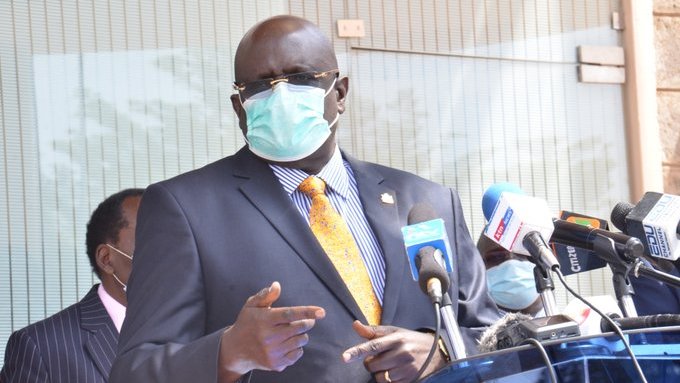
#Covid-19: Kenya cancels 2020 academic year

George Magoha

The Education Cabinet Secretary Professor George Magoha has said Schools in Kenya will not re-open until 2021 due to fears of COVID-19 infections which have started taking toll in the country.

As of today, there are 11,468,979 confirmed cases of COVID-19, and 535,181 deaths reported to the world health organisation (WHO). According to WHO Kenya have 7886 confirmed cases of Covid-19 and 160 deaths.

According to Professor Magoha it will not be practical and safe to re-open schools because the peak period for the virus infections is just starting.

 “This academic year is lost, meaning all learners will be required to repeat their current classes when schools reopen next year.”  He said without giving exact dates.

Consequently, he said, national examinations for primary and secondary schools will not be done this year. “Schools will reopen next year, that is when KCPE and KCSE examinations will be done,” Magoha said.

Stories Continues after ad

Paul Mwiru, Gerald Karuhanga join Muntu’s political party

Jinja East MP Paul Mwiru and Ntungamo Municipality MP Gerald Karuhanga have joined Gen Mugisha Muntu’s party, The Alliance for National Transformation (ANT).

The two were unveiled by the principal and presidential aspirant, Gen Mugisha Muntu. Muntu Launched ANT 13 months after he embarked on leaving the Forum for Democratic Change (FDC) Party following intraparty misunderstandings.

Speaking at Party offices on Buganda road, Mwiru, who formally a deputy spokesperson of FDC and one of the lawyers who corresponded legal team of the party said “Today I want to inform the nation that I will play my politics in this newly found political party because there is need to see the country getting on the right track in terms of health, education and other sectors.”

“I have joined this Party by choice and will because I know the task ahead of us. We need an organised group and that is why I join the Alliance. What defines me as a person is that what I say is what I do.” He said

“We have come because of how the party intends to conduct its activities. ANT puts Uganda first. We have come to lay a brick on the processes which will lead to the transformation of this country. The responsibility to a better Uganda begins with us”

Karuhanga said “if there is any historical moment I have anxiously waited in my life then it is joining this Party-a Party whose foundation constitutes the core values that our nation needs.”

He said if it wasn’t for laws, he should have joined this Party right from the launch. “I know the challenges ahead but am very sure that the team I have joined will put People First.”

 “ It gives me great joy that I am finally joining a party that believes and practices the values I cherish: honesty, integrity, transparency, zero tolerance to corruption, equity, justice.” He said

Stories Continues after ad

#Covid-19: Victoria University to rollout free online classes

The Presidential advisor on Information and Communication Technology (ICT) Ham Mulira has applauded Victoria University for availing various alternatives for students to with their studies.

Earlier the Vice chancellor of Victoria University Dr Krishna Sharma confirmed that soon or later, the institution will embark of E- teaching given the fact that all students were availed with laptops.

Speaking at Victoria University, Mr Mulira alternatives such as availing laptops to all students will avail them with the opportunity to study during Covid-19 period.

“Government through the National Council for Higher Education has come up with online/ distance learning guidelines for Higher learning education institutions on how to use technology as a medium of communication to impart knowledge to students while they are away from school.” He said

Dr Krishna Sharma said “it is the responsibility of universities and education institutions to foresee and come up with innovative ways to ensure they are not interrupted by any pandemic.”

“The University is ready to commence online teaching adding that all the issues raised in the guidelines by NCHE have already been in place at Victoria University.” He said adding that online classes will be conducted at free cost while those who will not be able will be provided with printed contents for self-study.

Stories Continues after ad

Tony Mawejje joins Police FC

Tony Mawejje

Uganda Cranes midfielder Tony Mawejje has completed his move to Uganda Premier League side Uganda Police Football Club on a two-year deal.

Mawejje rejoins Police after being clubless since 2019 when he terminated his contract with Al-Arabi SC of Kuwait. He was part of the Police squad between 2006 and 2007.

The 33-year-old experienced versatile midfielder has played for more than 10 clubs in his career spanning over a decade.

Mawejje started playing football in 2004 at Kampala City Council FC, now KCCA FC, until 2005 before he joined Police Jinja for a stint that lasted about two years.

In 2008, Mawejje joined Uganda Revenue Authority (URA FC) and left in 2009 for IBV Vestmannaeyjar and the club became his first foreign team.

Mawejje spent a long time with the Icelandic club compared to the rest of the other clubs he has featured for. He made 106 appearances and scored 10 goals.

The midfielder joined Golden Arrows of South Africa in 2012 on loan, made an appearance, and scored no goal before returning to Europe and this time around joined a Norwegian club Haugesund but made no appearance at all in 2014.

He then joined Valur of Iceland on loan again in the same year, where he played for 11 games and scored a goal. Mawejje joined Protur, his third Icelandic club, from 2015 to 2017, and played in 16 games but did not manage to find the back of the net.

In 2017 to 2019, Mawejje left for KF Tirana of Albania and played a combined 52 matches and scored two goals.

He had a short stint with Al-Arabi SC before he severed the association, meaning he has been clubless since last year.

Mawejje has appeared 83 times for Uganda Cranes, having scored 8 goals.

Stories Continues after ad

Uganda’s coalitions have been a travesty of democracy

Ambassador Henry Mayega.

By  Ambassador Henry Mayega

Since the advent of the Yoweri Museveni administration in 1986, Uganda has had a host of coalitions formed; all of them cobbling together opposition political parties plus the disgruntled few from the NRM. After the promulgation of the 1995 constitution, citizens woke up to the ill-fated Paul Semogerere-led coalition that took part in the 1996 general elections (it brought together UPC and DP, originally arch political rivals).

The subsequent general elections of 2001, 2006, 2011 and 2016 basically saw that political colossus with clay feet, Kiiza Besigye, failingly lead upstarts in those futile political experiments against the indomitable and safe-paired hands of Yoweri Museveni. Kiiza Besigye, a usually conspicuous common denominator in those futile schemes, and sybarite Bobi Wine are at it again; they have birthed the “united forces of change” without ably defining what it stands for; they are better known for their ill-intentioned defiance hooliganism through such outfits.

But those coalition machinations were not without a precedent; the 1962 UPC-KY coalition was, some have argued, an absolute necessity because the alternative would have delayed Uganda’s independence yet the most popular slogan then was “independence now.” But the enigmatic fall out of 1966, from which we are still reeling, diminished the sloganeering of the time. All those enumerated coalitional attempts were, hugely, a travesty of democracy, including the one of 1962 that yielded a particularly unstable governing cabal. Why?

First, all the post 1986 coalitions have always collapsed, like a card-house at a flick of a child’s finger, before elections majorly because they have all lacked minimum agendas and the requisite yarn to piece and stitch them together; many men and women with many thoughts and egos have had no one to forcefully whip them into line, otherwise theirs has been a wild goose chase.

The only exception was in 1962, but the UPC-KY cabal, mortifyingly, did not navigate the then political rapids. Likewise, faced with President Yoweri Museveni’s charm, appeal and formidability, all the coalitions of the period 1996 – 2016 have vanished from Uganda’s crowded political canvass faster than they came.

Secondly, by focusing on just the removal of Uganda’s best President whose score card speaks volumes before the eyes of the voter, it has been a nightmare for the opposition to recharge their political batteries at every other round of elections; their outbursts against the president have been devoid of any well-articulated and salable agendas.

That in itself has boomeranged on the entire opposition in the past and will do so in the years to come. They have had neither an appetizing brand, nor a coherent voice that echoes favorably in the ears of the voter and no assurance that they can secure us as President Museveni has done; this president has defeated over seventeen rebel groups and warded off hostile neighborhoods.

That fit is not achieved by cream-puffs like the myriad of our past leaders; it is won by valiant and valorous individuals like Yoweri Museveni.

Thirdly, Kiiza Besigye, Mugisha Muntu and their other collaborating fifth columnists cannot be democrats; they have been chocking and muddling up democracy for far too long, keeping the gullible in their tight-controlled stranglehold ; that group formed PAFO, the Reform Agenda, then the FDC and now the infamous “peoples’ government and ANT. Their impatience has neither permitted democracy to take root in any of those creations nor respected the leaderships left behind.

They have systematically stifled intra-party and inter-party democracy by not permitting a conducive environment for the growth and healthy permutation of structures of their own and others’ parties. In all former coalitions, Kiiza Besigye has devoured huge chunks from independence parties, the UPC and DP and he continues to cajole the gullible Erias Lukwagos and Bobi Wines of this world; by the time they wake up, the game will be over because he has mastered it.

Ugandans must have seen the theoretical, miserable and laughable comments from some Makerere University academics in support of those coalitions; those theorists should not be begrudged because they imagine these are lecture theatre matters.

Fourthly, those coalitions have been elitist, opportunistic, disruptive, and a disaster in waiting. They have had no ideology; they have been an aggregation of political incompetence, bringing together derelict and tumbledown groups that have, largely, neither grass-root support, nor national appeal and they get fused into the mire of a confused political cobweb; a repeat of the 1979 UNLF debacle that was born in Moshi, Tanzania after the ousting of Uganda’s most diabolic regime of Idi Amin which demised in Uganda the following year!

Ambassador Henry Mayega

Deputy Head of Mission, Uganda Embassy, Beijing, China

Stories Continues after ad

WHO discontinues hydroxychloroquine and lopinavir treatment arms for COVID-19

hydroxychloroquine

The World health organisation (WHO) has accepted the recommendation from the Solidarity Trial’s International Steering Committee to discontinue the trial’s hydroxychloroquine and lopinavir/ritonavir arms. The Solidarity Trial was established by WHO to find an effective COVID-19 treatment for hospitalized patients.

The International Steering Committee formulated the recommendation in light of the evidence for hydroxychloroquine vs standard of care and for lopinavir/ritonavir vs standard of care from the Solidarity trial interim results, and from a review of the evidence from all trials presented at the 1-2 July WHO Summit on COVID-19 research and innovation.

These interim trial results show that hydroxychloroquine and lopinavir/ritonavir produce little or no reduction in the mortality of hospitalized COVID-19 patients when compared to standard of care. Solidarity trial investigators will interrupt the trials with immediate effect.

For each of the drugs, the interim results do not provide solid evidence of increased mortality. There were, however, some associated safety signals in the clinical laboratory findings of the add on Discovery trial, a participant in the Solidarity trial. These will also be reported in the peer-reviewed publication.

This decision applies only to the conduct of the Solidarity trial in hospitalized patients and does not affect the possible evaluation in other studies of hydroxychloroquine or lopinavir/ritonavir in non-hospitalized patients or as pre or post exposure prophylaxis for COVID-19. The interim Solidarity results are now being readied for peer-reviewed publication.

Stories Continues after ad

FDC reject government’s proposal to handpick flag bearers

fdc

The Forum for Democratic Change (FDC) has rejected the government’s proposed regulations to govern political parties’ internal elections during Covid-19 period, presented to Parliament Last week.

Parties under regulation (2) to conduct virtual meetings, generate resolutions through signing of papers and to use unauthorized organs of parties to handpick flag bearers.

The party spokesperson Ssemujju Nganda urged Parliament to reject proposed regulations claiming that they have the effect of overthrowing multiparty democracy. “As FDC, the procedures and processes of candidate identification and selection are well laid out in our constitution. We will not learn NRM bad manners.”

“We have been informed that these regulations are solely to benefit the National Resistance Movement (NRM) which manipulated its Constitution recently to provide for lining up behind candidates and are now stuck because of Covid-19. The NRM wants to return to the Electoral College and secret ballot which they selfishly removed from their constitution. Let them carry their cross alone.” He said adding that even when they are passed by Parliament, FDC will defy them.

The FDC believes World Health Organization (WHO) finding that social distancing, hand washing and wearing face masks are the surest way of stopping the spread of Covid-19 by the Corona virus.

“Holding a normal election on the dates stipulated in the Constitution (January-February 2020) as announced by the Electoral Commission is a big risk. But if as a country we choose to do so, these elections must be transparent as commanded by the Constitution. The Constitution provides for only normal elections where candidates freely interact with the electorate.” He said adding that any attempt to modify these elections will be unlawful.

He said the country should allow the term of office for the current administration to expire and an interim council should run the government and organize elections when the pandemic is over. The nature of the council and its members should be agreed upon by all political players in the country.

“That is what will resolve the current impasse. Parliament can make the necessary changes to the Constitution and electoral laws to accommodate this situation.”

Stories Continues after ad

How Makerere University student Emmanuel Tegu met his death

Tegu

Police have refuted all claims of the Makerere University student Emmanuel Tegu who recently passed on at Mulago hospital on Saturday 4th July. Tegu is averred to have been battered by aggressive Local defence unity (LDU) officers for allegedly flouting curfew guidelines.

According to Police Spokesperson Fred Enanga, the third year student was pursuing BSc. Animal production (BAP), was beaten by a mob on 28th June at 11:00 PM near Lumumba hall.

“Preliminary findings indicate the deceased informed his girlfriend that he was going to church. He revealed that the victim was a son to a police officer identified as Sgt. Sam Okwalinga.”

Enanga said Tegu had Bipolar, a mental illness and was found half-naked in Makerere University by patrol teams.

“Tegu became more aggressive as they (patrol teams) tried to pursue him and started pelting them with stones.” Enanga said adding that CCTV footage shows him pelting officers with stones.

“Police teams got a disturbance call from area councillors. Tegu reached Centenary Bank in Makerere University and tried to attack the guards there. One of the guards raised an alarm and residents from Lumumba Hall descended on him,” Enanga said

He faulted the victim for moving with no identification document and confirmed that they are holding suspects in connection to the death of Emmanuel Tegu

Tegu was laid to rest on July 5, 2020, at the family’s ancestral home in Kanyum village, Kolir sub-county, Bukedea district.

Makerere University Guild President Julius Kateregga said he has been getting reports from students pointing to attacks from LDUs.

Stories Continues after ad

Employers, workplaces must not be centers of Covid-19 transmission

By Alex Asiimwe

On the June 22nd, the President addressed the Nation on matters of #COVID-19 and the lockdown relaxation.

He pointed out the need to ensure compliance to #COVID-19 prevention measures as stipulated by the Ministry of Health.

He also said that more effort is needed in areas with poor compliance to prevention measures such as Kikuubo in Kampala and other crowded down-town settings, some supermarkets that do not enforce #Covid-19 control SOPs.

It should be noted that non-compliance from workplace may pose a risk to all Ugandans and may lead to further spread of the infection hence eroding the gains so far registered.

The #Covid-19 outbreak in one factory is a wake-up call for all labour officers including occupational health inspectors both at the Directorate of Labour, Employment and Occupational Safety and Health, Ministry of Gender and Labour Officers in local governments and KCCA to intensify labour/occupational health inspections to enforce the #COVID-19 prevention standards at workplaces.

In order to complement the efforts of the Ministry of Health (MoH) in containing this pandemic, the Directorate of Labour, Employment and Occupational Safety and Health in developed #COVID-19 Prevention at Workplaces SOPs.

The SOPs are intended to ensure the safety and health of workers, employers, contractors and general public during the fight of this pandemic.

To contextualize these SOPs with the national legal framework, S.10 of the Employment Act, 2006 empowers the labour officer to enforce legal provisions relating conditions of work and protection of workers.

Similarly, s.11 of the same Act empowers the labour officers to close a workplace if there is imminent danger to health or safety of the workers.

Also note that the s.13 of the Occupational Safety and Health Act, 2006 provides the duty of employers to protect his or her workers and the general public from the dangerous aspects of the employer’s undertaking at his or her own cost.

The law further mandates employers to provide adequate and appropriate information, instructions, training and supervision necessary to ensure the safety and health of the employees, and the application and use of occupational safety and health measures, taking into account the functions and capabilities of the different categories of workers in an undertaking.

It is for that reason that the Ministry of Gender issued a circular dated 13th May 2020 to all CAOs, town clerks and KCAA to facilitate labour officers to undertake #COVID-19 Labour Inspections and report monthly.

The #COVID-19 Prevention at Workplaces Standard Operating Procedures (SOPs) requires the employers to;
i. Establish a workplace #COVID-19 Taskforce of 3 to 5 workers with gender lens. This Committee is mandated to champion the #COVID-19 prevention and control measures in a facility;
ii. maintain workplace hygiene which includes both hand washing facilities and tools for that purpose
iii. put in place proper signage which includes informative, precaution, mandatory and prohibitive signages on #COVID-19 prevention and control measures;
iv. implement social distancing. All employers are required to configure their work processes to #COVID-19 prevention and control measures including social distancing in all company/organization work processes;
v. monitoring of employee’s Health. This includes medical check-up of all employees on the symptoms of #COVID-19, providing necessary tools to the front line workers, training all workers on the #COVID-19 prevention, reporting employees and clients who present with symptoms of the #COVID-19 to the MoH;
vi. respect employee rights which includes employees suffering from #COVID-19 should not be terminated but instead be granted sick leave with pay in accordance with the Employment Act, 2006, Contract of Service and Collective Bargaining Agreement if any.

Employers, Government remains committed to protect all persons in Uganda.

Accordingly, it has recruited over 159 Labour Officers across the country to enforce legal provisions relating conditions of work and protection of workers but also most importantly provide advisory services including training to employers for enhanced labour productivity.

Therefore, Employers, utilize these labour offices in the fight against this pandemic.

The Writer is a Commissioner Labour, Industrial Relations & Productivity, Ministry of Gender, Labour and Social Development
Email: alex.asiimwe@mglsd.go.ug

Stories Continues after ad