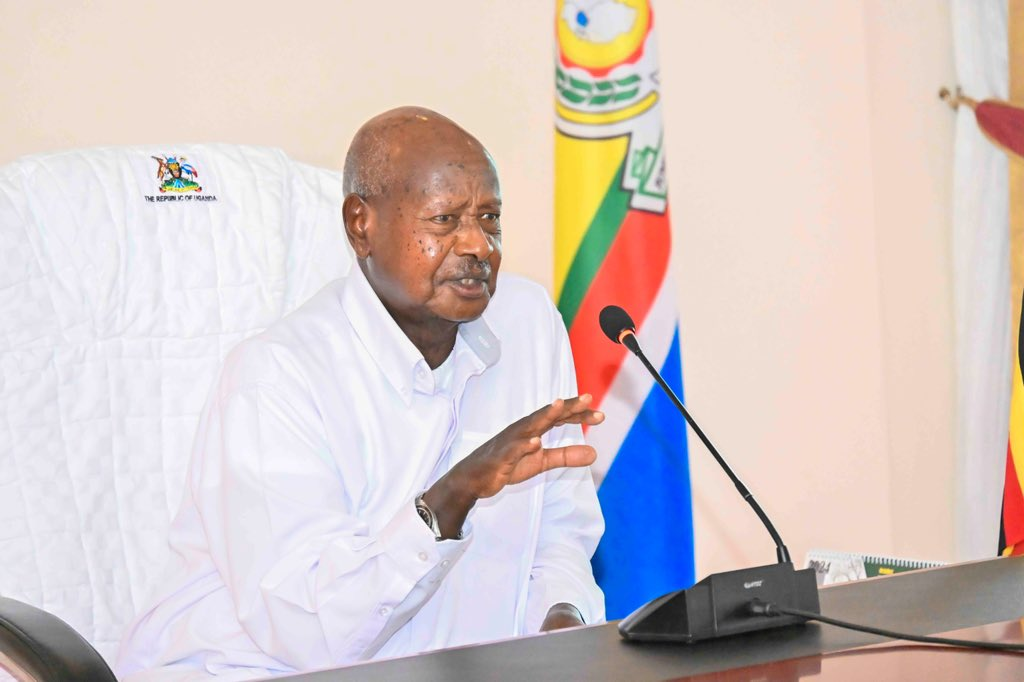
President Yoweri Museveni has responded firmly to recent social media stories spreading false and malicious allegations against key figures in the National Resistance Movement (NRM), Abu Mukasa and Prossy Nalweyiso.
He acknowledged that arrests had been made under his orders, following intelligence information, but criticized those dragging innocent names into the mix.

“Some staff at State House have been arrested for a number of offences and they are already charged in the appropriate State courts. The facts of the alleged offences will come out in the trial,” Museveni stated.
He however, questioned why names such as Abu Mukasa, a prominent NRM supporter and investor, and Prossy Nalweyiso, a veteran of the People’s Resistance, were being falsely implicated.
Museveni praised Abu Mukasa for his invaluable contributions to Uganda’s economy. “Indeed, Abu Mukasa has brought billions of dollars of investments to Uganda. That seems to be his offence to the foreign and local parasites that would like Uganda’s economy to remain stunted as long as they benefit individually,” he remarked, clearly frustrated with those seeking to undermine his efforts.

Mukasa’s role in bringing the multi-billion-dollar bulk fuel supplier Vittol to Uganda was highlighted. At one point, Vittol was offering competitive prices for petroleum, diesel, and kerosene far below those being charged by other suppliers.
“He brought to us a multi-billion-dollar bulk fuel supplying company known as Vittol that, at one point, was offering to sell us a tonne of petroleum at $61.5, a tonne of diesel at $83 and a tonne of Kerosene at $79.25 while the parasites, working with our either corrupt or careless officials, were supplying the same products at: petroleum at $97.5, diesel at $118 and Kerosene at $114 respectively,” Museveni said.
According to Museveni, these “parasites,” working with corrupt or careless officials, inflated prices, costing Ugandans significantly more. Mukasa’s intervention, along with other investors like Sheikh Maktoum, has been instrumental in bringing cheaper fuel and investment opportunities to the country.
“Sheikh Maktoum has brought us other investors in Air Cargo, gold refinery, produce export, etc. After a long struggle with the parasites, Uganda is now getting cheaper petroleum products,” Museveni stated, reminding Ugandans of the many times the Energy Minister had stepped in to order lower prices.
On the allegations surrounding Prossy Nalweyiso, Museveni reaffirmed her loyalty and long-standing service to the NRM cause. “Yes, she is not highly educated. However, the majority of the NRA freedom fighters were even less educated than Nalweyiso. Nevertheless, these uneducated Ugandans liberated both the uneducated entirety of other Ugandans and the educated that had failed to solve the problem of governance and constitutionality in Uganda.”
Museveni also invoked a biblical reference to expose those spreading lies and exploiting the system for personal gain. “We shall know them by their fruits, Jesus educates us in the book of Matthew, chapter 7, verse 20.”
He called out those attempting to undermine the contributions of the uneducated cadres within the National Resistance Movement (NRM) to remember that these individuals played a big role in addressing Uganda’s major economic challenges in the past, such as crippling shortages of essential goods and the prevalence of black market practices.
“There is a simple acid test you could apply to discover the usefulness of the uneducated Nalweyisos,” Museveni said. “In 1986, you had crippling shortages of soap, salt, paraffin, sugar, etc., and you had magendo (smuggling), Kibaanda (forex black market), and Kusamula (speculation). What happened to those problems? Who contributed to their solution? Were the uneducated Nalweyisos part of the contributors?”
He reminded Ugandans that while there are still challenges like poverty and unemployment, it was the NRM, using both educated and uneducated individuals that solved those earlier problems. He elaborated that the NRM had always understood how to harness the skills of modestly educated fighters, alongside those with formal education. “The Political Commissars and the intelligence officers were normally Makerere graduates – the Arondas, Muntus, Matsikos, etc. – while the Secondary school leavers and some of the uneducated, were Combat Commanders – Saleh, Kashaka, Mugume, Kyaligoonza, Musisi, Peter Kerim, etc.”
He added that today’s commanders are both educated and combat-experienced, but emphasized that the African resistance needs patriots, whether educated or uneducated. “Educated traitors are poison for Africa,” he warned, as he criticized social media figures who spread false narratives. “The ‘informant’ on social media is actually, Mr. Misinformant.”
He noted that the real issue for these “parasites” appears to be Uganda’s economic growth. He credited the NRM’s correct philosophical and strategic positions for Uganda’s robust economy, pointing out that significant foreign investments have been pouring in from countries like China, India, the UAE, and Europe. “Our agriculture is very strong. We shall shift it to irrigation. The strong UPDF and other security forces guarantee peace.”
He also condemned the online blackmailers, who he accused of targeting good investors like Sheikh Maktoum in an effort to drive them away from Uganda. He explained that some of these individuals even go so far as to demand money in exchange for not publishing defamatory stories. “We shall use the law to deal with these parasites,” Museveni vowed, urging Ugandans to be aware of these blackmailers.
Defending Prossy Nalweyiso’s contributions, Museveni pointed out that despite her lack of formal education, she is supported by highly educated professionals such as lawyers, economists, and Army officers. “She brings in her knowledge of our struggle and patriotism,” he said, highlighting her frequent radio appearances where she educates Ugandans about the history of the struggle.
He then shared a personal anecdote about his long history with Abu Mukasa, a key NRM supporter and investor, whom he first met in Washington many years ago. Mukasa, at the time, was working for Harris, an American military radio supplier. The President admired Mukasa’s initiative, sharing how he linked up with Harris through a well-known American General whom he met by offering to cut the grass in the General’s compound.
“Such initiatives by our young people are good. Stop Nyeko (envy), ihari (hatred), obuggya (jealousy), and etima (bitterness),” Museveni concluded, urging Ugandans to focus on the progress of the nation rather than tearing down those who are contributing to its development.