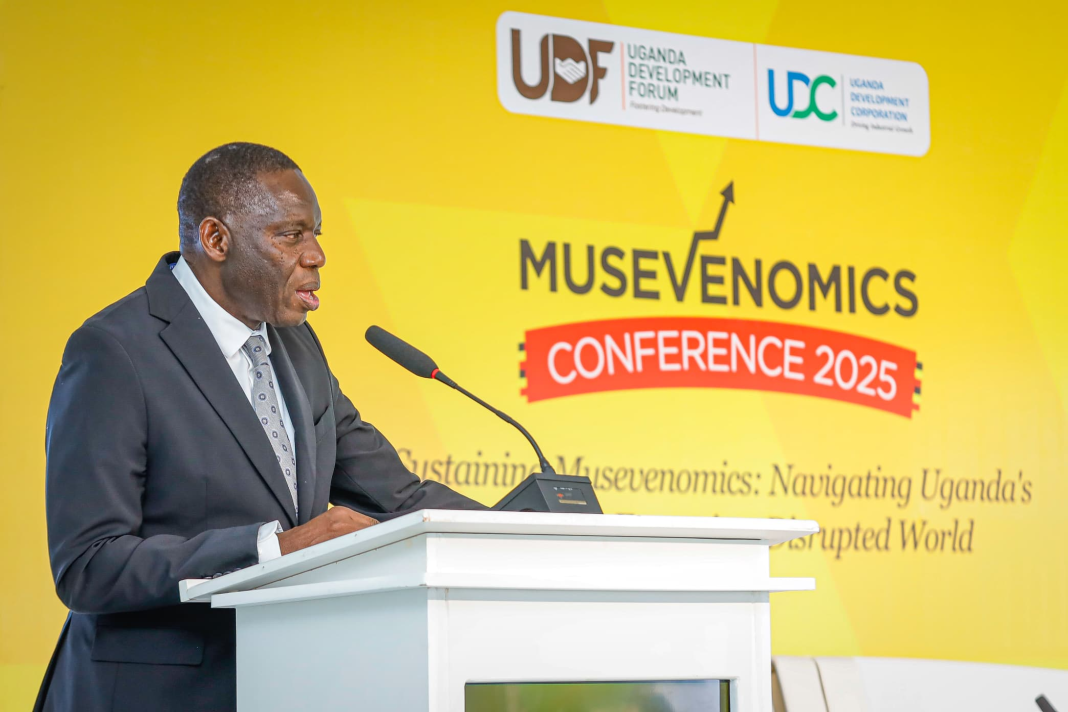
At the #Musevenomics2025 summit, Bank of Uganda Governor Michael Atingi-Ego delivered a powerful reflection on Uganda’s financial evolution, tracing the sector’s transformation from a past of repression to a future of inclusive growth and resilience.
He recalled a bleak history: “Uganda’s financial sector was once more of a barrier than a bridge to progress,” marked by “rampant inflation, a contracting productive base, and rigid interest rates.” This era of financial repression, he said, demanded fundamental reforms that laid the foundation for today’s economic stability.

Central to these reforms was the controversial privatization of Uganda Commercial Bank (UCB). Atingi-Ego described UCB as a “living embodiment of the problems of the past,” citing 75% non-performing loans and chronic mismanagement.
“Selling UCB to Stanbic Bank Uganda in 2002 was a crucial component of our comprehensive financial sector reform,” he stated, “transforming it from a long-standing liability into a dynamic bank” that now plays a key role in financing government programs.
The Governor emphasized that the Bank of Uganda’s mandate now goes beyond maintaining price stability. It includes financial inclusion, with significant gains from mobile money platforms, which have extended nearly Shs1 trillion in short-term loans and are increasingly linked to insurance and savings services.

He also outlined the integration of Environmental, Social, and Governance (ESG) principles within the banking sector. “We are urging commercial banks to participate in environmental protection for long-term sustainability in an agricultural economy,” he noted.
To build more resilient reserves, Atingi-Ego revealed a strategic shift: monetizing Uganda’s raw gold deposits, a move designed to support local artisanal miners while strengthening the country’s financial backbone. “We must move away from reliance on volatile portfolio flows,” he asserted.
The Governor closed with a focus on digital transformation, highlighting its role in driving inclusive growth while addressing cybersecurity. He envisions a “future of prosperity” powered by secure and accessible digital financial services.
In a complementary address, Dennis Galabuzi Ssozi, the National Coordinator for the Parish Development Model (PDM), brought grassroots development into sharp focus.
Galabuzi began by affirming the state’s crucial role in strategic sectors. “Electricity, water, and telecom must remain under strong state involvement,” he warned. “A collapse in these foreign-dominated utilities could cripple half the economy.”
Turning to the PDM, he described it as “a government strategy to accelerate wealth creation and improve the quality of life of Ugandans by delivering services closer to the citizens.” Using an aircraft analogy, he said: “We are bringing services down to the ground level, making the parish the epicenter for planning, budgeting and service delivery.”
The model’s design tackles Uganda’s youth bulge, with 51% of the population under 16 years. “This dependency ratio must be flipped,” Galabuzi emphasized. “With the right policies, this can become our demographic dividend.”
He concluded that Uganda must seize its greatest opportunities—its youthful population, strong agricultural potential, rising urbanization, and arable land—through a plan of execution that empowers grassroots households to drive economic transformation and independence.