Uganda’s anti corruption watchdog has warned that the nature of corruption in the country is rapidly evolving, moving from small scale bribery to more organized schemes that sometimes involve sophisticated networks operating beyond national borders.
Inspector General of Government Aisha Naluzze Batala said the changing character of corruption poses a new challenge to accountability institutions and requires stronger investigative approaches and coordinated action to effectively tackle the vice.

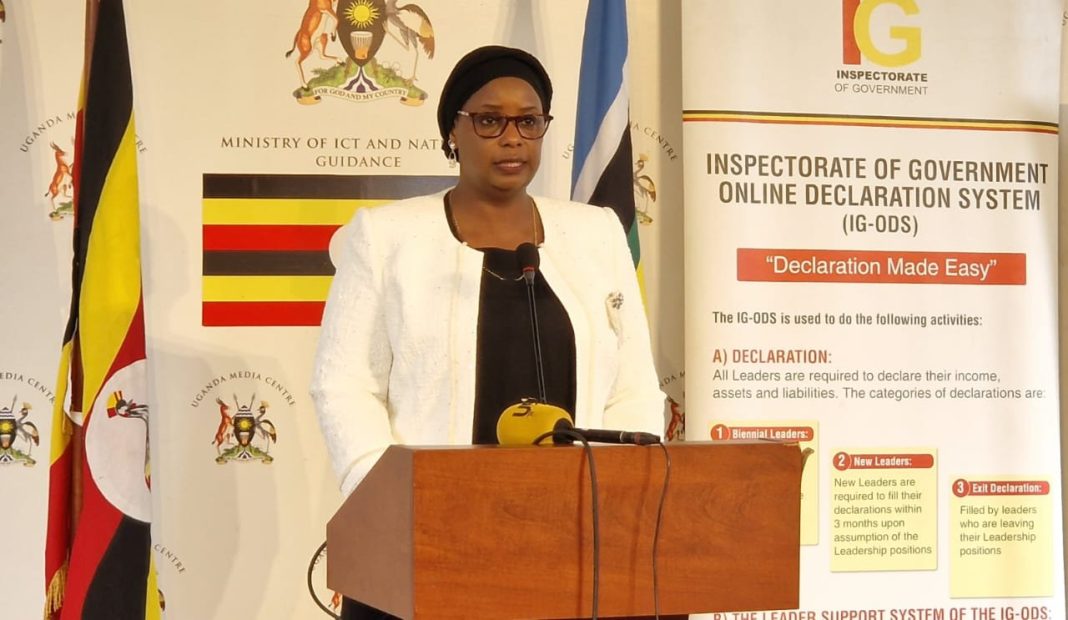
Batala made the remarks on Thursday while addressing journalists at the Uganda Media Centre in Kampala during her first press briefing since taking office, marking 100 days at the helm of the Inspectorate of Government.
She cautioned that corruption is increasingly becoming complex and in some cases socially tolerated, a trend she said could undermine efforts to promote integrity in public institutions.
“Corruption is no longer predominantly petty in nature. It is increasingly growing and becoming sophisticated, sometimes syndicated and in certain instances linked to cross border networks. In some cases it is also normalized or even glorified,” Batala said.

The Inspectorate of Government is constitutionally mandated to fight corruption, enforce the Leadership Code, investigate complaints against public officials and promote integrity in public service.
Batala, who was appointed by President Yoweri Kaguta Museveni in October 2025 and sworn into office in November, said she assumed office with a clear strategy aimed at strengthening the institution’s effectiveness in tackling corruption and maladministration.
Among the measures introduced are improvements in complaint registration systems, speeding up investigations, expanding the use of digital tools in case management and prioritizing high impact corruption cases.
She said investigators have also been directed to adopt prosecution led investigations and increase focus on financial crimes such as money laundering.
“This should be a warning to public officials out there. If we get you, our first action is to ensure that you are prosecuted,” Batala said.
According to the Inspectorate, a total of 1,516 complaints were registered between July and December 2025. Of these, 1,151 cases were sanctioned representing about 75 percent of the complaints handled during that period.
During the same period, the institution concluded investigations into 308 corruption cases and 330 Ombudsman-related complaints, including 14 high-profile corruption cases.
The Inspectorate also recovered more than Shs2 billion in misappropriated public funds and secured payment of over Shs844 million to public officers who had previously been denied or delayed salaries, pensions and gratuities.
Batala said the institution also carried out eight systemic investigations and seven systems reviews aimed at identifying structural weaknesses within public institutions that often create opportunities for corruption.
Disciplinary action has also been taken against several government officials following investigations by the Inspectorate.
Between January and February 2026, twelve public officers were dismissed from service, four including a Chief Administrative Officer were interdicted, three were reprimanded and one officer was demoted.
The Inspectorate also recovered nearly Shs90 million in unspent funds under the Development Response to Displacement Impacts Project in districts supervised by the Moyo regional office.
Batala further revealed that she conducted oversight visits to regional Inspectorate offices in Kabale, Mbarara and Masaka and carried out spot checks at the regional referral hospitals in the same areas.
The inspections uncovered service delivery gaps including overcrowding in hospital wards, non functional medical equipment, shortages of essential medicines and allegations of extortion by some health workers. Three arrests were made following the inspections.
Despite the progress, Batala acknowledged that the Inspectorate continues to face operational challenges including limited staffing levels, gaps in specialized investigative skills, inadequate funding and an aging vehicle fleet that affects field operations.
She said these constraints come at a time when corruption cases are becoming more complex and often involve financial crimes and organized networks.
Going forward, the Inspectorate plans to intensify prosecution-led investigations and concentrate on high-impact corruption cases in order to strengthen deterrence.
Batala also pledged stronger collaboration with anti-corruption agencies, civil society organizations, the private sector, and the media to strengthen the national fight against corruption.
“Our goal is not only to enforce the law but also to strengthen systems and prevent corruption before it occurs,” she said.