A total of 43 Ugandan students who had been studying in Iran have safely returned home following a government-led evacuation triggered by renewed conflict in the Middle Eastern country.
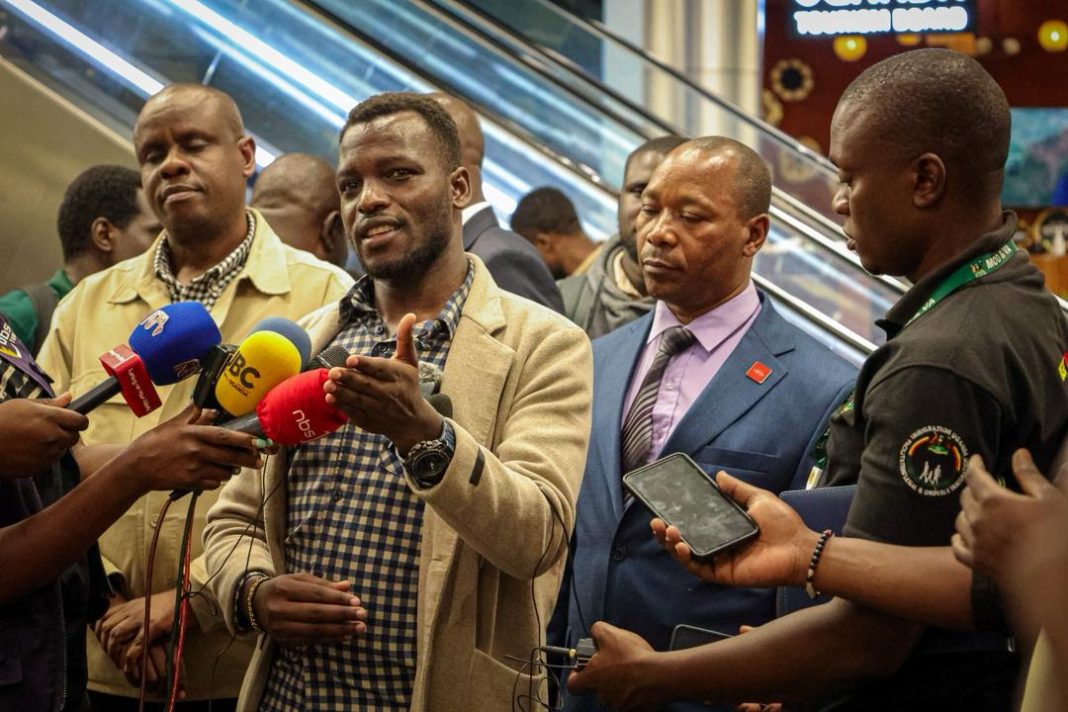
The students arrived in Uganda on Thursday after a coordinated rescue operation organised by the government through diplomatic and security agencies. They were received on arrival by the Minister of State for Youth and Children Affairs, Balaam Barugahara, who commended the authorities for ensuring the students’ safe return.

“As you are aware, there is a war happening in Iran, and these young people were studying at one of the universities there. Most of them are pursuing programmes in information technology and other science disciplines, while a few are studying business,” Barugahara said.
He explained that the evacuation process began after Uganda’s Ambassador to Iran, Twaha Matata, notified the government through the Ministry of Foreign Affairs (Uganda) when the situation in Iran deteriorated. President Yoweri Kaguta Museveni later approved the evacuation of students who wished to return to Uganda.
Barugahara also acknowledged the role played by the Chief of Defence Forces of the Uganda People’s Defence Forces, Muhoozi Kainerugaba, along with the Director General of the External Security Organisation and Uganda’s Military Attaché in Turkey, Bob Ogiki, in coordinating the evacuation exercise.

According to the minister, about 51 Ugandan students were studying at one of the universities in Iran at the time the conflict erupted. However, only 43 opted to return to Uganda while others chose to remain.
“The government was willing to bring all of them back, but some decided to stay behind willingly,” he said, adding that authorities remain ready to support any other Ugandan students in Iran who may later wish to return home.
Barugahara further assured the students that government institutions would work with families and relevant agencies to ensure their education continues despite the disruption.
“These are scientists and the President has been investing heavily in science education. The government cannot abandon them. We shall engage different government institutions to determine the best way forward so that they can complete their studies,” he said.
Speaking on behalf of the Permanent Secretary at the Ministry of Foreign Affairs (Uganda), Mr Evans Aryabaha praised the swift response by government officials and diplomatic missions that helped facilitate the evacuation.
“We did not expect this situation to happen, but when it did, the government acted quickly so that you could return safely. We appreciate everyone who participated in this process and we are happy to receive you home,” Aryabaha said.
He encouraged the students to remain vigilant during times of crisis and expressed hope that they would eventually complete their studies once circumstances allow.
“We hope you will finish your studies when conditions permit. Whenever such situations arise, it is important to act with diligence and vigilance so that you remain safe and able to continue contributing productively,” he added.
Some of the students narrated the tense journey that led to their evacuation. Isaac Niwamanya and Sarah Mayanja, both pursuing Architectural Engineering, said the situation in Iran became alarming after fighting broke out on February 28, prompting them to seek immediate evacuation.
“With guidance from our ambassador, H.E. Twaha Matata, a bus was organised and it transported us from Tehran to the Bazargan border with Turkey. The journey took about 14 hours,” they explained.
The students said they later waited for clearance to cross into Turkey before travelling another 15 hours to Istanbul, where they were received and accommodated with support from Uganda’s embassy officials and the military attaché.
“Today we finally travelled from Turkey back to Uganda. Above all, we thank God for protecting us and we are grateful to the Government of Uganda, the President, the Chief of Defence Forces, the Ministry of Foreign Affairs and all the embassy officials who helped ensure our safe evacuation,” the students said.
Another student, Oscar Nyegyema, who is pursuing a bachelor’s degree in Computer Engineering, appealed to government authorities to support them in continuing their education.
“Many of us were able to study there because we could not afford education elsewhere. Given the uncertainty of the situation, we humbly request the Ministry of Education and other authorities to explore ways of helping us continue our studies, possibly by integrating us into universities in Uganda,” he said.
Most of the students had been studying in Iran on scholarships and fear their academic programmes may be disrupted by the ongoing conflict. Despite the uncertainty, they expressed hope that the situation will stabilise soon so they can resume and complete their studies.