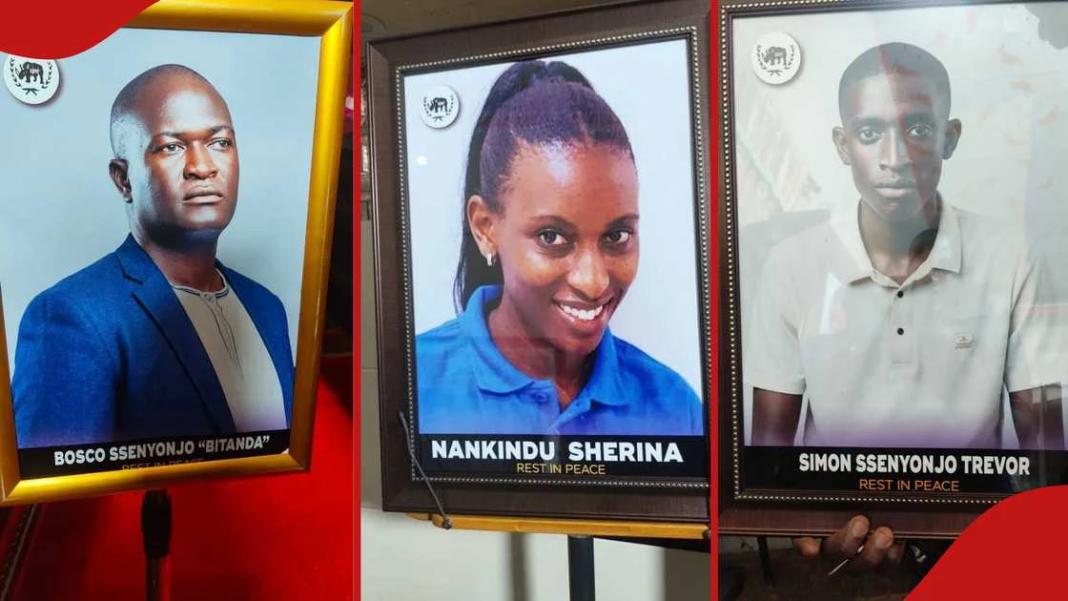
The High Court of Uganda in Masaka has resolved a burial dispute and directed that the late Bosco Ssenyonjo alias Bitanda be laid to rest at his ancestral home in Kyalusolwe, Nyendo Mukungwe, in accordance with Buganda customs.
In a detailed ruling delivered on March 26, 2026, Justice Victoria N N Katamba brought to a close a family wrangle that had threatened to delay burial arrangements following a tragic road accident that claimed the lives of Ssenyonjo and two of his children.

The dispute had pitted the deceased’s widow, Jane Nabukeera, against his mother, brother, and several women claiming to be his customary wives, with both sides advancing conflicting positions on where he should be buried.
While the widow sought to have the deceased buried at his home in Mpugwe, arguing that he had expressed such wishes during his lifetime, the wider family insisted on burial at the ancestral grounds, citing long standing cultural practices and the deceased’s ties to his clan.
In her judgment, Justice Katamba noted that although several parties claimed the deceased had expressed his preferred burial place, none of the accounts was supported by clear or consistent evidence.

“In nearly every affidavit, the deponents assert that the deceased made known to them his wishes as to where he desired to be buried. However, none of these alleged declarations was made in the presence of more than one witness,” she observed.
She added, “The court is confronted with a classic case of he says she says, with no independent or corroborative evidence to support any one account.”
The judge also questioned the credibility of some individuals who claimed to be customary wives of the deceased, noting that their assertions were not backed by sufficient proof such as marriage documentation.
“In the absence of cogent evidence establishing their status as customary wives, their testimonies on the wishes of the deceased carry little probative value,” she ruled.
With no reliable evidence on the deceased’s stated wishes, the court turned to his conduct and the applicable customary law to determine the appropriate burial place.
Justice Katamba found that Ssenyonjo’s actions during his lifetime, including efforts to secure and preserve the ancestral burial grounds, pointed to a strong connection to the family land.
“Where a person intervenes to secure ancestral burial land from alienation, the most reasonable inference is that he regarded that land as of enduring personal and familial importance. On a balance of probabilities, it is more likely than not that he intended to be laid to rest there.”
The court emphasised that customs remain a key consideration in burial disputes, especially where they are consistent with the Constitution and principles of justice,” she stated.
“Ancestry is not a matter of choice but of birth, and the customs that flow from it cannot be lightly disregarded,” Justice Katamba said.
She further noted that burial at the ancestral home would provide a neutral ground for all family members, particularly in light of the deceased’s polygamous life, ensuring equal access for his children, widows and relatives.
The court rejected the argument that the widow had exclusive authority to determine the burial site, ruling that her rights arose within the same customary framework she sought to set aside.
“She cannot invoke that framework to establish her status as a widow and then disregard it when it comes to the burial of the deceased,” the judge held.
However, the court made a separate finding regarding the deceased’s two children who died in the same accident, allowing their mother to bury them at Mpugwe.
“It is both just and humane that the applicant, as their mother and a grieving parent, be allowed to lay her children to rest at the home she shared with the deceased,” Justice Katamba ruled.
In addition, the court ordered that a DNA sample be extracted from the deceased’s body before burial and preserved for any future disputes over paternity, although no immediate testing will be conducted.
The ruling also outlined the sequence of burial arrangements, directing that Ssenyonjo’s funeral be held at the ancestral home, followed by the burial of his children the next day at Mpugwe.
Beyond the legal determination, the judge used the case to caution families against escalating burial disputes to court, urging reconciliation during moments of loss.
“Death is intended to unite rather than divide. It is a time for reconciliation, for setting aside differences, and for honouring the departed,” she advised.
She further encouraged the use of mediation in resolving family conflicts, noting that it preserves relationships and promotes healing.
The decision brings an end to days of tension among relatives and clears the way for final rites to proceed. The ruling sets a precedent on the role of customary law and family conduct in determining burial rights in Uganda.