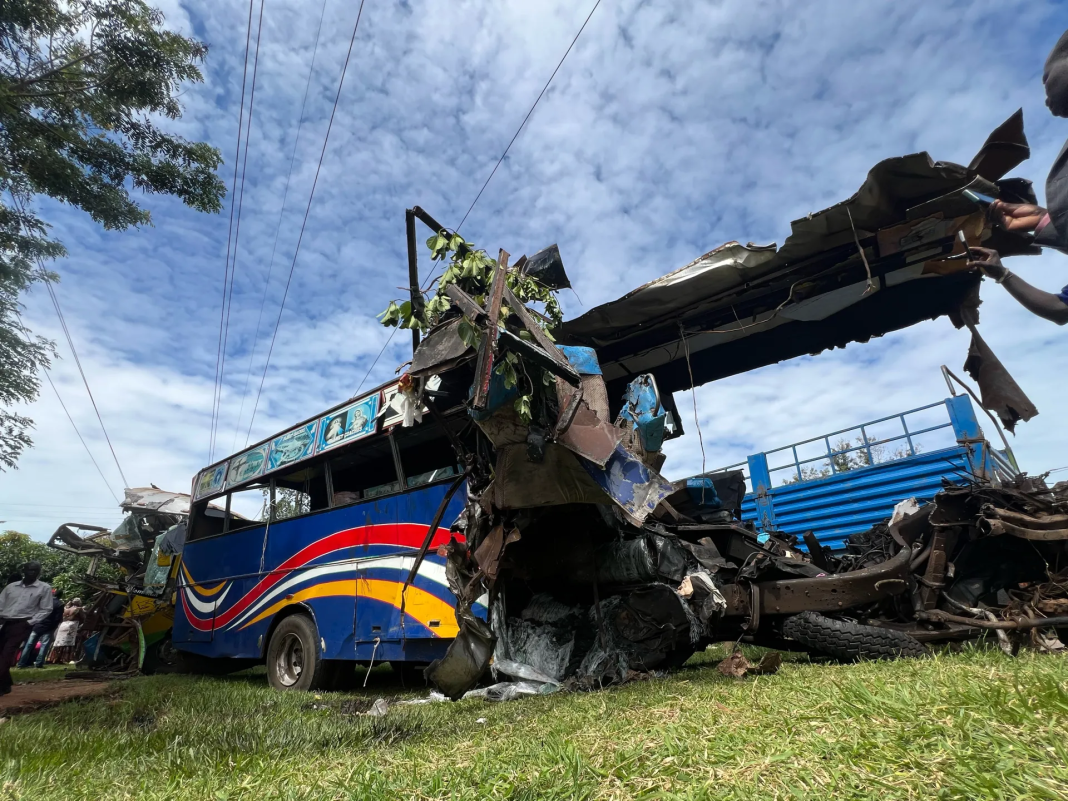
At least 4,602 people lost their lives in 26,044 road crashes across Uganda in 2025, according to the Annual Crime Report 2025 released by the Uganda Police Force at its Naguru headquarters, today.
Presenting the traffic and road safety findings, Lawrence Niwabiine said the latest figures reflect a troubling rise in road fatalities despite a significant drop in traffic offenses.

“A total of 322,441 traffic related cases were registered in 2025 compared to 426,432 cases in 2024, representing a 24.4 percent decrease,” Niwabiine said.
He however cautioned that the reduction in offenses has not translated into safer roads.
“Road traffic crashes increased by 3.7 percent in 2025 compared to 2024,” he added.

According to the report, total crashes rose from 25,107 in 2024 to 26,044 in 2025. Of these, 4,602 were fatal crashes, 13,563 were serious crashes involving injuries, while 7,879 were classified as minor.
“In 2024, we recorded 4,434 deaths, which increased to 4,602 in 2025,” Niwabiine said, underscoring the growing burden of road carnage.
The findings build on trends observed in 2024, where the Directorate of Traffic and Road Safety had already registered a 6.4 percent increase in crashes from the previous year, alongside a 7 percent rise in deaths and a 4.4 percent increase in total casualties to 25,808.
The 2024 data further showed that 4,434 crashes were fatal, 13,134 were serious, and 7,539 were minor, highlighting a steady escalation that has now carried into 2025.
Analysis from the Directorate indicates that the most dangerous hours on Uganda’s roads remain between 18:00 and 19:59, when the highest number of crashes and fatalities occur.
“In that period, we registered the highest number of crashes and casualties. It remains the peak time on our roads,” Niwabiine noted in the earlier assessment.
The report also maintains that Sundays continue to record the highest number of crashes, followed by Saturdays and Mondays, despite relatively lighter traffic volumes.
“On Sundays, we have fewer vehicles on the road, yet we register the highest number of crashes and deaths,” he said.
Pedestrians remain the most vulnerable road users, accounting for 19.5 percent of all crashes, followed by side swipe collisions at 17.7 percent and rear end collisions at 16.2 percent. Head on collisions accounted for 13 percent, while angle collisions contributed 10.5 percent and single vehicle crashes made up 9 percent.
Police attribute the majority of crashes to human error, particularly careless overtaking and speeding, which together accounted for 44.5 percent of all crashes in 2024, a trend that continues to dominate into 2025.
“Careless overtaking accounted for 5,657 crashes, while speeding caused 5,505 crashes,” Niwabiine explained, adding that 2,681 crashes were linked to unknown causes, largely involving hit and run incidents.
Motorcyclists and their passengers remain the hardest hit category. Deaths among motorcyclists rose significantly in 2024 by 13.2 percent from 1,520 to 1,720, while fatalities among their passengers increased by 10.1 percent.
Passengers in light omnibus vehicles also registered a sharp rise in deaths, jumping from 93 in 2023 to 144 in 2024, representing a 54.8 percent increase, a pattern that continues to raise concern among traffic authorities.
The Annual Crime Report was released under the leadership of Abbas Byakagaba, with police acknowledging that road safety remains one of the most pressing public concerns.
“As government, we are undertaking several measures to improve road safety,” Niwabiine said.
He outlined ongoing interventions including mandatory vehicle inspection to eliminate unroadworthy vehicles, automation of driver testing systems to improve competence, and the fast tracking of an intelligent transport monitoring system.
“Long term solutions such as road redesign and development of mass public transport systems including rail and bus services are also being considered to discipline road users,” he added.
Despite a notable 24.4 percent reduction in traffic offenses in 2025, the continued rise in crashes and fatalities highlights a persistent road safety crisis, with authorities warning that stricter enforcement, behavioral change and sustained investment in infrastructure will be critical to reversing the trend.