Nigerian billionaire, Aliko Dangote has committed to constructing a large-scale oil refinery in East Africa modelled on his Nigerian facility. The project will only move forward with strong political and institutional backing as Africa accelerates efforts toward industrial self-sufficiency.
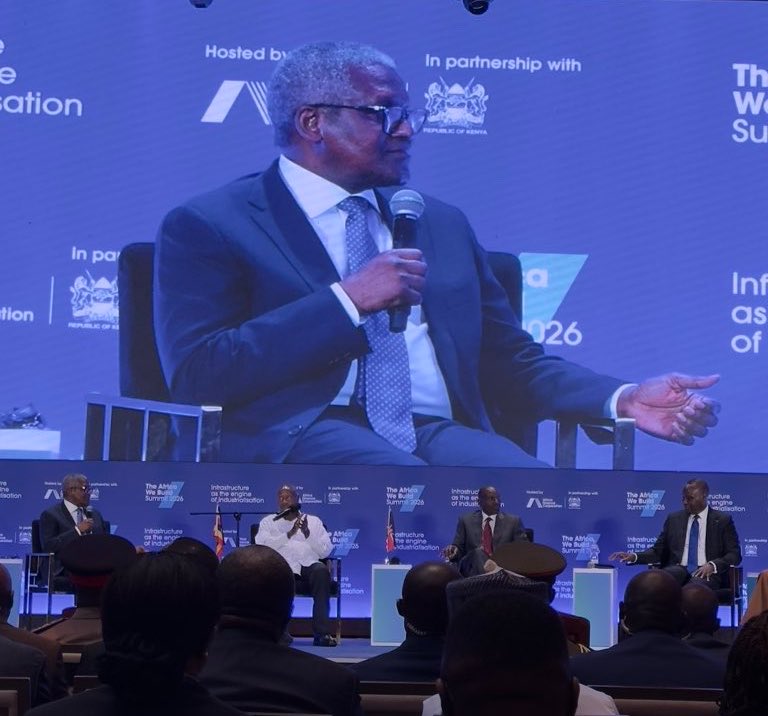
Speaking at the Africa We Build Summit 2026 in Nairobi on Wednesday,22, Dangote said discussions around the proposed refinery were still in early stages but expressed confidence that the initiative would succeed with an aim to boost Africa’s capacity to deliver major industrial projects.

“I can commit the two presidents (Museveni and Ruto) who were here. If they will support the refinery, we will build the identical one that we have in Nigeria, six hundred and fifty thousand barrels,” Dangote said.
He added that the refinery plan forms part of a wider industrial push already underway in Nigeria, which he said is designed to make Africa more self reliant in energy and petrochemical production.
“The discussions are still early, though, but the three of you, it seems like you are trying to make this work. It will work. There is nothing that can stop it. We have done the one in Nigeria and that is why we are taking the bold move, which we have started already. Piling has started. We are building that one to a scale of one point four million barrels a day will give us the will be the largest refinery in the world,”he said.

Dangote warned that Africa’s continued reliance on importing finished goods while exporting raw materials was economically unsustainable, citing sharp increases in global input costs.
“This is coming with a lot of petrochemicals. I mean you look at it today in Nigeria, if not because we have polypropylene, many businesses would have collapsed because cement, flour, rice, grains, everything depends on it. And the cost has shot up from nine hundred dollars a ton to three thousand. There is no way you can afford it. That is why we must learn how to build self sufficiency,”he said.
He also recalled earlier challenges in financing large industrial projects, saying Africa’s financial ecosystem has matured enough to support ambitious investments.
“We were even paying forty four percent interest rates in Nigeria. We had to go to IFC to raise money. Our first loan was four hundred and seventy eight million dollars. They said you need seven years, two years moratorium, five years repayment. We agreed. But we paid the money back before the expiration of the moratorium, in eighteen months. So it is possible Africans can do it. Let us not be scared,”he said.
Dangote further supported recent policy moves by Uganda aimed at stopping the export of unprocessed minerals, saying such decisions are critical for retaining value within African economies.
“I must really thank the President of Uganda for taking this bold move, stopping the export of unprocessed minerals. No export of tin, no export of copper. They are all there in the ground. They will be forced. They will come and produce,”he said.
Ugandan President Yoweri Museveni said Uganda’s long term resource strategy has been to ensure minerals and oil benefit the domestic industry rather than being exported in raw form.
“What he told you, in Uganda, I have banned the export of unprocessed minerals. I have banned all of them. No export of tin, no export of copper. They are all there in the ground. But slowly, we are getting investors,” Museveni said.
He cited Uganda’s iron ore as an example of lost value due to raw exports, saying earlier deals undervalued the country’s resources.
“Some Indian guy from India had come and made a deal to sell our iron ore at forty seven dollars per ton. The iron ore of Uganda is the best in the whole world. It is about seventy percent pure. When you sell iron ore, somebody goes and makes it into steel and earns far more. I stopped them,” he said.
Museveni added that Uganda is now attracting investors into steel production, including those from Kenya.
“I am glad that some investors from Kenya, encouraged by His Excellency Ruto, are now investing in the steel industry in Uganda,” he said.
Kenyan President William Ruto highlighted growing regional cooperation in infrastructure and resource development, citing past discussions with Museveni on strategic investments.
“Kenya Pipeline, because we wanted to unlock the value of Kenya Pipeline and use it for the transformation of the country. President Museveni called me and said I want to buy fifty percent of Kenya Pipeline. He told me I don’t care the price,” Ruto said.
He said Uganda and Kenya are now aligning their investment strategies to ensure long term regional benefits.
“Mzee, I want to assure you that the same way you invested in Kenya Pipeline, Kenya is going to invest in your refinery and in the future of our resources together,” Ruto said.
Ruto also urged African leaders to prioritize long term industrial development over short term gains.
“Not the short term benefit you get from something cheap from somewhere else, but the benefit of building something for the future that will not only earn you money today, but earn you opportunities tomorrow,” he said.
The summit concluded with calls for deeper regional integration and joint investment in large scale infrastructure projects, with the proposed East African refinery emerging as one of the most ambitious industrial proposals under discussion.