
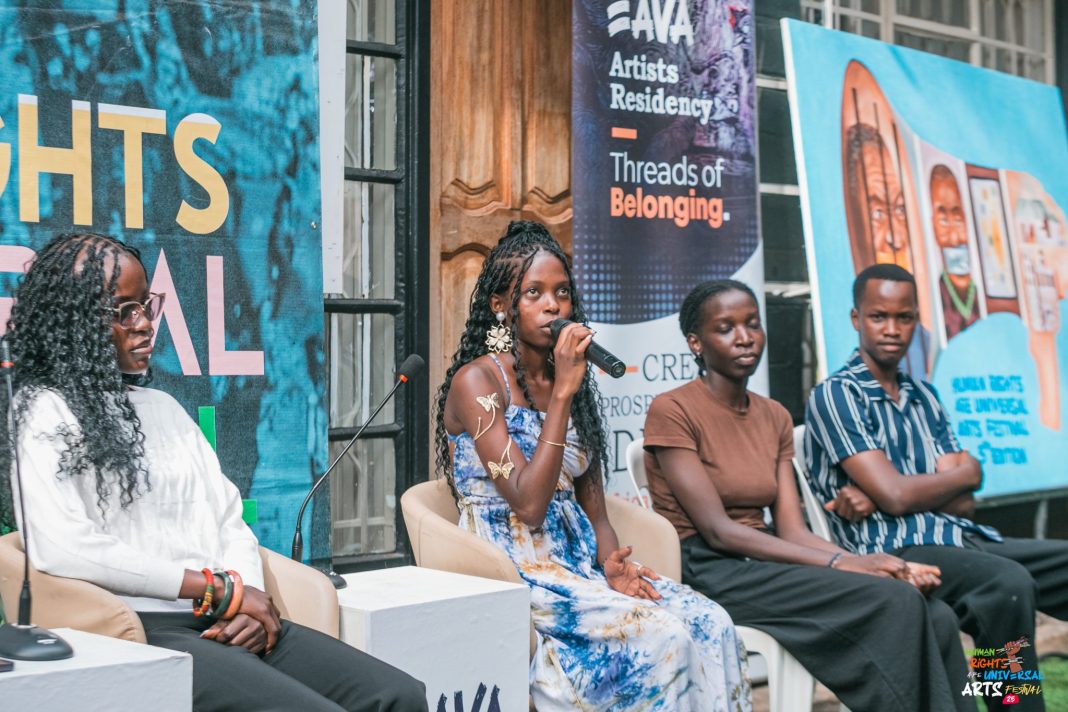
Artists, digital rights advocates and cultural practitioners have called for stronger protection of intellectual property, online safety and freedom of expression as the fifth edition of the Human Rights Are Universal Arts Festival entered its second day at Xenson Art Space in Kampala.
The discussions explored how artificial intelligence, digital platforms and media practices are shaping ownership of creative work, personal identity and the freedom of individuals, particularly women, to participate in online spaces without fear of exploitation.

Held under the theme “Threads of Belonging,” the festival also featured an exhibition showcasing artists whose work examines identity, inclusion, community and the different experiences that shape people’s sense of belonging.
During a panel discussion titled “Who Owns Your Voice? Our Lives Online,” participants examined who controls the digital tools through which people communicate, create and share information, as well as the rights of individuals whose work and images are used online.
Raymond B. Amumpaire raised concerns about the use of artists’ work to train artificial intelligence models, questioning how creators could protect their intellectual property when technology companies use their work to develop new products.

“AI companies have trained their models on so much of the work that creatives have done. Where then does that leave my intellectual property, if the model was trained on work that I originally created?” Amumpaire asked.
He argued that the growth of artificial intelligence should not diminish existing property rights, pointing to the Constitution of Uganda as a basis for protecting ownership in the changing digital environment.
“The Constitution of Uganda gives you the right to own property. The same aspects we had in the world before artificial intelligence gained prominence are playing out for us now,” Amumpaire said.
Sanyu Mulungi challenged participants to look beyond the technology itself and examine the people and institutions controlling its development and use, including who has access to digital tools and the power to influence them.
“Who is using it? Who has the power to influence these tools? Who has access to these tools? We need to think beyond and question all the systems, so we can have a humanised AI system and internet freedoms,” Mulungi said.
She also called for consent to become a central principle in the sharing of digital content, warning against the circulation of people’s images and creative work without their permission.
“Put consent at the centre of everything. If you’re going to share someone’s image or content, ask first. If it’s a no, don’t share it,” Mulungi said.
Athena Ibembe highlighted the personal cost of online visibility, particularly for women and other people whose images and experiences can be extracted, repackaged and circulated by media platforms without sufficient consideration for their interests.
“Media has a way of taking your image and extracting all the juice, all the gist that’s in there. And when they’re done with you, you’re left with no choice but to go back tribal, to cherry-pick when and where you speak,” Ibembe said.
She observed that some people were retreating into private or closely controlled spaces to regain authority over how their identities and experiences were presented online.
“We’ve gone private. We’ve gone back tribal in the way we share ourselves, in the way we represent ourselves online. Because it’s the only way you can take back agency over how you are communicated,” Ibembe said.
However, Mulungi urged people not to abandon online spaces altogether, arguing that visibility can be empowering when individuals are able to participate on their own terms and their rights are respected.
“We need to challenge that. If you can speak online, speak. We need to think of visibility in a more affirming way than hiding yourself,” Mulungi said.
The discussion highlighted the need to balance participation in digital spaces with safeguards for privacy, consent, intellectual property and freedom of expression as artificial intelligence and online platforms become increasingly influential in everyday life.
The festival’s second day also featured the opening of an exhibition bringing together works by artists exploring what it means to belong, how identity is formed and the experiences that connect individuals to their communities.
Linda Suzan reflected on experimenting with different materials to capture experiences that resonate with individuals and communities, using her artistic practice to connect personal stories with shared experiences.
Jacinta Nabulime used glass and a single thread to examine the fragility of rights and belonging, presenting the idea that hatred can easily shatter a person’s sense of acceptance and place within a community.
Meriam Wajire Napio, an artist in the East African Visual Arts (EAVA) Residency programme, explored belonging through crochet and repurposed materials. Her work considers how people can reshape their lives, transform existing materials and claim ownership of the identities they choose to create.
Vini Mercy focused on social inclusion and representation, celebrating dark-skinned people and drawing attention to her tribe, which she said is not widely represented in Uganda.
The artists’ contributions reflected the festival’s central theme by showing how creativity can challenge exclusion, preserve identity and create spaces where people feel recognised and accepted.
For Kabeya Ilunga, one of this year’s EAVA Artists Residency cohort, the theme also raised questions about displacement, identity and the meaning of belonging.
“What did I carry with me when I came to Uganda as a refugee? What makes us feel like we belong somewhere? I’m here alone, but I feel like I belong to Uganda, since I’ve been selected to represent Uganda outside the country,” Ilunga said.
Kigozi Axum, another artist in this year’s residency cohort, said the theme had influenced his creative process by encouraging him to examine questions of identity through painting.
“Why do I belong where I am? As I was painting, it was as if I was drawing answers to the questions I’d been carrying. Threads of Belonging has been one of the most beautiful themes I’ve worked with. It has shaped my practice in ways unimaginable,” Axum said.
The festival also used the exhibition to promote direct support for artists by encouraging visitors to purchase their work.
Vincent Kyabayinze, founder of EAVA Visual Arts, said proceeds from the exhibition’s sales would go directly to the artists, providing them with an opportunity to earn from their creative work.
“Everything inside is up for sale, and we would love you to buy, so you can support the artists. The money goes directly to the artist. It doesn’t come to us,” Kyabayinze said.
He added that the exhibition included affordable works without compromising artistic quality, making it possible for more people to purchase art while supporting the creators.
“They are slightly cheaper in monetary value, but not cheaper in quality. It doesn’t mean that if they’re cheap, they’ve lost their value. They are just affordable,” Kyabayinze said.
The discussions and exhibition demonstrated how the festival brings human rights debates into the creative space, using art and public dialogue to examine issues of dignity, identity, equality, participation and the protection of individual rights.
By bringing together artists, cultural practitioners and digital rights advocates, the festival seeks to encourage conversations about how people can express themselves freely, protect their work and identities, and build communities in which differences are recognised rather than used as grounds for exclusion.