Uganda has urged Italian investors to establish processing plants in the country to add value to coffee, milk, minerals and other agricultural products instead of exporting them as raw materials, as the government seeks to create jobs, increase export earnings and expand industrial production.
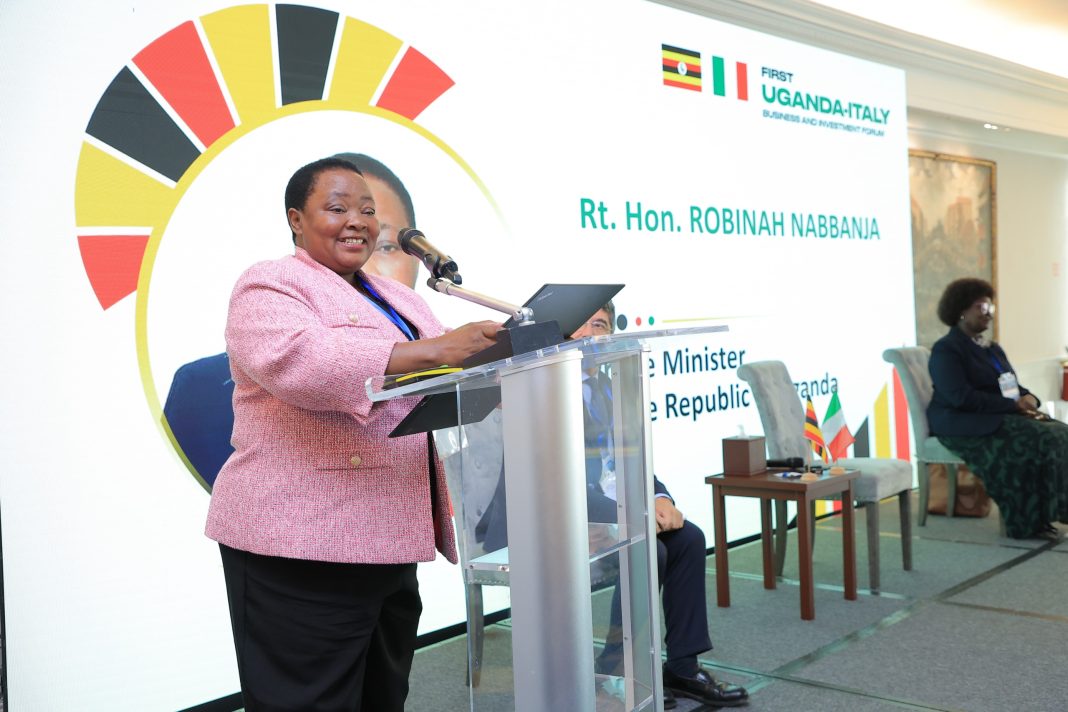
Prime Minister Robinah Nabbanja made the appeal on Tuesday while opening the first Uganda-Italy Business and Investment Forum at Rome Cavalieri, a Waldorf Astoria hotel in Rome, Italy, where she called for stronger commercial partnerships between the two countries.

“We want our people from Italy to take coffee made in Uganda, not grown in Uganda,” Nabbanja told Ugandan officials and Italian business leaders, arguing that roasting, processing and packaging coffee locally would create employment opportunities for Uganda’s growing youth population.
Uganda is a major coffee producer and Italy is one of its leading export markets. The country exported 8.8 million 60-kilogramme bags of coffee in the year ending April 2026, earning $2.4 billion, according to figures cited at the forum.
Nabbanja said Ugandan farmers who grow, maintain and harvest coffee earn little from selling raw beans compared with the value captured by businesses that process and market the finished product abroad.

“That is where I want partnerships, so that we can help that poor Ugandan who makes you have a cup of coffee on the table,” she said.
The Prime Minister urged Italian companies to invest in coffee roasting, packaging and soluble coffee production in Uganda, saying the country wanted to retain more of the economic benefits generated by its agricultural exports.
Gerald Kyalo, the Commissioner for Coffee at the Ministry of Agriculture, Animal Industry and Fisheries, said more than 12 million Ugandans depend on coffee for their livelihoods, while Italy accounts for about a quarter of Uganda’s coffee exports.
He said robusta accounts for 89 per cent of Uganda’s coffee production, with arabica making up the remaining 11 per cent, adding that Italy had purchased more than two million bags of Ugandan coffee annually in each of the past five years.
“You are our main market, and we are your most important supplier of coffee,” Kyalo told Italian buyers.
Kyalo said Uganda’s coffee production had reached 9.5 million bags in the 2025/2026 financial year, putting the country on course to meet its target of producing 20 million bags annually by 2030 following the distribution of more seedlings to farmers.
He also sought to reassure European buyers about Uganda’s preparedness for the European Union Deforestation Regulation, which requires evidence that products entering the European market have not been sourced from land affected by deforestation.
Kyalo said Uganda had registered 1.5 million coffee farmers and mapped 1.6 million coffee gardens, with plans to increase the number of mapped gardens to 2.6 million by the end of December. A traceability system linking farmers, traders and a national data warehouse is being piloted.
“We are ready for EUDR. Don’t lose sleep that you will not have coffee from Uganda,” he said.
Kyalo added that Uganda consumes only about seven per cent of the coffee it produces, making local processing and increased domestic consumption important opportunities for investment. He said coffee exports would carry a national “Ugandan Coffee” brand and logo from the next financial year.
Beyond coffee, Nabbanja invited Italian companies to invest in agro-processing, manufacturing, energy, tourism, mineral value addition and pharmaceutical production, linking the opportunities to the government’s strategy to expand the economy through agro-industrialisation, tourism, mineral development and science, technology and innovation.
She said Uganda’s economy was valued at $69 billion and growing at about six per cent annually, while emphasising that reliable electricity would be essential to support industrialisation.
The government plans to generate 52,000 megawatts of electricity by 2040, Nabbanja said, urging Italian investors to participate in energy generation and related infrastructure.
She also called on Italian pharmaceutical companies to establish manufacturing facilities in Uganda to supply the domestic and regional markets, saying the COVID-19 pandemic had demonstrated the risks of depending on external suppliers for essential medicines.
Nabbanja asked the Italian government to prioritise Uganda under its Mattei Plan for Africa and urged Italian state-backed financial institutions, including CDP, SACE and SIMEST, to support companies seeking to invest in the country.
She assured investors that their capital and profits would be protected by law and said her office would intervene where they encountered obstacles while doing business in Uganda.
Robert Mukiza, the Director General of the Uganda Investment Authority, told the forum that investors could target returns of 14 per cent on investment in Uganda, while positioning the country as a base for serving markets across Africa.
“The most important market in the world, whether you want it or not, is Africa. You better get there now, and serve Africa from Uganda,” Mukiza said.
He said Uganda offered access to regional markets through the East African Community, the Common Market for Eastern and Southern Africa and the African Continental Free Trade Area, while its investment facilitation centre brings together several business registration, licensing and administrative services.
Mukiza said investors undertaking value addition could access incentives including serviced land in industrial parks, a 10-year tax holiday, tax-free imports of plant and machinery, and tax deductions for research and training, subject to the applicable requirements.
He also called for investment in electricity generation and transmission, saying Uganda needed additional capital to meet its long-term energy targets and reduce the cost of financing projects.
Hez Kimoomi Alinda, the Executive Director of the Uganda Free Zones and Export Promotion Authority, said Uganda wanted Italian businesses to move beyond buying raw commodities and establish production facilities that would enable the country to export higher-value goods.
Alinda said Uganda’s fish accounted for only two per cent of Italy’s fish imports and noted that Ugandan cocoa was exported unroasted, presenting opportunities for Italian firms to manufacture cocoa butter, cocoa liquor and chocolate locally.
He identified fresh fruit and vegetables, vanilla, tea, spices, dairy products, aquaculture, cold-chain infrastructure, packaging, information technology-enabled services and tourism as additional investment opportunities.
Alinda also called for investment in testing laboratories to help Ugandan fresh produce meet European Union standards and offered Italian investors a free 1,031-square-metre production facility at Entebbe for value addition targeting Italian and other European markets.
“Come to Uganda, aggregate our fresh fruits and vegetables and open a distribution chain in Italy. Nobody will compete with you,” he said.
Humphrey Asiimwe, the Chief Executive of the Uganda Chamber of Energy and Minerals, invited Italian investors to explore opportunities in oil and gas, electricity and mineral processing.
He said Uganda had 58 known minerals, 23 of which were commercially viable, including graphite, tin, tungsten and rare earth elements needed for the energy transition.
Asiimwe said the country was preparing for its first oil production and that crude oil development would create opportunities in refining, petrochemicals, fertiliser manufacturing and pipeline services.
He also urged Italian companies to invest in electricity generation, transmission, distribution and battery storage, noting that Uganda currently generated about 2,100 megawatts and relied heavily on hydropower.
On minerals, Asiimwe said Uganda wanted more processing to take place locally rather than exporting unprocessed ores and concentrates. He cited gold refining as an example of domestic value addition and said mining investors were exempt from value-added tax on raw materials.
Uganda’s Ambassador to Italy, Elizabeth Paula Napeyok, said the forum was intended to deepen economic cooperation and move relations between the two countries beyond diplomatic engagement.
“We would like to see the relationship graduating from only diplomatic matters to trade and investment,” Napeyok said.
Fabrizio Lobasso of Italy’s Ministry of Foreign Affairs and International Cooperation said Italy wanted partnerships involving joint ventures, technology transfer, skills development and digitalisation rather than relationships limited to exporting and importing goods.
He said an Italian foreign ministry delegation was expected to visit Uganda in early November.
“This morning I had my espresso, and inside the cup I didn’t see only coffee. I see the commitment of Ugandan farmers,” Lobasso said.
Giorgio Traietti, a board member of Confindustria Assafrica & Mediterraneo, said Italian companies viewed Uganda as a potential gateway to East African markets and that his association would follow up with Ugandan investment and industry agencies on the opportunities discussed.
The two-day forum, held under the theme “Unlocking Shared Prosperity”, was organised by Uganda’s Embassy in Italy in partnership with Confindustria Assafrica & Mediterraneo, the United Nations Industrial Development Organization’s Investment and Technology Promotion Office in Italy, and Bergs & More Srl.
The meeting is part of Uganda’s Economic and Commercial Diplomacy Strategy for 2025/2026 to 2029/2030, which seeks to use the country’s diplomatic missions to promote exports, attract foreign investment, develop tourism and secure technology partnerships.