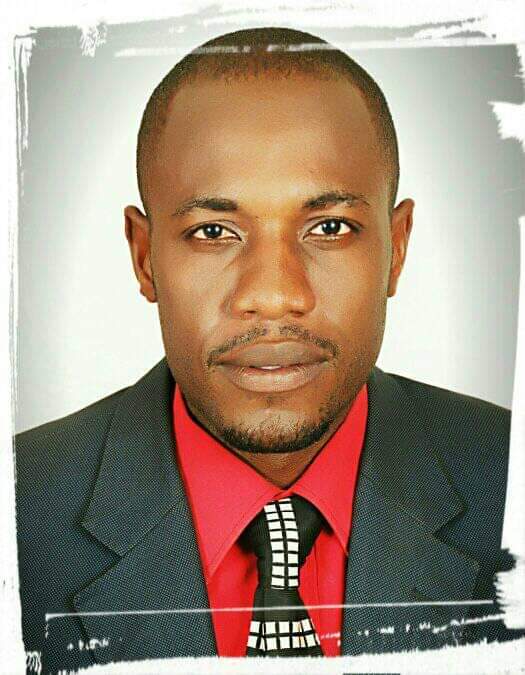
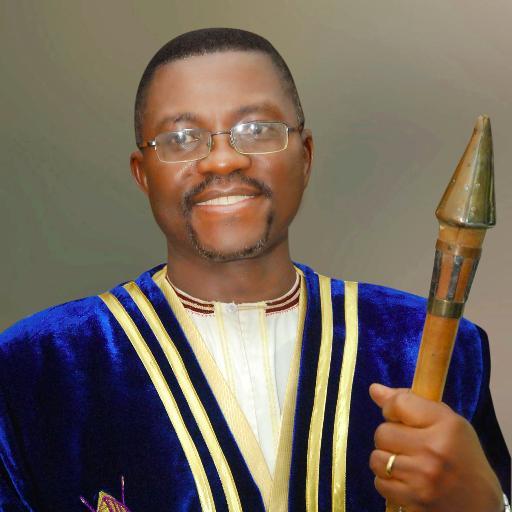
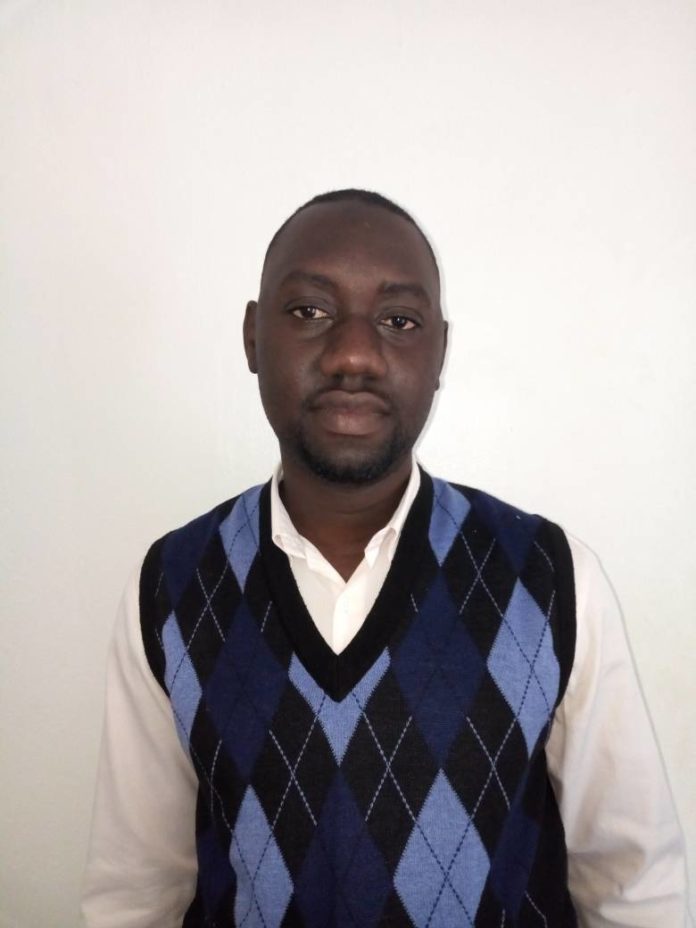
Sam Kirisa one of the two picked distributing food items.
Police in Kamulu is holding two men for disobeying presidential directives.
Sam Kisira and Stanley Ngobi were on Easter Monday nabbed from Luzinga Trading Centre in Wankole Sub County while giving out food stuffs and sanitizers to a group of gathered residents.
“We have in custody two men; Sam Isabirye and Stanley Ngobi who were giving out relief items with inscriptions that promote a politician. This is illegal because the president directed that whoever has items to donate must take it to the District Taskforce in the fight against COVID-19 pandemic,” said Michael Kasadha, the Busoga North Regional Police Spokesman.
This website has established that the duo are main campaigners of Betty Naigaga who last year declared her intentions to contest for Kamuli woman MP seat, a position currently occupied by speaker, Rebecca Kadaga. To make the matter even worse, Naigaga’s team made announcements on Luzinga Community Radio lauding her for what to them was standing with the vulnerable poor.
Eagle Online has further learnt that Naigaga is a member of the ruling National Resistance Movement.
We could not readily get her for a comment but the Kamuli District NRM Administrative Officer, Trevor Solomon Baleke could not confirm whether she is their registered member.
“That is not how the members of NRM do things. For us as party, we are adhering to the directives of the president because it is in our interest that Uganda as a country wins the battle against Coronavirus,” he said.
“Whoever disobeys the presidential directives does it as a person and has to be treated as an enemy of the people. Our cadres are not using the pandemic to look for cheap popularity, because we are all aware that gathering people is risky in this critical period,” Baleke explained.
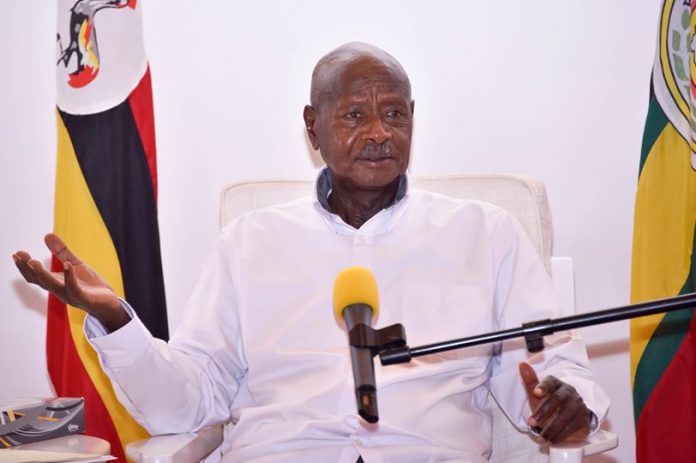
On Tuesday March, 31, President Museveni said that distribution of food to a group of people equates to attempted murder.
Museveni advised those who may want to reach out to the vulnerable poor to channel the items through either the national task force committee headed by the Prime Minister Dr Ruhakana Rugunda or the taskforce committees at the district headed by RDCs.
He directed the police to arrest individuals who would be found distributing food to people.
Most politicians adhered to this directive and indeed the duo in custody become the first persons to be arrested on such charges.
The Judiciary has announced that it will give its ruling on former Security Minister Lt. Gen. Henry Tumukunde bail application tomorrow starting at 10 am.
In tweet, the judiciary “We shall stream live the session live from Buganda Road Court. Follow all the proceedings online”
High Court Judge Wilson Kwesiga set April 14, as the day he will deliver his ruling on the bail application filed by the presidential aspirant retired Gen.Tumukunde.
The presiding judge orders followed the outbreak of Coronavirus that all parties file written submissions and proceedings would be held via video conferencing at Buganda Road Magistrates Court.
“The applicant shall file written submissions with all supporting documentary evidence and serve the respondent not later than March 28, 2020. The respondent shall file the reply to the application not later than April 3, 2020. The applicant shall then file a rejoinder if any, not than April 6,” the judge said.
Gen. Tumukunde was arrested at his Kololo offices by a joint force of police, Chieftaincy of Military Intelligence (CMI) and Special Forces Command operatives (SFC) March 12, .
He was later produced before city hall grade one magistrate Valerian Tumuhimbise and charged with treason and unlawful possession of fire arms contrary to section 3 (1) of the fire arms amendment act Cap 299. He is currently on remand at Luzira prison.
His arrest came shortly after he announced that he would challenge Mr. Museveni for presidency. Museveni has been in power for over 35 years.
Cabinet has this afternoon extended the lockdown by three more weeks.
According to cabinet sources, the Ministers had initially agreed on two weeks but later extended to three after seeing what was happening in the neighbourhood.
“It was a heated debate with many colleagues arguing that extension of three weeks would inconvenience our people but we settled for three after what is happening in Kenya and Tanzania.” a cabinet minister told Eagle Online.
Adding “We all agreed that rather than having bodies on the street like Trump, we would rather have hungry and angry population”
President Museveni is set to address the nation this Tuesday as speculations are all over on what shall come next after the 14 days of curfew he decreed at the end of last month elapse tomorrow at 6:30am.
This morning social media was awash with posts suggesting that the president would address the nation tonight; to either lift the lockdown or extend it.
But Senior Presidential Press Secretary, Don Wanyama in a tweet this afternoon clarified that the president would address the nation tomorrow at 12:00pm.
“Just to guide, the current lockdown runs until tomorrow (Tuesday) midnight. Some people hadn’t gotten this clearly. You’ll therefore wait for @KagutaMuseveni to guide on way forward tomorrow at midday,” read the tweet. A similar tweet was tweeted by the minister of ICT and National Guidance, Judith Nabakooba at 1:00pm.
“H.E @KagutaMuseveni will address the nation once again tomorrow midday (12pm) to guide us on the way forward in light of the COVID19 pandemic,” Nabakooba’s tweet reads.
Currently Uganda has a total of 54 confirmed cases 4 of which have since recovered fully and discharged from the hospital, according to the ministry of health.
By the time of publishing this story, The Eagle Online established that a cabinet meeting was in session under the chairmanship of President Museveni to decide whether to extend the current lockdown over corona virus. Before convening cabinet, Museveni reportedly had a meeting with national taskforce on COVID-19 headed by Premier, Dr Ruhakana Rugunda. The meetings are to assess the situation and decide whether or not government should extend the lockdown.
For the last six days, there has been a rise in negative cases in the test samples tested everyday – having only one person tested positive. These result give hope that that Uganda is winning the war against the deadly virus. With 4 patients already discharged and more than 10 expected to be discharged this Easter Monday, Uganda becomes the leading country in East Africa with the highest number of patients recovering from COVID-19. The country has (so far) not recorded any COVID-19 related death.
Dr. Henry Mwebesa, the Director General Health Service at the ministry of Health revealed in a statement that Eighty-seven percent of the Corona cases Uganda is handling are imported cases, 11% are local transmissions while 2% have an unknown chain of transmission.
Information at the health ministry indicates that a cumulative total of 1,199 contacts have been listed to date, 589 (49%) of whom have completed the mandatory 14-day follow up period and have been discharged from daily follow up.
A total of 439 high-risk travellers are still under institutional quarantine while 654 were discharged.
The recent revelations by Political commentator and former Presidential Press Secretary Tamale Mirundi about Mengo’s Shs100 million contribution to #Covid 19 task force cannot be taken lightly.
Mirundi’s outbursts at times edge more on fiction than reality but this time round, when you listen carefully to his interview on HDTV, he seems to have implicating evidence that suggests that Appolo Makubuya, who postures as a close confidant to Kabaka Ronald Muwenda Mutebi has managed to scheme his way to use his personal relationship with the Kabaka for his personal selfish Interests.
As a concerned Muganda, I hate to think of my Kabaka as cheap to the extent of being used to offer a cheque worth Shs100 million yet this money was actually meant to facilitate a deal if we are to take Tamale’s words as gospel truth.
We would like Katikiro Mayiga to come out on record and clarify the following,
1. Did Kabaka contribute the 100M from his benevolence as the Kabaka or not?
2. Was the contribution Institutional as in from Buganda Kingdom or it was from the Kabaka as an Individual?
3. Were you aware as the Katikiro of this donation or you also learnt of it from the press?
4. Was the donation a cash contribution or it was to be Posho worth Shs100 million as Tamale is alleging?
We as Baganda will not sit back when certain individuals are dragging the name of the Kabaka into their dubious deals and therefore, it’s of utmost importance that as the Katikiro, you protect our Kabaka from such hyenas.
Buganda Kingdoms’ wide spread respect and admiration from time immemorial as sung in the Kingdoms Anthem cannot be seen to be washed down the drain during omulembe omutebi and we can assure you that we shall not tolerate it!
As local leaders were still struggling, looking for how to help the vulnerable poor in their district during this period of quarantine and curfew, a man in the Eastern district of Luuka has allegedly starved to death.
In his small house, Lwenda Waiswa Amigo of Nawantale village in Bukanga Sub County lived alone since his wife divorced him and went with their four children about a year ago. Amigo was surviving on handouts from well wishers and his younger brother, Isa Kafeero.
Kafeero’s daughter, Shamina Namuddu told reporters that her uncle was last seen two days ago only to hear from the neighbours today that he had died from his house.
“Two days ago, my father left us with Shs2000 and told us to give it to him (the deceased) so that he could buy some food. But we failed to see him. We thought he had gone either in a bar or somewhere until today when a bad smell was coming from his house and when police came, they found him dead,” she said.
There was nothing like food found in Lwenda’s house apart from a couple of empty tins of waragi and dirty plates.
George Kagweri, the LC III chairman of Bukanga Sub County warned the residents to use the available food sparingly and to always share with the vulnerable poor in their neighborhood.
“Maama Minister (for Presidency, Esther Mbayo), we are aware that government stopped you (politicians) from giving out food but I urge you to use all possible means to help us with food otherwise we shall lose more people,” he appealed.
Kagweri also asked married couples to stop the habit of divorcing, saying had Lwenda’s wife not abandoned her, he would have maybe not starved to death.
Eagle Online could not establish whether at Bukanga police post where Lwenda’s demise was reported the cause of his death was recorded as starvation. But the Officer in Charge this police post, Nathan Kasala Kasiba told mourners that “since you are all saying that Waiswa (Lwenda) died of a natural death, we have as police allowed you to bury.”
Some residents who asked not to be named told us that the deceased, who had suffered with severe social anxiety, had cut himself off from family and friends.
“And during this period (of quarantine) it is not easy to find someone who can give you food. Everyone is saving for their families,” one woman said.
The Clerk of Parliament, Jane Kibirige has written a warning letter Mr. Sam Obbo, the Private Press Secretary to the Speaker over what she terms as unbecoming behavior of indulging in whatsup content which demeans the credibility of the institution of parliament.
Mr. Obbo was hired by parliament to handle the press desk in the office of the Speaker Rebecca Kadaga.
This website has reliably learnt that last week Ms Kibirige wrote a warning letter to Mr. Obbo indicating that Obbo participated in sharing a whatsup content about Members of Parliament when he posted a whatsup discussion to a forum of parliament staff asking to establish the source. In the same letter, Obbo was warned of absenteeism and dodging working.
“Yes it is true; Mr.Obbo has been warned although I don’t know the suspension bit. What happens between him and the Cleark and the Speaker is far beyond my reach” a source said.
Obbo is a seasoned editor and has worked with reputable newsrooms like the Daily Monitor where he rose to the rank of Politics and Public Affairs editor.
Whatsup content
It is alleged that Obbo shared the content to two forums of parliament staff and a section of scribes at parliament. “Obbo was just doing his working of a true watchdog about the institution of parliament and office of the Speaker but unfortunately, some people went to the Clerk bad mouthing his as the originator of the document.
According to sources, Obbo denied allegations are the author of the document but rather said by sharing the document, he was finding from his colleagues on who could be behind the document.
This website has learnt that the content of the document was about a trip Members of Parliament were supposed to travel to Italy to benchmark on parliamentary democracy but within the proposal were an additional allowance indicating that they would travel to China as well.
Uganda Ministry of Health has announced that one person among the 169 tested today has tested positive.
Uganda initially had 53 patients who tested positive and have been undergoing treatment but yesterday three were discharged after completing successful treatment and testing negative.
The country yesterday announced that all 555 samples of people who had undergone institutional quarantine
“One new case confirmed of COVID-19 out of the 169 samples tested today at Uganda Virus Research Institute. The total number of confirmed cases stands at 54 in Uganda. So far, 4 patients have recovered and been discharged from Entebbe Grade B Hospital on 11/04/2020 following recovery from COVID-19″
As part of the measures to curtail the spread of #COVID-19, Ugandan President, Yoweri Museveni imposed a 14 days curfew limiting movements of people and closure of schools and other vital institutions that were perceived to be breeding grounds for the speedy spreading of the virus.
Ever since I learnt of the novel Coronavirus in January this very year, I wasn’t anticipating and expecting certain inconveniences like the present lockdown assuming that it would spread globally, I thought it was a Chinese issue that would be sorted in a few days but I was surprised that even when a very huge hospital was constructed in a few days to deal with the virus, figures showed it was not to stop spreading any time soon in China
What started as a Chinese issue has really surprised the world and mainly the developed countries because when the spread of COVID-19 in China was slowing down, for Italy it was worse and everything was a mess when it conquered the United States, United Kingdom and now the whole of Africa also started getting it from the people who had travelled. Many of the cases in Africa were brought in by business people who were in either Dubai or travelers who were in the States and the United Kingdom for reasons they know better.
Stories were everywhere about LOCK DOWN but this was something that we were not familiar with, a word that described what we never thought could happen in Africa mainly in the pearl of Africa but I am now witness to what a Lockdown is. Several countries and cities like Wuhan, Italy and the USA locked down and some of us thought that whites can do so because they are very organized and respect directives better than us Africans who understand directives but decide to disrespect them.
I have had an experience that will always be memorable to me in all my life not because it’s the best, but because it’s very surprising that I have seen things I never expected would happen . The Coronavirus lockdown has seen parks close their gates, cafes shut down, Bars silent, clubs closed, Arcades silent, roads with only a few cars with stickers, with only their riders, Handwahing containers everywhere including, markets, public transport, supermarkets and gyms. In this case slayers say that Corona virus is very special, it has indeed been special because it has made us do things we have never done like washing hands at all our destinations and sanitizing our hands regularly which I think is good and should be the usual norm even after this pandemic.
Life in the Uganda has changed like never before in a peacetime. People have been told to stay at home where possible and only leave just to go and buy basics at the markets or even just walk around their premises or to shop for necessities; as key workers continue to work in social care, construction, the media and a number of other industries that have to do production.
For the past two weeks, living under lockdown has become the unreal new normal life that many Ugandans have got used to. Daily life at home and in the house is like being locked up in a prison cell, just that this one is full of panic for the married, bothersome for those with debts, funny for those who cannot access their families because the lockdown found them on duty out of their homes etc.
Empty streets over Coronavirus
Locked down alone at my place has become the worst experience; I experience deep loneliness, of a claustrophobic and urgent nature. The kind of incomprehensible panic that messaging and video calls and social media cannot touch, not knowing when I will next see my mum, or experience affectionate physical contact, or just jump in a taxi and go anywhere around the city. Life has become hard but our president says that it’s a matter of life and death so I must abide and forget that the clubs near my home existed, walking on foot used to be a punishment to myself but right now the easiest means of transport in the country is by use of foot, we are now the footsubish new brand transport means.
The unexpected consolation of distance is that I have never felt more connected, even to those I don’t know. That deceitful phrase that says that “we are all in this together” has finally come true because we are facing it equally, the white, black, the poor, the rich, the employed and the employed etc are all home until everything is ok and the virus is being contained.
Lockdown does not mean you get frustrated in all aspects of life. The one important aspect to remember is that you are not the only one facing the problem. You are asked to stay at home for your own safety and that of the community. So it was not just a lockdown and social distancing that were responsible for bringing down the number of deaths in China, but the country’s community surveillance approach. Since China has had such issues of dangerous viruses, it acted with speed to contain COVID-19 by putting in place several other strict measures, imposing total or partial lockdowns supported by a protective shield of community measures where by every time they found people with the virus, isolating them swiftly, and tracing those they contacted was always the immediate action.
The lockdown has taught me to evolve, upgrade and be resilient to change and overcome the challenges. Not everyone is lucky to see another day nor will we get a chance like this to be at home with people that we take long to meet like our landlords, neighbors and even our families. Life and its chapters will grow but playing around with it by not respecting the measures put in place by our government will lead us to massive death and Uganda will be like Italy and other states in the United states where very many people are dying.
The lockdown has been an extremely stressful and traumatic experience, but I always remind myself that it won’t last forever if we wash our hands regularly with soap, social distance ourselves, avoid shaking hands, avoid hugging and kissing, avoid crowds and most of all STAY SAFE AT HOME.
Police and other security agencies have arrested 32 people for participating in illegal assembly that contravenes the presidential directive on #COVID-19.
The arrested were found in areas of Kisalonsalo zone Kyebando hiding themselves taking local alcohol known as Malwa and other drugs that included marijuana, smoking cigarettes among others
Dickson Ambikiire the OC Kyebando Police post says they were informed by a well-wisher about the group of the people who were convened in Kisalonsalo zone taking alcohol.
Ambikiire said he had warned this same group of people several times as per presidential directives but they acted adamantly.
He says it is a group of people who have been disguising as if they stay in the same setting yet they always gather purposely to take alcohol. Ambikiire told our reporter that when they were informed they swiftly swung in and arrested them and over 18 people have been transferred to the mother division old Kira road police station and they will soon be charged with disobedience of unlawful orders.
Told Eagle Online he was forced to patrol during the day and he realized some people disguise as if they stay in the same place which as well works as a bar and continue drinking and when you come, they hide alcohol and upon seeing you leaving, they converge and resume drinking.
“I urge all Ugandans to take presidential directives so serious because it is very important for the benefit of all of us Ugandans.”OC Ambikiire urges Ugandans.
He further added “When they tell you social distancing, they should understand that it should be social distancing”.
Some of the people at Kyebando police post waiting to be taken to Old Kira Road police Staion.
He says people should be more concerned and serious about this much as people have not taken this as a serious matter.
Meddie Wahab, the Local Defence Unit operative who led the fellow LDUs told Eagle Online that these people had ignored several warnings.
According to Patrick Onyango the Kampala Metropolitan Police Spokesperson, people who are found of being in bars drinking alcohol must be careful in this lockdown period because it might cost them highly.