Stanbic Bank
Stanbic Bank
21.4 C
Kampala
Stanbic Bank
Stanbic Bank
Home Blog Page 1119

Bobi wine nominated for Africa Freedom Awards

Bobi Wine

Kyadondo East MP who doubles as patron of People Power, a political pressure in Uganda, Robert Kyagulanyi aka Bobi Wine, is in South Africa ahead of Africa Freedom Award organised by the Friedrich Naumann Foundation for Freedom (FNF).

The ceremony will take place tomorrow in Johannesburg, South Africa.

Bobi wine arrived last evening and shared his views on African perspective show at SABC TV moderated by South African journalist, Aldrin Sampear.

“We are happy to announce that Bobi Wine, representing the People Movement has accepted the 2019 Africa Freedom Prize nomination from the Friedrich Naumann Foundation for Freedom in Africa.” The foundation announced.

Responding to the nomination, Bobi wine said “I would like to thank Freedom Foundation Africa for the nomination. It means a lot to the movement and we need as much support for our work as we can get.”

The political wave in Uganda is turning against the liberation President who has been in power since 1986. The political atmosphere in the country has turned hostile to opposition Political leaders. The president under the guise of Public order management act, has banned them from campaigning, rallying and organizing, a different approach to advance freedom became necessary.

People Power is a freedom movement in Uganda that is seeking democracy, human rights and the rule of law in Uganda in this lifetime. Several attempts to silence Bobi Wine and the People Power movement has been made since their inception.

Their leader Bobi Wine has been imprisoned for ‘annoying the President’, their members have been attacked in public and attempts on their lives have been made in the name of silencing the movement. These attempts however have done little to stop the movement. With a drive to make a change from freedom, they keep moving forward.

Stories Continues after ad

Most Ugandans not satisfied with country’s direction in fighting corruption – Survey

Father Simon Lokodo

70 percent of citizens in Uganda are disappointed and dissatisfied with the country’s direction towards fighting corruption, a survey has proved.

The findings were released by Twaweza in a research brief titled ‘More food, less money: Ugandans’ experiences and opinions on poverty and livelihoods’. The brief is based on data from Sauti za Wanainchi, Africa’s first nationally representative high-frequency mobile phone survey.

The findings are based on data collected from 1,905 respondents across Uganda in November 2018.

According to the survey, citizens were asked if they are satisfied or dissatisfied with the direction that Uganda is taking in the areas of managing the economy, fighting corruption in government, creating income/job opportunities and improving security in the country.

72 percent were completely somewhat dissatisfied with the way the government has handled the economy, 70 percent was disappointed in the way corruption has been handled in the country, while 67 percent were dissatisfied with how the government has handled the problem of solving unemployment in the county.

48 percent of the sample space was however pleased or satisfied with how the security concerns have been handled.

Yesterday President Yoweri Museveni was Chief Walker in Anti-Corruption Walk, aimed at telling the world that he was committed to fighting corruption. He would later say at Kololo Airstrip that among others like the need for material possessions, Ugandan public officials lack integrity which has partly contributed to corruption.

Museveni said he recently followed up a case in which a pupil had been defiled but the police was not serious about the issue. He however did not pledge to the public how his government was going to boost the fight against corruption, apart from mentioning agencies anti-graft agencies like IGG, State House Anti-Corruption Unit and the courts.

 A few former top officials in government are serving sentences in Luzira over corruption, though citizens think more should be arrested.

Uganda is the 149 least corrupt nations out of 175 countries, according to the 2018 Corruption Perceptions Index reported by Transparency International. Corruption Rank in Uganda averaged 115.45 from 1996 until 2018, reaching an all-time high of 151 in 2016 and a record low of 43 in 1996.

The Corruption Perceptions Index ranks countries and territories based on how corrupt their public sector is perceived to be

Corruption constitutes a major challenge for businesses operating or planning to invest in Uganda. The police, the judiciary and procurement are areas where corruption risks are very high and under-the-table cash payments are expected. The core of Uganda’s legal anti-corruption framework is the Anti-Corruption Act, the Penal Code, the Inspectorate of Government Act 2002, the Public Finance Management Act 2015 and the Leadership Code Act 2002 (LCA).

The Penal Code provides instruments to deal with various corruption offenses including embezzlement, causing financial loss, abuse of office and fraud. The LCA is designed to increase transparency and to curb corruption among senior public officials; it also criminalizes attempted corruption, active and passive briberyextortion, bribery of a foreign public official and abuse of office.

Under the LCA, gifts or donations must be declared if they exceed five currency points in value. Corruption challenges are exacerbated by weak law enforcement, which fuels a culture of impunity. There is no distinction between a bribe and a facilitation payment under Ugandan law.

Stories Continues after ad
Uganda tops Africa in coffee exports in October

Uganda coffee exports

Uganda’s coffee exports of 378,238 bags led shipments from African countries, followed by Ethiopia, according to the International Coffee Organisation (ICO)’s Coffee Market Report for November.

The total volume of exports from Africa was 958,055 bags, says the report. But in comparison with the same month in the previous year, Arabica exports from Uganda fell 30 percent to 75,501 bags, while Robusta exports rose by 24.6 percent to 302,737 bags.

Exports of Arabica from Uganda have declined for most of 2019, dropping 16.6 percent in the first ten months compared to the same period in 2018. However, the increase in Robusta exports have more than offset the fall, and as a result total exports from the country increased 7.4 percent for the same period. The Uganda Coffee Development Authority attributed this increase to good main and secondary harvests on account of favourable weather in 2019.

Meanwhile, global exports in October 2019 totalled 8.91 million bags, their lowest monthly level since September 2017. According to the report, this represents a drop of 13.4 percent compared to the same period in the previous year, and of 2.4 percent compared to October 2017.

Shipments of Robust as fell 21.6 percent to 2.82 million bags and Arabicas fell 9 percent to 6.08 million bags. Other Mild Arabicas saw the largest decline, falling 23.2 percent to 1.33 million bags, while Brazilian Naturals fell 9.5 percent to 3.44 million bags. Colombian Milds, conversely, saw an increase of 13.5 percent to 1.31 million bags compared to October 2018.

The depreciation of the Colombian Peso against the US Dollar for much of 2019 could be a contributing factor for higher shipments of Colombian Milds, the report says.

Exports from South America amounted to 5.29 million bags in October 2019, led by 3.42 million bags from Brazil. Brazil’s exports—which accounted for 38.4 percent of the total coffee exports in October 2019— fell 12.9 percent compared to October 2018, owing to its smaller 2019/20 off-year crop.

 Despite the monthly fall in shipments compared to 2018, the report says Brazil’s export total to date for its 2019/20 crop year is at a record level of 23.62 million bags. This is 7.2 percent greater than its next highest level of 22.04 million bags, reached in April–October 2014.

Stories Continues after ad

Is COSASE messing up Asian property inquiry?

MP Ibrahim Kasozi

Kampala businessman Sudhir Ruparelia yesterday snubbed summons by Parliament’s Committee on Statutory Authorities and State Enterprises (COSASE) investigating acquisition of properties from the Departed Asians Properties Custodian Board (DAPCB).

The DAPCB was formed to assist Asians who abandoned properties when President Idi Amin expelled them in 1972 to repossess them. However some Asians were compensated as their properties were transferred to Ugandans by way of buying them from DAPCB.

COSASE had invited Sudhir to appear before the committee to explain how he acquired five properties that a whistle blower alleged were never repossessed from DAPCB and should be in government possession. But the committee has failed to differentiate properties that were sold by DAPCB and properties some Ugandans acquired from individuals.

Sudhir didn’t show up for the summons yesterday, but His lawyers Walusimbi & Co. Advocates had on Tuesday asked COSASE Chairperson Ibrahim Kasozi to explain why their client should appear before Parliament given that he never acquired the properties from DAPCB, but from individuals and private companies.

Kasozi has named five properties that the committee is interested in. The properties are Plot 23 on Jinja Road, Plot 24 on Kampala Road, Plot 5 on Colville Street, Plot 3 and 5 on Bombo Road in Kampala and Plot 26 on Republic Street in Mbale.

Sudhir’s lawyers wrote back on the same day. “Our client reiterates that he has in all instances not purchased any of the said properties from the Departed Asians Custodian Board, which your esteemed committee is inquiring into.”

The lawyers went ahead to expound on the status of the properties the committee was interested in.

On Plot 43, Jinja Road: “Our clients records do not reflect this description. He has instructed us to carry out a further search at the land registry and revert to him at the earliest.”

The lawyers argued that Plot 24 on Kampala Road was resolved by a court decision between Meera Investments Ltd and DAPCB and can’t be subjected to an inquiry.

Nelson Walusimbi, Sudhir’s lawyer also adduced evidence by way of a title with transfer details indicating that the tycoon purchased Plot 8 Colville Street from the then registered proprietor, Uganda Theatres Limited.

He added that Plot 26, Republic Street Mbale was purchased from Nakasero Soap Works. Plot 3 &5 Bombo Road were purchased from Joint Ven (U) Ltd.

“Our client requests for specific information about any possible dealings the honourable committee estimates he may have had with the statutory body so that he responds to those,” Walusimbi wrote.

However, it is said some sections of the public is that some members of the committee tried to use the “summons” as way to extort money from the tycoon, but he has stood his ground indicating that his properties were legally acquired them from private individuals and from DAPCB.

Days ago the Uganda Law Society (ULS), an umbrella association of lawyers in Uganda wrote to Speaker of Parliament about COSASE’s conduct of summoning lawyers to appear before parliament on matters related to DAPCB, saying some cases are in court, which would violate the Sub Judice Rule.

Stories Continues after ad

Emirates to expand reach in Mexico via enhanced agreement with Interjet Airlines

Emirates celebrates the arrival of its inaugural flight from Dubai International Airport (DXB) to Fort Lauderdale-Hollywood International Airport (FLL), marking the launch of their eleventh U.S. gateway on Thursday, Dec. 15, 2016, in Fort Lauderdale, Fla. (Jesus Aranguren/AP Images for Emirates Airline)

Emirates, airline and Interjet Airlines have announced an enhanced interline agreement, which is set to open new routes and destinations for passengers travelling between Mexico, the Gulf and Middle East and beyond.

With a single ticket, Emirates’ passengers can now seamlessly connect via Mexico City onto Interjet flights to Leon/Guanajuato, Culiacan, Cancun, Chihuahua, Guadalajara, Merida, Monterrey, Puerto Vallarta, Tampico, Tuxtla Gutierrez, Tijuana and Villahermosa. Similarly, Interjet’s customers will be able to travel with great ease to Emirates’ destinations within the Middle East, Spain, South East Asia, the Far East and North Africa.

“We’re pleased to establish a partnership with Interjet Airlines, allowing Emirates passengers to benefit from increased choice, flexibility and ease of connection to different cities within Mexico and to regional international points beyond. This partnership further demonstrates our commitment to Mexico for the long run, as we continue to look at ways to build our operations in the market to best serve our customers,” said Adnan Kazim, Emirates’ Chief Commercial Officer.

“While the interline agreement is only the start of our collaboration, we’re looking forward to explore more mutual opportunities and a wider scope of partnership in the near future,” he added.

Emirates’ partnership with Interjet started in April 2019 with a one-way Interline agreement, allowing passengers from Emirates’ 12 US gateways to travel to Mexico City on Interjet flights. With the expanded partnership agreement, Emirates’ passengers can now tap into Interjet’s strong domestic presence in Mexico and access 12 destinations beyond Mexico City. The enhanced agreement with Interjet Airlines also provides Emirates’ customers choice of over 15 regional international destinations beyond Mexico City.

“Since our initial interline agreement in April 2019, Interjet’s relationship with Emirates has truly been a success,” said Julio Gamero, Interjet’s Chief Commercial Officer. “This enhanced agreement, provides travelers from both airlines access to a broader network not only with more flight choices, but for Emirates customers, access to more of Mexico with our many domestic connections from Mexico City. When you combine this with seamless reservations, one-stop check-in with baggage checked to the final destination, more legroom between seats and Interjet’s outstanding on-board service, it’s easy to see why this agreement is a win-win for both airlines,” he added.

Starting 9 December 2019, Emirates will launch its new daily service from Dubai (DXB) to Mexico City International Airport (MEX), via the Spanish city of Barcelona (BCN). Interjet customers can start booking their trips through Emirates’ website, Online Travel Agencies (OTA’s) or travel agents, benefiting from the convenience of holding a single ticket with a single baggage policy.

Stories Continues after ad

New global action initiative to help curb rapid spread of Fall Armyworm

Fall Armyworms eat maize plant leaves

Food and Agriculture Organisation (FAO) has launched a three-year Global Action for Fall Armyworm Control to scale up efforts to curb the growing spread of the invasive pest which is causing serious damage to food production and affecting millions of farmers across the world.

Fall Armyworm (FAW), a crop pest native to the Americas, has rapidly spread through Africa, and to the Near East and Asia in the past four years.

“It {Fall Armyworm} threatens food security of hundreds of millions of people and the livelihoods of smallholder farmers,” said FAO Director-General Qu Dongyu. He made the remarks yesterday at the launch of the Global Action on the sidelines of the FAO’s Council, the Organization’s executive body.

”This is a global threat that requires a global perspective,” he stressed, urging the FAO member states “to greatly scale up the existing efforts” to prevent the further spread of this harmful pest to new regions.

The event also saw the participation of Cabo Verde’s Minister of Agriculture and Environment Gilberto Silva; Undersecretary of Ministry of Agriculture of the Philippines Rodolfo V. Vicerra; Chief Scientist of USAID Robert Bertram; Norway’s Ambassador and Permanent Representative to FAO Aslak Brun; Secretary, Secretariat of the International Plant Protection Convention, Jingyuan Xia; as well as government officials and experts from around the world, UN agencies and academia.

In his address, Qu said that FAO is seeking to mobilise US$500 million over the next three years to control Fall Armyworm. To this end, he proposed the establishment of a Global Action Fund – the first ever multi-partner trust fund aimed at addressing the Fall Armyworm threats, – and encouraged countries to contribute to this funding mechanism.

The initiative also calls for increased partnerships to complement current FAO mechanisms such as Farmer Field Schools and South-South and Triangular Cooperation as well as to create new cooperation channels, Qu noted. In particular, he added, it will feed into FAO’s new data-driven Hand-in-Hand initiative to target interventions where most needed.

“We must all work together, FAO, international organizations, governments, the private sectors, research centres, academia, and civil society. With the proposed Global Action, FAO commits to putting the knowledge, experience and lessons learned from stakeholders and partners at the service of farmers throughout the world to stem the global threat of this pest,” the FAO Director-General concluded.

Global Action Programme

The Global Action will be implemented between 2020 and 2022. It is expected to mobilize global resources and expertise to enhance national capacities to tackle FAW, reinforce efforts to discourage widespread use of highly hazardous pesticides, and provide resources for scientific research and innovation to develop efficient solutions to tackle the pest, such as FAO’s Fall Armyworm Monitoring and Early Warning System mobile app.

Doing so will help to bring the pest under control in the affected areas and reduce the risk of its further introduction and spread to new regions, including Europe and South Pacific.

Deadly pest

The Fall Armyworm (FAW) is an insect pest, which causes considerable yield losses in cultivated maize, rice, sorghum, millet, and other crops as it is capable of attacking over 80 species of crops, if not under good management and control.

Based on 2018 estimates, every year up to 17.7 million tonnes of maize are lost to this pest in Africa alone. This amount of maize could feed tens of millions of people; and represents an economic loss of up to US$4.6 billion.

Stories Continues after ad

With peace and security, Mogadishu is changing

Boys pose for a photo at Liido beach Mogadishu. Photo by AMISOM-Omar Abdisalan

Mogadishu is coming to life, again.

These days, Mogadishu’s beautiful beaches are a hive of activity. Nestled in northern Mogadishu, the popular hangout spot, Liido Beach, is surrounded by beautiful beach hotels and restaurants, which are a favourite weekend getaway for many local residents who go there to relax and enjoy their days away from the hustle and bustle of Mogadishu City.

Over the years—thanks to the increasing peace and stability that Mogadishu is enjoying—the city, and in particular its sprawling beaches, have seen an increase in the number of ordinary people visiting them for business and for pleasure. The peace dividend is paying off in many ways, with Somalis from the diaspora also returning and investing heavily in the hotel and hospitality industry.

The kaleidoscope of colour and laughter that are the sights and sounds of Liido Beach are a far cry from the period before 2009, when Mogadishu was under the control of the militant group Al-Shabaab, whose reign of terror forbade any form of leisure activities and banned swimming.

Somalis enjoying themselves at beach in Mogadishu


After the African Union Mission in Somalia (AMISOM) forces routed Al-Shabaab out of Mogadishu in 2009, the city has been coming to life, regaining its former glory as a business hub and leisure destination.

According to the World Bank report of August 2019, Somalia’s “real GDP is projected to grow by 3.0–3.5 percent, an outlook predicated on extension of the security gains and policy reforms the authorities have achieved to date,” the report indicated in part. Mobile money transfers have revolutionized business in Somalia and transactions are easy and fast.

Today, the pristine waters of the ocean are beckoning.

Liido Beach is a stretch of gorgeous sandy beach approximately two kilometres long in the north of the Somalia capital, Mogadishu, overlooking the Indian Ocean. The name Liido derives from the Italian word for ‘beach’. In the 1970’s and early 80’s the beach was full of foreign tourists, and many locals. Today, as Somalia rebuilds after years of armed conflict, security in and around Mogadishu is very tight. For everyone’s insurance, there are several checkpoints manned by heavily armed police and paramilitary officers before one gets to Liido.

For friends and family

On Fridays, which are weekends in Somalia, it is now a common feature to see hundreds of residents; young and old, mothers and fathers, boys and girls, flock to Liido Beach to dine, swim, play beach soccer or, simply, take a boat ride across the waters. Local businesspeople enjoy brisk business hiring out boats and luminous bright floaters for the less confident swimmers. Several hotels and restaurants offer freshly squeezed fruit juices, food and fresh fish, a variety of seafood and the choicest of Somalia’s cuisine.

On the day of their graduation from Salaam University, close friends Sowda Abdirahman and Ruqia Afrah, chose Liido Beach as the best spot to celebrate their graduation. Clad in their black and green graduation gowns, the two young ladies were a standout among the swimmers and, confidently, told us that they were ready to help in the reconstruction of Mogadishu. They had both graduated with a degree in banking and finance.

Two female graduates celebrate their graduation with friends and family at the Lido beach in Mogadishu, Somalia on November 15 2019. AMISOM Photo

We caught up with Sowda, Ruqia and their families at the top balcony of Dolphin Hotel, which overlooks the ocean, giving one a bird’s eye view of the activity on the beach, and of the serene waters.

“We came here to find a cool place to relax as we celebrate our graduation because this is one of the most beautiful places in the city. I came to enjoy the moment with family and friends,’’ 21-year-old Sowda said, standing at the edge of the balcony gazing out at the beautiful view of Lido beach.

As she looks across the ocean, 22-year-old Ruqia, talks about the future she dreams of for herself and her country.

“First, I want to first work for a big corporation. Then I want to start a unique business that is not common so that other girls could emulate me. That is why I studied banking and finance,” she said.

Peace dividend

With improving peace and security as well as expanding business opportunities across the country, Mogadishu is witnessing a construction boom and is now home to several thriving businesses. International investors are coming in, and the locals are renowned for their industrious nature and entrepreneurship.

Somalia is witnessing an impressive growth of its aviation sector, and Mogadishu’s Aden Abdulle International Airport now attracts some of the world’s best-known international airlines. Turkish Airlines, Kenya Airways, Ethiopia Airlines, and Qatar Airlines operate regular flights into Mogadishu and, recently, Uganda Airlines joined the growing list of international and regional airlines that now fly into Somalia. Inside the international airport, a Turkish company has constructed a 5-star hotel, the first of its kind, the Decale Hotel with exquisite rooms, including luxurious presidential suites.

Across town, the first gated community called Dar-u-Salaam is now complete, with its impressive villas, a children’s park, school, hospital and shops. The face of Mogadishu is changing, and changing fast.

In late November, the second Mogadishu Tech Summit, an annual gathering of tech savvy, digital entrepreneurs and innovators has just successfully been held, attracting over 5 000 visitors, the majority of whom were youth. A women-owned cosmetic company called Sadra Beauty Company, started and run by three university graduates, won this year’s coveted Khalid Innovation Trophy that came with a US $5 000.00 cash prize.

Salaam Bank pledged US $5 million for the next three years to be made available to innovators and entrepreneurs, with access to the funds provided through iRise, Somalia’s first-ever technology innovation hub which promotes collaboration between innovators and investors, while also offering resources needed by budding entrepreneurs and startups, such as business training, mentorship, project evaluation and support during the incubation stages of their projects. Last year, Premier Bank injected US $1 million into the tech summit, with close to a quarter of that amount already disbursed to emerging innovators and entrepreneurs.

“If we want to grow and develop our economy it is very important that we invest in technology and encourage entrepreneurs,” Shuayb Mohamed, Chief Executive Officer of Salaam Bank said.

The Mogadishu of the past no longer remains; it has been replaced by the hustle and bustle of any capital city in Africa.  The signs of progress abound, as Mogadishu continues to reclaim her position as an economic contributor to the Horn of Africa.

Stories Continues after ad
Uganda police officers complete tour of duty amid glowing praise from AMISOM

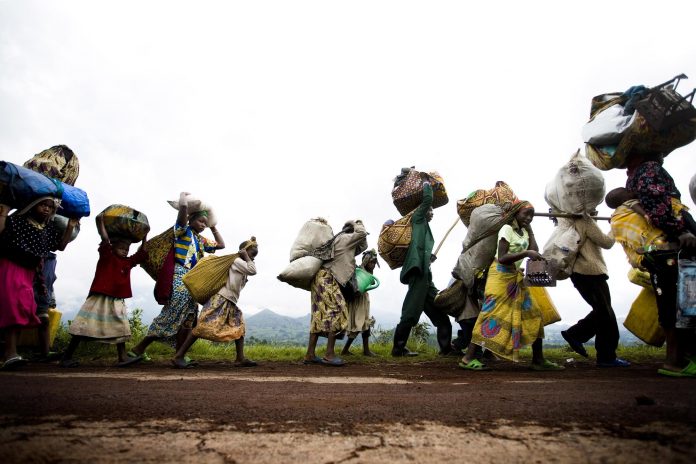
Individual Police Officers (IPOs), serving under the African Union Mission in Somalia (AMISOM) in a group photo with AMISOM senior Police officers at the end of a medal award ceremony in Mogadishu to mark the completion of their one-year tour of duty in Somalia on December 01, 2019. AMISOM Photo / Ilyas Ahmed

Seventeen police officers from Uganda have completed their one-year tour of duty, where they served under the police component of the African Union Mission in Somalia (AMISOM).

AMISOM Police Commissioner Augustine Magnus Kailie days ago presided over the send-off medal parade in Mogadishu, and paid glowing tribute to the officers for their dedication, professionalism and contribution to achieving AMISOM’s mandate.

“I want to congratulate you for your good work during the last 12 months. We appreciate your contribution towards the implementation of AMISOM Police mandate,” Commissioner Magnus Kailie said.

“You have acquired knowledge and wealth. You must use them wisely. I would like to advise you all to employ your time in improving your life and the lives of others around you. I implore you that when you go back home, you should not be the same as you came. You should observe human rights. As a peacekeeper, you have been mentoring the Somali Police. So, when you go back home, tell them you are a different person, with international experience, and that you observe human rights,” he advised.

The UN Security Council in its resolution 2472 (2019) adopted on 31 May this year, authorised AMISOM to deploy 1,040 police personnel including five Formed Police Units and Individual Police Officers (IPOs). The Formed Police Units provide operational support such as public order management and VIP escort and protection, while the IPOs train, mentor, and advise the Somali Police officers. The individual police personnel have been playing a critical in the stabilisation process of Somalia, especially with the maintenance of law and order in liberated areas.

“As AMISOM Police, we are mandated to help build the capacity of the Somali Police Force. For instance, in HirShabelle State, we have overseen the recruitment, training and deployment of SPF officers. In that way, we have contributed in building the capacity of the Somalis such that they can take over security responsibilities when AMISOM exits Somalia in 2021,” said outgoing AMISOM Police Public Information Officer, Isah Semwogerere.

Commissioner Kailie also decorated the officers with medals of honour and gave them certificates, together with AMISOM Police Chief of Staff Rex Dundun, AMISOM Police Operations Coordinator Daniel Ali Gwambal, and AMISOM Police Reform, Restructuring and Development Coordinator Maxwell Chikunguru.

Outgoing Uganda contingent Police Commander Ibrahim Saiga expressed gratitude to the AMISOM Senior Leadership Team for the opportunity rendered to him and his fellow officers, stating that much as they have trained the Somali Police Force officers, they have also learnt a lot from the mission.

A poignant moment during this ceremony was observing a minute of silence in honour of former acting AMISOM Police Commissioner, the late Christine Alalo, who perished in a plane crash in Ethiopia in March this year.

Stories Continues after ad

Signs point to global economic recession: Policy-makers ignore Minsky’s lessons at their peril

Desmond Lachman

By Desmond Lachman

The 2008 financial crisis furnished markets with a painful lesson in ‘Minsky moments’, when asset prices collapse following a prolonged period of reckless speculative activity.

US economist Hyman Minsky never tired of warning that extended bull markets always end in epic collapses. The prolonged period of exuberance that financial markets are now experiencing would surely make him shudder.

A decade of ultra-easy monetary policy conducted by the world’s major central banks has fuelled this dangerous bull market. To cite one example, US equity prices have increased more than threefold since their nadir in March 2009, and the US equity bull market is in its eleventh year.

Financial market exuberance has begotten years of reckless lending. The risky US leveraged loan market has increased to more than $1.3tn. The size of the global leveraged loan market is around two-and-a-half times the size of the US subprime market in 2008. In 2017, oft-troubled Argentina was able to issue a 100-year bond. Today, European high-yield borrowers can place their debt at negative interest rates. Italy, dysfunctional and heavily-indebted as its government may be, can borrow at a lower interest rate than the US. Greece, which is slowly emerging from years of hardship, is able to borrow at negative rates.

Despite the clearest signals of gross global credit misallocation and the serious mispricing of credit risk, markets and policy-makers seem remarkably sanguine. The possibility of a violent repricing of risky assets, which could lead to large strains in the financial markets, is apparently far from their minds.

Their complacency is surprising, particularly in the light of early warning signs. In August, Argentina fell into a technical default on its bond obligations. In China, domestic corporate bonds are defaulting at an increasing rate following a year of record defaults in 2018. For WeWork, the much-vaunted US shared-workspace company, its equity bubble burst spectacularly in October.

Many factors point towards a global economic recession. According to the International Monetary Fund, whereas 75% of all countries were experiencing economic upswings in 2018, today 90% are suffering from slowdowns. Much of this can be attributed to the multiple fronts on which US President Donald Trump is fighting his trade war.

With the world economy already slowing, one might have expected markets to price in at least some possibility that the continuing quagmire in Hong Kong might precipitate an escalation of the US-China trade war. Markets seem to be ignoring, too, some probability of a hard Brexit, an oil price shock resulting from US-Iran tensions, or the possibility that Democratic candidate Elizabeth Warren – who has called regularly on congress and regulators to mitigate the threat of a downturn – might win next year’s US presidential election.

People frequently quote Minsky’s warnings about extended bull markets. But the economist also taught, just as importantly, that markets have short memories and habitually delude themselves into believing that ‘this time will be different’. Judging by today’s market exuberance in the face of mounting economic and political risks, it seems Minsky is soon likely to be proved correct again on both counts.

Desmond Lachman is a resident fellow at the American Enterprise Institute. He was formerly a deputy director in the International Monetary Fund’s Policy Development and Review Department and the chief emerging market economic strategist at Salomon Smith Barney.

Stories Continues after ad

Stop misinforming the public on Uganda’s history-Museveni tells Buganda’s Apollo Makubuya 

Apollo Makubuya


President Yoweri Museveni has bashed Mr Apollo Makubuya, Advisor of Buganda Kingdom, for miss presentation of facts and implored him to embark on making research to get on the right truck.

In his speech during the Memorial Lecture for Edward Mutesa II that was held at the Sheraton Hotel in Kampala, the former third Deputy Prime Minister and Attorney General of the kingdom Apollo said the deceased worked towards uniting the Uganda as one country among others.

Mr Makubuya and lawyer David Mpanga were demoted by the Kabaka of Buganda in the last reshuffle that saw the two gentlemen pushed to lesser important roles in the kingdom. Mpanga was to later to be removed as the country’s Managing Partner for Bowmans Uganda chapter after court declared him conflicted.

However, on taking up the microphone, President Yoweri Museveni who was also the chief guest lauded the Mutesa II for working towards the development of this county. He however, eluded Mutesa’s failure to his advisers who included the former President Apollo Milton Obote, the hypocrite leader who later attacked the palace.

“I don’t know whether Makubuya you know that now? Yes, the Democratic Party didn’t agree with Kabaka Yekka. The problem was Obote’s hypocrisy and Ben Kiwanuka’s truthfulness” he told Makubuya.

He said Democratic Party did not liaise with Kabaka Yekka when they tabled Federal as one of their demands.

Museveni further educated Makubuya that the problem began when the DP had issues with the kingdom because they were demanding a lot of impossibilities.

“Some of the demands according to the president were to have a state within a state. Makubuya, have you noted that one down?” he elaborated.

Museveni said Kabaka Yekka mistreated DP in Buganda for telling the truth. Do you get that one Makubuya? Makubuya should research” he said adding that Kabaka was fed on ill advice about the on lost counties of Bugangaizi and Buyaga

Makubuya talked of talking the truth. These counties where Bunyoro counties and there was no debate about that. Buganda had already got Buruli, Singo, Bugerere, and Buwekula. They should have left Bugangaizi and Buyaga to go back to Bunyoro


Stories Continues after ad