Stanbic Bank
Stanbic Bank
19 C
Kampala
Stanbic Bank
Stanbic Bank
Home Blog Page 1134

Dfcu kicks out conflicted Sebalu and Lule lawyers in the fraudulent acquired Meera Investment property case

The Former Crane Bank Ntinda branch, which DFCU took over and illegally rebranded in its name, was ordered by the court to vacate and compensate Meera Investments because the property belongs to Meera.

Dfcu Bank has finally conceded, as ruled by court, and has kicked out lawyers of Sebalu, Lule and Company Advocates from representing the lender in the case filed against it (Dfcu) by tycoon Sudhir Ruparelia’s real estate and property management firm, Meera Investment Limited.

Dfcu Bank has now recruited new lawyers of yet another Kampala law firm M/S Kalenge, Bwanika, Ssawa & Co Advocates, according to the notice of change of advocates dated November 20, 2019.

The High Court on April 29, 2019 declared Sebalu & Lule Advocates as conflicted, and therefore, unfit to represent the Dfcu Bank in a longstanding a commercial dispute.

Court agreed with Meera Investments Limited that the lawyers had relevant information concerning Crane Management Services having participated in the review of its tenancy agreements.

“The Applicant has made out a case that the first respondent has relevant information of the applicant. The information is relevant and I accordingly grant an injunction restraining the first respondent from handling any case involving the applicant,” court said then.

David Mpanga who was kicked out of the earlier case involving Sudhir.

Meera Investment Limited  sued Dfcu Bank demanding rental arrears amounting to Shs2.9b and US $385,728.54 in respect of tenancies of suit properties that are owned by the Meera Investment Limited which is part of the Ruparelia Group of Companies.

In the suit, Meera Investment Limited  contended that when Dfcu Bank took over management of Crane Bank Limited, it illegally took possession of the rental facilities from which the real estate company seeks to recover its arrears.

However, in defence, Dfcu Bank contracted the Law firm of Sebalu & Lule Advocates but Mr. Rupareria says he contracted the same law firm in 2006 to draw and review tenancy agreements in respect of the said rental premises thus there is conflict between the lawyer and his client.

The company also asked the court to issue a permanent injunction, restraining Sebalu & Lule Advocates from appearing as defence counsel for Dfcu Bank in the other court case that the two principals are battling out.

Section 4 of Advocates Act  regulations,  provide that an advocate shall not accept instructions from any person in respect of a contentious or non-contentious matter if the matter involves a former client and the advocate as a result of acting for the former client is aware of any facts which may be prejudicial to the client in that matter.

As if that was not bad enough, Sebalu and Lule Advocates misadvised Dfcu Bank that it could take over Meera Investment Limited properties which had been leased to Crane Bank Limited before Dfcu Bank to some assets of the latter in January 2017.

Lawyer Timothy Masembe Kanyerezi whom declared conflicted in BoU/Sudhir case.

The transaction has brought Dfcu Bank and the Bank of Uganda (BoU) into a financial misunderstanding after former decided that it could not takeover the freehold Meera Investment properties. Dfcu Bank now wants Shs47 billion from BoU as compensation for the loss of the properties. But BoU says it cannot pay that money. However, reports indicate that the governor of BoU, Emmanuel Tumusiime Mutebile and the board refused to pay Shs47 billion to Dfcu stating the transaction was illegal.

Also in December 2017, the Commercial disqualified city lawyers Mr Kanyererezi Masembe of MMAKS Advocates and Mr David  Mpanga  of Bowmans Advocates from the  Sh397 billion  Sudhir Ruparelia’s case against Bank of Uganda (BoU), citing conflict of interest.

In his ruling delivered on December 21, 2017, the head of the Commercial Court Division, Justice Wangutusi stated that Mr. David Mpanga of A.F. Mpanga Advocates and Timothy Masembe of MMAKS Advocates acted in violation of the Advocates (Professional Conduct) regulations.


Stories Continues after ad

PICTORIAL: Rema, Dr Hamza enjoy honey moon at Murchison falls national park

rema and sebunya

Singer Rema Namakula and Dr Hamza Sebunya are currently enjoying their honeymoon at Murchison falls national park.

The two lover birds have camped at Paraa Safari Lodge, in Murchison fall national park.

Last week, Rema introduced Dr. Sebunya  to her family members at a colorful function held at their ancestral home in Nabbingo.

The function was attended by a number of guests from Buganda kingdom, central government, city tycoons, talented musicians, Muslim clerics, friends and relatives.

Nabagereka Sylvia Nagginda was the chief guest as Uganda witnessed Rema move to a recognized marriage. She implored Rema to always respect her husband, and take care of him for their desired life to move on.

Sebunya, donated a number of gifts to Rema’s family members who included Halima Namakula among others.  Among the gifts included: A Refrigerator, Television set, Sofa sets, solar panel and more.

Stories Continues after ad

Local Think Tank, Brookings Institution to undertake a study on youth unemployment

Ugandan youth march in Kampala over lack of jobs

Makerere’s Economic Policy Research Centre (EPRC) and Brookings Institution, USA, have inked  a  memorandum of understand to jointly undertake a study addressing African Youth unemployment through Industries without Smokestacks(IWOSS).The 2019-2021 initiative is focused on the formal employment creation of these industries to address the youth unemployment challenges in Africa.

It is conceived that while many efforts and interventions have focused on the supply side of the labour market, large-scale demand –side efforts have been limited. The project’s goal is to fill this gap and inform strategies and effective policies to address youth unemployment and job creation challenges in Africa.

Over the next three years, activities will include in-depth research, high-level engagement and broad dissemination. Specific countries of focus besides Uganda include Ghana, South Africa, Senegal and Kenya.

This project is a joint initiative between EPRC and Brookings’s Africa Growth Initiative (AGI) with specific deliveries being a series of workshops to discuss research methodology, review of draft publications; in-depth country and sector studies. Others will be disseminations including supplemental blogs and or podcasts, in country and US based events and discussions, policy briefs and contributions to related publications and presentations at select fora.

In support of the goals of the initiative led by Dr.Brahima  S.Culibaly,AGI Director and Senior Fellow,Dr.Haroon Bhorat a Non-resident Senior Fellow at the Brookings Institution ,EPRC will lead  the country case study for Uganda to assess the  scope for  IWOSS in the country to generate large scale formal employment opportunities for young people.

Leveraging frameworks developed for this purpose,EPRC will also conduct action oriented  research to identify ,in collaboration with the project leadership team, the key IWOSS in Uganda with greatest scope  to contribute to economic development; identify the key constraints to growth of these industries including infrastructure,s kills, regulatory requirements, capacity to export, agglomeration, and firms’ capabilities.

The study will assess the current employment creation potential along the value chains, where applicable, of these industries both under the current sectoral growth trajectory and economic and policy environment, as well as projected employment opportunities where constraints are addressed.

It will also assess the labour skills, particularly soft and digital skills, requirements of IWOSS, compare these requirements to existing labour skills of the unemployed youth to document any gaps, and suggest policy interventions to bridge them.

As part of the research, EPRC will conduct, as appropriate, interviews with a gender-balanced sample of key stakeholders including unemployed or underemployed youth, policy makers, the private sector, and experts.

Stories Continues after ad

Deputy Speaker Jacob Oulanyah blasts EU over interfering in African politics

Deputy Speaker of Parliament Jacob Oulanyah

The Deputy Speaker of Parliament, Jacob Oulanyah has castigated the European Union (EU) and urged the bloc to respect the sovereignty of African states.

He accused the EU of continuously influencing how African countries define democracy, saying that whilst many African states are independent, they cannot practice their own ideologies of democracy.

“Why are we disrespecting people? If a country wants to do what is best for them, allow them to seek and find on their own what is best for them as a country,” Oulanyah said.

Oulanyah made the remarks at the ongoing 55th Session of the African Caribbean and Pacific (ACP) and the 38th Session on Joint African-Caribbean and Pacific-European Union (ACP-EU) Parliamentary Assembly in Kigali, Rwanda.

The Joint Political Committee which is meeting from 13 to 22 November 2019 debated and adopted a report on democracy and respect for the constitution in EU and ACP states.

Oulanyah expressed dissatisfaction with the report for criticizing 18 nations without presidential term limits in the Sub Sahara Africa arguing that some developed countries do not have written constitutions.

“What should be clear is the respect of the constitution and how, if at all, the people wish to amend it to suit their country’s evolving needs,” Oulanyah said.

According to Oulanyah, the EU should instead focus on investing in the stability and prosperity of nations through practical policies and creating a platform for equal dialogues on global matters.
Weidou Adjedoue a delegate from Madagascar said, “I support wholesomely the idea that dignity and respect to African members in the ACP-EU should be focused on”.

The report which was generated by the ACP joint political committee received overwhelming support and it recommends that continued efforts should be made to ensure people’s participation in decision-making processes, including the role of the opposition and the involvement of civil society without discrimination.

The ACP-EU partnership agreement, signed in Contonou in June 2000 was concluded for a 20-year period from 2000 to 2020. It has been the framework for the EU’s relations with 79 ACP countries.

Stories Continues after ad

Ugandans mourn late Meddie Kaggwa, Besigye says he was humble man

Late Meddie Kaggwa

Ugandans continue to mourn and send condolences to the family of late Meddie Kaggwa, who was the Chairperson of the Uganda Human Rights Commission (UHRC) and was at the forefront of defending the rights of Ugandans in all ways possible.

News of the passing of Dr Meddie Kaggwa broke Wednesday morning, creating a somber mood among staff at UHRC head office in Kampala.

Kaggwa, 64, died after reportedly collapsing in his car on the way to work this morning. He was pronounced dead by doctors at Case Hospital where he was rushed on Wednesday morning on basic life support.

“Med Kaggwa was brought here by a doctor who found him lying unconscious in his car at Mulago roundabout. He arrived here at 7:55am. We worked tirelessly but at 9:00 am, he breathed his last. The cause of his death is not known yet,” Dr. Patrick Kaliika, Director of Case Hospital said.

But the family has reported he was on hypertensive on treatment.

Officials at the UHRC confirmed the development saying that he collapsed while driving his official car around Mulago.

The officials said that Kaggwa was driving himself in the UHRC official vehicle on Wednesday morning at about 7.30am.

His car was broken into by standers as it was locked. He was found convulsing and unresponsive. Doctors at Case Hospital said he was unresponsive after arriving there despite efforts to resuscitate him.

A number of politicians and others members of the public continue to mourn the late lawyer and former legislator.

“OMG! Another outrightly “strange” high profile death. Let’s now wait for versions of what (could have) happened. Hon Medi Kaggwa has been a humble, self-effacing &respectful public servant. My thoughts and prayers go to his family &friends. Inna lillahi wa Inna illahi raj’un,” said veteran politician Dr. Col. Kizza Besigye on his Twitter habdle.

The President of opposition political party Forum for Democratric Change Patrick Amuriat upon learning of Kaggwa’s death said the late was objective as much as he served the government, hardworking and peaceful officer asking all Ugandans embrace his good deeds.

 The UPDF Spokesperson, Brig.Richard Karemire on his Twitter handle said: “The UPDF fraternity conveys its condolonces to the family and colleagues of the late Dr. Meddy Kaggwa. We on many occassions worked closely with his office and salute his contribution towards entrenching constitutionalism and the rule of law in the country. Rest in peace.”

Yesterday Kaggwa made a presentation before the Police council on the status and observance of human rights.

The Uganda Law Society (ULS) is among the institutions that were first to learn of Kaggwa’s demise and wished his soul to rest in peace. “@ug_lawsociety informs you of the death of our member Advocate Med Kaggwa, the Chairperson of the @UHRC UGANDA which occurred today morning. Burial arrangements will be communicated to you later. May his soul rest in eternal peace.”

“Shocker. Rest In Peace my friend Med Kaggwa. Inna Lillahi wa inna ilaihi raji’un!,” Crispin Kaheru, former coordinator of CCEDU said on his Twitter handle.

Other MPs including Allan Sewanyana and Latif Sebaggala praised the late for his contribution in the fight against the abuse of human rights in Uganda, though Sewanyana said his office was not empowered enough to do its work.

Stories Continues after ad

Uganda overcomes Ethiopia to storm Cecafa Women’s Challenge Cup semis

crested-cranes-XI

Uganda Women’s national football team, The Crested Cranes beat Ethiopia 1-0 in the second group B match of the 2019 CECAFA Women Challenge cup at the Chamazi Stadium in Dar es Salaam, Tanzania on Tuesday.

Fauzia Najjemba was the heroine on the evening, scoring in the 73rd minute of the well contested duel. Najjemba’s shot off her lethal left foot inside the goal area in an acute angle for the lone strike.

Uganda sealed a slot to the semi-finals of the regional competition with a game to play against Kenya on Thursday, 21st November 2019.

Kenya humbled Djibouti 12-0, coming one goal shy of Uganda’s 13-0 over the same opponents on Sunday.

The two teams are tied on six points each with 14 goals scored and none conceded. They will play the last Group game on Thursday to decide which team tops the group.

In group A, hosts and defending champions Tanzania also qualified to the next stage but the battle for the second slot is between South Sudan and Burundi who face off on Wednesday.

Stories Continues after ad

Local banks tighten credit standards to enterprises in first quarter of FY 2019/20

Local commercial banks have eased credit standards for SMEs

In the first quarter of FY 2019/20, local commercial banks tightened credit standards on loans to enterprises contrary to the easing observed in the previous quarter, the Bank of Uganda (BoU) says in a recent survey that was conducted to enhance BoU’s understanding of the lending behaviour and loan financing conditions among the deposit-taking institutions and but also to capture leading information on credit developments.

Credit standards consist of internal banking rules/criteria/guidelines which determine lending based on sector, area, size, duration, financial indicators, what type of loans (collaterised, non-collaterised, investments, overdrafts and amounts to be provided, and to which clients. The survey measures changes in such standards including cases where banks have introduced new lending policies or amended existing ones.

BoU says banks reported tightened credit standards on a net basis of 15.5 percent during the quarter. Across firm size, credit standards were eased for loans to SMEs (6.4 percent), while loans to large enterprises recorded a net tightening of 18.1 percent. In terms of loan duration, banks eased credit standards for short term loans and tightened long term loans in the quarter to September 2019.

According to BoU, the major reason cited for the easing of loans to SMEs and short term loans was the deliberate strategy by banks to grow new lending to SME’s and short term facilities while maintaining good portfolio quality and the impact of International Financial Reporting Standard 9 (IFRS9).

On the other hand, BoU says the approval of loans to large enterprises has tightened as the banks seek to reduce on the large risk exposures and slowdown in economic activities.

However, the central bank reports that in the quarter to December 2019, banks expect to tighten overall credit standards on a net basis, at a much higher pace compared to the previous quarter’s expectations. “The net tightening applies to credit standards on short term loans, long term loans and loans to large enterprises. On the other hand, banks anticipate easing credit standards for only small and medium sized enterprises on a net basis in the coming quarter to December 2019,” it says.

BoU says that the main explanations provided by banks for the expected tightening of credit standards over the quarter to December 2019 include: unstable foreign exchange rates especially the dollar rates which make borrowing expensive, and unpredictability of the markets within the banking sector.

Credit Standards by Economic Sector

Banks reported that they had tightened credit standards for the majority of the sectors of the economy on a net basis in the quarter to September 2019. The following sectors recorded a net tightening; Building, Mortgage, Construction and Real Estate (11.0 percent) followed by Transport and Communication (9.7 percent), Trade (5.9 percent), Manufacturing (5.1 percent), Mining and Quarrying (4.3 percent), Agriculture (2.7 percent), Electricity and water (1.3) and Business Services (0.3) while Personal and Household and community, social and other services eased with 13.8 percent and 0.7 percent, respectively.

The major reason given for the net tightening for Building, Mortgage, Construction and Real Estate sector was the increased price fluctuations within the sector; Transport tightened because of the increased risks of accidents; Trade recorded a net tightening due to the slowdown in economic activities. The tightening to the Agriculture sector was attributed to the declining prices of produce due to bumper harvests with constant demand e.g. sugar.

The survey covered the outturn for the quarter ended September 2019 and expectations for the quarter to December 2019.

Stories Continues after ad

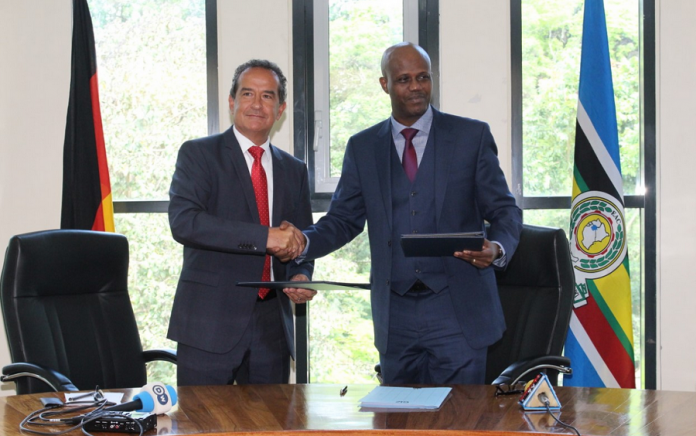
US$4.8b needed for drafting of EAC political confederation constitution

President Museveni launched national consultations for EAC Political Conferderation Constitution

The EAC Secretary General Amb. Liberat Mfumukeko days ago said the drafting of the East African Community (EAC) Political Confederation Constitution requires US$4.8 billion (about Shs17.760 trillion)

“It is an expensive project requiring substantial financial investment. So far, we have been behind the schedules in the process due to insufficient financial allocation for this project. In our estimation, the process of drafting the Constitution will require resources to the tune of US$4.8 billion,” Mfumukeko said on Monday at the launch of the National Stakeholders Consultations in Entebbe.

The SG urged the Summit of EAC Heads of State to consider a special funding arrangement to enable the completion of the project in good time, adding that the National Stakeholders Consultations would ensure participation of EAC citizens in the integration process and particularly the Political Federation pillar.

“The drafting of the EAC Political Confederation is being undertaken by a team of Constitutional Experts nominated by the Partner States. The 18-member team is chaired by Justice Dr. Benjamin Odoki, the Chief Justice Emeritus of the Uganda. He said the Confederation Constitution development process was projected to be completed in 2022 with its adoption by the Summit.

President Yoweri Kaguta Museveni who was chosen by his EAC peers to spearhead the drafting of the constitution launched the National Stakeholders Consultations in Entebbe.

He underscored the importance of the EAC attaining a Political Federation, adding that the Political Confederation was a transitional model to the Political Federation as enshrined in the Treaty for the Establishment of the EAC.

Museveni said that the Political Federation would re-energise efforts to promote the prosperity of all East Africans which can be attained through trade and economic growth.

He said that the Political Federation would also guarantee the strategic security of smaller member countries of the Community against external threats.He further cited fraternity of all East Africans noting that the peoples of the East African region share similar cultures, languages and origins with Kiswahili as a lingua franca.

Justice (retired) Odoki, disclosed that the team had already completed a comprehensive study of various confederations around the world for purposes of appreciating the concept and practice of confederations.

Odoki further said that the team had also finalised a study and analysing of the EAC establishment.

The Political Federation is the fourth and ultimate pillar in the EAC integration process after the Customs Union, the Common Market and the East African Monetary Union. In May 2017, the Summit of EAC Heads of State agreed on the Political Confederation as a transitional model to the Political Federation.

In February 2018, the Summit through the Council of Ministers constituted a team of 18 Constitutional Experts and Legislative Draftspersons to draft a Constitution for the Political Confederation. The team was tasked with developing a Draft Constitution for consideration by the Summit. At its 20th Ordinary Meeting held in Arusha, Tanzania in February 2019, the Summit requested the team to provide it with a preliminary report by November 2019.

Stories Continues after ad

Africa: Urgent action needed to mobilise domestic resources as tax revenues plateau

Africa needs to boost tax collection efforts in order to fund development

The average tax-to-GDP ratio for the 26 countries participating in the new edition of Revenue Statistics in Africa was unchanged at 17.2 percent for the third consecutive year in 2017. This was lower than the averages for Latin America and the Caribbean (LAC) at 22.8 percent and for the OECD at 34.2 percent, underlining the need for urgent action to enhance domestic revenue mobilisation in Africa.

The 26 countries covered in Revenue Statistics in Africa 2019, released Tuesday in Tunis at the African Union’s 13th Session of the Committee of Directors-General of National Statistics Offices, represent nearly three-quarters of Africa’s GDP. The report shows that tax-to-GDP ratios varied widely across these countries in 2017, ranging from 5.7 percent in Nigeria to 31.5 percent in the Seychelles. This fourth edition has grown from 21 to 26 countries and includes Equatorial Guinea, Madagascar, Mauritania, Nigeria and the Seychelles for the first time.

While tax revenues plateaued as a percentage of GDP for the Africa (26) in 2017, non-tax revenues (primarily rents and royalties from natural resources, as well as grants) continued to decline and were lower than tax revenues in all but three of the 26 countries: Botswana, the Republic of the Congo and Equatorial Guinea. Between 2010 and 2017, an increase in tax revenues equivalent to 1.9 percent of GDP on average was offset by a decline in non-tax revenues from 7.5 percent of GDP to 5.7 percent of GDP.

African economies continue to rely heavily on taxes on goods and services, which accounted for 53.7percent of total tax revenues across the 26 countries. Within this category, value-added taxes (VAT) accounted for 29.4 percent of total tax revenues. Meanwhile, corporate income taxes (CIT) generated 18.6 percent of total tax revenues – a higher proportion than in LAC and in the OECD – and were equivalent to 2.8 percent of GDP in 2017. This is the same level as in 2016, halting the decline in CIT as a percentage of GDP since 2013.

Overall, the tax structure across participating countries has evolved over the past decade, with VAT and personal income tax (PIT) accounting for a higher proportion of revenue generation in 2017 relative to 2008, on average. However, PIT (15.4 percent of total tax revenues) and social security contributions (8.1 percent of total tax revenues) remain low in Africa. Reforms to broaden the personal tax base, remove harmful and regressive subsidies, and expand social insurance coverage can assist in domestic resource mobilisation efforts while contributing to inclusive growth.

Enhancing the efficiency of VAT systems can also provide higher and more sustainable revenues, and improve distributional or environmental outcomes. Environmental taxes are found to represent a small but increasing share of tax revenues in Africa and can have an important role in raising revenues and encouraging the transition to a low-carbon economy. Property taxes are shown to be much lower in Africa than in LAC and in the OECD but have the potential to play a key role in funding better local services. Equally, improvements in governance and spending may also lead to higher revenues by improving tax morale and making citizens more willing to pay taxes.

A special feature assesses the potential impact of the African Continental Free Trade Area (AfCFTA) on the level and structure of tax revenues, drawing on the detailed data on these revenues in this report. While AfCFTA is likely to strengthen Africa’s economic growth and increase tax revenues in the medium-to-long term, the elimination of taxes on trade within the region will likely reduce revenues in the short term. Trade taxes accounted for 11.8 percent of total taxation on average in 2017 across the 26 countries in this report.  Low-income and least developed countries in the region tend to rely more on trade taxes and are more vulnerable to the short-term impact of reduced trade taxes, underlining the importance of the flexibility mechanisms envisaged by the AfCFTA.

Revenue Statistics in Africa is a joint initiative between the African Tax Administration Forum (ATAF), the African Union Commission (AUC) and the Organisation for Economic Co-operation and Development (OECD) and its Development Centre, with the technical support of the African Development Bank (AfDB), the World Customs Organisation (WCO) and the Cercle de Réflexion et d’Échange des Dirigeants des Administrations fiscales (CREDAF) and the financial support of the European Union.

The topic covers countries of; Botswana, Burkina Faso, Cabo Verde, Cameroon, Republic of the Congo, Democratic Republic of the Congo, Côte d’Ivoire, Egypt, Equatorial Guinea, Eswatini, Ghana, Kenya, Madagascar, Mali, Mauritania, Mauritius, Morocco, Niger, Nigeria, Rwanda, Senegal, Seychelles, South Africa, Togo, Tunisia and Uganda.

Stories Continues after ad

Six technology trends will spawn countless new ventures

Martin Zwilling

By Martin Zwilling

A tidal wave of valuable data is surging from the Internet and connected devices today, and the volume is growing exponentially each year. It’s enough to drown any business which tries to fight it or ignore it, and it’s an opportunity to ride higher and faster than even the successes of Google and Facebook, for those startups that use it as their driving force.

Per the latest study by networking giant Cisco, the world’s yearly mobile data traffic has grown 17-fold over the past 5 years, reaching 11.5 exabytes per month at the end of 2017, of which more than half was video. According to the classic book “Data Crush,” by Christopher Surdak, data in all formats will soon be the largest source of new opportunities for startups, or death.

According to what I see, as outlined by Surdak, this data surge is being driven by the following six technological and social trends:

Mobility: smartphones, tablets, and the “Internet of things.” Smartphone penetration in the U.S. exceeds 80 percent of all mobile phone owners, and these generate more data from their non-phone functions than voice. In addition, more people now own cell phones than toothbrushes. All devices are becoming self-aware and Internet connected.

Virtual living: the rise and growing dominance of social media. Facebook has created an environment where millions of people can hold billions of conversations with people and companies, transforming how people expect to interact with each other and the world. For startups, this is an engagement opportunity worth billions of dollars.

Digital commerce: infinite options for buying goods and services online. Data-enabled shopping has completely changed our purchasing experience, has undermined some of the greatest brand names, and has created some new brands, like Amazon, that now dominate. There is still infinite room for new startup sales modes and models.

Online entertainment: millions of channels, billions of actors. With the adoption of the Internet, digital entertainment has rocketed across the world, changing how people entertain themselves. YouTube is now the 800-pound gorilla of entertainment. Online gaming has moved from the geeks to the mainstream. The audience is now the actors.

Cloud computing: the death of dedicated infrastructure. More and more company and personal services are being virtualized to the Cloud. Many companies are already seeing their computing costs drop by thirty percent as they move in this direction, providing new startup opportunities with the Everything as a Service (EaaS) trend.

Big data:” learning from the flood. Big data is mining the storage for knowledge. This gives rise to the personalization and customization that we all want. Analytics will soon drive nearly all business decisions for any company that wants to remain relevant to its customers. Startups are in the best position to provide the analytics, and use them first.

As an entrepreneur, what steps can you take to help your business not only survive the data hurricane, but to thrive under these new and challenging conditions? Surdak emphasizes that the goal is to either mitigate some of the pressure caused by data growth or to put that pressure to work for you in growing your startup and remaining competitive:

  • Focus: play to your strengths. Determine your core business strategy and resolve to remain true to it. Make strategic versus opportunistic decisions.
  • Accelerate: speed is life in this new world. Look for and reward quantum changes, like cutting cycle time in half, in your processes, products, and services.
  • Data enable: use metrics and measurements. Extend data metrics into non-traditional channels, such as email, internal social media, and customer collaboration platforms.
  • Quantification: big data, bigger results, and controls. Startups should seek to continually improve performance through statistical analysis and predictive monitoring.
  • Gamify: engagement to get what you pay for. Use internal collaboration platforms, then extend to online customers through your website, blogs, and social media.
  • Crowdsource: putting your audience to work beyond customers. Look beyond today’s requirements for entire new market opportunities.

You need to start now to understand the trends and specifics of the information tidal wave that is building up in front of us. Use the steps outlined here to stay ahead of it, and use its power to propel your startup into the future, ahead of your competition. The possibilities are endless, but the downside will be painful.

The Writer is Veteran startup mentor, executive, blogger, author, tech professional, professor, and investor. Published on Forbes, Entrepreneur, Inc, Huffington Post, etc.

Stories Continues after ad