Stanbic Bank
Stanbic Bank
18.9 C
Kampala
Stanbic Bank
Stanbic Bank
Home Blog Page 1146

UPL Awards: Bamweyana, Bayo are September’s best

The first Uganda Premier League monthly awards for the 2019/20 season took place today morning at Kati Kati Restaurant off Logogo By-Pass in Kampala.

Vipers SC forward Fahad Bayo was named the Pilsner player of the month while Maroons manager Douglas Bamweyana was crowned coach for the month of September.

Bayo beat SC Villa Jogoo midfielder David Owori and Maroons forward Steven Mukwala to the prize.

The forward scored three goals in the two games played during the month, the winner against Tooro United and then a brace in their two-all draw against Mbarara city.

Maroons head coach Bamweyana beat his replacement at SC Villa coach Edward Kaziba to the award. He picked up two wins, against Kyetume 1-0, and Tooro United 2-0 away before losing to Bright Stars 3-2 in their other game.

Both Bayo and bamweyana walked away with a reward of one million Ugandan shillings each.

Pilsner Lager signed a partnership deal last season with the StarTimes Uganda Premier League to award the competition’s best players and coaches for the next three years.

The awards are named ‘Pilsner man of the match award’ and the monthly awards named ‘Pilsner player of the month award’ and ‘Pilsner coach of the month award’.

The Pilsner man of the match walks away with one hundred thousand shillings (Ugx 100,000) after every match.

Attachments area

Stories Continues after ad

Rwanda Tourism under attack as 14 are killed

Seeing Gorillas in Rwanda could mean to be under attack by terrorists. A popular tourist district in Rwanda was a scene of terror on Friday. The region  is popular with tourists visiting nearby Volcanoes National Park to see gorillas. It is not yet known whether tourists were among those killed. Eighteen Rwandans were wounded.

Rwandan police say 19 attackers have been killed and others are on the run after their assault on a popular tourist area killed at least 14 people over the weekend in the Rwanda district of Muszanze. The CCSCR is sounding the alarm about the Rwandan government’s tendency to make unarmed civilians the human shields

National police spokesman John Bosco Kabera said in a statement late Sunday that five other attackers have been arrested after the assault on Friday in Musanze district near the Congo border.

Dozens of rebel groups are active in mineral-rich eastern Congo, and the Rwandan district has been attacked repeatedly in the past. The Rwanda Development Board, which promotes tourism, says in a statement that order has been restored in the area.

Stories Continues after ad

Minister urges universities to emulate KIU curriculum

Dr. Chrysostom Muyingo

The State Minister for Higher Education Dr. John Chrysostom Muyingo has urged various Universities in the country to emulate the advancements of curriculum in research department at Kampala International University (KIU).

The minister raised the call during the 9th Uganda Vice Chancellors’ forum conference, which was held at KIU’s library under the theme; higher education.

The conference gathered University Vice Chancellors, Deputy Vice Chancellors, and other different heads of tertiary institutions across the country to brainstorm on issues concerning higher education in Uganda, and drafting of resolutions to foster the sustainability of research and quality education in the country.

According to the minister, the core value of a University is to be an actor in helping the state in problem solving by producing graduates of value.

“The Universities that we have are supposed to be addressing problems of Ugandans. Unfortunately, problems have persisted because Universities these days serve the interests of those who pay the money and forget their core role in the society,” said the minister.

Before the minister’s address in the conference, a debate on Dr. A. B. Kosozi’s and Professor John Mugisha’s presentations on the quality of education in higher levels of learning sparked different reactions on the way forward in shaping the future of learning from theory to practically solution seeking.

Dr. Ssengozi Bagenda from African Rural University in Uganda said the declining number of people holding PHDs is one of the major reasons the education system is not producing solution based graduates.

“if we had many of these people, they would document different findings that are rooted in solving problems in our community,” said Ssengozi.

He raised an opinion that Universities should collaborate in different fields to fasten the amount of people who get PHD qualifications.

Mr John B. Alege, the Dean for School of Public Health at Clarke International University backed up Dr. Ssengozi’s idea by calling for a collaborative approach amongst Universities in Uganda.

“Many of our Universities don’t have partnerships among ourselves. That is a major point of weakness we should work upon,” said Alege.

He said in order for a country to achieve an increased number of higher level scholars, partnerships in mentorship should be prioritised locally even before considering having partnerships with other Universities in the overseas.

The KIU Vice Chancellor, Dr. mouhamad Mpezamihigo said that however much having partnerships amongst Universities is a good idea, there is need for the National Council for Higher Education and the Ministry of Education and Sports to draft accommodative regulations that permit partnerships.

“I feel that in order for us to beat specific target of the number of quality PHDs, we need an enabling environment that allows collaboration of Universities in producing them,” said mpezamihigo.

The conference resolved to involve all stakeholders in national planning, Government continues investing in research, Universities should have their specific Law / Actand Government change the way university education is funded.

They are also decided to Make Makerere a Postgraduate Research Based University, Government should assist universities to create more PhDsEducation structure be examined in relation to A level and Higher education should be relevant to national development.

Stories Continues after ad

Tourism sector vital for EAC – legislators say as they call for embrace of single tourism visa

Despite the significant contribution of the tourism sector in region’s economic growth, provision of employment and poverty reduction, certain overriding challenges that include sector underfunding, insecurity, lack of harmonized policies and laws, among others, need to be speedily addressed, the East African Legislative Assembly has said. A report of the Assembly on the Oversight activity on the Performance of the Tourism Sector in the region, wants the EAC to fastrack the conclusion of the EAC Protocol on Tourism and Wildlife Management, as well as in strengthening a pool of EAC Classification Assessors to ensure efficiency and effectiveness in classification of tourism establishment.

The Assembly is also reiterating creation of a well-coordinated and digitized information exchange hub for the advancement of joint tourist visa mechanism in a bid to attract tourists in the region.  Mary Mugyenyi who presented the report to the House further said it was necessary for the Partner States to harmonise their national laws on tourism and related sectors.   The EAC Council of Ministers is further urged to follow up with the Republics of Burundi and South Sudan and the United Republic of Tanzania to join the EAC Single Tourist Visa.

According to the Report, EAC tourism arrivals have increased from 3.5 million persons in 2006 to 5.7 million persons in 2017. However, this is still substantially low given that it represents only 8.6% of the Africa market share and 0.3% of the global market share. Tourism contributed to the Gross Domestic Product of the EAC Partner States by an average of 8.8% in 2017. The percentage contribution was higher than the average in Rwanda (12.7%), Kenya (9.7%) and Tanzania (9.0%). Tourism contributes an average of 18.8% to EAC total exports, although the percentage contribution was higher, in Rwanda (30.5%) and Tanzania (26%).

In the Partner States, the report makes interesting findings – that include a number of achievements and challenges.   In Burundi, the report states the country has 126 tourist sites of which 57% are tangible cultural heritage aspects and 32% are natural heritage aspects. The weather is deemed as favorable while the culture is rich. The country further portrays rich African cuisine and culinary culture. Areas to be enhanced in the tourism sector include, development of infrastructure in all provinces; re-classification of hotel and categorization of accommodation in Burundi.

In Kenya, the country has instituted a number of strategies that include development of tourism policies to support expansion of the tourism sector and a provision of charter incentives to enhance travel have been instituted. The country’s major activities include holiday travel (68%), business travel (18%) and transit (14%). Tourism sector registered improved performance in 2018, mainly attributed to growth of aviation, investors’ confidence, withdrawal of travel advisories, visits by foreign dignitaries and revitalized marketing efforts. The challenges for the Republic of Kenya include globalization which is leading to creation of uniform standards and protocols and the heavy taxation of the sector among others.

The Republic of South Sudan on its part, is endowed with a unique and diverse tourist attraction including the massive wildlife migration at Boma and Badigilo National Parks, considered second to the annual Serengeti-Maasai Mara animal migration. The report cites challenges including; infrastructure, insecurity caused by political instability, poverty and unemployment; inadequacy of data and research and lack of relevant policies and laws to regulate the sector.

The Tourism industry is a strategic priority for Rwanda and has been fundamental in the transformation and modernization of the national economy. Tourism continues to be a leading foreign exchange earner since 2007. The tourist attractions in Rwanda include wildlife protected areas, Akagera national park, Nyungwe national park and various reserves and sanctuaries, lakes, rivers and swamps. Notable challenges include over-reliance and dependency on the gorilla product as a major source of tourism revenue and the need for enhanced marketing as a wildlife, eco-tourism, cultural and conference destination.

Republic of Uganda, the report says, has branded itself as “Gifted by Nature” with many tourist attractions including wildlife, nature, geography, culture, heritage and good weather all the year around. Tourists sites in Uganda, include the source of the Nile, the Mount Rwenzori, Mount Elgon, Mugahinga, and Kigulu hills. The Equator, Bishop Hannington site, hot springs, handicraft and souvenir development, marine tourism and sport tourism are also major tourist attractions.

Uganda witnessed a 7.4% increase in international tourist arrivals in 2018, with the numbers growing from 1,402,409 persons in 2017 to 1,506,669 persons in 2018. Direct revenue from international tourism rose from US$ 1.453 billion in 2017 to US$1.6 billion in 2018. The challenges that affect tourist sector in Uganda include weak capacity in terms of instructional infrastructure for training manpower and human resource and inadequate funding.

At debate time, Dr Abdulla Makame said there was need to consolidate the tourism industry in order to spur revenue, saying the sector would promote the region and create direct and indirect employment. The legislator called for the speedy conclusion of the Protocol on Tourism and Wildlife. Hon Leontine Nzeyimana, said tourism was a major revenue earner for the region. Hon Fatuma Ndangiza said with innovation and focus, the region can truly benefit from the sector.

Abdikadir Aden rallied for the implementation of the single tourism visa saying a mechanism for revenue sharing was long overdue. The legislator rallied for enhancement of local tourism saying the region needs to make it easy for East Africans to freely enjoy the tourist attractions.

Kennedy Mukulia said there was need to revive the East African Airlines to tap the revenue from the tourism sector. The Member said security was paramount for the region and called on authorities to be vigilant and ensure tourists coming in to the region abide with existing laws and regulations. Dennis Namaara said intra-competition amongst the Partner States led to situation where the region loses comparative advantage through marketing.

Others who supported the report include Pierre Celestin Rwigema, Hon Josephine Lemoyan, Hon Dr Woda Jeremiah, Hon Fatuma Ibrahim, Hon Jean Marie Muhirwa, Hon Marie Claire Burikukiye, Hon Dr Ngwaru Maghembe, Hon Oda Gasinzigwa, Hon Rose Akol and Hon Dr Damas Ndumbaro, Deputy Minister, Ministry of Foreign Affairs and EAC, United Republic of Tanzania.

Cabinet Secretary, Ministry of EAC, Kenya, Hon Adan Mohammed, thanked the Committee for an elaborate report and said the region needed to focus more on connectivity to spur tourism, convenience. The Minister said natural endowments were necessary – but said in other places, products can be created and marketed to spur tourism. He called for more focus on local and domestic tourism. In Kenya, the Cabinet Secretary said bed occupancy at the Coast region were significantly lower until government and private sector deliberately put efforts to market the coastline.

The Chair of Council of Ministers,  Olivier Nduhungirehe, said Council of Ministers will duly implement the report. He informed the House that Council of Ministers would engage the Sectoral Council on Tourism and Wildlife to address the emanating challenges.   Similarly, he said all citizens of the region would as necessitated by the Community, pay same rates for hotels and national parks as nationals of the Partner States.

Stories Continues after ad

50 Million African Women Speak Project to launch networking Platform

The EAC convened a 5-day content harmonisation workshop for the three regional economic blocs implementing the 50 Million African Women Speak (50MAWS) project, EAC, EACOWAS and COMESA. The workshop, hosted in Moshi, Tanzania, was convened in preparation for the launch of the 50MAWS Networking Platform planned for November 2019.

Officiating the workshop, EAC Deputy Secretary General in charge of Productive and Social Sectors, Christophe Bazivamo commended the collaboration between EAC, ECOWAS, and COMESA, and the commitment by each party in pushing the agenda of women economic empowerment in the continent.

Bazivamo noted that the implementation of the EAC Customs Union and Common Market Protocols have enhanced trade and investment in the EAC region. “The Community is currently working hard to come up with a single currency for daily transactions within the Community as well as build a super-state under a political federation,” he added.

The Deputy Secretary General stated that while many efforts and initiatives where in place to better facilitate women in business, the 50 Million African Women Speak Networking Platform is coming in to complement these efforts.

He called upon the implementing partners of the project to strive to address the needs of women, and men, in business in the continent, by identifying which sectors employ most people in Africa and what their information needs are.

“The agriculture sector contributes an estimated 30% of the national GDP in Africa. More than 80% of the African population is engaged in the agriculture sector, and 55% are women,” Hon. Bazivamo noted.

He stated that the EAC region has seen an increase in industries in recent years, and an estimated 80% of these new industries are mainly in agro-processing, agriculture inputs and others along the agriculture value chain.

“Agriculture accounts for 65% of the East African Community intra-regional trade in the form of agriculture products; either outputs or inputs,” Bazivamo stressedThe Deputy Secretary General also called upon EAC, ECOWAC and COMESA to take full advantage of the digital era in facilitating access to commercially viable information.

According to him, there is a need to device strategizes that will pave way for effective utilization of information technologies in promoting innovation, investment and sustainable economic development as the African continent was still lagging behind in the domain of technology.

Attending the workshop were EAC Director of Social Sectors, Ms Mary Makoffu, and members of the EAC, ECOWAS and COMESA project implementation units.

Stories Continues after ad

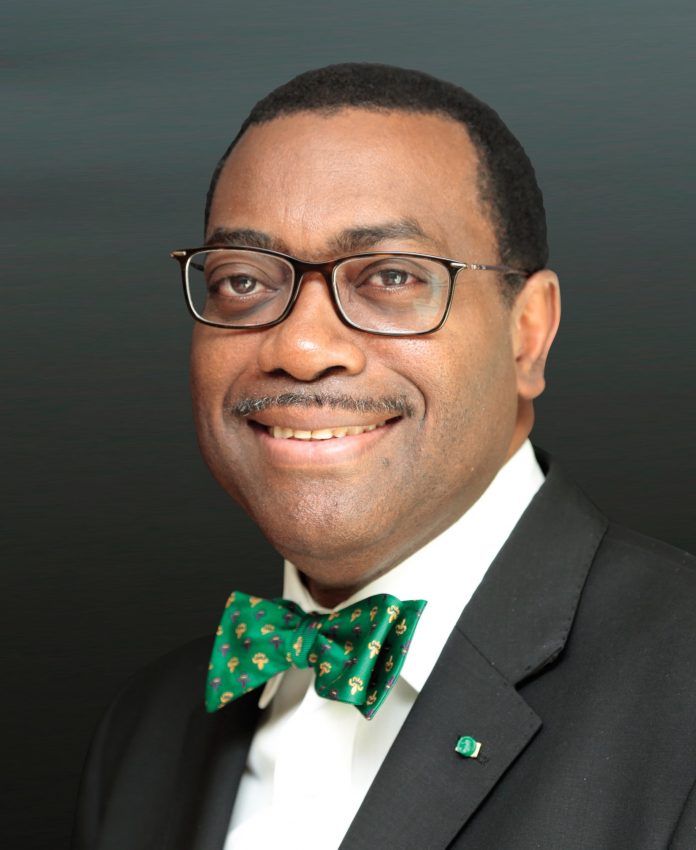
AfDB approves loans of €209m for expansion of ‘Great North Road’

The African Development Bank (AfDB) has approved loans of around €209 million to fund the expansion of a highway that links major economic hubs in Kenya.

The approval was granted days ago during a meeting at the Bank’s headquarters in Abidjan.

The total project cost is €257.68 million, of which €178.02 million (69%) will be financed by the Bank Group, while 12% will come from the Africa Growing Together Fund, set up by the Bank and the People’s Bank of China in 2014. The remaining 19% will be financed by the Kenyan government.

The five-year project will convert the 84km Kenol–Sagana–Marua Road in central and eastern Kenya from a two-way single carriageway into a dual bypass, and is due for completion in 2025. The new road will enhance traffic flow between the port city of Mombasa and major centres like Nairobi. It will also ease transport between Nairobi and the Mount Kenya region; and ultimately Ethiopia.

The current Kenol–Sagana–Marua Road is situated along the “Great North Road”, which forms part of the 800km stretch between Nairobi and Moyale and runs across the five counties of Muranga, Kirinyaga, Machakos, Embu and Nyeri.

Kenol–Sagana–Marua Road is also part of the Trans-Africa Highway, commonly known as the Cape to Cairo route.

According to a project report, about 1.15 million people will benefit from the upgraded highway. 44% of the beneficiaries are likely to be women. The beneficiaries include producers, manufacturers and traders, who will save time and money, thanks to improved access on the main corridor to the north.

Building a 21st century road must also take into account climate change, which often leads to road runoff, flooding and erosion. In order to counter these phenomena, trees will be planted in the surrounding area. The project is part of broader government efforts to improve the country’s infrastructure, including the construction of 1,304 km of new roads in recent years. The Bank’s present portfolio in Kenya consists of 38 operations, totaling around $3.3 billion.

Stories Continues after ad

EALA call urges Council of Ministers to fasttrack remittances to remedy bad financial situation

National flags for some of member states of EAC

The East African Legislative Assembly (EALA) once again wants the East African Community Council of Ministers to address the dire financial crisis, the regional bloc is in.  Critical to the matter is the need for all Partner States to duly remit their financial obligations in a timely manner and fashion. Particularly, the Assembly has recommended that the Council of Ministers should consider invoking Article 143 or 146 to impose sanctions against Partner States that default on payment. Particularly, one Partner State, the Republic of South Sudan is been urged to comply by end of October 2019.

As the matter came under scrutiny, the House commended the Republic of Uganda for honouring its contribution for the Financial Year 2019/20 to the tune on 72% as at October 2nd 2019. EALA urged other Partner States to emulate the Republic of Uganda by complying with regulation 23(5) of EAC Financial Rules and Regulations.  Consequently, EALA also wants the Alternative Financing Mechanism finalized and effected and a reconsideration and removal of the zero budget increase ceilings.

The Assembly’s debate follows a petition filed by the regional Civil Society Organizations under the aegis of the East African Civil Society Organizations Forum (EACSOF).  EACSOF had in the petition made a number of prayers for consideration by the Assembly on matters it deemed of concern to itself and citizens of the region.  The petition signed by acting Executive Director, Martha Makenge, avers two critical matters; on the implementation of the budget of the EAC after being passed by EALA and assented to by the Summit and on the implementation of the Customs Union and the Common Market Protocols with specific focus on implementation of Article 24 of the Customs Union Protocol (on the EAC Trade Remedies Committee).

Chief among the prayers of the petition signed by the Acting Executive Director, Martha Makenge, was for Council of Ministers to recommend to the Summit of EAC Heads of State to invoke article 143 and 146 on Partner States that have met the criteria of activation of that particular article. The EACSOF is further considering filing a legal suit with the East African Court of Justice (EACJ) on interpretation of Article 143 of the Treaty and why it has not been invoked in such circumstances that are detrimental to EAC”, the petition reads in part.

EACSOF further tasked the Assembly in its petition to question the Council of Ministers as to why some Partner States had not cleared the arrears of 2018/19 and that until the first quarter of 2019/20, there were yet to be any remittances. The petitioners therefore sought clarification to know if the failures to pay were tantamount to display of no commitment to the integration process.

The EACSOF Chief Executive further remarked that as the first quarter of 2019/20, only the Republics of Rwanda and Uganda had remitted their dues for the Financial Year 2019/20.  The petitioners are therefore concerned if the inaction of the other Partner States, whose remittances were yet to be received as at today, was an indication of less commitment to the integration process.

The petition also questions the Office of the EAC Secretary General on the actions taken with regards to remittances and implementation of Article 24 of the Customs Union Protocol; and why no public statement(s) with regards to those two matters have been undertaken.

The petitioners informed the Assembly of their constant follow-up of issues of interest to themselves.

On implementation of the Customs Union and Common Market Protocols, the EACSOF raised the fact the sustained existence of Technical Barriers to Trade (TBTs) and Non-Tariff Barriers (NTBs) was duly affecting trade.

“EACSOF has been constantly following up the integration process of the EAC, with particular interest of observing the implementation of the EAC Treaty, Protocols, Laws developed in EALA as well as Policies, Strategies, Plans and Programs,” Mrs Makenge said in the petition.

Upon receipt of the petition, EALA Speaker, Martin Ngoga, forwarded the same to the Committee on General Purpose as stipulated by the Rules of the House. The Committee thereafter interacted with the officials of the EACSOF and the EAC Council of Ministers. The Chairperson of the GPC, Abdikadir Aden then presented the report of the General Purpose Committee on the subject matter as the House got underway.

Makame said the matter of elimination of NTBs was critical and is provided for under the EAC Treaty and the Customs Union Protocol.  “The issue of elimination of NTBs and trade disputes are provided for and the matter is crucial for East Africans to trade and matters to do with trade disputes are resolved,” Makamsaid I am convinced the Council of Ministers has agreed to take remedial measures,”he said.

Maryam Ussi had sought an answer if there was a substantive Council Member from Republic of South Sudan given the prolonged absence of the Minister from the Assembly.  In response, the Speaker declared the matter not applicable for determination as the Minister from South Sudan, was yet to be sworn -in and therefore not subjected to the Rules of the House at this point in time.

Kasamba Mathias said whereas the Community appreciates the remittances of funds due by the Partner States, the consistent delay was worrisome.  He said the current budget performance stands at 59% and wondered whether it was prudent to continue planning for support of 100% of all activities. “We need to find out why the Republic of South Sudan is not paying”, Kasamba said“I support the motion to give them the month-long deadline to show commitment to the integration process. What timelines should we give the Minister for EAC from Republic of South Sudan to be sworn in?” He asked.

Rose Akol said the Community had done a lot to bring peace to the Republic of South Sudan. “I want to commend the South Sudan Chapter of EALA for attempts they have made to make follow-up on the issue of remittancesshe said.  “Due to no funds the Community is failing to honour its obligations,” the legislator said, adding that the Court (East African Court of Justice) was unable to hold its cases – thereby delaying justice.   “With all the provisions of the EAC Treaty, why is there failure on the part of the Council of Ministers to take any course of action?” Akol wondered“If the sanctions are to be in place, then I see a situation where Republic of South Sudan citizens in the Partner States may be in a precarious place with regards to enjoying the accrued benefits.

Kennedy Mukulia appreciated the courtesies so far extended by the EAC to the Republic of South Sudan and said sanctioning was not an option citing the case of Greece crisis in the European Union.  “The Country should be urged to comply,” he said.

Wanjiku Muhia sought to be informed about the level of commitment of the Republic of South Sudan in the Community.  “The matter is nothing personal – but for the good of the EAC, she said. The legislator rallied the EALA to continue with its debate and oversight mandate to ensure the EAC realizes its objectives.  “I plead with the front-bench (Council of Ministers) to give us the answer to unlock the impasse,” she said.

Kim Ghai, said sanctioning the Republic of South Sudan would jeopardise the country’s gains including the quest for peace. He further mentioned that it was important for Members to give South Sudan time. “While South Sudan rejected the option to join the League of Arab nations, it is interested in remaining within the EAC fold. “Sanctioning the country will not solve the problem,” he said.  He recommended that the Chair of the Summit and the Summit Members reach out to the President of the Republic of South Sudan and sort the issue.  The legislator also asked the Council of Ministers to hold the next meeting in Juba and emphasise the need for remittances.

Others who supported the motion were Fancy Nkuhi, George Odongo, Mary Mugyenyi, Fatuma Ibrahim.

In response, Adan Mohamed, Cabinet Secretary, Ministry of EAC Kenya said the Council of Ministers would study the recommendations of the House. He maintained that Council of Ministers expects that a report on the Alternative Funding mechanism shall be on its agenda before the next Summit of EAC Heads of State in November, 2019. The report is also expected to address the current policy of zero budget increase ceiling. “The Council is aware that once concluded, the alternative funding mechanism will be a solution to the financial challenges.  Council will continue directing Partner States to remit the finances in a timely manner,” Mohammed said

The Minister informed the House the Sectoral Council of Ministers responsible for EAC Affairs and Planning at its 24th Meeting directed the EAC Secretary General to make proposals on sanctions that can be imposed on EAC Partner States that breach the Treaty in line with Article 143.

The Secretariat has already prepared a draft Schedule of Sanctions to be applied automatically which are still under consideration. The draft Schedule of Sanctions goes beyond the non-remittance of financial contributions to other breaches of the Treaty,” the Cabinet Secretary stated.

Stories Continues after ad

Crisis after crisis Dfcu bank contradicts self over exit of Sudhir properties

William Sekabembe Dfcu-Bank-Uganda’s-Chief of Business and-Executive Director-William-Sekabembe


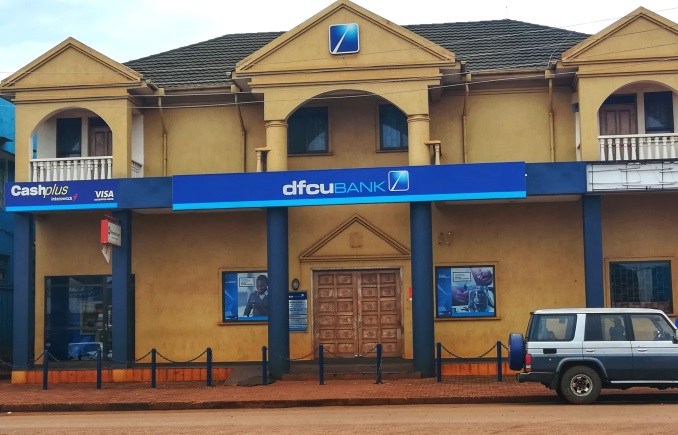
Dfcu bank is in a PR crisis after internal documents leaked indicating, the financial institution was existing branches they had fraudulently taken over from Meera Investment which part of the Ruparelia Group owned by city businessman Sudhir Ruparelia.

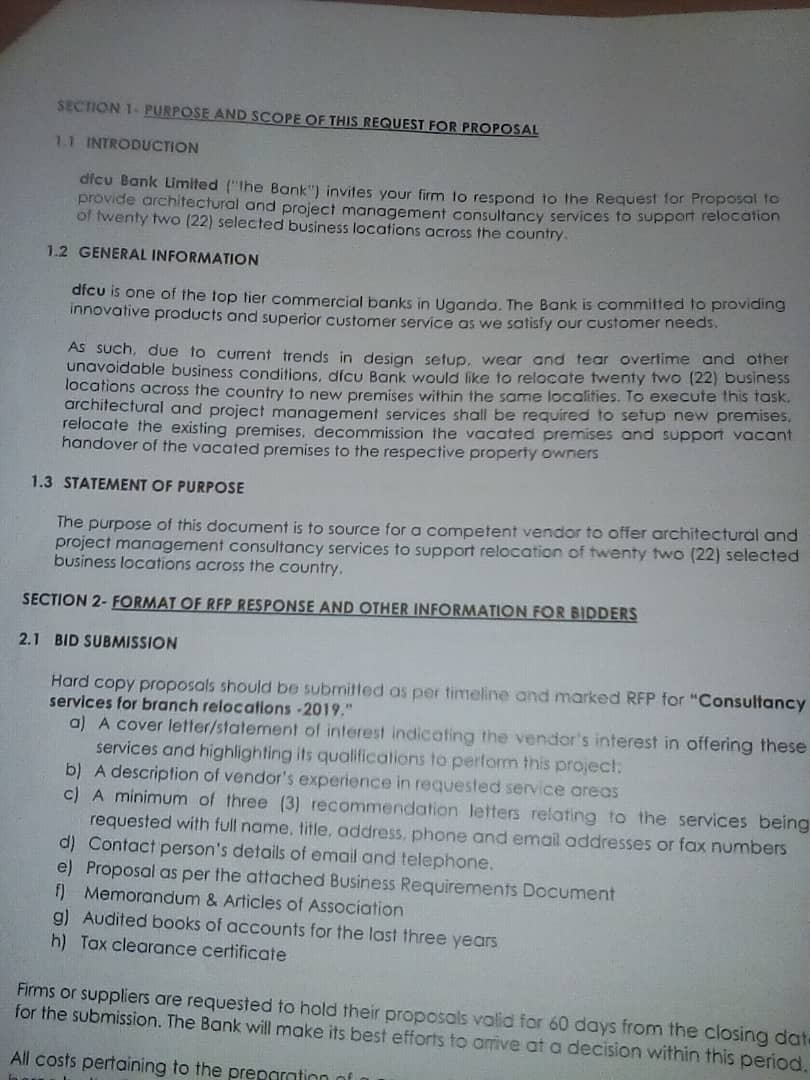
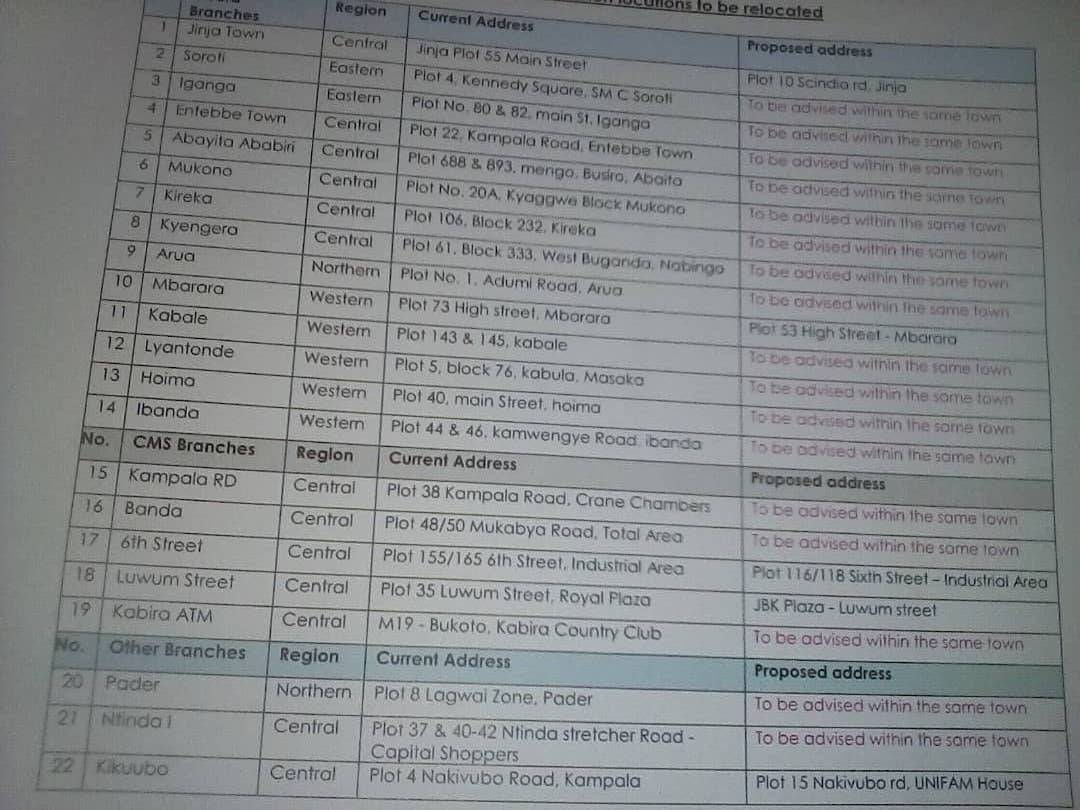
This website exposed a leaked internal document from Dfcu calling for bids to provide for space in areas and districts they currently occupy some of the properties they fraudulently took over after Bank of Uganda sold Crane Bank.

The embattled DFCU Bank has conceded and has decided to vacate all the branches owned by Meera Investments Limited.

Ssekabembe’s denial

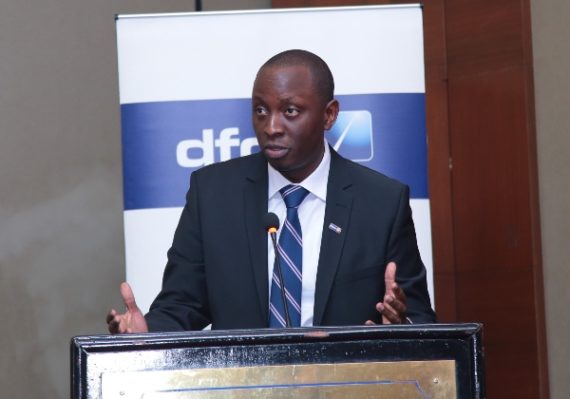
However, in a bid to nip the leaked document and stories afterword, Dfcu bank chief of business and Executive Director William Ssekabembe has gone on defensive saying it is fake news but has declined to comment on the leaked document. Ssekabembe has even hired some of the social media bloggers and other online websites to spin and deny.

“Dfcu bank has a network of 63 branches spread across the country. As we communicated at this year’s annual general meeting in June, the bank is in the process of implementing its digital strategy to drive better customer experience, improve efficiency and align its operations with emerging trends in the financial rationalization of branch operations and redesigning of branch model” reads the statement from Ssekabembe”.

Nevertheless, the statement shows the inconsistencies as it talks about rationalization, digital and agency banking and further rationalization of branches. However, the bank’s statement shows they are moving in the direction of closing a number of branches which Ssekabembe doesn’t want to admit.

Click on the link to read the internal document calling for bidding 

RFP – Consultancy services for relocation of selected dfcu Bank branches 2019 (1)

This website has learnt that the contradiction is as a result of the power struggle between Ssekabembe and Managing Director, Mathias Katamba. It is understood that Katamba is of the view that properties illegal acquired by the bank be returned to Meera Investment since they aren’t part of the Crane Bank but a group led by Ssekabembe who represents views of beneficiaries of the Dfcu-Crane Bank deal are against. Recently Dfcu wrote to Bank of Uganda for guidance on how to handle the issue of branches but BoU hasn’t replied them one month after.

DFCU Bank has called already opened bids for companies that want to provide consultancy services at it seeks to relocate to new areas in various districts and towns across Uganda.

The bank has been operating its business in buildings/properties belonging to Meera Investments Limited since it acquired Crane Bank Limited in 2017.

In August it emerged that the bank was misled by city Law firm Sebalu & Lule Advocates to illegally transfer title properties into its name yet the properties belong to Meera Investments Ltd even though it had leased them to Crane Bank Limited.

According to a leaked dossier, the Sebalu & Lule Advocates who have been barred by court from representing the same bank against city tycoon Sudhir Ruparelia for being conflicted. The law firm misled dfcu Bank to transfer leasehold titles from Crane Bank Ltd during the controversial takeover two years ago.
In a leaked document titled Transfer of former Crane Bank household properties, dated May 8, 2017, “the law firm skipped important aspects of the law including the fact that banks are not allowed to invest in business for fear of conflict of interest with their clients, apart from their main premises” banking analysts say.

“In light of the lengthy of time between the completion of date and when dfcu can vividly exercise the option to rescind the purchase of household properties, our recommendations is that the transfer be registered immediately,” reads an excerpt from the leaked document.

The whole procedure was entangled with fraud as there was no consent from the Landlord (Meera Investment Ltd) before transferring the lease to another party.

“The developments in August nullified the transfer as lack of consent alone nullifies the whole procedure” as ownership belonged to Meera Investment Ltd, an independent


Stories Continues after ad

DFCU Bank in panic as it exits fraudulently acquired Sudhir properties

The embattled DFCU Bank has conceded and has decided to vacate all the branches owned by Meera Investments Limited, which is part of the Ruparelia Group of Companies.

DFCU Bank has called already opened bids for companies that want to provide consultancy services at it seeks to relocate to new areas in various districts and towns across Uganda.

The bank has been operating its business in buildings/properties belonging to Meera Investments Limited since it acquired Crane Bank Limited in 2017.

In August it emerged that the bank was misled by city Law firm Sebalu & Lule Advocates to illegally transfer title properties into its name yet the properties belong to Meera Investments Ltd even though it had leased them to Crane Bank Limited.

According to a leaked dossier, the Sebalu & Lule Advocates who have been barred by court from representing the same bank against city tycoon Sudhir Ruparelia for being conflicted. The law firm misled dfcu Bank to transfer leasehold titles from Crane Bank Ltd during the controversial takeover two years ago.

In a leaked document titled Transfer of former Crane Bank household properties, dated May 8, 2017, “the law firm skipped important aspects of the law including the fact that banks are not allowed to invest in business for fear of conflict of interest with their clients, apart from their main premises” banking analysts say.

“In light of the lengthy of time between the completion of date and when dfcu can vividly exercise the option to rescind the purchase of household properties, our recommendations is that the transfer be registered immediately,” reads an excerpt from the leaked document.

The whole procedure was entangled with fraud as there was no consent from the Landlord (Meera Investment Ltd) before transferring the lease to another party.

“The developments in August nullified the transfer as lack of consent alone nullifies the whole procedure” as ownership belonged to Meera Investment Ltd, an independent

Genesis

The Bank of Uganda on October 20, 2016 closed Crane Bank Ltd, previously one of the best performing banks at Shs 200 billion to DFCU Bank, with the money being paid in installments without interest.

BoU has since come under the spotlight after the closure of seven commercial banks of which Crane Bank Ltd was one of them, with parliament’s committee on Commissions, State Authorities and State Enterprises (COSASE) nt and the Auditor General faulting BoU officials for not following the established guidelines and procedures when closing the bank.

The dfcu Bank which received some of the assets and liabilities of Crane Bank would be allowed to operate in different branches whose ownership belonged to Meera Investments Ltd.

Between 2012 and 2016, Meera leased the 46 properties to Crane Bank on different terms with the leases being duly registered as encumbrances on Meera’s freehold and mailo interest.
The lease titles were subsequently processed and issued to Crane Bank.
Crane Bank agreed to pay US$6,000 as ground rent for each of the properties effective on or before the January 1, of every year to the property owners (Meera Investments).

The lease agreements, court documents show, provided that Meera had the option to review the ground rent after the expiry of three years.

Meera had also agreed with Crane Bank under various lease agreements that in case of any breach, non-performance, or non-observance of what they had agreed on in the lease agreements, it will be lawful for Meera to seek legal redress from court.

“It was further agreed between the plaintiff [Lessor] and Crane Bank [Lessee] that anything done contrary to the terms of the lease agreements would forthwith cease the lessee’s rights or interest in the suit properties without prejudice to the lessor’s entitlement to rent unpaid and due,” Meera claims.
With the agreements in place, on October 20, 2016, BoU took over Crane Bank under statutory management.

On January 24, 2017 Bank of Uganda announced that it had transferred all the assets and liabilities of the bank to dfcu Bank.But this was an illegality where top officials of BoU are said to have benefited financially.

dfcu Bank, which was the new tenant then moved to take over the 46 properties, without the consent of the owners Meera Investments.

“Through a subsequent search at the relevant land registries, the plaintiff (Meera Investments) discovered that; without it’s prior written consent, the first defendant (dfcu), in addition to taking possession of the suit properties, caused the leasehold interest to be transferred into its names and had been registered thereon as the proprietor of the leasehold interest,” Meera Investments sais in their plaint of recovering rent and properties.

They argued that at the execution of the transfers in favour of dfcu and at the time of causing the transfer of the leasehold interest into the names of dfcu, the registration of Meera as the proprietor of the freehold and mailo was and is still intact.

Meera argued that dfcu Bank was aware of this fact or could have ascertained by way of a simple search.

The company also at the time faulted the commissioner land registration for fraudulently going ahead to transfer the leases of the properties to Dfcu without the prior consent of the owners.

“The plaintiff avers that the second defendant (commissioner land registration), [was] well aware of the existing lease agreements and the conditions therein including the requirements for obtaining prior written consent from the plaintiff as the lessor, before any transfer of the leases and parting with possession thereof, nonetheless proceeded to illegally transfer and register the first defendant as lessee of the suit properties, without any consent or authorisation from the plaintiff as required under the various lease agreements,” it argued.

Sebalu & Lule Advocates, claimed Sudhir fraudulently transferred freehold titles of 48 plots of land (where the bank has its branches), purchased and developed using the bank’s finances into the names of Meera Investments from Crane bank.

The plots, according to the court documents, were then reportedly leased to the owner (Crane bank) at UGX100 million premium for 49 years and $6,000 in ground rent per year payable to Meera Investments.

Sudhir has since dismissed the allegations as “presumptuous, speculative and founded on fanciful reasoning.”

He said they do not reflect the market realities of obtaining leasehold titles in Uganda

According to Sudhir, BOU’s allegation that Crane Bank obtained over 14 freehold titles is false since the bank is a “non- citizen,” thus couldn’t hold the land as a freehold owner as stipulated by the Land Act.

As part of Crane Bank’s expansion plan, Sudhir argued, the bank acquired a number of leases with different tenure, some of which were to last just seven years with a commercial view that it was better in the long run to obtain freehold titles in lieu of the said leases.

He added that after Crane bank obtained over 14 freehold titles, it was considered that pursuant to the Land Act, the bank could not hold the land as a freehold owner since it was a non-citizen within the meaning of the Land Act.

Meera has previously asked court to declare that the continued presence of dfcu Bank on its properties amounts to trespass and that they should be ordered to vacate with immediate effect.

Stories Continues after ad

BREAKING: Museveni drops IGG Mulyagonja, sends her to Court of appeal

OUT-IGG-Irene Mulyagonja

President Yoweri Museveni has dropped the Inspector General of Government, justice Irene Mulyagonja and named her justice of Court of Appeal.

Justice Mulyagonja was appointed IGG in April 2012 replacing Justice Faith Mwondha.

Museveni also named Monica Mugenyi kalegira, Muzamiru Kibeedi Mutangula as justices of the same court.

The president also appointed Vincent Emmy Mugabo, Immaculate Busingye, Jane Okuo, Isaac Muwata, Jesse Rugyema Byaruhanga, Isah Serunkuma, Jeanne Rwakakoko and Suzan Abinyo, Esther Nambayo, Victoria Nakintu Nkwanga Katumba,Boniface Wamala and Philip Odoki as justices of the High Court.

Sources within the presidency told Eagle Online that Bugweri County legislator Abdul Katuntu was likely to replace Justice Mulyagonja.

Stories Continues after ad