|
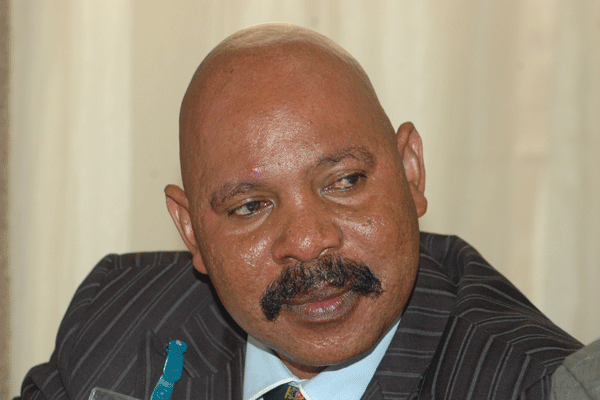
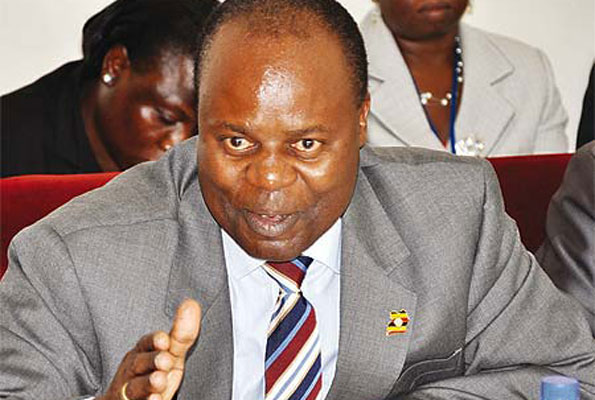
Bank of Uganda (BoU) Deputy Governor Dr Louis Kasekende on Tuesday could hardly explain the disappearance of Shs800 million that was meant to be paid to the Departed Asians Properties Custodian Board (DAPCB) as compensation following the controversial closure of commercial banks. Last week, while interfacing with MPs on the Parliament’s Committee for Commissions, Statutory Authorities and State Enterprises (COSASE), the DAPCB executive secretary, George William Bizibu stated that BoU was yet to compensate the money they had in International Credit Bank before it was closed due to undercapitalisation. MPs demanded to know from Kasekende why DAPCB has not yet received the money yet some shoddy companies and individuals were paid by the government. Kasekende explained that all people and companies were compensated and that he does not remember a claim from DAPCB. “We wrote out information and published in the newspapers asking those who had accounts to come for their money. The Custodian Board should explain why they did not come. According to the information I have, all account holders were paid. Why is this an exception?” he said. However, this did not please the MPs, who demanded to know why BoU compensated some individuals at least twice for non-existent properties. “In Annex C, it is indicated that Plot 7 Kanjokya Street was paid for by the government to two different people with the same amount,” said Samia Bugwe South MP Gideon Onyango, while reading through some of the documents submitted by BoU officials. Kasekende explained that BoU only effected payments acting on the instructions of DAPCB. “The paying agent will not answer those questions. I have not made an audit of how many properties were compensated. The information we are giving you, we got it in our archives,” he stated. The select sub-committee COSASE is investigating circumstances under which properties that were compensated for by government have been grabbed. The Members of Parliament have since asked the government officials who handled the Departed Asians properties to table proof of compensation for each property. The select sub-committee is chaired by Makindye East MP Ibrahim Kasozi.
|
MPs quiz BoU’s Kasekende over compensation of departed Asians’ properties
Global exports in first nine months of coffee year 2018/19 increase 6.5%
|
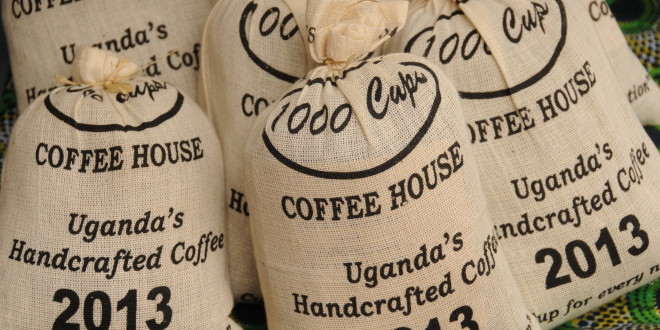
Global exports in the first nine months of coffee year 2018/19 reached 97.28 million bags, an increase of 6.5 per cent compared to the same period one year ago, according to the latest report released by International Coffee Organisation (ICO). According to the report, shipments of Brazilian Naturals rose by 20.6 per cent to 31.12 million bags while Colombian Milds increased by 8.1 per cent to 11.36 million bags. Robusta exports increased by 1.4 percent to 34.45 million bags in October 2018 to June 2019 while Other Milds fell by 3.3 percent to 20.35 million bags. The decrease in Other Milds is driven by India, Mexico, and Costa Rica where exports decreased by 9.2 per cent to 4.69 million bags, by 11.8 per cent to 2.11 million bags, and by 12.3 per cent to 785,601 bags, respectively. In coffee year 2018/19, world production is estimated at 168.77 million bags, with Arabica output, estimated at 103.79 million bags, accounting for 61 per cent and Robusta, estimated at 64.98 million bags, representing 39 per cent of the total. Output in the five largest producers this coffee year would account for 73 per cent of world production. Brazil’s production in crop year ending March 2019 increased by 18.5 per cent to 62.5 million bags, which is reflected in the 20.6 per cent increase in its exports this period, reaching 37.13 million bags. Brazil’s Robusta production has recovered from the previous drought as evidenced by the growth in green Robusta exports. After declining by 72 per cent to 119,146 bags in the first six months of 2017, exports more than tripled to 505,912 bags in January to June 2018 and increased to 1.46 million bags in the first six months of 2019. Brazil’s exports of green Arabica in the first half of 2019 reached 15.86 million bags compared to 12.42 million bags last year. Vietnam’s production is estimated 1.3 percent lower at 30 million bags as adverse weather conditions affected the yield in crop year 2018/19. Despite the reduction, output in 2018/19 would be the second largest volume on record for Vietnam following 2017/18. Its exports in the first nine months of the year declined by 3.9 per cent to 21.1 million bags. Output from Colombia is estimated at 13.95 million bags in 2018/19, 1 per cent higher than last year. According to the National Federation of Coffee Growers, production from October 2018 to June 2019 reached 10.34 million bags, 1.1 per cent lower than the same period in 2017/18. However, exports from Colombia in the first nine months of coffee year 2018/19 amounted to 10.17 million bags, an increase of 7 per cent from last year. Its shipments of soluble exports have grown steadily in recent years. In 2015/16, soluble exports represented around 5 per cent of total exports, while in 2018/19 they represent around 6 per cent. Colombia’s imports in the first half of coffee year 2018/19 increased to 865,024 bags from 288,115 bags during the same period in 2017/18, with imports of green coffee accounting for 95.8 per cent of total imports this year. Indonesia’s production declined by 5.6 per cent to 10.2 million bags in its crop year ending March 2019. Shipments during crop year 2018/19 declined by 33.7 per cent to 5.15 million bags. In addition to the decline in output, steadily increasing consumption has reduced the availability of coffee for exports. Around 75 per cent of Indonesia’s green coffee exports are shipments of green Robusta, which reached 2.06 million bags in the first nine months of the coffee year compared to 2.44 million bags last year. The share of soluble in the total exports has increased from 5.9 per cent in 2010/11 to 20.7 per cent in 2018/19. Total soluble shipments in the first nine months amounted to 749,372 bags. Production in Ethiopia is estimated at 7.5 million bags, 0.6 per cent higher than in crop year 2017/18. While Ethiopia is the world’s fifth largest producer, it is the ninth largest exporter given the high rate of domestic consumption. In 2018/19, Ethiopia’s consumption is estimated at 3.8 million bags, which represents 50.7 per cent of its expected output. Exports in the first nine months of coffee year 2018/19 amounted to 2.47 million bags compared to 2.65 million bags in 2017/18. World coffee consumption is estimated 2.1 per cent higher in coffee year 2018/19 at 164.84 million bags with the largest growth in Asia and Oceania where demand rose by 3.6 per cent to 35.91 million bags. Consumption in Europe has slowed, increasing by 1.5 per cent to 53.97 million bags compared to an increase of 2.1 per cent in 2017/18. However, demand in North America grew by 2.2 per cent to 30.61 million bags. Consumption in South America increased by 1.1 percent to 27.27 million bags, in Africa by 3 per cent to 11.88 million bags, and in Central America and Mexico by 0.2 per cent to 5.21 million bags. Despite this growth, world production is expected to exceed consumption by 3.92 million bags, resulting in a cumulative surplus of 8 million bags over the last two seasons.
|
Kadaga faults international community over refugees
|
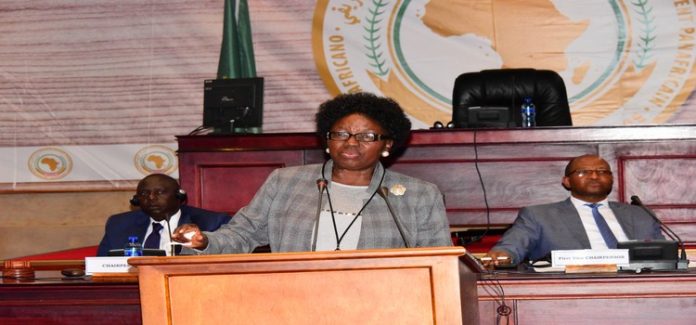
The Speaker of Parliament, Rebecca Kadaga, has criticized the international community for failing to make good their financial contributions to support refugees in Uganda as they had pledged during the Kampala Solidarity Summit on Refugees in 2017. Addressing the 10th Conference of Speakers of African Parliaments and Senates at the Pan-African Parliament in Midrand, South Africa, on Tuesday, 06 August 2019, Kadaga said that of the US$15 million that was projected to be collected at the summit, only US$540,000 was realised. “We had a solidarity summit in Uganda with all the world’s big names and leaders from the biggest economies but it was quite shocking when such leaders pledged very little sums of money and later even failed to fulfil the pledges,” she said. Uganda, being the second biggest refugee hosting country in the world and the first in Africa, was selected to host the refugee summit attended by world leaders and technocrats who included the United Nations Secretary General, Antonio Guterres. The United Nations High Commissioner for Refugees (UNHCR) June 2018 report shows that Africa has the highest number of forced migrants in the world. The continent accounted for nearly one third of the world’s 68 million forced migrants, including 6.3 million refugees and 14.5 million internally displaced persons. Host countries continue to shoulder the responsibility of and facilitating refugees’ access to basic needs. However, this reduces the resources and resilience of the host communities. “Settling of refugees comes with a cost to our people because there is a lot of pressure on the local population to share facilities. In one of our districts of Adjumani, 50 per cent of the population is made up of refugees and so there is pressure on water, schools, health facilities and the environment and this is very costly to the Uganda government,” Kadaga said. Speaker Kadaga requested the UNHCR to build permanent structures such as health centres and schools in the refugee settlements as a stopgap to support host communities that have co-existed with refugees in the event that they leave. Kadaga proposed that for refugee host countries, there should be inter-ministerial coordination mechanisms to bring together the government, international, local and civil society organisations to address the refugee issue from a wider perspective. “I want to confirm that refugees living in Uganda are not in camps but settlements, which gives them freedom of movement, access to social service and employment,” Kadaga told the Speakers. The Speaker of the Algerian Parliament, Slimane Chenine, said the increased armed conflicts on the continent had worsened the refugee problem over the last two years. “To resolve this problem, my country has always proposed a holistic approach that is balanced and will require solidarity based on human rights, sovereignty and national security,” said Chenine. In his presentation, George Kachio, the UNHCR Representative for Southern Africa revealed that over 100,000 Africans leave the continent every year for Europe. Speaking as chief guest, the President of the Inter Parliamentary Union (IPU), Gabriela Cuevas Barron, called on countries of the AU to work together in regard to development, gender equality, youth empowerment, fighting terrorism, climate change, migration and refugees issues. “The safest countries in the world are those practicing democracy. We have the power to change the world and we need to give results to our people,” Barron said and signalled out Kadaga for aggressively advocating for an IPU President that could work with Africa. The two-day Speaker’s conference is being held under the theme, “Finding durable solutions to forced migration to accelerate integration and development in Africa: the role of National and Regional Parliaments. Over 90 per cent of African countries are party to the 1951 Refugee Convention and have passed laws for its implementation.
|
NGOs in danger as minister says many are operating on forged documents
|
The Minister of Internal Affairs, Gen. Jeje Odong has said that a number of Non-Government Organisations (NGOs) in Uganda are operating on forged documents. “The forgeries were either committed intentionally by the NGOs, or by middle men hired by the NGOs to renew the permits and upon failure to meet the renewal requirements, resorted to forging,” he said on Wednesday at the government –owned Uganda Media Centre while addressing journalists. As of July 31, 2019, the National NGO register indicated that there were 14,207 registered NGOs, out of which 3,810 had valid permits, while 10,397 had expired permits. Government has now embarked on a follow up on the NGO Verification non-compliant districts and engaging the Ministry of Local Government. A database for CBOs was developed and the process of updating is on-going. “In order to effectively implement the NGO regulatory framework, there was a need for a verification and validation of the information on NGOs. We’ve now embarked on an NGO verification and validation exercise which is still ongoing,” he said. “Some NGOs that are ignorant of the NGO Verification law. A number of NGOs think that possession of a certificate of registration allows them to operate freely without any requirement to renew,” he said. The minister, said NGO verification will help to determine meaningful relationships, correlations and variations in the data with the NGO Bureau and districts, to ascertain the status of NGOs operating in the Country. This exercise began on the 1st day of November, 2018. He said on 8th April 2019, a communication was sent out to all districts requesting for a copy of the Community Based organizations (CBO) register and NGO inventory. Out of 128, 71 districts submitted their NGO Verification data and 57 did not comply. The Non-Governmental Organizations (NGO) Act 2016 established the National Bureau for NGOs (NGO Bureau) as a semi-autonomous entity under the Ministry of Internal Affairs to replace the National NGO Board. The NGO Bureau is mandated to register, regulate, monitor, inspect, coordinate and oversee NGO operations in the country. A National NGO Register was established in 1989 after establishment of the National NGO Board under the NGO Registration Act Cap 113 of 1989.
|
Chief Justice sets up taskforce to investigate corruption in judiciary
|
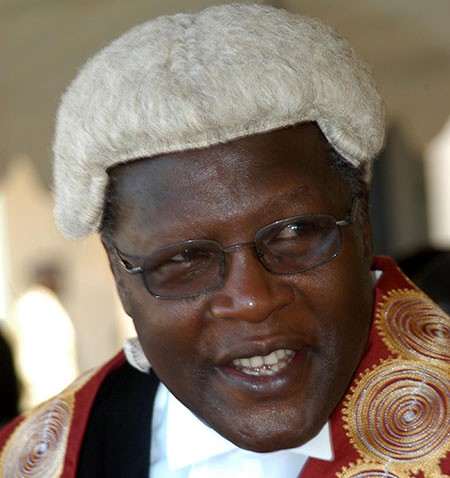
The Chief Justice of Uganda, Bart Katureebe has set up a six- member taskforce to investigation allegations of corruption in the judiciary, one the institutions complained about by Ugandans due to poor service delivery. According to Wednesday’ press release, the team is headed by Ms Immaculate Busingye, the Inspector of Courts. The other committee members include; Vincent Emma Mugabo (Registrar/Public Relations Officer), Susan Abinyo (Registrar/Magistrates Affairs and Data Management), Godfrey Kawesa (President UJOA), Ayebare Tumwebaze (Assistant Registrar in the Office of the Chief Registrar/Projects) and Solomon Muyita (Senior Communications Officer). According to the Office No. 4 of 2019, dated July 30, 2019, the team was tasked to commence work with immediate effect and would report within 60 days even though this deadline could be extended by Katureebe. “Interface with the investigation team of Vision Group to understand the scope and purpose of their on-going project on exposing corruption in the judiciary,” reads one of the terms of reference to the committee. The team will then receive the media recordings with the view of identifying the corrupt staff who will then be invited to have an interface with the investigating team of the court that will make a report to Katureebe on the way forward by September 30, 2019. Any court staff captured receiving the bribe will be dealt with in accordance with the law. “What has been happening is people say they have paid money for court services, but they are usually not willing to bring the evidence to us. We encourage such audits in all courts, and we are willing to do it as a partnership,” Katureebe said, adding that culprits will be handled by the Judicial Service Commission. The Judiciary improved to ninth position in the 2017 Inspector General of Government (IGG) survey with 2.2 percent complaints in corruption complaints received of all sectors considered. This was attributed to the strengthened internal mechanisms of fighting graft in judicial institutions. According to Mr Paul Gadenya the Chief Registrar of Courts, the decline in corruption complaints against the Judiciary then, was a result of strengthening the judicial inspectorate department that deals with complaints against errant judicial officers as well as the case backlog committee that is following up pending cases in the court system to ensure that cases of litigants are resolved in a short period hence translating into very few complaints from the public.
|
Uganda in group B for the CECAFA U15 tournament
|
For the first time in Africa, an U15’s football nations tournament will be played as CECAFA launched the junior regional tourney scheduled to kick off on August 17th. Uganda has been placed in group B alongside Rwanda, Ethiopia & South Sudan. Group A consists of host Eritrea, Kenya, Burundi and Somalia while group C has only three teams – Tanzania, Sudan and Djibouti. The inaugural tournament is to help the region prepare for the Under 17 AFCON qualifiers that start early next year. The team to represent Uganda will be selected from the players at the ongoing Odilo FUFA Football Schools Championships in Njeru. Eritrea will host the tournament from August 17th to September 1st. The event is to be sponsored by the FIFA Forward Programme initiative. CECAFA under -15 Challenge Cup GROUPS GROUP A: Eritrea, Kenya, Burundi, Somalia GROUP B: Uganda, Rwanda, Ethiopia, South Sudan GROUP C: Tanzania, Sudan, Djibouti Uganda’s fixtures: August 17 – Uganda vs. Ethiopia August 20 – South Sudan vs. Uganda August 25 – Uganda vs. Rwanda
|
Standard Chartered launches first social banking solution in Uganda, the SC Keyboard
|
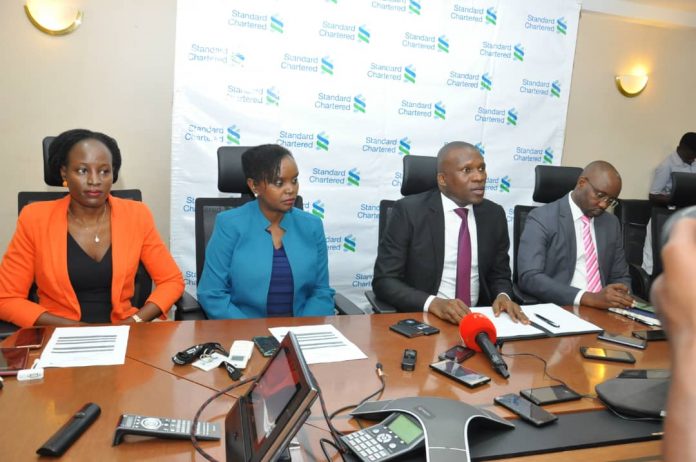
Standard Chartered today announced yet another first banking feature in the Ugandan market. In its continued efforts to meet the rising demands of the country’s young and digitally-savvy population, the Bank has launched the country’s first social banking solution called “SC Keyboard”. The feature, which is part of the Bank’s newly launched Full Digital Bank on Mobile, allows the Bank’s customers to access a variety of financial services from within any social or messaging platform without having to open the Banking app. Being unveiled on the back of the first Digital Bank that was launched at the beginning of the year, the solution is a first for the Bank in Uganda. The keyboard-based banking solution allows clients to transfer money in real-time, pay utility bills and instantly check balances from within any social or messaging platform. The unique digital solution can be configured as the default keyboard on any smartphone, making banking quick and seamless for customers who no longer need to log into their SC Mobile app for basic banking services. Speaking at a press conference to launch the feature, Moses Rutahigwa, the Bank’s Head of Retail Banking, said: “The SC Keyboard is an important milestone in our digital journey. It was designed with our clients in mind, as users can now pay their bills, view their account balances and transfer money to their friends or family through any social or messaging platform, be it WhatsApp, Instagram, Facebook, Messenger or traditional SMS’s. We want our interactions to be simple, intuitive and seamless and we will remain committed to leveraging the best technology to make banking more convenient thereby enhancing customer centricity and service delivery.” The SC Keyboard seamlessly integrates into the keyboard of any smartphone, allowing users to access financial services without having to access (login to) the main App. From within any popular chat application like WhatsApp, Messenger, Twitter, LinkedIn and even traditional SMS, users can check their balances, pay bills or send money to any mobile wallet, without having to exit their chat mode. This feature makes financial transactions more accessible, hassle-free and convenient. The Bank continues to leverage on its Digital Baking Capabilities given the evolution of the banking landscape as more and more users adopt online and mobile banking into their daily financial activities. Rutahigwa further added; “Our clients nowadays expect convenience, affordability, security and the aspect of lifestyle in the banking activities. They want to be able to open accounts wherever they are, and they want to do so speedily. They also expect to be able to perform more than just banking transactions on their online platforms – they want to be able to pay bills, access information on banking and financial trends, and much more. We will, therefore, continue to leverage on our aspiration of being the digital bank with a human touch.” Standard Chartered’s Digital Bank on Mobile serves as the Bank’s digital platform and anchor to SC Keyboard and other future capabilities. It continues to give clients practical and attractive options such as a free ATM card that is delivered to a location of a client’s choosing; an account with no monthly ledger fees and no need to maintain a minimum balance. The App., called the “SC Mobile Uganda App” can be downloaded or upgraded via Playstore or AppStore. To enjoy the seamless and easy access to banking by SC Keyboard, clients need to: · Have an Android or iOS smartphone phone with fingerprint support, install SC Mobile App. and enable SC Keyboard in the device settings and Select SC Keyboard as your default keyboard and start using it
|
Wayne Rooney holds talks with Derby over English return
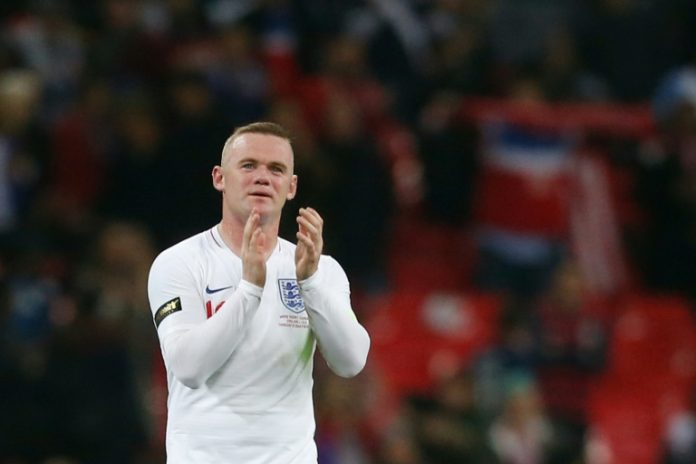
Wayne Rooney could be on his way to Championship side Derby after owner Mel Morris confirmed on Tuesday that the club were attempting to finalise a move for the former England captain.
The 33-year-old has been linked with a player-coach role at Pride Park, where his former England teammate Frank Lampard was given his first opportunity in management last year.
He is under contract at MLS side DC United until the end of the 2021 season but reports suggest his wife Coleen is homesick and has returned to Britain with their children.
Reports of Derby’s interest in the former Manchester United star emerged shortly before the side, under new boss Phillip Cocu, opened their Championship campaign with a 2-1 victory at Huddersfield on Monday.
“It’s literally only been a couple of days in the offing,” Derby owner Mel Morris told Talksport.
“The starting point was that we understood he (Rooney) was keen to return to the UK and we decided to see if we could do something off the back of that.
“It’s never done until it’s done and obviously we are very focused and keen to get this over the line.”
Premier League side Burnley and second-tier West Brom have also reportedly declared an interest in Rooney, who is the record goalscorer for England and United.
Rooney has engineered an upturn in DC United’s fortunes since he arrived from Everton and teammate Steve Birnbaum said he had had a major impact.
“He’s changed everything, he’s changed the culture of the club,” Birnbaum told the Daily Telegraph.
“The work ethic he puts in during practice and you guys see it in the games. We have this sort of confidence or swag going into games because of him.”
Rooney gave short shrift to questions about his future last week.
“Is that what was in the media? That my wife has got her own way?” he told AFP.
“Those reports are a bit far-fetched. I’m concentrating on playing for DC United and trying to get them into the playoffs. I haven’t thought about anything beyond that.”
Rooney has made no secret of his desire to move into coaching following contempories including Ryan Giggs, John Terry, Steven Gerrard and Phil Neville.
“Coaching is something which I have thought about for a long time,” Rooney said.
“I’m in the process now of going through my badges. It would be a shame for me to finish playing and just walk away from the game.
“I have a desire to go into management and hopefully the right opportunity will come up.”
Local telecoms to bring airtime services closer to customers
|
The telecom service providers, Africell Uganda and MTN Uganda have partnered to bring airtime services closer to the former’s customers. Under the partnership, Africell Uganda’s customers will be topping-up airtime from MTN mobile money agents countrywide. The solution comes after the removal of scratch recharge cards and stemming from the continuous engagement between Africell Uganda and MTN management. Africell is not the first to benefit from an MTN partnership, DStv has recently been a direct beneficiary in a similar arrangement and customers continue to enjoy the financial inclusion, convenience and affordability that comes with such collaboration. According to chief executive officer (CEO) of Africell, Ziad Daoud, the discussions about this partnership were not easy, started but I am glad we finally got to agree on working together for the good of our customers and the industry at large. “Dear customers, as part of our continuous efforts to serve you better and bring you services closer, we have introduced yet another recharge option. Now under the assisted payment service, you can buy Africell airtime and data bundles at any MTN mobile money agent country wide,” he said. He said Africell shops and outlets remain open to assist and serve you with our wider range of products including airtime, Data bundles, phones, 4GMIFI’s and more. He encouraged customers to embrace the service from all the MTN Mobile Money agents. The chief executive officer (CEO) of MTN Uganda, Wim Vanhelleputte said Uganda communications commission (UCC) and Bank of Uganda (BOU) are promoting interoperability and infrastructure sharing among others, “We have brought all this together today through the Assisted Payments initiative.” He added According to public relations officers of Africell, Edgar Karamagi, they are moving away from direct competition to partnership, hence our infrastructure sharing services and this Africell-MTN collaboration. He said the top-up solution gives real-time transactions with no delays and upon successful purchase, the customer receives an SMS message alert to as a confirmation of the transaction. This is not the first time that telecom service providers are partnering to bring services to their customers, Airtel Uganda entered into partnership with K2 telecom to avail all services to its customers. Under the partnership, K2 customers can access airtime, mobile money, pay utility bills and other services.
|
Balance of trade improves as Kenya imports more from Uganda

|
Uganda’s balance of trade with Kenya is now more or less equal, with Uganda importing goods worth US$600 million (about Shs2 trillion) from Kenya while Kenya imports goods worth about US$500 million (about Sh1.9 trillion) from Uganda. Uganda’s Consul General in Mombasa Phillip Katureebe Tayebwa says six years ago, the country imported goods worth US$700 million (about Sh2.2 trillion) from Kenya while Kenya imported goods worth $150 million (about Sh555 billion) in return but that has now changed. Tayebwa spoke while announcing the third Trade and Business Facilitation Symposium, organized by the Ugandan Consulate in Kenya, to be held Mombasa next week. The official attributed this to the growth and stabilisation of the Ugandan economy which has seen more production of goods and services in the recent years as industries and other corporates get established as a result of promoting the country as an investment destination. “Most of our goods pass through the Mombasa port, whose improvement and the establishment of the SGR are a major boost for our trade,” said Tayebwa. Speaking to journalists at the Ugandan consulate in Mombasa, Tayebwa said the cordial relationship that the two neighbouring countries enjoy is significant in boosting trade and economic growth in both countries. The symposium will bring together at least 300 public and private sector players from both countries to discuss issues that affect trade between the two countries and especially along the Northern Corridor. Tayebwa said the Ugandan consul general from Guangzhou (China), the High Commissioner in Dar es Salaam (Tanzania), the ambassadors in UAE and Qatar, captains of industry in both Kenya and Uganda, are among those expected to attend the symposium. The first and second symposia were held in Guangzhou, China in 2017 and 2018. However, there were complaints about the distance people had to travel to get to the symposia, forcing the organizers to consider venues closer home. There are already proposals to have the next symposium held in Kampala or Dar es Salaam. Tayebwa said the symposium will discuss issues that affect businessmen from both countries when trading. He, however, said there are no longer major trade barriers between the two East African Community member states. The Consul General said the one-stop border posts and efforts to reduce stoppages while are in transit are working magic. “Around 2012, 2013, we had almost 100 road blocks between the Mombasa port and Uganda. This was reduced to 23, the number got down to five and now we are almost getting to two – at the Mombasa port and the border,” said Tayebwa. He said the halt of the construction of the SGR is nothing to be worried about saying the SGR is a major regional project that requires a lot of ground work. “When eating, you have to take breaks. You cannot just be throwing food into the mouth non-stop. You will choke,” said Tayebwa. “China people have committed themselves to this project. There is a halt but not a stop,” said the official. He said that there has been a misconception that with the advent of the SGR, the Meter Gauge Railway has been discarded. “The rehabilitation of the MGR is a mitigation measure in the short run,” he said.
|