Stanbic Bank
Stanbic Bank
18.4 C
Kampala
Stanbic Bank
Stanbic Bank
Home Blog Page 1302

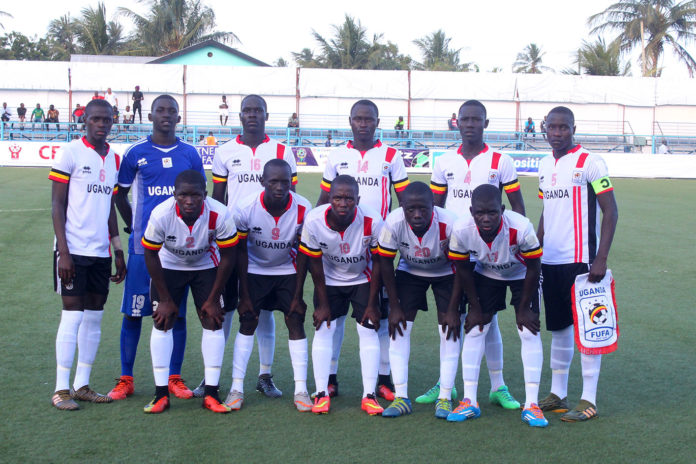
Uganda Cubs off to Tanzania for U17 Afcon tournament

Uganda Cubs team

The Uganda U-17 National football team flew to Dar-es-Salaam this morning for the Total CAF U17 final tournament to take place from 14th-28th April in Tanzania.

This was after a successful 10 day training camp in Kenya (1st-10th April) meant for acclimatization to the high temperatures of the host city where two practice matches were played in Nairobi with Kenya U18 (0-0) and Gor Mahia FC U20 (4-4).

A contingent of 31 which comprised of 21 players and 10 officials left Nairobi for Dar es Salaam aboard Kenya Airways.

Head Coach Paa Samuel Kwesi shared his mind with the Fufa media team about the two camps in Njeru, Kenya.

“I think they are doing well, fortunately, we have an able assistant who did a good job, therefore, we are just adding onto what has been done already and so far it’s been good.” Paa Samuel Kwesi Fabin told fufa.co.ug

While speaking about the away camp, he applauded the boys’ performance.

“It is common knowledge that when you gather children at the U17 level and move them out of their country to another country it gives them enough energy to work hard due to that excitement and since we came in Kenya the boys have performed very well and improved day by day.” He added

The team will on the Thursday, the 11th of April undertake the mandatory Magnetic resonance imaging (MRI) test to confirm their age.

Uganda’s will open its campaign against Angola on 14th April, then Tanzania on 17th and end with Nigeria on the 20th April in the group stages.

Group B has Guinea, Cameroon, Senegal and Morocco.

The top two teams in each of the two groups in the tournament will qualify automatically for the 2019 U-17 FIFA World Cup that will be held in Brazil.

Team travelling (21 players and 10 officials)

Goalkeepers: Oyo Delton (Kirinya Jinja SS FC), Jack Komakech (Ndejje University FC), and Mubiru Patrick (Bright Stars FC)

Outfield Players: Kevin Ssekimbegga (Express FC), Ibrahim Juma (KCCA FC), Kasozi Samson (Bright Stars FC), Kizito Mugweri Gavin (Vipers SC), Opira Innocent (Ndejje University), Ssekajja Davis (Bright Stars FC), Kakaire Thomas (Bright Stars FC), Iddi Abdul Wahid (Cagliari FC – Italy), Mwaka Polycarp (Ndejje University FC), Opaala Edrine Mukisa (Kirinya Jinja SS FC), John Kokas Alou (URA FC), Jarieko James (Paidha Black Angels FC), Asaba Ivan (Vipers SC), Najib Yiga (Vipers SC), Mugulusi Isma (Kirinya Jinja SS FC), Mugisha Rogers (Mbarara City FC), Opiro Justine(KCCA SA), Kawooya Andrew (Vipers SC)

Team officials:

Ariga Rasoul – Leader of Delegation

Paa Samuel Kwesi Fabin – Head Coach

Magera Jackson – 1st Assistant coach

Hamuza Lutalo – 2nd Assistant coach

Mubarak Kiberu – Goalkeeper coach

Osei-Owusu Derrick – Physical fitness coach

Emmanuel Nakabago – Team Doctor

Bashir Mutyaba – Team Coordinator

Omaria Bosco – Team Media Officer

Bumpenje Frank – Kit Manager

Stories Continues after ad

Police arrests Amuriat, leaves Besigye waving to his supporters

Forum for Democratic Change (FDC) party president, Patrick Oboi Amuriat, has been arrested alongside activist Nicholas Atuhairwe and are detained in Tororo Central Police Station.

Amuriat and the group that included former party president, Dr. Kizza Besigye were making their way to Youth Centre in Tororo where they were scheduled to preach their gospel against the incumbency president Museveni.

The meeting was however, disrupted on the basis that police was not informed about the gathering as stipulated under 2010 public order management act.

However, confrontations erupted with FDC supporters accusing police of disrupting their meetings under public order management act which people accuse of a mask to weaken opposition political parties and stopping them from conversing for support throughout the country.

Conversely, police responded with blue teargas after it first ordered them to vacate the youth center, “you go, leave this place,” police officer was heard giving orders.

“Uganda is for both of us not the ruling party, why do you always waste tax payers money in a democratic state where there is multiparty politics, we are fed up,” said one of supporter as tear gas choked him.

“Police threw teargas into our meeting room in Tororo forcing our leaders our leaders out. Although we had paid and booked the Youth Centre, we have left it because it was no longer usable,” said Dr. Besigye as they drove him through Tororo town.

Stories Continues after ad

Gen. Kyaligonza declines to appear before court

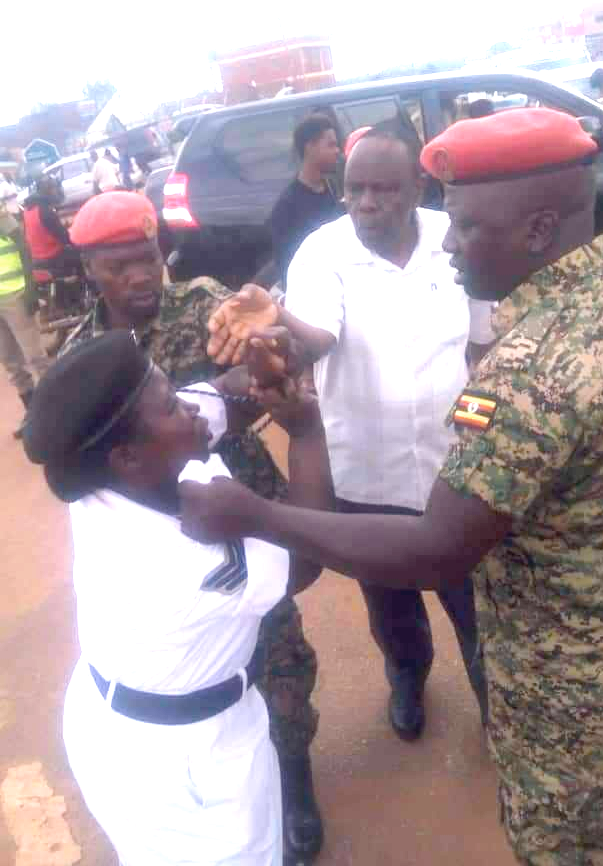
Maj. Gen. Matayo Kyaligonza assaulting the traffic officer.

Uganda’s ambassador to Burundi, Maj. Gen. (rtd) Matayo Kyaligonza and his aides have failed to appear before Mukono Chief Magistrates Court over charges of assaulting traffic officer, Sgt Namaganda Esther.

Gen. Kyaligonza was last week summoned by Mukono Chief Magistrate, Juliet Hatanga alongside his bodyguards RA/221607 L/CPL Bushindiki Peter and RA/230927 Okurut John Robert currently serving under Uganda peoples Defence forces (UPDF).

CPL Bushindiki and Okurut were reportedly arrested and are currently held at Makindye military detention facility awaiting their trial.

They trio are leveled with four counts which include obstructing a police officer from executing her duties and common assault.

Prosecution avers that on February 24, Sgt Namaganda was roughed up by gen Kyaligonza’s aides as she tried to stop ambassador’s convoy that was wrongly making a U-turn at Seeta road junction on Kampala-Jinja Highway.

In press conference the was called by the ambassador in question, he challenged Sgt Namaganda to table evidences indicting that he assaulted her and he vowed to drag to court any person who accuses him of assaulting Sgt Namaganda Esther.

Recently parliament chaired by Speaker Rebecca Kadaga, moved a motion seeking for recalling of the Gen. Kyaligonza.

“I condemn the actions of Maj. Gen. Kyaligonza and his bodyguards of assaulting a traffic officer. I find this unacceptable and am glad Police arrested them. I call upon the IGP Okoth Ochola to promote Sgt. Esther Namaganda for insisting on doing her job according to the law,” she said during the plenary.

Stories Continues after ad

Champions League: Man United vs Barcelona preview

United - Barcelona

Manchester United host Barcelona at in the UEFA Champions League quarter-finals on Wednesday night in a fixture which brings the Catalan giants to the Theatre of Dreams for the first time in 11 years.

The Spanish heavyweights have all but wrapped up the La Liga league title after 2-0 victory over Atletico Madrid at the weekend but it’s the Champions League they want the most and they will be keen for a positive result in this first leg.

Manchester United stunned PSG in the previous round to make it to this stage and will have to be at their very best once again with Lionel Messi, who has scored 43 goals in 40 games this season.

Suarez, Coutinho and Dembele are the other stars who will keep United defenders on their toes.

On their last visit at O.T, the tie was decided by just one goal – an unforgettable strike from Paul Scholes – but this time around Ole has claimed he could see the ball finding the back of the net on a few more occasions, given the attacking resources available to both sides.

The Red Devils will look up to the attacking options of Paul Pogba, Mata, Martial, Rashford and Lukaku to step up and deliver a great performance.

Key Stats

This is the first Champions League meeting between Barcelona and Manchester United since the 2011 final, which Barcelona won 3-1 at Wembley.

Manchester United have never lost a home European match against Barcelona (W2 D2 L0), with this is the first meeting between the sides at Old Trafford since the second leg of the 2007-08 Champions League semi-final, a 1-0 win for the Red Devils..

Manchester United have won two of their last 11 Champions League knockout ties (W2 D3 L6), failing to win either of their quarter-final games in the 2013-14 season under David Moyes against Bayern Munich.

Since Chelsea eliminated Barcelona in the 2011-12 semi-final, English teams have been eliminated in 10 of their last 11 Champions League knockout ties against Spanish sides – the exception was Leicester City against Sevilla in the last 16 in 2016-17..

Barcelona’s Lionel Messi has scored 22 Champions League goals in 30 appearances against English teams – more than any other player in the history of the competition.

Lionel Messi has failed to score in any of his last 11 Champions League quarter-final appearances for Barcelona; since netting against PSG in April 2013, the Argentinian forward has attempted 49 shots without success at this stage of the competition.

Form:

Man United: LWLLWWWDWL

Barcelona: WDWWWWWWWD

Possible line-ups:

Man United: De Gea; Young, Smalling, Lindelöf, Shaw; Matić, Herrera, Pogba; Lingard, Rashford, Martial

Out: Bailly (concussion), Darmian (unknown), Sánchez (knee), Valencia (fitness)

Doubtful: Herrera (unknown), Matić (unknown), Rashford (ankle)

Misses next match if booked: Herrera, Matić, Shaw, Valencia, Young

Barcelona: Ter Stegen; Semedo, Piqué, Lenglet, Alba; Vidal, Arthur, Busquets, Rakitić; Messi, Suárez

Out: Rafinha (knee)

Doubtful: Dembélé (hamstring)

Misses next game if booked: Semedo.

The return leg will be played on Tuesday, 16 April in Camp Nou. The aggregate winner over both legs will have to face the winner between Liverpool and Porto in semis.

Stories Continues after ad

Express draw Bright Stars in Uganda Cup semi-finals

Express FC players.

FUFA have today held draws for the 45th edition of the Uganda Cup for the semi-final stage.

Ten-time record champions Express FC have been drawn against fellow Uganda Premier League side Bright Stars FC, who eliminated Nebbi Central FC in the quarter-final stage in Nebbi.

Express eliminated BUL FC in the quarter-finals at Wankulukuku Stadium and remains the only club among the semifinalists that has ever won the title.

The Red Eagles will be seeking for Uganda Cup glory which they last had in 2007.

In the other semi-final, two Fufa Big League sides will face off as Kyetume takes on Proline FC to fight for a place in the final.

At the stage, the ties are played on a home and away basis.

The first leg is slated for 24th-28th April 2019 and the return leg for the 5th-9th May 2019.

Buganda region will host the Uganda Cup final this year but the ground and date will be communicated in due course.

The winning club of the Uganda Cup will walk away with Shs40 million, runners up Shs20 million, semi-finalists Shs10 million while the quarter finalists Shs5 million.

The winner of the competition represents Uganda in the Caf Confederation Cup as per the rules of the competition. KCCA FC are the defending champions.

Express FC and KCCA FC are the teams that have won the Uganda Cup most, ten times each.


2019 Uganda Semi-finals:

Kyetume FC Vs Proline FC

Bright Stars FC Vs Express FC

Stories Continues after ad

Uganda Premier League: Paidha Black Angels relegated to Fufa Big League

Paidha black angels

Paidha Black Angels SC have been relegated from the StarTimes Uganda Premier League this week after losing 2-0 to KCCA FC at the Bar Okoro stadium in Zombo.

The Black Angel’s one-year in the top tier of Ugandan football is over after their relegation to the Fufa Big League was confirmed with four games left to play.

Second half goals from Muzamiru Mutyaba and Patrick Kaddu were enough for the visitors to take all the maximum points in a closely contested tie.

The goals were also enough for KCCA to open a seven-point lead at the top; at least until second-placed Vipers face Mbarara City on Wednesday.

The result confirmed that even if Paidha won all their remaining four games, they would not overtake Maroons, who are a place above relegation zone.

This was Paidha’s 17th defeat in 26 matches, which kept them at the bottom of the 16-table log with just 12 points.

They have the worst goal difference in the league, having conceded 43 goals and scored only 17.

Three teams are to be relegated from the Uganda Premier League – one has been confirmed.

The other teams battling relegation are; SC Villa Jogoo, Maroons FC, Nyamityobora FC and Ndejje University.

Stories Continues after ad

Inaugural WHO Partners Forum launches new push for collaboration on global health

To meet the world’s most pressing health challenges, the World Health Organisation (WHO), governments and global health leaders on Tuesday called for improved partnerships and resourcing to support WHO’s mission to deliver care, services and protection for billions of people by 2023.

The inaugural two-day WHO Partners Forum opened in Stockholm and will be co-hosted with the Government of Sweden.

The meeting will result in a shared understanding of how to strengthen partnerships and improve effective financing of WHO, with an emphasis on predictability and flexibility.

Global leaders in health and development, representing the public sector, health partnerships and non-State actors, will come together to launch a new era of collaboration and innovation around WHO’s resource needs. Under the Organization’s Thirteenth General Programme of Work (GPW13), WHO needs US$14.1 billion between now and 2023.

“WHO is committed to leaving no one behind as we strive for the highest attainable standard of health,” said Dr Tedros Adhanom Ghebreyesus, WHO Director-General. “WHO is building stronger and more strategic partnerships with governments, international organizations, philanthropies and the private sector to deliver on the health-related targets in the Sustainable Development Goals (SDGs).”

At the heart of the GPW13 are the “triple billion” goals of ensuring that by 2023, 1 billion more people are benefitting from universal health coverage, 1 billion more people are better protected from health emergencies, and 1 billion more people are enjoying better health and well-being.

Peter Eriksson, Sweden’s Minister for International Development Cooperation, says: “The first WHO Partners Forum is a historic moment for honest discussions on tackling modern global health threats. If the world is to meet current and future health challenges, we need to ensure WHO is equipped and supported to be able to lead the global response.”

Sweden’s Minister for Health and Social Affairs, Lena Hallengren, said great advances have been made in global public health in recent decades, but new threats are putting communities, countries and economies at risk.

“Countries and health partners alike must collaborate even closer to respond to health challenges,” said Ms Hallengren. “Fighting antimicrobial resistance, combating disease outbreaks and providing essential health services for all are keys not only to improving people’s wellbeing, but also to promoting growth and development. Only by coming up with a sustainable model to respond to pressing health threats in all countries will we be able to deliver on the ambition of the SDGs.”

Other participants in the Inaugural WHO Partners Forum include leadership of the Global Fund to Fight AIDS, Tuberculosis and Malaria, the Bill & Melinda Gates Foundation, International Federation of Red Cross and Red Crescent Societies and Gavi, the Vaccine Alliance.

Stories Continues after ad

AfDB boss makes strong case for increased U.S. investment in Africa

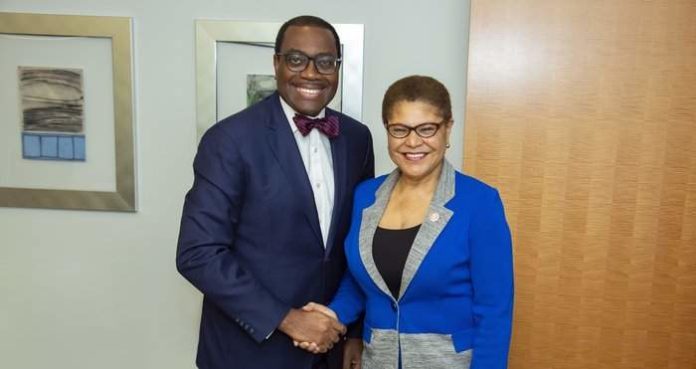
Adesina and U.S. Congresswoman Karen Bass

Speaking at a high-level dialogue in Washington D.C. on the sidelines of the on-going World Bank-IMF Spring meetings, the President of the African Development Bank, Akinwumi Adesina, said “It is time to turn around the declining investments of the U.S. in Africa. As the world’s private sector leader, the United States has a unique role to play in increasing investments in Africa and expanding opportunities for the U.S. private sector”.

Acknowledging continued U.S. support for Africa, Adesina said “Now is the time to scale up and take advantage of opportunities that other global players are already investing in”.

In attendance was U.S. Congresswoman Karen Bass, Chairwoman of the House Foreign Relations Subcommittee on Africa, Global Human Rights, and International Organizations; Thomas R. Hardy, Acting Director of US Trade and Development Agency; the Center for Global Development; representatives of the Presidential Advisory Council on Doing Business in Africa (PAC-DBIA); the American Jewish International Relations Institute; pension funds, private equity firms and African ambassadors.

Discussing the role of the African Development Bank in financing the continent’s development needs, Congresswoman Bass, said “Africa is fast becoming the continent of the future.” She reiterated U.S. commitment to and support for the work of the African Development Bank.

“This discussion comes at a critical juncture for the future of Africa. It is widely accepted that Africa is an investment hub. I personally and many of my colleagues will continue to advocate for full funding or increased funding to the Bank,” Congresswoman Bass told attendees.

Sharing his vision on the leading role of the African Development Bank, Adesina urged American businesses to engage more with the continent, saying “I strongly encourage you to look at Africa from an investment lens and not a development lens. Africa is a continent of huge untapped opportunities in power, infrastructure, IT and agriculture, which many other global players are already beginning to realize.”

Answering questions about the Bank’s innovative Africa Investment Forum, Adesina said “this first-ever gathering of world-class investors exceeded all expectations with projects worth over US$38.7 billion securing investment interest in just 72 hours.”

The Africa Investment Forum was convened by the African Development Bank in Johannesburg, South Africa in November 2018, in partnership with several African development finance institutions, to help bridge the continent’s growing infrastructure investment gap.

Adesina also asked for support for the Affirmative Finance Action for Women in Africa (AFAWA), as a means of changing the balance of financing because “women run Africa.”

AFAWA is a USD$300 million risk sharing facility designed to unlock USD$3 billion in credit for women-owned businesses and enterprises in Africa. The African Development Bank intends to introduce a ranking mechanism to evaluate financial institutions based on the share and quality of their lending to women and subsequent socio-economic impact.

The April 9 meeting was convened by Orrick, an international law firm with more than 25 offices across the globe. Orrick’s work focuses on finance, energy, infrastructure and technology, key sectors to help accelerate Africa’s economic development agenda.

In her concluding remarks, Congresswoman Karen Bass acknowledged that Africa needs investment in large infrastructure projects, including roads, railroads, ports, and transnational highways, “to achieve both structural transformation and market integration.”

She added that the U.S. Congress was continually considering the best ways to spur investments especially on the continent and that her office is exploring legislation to help facilitate investment in infrastructure projects.

According to Congresswomen Bass, the African Development Bank’s High 5s – Light up and Power Africa, Feed Africa, Industrialise Africa, Integrate Africa and Improve the Quality of Life for the People of Africa align with policy priorities that the United States Congress has been focusing on.

Stories Continues after ad

BREAKING: Kagame reshuffles army as tensions buildup

RWANDAN President Pual Kagame

Rwandan President and commander in chief of armed forces Paul Kagame has reshuffled the army and appointed senior Rwanda officers.

In the reshuffle that was announced in a radio message on Tuesday evening, Maj. Gen. Kagame said Jean Jacques Mupenzi had been promoted and appointed new Rwanda Defence Forces Chief of Staff.
Kagame also promoted to the rank of Major General Aloys Muganga as the new commander of Mechanised division.

“RDF press release-appointments and changes within RDF, Ref:RDF/MPR/A/07/02/19 Kigali,09 April 2019. H.E The president and commander in chief of Rwand defence forces (RDF) has made the following appointments and changes within RDF; a. Major General Jean Jacqous Pupenzi is promoted to the rank of Lieutenant General and appointed army chief of staff (ACOS) b. Lieutenant General Jacques Musemakweli becomes the Reserve Force chief of staff (RFCOS) while c. Major General Aloys Muganga becomes commander of the mechanized division. The appointments and redepolyment takes immediate effect” read the statement.
Gen. Musemakweli has replaced Gen. Fred Ibingira who is reportedly under house arrest.

The changes come up after the Spokesperson of Rwanda’s National Liberation Front Maj Sankara Callixte said they have no option but to fight President Paul Kagame, who he described as “a dictator and murderer”.

In an interview with Eagle online Maj Sankara said the kidnap of refugees, harassing of the opposition and lack of freedom of expression are the reasons why his group has launched an armed struggle against the Kigali regime in Nyungwe National Park in Rwanda near Burundi border.

“MRCD and our FLN we are a revolutionary movement, we are fighting for democracy! Kagame and his junta they are killing, torturing, kidnapping, non-freedom of expression, non-independent media, opposition leaders some of them are in jail for nothing, thousands of Rwandans are refuges in different countries most of them fear to lose their lives,” he said.

Mouvement Rwandais pour le Changement démocratique [MRCD] is the political and FLN is the armed wing of the a coalition of three political parties, PDR Ihumure headed by Paul Rusesabagina, CNRD headed by Gen Wilson Irategeka and RRM headed by Major Callixte Sankara that have launched an armed struggle against Kagame.

Maj Sankara said on Friday that the Rwanda Defence Forces had shelled the Bweyeye area which is heavily forested.

“They have also deployed heavily on the road from Kigali to Ruzizi which connects to the border with DR Congo. We warn people not to use that road,” he said.

Maj Sankara said the refugees would want to go back home but it’s not possible because “even exile the refugees are being hunted and killed”.

“Rwanda is in dictatorship and our mission is to liberate our compatriots oppressed by Kagame and his RPF and put in Rwanda a democratic government capable to live in peace,” he said. “12 millions of Rwandans have been taken is hostage by small group of criminals! All the economy of the country, big companies are in the hand of Kagame and RPF,”

However, yesterday during a presser in Kigali, Gen. Kagame downplayed the assertion by the rebels saying they are of less significance as RDF was fully in charge of Rwanda.

Stories Continues after ad

The Global Economy: A Delicate Moment

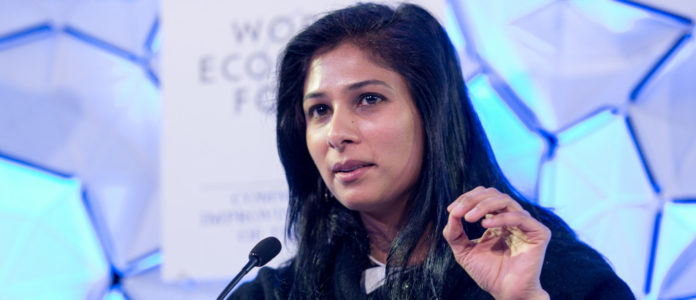
Gita Gopinath

By Gita Gopinath

A year ago, economic activity was accelerating in almost all regions of the world. One year later, much has changed. The escalation of US–China trade tensions, needed credit tightening in China, macroeconomic stress in Argentina and Turkey, disruptions to the auto sector in Germany, and financial tightening alongside the normalization of monetary policy in the larger advanced economies have all contributed to a significantly weakened global expansion, especially in the second half of 2018.

With this weakness expected to persist into the first half of 2019, our new World Economic Outlook (WEO) projects a slowdown in growth in 2019 for 70 percent of the world economy. Global growth softened to 3.6 percent in 2018 and is projected to decline further to 3.3 percent in 2019. The downward revision in growth of 0.2 percentage points for 2019 from the January projection is also broad based. It reflects negative revisions for several major economies including the euro area, Latin America, the United States, the United Kingdom, Canada, and Australia.

After the weak start, growth is projected to pick up in the second half of 2019. This pickup is supported by significant monetary policy accommodation by major economies, made possible by the absence of inflationary pressures despite growing at near potential. The US Federal Reserve, the European Central Bank, the Bank of Japan, and the Bank of England have all shifted to a more accommodative stance. China has ramped up its fiscal and monetary stimulus to counter the negative effect of trade tariffs. Furthermore, the outlook for US–China trade tensions has improved as the prospects of a trade agreement take shape.

After the weak start, growth is projected to pick up in the second half of 2019.

These policy responses have helped reverse the tightening of financial conditions to varying degrees across countries. Emerging markets have experienced some resumption in portfolio flows, a decline in sovereign borrowing costs, and a strengthening of their currencies relative to the US dollar. While the improvement in financial markets has been rapid, those in the real economy have been slow to materialize. Measures of industrial production and investment remain weak for now in many advanced and emerging market economies, and global trade has yet to recover.

With improved prospects for the second half of 2019, global growth in 2020 is projected to return to 3.6 percent. This recovery is precarious and predicated on a rebound in emerging market and developing economies, where growth is projected to increase from 4.4 percent in 2019 to 4.8 percent in 2020. Specifically, it relies on an expected rebound in growth in Argentina and Turkey and some improvement in a set of other stressed developing economies, and is therefore subject to considerable uncertainty. Growth in advanced economies will slow slightly in 2020, despite a partial recovery in the euro area, as the impact of US fiscal stimulus fades and growth tends toward the modest potential for the group, given aging trends and low productivity growth.

Beyond 2020, global growth is expected to stabilize at around 3½ percent, bolstered mainly by growth in China and India and their increasing weights in world income. Growth in emerging market and developing economies will stabilize at 5 percent, though with considerable variance as emerging Asia continues to grow faster than other regions. A similar pattern holds for low-income countries with some, particularly commodity importers, growing rapidly but others falling further behind the advanced world in per capita terms.

Risks to global growth

While the global economy continues to grow at a reasonable rate and a global recession is not in the baseline projections, there are many downside risks. Tensions in trade policy could flare up again and play out in other areas (such as the auto industry), with large disruptions to global supply chains. Growth in systemic economies such as the euro area and China may surprise on the downside, and the risks surrounding Brexit remain heightened. A deterioration in market sentiment could rapidly tighten financing conditions in an environment of large private and public sector debt in many countries, including sovereign-bank doom loop risks.

Building more inclusive economies

Given these risks, it is imperative that costly policy mistakes are avoided. Policymakers need to work cooperatively to help ensure that policy uncertainty doesn’t weaken investment. Fiscal policy will need to manage trade-offs between supporting demand, protecting social spending, and ensuring that public debt remains on a sustainable path, with the optimal mix depending on country-specific circumstances. Financial sector policies must address vulnerabilities proactively by deploying macroprudential tools (such as counter-cyclical capital buffers)—a task made more urgent by the possibility that interest rates will remain low for longer. Monetary policy should remain data dependent, be well communicated, and ensure that inflation expectations remain anchored.

Across all economies, the imperative is to take actions that boost potential output, improve inclusiveness, and strengthen resilience. There is a need for greater multilateral cooperation to resolve trade conflicts, to address climate change and risks from cybersecurity, and to improve the effectiveness of international taxation.

This is a delicate moment for the global economy. If the downside risks do not materialize and the policy support put in place is effective, global growth should rebound. If, however, any of the major risks materialize, then the expected recoveries in stressed economies, export-dependent economies, and highly-indebted economies may be derailed. In that case, policymakers will need to adjust. Depending on circumstances, this may require synchronized though country-specific fiscal stimulus across economies, complemented by accommodative monetary policy. Lastly, adequate resources for multilateral institutions remain essential to retain an effective global safety net, which would help stabilize the global economy.

The writer is IMF’s Chief Economist

Stories Continues after ad