Stanbic Bank
Stanbic Bank
18.4 C
Kampala
Stanbic Bank
Stanbic Bank
Home Blog Page 1317

Museveni urges UPDF to defend Ugandan citizens, says integration of Africa is crucial

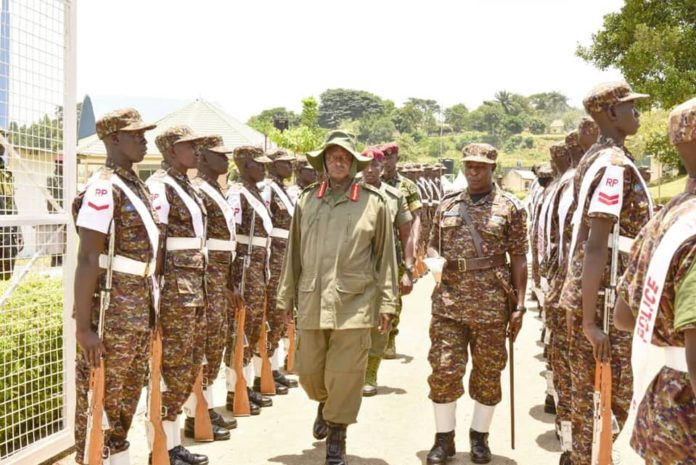
President Museveni who is also the Commander in Chief of armed forces inspecting a guard of honour mounted for him during his visit to Kakiri.

President Yoweri Museveni who is also the Commander in Chief of the Uganda Peoples Defence Forces (UPDF) has urged the force to always be alert and fight for the people of Uganda to be prosperous by providing a security service based on the four principles of patriotism, Pan Africanisim, Social-economic transformation and democracy.

“To be an officer in the UPDF, you must know our ideology. You must know the interests of your people. Prosperity means security for the people of Uganda. We can’t guarantee our prosperity if we go by identity. Patriotism can help our people much better than parochialism and sectarianism,” he said.

Museveni was Friday addressing officers and men of the First Infantry Division at Kakiri Barracks in Wakiso District. The President has embarked on a nation-wide on-spot working visits to UPDF Barracks interacting with officers and men over their welfare issues including Housing, Education for their Children, Health facilities at stations and income-generating activities for the wives of soldiers.

The President, who first met Platoon commanders, Company Commanders, Battalion Commanders and Brigade commanders separately, later held a combined meeting with other officers and men and said the UPDF must know its historical mission and the ideology of the revolution.

“I have come to check on the units and the service they extend to our people in terms of security. We want politics of patriotism. It will help give us a bigger market than regional groups. Without African integration, the common market of East Africa and Africa, there can never be prosperity. We are lagging behind in science and technology and we must push for political and economic integration. Uganda cannot survive alone in a modern age,” he said.

On education, Museveni said that government policy is to ensure free education for the children of the poor. He said at Primary level, government has provided free education to four children per family and said soldiers children can access army schools. He said they would consider a proposal to offer the same for secondary school education. He however blamed some individuals who are trying to frustrate the efforts by charging parents fees.

On housing, the Commander in Chief urged the Defence administration to consider using their own labour as opposed to contracting building services. He said the SFC hospital was constructed for about Shs400 million compared to the Shs1.5 billion earlier quoted by the private contractor. He therefore said that by using the UPDF construction Brigade, government would be able to meet the housing needs for the forces. He added that Government has been spending close to Shs96 billion on rented offices which he said must stop.

The Commander Engineering Major General Timothy Sabiiti Mutebile said the force needs 60,000 housing units but currently has only 7000. He said the UPDF engineering Brigade has about 2500 well-trained human resource personnel whom they can use to bridge the gap without using contractors.

He urged the force to strengthen their confidence through knowledge saying without knowledge they can easily be deflated. He said the development of science and technology is the primer of social change alongside patriotism, Pan Africanism, Social Economic transformation and democracy. The President elaborated with a gun show and said when a soldier runs out of bullets, he can still improvise with his gun and keep fighting.

He advised the officers to live healthy lives and avoid alcohol, prostitution and malaria.

He later announced a donation of Shs100 million to the SACCO of wives of soldiers involved in income generating activities.


Stories Continues after ad

Anti Counterfeit Network takes WFP to court over poinsoned food supplies in Karamoja

Counsel Fred Muwema

The World Food Program (WFP) and other partners face legal action over suspected contaminated food they supplied in Napak and Amudat areas found in karamoja region, killing a handful of people.

In a notice of intention to sue written to the Country Director WFP (Uganda) El Khidir Daloum, the director legal and corporate Affairs of Anti- Counterfeit Network Africa (ACN) Fred Muwema said “we have learnt that your organization has been involved in the supply of supper cereal also described as corn soya blend fortified food in Napak and Amudat which are found in Karamoja”.

A four paged notice dated 20th march, 2019 also adds that “we have also read media reports where you have confirmed that WFP suspended the distribution of the above impugned food last week because it was suspected to be poisoned or contaminated. This would amount to
counterfeit or fake food”.

The reports also indicate that three people are believed to have died due to suspected food poisoning and more 250 people have been admitted in various health centres with symptoms including
confusion, vomiting, headache, high fever and abdominal pain after consuming the impugned food.

Muwema said that it is not a mere coincidence that WFP suspended distribution of the impugned food at the time when only people who had consumed the impugned food were the ones dying or falling sick.
“This is a very serious food safety incident that appears to be evidently in breach of the Codex Alimentarius International food standards 1963(as amended)”

ACN had demanded a report from WFP which will furnish them with details of information to see whether due diligence was carried out on the supplier and whether the standards expected in the distribution process were adhered to or if they have supported the affected families.
Speaking to reporters from his office Saturday, Muwema said that they intend to institute a legal case of negligence, causing injury and death against WFP, government and a supplier who is a turkey company.

He continued that they will also be seeking a court order calling for an independent audit into the matter and damages for the injured plus people who have died as a result of consuming suspected poisoned food.

Government through the central public health laboratories is investigating samples of the food to ascertain the cause of death.

Stories Continues after ad

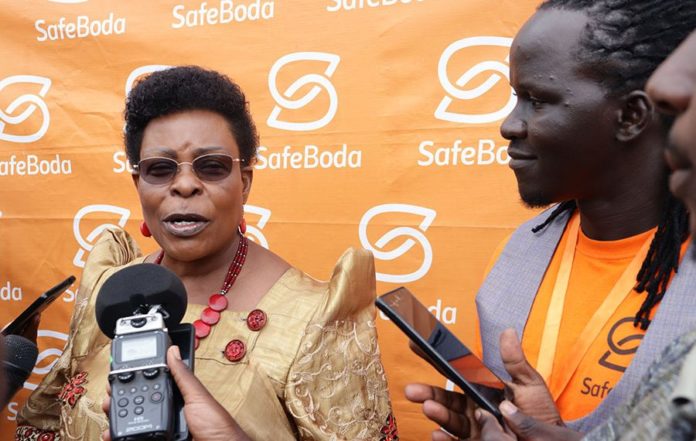
Safe Boda offers clients 50 percent discount on all cashless rides

One of the leading motor bike ride sharing applications in Uganda,
Safe Boda has a introduced a 50 percent discount to all its users who ride cashless this month.
According to a press sent to Eagle Online, every Safe Boda customer who uses mobile money, as a one off – and every time they will take a trip, the fare will be automatically deducted from their account, making it much more convenient.
To top up credit, users are advised to open their applications, tap payment,tap top up Safe Boda account and it will automatically link to their respective mobile money accounts.
They will then enter their private pin codes, approve and ride cashless. Damalie Wasukira, the Communications Manager at Safe Boda says that the company aim to promote a convenient transport experience which is why they encourage their customers to top up their accounts.

“Safe Boda aims to promote a convenient transport experience which is why we are encouraging our customers to top up their Safe Boda accounts and ride cashless. Customers can top up daily, weekly or monthly using MTN or Airtel money directly through the Safe Boda app. Payments are instant through the app and even more affordable,” she said.

Stories Continues after ad

EAC officials calls for harmonised pesticides testing

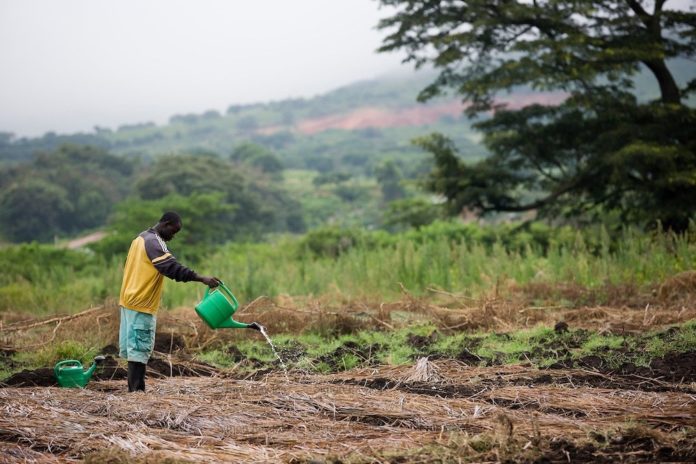
The EAC Deputy Secretary General in-charge of Productive and Social Sectors, Christophe Bazivamo has called upon pest control product companies to take advantage of EAC harmonized system for testing and registration of pesticides.

The 38th Extra-Ordinary Council of Ministers in approved the EAC pesticides management guidelines on efficacy trials, residue trials and registration requirements.  The Council further directed Partner States to domesticate them by 30th May 2020.

The EAC harmonized system comes with a number of benefits that will translate to reduced time and costs associated with testing and registration of pest control products across EAC Partner States.  It is expected that farmers in the region will have increased access to quality, safe and affordable pesticides.

Bazivamo said the companies that involvement of the Private Sector is pivotal for successful implementation of the guidelines. He further said that EAC appreciates and recognizes the contribution that the private sector makes in the EAC integration agenda.

He made the remarks during the Technical Working Group meeting on pilot testing of EAC harmonized pesticides registration guidelines held in Arusha, two days ago.
The meeting was convened by the EAC Secretariat with support from USAID Kenya & East Africa, the United States Department of Agriculture and Africa Lead II. The main objective of the meeting was to finalize roadmap and discuss modalities of pilot testing of EAC harmonized guidelines for testing and registration of pesticides.

Bazivamo said  that area of agrochemicals and pest control products is a key priority in the EAC agricultural sector. Article 108 of the EAC Treaty focuses on the need for EAC Partner States to adopt common mechanism to ensure safety, efficacy and potency of agricultural inputs including chemicals, drugs and vaccines.

He  urged Partner States to pilot implementation of the pesticide efficacy guidelines for the first three years in order to pave way for operationalization of full mutual recognition. The Sectoral Council also urged Partner States to prioritize joint testing of pesticides and to share information on products that can control the Fall Army Worm which has posed a major threat to food security in the region.

Since 2016 the Fall Army Worm has been spreading across much of sub-Saharan Africa. Currently, over 45 countries out of 55 countries in Sub-Saharan Africa have been affected.  It is estimated that Fall Army Worm has the potential to cause maize yield losses in the range of US$ 2 to 6 billion in Africa’s maize producing countries.

During the meeting, representatives of Bayer, Syngenta, AgBiTech, REAL IPM, Corteva, Provivi and Arysta Life Science made presentations about products developed by their respective companies to control the Fall Army Worm. The presentations also outlined the efficacy and safety of the products and EAC Partner States where the companies intend to conduct pilot trials of their products.


Stories Continues after ad

Ugandan to gain from AfDB Adaptation Benefits Mechanism

The public sector cannot provide enough finance to make African countries resilient to climate change impacts, and funding from the private sector is hard to come by. At the same time, many grassroot adaptation initiatives are being developed and some of these are making a big difference.
To supplement other efforts the African Development Bank (AfDB) launched The Adaptation Benefits Mechanism (ABM), an innovative mechanism  for mobilising new and additional public and private sector finance. The pilot phase will create a new asset – certified adaptation benefits, with a compliance value for the Paris Agreement, nationally determined contributions (NDCs) and the sustainable development goals (SDGs).
The Bank has raised the share of adaptation finance from less than 30% in 2016 to 49% in 2018, in order to better respond to the needs of the African continent.
The project developers participating in the pilot phase are the International Agroforestry Centre (ICRAF) in Côte d’Ivoire, Whave Solutions in Uganda, and the Center for Governance and Human Security Studies (CGHSS) in Rwanda.
Ben Sheardown from Whave Solutions said “The residents of Uganda are already beginning to experience the effects of climate change. The services that Whave Solutions is offering to rural communities not only help them to become more resilient, but also to improve their health and livelihoods”. Andrew Rucyahana from CGHSS said that as a social entrepreneur he wants to help vulnerable communities to adapt to climate change as well as earn a living from it.
Amani Kouassi from ICRAF explained how the organization enables adaptation activities, not only between governments and the private sector, but also between local governments and vulnerable communities. He also said that the high interest rates of commercial banks were impeding private sector engagement.
In the period 2019-2023, the African Development Bank will implement at least 12 ABM demonstration projects in Africa, with a focus on vulnerable communities in least developed and low-income countries. The results will inform and further develop the ABM before it is used in the international community.
The concept of the ABM has been developed by the African Development
Bank since 2016, with support by the Climate Investment Fund (CIF)
and in consultation with several African countries, including the Côte
d’Ivoire and Uganda, as well as other stakeholders. In the
UNFCCCdiscussions on Article 6 of the Paris Agreement, the ABM was
mentioned as an example of a non-market-based approach.

Attachments area
Stories Continues after ad

Uganda Airlines staff to get fat pay cheques as govt plan re-launch

Uganda Airlines is expected to fly in tourists when it resumes operations

Uganda Airlines staff will be one of the best paid in the country when the airline whose aircraft are yet to arrive in the country, starts operations that were halted over a decade ago due to liabilities it was incurring then .

According to leaked documents, the Chief Executive Officer expects (CEO) expects to earn a monthly salary of Shs 60 million. The money excludes other allowances and benefits. Ephraim Kalyebara Bagenda is the current acting CEO.

The documents indicate the chief finance officer will earn Shs50 million while the chief pilot will pocket Shs 42 million monthly. Flight captains will get Shs 38 million while the cabin crew including air hostesses will be paid Shs 3 million.

Government da is preparing set to re-launch the airline this year, with the Ministry of Works asking Parliament to quickly approve Shs283 billion which is the balance for the two A330 Neo- Airbuses.

Ntege Azuba, the minister for Works told the Budget Committee of Parliament on Friday that failure to clear this balance before the end of March 2019, could attract a penalty.

If the payment of the balance is done, Azuba said the two Airbuses will be delivered at Entebbe International Airport on the 8th of April this year.

Following the recent air crash in Ethiopia, the legislators tasked the ministries to present the CV’s of the pilots and captains that intend to fly the Uganda Airlines.

Stories Continues after ad

Are cash handouts to youths in Uganda sustainable?

Mr. Sserunjogi

By Brian Sserunjogi

Over the last decade, Uganda has undergone a significant demographic structure transition. Approximately 78 per cent of the country’s population is below the age of thirty while youth aged 18 to 30 years now contribute about 23 per cent (close to eight million) of the total population. In the same light, the country’s urban population increased three-fold from 2.9 million in 2002 to 7.4 million people in 2014.

The explosive urban population has emanated out of rural-urban migration, gazetting of new urban areas as well as natural population growth. While Uganda has registered a youth population bulge in general and in urban areas in particular, the generation of employment for the surging youth population has not moved in the same direction.

Youth unemployment continues to be a challenge in Uganda. According to Uganda Bureau of Statistics, youth unemployment among 18-30 year olds increased from 12.7 per cent in FY 2012/13 to 13.3 per cent by FY 2016/17. Moreover, urban youth unemployment (9.9 per cent) among youth aged 18-30 years was higher than the national unemployment rate of 9.2 per cent by 2016/17.

Levels of underemployment, vulnerable employment are even higher than the above levels of unemployment since most youth engage in part time work even for a few hours for survival. The pace of creating new employment opportunities has lagged behind labour force growth.

Mindful of the fact that the youth comprise about 64 per cent of the total unemployed persons in the country, government embraced promotion of entrepreneurship financing and self-employment through targeted youth funds. Indeed, the current National Development Plan (NDP) and the National Youth Policy (2011) identifies entrepreneurship as a key strategy towards solving youth unemployment. As such starting with the 2011/12 national budget, government allocated Shs44.5 billion to support youth entrepreneurship promotion programmes.

In 2012/13 budget, an extra Shs3.5 billion was earmarked to support youth self-employment while in FY 2013/14, government significantly boosted youth schemes by allocating Shs265 billion over a five-year period for the Youth Livelihood programme. More recent momentum for the youth employment came in the 2018/19 budget with government committing an extra Shs66 billion for Youth Livelihood programme.

While past government structured interventions are commendable, more recent interventions in the form of ad hoc presidential financial handouts to youth groups across urban centres are likely to be unsustainable and non-transformative. As such this approach is likely to encounter the same challenges that many of its predecessors schemes met. Past evaluation of schemes such as the Uganda Youth Venture Capital Fund’s (UYVCF), Entandikwa, Prosperity for All, Youth Livelihood programme (YLP) etc reveals that these schemes faced a numerous challenges.

Key among the challenges is political influence which interfered with the operations of the scheme; corruption; inadequate implementation preparation at the local governments, poor selection of enterprises to be funded; inadequate operational funds etc; Moreover, the timing of these youth interventions has been ad hoc largely coinciding with the buildup of national general elections. As such most youth groups have viewed these schemes as political gifts exacerbating the risk of misappropriation of availed finances consequently failing the well intentioned programmes.

Besides, youth entrepreneurship schemes in Uganda have not been approached comprehensively. While successful youth schemes involve a mix of financial and non-financial support to achieve lasting impacts, youth interventions in Uganda have solely focused on financial support ignoring other non-financial support services.

A desktop scan through the operation of youth funds across other African counties reveals that Uganda has a lot to learn from other pioneer countries in youth schemes to ensure that its interventions are sustainable and transformative.

For example, the objectives of the Kenya Youth Enterprise Development Fund and Namibia Youth Credit Scheme go beyond enterprise financing to provision of business development support services (mentoring, coaching and incubation). The Umsobomvu Youth Fund in South Africa is a comprehensive program aimed at making the young people employable through vocational training and skills acquisition, enterprise finance and promotion of community service.

In contrast, the Tunisia Youth Fund was developed with the objective of linking unemployed graduates with potential employers. The major activities of the Tunisia Youth Fund are to create a database on available job opportunities and link them to unemployed youths.

I therefore envisage that although provision of adhoc financial assistance to youth groups shall continue in 2019, it is highly unlikely to be transformative. To make them transformative government needs to build strong institutional and monitoring and evaluation frameworks with measurable indicators to monitor performance of youth funds. Moreover, multiple stakeholders in form of Public Private Partnerships (PPPs) need to be brought on board to ensure greater outreach and sustainability.

Lastly, government must continually eliminate the obstacles to self-employment to spur youth entrepreneurship. Challenges like unreliable and costly power, high taxation, corruption, poor road network, inadequate markets etc make it harder for small and medium enterprises to emerge and prosper.

The writer is a research fellow at the Economic Policy Research Centre (EPRC)

Stories Continues after ad

Rugby Cranes team for Hong Kong Sevens named

The Uganda Rugby Cranes team to play at the 44th edition of the Hong Kong sevens has today been named, with 12 players summoned.

The Captain of the Sevens team will be Micheal Wokorach, and be deputized by Philip Wokorach.

The 2019 Hong Kong Sevens will begin on Friday, 5th April and end on Sunday, 7th April 2019.

Uganda are in Pool G alongside Chile, Germany and Cook Islands.

The Rugby Cranes will play two games on 5th April against Germany and Chile before taking on Cook Islands the next day at the Hong Kong Stadium.

The tournament is considered the premier tournament on the World Rugby Sevens Series competition. It is currently the seventh tournament on the World Series calendar, and is held annually in Hong Kong on a weekend in late March or early April.

The 2019 Hong Kong Sevens will also include the World Series Qualifier tournament, with the winner of that event gaining core team status for the 2019–20 World Rugby Sevens Series.

Uganda Rugby Cranes Team:

* Pius Ogena
* Desire Ayera
* Michael Wokorach
* Isaac Massa
* Ian Munyani
* Byron Oketayot
* Paul Masendi
* Aron Ofoirwoth
* Adrian Kasito
* Philip Wokorach
* Kisiga Timothy
* Joseph Aredo

Stories Continues after ad

Kin Kariisa, Mbire appointed to Eco bank board

The CEO of Next media, Kin Kariisa, has been appointed the Board chairman of Eco Bank Uganda replacing the long serving Henry Lubwama.

Kariisa was tasked to invest more in information and technology innovations for transformation of the banking sector. Businessman Charles Mbire, also MTN Uganda Chairman has been appointed board member.

“I’m very proud of Eco bank and I always love to talk about it, that’s why great people like Henry Lubwama, Charles Mbire and Kin Kariisa accepted to join us,” said Clement Dodoo the Managing Director Eco bank.

Dodoo lauded the outgoing chairman saying everything that he has touched is a legacy because it stands on quality and that’s what Eco bank has received. “I think he has been a perfect example of what one can achieve,” he added.

Eco bank originally come from West Africa and has rolled to Ghana, Côte d’Ivoire, Burkina Faso, Benin then Nigeria, and other 31 African countries and the whole of middle Africa.

The Executive Director Eco bank Uganda, Annette Kihuguru, said Mr Lubwama has played a very constructive role in making Eco bank great amidst great challenges, “we thank him for the progress the bank has achieved. We shall continue to put the knowledge you’ve imparted to good use,” she said.

After very many things that have been talked about me, I feel like abandoning my speech am just say thank you. I feel extremely humbled to be honored,” said Lubwama.

“I have realized that I have been one of the longest board members and it was time for me to go because I have attained and fulfilled my vision. Thank you for appreciating the service we’ve given to this institution,” he said

He said Eco bank wouldn’t be great without customers. “I want them to know that it’s strong and truly a Pan African bank destined to serve your interests.”

Stories Continues after ad

Nawangwe, Kamunyu agree settlement as suspension is lifted

Dr. Deus-Kamunyu-Muhwezi

Makerere University has agreed to lift the suspension of Dr Deus Kamunyu Muhwezi, the Chairman Makerere University Academic Staff Association (MUASA) after reaching a consent settlement in court on March 13, 2019.

The university suspended Kamunyu for allegedly inciting violence amongst the academic staff. He was suspended by Vice Chancellor Prof. Banarbas Nawangwe.

Kamunyu then said his suspension was very vague, harsh, in bad faith and against all laws of the country. The suspension he said undermines his rights as a citizen to have access to my official home, public buildings and related services.

He would later sue the university and Nawangwe for wrongful and unfair suspension.

In the settlement Kamunyu agreed to submit to the internal disciplinary process commenced by the Appointments Board while the latter also agreed to adhere to the principles of natural justice, fairness and equity.

The settlement further said Kamunyu can sue the university and Nawangwe for defamation in case he is interested.

The settlement was ruled by Justice Lydia Mugambe. Kamunyu was represented by Counsel Felix Ampaire while the university and Nawangwe were represented by Hudson Musoke.

Stories Continues after ad