Stanbic Bank
Stanbic Bank
16.9 C
Kampala
Stanbic Bank
Stanbic Bank
Home Blog Page 1354

Police says Minister Nantaba survived assassination as guards kill attacker

Idah Nantaba

Uganda’s State Minister of Information and Communications Technology, Aidah Nantaba on Sunday at around 2:40pm survived an alleged assassination by unknown gunmen who opened fire on her official car as she travelled from her constituency, Kayunga to Kampala.

Before the shooting, the gunmen trailed the minister for some minutes. They were traveling on a Suzuki motorbike, Registration No. UAL 822A.

The attack targeting Nantaba took place not very far from Nagalama.

By the time of filing this story, a terrified Nantaba was at Nagalama police station recording a statement and the police had not spoken about the incident.

Kampala Metropolitan Police Spokesperson, Luke Owoyesigire says, the Kayunga legislator was suspicious of the men on the motorbike before she called the Nagalama Police station which alerted other stations.

“The Police then started patrolling and monitoring the surroundings before the gunmen opened fire which prompted the Police to fire back before killing one of the gunmen on spot,” Owoyesigire has said.

Oweyesigire says the Police has launched the hunt for the other gunman as investigations the incident continue

Stories Continues after ad

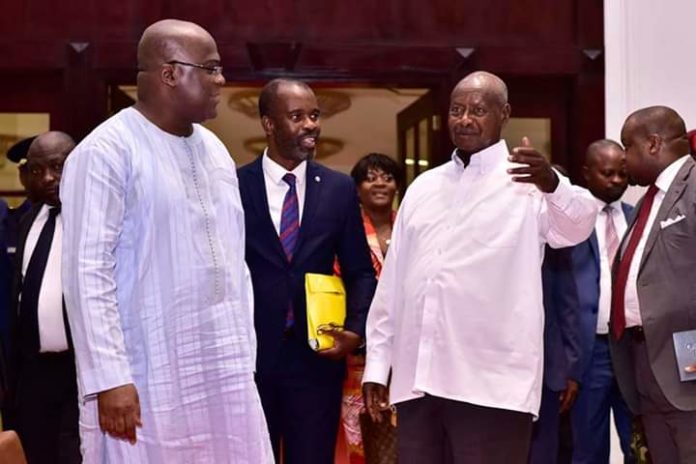
Museveni, Tshisekedi discuss trade, regional security

Museveni and his visitor Tshisekedi discussed trade, regional security

President Yoweri Museveni last evening hosted the newly elected DR Congo president Felix Tshisekedi at State House Entebbe.

The two leaders discussed trade, regional security and other areas of bilateral interest to Uganda and the neighbouring DR Congo.

“President Museveni later hosted President Tshisekedi to a dinner,” read the statement from State House without giving further details.

“Last evening, I hosted His Excellency Felix Tshisekedi at State House Entebbe. We discussed trade, regional security and other areas of bilateral interest to Uganda and the DR Congo,” Museveni confirmed on his twitter page.

This is the second time the two leaders are meeting in less than six months. Mr Tshisekedi met Museveni before the election was held in DRC where he was chosen to in January this year to replace Joseph Kabila, who had ruled the country for 18 years.

Tshisekedi visit is a boost for Uganda especially on the trade front, following Rwanda’s imposing a trade embargo Ugandan goods.

Stories Continues after ad

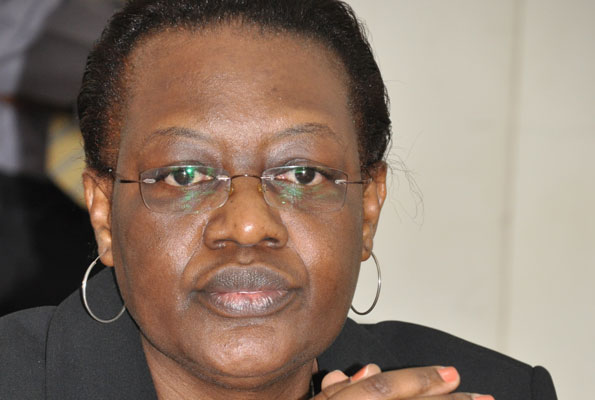
Youth organisation threatens to sue IGG over report on Bagyenda’s wealth

HOT SEAT: IGG Irene Mulyagonja

A youth organisation has threatened to drag to court the Inspector General of Government (IGG) Justice Irene Mulyagonja, for alleged failure to release a report on the alleged illicit wealth of former Bank of Uganda (BoU) executive director of bank supervision Ms Justine
Bagyenda.

The organisation-Youth Power Research Uganda through Nsubuga K.S & Co. Advocates want the IGG to release a report on the investigations so far carried out on Bagyenda’ alleged illicit wealth, with the lawyers giving the IGG two days from receipt of the letter to respond to their
client’s demands. The IGG received the letter on March 21,2019.

The lawyers also threatened the IGG with Shs15 million as legal costs
should she fail to respond to their client’s claims within the
stipulated time.
They claim that Bagyenda is a close associate of the IGG, the reason the latter has failed to investigate and produce the report on the former’s alleged illicit wealth, they claim has never been declared.

“Take notice that your actions are not only malicious and breach of constitutional and legal duty but also have caused a lot of confusion in society, anxiety and mistrust of your office to our client,” the letter reads in part.

They accuse the IGG of failing to investigate Bagyenda over the closure of Crane Bank Limited and others as cited in August 2018 by the Auditor General John Muwanga and later parliament’s report (COSASE report) on the closure of the same banks.

They allege that their follow up with the IGG on the same issue led to the arrest of some of the organisation’s representatives for alleged blackmail and threatening violence, a charge, the lawyers say was raised by the IGG.

IGG’s early responses

In June 2018, Justice Mulyagonja revealed that she was compiling a report about the matter.
Ms Bagyenda, who faces allegations of amassing wealth in the whistleblowers petitions to the IGG, was also being investigated by Financial Intelligence Authority (FIA) over money laundering
accusations.

On February 20, a whistleblower petitioned the IGG to investigate Ms Bagyenda, referring to different assets, and the billions of shillings she allegedly held in two bank accounts in Kampala.

However, more than three months later, the IGG came under pressure as critics raise concerns over the duration of the investigations and also some of the sections of the public alleging that she had blocked the process because Ms Bagyenda is her friend.

“Ms Bagyenda’s investigations and asset verification has been carried out by the Leadership Code Directorate in the office of the IGG,” a statement said then in June.

The IGG said much as there is public interest in the matter, her office by law is not supposed to reveal every step of investigations of any kind to the public but reports are sent to the relevant
government agencies that have authority over the person being investigated.

“We welcome any other authority that can verify Bagyenda’s assets. We shall hand over the declarations so that authority does the verification so that the public stops accusing me of being friends with this woman. I don’t know where they trace me being a friend ofBagyenda.
I came to know Justine Bagyenda as director of bank supervision about two years ago. Before that, I didn’t know this woman (Bagyenda),” she said.

Mulyagonja, who also clarified that her investigations into Ms Bagyenda does not relate to the sale of Crane Bank by the Central Bank, said her verification of assets report will be sent to the
Parliament Committee on Commissions, Statutory Authorities and State Enterprises which is doing other investigations on Bank of Uganda.

Stories Continues after ad

Lawyer Mabirizi drags govt to court over Shs1.3trn approved for Lubowa Hospital

Male Mabirizi

Celebrated city lawyer Male Mabirizi, has dragged government to court seeking to quash a recent parliamentary resolution to guarantee payment of U$379.7million (shs1.3 trillion) loan for the construction of an ultra-modern hospital in Lubowa.

Parliament last week passed a resolution committing the government to guarantee the said money for the project that will be a joint venture between FINASI and ROKO construction Ltd.

Mabirizi in his suit says the resolution passed by parliament was done illegally and should be reversed.

“Despite protestations on the legality, common sense and viability of the proposal, the presiding Speaker, Rebecca Kadaga put the matter to a random vote and at the time of putting the matter to the vote, Parliament lacked the required quorum of the required one-thirds of all the members and hence the Speaker acted ultra vires, with material irregularity and illegality in putting the matter to vote,” Mabirizi says in his affidavit.

“When the speaker put the question whether to approve the majority committee report or not, I observed that the voices which were not in support of approval of the majority Committee Report were more than those in support, but to my surprise, the Speaker ruled that the majority report was approved.”

The lawyer argues that the process of passing the resolution that guaranteed payment of the money for the construction of the hospital contained a number of irregularities and that the outcome cannot be upheld.

According to Mabirizi, the resolution passed by parliament was unreasonable, unfair, contrary to common sense and an uncalled for burden on the taxpayers of this country.

He also argues that Kadaga acted illegally by putting the motion to vote yet parliament lacked the required quorum of one third of all members of parliament but it went ahead to pass the resolution.

Stories Continues after ad
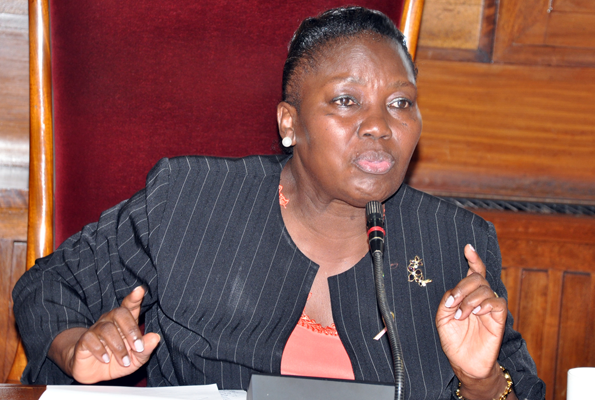
Kadaga undergoes treatment at Aga khan hospital

Speaker Rebecca Kadaga

Parliament has confirmed that its ailing speaker, Rebecca Kadaga has been airlifted to Nairobi’s Aga khan hospital for further treatment.

Speakers’ admission to the Nairobi health facility has been confirmed by parliament’s press secretary Sam Obbo who said the decision was made basing on doctors’ advice.

Mr. Obbo said the speaker is stable and is steadily recovering and soon she will resume with her work.

Kadaga was on Thursday night admitted to Nakasero hospital over fatigue related illness attained from hectic working tour in morocco and USA.

“Due to hectic work schedule, fatigue and jet lag, she had to admitted, we hope her privacy will be respected during this period,” reads in part of the statement released by parliament’s press secretary

Yesterday president Museveni visited Kadaga before she was airlifted to Nairobi where she is receiving medical attention.

Stories Continues after ad
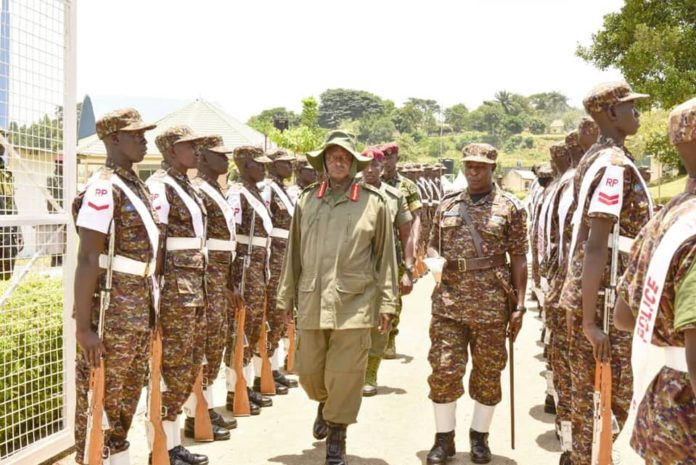
Museveni urges UPDF to defend Ugandan citizens, says integration of Africa is crucial

President Museveni who is also the Commander in Chief of armed forces inspecting a guard of honour mounted for him during his visit to Kakiri.

President Yoweri Museveni who is also the Commander in Chief of the Uganda Peoples Defence Forces (UPDF) has urged the force to always be alert and fight for the people of Uganda to be prosperous by providing a security service based on the four principles of patriotism, Pan Africanisim, Social-economic transformation and democracy.

“To be an officer in the UPDF, you must know our ideology. You must know the interests of your people. Prosperity means security for the people of Uganda. We can’t guarantee our prosperity if we go by identity. Patriotism can help our people much better than parochialism and sectarianism,” he said.

Museveni was Friday addressing officers and men of the First Infantry Division at Kakiri Barracks in Wakiso District. The President has embarked on a nation-wide on-spot working visits to UPDF Barracks interacting with officers and men over their welfare issues including Housing, Education for their Children, Health facilities at stations and income-generating activities for the wives of soldiers.

The President, who first met Platoon commanders, Company Commanders, Battalion Commanders and Brigade commanders separately, later held a combined meeting with other officers and men and said the UPDF must know its historical mission and the ideology of the revolution.

“I have come to check on the units and the service they extend to our people in terms of security. We want politics of patriotism. It will help give us a bigger market than regional groups. Without African integration, the common market of East Africa and Africa, there can never be prosperity. We are lagging behind in science and technology and we must push for political and economic integration. Uganda cannot survive alone in a modern age,” he said.

On education, Museveni said that government policy is to ensure free education for the children of the poor. He said at Primary level, government has provided free education to four children per family and said soldiers children can access army schools. He said they would consider a proposal to offer the same for secondary school education. He however blamed some individuals who are trying to frustrate the efforts by charging parents fees.

On housing, the Commander in Chief urged the Defence administration to consider using their own labour as opposed to contracting building services. He said the SFC hospital was constructed for about Shs400 million compared to the Shs1.5 billion earlier quoted by the private contractor. He therefore said that by using the UPDF construction Brigade, government would be able to meet the housing needs for the forces. He added that Government has been spending close to Shs96 billion on rented offices which he said must stop.

The Commander Engineering Major General Timothy Sabiiti Mutebile said the force needs 60,000 housing units but currently has only 7000. He said the UPDF engineering Brigade has about 2500 well-trained human resource personnel whom they can use to bridge the gap without using contractors.

He urged the force to strengthen their confidence through knowledge saying without knowledge they can easily be deflated. He said the development of science and technology is the primer of social change alongside patriotism, Pan Africanism, Social Economic transformation and democracy. The President elaborated with a gun show and said when a soldier runs out of bullets, he can still improvise with his gun and keep fighting.

He advised the officers to live healthy lives and avoid alcohol, prostitution and malaria.

He later announced a donation of Shs100 million to the SACCO of wives of soldiers involved in income generating activities.

Stories Continues after ad
Anti Counterfeit Network takes WFP to court over poinsoned food supplies in Karamoja

Counsel Fred Muwema

The World Food Program (WFP) and other partners face legal action over suspected contaminated food they supplied in Napak and Amudat areas found in karamoja region, killing a handful of people.

In a notice of intention to sue written to the Country Director WFP (Uganda) El Khidir Daloum, the director legal and corporate Affairs of Anti- Counterfeit Network Africa (ACN) Fred Muwema said “we have learnt that your organization has been involved in the supply of supper cereal also described as corn soya blend fortified food in Napak and Amudat which are found in Karamoja”.

A four paged notice dated 20th march, 2019 also adds that “we have also read media reports where you have confirmed that WFP suspended the distribution of the above impugned food last week because it was suspected to be poisoned or contaminated. This would amount to
counterfeit or fake food”.

The reports also indicate that three people are believed to have died due to suspected food poisoning and more 250 people have been admitted in various health centres with symptoms including
confusion, vomiting, headache, high fever and abdominal pain after consuming the impugned food.

Muwema said that it is not a mere coincidence that WFP suspended distribution of the impugned food at the time when only people who had consumed the impugned food were the ones dying or falling sick.
“This is a very serious food safety incident that appears to be evidently in breach of the Codex Alimentarius International food standards 1963(as amended)”

ACN had demanded a report from WFP which will furnish them with details of information to see whether due diligence was carried out on the supplier and whether the standards expected in the distribution process were adhered to or if they have supported the affected families.
Speaking to reporters from his office Saturday, Muwema said that they intend to institute a legal case of negligence, causing injury and death against WFP, government and a supplier who is a turkey company.

He continued that they will also be seeking a court order calling for an independent audit into the matter and damages for the injured plus people who have died as a result of consuming suspected poisoned food.

Government through the central public health laboratories is investigating samples of the food to ascertain the cause of death.

Stories Continues after ad

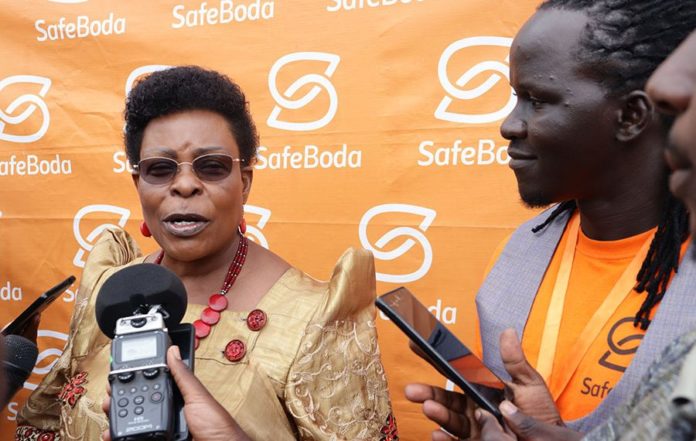
Safe Boda offers clients 50 percent discount on all cashless rides

One of the leading motor bike ride sharing applications in Uganda,
Safe Boda has a introduced a 50 percent discount to all its users who ride cashless this month.
According to a press sent to Eagle Online, every Safe Boda customer who uses mobile money, as a one off – and every time they will take a trip, the fare will be automatically deducted from their account, making it much more convenient.
To top up credit, users are advised to open their applications, tap payment,tap top up Safe Boda account and it will automatically link to their respective mobile money accounts.
They will then enter their private pin codes, approve and ride cashless. Damalie Wasukira, the Communications Manager at Safe Boda says that the company aim to promote a convenient transport experience which is why they encourage their customers to top up their accounts.

“Safe Boda aims to promote a convenient transport experience which is why we are encouraging our customers to top up their Safe Boda accounts and ride cashless. Customers can top up daily, weekly or monthly using MTN or Airtel money directly through the Safe Boda app. Payments are instant through the app and even more affordable,” she said.

Stories Continues after ad

EAC officials calls for harmonised pesticides testing

The EAC Deputy Secretary General in-charge of Productive and Social Sectors, Christophe Bazivamo has called upon pest control product companies to take advantage of EAC harmonized system for testing and registration of pesticides.

The 38th Extra-Ordinary Council of Ministers in approved the EAC pesticides management guidelines on efficacy trials, residue trials and registration requirements.  The Council further directed Partner States to domesticate them by 30th May 2020.

The EAC harmonized system comes with a number of benefits that will translate to reduced time and costs associated with testing and registration of pest control products across EAC Partner States.  It is expected that farmers in the region will have increased access to quality, safe and affordable pesticides.

Bazivamo said the companies that involvement of the Private Sector is pivotal for successful implementation of the guidelines. He further said that EAC appreciates and recognizes the contribution that the private sector makes in the EAC integration agenda.

He made the remarks during the Technical Working Group meeting on pilot testing of EAC harmonized pesticides registration guidelines held in Arusha, two days ago.
The meeting was convened by the EAC Secretariat with support from USAID Kenya & East Africa, the United States Department of Agriculture and Africa Lead II. The main objective of the meeting was to finalize roadmap and discuss modalities of pilot testing of EAC harmonized guidelines for testing and registration of pesticides.

Bazivamo said  that area of agrochemicals and pest control products is a key priority in the EAC agricultural sector. Article 108 of the EAC Treaty focuses on the need for EAC Partner States to adopt common mechanism to ensure safety, efficacy and potency of agricultural inputs including chemicals, drugs and vaccines.

He  urged Partner States to pilot implementation of the pesticide efficacy guidelines for the first three years in order to pave way for operationalization of full mutual recognition. The Sectoral Council also urged Partner States to prioritize joint testing of pesticides and to share information on products that can control the Fall Army Worm which has posed a major threat to food security in the region.

Since 2016 the Fall Army Worm has been spreading across much of sub-Saharan Africa. Currently, over 45 countries out of 55 countries in Sub-Saharan Africa have been affected.  It is estimated that Fall Army Worm has the potential to cause maize yield losses in the range of US$ 2 to 6 billion in Africa’s maize producing countries.

During the meeting, representatives of Bayer, Syngenta, AgBiTech, REAL IPM, Corteva, Provivi and Arysta Life Science made presentations about products developed by their respective companies to control the Fall Army Worm. The presentations also outlined the efficacy and safety of the products and EAC Partner States where the companies intend to conduct pilot trials of their products.


Stories Continues after ad

Ugandan to gain from AfDB Adaptation Benefits Mechanism

The public sector cannot provide enough finance to make African countries resilient to climate change impacts, and funding from the private sector is hard to come by. At the same time, many grassroot adaptation initiatives are being developed and some of these are making a big difference.
To supplement other efforts the African Development Bank (AfDB) launched The Adaptation Benefits Mechanism (ABM), an innovative mechanism  for mobilising new and additional public and private sector finance. The pilot phase will create a new asset – certified adaptation benefits, with a compliance value for the Paris Agreement, nationally determined contributions (NDCs) and the sustainable development goals (SDGs).
The Bank has raised the share of adaptation finance from less than 30% in 2016 to 49% in 2018, in order to better respond to the needs of the African continent.
The project developers participating in the pilot phase are the International Agroforestry Centre (ICRAF) in Côte d’Ivoire, Whave Solutions in Uganda, and the Center for Governance and Human Security Studies (CGHSS) in Rwanda.
Ben Sheardown from Whave Solutions said “The residents of Uganda are already beginning to experience the effects of climate change. The services that Whave Solutions is offering to rural communities not only help them to become more resilient, but also to improve their health and livelihoods”. Andrew Rucyahana from CGHSS said that as a social entrepreneur he wants to help vulnerable communities to adapt to climate change as well as earn a living from it.
Amani Kouassi from ICRAF explained how the organization enables adaptation activities, not only between governments and the private sector, but also between local governments and vulnerable communities. He also said that the high interest rates of commercial banks were impeding private sector engagement.
In the period 2019-2023, the African Development Bank will implement at least 12 ABM demonstration projects in Africa, with a focus on vulnerable communities in least developed and low-income countries. The results will inform and further develop the ABM before it is used in the international community.
The concept of the ABM has been developed by the African Development
Bank since 2016, with support by the Climate Investment Fund (CIF)
and in consultation with several African countries, including the Côte
d’Ivoire and Uganda, as well as other stakeholders. In the
UNFCCCdiscussions on Article 6 of the Paris Agreement, the ABM was
mentioned as an example of a non-market-based approach.

Attachments area
Stories Continues after ad