Stanbic Bank
Stanbic Bank
18.8 C
Kampala
Stanbic Bank
Stanbic Bank
Home Blog Page 1360

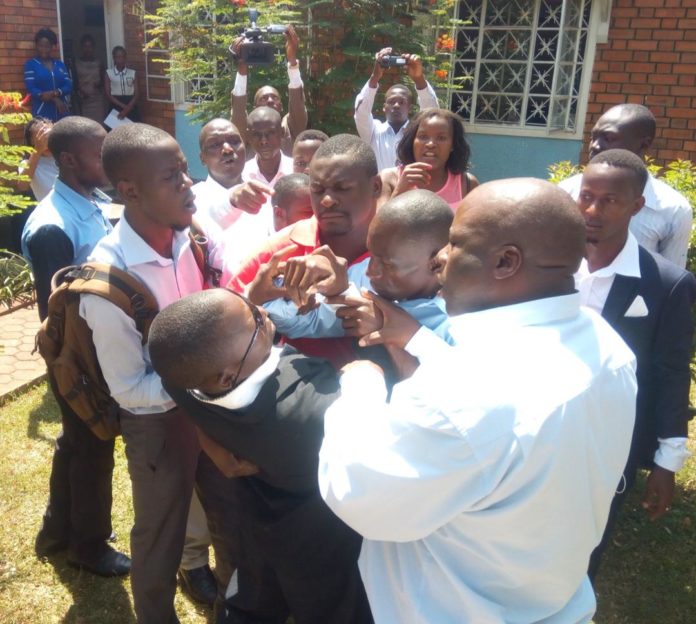
FDC members harass journalists at Najjanankumbi

Reporters being roughed up at FDC head office.

Journalists who had gone to the weekly Forum for Democratic Change (FDC) press briefing were on Monday mistreated as they protested the suspension of the event.

The journalist were harassed by the FDC) errant members.

The incident at the party headquarters in Najjanankumbi started when journalist complained about the late cancellation of press conference after they had spent hours waiting for party officials begin addressing them on the latest developments in the party.

At about 11:00am, the officials apologized to journalists and informed them that press briefing would not take place on the account that the party spokesperson who doubles as Kira Municipality MP, Ibrahim Semujju Nganda was held up in a meeting and therefore would not be in position to address them.

Journalist therefore became furious castigating the party’s practice of wasting their time and making them sit for hours.

Members of the fourth estate insisted not to get out of the conference room without seeing or talking to concerned party members. This prompted FDC members Henry Katumba and another person identified as George to lock them into the conference room.

The fracas led to assault of a number of journalists. Our effort to speak to FDC spokesperson Mr. Semujju Nganda was futile since he could not pick our calls.

Journalist body, Uganda journalists association (UJA) condemned the incident and called for boycotting of FDC weekly press briefing.

Stories Continues after ad

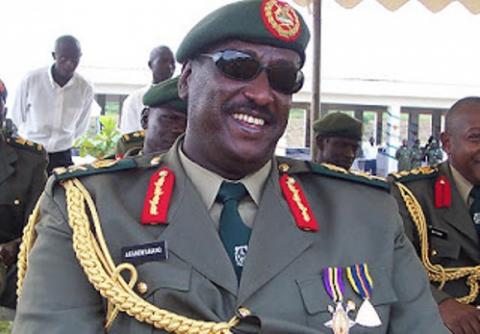
Rwanda accuses Gen. Saleh of doing business with its rebels

Gen. Salim Saleh

Rwanda continues to be desperate as Uganda continues to keep businessman Tribert Rujugiro Ayabatwa in the country as he does his business.

The government through the RPF owned paper The New Times online version claims the businessman is a fugitive even though it presents no evidence to that claim.

The regime in Kigali says Rujugiro Ayabatwa is involved with ‘a group’ that has declared war on Rwanda’s legitimate government and to tarnish the leadership of Rwanda in a string of unchallenged claims and allegations.

The regime seem not to be happy with Sunday Vision of March 17, for running the businessman’s interview. “In a question and answer newspaper interview, normally the journalist interjects with probing, insightful, researched questions as a check against a subject using a newspaper – or magazine, or other news medium – as a platform to air their misinformation,” says Grace Kamugisha who wrote what seems to be a paid-up article and yet claims Sunday Vision’s article was paid for and planted by Ugandan state actors.

“The man merely says everything that serves him (and his partners in the highest levels of the Ugandan government) to misinform the public about the true nature of his; and by extension his Kampala partners’, problems with Kigali. We shall come to that. A good interview strives to show there are two sides to a story. In this one the Sunday Vision has thrown balance completely out the window,” he cries.

The writer who seem to be writing on behalf of the Rwandan government seem to have other reasons why Rujugiro left Rwanda other than on principle and mistreatment where government took over his commercial properties and the like.

“The facts are that Rujugiro left Rwanda because his business practices – the ones that have made him successful in a number of African countries including Uganda where he has a tobacco processing plant in Arua – were completely incompatible with Kigali’s anti-corruption and graft-intolerant ethic in running its state affairs,” he says.

The record shows that wherever Rujugiro has worked and his businesses succeeded, those countries are characterized by high levels of graft. It is the kind of countries that regularly score poorly on Transparency International indices, he alleges.

He alleges Rujugiro left Rwanda in 2010 after repeated issues with the administration because of his ‘shady business practices’. “He did not like to pay taxes. He expected that because he had contributed to the liberation struggle he would be exempted from paying taxes. When that did not happen he became very unhappy,” he says.

The website says he would constantly offer kickbacks to policy makers to exempt him from the rules of doing business that applied to all other businessmen and women. “He found out that graft like that had no place in Rwanda,” he says.

“Rujugiro’s methods had worked well in Burundi – where he cut his teeth in the business world – and other places like Uganda where stories of monstrous scams have dogged Museveni’s rule from day one,” he alleges.

He alleges that as a smuggler of cigarettes in Bujumbura, and then rose during the administration of Jean Baptiste Bagaza from the mid-1970s to late 80s. Rujugiro corrupted a number of officials to, among other things, avoid taxes and kill competition. “When Pierre Buyoya took power, he locked the Rwandan up for three years in Bujumbura central jail for the offences,” he says.

He says another country where Rujugiro’s corrupt practices landed him into big trouble was South Africa. In November 2006 South African Revenue Services (SARS) officials barricaded his cigarette manufacturing company in Wilsonia, Eastern Cape amid a 57 million Rand fraud case against Tribert Rujugiro Ayabatwa and his senior employees, he says.

News reports said agents of SARS swooped on the premises of the company, Mastermind Tobacco Company, sealing all its entrances.

Rujugiro, knowing SARS was on his case for his fraudulent activities had already fled SA, and couldn’t go back there. He was in Rwanda at the time. Reports are that President Kagame repeatedly advised him to clear his issues with South Africa and “to not tarnish Rwanda’s good name like that”.

He alleges that on October 13, 2008 London Police (Scotland Yard) arrested the Rwandan businessman at Heathrow Airport. “They acted on an Interpol red notice following an international arrest warrant put out by South Africa,” he alleges.

Scotland Yard would release Rujugiro – with a leg bracelet to monitor his movements – after he agreed to pay the South African taxman US$ 7.I million in arrears.

“But journalism was not the aim of the paper’s interview. The politics of Kampala’s antagonism against Rwanda was the aim,” he cries.

He alleges Rujugiro left Rwanda in 2010 with a vengeful heart, to fund dissidents fighting Rwanda including Kayumba Nyamwasa, boss of RNC – the rebel group that’s facilitated by President Museveni in plots to bring war back to Rwanda.

He alleges part of Rujugiro’s anti-Rwanda efforts is to finance RNC misinformation, such as paying one David Himbara, the rebel group’s chief propagandist that’s based in Canada. It is a matter of record that in September 2017 for instance, Rujugiro through Himbara paid the Washington DC lobby firm Podesta Inc US$ 440,000.

According to the writer, the aim was to buy access to the US Congress, for Himbara to level allegations of a nature to smear and tarnish Rwanda. In the interview, Rujugiro claims, “if he funded rebels against Rwanda, it would fall in six months. But his payments to Himbara, and to US lobbyist firms show he indeed is funding RNC.

The writer alleges Rujugiro, “channels through Himbara ample sums of money to go into RNC operations. “This renders his claim – that if he funded RNC the government of Rwanda would fall in six months,” he says adding that that was an idle boast.

He alleges Rujugiro’s tobacco company in Arua is not benefitting Ugandans. “A Kigali-based observer, speaking anonymously, comments that he would advise Ugandan lawmakers to immediately investigate that company, Meridian Tobacco Company, to ascertain whether it really is paying its tax obligations to Ugandans,” he alleges

Enter Gen. Saleh

The writer accuses Gen. Salim Saleh, President Museveni’s brother, as being a shareholder, with a fifteen percent stake in Rujugiro’s company. “Meridian Tobacco’s documents at the Uganda registry of companies show that. “The fact Saleh is involved already is a glaring red flag that this is a fraudulent company!” the analyst commented,” he alleges.

He alleges that Saleh has been involved in “hundreds of crooked activities he has perpetrated, or participated in down the decades his brother has been in power. It should also be noted that in all Saleh’s crooked activities, he has done everything on behalf of Museveni. “The hand of Museveni is never absent in Saleh’s activities,” he alleges.

“Rujugiro’s interview is peppered throughout with personal attacks on President Kagame. It however is a new kind of low for the Ugandan paper to allow Rujugiro drag the President’s family into a polemic they have nothing to do with,” he said.

“All that cannot obscure the fact Rujugiro is in partnership with the Ugandan authorities in the mutual goal to destabilize Rwanda. It also cannot take away the fact a renowned fraudster – that happens to be the chief financier of one of the main terrorist groups against Rwanda – is running a firm that only is a front for that group, with the partnership of Ugandan government officials,” he alleges.
Eagle Online couldn’t a comment from Gen. Saleh on the above allegations as he didn’t answer his mobile phone.

Uganda has denied accusations that it is hosting elements that want to destabilize Rwanda.

Stories Continues after ad

Isimba Hydro Power project ready for commissioning on Thursday

Isimba dam

Minister of Energy and Mineral Development, Eng. Irene Muloni, is on Thursday expected to commission Isimba Hydro Power project.

The construction of the 183 megawatts project was launched in 2013, with the construction works beginning in 2015. The contractors, China Water and Electrical Company Limited are finalizing the construction process with the dam built and the generating equipment installed.

The Isimba Hydro Power project cost US$567 million with 85 percent funding from the Chinese government and 15 percent from Government of Uganda. The 47 months project period ends on 31 March 2019 and it will be inter-connected to the Bujagali power dam 42 km away in Jinja.

According to a statement released by the Chairperson of the Steering Committee of Isimba Hydro Power, Eng. Badru Kiggundu, the operational handover will take place at Uganda Electricity Generational Company Limited and there will be a defect liability period of two years within which if anything develops, it will be the responsibility of the contractor to rectify.

“During the defect liability period of two years, the contractor, China Water and Electrical Company Limited will construction a bridge across the river linking Kayunga to Kamuli Districts,” said Kiggundu

He said that the bridge will be in two spans; one from Kayunga to Kuva Island and the other from Kuva Island to Kamuli side. These are realistic developments and as a country, this is one of the flagship projects followed by the bigger brother Karuma.

“The project has been realized due to the good bilateral relations between Ugandan and Chinese presidents and said Ugandans should be proud of the project. Let us take advantage of the power that will be poured on the grid not just to light our homes but to establish factories; they don’t have to be very big so that we can realize some revenue out of this added power,” he said.

Stories Continues after ad

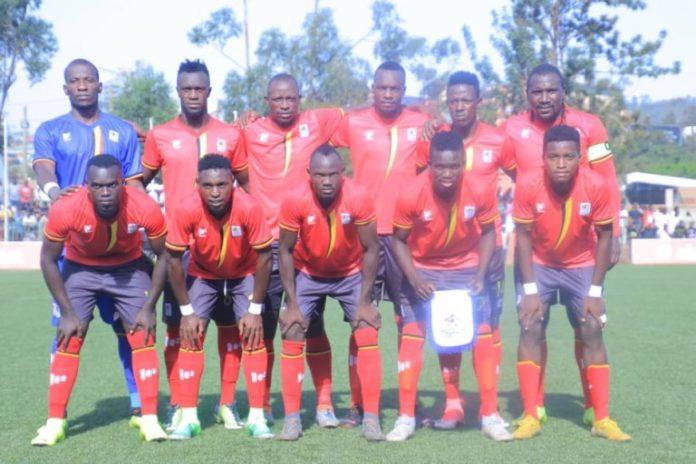
Uganda Cranes arrive in Egypt for training camp

Uganda Cranes

The Uganda Cranes team have arrived in Cairo, Egypt for their training camp in preparation for the last 2019 Afcon qualifier game against Tanzania on Sunday, 24th March 2019 in Dar es Salam.

This was after a successful week long non-residential training at KCCA stadium in Lugogo that climaxed with a trial game against Kampala Region Select a game The Uganda Cranes comfortably won 4-0.

The team will train throughout the week up to Friday and thereafter, switch to Tanzania on Saturday ahead of AFCON Qualifiers game on Sunday.

Joseph Ochaya, Emmanuel Okwi and Juuko Murushid all joined the team a stopover in Addis Ababa, Ethiopia while other missing players will join the rest in the course of the week.

The team will have a test match against a league one Egyptian club on Wednesday.

The team will be accommodated at Tolip Salfotsan Hotel in Cairo City, Egypt and Spa Ismaila Forsan Island.

Uganda is among the fourteen nations to have already secured a place at the 2019 Afcon in Egypt while Tanzania will need to win and hope Lesotho falter against Cape Verde in the other Group L stage match.

Meanwhile, Uganda Cranes tactician Sebastian Desabre has tasked players to make use of this camp and finish the qualifiers on a higher note.

Players in camp so far;

Murushid Jjuuko (Simba, Tanzania), Timothy Awany (KCCA, Uganda), Halid Lwaliwa (Vipers, Uganda), Geofrey Walusimbi (Free Agent), Joseph Ochaya (TP Mazembe, DR Congo), Nico Wakiro Wadada (Azam, Tanzania), Hassan Wasswa Mawanda (Free Agent), Tadeo Lwanga (Vipers, Uganda), Ibrahim Sadam Juma (KCCA, Uganda), Moses Waiswa (Vipers, Uganda), Emmanuel Arnold Okwi (Simba, Tanzania), Allan Kyambadde (KCCA, Uganda), Allan Okello (KCCA,Uganda), Henry Patrick Kaddu (KCCA, Uganda)

Stories Continues after ad

NMG’s Tony Glencross suffers Bells’ palsy due to work stress

NMG Managing Director Tony Glencross

Tony Glencross, the managing director Nation Media Group-Uganda developed Bell’s palsy, a sudden, temporary weakness in the facial muscles that makes half of the face appear to droop. He attributed the uncovered to a stressful work environment.

“As I gave a speech at a party, I noticed my speech was slurry yet I had not taken alcohol. This worried me,” he says of the situation he says he experienced last December.

Bell’s palsy affects both men and women equally but is more common in those aged between 15 and 60 years. It is often mistaken for a stroke but according to neuro physicians. The condition causes a temporary partial paralysis of the muscles in the face only.

Bell’s palsy symptoms can develop a few weeks after you experience a stressful situation, trauma, viral infection, or eye infection. They are usually abrupt but noticeable when you try to eat or drink or when you look at yourself in the mirror.

Others are uncontrollable drooling, difficulty chewing and drinking, inability to make facial expressions such as smiling or frowning, facial weakness and muscle twitches in the face.

Stories Continues after ad

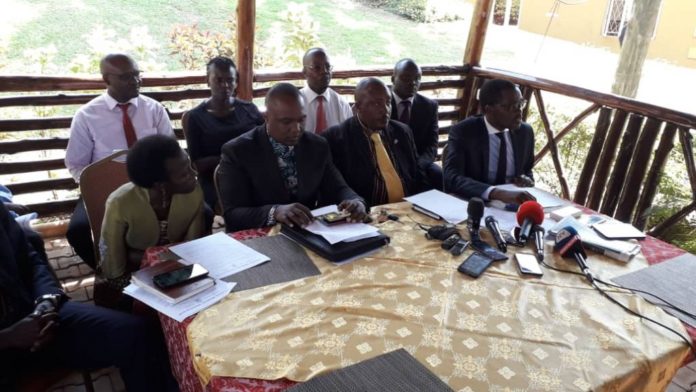
Doctors body to petition parliament over Lubowa hospital

Members of Uganda Medical Association addressing the press

Medical practitioners under the umbrella of the Uganda Medical Association (UMA) are to petition President Yoweri Museveni and Parliament over the Shs1.4 trillion specialised hospital in Lubowa, saying the money should instead be given to Mulago National Referral Hospital.

Speaking to journalists from Mulago Guest House, the association president Dr Obuku Ekwaru said that priority should be given to local needs including refurbishing Mulago and the Uganda Heart Institute.

Dr. Obuku wondered why long term investors who have been operating in the country have not been aided in the past to better their investments.

In the petition they also want the government to come with a strategy of retaining and training specialists to deal with the issue of brain drain that continues to affect health service delivery.

The association members said that the facility will be owned by government, local specialists should be involved in the planning and set up of the facility that they say has had its price exaggerated.

Parliament last week approved a promissory loan worth Shs1.3 trillion to an Italian investor FINASI to build a specialised government hospital at Lubowa amidst stiff resistance from opposition legislators.

Government will facilitate the investor with the loan and upon completion, FINASI will own the facility for six years before giving it back to government.

Stories Continues after ad

Ugandan players who qualified for the quarter-finals of Caf inter-club competitions

Okwi helped Simba qualify for quarters of Caf CL

The 2018/19 Caf Champions League and Confederations Cup quarter-finalists were confirmed over the weekend after completion of the group stages.

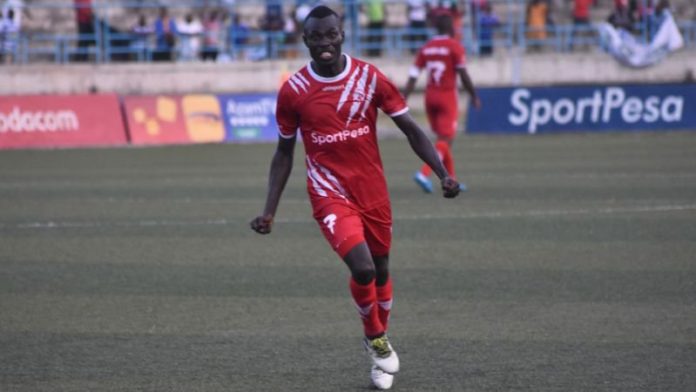
Emmanuel Okwi and defender Murushid Jjuuko helped Tanzania’s Simba come from a goal down to beat AS Vita of DR Congo to reach the Caf Champions League quarterfinals thanks to a late Cletus Chama in stoppage time.

Okwi featured for 58 minutes before being substituted with Harouna Niyonzimana at Taifa Stadium in Dar es salaam.

Denis Onyango helped Mamelodi Sundowns qualify for the Caf Champions League quarter-finals despite a 1-0 defeat to Wydad Casablanca in Morocco.

Gor Mahia will play the quarter finals of the CAF Confederations Cup for the first time in their history after holding on for a nervy 1-0 win over Petro de Luanda at the Kasarani Stadium in Nairobi despite finishing the game with only nine men.

Erisa Ssekisambu was brought on in the 85th minute in the place of Nicholas Kipkirui while Shafik Batambuze started the match and was shown a red card in the 74th minute. Jacques Tuyisenge’s penalty 12 minutes into the second half proved enough to send Gor through.

Goalkeeper Salim Jamal Magoola played 90 minutes as his side Al Hilal defeated Zambia’s Nkana FC 4-1 in Omdurman Sudan to seal progression to the quarter-finals of the Caf Confederations Cup.

The quarter-finalists for Caf Champions League: Mamelodi Sundowns (SA), Simba (Tanzania), CS Constantine (Algeria), Al Ahly (Egypt), Wydad Casablanca (Morocco), TP Mazembe (DR Congo), AC Horoya (Guinea) and Esperance (Tunisia).

Qualified teams for Confederations cup quarter-finals: RS Berkane (Morocco), Hassania Agadir (Morocco), Gor Mahia (Kenya), AL Hilal (Sudan), Zamalek SC (Egypt), ES Sfaxien (Tunisia), Etoile du Sahel (Tunisia) and Nkana FC (Zambia).

The final will be held on 19th and 26th May 2019.

The first legs and second legs of the quarter-finals will be played on 5th and 12th April respectively.

The winners of the 2018–19 CAF Confederation Cup earn the right to play against the winners of the 2018–19 CAF Champions League in the 2019 CAF Super Cup. Raja Casablanca are the defending champions.

The final eight draw is scheduled to take place at CAF’s headquarters on Wednesday 20 March 2019.

Stories Continues after ad

Digital tax stamps the answer to unfair competition

Mr. Ssempogo

By Herbert Ssempogo

Arguably, one of the biggest nightmares traders contend with is unfair competition.

Often, the unethical acts, which gradually edge counterparts out of business, are linked to flouting of regulations.

For example, a trader could be a smuggler, skirting tax and, therefore, gaining undue advantage over others and denying the Government of Uganda revenue.

In the 2016/2017 financial year, the Enforcement Division of Uganda Revenue Authority (URA) made 7,257 recoveries from smugglers. From these, sh51.3bn was collected. A total of sh60.6bn was collected from 8,918 recoveries in 2017/2018.

Were the items not recovered, the challenge would have been double edged-unfair completion and revenue loss to traders and the Government respectively.

Other than smuggling, a trader could be selling counterfeit (look alike) or fake products. The effect of such unscrupulousness would be higher sales in part as a result of low prices.

And yet, the ordinary, uninformed person would rather buy a low priced item regardless of its quality or a trader’s compliance record.

The aforementioned unfairness is what has up until now happened to many a trader and the attendant undesirable impact. But soon, it will be a thing of the past.

In what is set to further help level traders’ playing field, authorities among them Uganda Revenue Authority, Uganda National Bureau of Standard and Ministry of Trade are soon introducing Digital Tax Stamps (DTS).

Not a new tax as some people have argued, the impending DTS involves the physical stamping of a product. The stamping is done at a production line where a stamp is affixed on a product or in a gazetted area for the case of imported excisable products.

At affixation, all details about a product are captured real time. This data will be accessible by revenue administrators, policy makers and consumers through mechanisms that will facilitate access to the information.

For example, using a smart phone to read the stamp, consumers will know an item’s details-name, importer/manufacturer and expiry date in real-time. This is the information captured at stamp affixation.

And that’s how unscrupulous traders will not survive since consumers will be empowered to only buy genuine products. Slowly, crafty traders, who have hitherto denied others business, will suffer the same fate.

Curbing unfair competition is merely one of DTS’ pluses. Others are reducing informality and enabling the Government make informed decisions based on captured data.

DTS will officially kick off with all cigarettes by the end of April 1st 2019. Beers will follow in May, 2019 while sodas, bottled water, spirits and wines will follow in June, 2019. The full roll-out is scheduled for July, 2019.

There will be two types of stamps namely paper for wines, spirits and cigarettes and direct marking for beer, water and sodas.

After the roll-out, enforcement teams will use specialised gadgets to determine the validity and authenticity of stamped products. Manufacturers, whose products do not comply, will be offered a grace period and an opportunity to comply.

Before the stamping starts, stakeholders will be sensitised. Amid these interactions, participants will familiarise with the stamps. Already, several sensitisation meetings involving manufacturers, URA and the Ministry of Finance, Planning and Economic Development have occurred.

The key argument in these interactions including several with Uganda Manufacturers Association members, is that the development is meant to reduce informality. Informality affects players as much as it affects Government’s activities for example revenue collection.

It will bring on board manufacturers and others, who have for a long time remained unknown, a state that facilitates non-compliance. Regulations among them tax.

Already, DTS are being used for similar reasons in neighboring Kenya.

Herbert Ssempogo works in URA – Media Unit, Public & Corporate Affairs

Stories Continues after ad

Joint AU-UN team examines the implementation of the Somalia Transition Plan

A delegation from the United Nations Headquarters and the African Union Peace Operations Support Division at the AMISOM mission headquarters in a meeting with AMISOM Sector 5 commanders in Jowhar, Somalia on 12 March 2019. AMISOM Photo

A visiting African Union and United Nations (AU-UN) delegation completed up its weeklong assessment tour of Somalia this weekend, after evaluating progress made by the African Union Mission in Somalia (AMISOM), in the implementation of specified tasks, stipulated in the Somalia Transition Plan.

The AU-UN delegation travelled to the port city of Kismayo in Jubbaland State; and Jowhar, the administrative capital of HirShabelle State this week, to assess the reconfiguration of AU troops, in line with the Transition Plan.

The troops have played a significant role in cushioning the Federal Member States from Al-Shabaab insurgency, since setting up base in the regions.

“The objective of our visit is to discuss with AMISOM military, police and civilian components, the progress made in the past year, assess the implementation of the Transition Plan; and the recent UN Security Council Resolution on Somalia,” Vincent Pasquini, the Team Leader of the visiting delegation said.

Mr. Pasquini, who is from the UN Department of Political and Peacebuilding Affairs (DPPA) and the Department of Peace Operations (DPO), noted that the delegation made an assessment of the transition activities being undertaken by military contingents from Troop Contributing Countries to AMISOM, and their interface with the Somali National Security Forces. The countries include Uganda and Burundi among others.

While in Jowhar, the delegation held closed-door consultations with senior Burundi military officials, to understand the magnitude of the challenges facing their troops. Captain Melance Nkengurutse, the Spokesperson for the Burundian troops said discussions with the delegation was centred on operational issues and joint operations between the AU troops and the Somali National Army.

Before their departure from Somalia, the visiting delegation is expected to hold consultative talks with the Federal Government of Somalia, AMISOM leadership, the UN and international partners, on various issues; among them the implementation of the recommendations contained in the AMISOM Operational Readiness Assessment (ORA) report; and the political and security situation in the country, ahead of the one-person, one-vote elections, due in 2020/2021.

Stories Continues after ad

Study ranks Kampala third in East Africa for highest FDI inflows

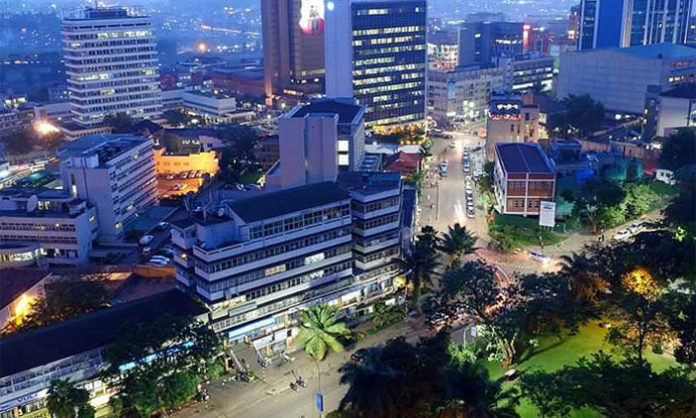
Kampala has been ranked third behind Nairobi and Dar es Salaam in East Africa to receive huge foreign direct investment (FDI) inflows.

Kampala, which ranked 26th in Africa and 335th in the world with FDI amounted US$2.3 billion, a growth of eight per cent when compared with the previous report followed by Kigali, which is ranked 27th in Africa and 349th in the world after receiving FDIs amounting US$2.3 billion.

This was reported in the recent study titled The States of African Cities 2003-2018 jointly published by the UN-Habitat, African Development Bank, Wits School of Economic and Business sciences and UK Aid.

The report, which covers the period of 15 years has also revealed that Dar es Salaam was ranked 224th among 1,325th cities in the world, to record huge investments.

Nairobi was leading after being ranked eighth in Africa by recording FDI valued US$5.9 billion, a growth of 25.1 per cent compared with the previous report of 2008.

During the reviewed period, Dar es Salaam city received FDIs amounting $3.4 billion, a decrease of 4.75 per cent recorded during the previous ranking held in 2008.

Manufacturing and services sectors attracted more investments to African cities, not only Dar es Salaam, but also other cities featured, the report has said.

The resources sector is the second-largest recipient of FDI, accounting for 34 per cent of total FDI. “The resources sector in Africa is extractive in nature and mainly associated with the export of raw material rather than local value addition,” says the 322-pages report.

Other leading sectors to receive FDI were construction, geological exploration and development, Import and export trade as well as wholesale and retail trade.

The report has said that domestic market size, well-developed norms of trustworthiness, low level of corruption, rule of law have strong positive impacts on attracting FDI into Africa.

“FDI will locate in countries with large and expanding markets with greater purchasing power and where firms are likely to obtain a higher return on capital and investment profit,” says a report.

Further, the report shows that availability of domestic credit, financial market development and Presidential systems of government were highly significant and positive to attracting FDI.

The report has ranked Mombasa as the fifth city to attract more FDIs in East Africa with a portfolio of $1.3 billion, a growth of 4.9 per cent. It was also ranked 34th in Africa and 435 out of 1,325 cities in the world.

The main FDI sources according to the report were Paris, Tokyo, London, New York, Singapore, Seoul, Hong Kong, Chicago and Dubai.

Generally, the report has shown that Cairo holds the first place in Africa in terms of volume of FDI attracted, followed in 2nd place by Johannesburg, then Tangiers (3rd), Lagos (4th), Casablanca (5th), Algiers (6th), Cape Town (7th), Nairobi (8th), Abidjan (9th) and Dakar (10th). The case study of Cairo reveals that, apart from the proximity to Europe and Arab States, Cairo is a vibrant city with well-developed infrastructure and road networks, an availability of skilled workers, a conducive foreign investment environment and ease of doing business which makes it a desirable location for investment.

“It is noteworthy that 40 per cent of the top 10 are in Northern Africa, but also that many of these are currently experiencing negative FDI growth, arguably reflecting political and social tensions in the wake of the ‘Arab Spring’,” reads the report.

“It is further noteworthy that many newly emerging urban economies like Abidjan,

Accra and Kigali have high positive growth rate.”

UN-Habitat Executive Director Ms Maimunah Mohd Sharif commented in the report that with a population of over 1.2 billion and a combined GDP of US$3.4 trillion, Africa is an attractive destination for foreign direct investment (FDI), which amounted to US$56.5 billion in 2016.

The report shows that although Africa receives a modest share of global FDI, it has the second highest investment growth rate, when compared to other world regions.

Moreover, she said Africa’s rapidly growing population is increasingly living in cities with the continent’s urban population expected to reach 50 per cent by 2030, up from 36 per cent in 2016. “Benefiting from economies of scale and agglomeration, African cities are becoming the drivers of economic growth and productivity,” she said. “The report also shows that African governments need to connect FDI attraction to sustainable urbanisation by underpinning it with robust national urban policies, urban planning, and financial and legal systems.”

The report critically considers the benefits of FDI into job-rich and higher productivity sectors (e.g. IT and manufacturing) compared to capital intensive sectors with limited value addition (e.g. resources).

It was argued that African countries should find the best trajectories for their development, taking into account their country and city-specific locational advantages in attracting public and private investment.

The study noted that FDI into Africa has neither lifted African populations out of poverty nor has it addressed the growing gap between the more innovative and technologically lagging countries.

The city with the highest amount of FDI inflows is Johannesburg with US$944 million, followed by Lagos, Cape Town and Nairobi, which attracted FDI inflows of US$658 million, US$460 million and US$427 million respectively.

Pierre Guislain, the Vice-President, Private Sector, Infrastructure & Industrialisation, African Development Bank commented that “an interesting finding is that in contrast to conventional FDI theory, Chinese investment in Africa tends to focus on countries with lower political stability”.

so as to explore underinvested states, as well as to avoid competition with investors from advanced economies.

The research shows that Chinese firms have made contributions to African development, particularly in the energy and infrastructure sectors, with the incentive of creating more attractive investment environments and to stake a claim in the economic development of the continent.

Stories Continues after ad