Stanbic Bank
Stanbic Bank
19.4 C
Kampala
Stanbic Bank
Stanbic Bank
Home Blog Page 1367

UN agency plan tackles ‘hidden cost’ of gold, paves way for safer, mercury-free mining

From smartphones to wedding rings, the hidden cost of everyday gold is its threat to human and environmental health, according to a new United Nations-driven initiative launched on Monday that aims to tackle mercury-based mining methods.

As gold production exposes millions of men, women and children globally to toxic levels of mercury every year, a new $180-million Global Environment Facility-backed Global Opportunities for the Long-term Development of the artisanal and small-scale gold mining (ASGM) sector (GEF GOLD) programme will improve conditions for miners across eight countries while slashing harmful mercury emissions.

“The widespread use of mercury in the artisanal and small-scale sector affects the environment and people, particularly in developing countries” said Philippe Scholtès, the UN Industrial Development Organization’s (UNIDO) Managing Director of Programme Development and Technical Cooperation.

The ASGM, which accounts for 20 per cent of the world’s annual gold production, is the single largest source of man-made mercury emissions, responsible for releasing of as much as 1,000 tonnes of mercury to the atmosphere annually.

“Mercury emissions impact health and ecosystems, contaminating the food we eat, the water we drink and the air we breathe,” explained Joyce Msuya, Acting Executive Director of UN Environment(UNEP). “This is a long-term problem we need to confront now” to protect health, provide livelihoods and save the planet, she added.

Moreover, some 15 million people work in the ASGM sector, including 4.5 million women and over 600,000 children.

“By phasing out mercury use and connecting miners to markets for responsibly produced and sourced minerals, GEF GOLD will help to ensure the gold value chain both supports miners and provides consumers with access to ethically produced, environmentally sustainable gold,” said Jacob Duer, Head of UNEP’s Chemicals and Health branch.

Working on the edge

To sate the appetite for gold for jewelry, investment and consumer products, miners and processors often work in harsh conditions without industry protections on pay, health or safety, with many relying on toxic, mercury-based extraction methods.

“It is important to transform the extremely harmful practice using mercury in ASGM to protect the human health and ecosystem,” stressed Abdoulaye Mar Dieye, UN Nations Development Programme, (UNDP) Director of the Policy and Programme Support Bureau.

Studies indicate that ASGM mercury exposure is a major, largely neglected global health problem that put miners and their communities at risk of brain damage; vision and hearing loss; and delayed childhood development.

While ASGM offers employment for rural populations, miners frequently operate on the edges of legality, with ASGM either banned outright or limited by legislation. GEF GOLD intends to secure miners’ livelihoods by supporting regulatory and policy reforms to formalize ASGM across the programme countries – opening market and finance access to increase incomes and enable mercury-free technology.

Additionally, the GEF GOLD programme will work with the private sector to promote compliance with international standards on responsible mineral supply chains.

Spanning eight countries, the five-year programme is a partnership between UNEP, UNDP, UNIDO, the Global Environment Facility, Conservation International and the governments of Burkina Faso, Colombia, Guyana, Indonesia, Kenya, Mongolia, the Philippines and Peru.

Stories Continues after ad

Ugandan national appointed Director United Nations Relief and Works Agency for Palestine refugees

Mr Michael Ebye Amanya

The United Nations Relief and Works Agency for Palestine refugees in the Near East (UNRWA) has appointed Mr. Michael Ebye Amanya a Ugandan national, to the position of Director of UNRWA Affairs in the Syrian Arab Republic as of February 15 2019.

Mr. Amanya joined UNRWA in March 2017 as Deputy Director of Programmes, Syria Field Office. In that role, he supervised the development and implementation of programmes for the 438,000 Palestine refugees in Syria.

“I am excited to be able to continue building on our work with and for the Palestine refugee community of Syria. After eight years of conflict, Palestine refugees continue to be one of the most vulnerable groups in Syria with immense humanitarian needs,” Amanya said. “I look forward to ensuring that UNRWA continues to provide quality services and emergency assistance to support Palestine refugees.”

Amanya has spent more than 25 years working in the humanitarian assistance field, including with the International Rescue Committee and Action Aid. He was the first Regional Director for the Middle East for the International Rescue Committee (IRC) between 2007 and 2010.

Subsequently, he became the IRC’s Regional Director for the Democratic Republic of Congo (DRC) in 2012 and led a programme that provided assistance to 2.5 million displaced and vulnerable Congolese.

Earlier deployments with IRC and Action Aid saw him develop and implement programmes in response to the Rwandan genocide, Darfur conflict, the refugee crisis in Western Tanzania and internal displacement in Northern and Western Uganda.

Amanya received his Bachelor of Arts in social work and social administration and Master of Arts in social sector planning and management from Makerere University in Uganda.

UNRWA is funded almost entirely by voluntary contributions and financial support has been outpaced by the growth in needs

Stories Continues after ad

French insurance firm in partnership with Rugby Africa to support women atheletes

Rugby-She-Cranes

French insurance firm, Société Générale and Rugby Africa have agreed to join forces for the next two years to support the development of rugby in Africa, with a particular emphasis on rugby competitions for women and young athletes.

The new partnership is an additional milestone in Société Générale’s ongoing commitment to supporting the development and openness of rugby in France and internationally, especially in Africa.

Rugby Africa is one of the six regional associations of World Rugby, the international body that oversees the organisation of the Rugby World Cup.

The partnership will focus specifically on: World Rugby’s Get into Rugby program, which aims to encourage everyone around the world to take up rugby and the two official competitions for women’s rugby, the Africa Women’s Sevens, and under-20s rugby with the U20 Barthès Trophy

“This partnership is the continuation of two of our long-term commitments: to rugby, of which we have been a reliable partner for over 30 years, and to Africa, with our Grow with Africainitiative, a program central to our priorities that aims to promote the sustainable development of the continent,” said Caroline Guillaumin, Director of Human Resources and Communication for the Group.

She said African rugby was booming, and we intend, in association with Rugby Africa, to implement important rugby development projects as a force for social cohesion.

“This partnership uniting us with Société Générale will instill more vigour in the development of African rugby, especially with young people and women. Currently, around half a million children and teenagers are introduced to rugby every year in Africa,” said Abdelaziz Bougja, President of Rugby Africa.

He said the number of registered female players has more than tripled in recent years in Africa. This partnership is a decisive step forward for Rugby Africa as it brings the necessary investment to support this rapid growth. We thank Société Générale for the confidence they have placed in Rugby Africa and its federations.

Société Générale is a long-standing partner of rugby, a sport with which the Bank shares the common values of team spirit, commitment and respect. The Bank supports the development of all forms of rugby, from the amateur level to the highest professional level.

In France: it is partner to more than 450 amateur clubs in France, the Top 14, PROD2, the French Rugby Federation (FFR) as well as the French national rugby team.

Internationally, it is a major partner and the official bank of the Rugby World Cup for the sixth time, a partner of Rugby India (Indian Rugby Federation) and title sponsor of the rugby sevens national teams in all categories (men, women and junior) since 2017, backer of the association Terres en Mêlées and partner of the Algerian Rugby Federation.

Stories Continues after ad

Cabinet okays physical planners registration bill 2019

Mr. Ofwono Opondo.

Cabinet has approved Physical Planners Registration Bill, 2019 peddled at regulating physical planners and holding them accountable for their professional conduct.

The regulation is in line with the Physical Planning Act 2010 that empowers the local physical planning committee to prohibit or control the use and development of land and buildings in the interests of the proper and orderly development of its area.

The act prohibits a person from carrying out any development within the planning area without obtaining development permission from the committee.

Speaking at Media Centre, government spokesperson, Ofwono Opondo, said Physical planners will play a more effective role in all physical planning matters in the Country within the pretext of the law and regulation.

“There will be enhanced coordination between the physical planning profession and other professionals in the Construction Industry within the Country. Physical planners will be made more responsible and accountable for their professional conduct,” he said.

He said, the physical planning practice will be more responsive to the Country’s Physical Development Plans since the registration of Physical Planner’s will be done an annual basis.

Mr. Opondo said physical planning practice and professional interests of the registered Physical Planners who may wish to operate in Uganda will be regulated and Quack Physical Planners who have defrauded many local Governments and private developers will be eliminated.

Stories Continues after ad

East Africa Crude Oil Pipeline to top EA’s infrastructure projects funding -report

Crude oil pipeline

Uganda and Tanzania’s Tanzania oil and pipeline projects will top this year’s infrastructure transactions in the region, with the two countries seeking over US$7 billion funding for the projects, a new report says.

According to Debtwire’s Africa Project Finance Trend update for 2019, the oil and infrastructure sectors are the most likely to attract interest from investors and financiers this year.

Uganda is expected to top the infrastructure transactions with the US$3.5 billion joint East Africa Crude Oil Pipeline project that will run from in the oil rich district of Hoima on the border with DRC to the Indian Ocean port of Tanga in Tanzania.

Stanbic Bank Uganda, the lead arranger for a US$2.5 billion loan, said that it expects the deal to be concluded in June 2019. The balance of US$1 billion is expected to come from shareholders in the form of equity.

In November 2018, Uganda announced that it expected to have a conclusive financial deal for the joint pipeline with Tanzania by mid-2019, paving the way for its construction after months of delays that have seen Kampala revise its oil production timelines.

Last week, Energy Minister Eng. Irene Muloni hinted that production is likely to start in 2022, a slight delay from the revised date of 2021.

Uganda discovered crude reserves more than 10 years ago, but production has been repeatedly delayed by disagreements with field operators over taxes and development strategy. A lack of infrastructure such as a pipeline and a refinery have also held up output.

China’s CNOOC and France’s Total and Tullow Oil have stakes in the two areas. CNOOC is the operator of Kingfisher block while Total leads the exploration in Tilenga.

“We are preparing for production. We have to build a pipeline for exports and a refinery to add value. So unless those two projects are done we cannot start production,” said Ms Muloni.

In April 2last year, Uganda signed a deal with a consortium, including a subsidiary of General Electric, to build and operate a 60,000 barrel per day refinery that will cost between US$3 billion and US$4 billion. The refinery is expected to be operational by 2023.

Minister Muloni said Uganda would announce its next exploration licensing round May this year.

A final investment decision for the refinery will be taken by September 2020 and the project is expected to be completed in three years’ time, she said.

The crude export pipeline through Tanzania, with a capacity to transport 260,000 barrels a day, will be built by 2022, the minister said.

Stories Continues after ad

Four FUFA Big League teams reach Uganda Cup quarterfinals

Uganda cup trophy

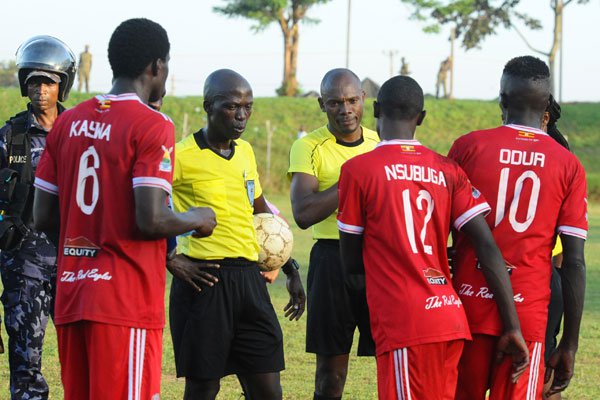
The round of 16 games have been concluded and the quarter-finalists of the 2018/19 Stanbic Uganda Cup quarter finals have been confirmed.

Four sides from the second tier of Ugandan football, the FUFA Big League are still in the competition while the rest are from the Uganda premier League.

Nebbi Central, Wakiso Giants, Kyetume and Proline FC are from the Big League. Express, Vipers, Bright Stars and BUL are the UPL sides left in the competition.

The date for the quarterfinals draw and dates for the games to be played will be communicated.

The winning club of the Uganda Cup will smile home with Shs40 million, runners up Shs20 million, semi-finalists Shs10 million, quarter finalists Shs5 million and Shs2.5 million for each of the clubs that finished at the round of 16 stage.

The host region and ground for the final of the 45th edition of the Uganda Cup will be communicated in due course.

The winner of the competition represents Uganda in the CAF Confederation Cup as per the rules of the competition. KCCA FC are the defending champions.

Qualified teams: Express, Vipers SC, Bright Stars, BUL, Nebbi Central, Wakiso Giants, Kyetume and Proline FC.

Round of 16 results:

Proline FC 2-1 Onduparaka FC

Kitara FC 0-1 Kyetume FC

URA FC 1-2 Bright Stars FC

Vipers SC 1-0 Kiboga Young SC

Nebbi Central FC 1-0 Nkambi Coffee FC

BUL FC 4-1 Bukedea TC FC

Wakiso Giants FC (4) 0-0 (2) Tooro United FC

Express FC (4) 0 – 0 (1) Police FC

Stories Continues after ad

Champions League: Liverpool vs Bayern preview

lewandowski and salah will need to inspire their teams to glory

The two sides that boast 10 Champions League/European Cup titles between them, meet in the Champions League round of 16 first leg tie on Tuesday night at Anfield.

Liverpool and Bayern have never met since the competition’s re-branding in 1992. The previous time they met in a two-legged tie was in the European Cup semifinal in 1981, when the Mersysiders triumphed on the away goals rule following a 1-1 draw in Germany.

Friendly encounters aside, their most recent meeting was in the 2001 UEFA Super Cup, where Liverpool walked away with a 3-2 victory.

With Van Dijk suspended and Lovren doubtful, Klopp has to decide who will partner Joel Matip at centre-back. Xherdan Shaqiri (abdominal) faces a late fitness test and is a doubt to face his former club.

Fabinho could pattern with Matip as a solution to Liverpool’s defensive fitness crisis. This comes after Jurgen Klopp revealed that Dejan Lovren would be subject to a last-minute fitness assessment ahead of the last-16 showdown at Anfield.

Joe Gomez (ankle) and Alex Oxlade-Chamberlain (knee) remain long-term absentees.

Bayern Munich will be without centre-back Jerome Boateng after he was ruled out with “stomach flu”. Thomas Muller serves the first of a two-game suspension.

Winger Franck Ribery has joined up with the Bundesliga champions in England following the birth of his child ahead of the game.

Kingsley Coman has been declared fit after suffering a knock in Friday’s 3-2 away win over Augsburg. Arjen Robben, who has not featured for Bayern since late November due to a thigh injury, is not included in the 21-man squad.

The return leg will be played on 13th March at Allianz Arena in Munich.

Key stats

Bayern Munich have won only one of their seven matches in European competition against Liverpool (D4 L2).

Liverpool and Bayern Munich’s only previous encounter in the European Cup/Champions League came in the 1980/81 semis. Liverpool progressed on away goals (1-1 on aggregate) – they would go on to beat Real Madrid in the final (1-0).

Bayern Munich haven’t scored a single goal against Liverpool at Anfield (3 games).

Liverpool are unbeaten in 19 consecutive European matches at Anfield (W14 D5), last losing at home back in October 2014 against Real Madrid in the Champions League (0-3). It’s their second longest unbeaten streak at home in European competition after their 40-match run between September 1974 and December 1991.

Bayern Munich were one of five teams to remain unbeaten in this season’s Champions League group stages, along with Ajax, Barcelona, Lyon and Porto. They have reached the Champions League semi-finals in seven of the last nine seasons.

Bayern Munich are on a run of eight consecutive Champions League away matches without a defeat (W6 D2), with their last loss on the road coming in September 2017 versus Paris Saint-Germain (0-3).

Bayern Munich are the top scoring side from set-pieces in this season’s Champions League with eight goals, including five from corner situations (also a competition high).

Stories Continues after ad

MTN Group officials in country to meet Museveni over CEO deportation

President Museveni meeting MTN group CEO last month.

South Africa based MTN Group have arrived in the country to hold negotiations with President Yoweri Museveni and other government officials over the recent deportation of Wim Vanhellepute, the CEO of its affiliate MTN Uganda on allegations of compromising Uganda’s national security, Eagle Online can say.

The MTN Group officials led by the CEO Robert Shuter and others were expected to meet with the officials of telecoms regulator, Uganda Communications Commission (UCC) which is in the final stages of awarding MTN Uganda a new 10 year license worth about US $58 million, even though President Museveni said the fee should have been about US$100 million.

Days ago Eagle Online reported MTN Group was in preparations to send a delegation to Uganda to meet top government officials, following the deportation of Vanhelleputte.

A source said then that the deportation of Vanhelleputte caused fear among shareholders of MTN Group thinking that their business in Uganda could be closed especially after several warnings by President Museveni about the companies activities which included among others under declaration of profits for taxation.

The South African delegation is being guided by MTN Uganda Chairman Charles Magezi Mbire who is expected to lead them in meeting government officials.

In a letter signed by Internal Affairs Minister Gen Jeje Odongo, Vanhelleputte is to stay outside Uganda indefinitely.Meanwhile MTN Uganda has appointed a Ugandan as Gordian Kyomukama as the Acting CEO after the deportation of Vanhelleputte, the company said in the latest statement.

“To ensure business continuity, we have appointed Mr. Gordian Kyomukama, currently Chief Technology Officer, as Acting Chief Executive. Our focus continues to be on elivering the best quality products and services to our customers,” the statement said.

Vanhelleputte’s deportation comes about a month after the arrest and deportation of three other senior employees of the telecommunications giant. These were; the chief marketing officer, Mr Olivier Prentout, the mobile money general manager Ms Elsa Mussolini and Annie Tabura who was the general manager for sales and distribution at MTN Uganda.

There has been a continuing investigation against more MTN staff for allegedly compromising National Security using their positions at the company.

Following the deportation of the staff in January MTN Group’s CEO Robert Shuter would meet Museveni in Davos, Switzerland during the World Economic Forum. Sources say the brief discussion focused on an array of issues such as the company listing the Group’s affiliate on the Uganda Securities Exchange but as well as discussion on the deported MTN workers.

Sources said Shuter approached Museveni in Davos to see how they could resolve the on-going scandal involving the deportation of staff of the company for allegedly working to breach Uganda’s national security.

“MTN is a big business in Uganda and earning huge profits and the CEO cannot take the recent allegations lightly,” a source said.

Shareholding in MTN Group

Public (1 330 035 300 shares)

Directors and associates of the Company holdings (325087 shares)

MTN Zakhele Futhi (RF) Limited (76, 835, 378 shares

Lombard Odier Darier Hentsch &Cie (M1 Limited) (185, 657, 322 shares)

Government Employees Pension Fund (281, 210, 416 shares)

Mobile Telephone Networks Holdings (10, 206, 255 shares)

Stories Continues after ad

EAC Secretariat conducts one-day sensitisation mission to South Sudan

EAC Secretariat conducts a one-day sensitization mission to the Republic of South Sudan.

The EAC Secretariat staff under the Directorate of Productive Sectors led by Director of Productive Sectors, Jean Baptiste Havugimana, conducted a one-day sensitization mission in Juba, South Sudan.

The EAC Secretariat team comprised of senior staff drawn from the departments of Agriculture and Food Security, Energy, Industry and SMEs Development, Tourism and wildlife management, Environment and Natural Resources management. The event attracted high level policy makers and technical officers drawn from key Ministries in South Sudan.

In his opening remarks, Havugimana noted that the RSS is a valuable and strategic member of the Community in numerous ways. If sustainably exploited, resources in South Sudan could contribute significantly to increased trade and socio-economic development of the Community.

On his part, Leo Okwahi, Director General Ministry of Trade and Industry and East African Affairs, underscored the tremendous potential associated with Productive Sectors in the country. He applauded the EAC Secretariat for organizing the visit and for choosing this very hands-on and customized approach for South Sudan.

He said this kind of visit was much needed in order to try to match actions of EAC productive sectors with the real situations prevailing in those sectors on the ground in S. Sudan. He underscored the fact that the protracted civil war has led to among other many issues; loss of lives, displaced people, stopped all the activities in the productive sectors and other economic and social sectors and undermined the country’s progress since it gained independence eight years ago.

He however, expressed optimism that the peace agreement signed in 2018 was crucial for political stability and socio-economic development of the country.

During the event, EAC Secretariat team made elaborate presentations of key flagship programmes implemented under the Productive Sectors as well as backward and forward linkages across the productive sectors and other socio-economic sectors.

They highlighted in great details achievements and success stories registered so far while indicating where and how they think South Sudan can be immediately involved to achieve quick wins.

Interactive discussions that followed the presentations focused on the benefits that the EAC integration agenda offers and how the Republic of South Sudan can be fully engaged and integrated in the existing programmes, initiatives and projects under productive sectors.

Many observations were made during the meeting by South Sudanese experts and areas prone to quick wins in all the five sectors identified as follows;

Revival of agriculture and livestock sectors basing on the EAC Food and Nutrition Strategy and Action Plan. Agriculture was the main stay of the economy and the country was self-reliant in food and nutrition security until civil strife disrupted the sector. Currently, the country depends largely on imports of all sorts of food from the north Sudan, Uganda and Kenya. In addition, the huge livestock population in the country could be exploited to increase household incomes in areas such as dairy production, meat processing and hides and leather value addition.

South Sudan has vast energy reserves including oil. However, the energy sector is underdeveloped and under exploited. The little available electricity in Juba and other urban areas is produced using costly diesel generators. The EAC power pool and the ongoing interconnections arrangements can benefit RSS to mitigate this challenge. Solar energy can help solve much of this problem especially for urban households.

The country is a potentially lucrative tourist destination but a lot needs to be done in development of tourist facilities and laying down the necessary infrastructure to market tourism. RSS can benefit from EAC single tourist visa arrangements and joint regional marketing interventions led by EAC.

In the area of Industrial development, there is need to pay more attention to promotion of Small Scale Enterprises (SMEs) in order to create more employment opportunities for the youth in agro processing and manufacturing. The country had a number of agro-based industry factories that were running before the war. This could be revitalized to reduce reliance on imports.

Under Environment and Natural Resources Management, the first thing that can be done is the fight against lithering and Pollution. Plastics and all types of other paper waste are everywhere in the City of Juba. A customized awareness and fight against lithering and pollution Programme can be introduced first in the City of Juba and later on scaled up to other cities.

The one-day sensitization mission meeting ended on a high note with South Sudan Sudanese experts committing themselves to escalate the conclusions of the meeting to their principals to ensure that EAC programmes are embraced and mainstreamed in national planning and budgeting cycles of the Republic of South Sudan.

They also committed to prioritize implementation of Summit and Council of Ministers Decisions and Directives in order to contribute towards achievements of the goals of the Community.

Stories Continues after ad

BoU in crisis: Who takes responsibility as COSASE finalises report of inquiry?

Hard times await top officials at the BoU.

The Bank of Uganda (BoU) has been exposed as wanting in terms of its operations and human resource especially in the senior staff following the conclusion of the probe of the central bank by parliament’s Committee on Commissions, Statutory Authorities and State Enterprises (COSASE).

COSASE chaired by MP Abdu Katuntu concluded its probe BoU over the controversial closure of seven commercial banks such as Teefe Trust Bank, Greenland Bank, International Credit Bank (ICB), Cooperative Bank, National Bank of Commerce (NBC), Global Trust Bank Uganda (GTBU) and Crane Bank Limited (CBL). The MPs are now in Jinja writing a report that is likely to cause massive changes at BoU should government act on the recommendations.

During the investigations about six BoU officials stood out. They included; Governor Emmanuel Tumusiime-Mutebile, his deputy Dr. Louis Kasekende, former Executive Director for Supervision Ms Justine Bagyenda, Ben Sekabira, the Director Financial Markets Development Coordination, Margaret Kasule, the legal counsel and Katimbo Mugwanya, now retired from BoU but acted as statutory manager for CBL. The crisis at BoU is blamed on these officials who did not do their work as expected, more in the supervision of banks and management of their closure.

Emmanuel Tumusiime- Mutebile

Emmanuel Tumusiime-Mutebile has been credit for checking Uganda’s inflation since he joined BoU in January 2001. Apart from the year 2011, Tumusiime-Mutebile through monetary policy regulation has kept inflation within a single digit target.

However, Mutebile seems to have kept a blind eye as far the supervision and regulation of the financial sector is concerned when one considers under the Financial Institutions Act 2004 and the Micro Finance Deposit Taking Institutions Act 2003 and Implementing Regulations. This was imminent in the closure of National Bank of Commerce, Global Trust Bank Uganda and CBL. Mutebile during COSASE probe admitted that he has never seen most of the documents related to the closure of several banks. He would later contradict himself that he signed documents in the sale of GTBU after saying he never saw any documents. It caused drama in parliament with some Members of Parliament suggesting he be put on oath. On that, sections think Mutebile, aged 70, should retire.

Dr. Louis Kasekende

Very rich, Dr Kasekende, is as guilty as his boss Tumusiime-Mutebile. He failed to follow up issues related to the closure of banks. He failed to supervisor officials who were below him especially Bagyenda, Sekabira. He also tried hard to stop the Auditor General from investigating BoU. He knew all was not well as far as BoU’s operations were concerned. In his report, the Auditor General revealed that banks were closed without guidelines. He went ahead to say critical documents were missing. By the time COSASE concluded its probe, some of those documents were missing especially on GTBU, CBL, Teefe Trust Bank and Cooperative Bank. Kasekende approved Shs478 billion injected in CBL but failed to provide accountability for all the money.

Justine Bagyenda

Wealthy, Justine Bagyenda rose through the ranks to become the executive director of bank supervision before retiring mid-2018.In that position, as COSASE probe found out, she had become powerful that sometimes she took decisions on her own without consulting her bosses. Bagyenda is alleged to have hidden crucial documents related to closure of some banks, though she denied that during COSASE inquiry. She said to have contacted buyers of GTBU and CBL over phone and later drafted sale agreements without much involvement of Mutebile. She was so powerful that the majority shareholder in CBL Sudhir Ruparelia told MPs on COSASE that Bagyenda forced his then operating bank to buy some properties of NBC. That he said was done on phone. Former owners of CBL, NBC and GBTU told MPs that Bagyenda was solely responsible for the closure of their banks. They now want compensations in hundreds of billions of shillings. The taxpayer is likely to incur more losses should the compensation be okayed by parliament and central government. It should be remembered that the whole COSASE inquiry almost revolved around Bagyenda.

Ben Sekabira

Mr. Ben Sekabira is one of the longest serving officials at BoU, having joined that institution as a junior banking officer. Actually Mutebile, Kasekende and Bagyenda found him there. And he testified during COSASE probe that he witnessed and participated in the closure of most of the banks closed in the 1990s where he acted as a statutory manager. Sekabira in one of the sessions with MPs said he used to hand reports on closed commercial banks to his former bosses Edward Katimbo Mugwanya and Bagyenda. With those reports missing, it created controversy on who was telling the truth. Sekabira would later tell MPs that much as BoU injected Shs478 billion in CBL, it only needed Shs157 billion to stay afloat before Bagyenda cleared its closure on October 20, 2016. Sekabira contradicted his boss Mutebile who told MPs that he did not have figures regarding CBL’s undercapitalisation.

Edward Katimbo Mugwanya

Mr Edward Katimbo Mugwanya, was a former director at BoU who was appointed Statutory Manager for the sale of CBL, admitted that he did not know how the money that was injected in Crane Bank was arrived at. That query was raised by the Auditor General in his report that COSASE used to pin BoU officials. At the time CBL was closed Mugwanya had never written any report on the liquidation process of the bank.

Mrs. Margaret Kasule

Mrs. Margaret Kasule as BoU’s legal counsel leaves a lot to be desired as far her job is concerned. During the probe she was exposed to the extent that she failed to answer critical questions as regards the closure of banks. She was confused on which particular people ordered the closure of some banks. She also found difficulties in explain how the purchase and acquisition of liabilities agreements were reached at as Dfcu bank acquired GTBU in 2014 and CBL in 2017. At one time she also failed to explain the status of properties of closed banks. COSASE Chairperson Katuntu had to lecture her to understand. But she also allowed Bagyenda to negotiate sales agreements for GTBU and CBL, without her involving so much.

Her incompetence allowed MMKAS Advocates to do most of the work in sale of banks’ assets, earning about Shs4.2 billion that MPs said was so exorbitant, even though the lawyers explained how they arrived at that amount. Paying local service providers by government in foreign currency is prohibited under the law but Kasule allowed this to go on as BoU paid MMKAS Advocates part of this money in dollars.

While responding to MPs on COSASE during one of the sessions Mutebile accepted that all was not well at BoU. “I would like to thank you in particular, for your candid approach to tackling issues that you believe needed to have been addressed, or at least taken into consideration by the staff of the Bank of Uganda. I also would like to express my appreciation to the Auditor General for his report which raised issues that will culminate in an improvement in the operations of Bank of Uganda.

He added: “The Bank of Uganda acknowledges the relevance of this exercise and we are confident that it will enhance transparency and accountability, which are key values that the Bank upholds. This has highlighted the shortfalls within our processes, policies and practices.”

He continued: “It has been a learning process not only for the management but also for the staff who followed the proceedings closely, and I am confident that resulting from this process, we will review ourselves, the bank’s processes and policies in order to strengthen our capacity to perform the functions of the Central Bank better.”

Tumusiime-Mutebile said he would put in place measures that translate BoU into a stronger institution that boosts the confidence of the public. “We want to see a stronger financial sector and economy built on the confidence that the public has in us,” he concluded.

Stories Continues after ad