Stanbic Bank
Stanbic Bank
20.8 C
Kampala
Stanbic Bank
Stanbic Bank
Home Blog Page 1409

Court orders Dfcu Bank to pay former Crane Bank employee Sh82m as lawyers AF Mpanga, MMAKS are banned

Dfcu Bank headquarters in Kampala.

The Commercial Court has ruled that Dfcu Bank pays Shs62 million to Mr. Shakil Pathan Ismail, a former employee of the defunct Crane Bank Limited (CBL). The ruling delivered by Head of the Commercial Court, Justice David Wangutusi also awarded Mr. Shakil general damages worth Shs20 million.

The special damages come with 21 per cent interest per annum from April 2016 on till payment is made in full. The judge also ordered the bank pays a further 6 per cent interest on damages from the date of judgement till the amount is fully paid.

The judge also ruled that Dfcu Bank meets the costs of the suit that has further tainted the image of the bank in the eyes of the public. The bank continues to be in the news for acquiring CBL and Global Trust Bank controversially. Former workers of CBL are also in the process of demanding compensation from Dfcu Bank for terminating their services in violation of an earlier agreement.

The ruling was delivered in Kampala on January 19, 2019

In 2017, Mr. Shakil sued Dfcu Bank for the recovery of Shs62 million which he said the bank unlawfully blocked/deducted from his salary account. That happened after Dfcu Bank bought off CBL on January 25, 2017.

“It is without doubt that the defendant kept the plaintiff (Shakil) out of use of his money. The bank must have used this money for commercial purposes. It is also without doubt that if the plaintiff had borrowed that money from the bank, he would have paid it back at commercial interest rate. What is good for the goose should also be good for the gander,” Wangutusi said in a written judgement.

DfcuBank used MMAKS Advocates in the said suit praying that court allows it to add on CBL in receivership as the second defendant, but the judge dismissed it, saying MMAKS Advocates had once served CBL and now could not be allowed to turn against the same bank as ruled in; Bank of Uganda Vs Crane Bank Civil Suit No.493 of 2017.

MMAKS is forbidden from representing any entity against Crane Bank, secondly Dfcu as a successor of Crane Bank can suffer all all all the previous liabilities inherited from Crane Bank provided the victims of these liabilities were never privy to the purchase of Crane Bank asserts and liabilities.

“It did not matter whether the firm had many lawyers and the one now assigned with the new matter did not personally handle the complainant’s case. Conflict would still be imputed from the “Canteen factor”, he said.

“Canteen factor is this case included social chat between colleagues or with client that gave vital information so if the interaction is between one of the partners it will be imputed to the others,” he explained.

The judgment was delivered in the presence of Mr. Timothy Lugayizi-Dfcu Bank counsel and Ms Daphne Atuhaire-assistant to Mr. Nelson Walusimbi, Counsel for Mr. Shakil.

Stories Continues after ad

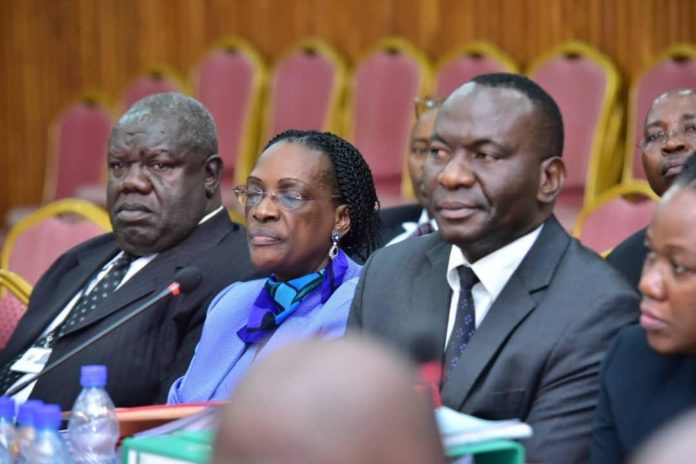
COSASE inquiry leaves Bank of Uganda, law firms exposed as wanting

The ground can no longer hold for BoU officials.

When the Bank of Uganda (BoU) started closing commercial banks right from 1993 on account of insolvency, the officials there did not at any one time anticipate they would face a parliamentary probe for their actions, for they thought the central bank was independent and could do its business causally without following the established laws and procedures.

That long-held view by the BoU senior staff was to change when some of the owners of the closed banks started complaining of the unfair closure of their branches, even as they pleaded that they be given second chance. Particularly the sale of Crane Bank (CBL)in January 2017 put BoU in disrepute to the extent that parliament ordered the Auditor General John Muwanga to carry out a special audit on the closure of seven banks by BoU. BoU would later resist Muwanga’s probe but later gave in after failing to garner support from the executive.

Muwanga’s well written audit report formed the basis on which the Parliamentary Committee on Commissions, State Authorities and State Enterprises (COSASE) are probing BoU senior staff as the MPs seek answers to the queries raised in the report. The report was published on August 27, 2018 and handed over to the Speaker of Parliament Rebecca Kadaga.

Mr. Muwanga’s report on closure of banks and COSASE’s inquiry have been commended by the members of the public who have been watching the proceedings live on television. The inquiry has exposed BoU as an institution that doesn’t follow its own procedures. It exposed BoU staff as disorgainsed, uncoordinated, negligent, careless and not suitable to hold those jobs, despite having the qualifications. For instance, the inquiry exposed director legal department, Margaret Kasule, as wanting as she could not appropriately respond to questions relating to closure and sale of banks.

The inquiry further has exposed BoU staff as exhibiting corruption tendencies as well as allowing conflict of interest in the transaction. For instance the inquiry established that BoU sold Global Trust Bank Uganda (GTBU) and CBL to Dfcu Bank well knowing that BoU Staff retirement benefit scheme owns 0.59 shares in Dfcu Bank and as such stood to benefit from the two transactions. The MPs in the probe have established that that was foul play, which was accepted by BoU Governor Emmanuel Tumusiime-Mutebile.

Further, the probe has exposed BoU in the conflict of interest scenario. For instance, Dr. William Kalema was both on the boards of BoU and DFCU Bank when the latter bought GTBU. That is the reason why MPs on COSASE dismissed him from appearing alongside BoU staff in the inquiry. BoU has conceded defeat on this, saying it will never happen again, but the damage is already done.

BoU has been further exposed in that it did business with law firms whose directors represent the banks the central banks is supposed to regulate. For instance some of the MMAKS Advocates counsels are directors in some commercial banks. Sebalu & Lule Advocates have had business with BoU, the latter well knowing they did the same with CBL. That raises a question whether BoU can effectively do its regulatory work in such a scenario. The same layers at one time worked for CBL.

The inquiry has still exposed BoU as an institution a careless officials. For instance the Auditor General hired KPMG to produce a financial status report of CBL under receivership but responsible BoU officials did not sign on the report, leaving it hanging. The BoU staff were exposed as careless as they claimed to have spent Shs478.8 billion on CBL in liquidity support yet they cannot account for the money. Interestingly to show their carelessness they sold CBL at Shs200 billion, paid in installments. That is worsened that the bank doesn’t have all documents related to the transaction as they sold banks.

Mutebile recently accepted the faults committed by BoU as it closed banks. “I would like to thank you in particular, for your candid approach to tackling issues that you believe needed to have been addressed, or at least taken into consideration by the staff of the Bank of Uganda. I also would like to express my appreciation to the Auditor General for his report which raised issues that will culminate in an improvement in the operations of Bank of Uganda,” he told MPs on COSASE.

“The Bank of Uganda acknowledges the relevance of this exercise and we are confident that it will enhance transparency and accountability, which are key values that the Bank upholds. This interaction has highlighted the shortfalls within our processes, policies and practices,” he said, adding that the MPs probe had been a learning process not only for the Management but also for the staff. “I am confident that resulting from this process, we will review ourselves, the Banks processes and policies in order to strengthen our capacity to perform the functions of the Central Bank better,” he said.

He said it would be incumbent upon BoU to put in place measures that translate into a stronger institution and visibly boost the confidence of the public in the central Bank. “We want to see a stronger financial sector and economy built on the confidence that the public has in us,” he said.

Stories Continues after ad

Museveni supports Makerere in expulsion of lecturers

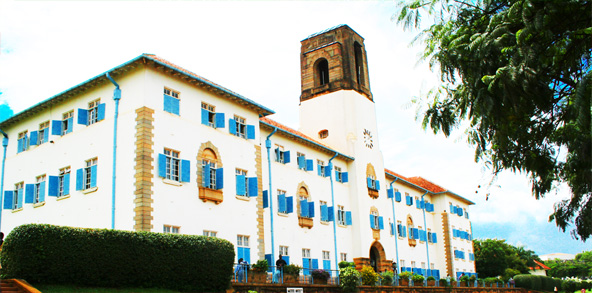
Makerere Main Building before it burnt down

President Yoweri Museveni has supported Makerere University administrators for expelling lecturers whop are undisciplined. Museveni made the remarks while officiating at the institution’s 69th graduation ceremony held at its grounds.

Museveni said there is no reason for a lecturer accused of raping a student to continue teaching, saying it is “rubbish”.

The university administration recently sacked over 40 lecturers on the account of indiscipline and absence from duty without notifying top administrators, with some believed to be teaching outside the country.

Museveni urged fresh graduates to form groups, saying government would support them to create their own jobs in textile industry, leather tanning, tailoring, among others.

The president said some of the students in the social disciplines need to understand the science of management to acquire managerial skills to enable you manage the factors of production in a clever way to make profits.

“The social scientists should focus on management and disciplines like accounting and auditing because as the economy expands, you need more of those. Scientists can also become managers,” he said.

He said the country still needs more doctors and engineers to serve the growing population which is estimated to be around 40 million people.

He said scientists in Uganda today stand to get jobs. There is no way scientists can be unemployed now, it is just a matter of better organization now in the public and private sector.

The Minister of Information and Communications Technology ICT and National Guidance, Frank Tumwebaze is among the 13,000 students graduating at Makerere University this week.

Over 13,000 students are lined up to graduate during the ongoing 69th graduation ceremony that is to take four days.

The Minister of ICT and National Guidance, Frank Tumwebaze was among the first cohort of graduands on Tuesday morning and was conferred upon a MA in Public Health.

According to the Academic Registrar, Mr Alfred Masikye, the ceremony will see a total of 13, 299 students graduate in different disciplines ranging from degrees, diplomas and PhD respectively. 368 students will graduate with First Class degrees.

Stories Continues after ad

Sultan of Sokoto, Kabaka of Bugunda call on traditional leaders to come together to help keep girls in school

Kabaka Muwenda Mutebi

Assembling leaders from across the continent to champion initiatives for keeping girls in school

ABUJA, Nigeria, January 15, 2019/ — The Sultan of Sokoto (Nigeria), His Eminence Muhammadu Sa’ad Abubakar III, together with The Kabaka of Bugundu (Uganda), His Highness Ronald Edward Frederick Kimera Muwenda Mutebi II, today, chaired the ‘Keeping Girls in School Summit’; a convening of African leaders, traditional rulers, religious heads, youth groups, advocates and thought leaders, in Abuja, Nigeria.

The two-day event brings together influential traditional and religious leaders from across the continent to discuss the critical issue of keeping girls in school to complete primary and secondary education (i.e. 12 years of education) and find solutions from within the rich, diverse cultures and values of Africa’s thought leaders. With poverty being one of the key drivers of keeping girls out of school, the Summit also seeks to promote incorporating in-school skills that generate income.

For decades, African governments and international development partners have been trying to improve and reduce suffering as a result of pregnancy and child birth. Very few improvements have been recorded in the health of women and children, despite studies showing that the health of children substantially improves when the mother is educated. Completion of secondary education by girls has been found to significantly improve not only maternal and child health, but women’s decision-making, as well as their ability to earn a living; thus improving the health and nutrition of families and communities. This undeniable link between the education of the mother and health and development outcomes of families, shows that the future of African families is dependent on the education of the girl.

The Summit provides a platform for community leaders to share ideas and best practices and develop strategies and networks to keep girls in school. It also serves as a means to sensitize and equip these leaders with the right skills to motivate parents and care givers to be deeply committed to ensuring all girls in their constituencies complete at least 12 years of education.

Speaking at the event, The Sultan of Sokoto, His Eminence Muhammadu Sa’ad Abubakar III called on all traditional and religious leaders on the continent to focus on the development of their communities; stating, “A key factor in the development of our communities is the education of our girls.”

He further stated, “I believe traditional and religious leaders will lead in shaping the future of Africa by ensuring all girls complete secondary school education and learn life and livelihood skills in the process.”

In attendance were His Excellency, Muhammadu Buhari, President of the Federal Republic of Nigeria, The Emir of Kano (Nigeria) His Highness Muhammadu Sanusi II who presented a lead paper titled “Perspective on Development in Africa – population, education and investment”; The Emir of Argungu (Kebbi state, Nigeria) His Highness Alhaji Samaila Mera; The Nnabagereka of Buganda Queen Sylvia Nagginda; The Asantehene of Asante Ghana,; Archbishop of Abuja, Cardinal John Onaiyekan; Sheikh Sheriff Ibrahim Saleh ; Queen Mother of the Asante, Her Majesty, Nana Ama Konadu; Sultan of Zinder (Niger Republic) His Highness, Alh. Aboubacar Sanda as well as representatives from international organisations such as the Children’s Investment Fund Foundation (CIFF), the United Nations International Children’s Emergency Fund (UNICEF), the United Nations Educational, Scientific and Cultural Organization (UNESCO) Nigeria, the United Nations Population Fund (UNFPA), the Department for International Development (DFID) and others. Also in attendance were representatives of various ministries, departments and agencies in Nigeria including the Minister of the Federal Capital Territory (FCT), Muhammad Musa Bello and the Minister of Education, Mallam Adamu Adamu who in his remarks reiterated the importance of girls’ education.

The conference gives the attending traditional and religious leaders the opportunity to reflect and come up with ideas on how they would contribute to the movement of keeping girls in school in their communities by increasing enrolment, retention and completion of school as well as ensuring girls acquire life and livelihood skills. This initiative would be amplified through the support of gender and youth focused groups and organizations.

African Youth Groups will support the traditional and religious leaders by amplifying the initiative through encouraging the youth to mentor and actively participating in promoting Keeping Girls in School in their communities. The Initiative also brings together African female leaders who will use their influence to promote keeping girls in school; serving as mentors and role models in their communities

Following the conference, it is envisioned that traditional and religious leaders will continue to have a platform for regular engagement and knowledge-sharing on keeping girls in School in Africa.

About Keeping Girls in School:

Keeping Girls in School is an initiative aimed at starting a social movement in Africa that will rapidly set the stage to leap frog improvement in maternal and child health and the status of women and girls in Africa. This initiative will engage and support traditional and religious leaders who shape social norms, culture and behaviour of a mass majority of people in Africa, regardless of class, religion or gender, to develop strategies and solutions from within and use their positions to ensure African girls finish at least twelve of year of school.

Stories Continues after ad

Mike Mutebi, Gaddafi Gadinho win UPL December awards

Mike Mutebi recieiving his accolade.

The 2018/19 StarTimes Uganda Premier League monthly Awards for December 2018 took place today morning at Kati Kati restaurant in Kampala.

Onduparaka FC midfielder Gaddafi Gadihno and Kampala Capital City Authority (KCCA) FC manager Mike Hillary Mutebi were named the Pilsner player and coach for the month of December 2018 respectively.

Gadaffi beat SC Villa attacking midfielder and league’s current top scorer Bashir Mutanda to the top accolade. The Caterpillars playmaker won the Pilsner man of the match award twice in the same month compared to Mutanda’s one.

Mike Mutebi beat URA manager Sam Ssimbwa to the Manager of the month for December 2018.

Both Gadaffi and Coach Mike Mutebi each walked away with a reward of one million Ugandan shillings.

This is the third time the awards have taken place this season since their inception in October 2018.

Mbarara City football club midfielder Paul Mucureezi was crowned the Pilsner StarTimes Uganda Premier League player of the Month for November and their manager, Charles Livingstone Mbabazi, was voted the Pilsner StarTimes Uganda Premier League Coach of the Month.

Pilsner Lager announced a new partnership deal with the StarTimes Uganda Premier League to award the competition’s best players and coaches for the next three years.

The awards are named ‘Pilsner man of the match award’ and the monthly awards named ‘Pilsner player of the month award’ and ‘Pilsner coach of the month award’.

Stories Continues after ad

Former BoU senior staff Katimbo Mugwanya rejected on Centenary Bank board

Katimbo Mugwanya

Centenary Bank has rejected former Bank of Uganda senior staff Edward Katimbo Mugwanya to sit on its board, following the MPs probe of BoU senior staff over the controversial sale of seven commercial banks which are now defunct.

The Auditor General John Muwanga in his special audit report of Bank of Uganda on defunct banks blamed its current and former staff of liquidating banks without producing reports related to the transactions. Katimbo Mugwanya is the key witness in the closure of the banks and when asked by MPs probing BoU staff to respond to Mr. Muwanga’s report, he has always failed provide convincing answers.

Mr. Mugwanya was both the liquidator of Crane Bank Limited (CBL) and Global Trust Bank Uganda Limited (GTBU) which were respectively sold to Dfcu Bank in January 2017 and July 2014. He worked closely a with another senior BoU staff Ben Sekabira, who was also liquidator of Greenland Bank, now defunct.

Katimbo and former BoU executive director for bank supervision Ms. Justine Bagyenda failed to convince MPs on Parliamentary Committee on Commissions, Statutory Authorities and State Enterprises (COSASE) on insolvency of CBL. They also failed to produce reports on the closure of the two banks.

BoU while exercising its powers under Section 87(3), 88(1) (a) & (b) of the Financial Institutions Act 2004, took over the management of Crane Bank Limited and claimed to have put Shs478 billion before selling it to Dfcu Bank at Shs200 billion, paid in installments. Then officials have failed to account for the money.

The­­­­­ main reason why the Bank of Uganda took over the management control of Crane Bank was because “it lacked sufficient capital and posed a systemic risk to the financial system.”

Stories Continues after ad

37 summoned for 2019 Netball World Cup preparations

Uganda-she-cranes

The Netball World Cup is exactly six months away. The tournament is scheduled for July 12th-21st at the Echo Areno in Liverpool, England.

And in a bid to start the preparations early, the Uganda Netball Federation through their technical department headed by William Mwanja listed a pool of thirty seven (37) locally based players.

The listing of players was done by coaches of different clubs in the league including She Cranes coach Vincent Kiwanuka during a meeting at the National council of Sports in Lugogo on Saturday, January 12.

It should be noted that the list is subject to revision depending on the budget of the federation as well as the availability of the players.

There will be another technical meeting on Wednesday, January 16 to review the list, and also the budget for the preparations.

The team also recently played England in the Vitality International Series to gauge their strength against their World Cup group opponents. She Cranes lost the series 3-0.

Uganda She Cranes are among the sixteen countries and are in group D alongside Samoa, England and Scotland.

The 2019 Netball World Cup will be the fifteenth staging of the premier competition in international netball, contested every four years. Australia are the defending champions.

Players summoned:

Goal Shooters: Zam Serra (NIC), Stella Oyella (Prisons), Martha Soigi (NIC), Amish (UCU), Kevin Abel (Police) and Brenda Nakibuule (UPDF).

Goal Attackers: Iren Eyaru (KCCA), Rachael Nanyonga (NIC), Vicky Nantumbwe (NIC), Hadijja Nakabuye (Prisons), Ali Kuluthum (Police) and M. Batamuliza (Police)

Wing Attackers: Susan Atino (KCCA), Norah Lunkuse (KCCA), Hope Birugi (Police), Enid Abalo (Police) and J. Nakafeero (Prisons)

Centre Players: Ruth Meeme (NIC), Jessica Achan (Prisons), Harriet Babirye (Police), Annet Najjuka (KCCA), Vero Namatovu (KCCA) and Betty Kiiza (NIC)

Wing Defenders: Hindu Namutebi (Police), Fauzia Nakisule (KCCA), Sylvia Nanyonga (Prisons), Irene Mirembe (UPDF), Tausi Mumena (Prisons) and Florence Adunia (NIC)

Goal Defenders: Lillian Ajio (Prisons), Joan Nampungu (NIC), Wycline Nantweta (KCCA) and Irene Akello (KCCA)

Goal Keepers: Stella Nanfuka (Prisons), Muhayimina Namuwaya (NIC), Shaffie Nalwanja (KCCA) and Nusura Sebbi (Police)

Stories Continues after ad

Kadaga to corrupt officials: Don’t expect protection from parliament, we shall expose you

Speaker Rebecca Kadaga

The Speaker of Parliament, Rebecca Kadaga, has lashed out to government officials who have occasionally tried to stop her from speaking about corruption saying, she will not retard from fighting the evil vice that is eating up the Country.

Speaking at the opening of parliament week, Kadaga said there are people in this country who think when you belong to certain political party, you should not speak about corruption and other evil things lamenting that the move tarnishes the image of the country.

She said they believe that if you are leader, you should not speak about corruption, you should not speak about corruption that you are spoiling the name of the party, name of the country.

“I did tell members last year when a complaint about the harassment of Ugandans on Lake Victoria by the army, there is a minister who came to my office to tell me that I should stop talking about the army,” she narrated. adding “I said what do you mean by stop talking about the army, he said am spoiling their name, I told him you can tell them to stop their atrocities then I stop talking and I chased him out of my office,” she said.

she further explained “Can you imagine someone coming to threaten the Speaker, I want to just say I will not stop speaking about corruption, I will continue speaking about atrocities,” She said

As a leader in Uganda she said, “We have no common agenda to commit atrocities, we have never had an agreement on that issue, and we have no common agenda to be corrupt and those who are corrupt, they are corrupt in their individual capacity and they should not expect protection from this house because we shall expose them until they go where they deserve,”

The 2019 parliament Week is premised on the theme ‘Championing accountability to improve service delivery’, with the objective of sharing information about Parliament with its stakeholders.

Stories Continues after ad

Increase budget for PWDs- Gender Minister

Peace Mutuzo

The Minister of State for Gender and Culture, Peace Mutuzo has called on Parliament to consider approving the proposed budget increase for Persons With Disabilities (PWDs).

She said that the current budget of Shs2 billion is insufficient and cannot support the 12.8 million PWDs.

“In our framework, we propose that this budget should be increased to shs12 billion. This money will support the councils for PWDs to be able to register PWDs to enable us effectively and efficiently plan for them,” said Mutuzo.

Speaking at the Third Annual Parliament week 2019 activities, Mutuzo said her ministry is working with the Ministry of Education and Sports to ensure that special interest and special needs education centres are established in every region to increase access to education for children with disabilities.

“This is what the Ministry of Education is intending to do at least within the next financial year,” said Mutuzo.

The Member of Parliament representing PWDs in the Central Region, Safia Nalule noted that people living with albinism still face the challenge of access to education and sunscreen among others. She added that people with albinism are prone to trafficking and sacrifice.

She said that in a bid to protect the rights of people living with albinism, a private member’s Bill titled, “The protection of the rights of persons with albinism Bill, 2018 has been drafted”.

“I request that we scrutinize this Bill and make our contributions before I seek leave of Parliament to allow me introduce this Bill,” said Nalule.

She noted the need to organised international conferences aimed at bringing together stakeholders to discuss strategies to improve the lives of persons living with albinism.

People living with albinism called on the Ministry of Education and Sports to give students with albinism extra time during national examinations.

The Executive Director, Uganda Albino Association, Jude Ssebyanzi said that given their visual inaccuracy, persons living with albinism cannot read as fast as other students.

“We need at least 30 extra minutes during national examinations so that we can compete with the rest of the students,” said Ssebyanzi.

He also asked the Ministry of Education and Sports to ensure that students with albinism are given front seats in classrooms and reading material with bigger fonts.

The Commissioner, Physical Education at the Ministry of Education and Sports, Lamex Omara Apita promised that the Ministry of Education will discuss the issues raised.

“As a Ministry, we do pursue the laws of the land and policies regarding persons who are marginalized. We shall do the same for persons with albinism within our means,” said Omara Apita.

Parliamentary Commissioner, Cecilia Ogwal who represented the Speaker of Parliament, Rebecca Kadaga pledged that the protection of the Rights of Persons with Albinism Bill, 2018 will be handled expeditiously.

She said that people living with albinism need to be given hope, courage and absorbed into the community.

“People with albinism are living in agony. Silent discrimination is worse than open discrimination. Your lives are in danger all the time,” said Ogwal.

Ogwal also called on stakeholders to find ways of mobilizing funds to support Parliament’s efforts to establish a centre for people living with albinism, besides the charity walk.

“The Speaker of Parliament has requested me to remind you that we have so far raised only shs72 million out of the expected shs5 billion. If only our partners could find other avenues of raising this money so that we can make this centre a reality,” said Ogwal.

Stories Continues after ad
Isimba hydropower dam ready for commissioning

Isimba dam

The Uganda Electricity Generation Company Limited (UEGCL), has said Isimba Hydropower Dam is set for commissioning at the end of this month The revelation was made by Mr Simon Kasyate, the UEGCL Corporate Affairs’ Manager,

All the dam’s four Kaplan turbine generator units were running by Friday last week when UEGCL board of directors concluded their routine appraisal of the project.

The appraisal was led by the chairperson, Eng. Proscovia Njuki. “We have written to the President, inviting him for the commissioning of this project on January 24. We are still waiting for response from him,” Mr Kasyate said.

He said commercial production and trade of power from Isimba dam will begin in March.

“That is when our commercial rates and charges will be applicable,” he said.

In April 2015, China International Water & Electric Corporation under UEGCL’s supervision, commenced the construction of the $567.7million (Shs2.1 trillion) Isimba hydropower

Tests on the functionality of the generator units started in December last year with Unit 2 and subsequently the rest were carried out until last week.

Attachments area

Stories Continues after ad