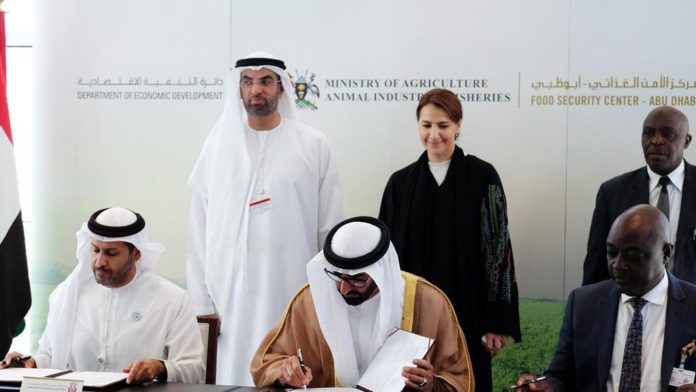
Uganda has signed a memorandum of understanding with UAE to establish one of the world’s only agricultural free zones in an attempt to enhance food security in the Emirates.
The 2,500-hectare free zone will allow private companies from the UAE to invest in agricultural production and development in Uganda.
Mariam Al Mehairi, Minister for Food Security said, it will also act as a launch pad for further investment into East and Central Africa. “There is a lot of potential to be unlocked in that area,” she said.
The agreement was signed at Agriscape, a two-day exhibition in Abu Dhabi that convenes dozens of producers, suppliers and investors from across the globe. The deal will promote agribusiness between the two countries and lead to an increase in UAE imports of Ugandan crops and beef.
As a result, the country imports about 90 per cent of its food and is therefore pursuing mutually beneficial opportunities in Africa and beyond. Talks began with the Ugandan government last year after the Gulfood exhibition in Dubai in February.
“Since then, about 14 Emirati companies have expressed interest in investing in the African country,” Uganda’s Agriculture Minister Vincent Ssempijja noted.
The UAE will look for similar, complementary investments in surrounding countries.
“Africa in general, from Uganda, Rwanda and South Africa to Nigeria and Zambia, is very promising,” said Khadim Al Darei, deputy chairman of Al Dahra, the headline sponsor of Agriscape.
“Currently only 5 per cent of African land has been utilized for agriculture and the consumers are also coming from Africa. Imagine if we find a way to tap into that, we would reduce speculation in prices and also feed the continent. How can it be that 800 million are suffering from hunger, while we have 600 million people suffering from obesity?” said Mr. Khadim
Food security has topped agendas all over the world as temperatures rise, but it is perhaps most pressing in Africa, where hunger is widespread and conflict and political instability deter investors.
Many Sub-Saharan countries feel international agricultural investment is the way to achieve that, “We are here to sell an image of our country as a good investment,” said Emmanuel Mulilo, a minister from the Democratic Republic of the Congo.
He said although the country was racked by conflict, it could feed its population, bolster agricultural production and start to export with agribusiness investment, bringing jobs and wealth.
The UAE has been one of Africa’s biggest investors; last year imports from Africa were valued at $21 billion (Dh77.13 billion).
The Compact with Africa focuses on a fundamental challenge for the continent: how to accelerate private sector investment and create jobs. To realize its full potential, all parties need to deliver.
The central idea behind the Compact is a simple one: create a platform for closer coordination between African countries, international organizations, and bilateral G20 partners to support economic, business, and financial sector reforms that will attract private investment.
Sixteen months on from the Berlin Summit that effectively launched the initiative, we can, and should, ask ourselves whether Compact countries and their international partners are doing enough to fully implement the initiative, and where we can make further progress.
It starts with a stronger economy
Compact countries have been implementing policies to strengthen economic stability—a fundamental pillar for attracting private investment.
Growth prospects for most Compact countries are favorable, although in many cases, including Egypt, Ethiopia, and Ghana, the fiscal space to scale-up public investment is constrained by elevated public debt levels. With limited room for additional borrowing, countries also need to boost domestic tax revenues and increase the efficiency of public spending to fund higher public investment.
Better business and financing frameworks make the difference
Private investors seek better business frameworks—with streamlined procedures, regulatory certainty, efficient courts, and transparency. Stronger and more developed financial sectors deepen capital markets and expand access to credit.
Equally critical to private investment is coordination between governments and partners. This has been highly effective in some countries, such as Ghana and Morocco—but less so in others. Implementing the ambitious and country-specific reform commitments under the Compact requires strong ownership by African countries, and stepped-up engagement and support from Compact partners to ensure adequate capacity and financing during implementation.
Development partners need to provide fine-tuned public support—such as risk mitigation instruments—to leverage private sector investment. The growing involvement of development finance institutions in G20 countries is welcome. They can contribute extensive expertise in the design and financing of large investment projects.
Stepping up to attract more private investment
Attracting private investment requires connecting countries directly with private investors, as was on display at the recent Germany-Ghana Investors “Virtual” Forum. Other G20 partners could step up their game in this area, including through funding of road shows and peer-learning events that bring together Compact countries and potential investors.
Of course, all these reforms take time and require strong ownership. We must be realistic about how quickly projects can be developed and implemented, and about the challenge of overcoming political opposition in some cases. But the potential rewards of meaningful economic reforms are worth the wait.
The IMF actively supports the Compact
The IMF continues to work closely with Compact countries to build strong macroeconomic, business, and financial frameworks that will encourage a scaling-up of private investment. We maintain a close policy dialogue with all 12 Compact countries, and IMF-supported programs are in place in 10 of those countries.
Our capacity development works to strengthen key public institutions. During 2017 and 2018, the Fund fielded 129 technical assistance missions in Compact countries and trained more than 1,700 government officials, in areas including tax administration, public investment management capacity, and financial sector supervision, to name a few.
A “win-win” collaboration
We continue to actively support the Compact process—a pragmatic “win-win” collaboration between advanced and developing countries. Achieving success in the current Compact countries will lay the basis for expanding the initiative across the continent.
A final thought in closing. In the next decade, 140 million children will come of age in the 12 Compact countries. Increasing private investment is not an abstract concept in terms of those children’s future—it is an imperative if they are to enter productive employment, and thereby deliver on Africa’s demographic dividend. Failure to meet this job creation challenge is not an option—and we have the tools and instruments to achieve success.
Over the past few weeks, we at the IMF have been making a case that this is not a time for complacency in the global economy. We must steer, not drift. The same is true of the Compact with Africa. To deliver on its full potential, reform-minded countries in Africa, international organizations, and G20 partners need to row together.
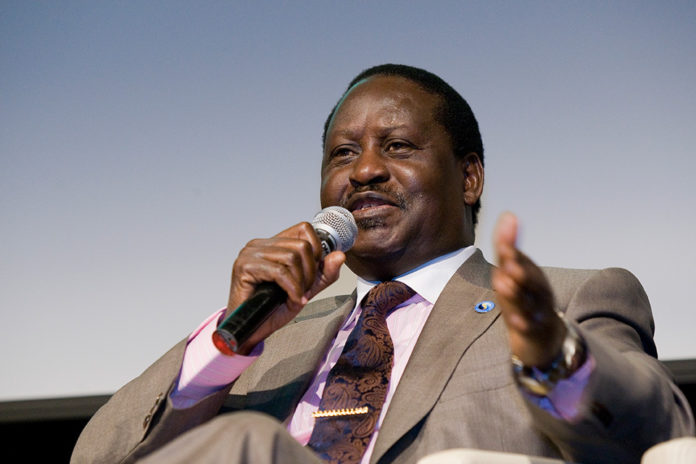
The recently appointed African Union special envoy for infrastructure development in the continent, Raila Odinga, has proclaimed plans to build a 60,000km road linking Mombasa in Kenya to Lagos in Nigeria in bid to link Africa via modern highways and railways.
Odinga said linking Kenya to Nigeria via road will be among his priorities as African Union’s high representative of infrastructure and development. He intends to oversee construction of 60,000km Trans-African highway project commissioned in 1971 to open up continent for trade.
“Primary projects will be an 8,000 kms highway linking Cairo (Egypt) to Dakar in Senegal. Another 8, 0000 kms road will stretch from Cairo and Cape Town (South Africa). A 60,000kms road linking Mombasa (Kenya) to Lagos (Nigeria) is part of this ambitious project,” he said hours ago.
Raila who said he accepted the role by AU because he believed land transport was an integral part of the continent’s economic growth added he intended to have another 4,700kms road between Dakar and Lagos built. He explained that out of nine highways proposed over four decades ago, only the 4,500kms road between Dakar and N’Djamena in Chad had been constructed.
“My belief is that having reliable road infrastructure and railways linking all corners of Africa will open up the continent and make it a gateway to the 21st century. Through my new position I am determined to take Africa to economic independence,” he said.
The 2018 African Economic Conference (AEC) will feature practical solutions from regional integration experts and the private sector, a senior African Development Bank (AfDB) staff has said, as preparations for the event move into top gear.
The 13th conference of the EAC, will take place in Kigali, Rwanda from December 3–5, 2018, under the theme “Regional and Continental Integration for Africa’s Development.” The United Nations Development Programme (UNDP) will host the meeting. The EAC is the leading forum for discussing African issues of the day.
“Expectations for the 2018 AEC are high,” organizers – African Development Bank, UNDP and United Nations Economic Commission for Africa – said days ago in Abidjan, Ivory Coast.
“The conference will be less academic, geared towards bringing together regional integration practitioners to provide us with practical solutions especially in the implementation of the African Continental Free Trade Area (AfCFTA). Private sector representatives will be sharing their experiences as they do business on the continent,” Bank Director for Integration, Moono Mupotola, said.
Despite some progress and strong affirmations of political commitment by African leaders, the path to continental integration has been slow. The main challenges include lack of political will and the absence of resources, as well as technical capacity to facilitate the implementation of commitments made. Mupotola underscored however that important milestones had been achieved in the recent past, including the launch of the African common passport in July 2016 and the commitment by 44 African countries to the launch of the AfCFTA.
This year’s meeting will focus on initiatives for accelerating progress in infrastructure integration, including the removal of barriers for movement of people goods and services across borders. Experts will share views, best practices and lessons for more effective policy and institutional harmonization in the context of the new Africa Continental Free Trade Area. Africa’s Agenda 2063 and the global Agenda 2030 will also be important frameworks for deliberations and actions taken at the conference.
Mupotola also said a new Bank policy that allows regional projects to allocate 10 per cent of total project budget to soft infrastructure interventions was another important step. The Bank is also currently developing a trade and transport facilitation toolkit which should assist task managers in the transport sector to include “soft” components in their project designs.
“There is need to scale up more, in the area of soft infrastructure to enable and facilitate integration in areas such as policy and regulatory harmonization, removal of non-tariff barriers, improvement in logistics between countries and other factors that affect Africa’s competitiveness,” the Director said.
The African Economic Conference is jointly organized by the African Development Bank, the UNDP and the UNECA. The African Development Bank will lead and host the 2019 EAC conference.
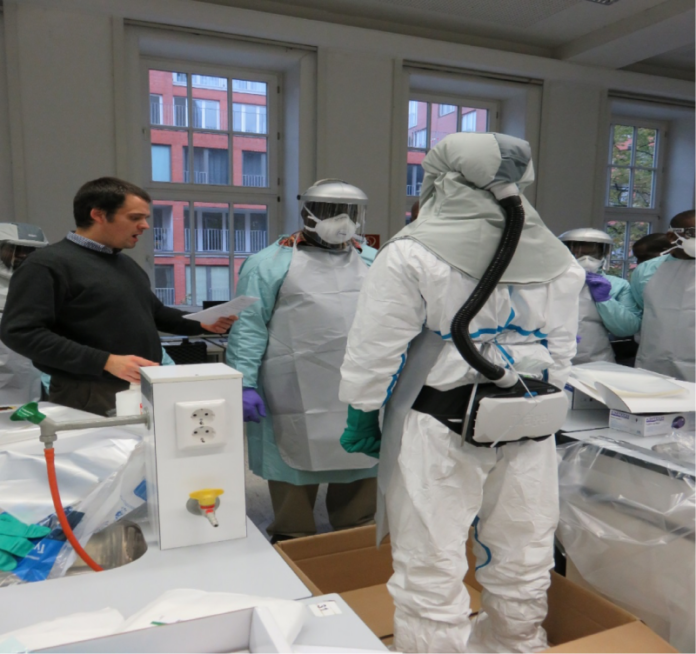
A four-week long practical Training of Trainers (ToTs) course involving twelve (12) medical laboratory experts from the EAC Partner States’ National Public Health Reference Laboratories (NPHLs), concluded on October 26, 2018 at the Bernard Notch Institute for Tropical Medicine (BNITM) Headquarters in Hamburg, Germany.
The training started on October 1, 2018 and focused on the assembly, operation, use and field deployment of the nine High Technology EAC Mobile Medical Laboratory equipment, reagents and supplies for the early detection and diagnosis of various highly infections biological agents such as the various Viral Haemorrhagic Fevers (VHFs), namely: Ebola, Marburg, Crimean-Congo Fever, Yellow Fever, among others which are endemic in East and Central Africa.
Currently, the EAC with technical and financial support from Germany through the Federal Ministry of Economic Cooperation and Development (BMZ), the German Development Bank (KfW) and the Bernard Notch Institute for Tropical Medicine (BNITM) is implementing “East African Community Regional Network of Mobile Medical Reference Laboratories for Communicable Diseases Project.” In 2016, Germany committed an initial three-year funding of Euro 10 Million for the project. Negotiations are currently underway for additional funding of Euro 13 Million for the year 2020 and beyond.
The main objective of the EAC Mobile Medical Laboratories Project is to strengthen capacities in all six EAC Partner States to respond to pathogens of biosafety level 3 and 4 nature and other outbreaks of highly infectious diseases that are prone to cause cross-border epidemics by rapid mobile diagnostic capacities that enable timely interventions through joint collaboration, linkages and cross-border networking among the National Public Health Reference Laboratories (NPHLs) in each of the EAC countries.
The participating NPHLs in the Partner States are: Institut National de Santé Publique (INSP), Burundi; National Public Health Laboratory Services, Kenya; National Reference Laboratory (NRL), Rwanda; Public Health Laboratory and National Blood Transfusion Centre, South Sudan; National Health Laboratory Quality Assurance and Training Centre (NHLQATC), Tanzania and Central Public Health Laboratories (CPHL), Uganda.
In addition, the EAC Mobile Laboratories Project has broad actions that include the training of various health and medical laboratory technical experts on the early detection and diagnosis of highly infectious pathogens and exchange of knowledge among Partner States at regional, national and sub-national levels, including joint disease outbreak investigations and response in cross-border areas.
William Sekabembe Dfcu-Bank-Uganda’s-Chief of Business and-Executive Director-William-Sekabembe
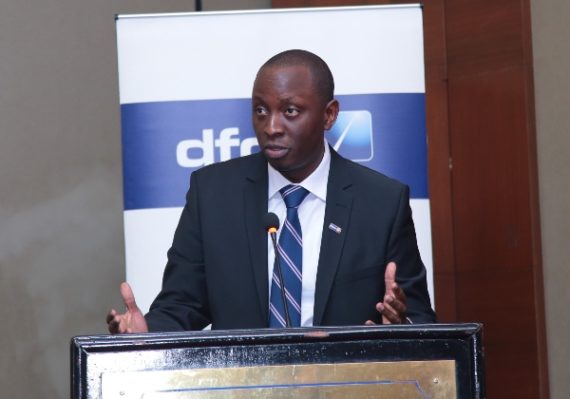
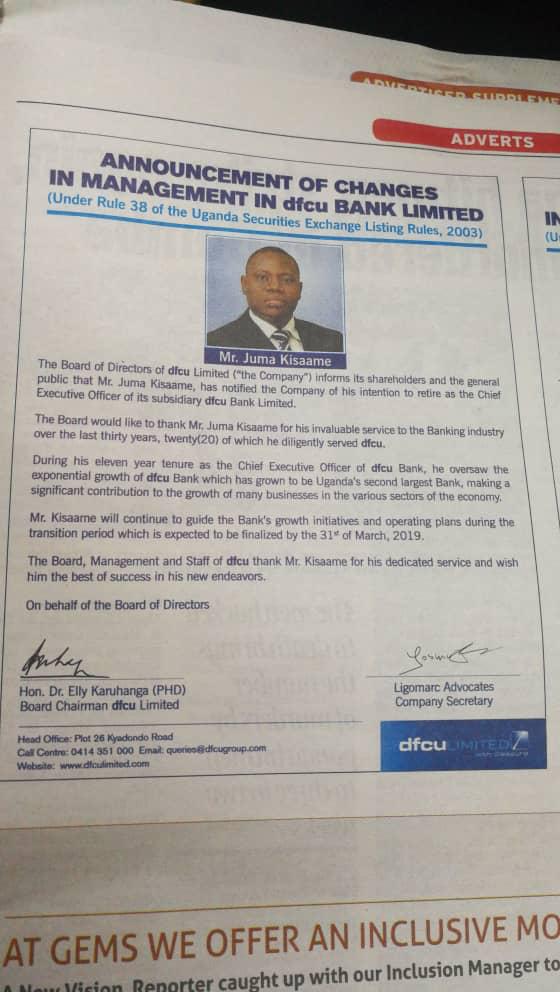
Dfcu Bank has named its Chief of Business and Executive Director, William Sekabembe, as new Managing Director (MD) following the resignation of Juma Kisaame who has been serving in that position.
Eagle Online days ago published a letter in which Sekabembe declined KCB Uganda’s offer to become their new MD. Sekabembe had all along been wanting to leave Dfcu but was convinced by directors there to stay with the promise that they would give him a fat management job and now he has got it.
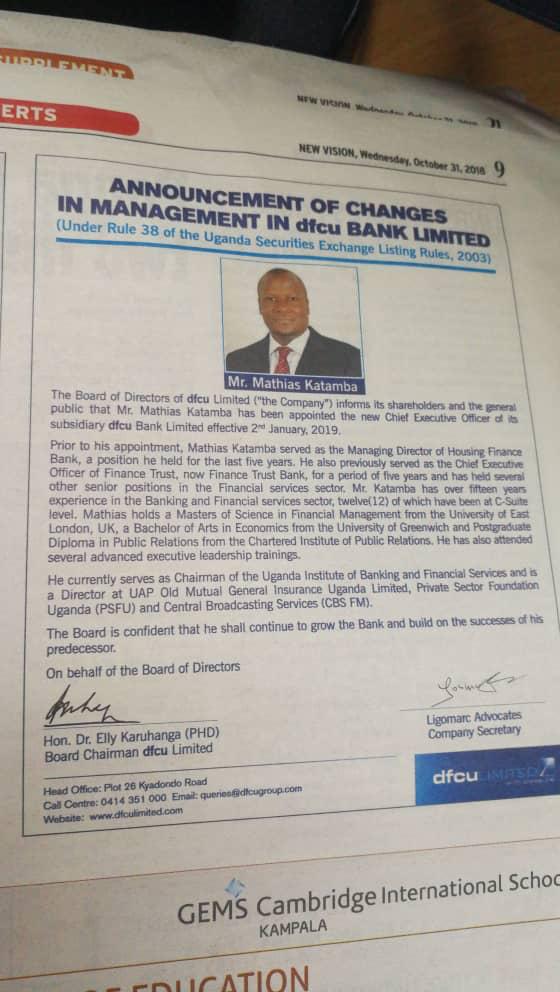
Sekabembe will now work with the Bank’s new Chief Executive Officer Mathias Katamba who recently resigned from Housing Finance Bank (HFB) as MD. Katamba will officially join Dfcu Bank effective January 2, 2019 as confirmed by Dfcu Limited Chairman Dr Elly Karuhanga.
The two men are now expected to turn-around the fortunes of Dfcu Bank which has not settled ever since it acquired its rival Crane Bank Limited (CBL) in a controversial transaction that was recently queried by the Auditor General John Muwanga in his special audit report of Bank of Uganda on defunct banks. Dfcu acquired CBL at Shs200 billion.
A new document reveals that the Bank of Uganda (BoU) Deputy Governor, Dr Louis Kasekende, has not declared all the wealth that he owns as required by the Leadership Code Act 2002 whose aim is to stop public officials from embezzling public funds.
The Code requires leaders to declare their incomes, assets and liabilities that may be tracked in case a public official is suspected of getting involved in corruption.
That a side, the document Eagle Online has accessed, reveals that Dr Kasekende has eight undeclared plots of land worth billions of shillings in Buloba and Lower Naguru.
The plots Kasekende has never declared are; Plot 38 (0.157 hectares) in Lower Naguru on East road worth Shs1.280 billion, Plot 1423 on block 314 in Buloba worth Shs432 million.
Others whose value is not quoted are; Plot 1738 (0.809 hectares), Plot 3213 (0.079 hectares), plot 1427 (3.647 hectares), plot 184 (2.7 hectares), plot 1754 (1.624 hectares) and plot 6102 (0.317 hectares). The plots are all found on block 314 in Buloba.
Meanwhile Kasekende was able to declare fiver properties. They include; Plot 2A (0.142 Hectares) in Makindu worth Shs3.6 billion, Plot 2 (0.22 Hectares) on Bukoto Rise worth Shs2.7 billion, Block 314, plot 706, Plot 1475 Lubowa Estate work Shs3.6 billion and Plot 12 on Corporation Road Ntinda.
Kasekende is married to Edith Kasekende, and together are the parents of three children; George, Vivienne and Stuart. Eagle Online recently reported how Edith transacted mobile money worth billions of shillings and a lot more monies on bank accounts. Eagle Online reported how their son George, transacted hundreds of millions of shillings on his personal account in centenary bank.
It is believed some of Kasekende’s properties and other wealth are in the names of his wife and the children.
Kasekende’s brief professional profile
The BoU website notes that;
From May 2006 to 2009, he served as Chief Economist of the African Development Bank (AfDB). As Chief Economist, he was the Bank’s spokesperson on socio-economic and development issues of importance for Africa. He supervised the Development Research Department, the Statistics Department and the African Development Institute. Between 2002 and 2004, he served as Alternate Executive Director and later as Executive Director at the World Bank for Africa Group 1, including 22 countries mostly from Anglophone Sub-Saharan Africa.
Prior to joining the World Bank, he had worked for 17 years at the Bank of Uganda in several capacities, including Director of Research Department, Executive Director responsible for Research and Policy and served as Deputy Governor between 1999 and 2002. He has previously served as a member of the United Nations Group of Eminent Persons for the Least Developed Countries and the World Bank Knowledge Advisory Commission.
Currently, Dr Kasekende is a Board Member of the African Export Import Bank (AFREXIMBANK), the International Economics Association (IEA) and the Africa Economic Research Consortium (AERC), and is a member of the National Steering Committee on Capital Markets Development in Uganda.
Dr Kasekende holds a Bachelor of Arts Degree of Makerere University, Diploma in Econometrics, Masters of Arts and PhD in Econometrics of the University of Manchester. He has authored several articles in academic journals and books.
Nusara Suknamai poses with trophy that Leicester City won in 2015-16 season
BBC Sport editor Dan Roan has been forced to apologize after he was heard describing the ex-model who died in the Leicester City helicopter crash alongside club owner Vichai Srivaddhanaprabha as the Thai businessman’s “mistress.”
Cameras picked up Roan making the unguarded off-air comments while reporting from Leicester’s King Power stadium, the scene of Saturday night’s crash which killed five people, including club owner Srivaddhanaprabha and his assistant, Nusara Suknamai.
Standing beside the masses off flowers and other tributes to the victims, Roan was heard on a Sky News feed saying: “The mistress who died in the crash… otherwise known as a member of staff…i.e. mistress.
“If you were a billionaire, it’s relatively expected, so we shouldn’t judge,” he added in an apparent joke with others standing near the memorial.
Suknamai, 32, was employed as Srivaddhanaprabha’s assistant and was traveling on board the billionaire’s helicopter when it crashed shortly after take-off from the pitch following Leicester’s Premier League match against West Ham on Saturday night.
Fellow Thai member of statt Kaveporn Punpare was also killed, as were pilot Eric Swaffer and his partner Izabela Roza Lechowicz.
After Roan’s insensitive comments emerged online, the BBC sports editor was forced into an apology, saying “absolutely no offence intended.”
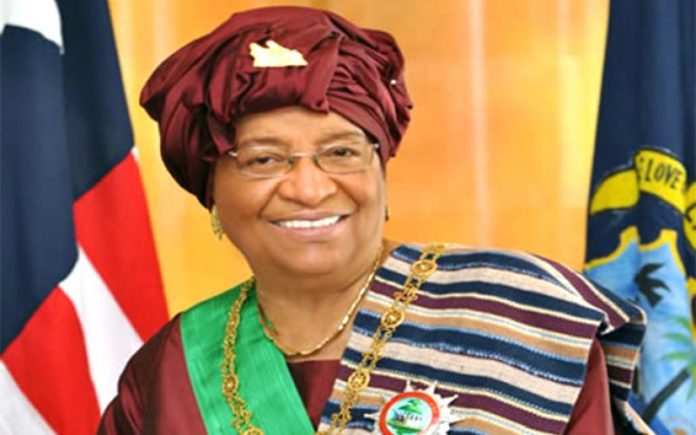
Ms. Christine Lagarde, Managing Director of the International Monetary Fund (IMF), on Tuesday announced the formation of two external advisory groups consisting of economic, financial, and public policy experts to inform the IMF’s 2020 Comprehensive Surveillance Review (CSR). One of the two groups- External Advisory Group on Surveillance, includes former Liberian president, Ellen Johnson Sirleaf.
The periodic review seeks to explore the IMF’s effectiveness in monitoring global economic developments and delivering policy advice to its 189 member countries. It will be forward-looking in nature and framed by the global macro-financial environment and other secular trends, including digital technology. The review will guide the IMF’s operational priorities through 2025.
“To accomplish this task, the CSR will take account of the strategic challenges and opportunities facing the IMF and its membership in ensuring sustained, balanced, and inclusive global growth,” Managing Director Lagarde stated. “The review will also assess the Fund’s capabilities and how it can innovate and adapt to continue to provide value to our members.
“As we embark on the CSR, we are proud to have access to the expertise of two groups of eminent people. The first such group consists of thought leaders who will provide overall guidance on surveillance challenges facing the Fund and help us chart the course for new policy approaches to enhance economic prosperity and maintain global economic stability.
And because the CSR will position the Fund’s surveillance function against the backdrop of the ongoing global technological transformation, we hope to richly benefit from leading thinkers and practitioners with experience in revolutionary industries in our second advisory group,” she added.
The External Advisory Group on Surveillance will serve as an independent check on staff analysis and will make recommendations that will be set out in the CSR. The Group will engage with Fund staff on the priorities and strategic direction of the review, and subsequently inform the emerging findings and staff’s preliminary recommendations. The Group’s independent views will be communicated to the IMF Executive Board, which will ultimately establish the Fund’s surveillance priorities.
The members of the Surveillance Group are:
Mr. Mohamed A. El-Erian. Chief Economic Advisor, Allianz.
Mr. Yiping Huang. Professor of Economics, National School of Development, Peking University.
Mr. Dani Rodrik. Ford Foundation Professor of International Political Economy, John F. Kennedy School of Government, Harvard University.
Ms. Ellen Johnson Sirleaf. Former President of Liberia. Joint winner of the 2011 Nobel Peace Prize.
Ms. Gertrude Tumpel Gugerell. Emerita Consultant, Austrian Institute of Economic Research (WIFO).
Mr. Rodrigo Valdes. Former Finance Minister of Chile. School of Government, Catholic University
Mr. Guntram Wolff. Director of Bruegel.
The external advisory group on digital technology will provide guidance on potential macro-economic consequences and policy implications from important technological trends that are underway; and help the IMF develop new policy approaches in surveillance through the lens of technological change. The Group’s independent views will also be communicated to the Executive Board.
The members of the Digital Technology Group are:
Ms. Diana Farrell. Founding President and CEO of the JPMorgan Chase Institute.
Mr. Austan Goolsbee. Robert P. Gwinn Professor of Economics, the University of Chicago Booth School of Business.
Mr. Svein Andresen. Former Secretary General, Financial Stability Board.
Mr. Eric Xiandong Jing. Executive Chairman and CEO, Ant Financial Services Group.
Mr. Timothy Murphy. General Counsel, Mastercard.
Mr. Joshua Gans. Professor of Strategic Management and the Jeffrey S. Skoll Chair of Technical Innovation and Entrepreneurship, the Rotman School of Management, University of Toronto.
The advisory groups for Surveillance and Digital Technology are expected to convene initially in November 2018. The CSR is expected to be concluded by Spring 2020.
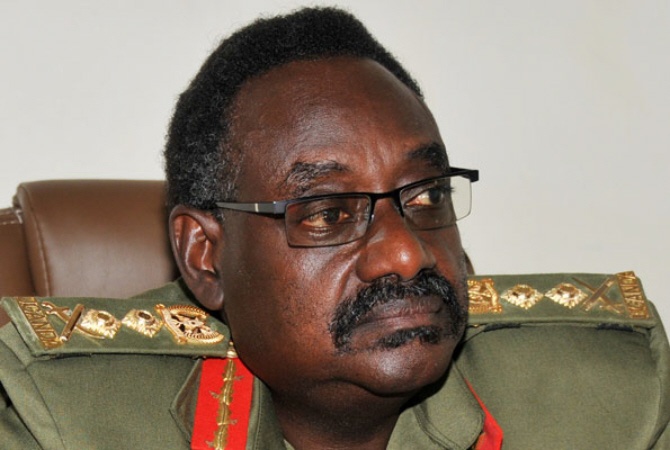
Gen. Sejusa has been defiant towards the government while government in turn has refused to retire him from army.
Former Coordinator of intelligence services Gen David Sejjusa aka Tinyefuza has been cleared to retire from the army, UPDF spokesperson Lt. Col. Deo Akiiki has confirmed.
He declined to comment on other developments surrounding the retirement, “Gen Tinyefuza will be among the officers to retire from the army, that is what I can say,” he said.
According to a source privy to anonymity, Sejusa’s retirement has been ordered by president Museveni after his long quest to retire home. He is expected to be included on the list of retiring officers in 2019.
This website has also learnt that former Deputy Chief of Defence Forces Lt. Gen Ivan Koreta and the chairman of National Enterprise Corporation Lt. Gen. Joram Mugume are among the officers set to retire home.
Upon falling out with army leadership and citing corruption issues over the Lord Resistance Movement war, Gen. Sejusa tendered in his resignation letter in 1996 however, his plea has always been turned down by the top officers. He sued government for forcefully retaining in the army and subsequently won the case in High Court but the state appealed the case in Court of Appeal that overturned the decision of High Court.
The bush war general who has always been against injustice in Museveni’s government, in 2016 secured a High court affirmation for him to be retired from the army since he was not serving soldier assigned nor executing any of the force’s duties.
Sejusa was in 2016 arrested and charged in General court martial over two offences of participating in political activities, insubordinate behavior, and two counts of conduct prejudicial to good order, and discipline expected from an army officer. He later acquitted and set free.
Gen. Sejusa will join a list of retired officers who include; Gen. Yoweri Museveni (President), Major General Kahinda Otafiire, Major General Benon Biraaro, Major Gen Matayo Kyaligonza, Major Gen Jim Muhwezi, Lieutenant General Henry Tumukunde, General Salim Saleh and Major General Mugisha Muntu (Former army commander)
David Sejusa profile
General David Sejusa (born 13 November 1954 as David Tinyefuza) decorated with the DAMU Medal and the Luweero Triangle Medal is a Ugandan lawyer, military officer and politician. He was the coordinator of intelligence services and a senior presidential adviser to President of Uganda Yoweri Museveni. He served as army commander and also a member of High Command UPDF, the UPDF defense council and a member of parliament representing the Uganda People’s Defence Force. He had a falling out with Museveni and formed the Freedom and Unity Front in exile in the United Kingdom following being charged for plotting a coup where he has been allegedly planning anti-government activities by the Museveni government.
Tinyefuza attended Nyakasura High School. He holds the degree of Bachelor of Laws Honours (LLB) and Master of Laws (LLM) from Makerere University. He also attended the Law Development Centre for the Diploma in Legal Practice where he left after a clerkship for cadet training in Tanzania. He was also a student leader at Makerere University. He has obtained the senior command qualifications of PSC from the Uganda Senior Command and Staff College at Kimaka, Jinja, Uganda. He also holds a Certificate in Information Technology from an institution in Canada. He also attended the Police Cadet Course in Tanzania and Senior Command Strategic Course.
He is married to Juliet Tinyefuza.
Name change
On 17 February 2012, David Tinyefuza officially changed his name to David Sejusa. He said that Sejusa is a family name that is also reflected on some of his academic documents but that he had abandoned it “around secondary school level” but that he would re-claim as “everybody back home” refers to him as such. He added: “There is nothing in reverting to my original name. It is comrades like you who didn’t know it was my name but those elder comrades have always referred to me as such. And I suggest that from today you quote me as Gen. David Sejusa.”
The Sejusa name is a Luganda rendering that is loosely translated as “I have no regrets;” it also has the same meaning in the Ankole rendition of Tinyefuza, which he said was a reason to take a new identity.
Military career
Prior to 1981, David Tinyefuza was a policeman with the Uganda Police Force serving as Assistant Superintendent of Police. In 1981, he became a combatant in the Uganda Bush War between the Uganda National Liberation Army (UNLA) of Milton Obote and the National Resistance Army (NRA) of Yoweri Museveni, from 1981 until 1986. For a period of 10 years following the victory of the NRA in 1986, he served as a member of the National Resistance Army Council (NRAC) and the National Executive Committee (NEC). Between 1989 and 1992, he served as Minister of State for Defense. In 1993, he was appointed Presidential Adviser on Peace and Security, serving in that capacity until 1997. He was appointed Senior Presidential Adviser and Coordinator of Intelligence in 2005, a position he held until 2013.
Politics
The party was founded in November 2013 with an official announcement later made in London, United Kingdom, where former General David Sejusa was in exile. Sejusa said of President Yoweri Museveni: “He’s had enough time. He can leave and go, and we start a new process of national healing. And we are organising ourselves, we are establishing a constitutional rule which he destroyed.” Sejusa denied seeking the presidency and said that it was “a waste of time” to run against Museveni within the structures of the current system. Two months earlier, Museveni challenged Sejusa to try to overthrow him, but added that whoever uses violence would be stopped. “If Sejusa wants to use force, let him come.” In turn, Sejusa responded to questions of whether he would use force to bring change and said: “It’s not so much that we want to do so. But if he continues to unleash terror on the population ours will be self defence.”
Following a rift with the establishment in May 2013 about Ugandan President Yoweri Museveni’s son, Muhoozi Kainerugaba, over allegation of nepotism and that he would eventually simply replace his father as president, a motion Kainerugaba denied, he founded the Freedom and Unity Front. Sejusa had earlier called on Ugandans to “build alternative capacity” and remove Museveni. He added, the week following his departure as a MP representing the military,that “no one should imagine that Museveni will be removed through elections.”
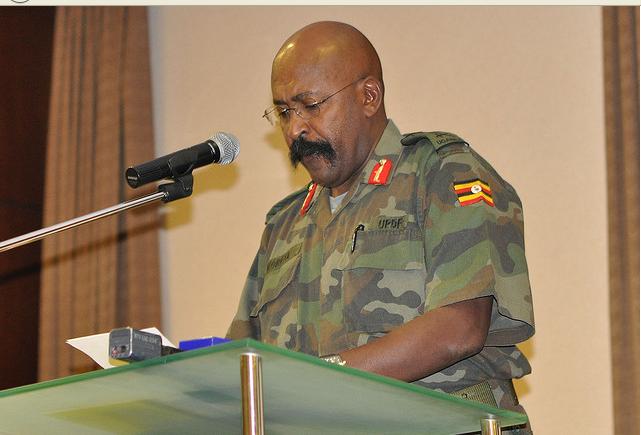
Lieutenant-General-Ivan-Koreta
Lt. Gen. Ivan Koreta
Ivan Koreta (born 15 October 1955) is a Ugandan military officer, diplomat and legislator. He is a lieutenant general in the Uganda People’s Defence Forces(UPDF) and a representative for the armed forces in the Parliament of Uganda; where he serves as a member of the Public Accounts Committee and the Committee on Presidential Affairs.
Koreta has been a member of the armed forces since 1981 and most recently served as the deputy chief of defence forces, the second-highest position in the UPDF, from 2005 to 2013. He also served from 2006 up until 2009 as the chairman of the General Court Martial, the second-highest military court in Uganda.
Early life
Koreta was born in Mbarara, Ankole sub-region, on 15 October 1955 in a Pentecostal family of the Banyankole. He had his primary education in his home town of Mbarara and attained his PLE certification in 1969.
He then attended Kiira College Butiki for his O-Level education, attaining a EACE certification in 1973. Koreta later on advanced to the University of Ibadan, graduating in 2003 with a Master of Science in Strategic Studies.
Military training and career
While still in his teens, Koreta attended military training in Mozambique as a member of the Front for National Salvation, a guerilla group led by Yoweri Museveni. He participated in the war that removed Idi Amin from power in 1979. When Museveni formed the National Resistance Army (NRA) in 1981, Koreta joined him. During the Ugandan Bush War, he became a battalion commander in the NRA. During the April 1986 battle to capture the Ugandan capital city Kampala, his 13th NRA Battalion was responsible for guarding the Kampala-Gulu highway at Matugga.
Since the NRA captured power and was subsequently transformed into the UPDF, Koreta has served in various roles, including the following: Commander of the First Division: 1986-1988 (at the rank of brigadier general)
Deputy Director of the Internal Security Organization: 1988-2001
Promoted to rank of major general: 2001
Lt.Gen. Joram Mugume
Lieutenant General Joram Mugume, is a military officer in the Uganda People’s Defence Forces (UPDF). He is the chairman of the board of directors of the National Enterprise Corporation (NEC), the business arm of the UPDF. He was appointed to that position by the Uganda Ministry of Defence and Veterans Affairs, on 20 February 2018. He has also served as the chairman of the “Military Land Board”, an organ of the UPDF. He has been serving in that position since 2005, having served as Deputy Chief of Defense Forces in the past.
Background
He was born in Kiruhura District, in Uganda’s Western Region
Joram Mugume was one of the first people to join the National Resistance Army (NRA). His military number is RO/00037, meaning he was the 37th recruit. At the time NRA captured Kampala in 1986, Mugume was the Commander of the 3rd Battalion. Later, he served as deputy army commander.When General David Sejusa was kicked out of the Ugandan parliament, Joram Mugume was one of the five military officers nominated to replace him.In May 2016, President Yoweri Museveni promoted him to the rank of Lieutenant General