Stanbic Bank
Stanbic Bank
21.9 C
Kampala
Stanbic Bank
Stanbic Bank
Home Blog Page 1461

Court dismisses Dr Mpozayo Christophe’s Case against the Government of Rwanda

Rwanda President Paul Kagame.Photo credit/reuters

The First Instance Division dismissed Dr Mpozayo Christophe’s Case against the Government of Rwanda over his arrest, detention, prosecution conviction and sentencing for the offence of inciting insurrection amongst the population for being in possession of ammunition.

The Applicant, who is a Rwandan Citizen and former Staff of the Community in the East African Legislative Assembly (EALA), was seeking Court orders to declare that the government infringed the fundamental Principles of the Community as well as Rwandan Laws.

In ruling Court held that it is not satisfied by the Applicant that Criminal Case was conducted against universally accepted principles of law, therefore declaration against his arrest, detention, trial and imprisonment being unlawful was declined.

Further Court said that the Applicant has not proved violation of the principles of law enshrined in Articles 6(d) and 7 (2) or the Treaty, hence Court not satisfied and declined to declare that the Republic of Rwanda violated the EAC Treaty and principles of good governance and rule of law as well as his conviction was unlawful as sought by the Applicant.

In addition Court considered that granting orders that the sentence imposed on the Applicant in Criminal Case be set aside as well as an order that the Applicant’s conviction be hereby set aside, would be tantamount to exercise an appellate jurisdiction over national courts, which jurisdiction the court is not clothed with, hence such orders sought declined to be granted.

On the prayer Court to award general damages to the Applicant, the Court said that it may award general damages in an appropriate case, however, in this case, it we are unable to do so because the Applicant has not proved his claims in his Reference hence prayer was declined. Similarly, Court found no basis to award aggravated and exemplary damages as sought by the Applicant, having not succeeded in his case.

Furthermore, Court noted that, the Applicant in his Written Submissions raised a claim for his unpaid monthly earning. Court retaliated that, such a claim is akin to a claim for special damages and that it is according to the law, that specific damages must be pleaded and proved. That In this case, they were not pleaded. In any event, the Applicant has not even succeeded in the Reference, hence the prayer was disallowed.

In conclusion, the Court said that, with regard to the prayer for costs, as stated in Rule 111(1), costs follow the event unless the Court for good reasons otherwise orders. In this case, the Applicant having failed to prove his claims under this Reference, he would not be entitled to costs. Ordinarily, he should be subjected to pay costs to the Respondent. However, the Court is aware that the Applicant could not afford to engage a lawyer to represent him initially and that the ones that represented him subsequently were doing so under a legal aid brief by the East African Law Society. In the circumstance, it is in the interest of justice that each party bears its own costs.

The Lawyer representing the Applicant, after the Judgment was delivered, he requested Court to provide him with the copies of the pleadings and the Judgment to enable him Appeal to the Appellate Division.

The Judgment was delivered by Honorouble Lady Justice Monica Mugenyi, (Principal Judge), Justice Isaac Lenaola (Deputy Principal Judge), Justice Dr Faustin Ntezilyayo, Justice Fakihi Jundu, and Justice Audace Ngiye

The Applicant was represented by Mr Joel Kimutai Bosek and Ms Moureen Okoth while the Respondent was represented by Counsel Arnest William holding brief for Nicholas Ntarugera Counsel for the Respondent AG Rwanda


Stories Continues after ad

MPs to summon DFCU top gurus over Crane Bank and Global Trust Bank takeover

Dfcu Bank headquarters in Kampala.

DFCU top guru are among those lined up by parliamentary Com­mit­tee on Com­mis­sions, Statu­tory Au­thor­i­ties and State Enterprises (Cosase) in an inquiry that is expected to begin soon, the Auditor General, John Muwanga, having presented his report on defunct banks sold/liquidated by the Bank of Uganda (BoU), Eagle Online understands.

DFCU bought Crane Bank Limited (CBL) in January 2017 and Global Trust Bank Uganda (GTBU) in July 2014 but the two deals, according to the Auditor General John Muwanga’s special report of BoU on seven defunct banks, are questionable as major documents were not available to him during his inquest of the central bank’s top brass.

The two banks were sold by BoU to DFCU on account of insolvency and under-capitalization respectively, each going for Shs200 billion and about Shs71 billion worth GTBU’s liabilities, respectively.

BoU’s sale of the two banks to DFCU, according to Muwanga was done without following established guidelines, which BoU top managers might have ignored intentionally for selfish interests. BoU sold other banks like Greenland Bank, Cooperative Bank, International Credit Bank and others in this regard of guidelines.

Section 95(1) (b) of the FIA 2004, states that the Central Bank shall within 12 months from taking over as a Receiver arrange for the purchase of assets and assumption of all or some of the liabilities by other financial institutions. This was not followed in the case of GTBU as BoU closed the bank and solicited for the buyers (DFCU) on the same date of July 25, 2014.

“I observed that there were no guidelines /regulations or policies in place to guide the identification of the purchasers of GTBU. There were also no guidelines to determine the procedures to be adopted by the Central Bank in the sale of assets and transfer of assets or liabilities of the defunct banks to DFCU,” Muwanga says.

Muwanga further says he was not provided with records of the procurement process to ascertain the bid requirements, offers made, list of bidders, evaluation criteria, evaluation report and negotiation minutes leading to the Purchase and &Assumption (P&A) agreement. “In the absence of guidelines and procurement records, I could not ascertain whether BoU selected and evaluated the bids in line with the evaluation criteria,” he says.

In July Eagle Online reported that Muwanga and his staff were finding it hard to access critical information as they investigated BoU top officials who presided over the liquidation and sale of defunct banks.

Among BoU officials questioned by Muwanga’s team of auditors were the Deputy Governor Dr Louise Kasekende and retired former director of supervision Justine Bagyenda who has her own case of alleged illicit accumulation of wealth, with billions of shillings on her bank accounts.

In mid-May this year, the Speaker of Parliament Rebecca Kadaga directed the AG to investigate BOU after reports emerged that the bank officials had earlier on refused to cooperate with the AG officials, claiming the case of the sale of Crane Bank was already in court and that it would breach the sub-judice rule. The Solicitor General Francis Atoke had advised BOU top managers not to cooperate with the AG’s investigators.

The expanded audit into BoU was prompted by petitions from Crane Bank shareholders and central bank employees regarding Shs200 billion taxpayers’ money that was allegedly invested into the defunct commercial bank before it was liquidated in October 2016 and sold to DFCU Bank in January 2017.

The shareholders had earlier on petitioned Parliament’s Committee on Commissions Statutory Authorities and State Enterprises (Cosase) chaired by MP Abdul Katuntu and requested for an investigation into the sale of Crane Bank to DFCU Bank and the closure of other several banks in the past.

Quoting from the interim report submitted to Cosase on April 10, MP Katuntu said that BoU officials had denied the Auditor General access to any information regarding closure of Crane Bank and the National Bank of Commerce (NBC).

Stories Continues after ad

Seven steps to a memorable new venture marketing rollout

Martin Zwilling

By Martin Zwilling

Even with instant two-way communication via the Internet and mobile phones, your greatest new solution or service won’t found or properly recognized without marketing. The challenge is to rise above the clutter, and stand out in the rush of over 500,000 other new businesses that get started in the U.S. every month. I find that digital marketing is the most visible and effective place to start.

Even within the digital marketing arena, there are a thousand alternatives, vying for your limited budget. Should you be buying key words from search engines, building fabulous web content, blasting out e-mail campaigns, or putting all your efforts into viral videos or social media? In fact, the first challenge is to build a strategy, put together a budget, and define measurement metrics.

As an advisor to many entrepreneurs and small businesses, I often get asked where to start, and how to proceed. In that context I offer the following practical steps and priorities:

Focus on a unique selling point (USP) for your offering. Digital marketing is all about establishing a voice and sending a message that customers can relate too, and makes you stand out. My advice is to keep it simple but memorable, and pick something you can highlight with pictures and videos. Put your customer at the top, rather than technology.

Research the top digital channels for your business today. There is no one best channel for all businesses. For young consumers today, it may be Instagram or Snapchat, while B2B offerings should take a hard look at LinkedIn and other business forums. Prioritize the list by customer reach, effort required by you, as well as cost.

Select no more than three that match your needs initially. You can’t do everything that you would like, even if you had the money. Resist the urge to try the latest “hot new channel,” just because all your friends are talking about it. Set specific objectives, budgets, and metrics for each one. Pick a theme and a team for each and get started.

Start creating content to get visibility and build a following. Here is where you may need outside expert help to be effective. Traditional marketing hype won’t get you the attention you need. Today’s audience is looking for something more creative, more visual, engaging, and interactive. Here is where you have to think outside the box.

Concentrate on building your brand image and message. Now is the time to integrate and solidify your brand across all the channels and platforms you have selected. You need to hone your design and tone, taking a strategic approach to establish brand recognition in your marketplace, all while keeping your target audience on top of mind.

Expand marketing in channels that work and add others. Based on metrics, revenue growth, and customer feedback, it’s now time to prune digital channels that don’t work for you, experiment with new ones, and expand your efforts where you see success. Content that works should be relentlessly repurposed, from web site to social media, events, etc.

Add elements of traditional marketing to maximize visibility. While non-digital marketing typically costs more money, it may be required to reach all elements of your audience. There are still customers who won’t give your brand total credibility until it appears on television ads, in newspapers, direct marketing, and at trade shows.

In every case, I have found that marketing is more important than ever for the growth and visibility of a new brand, and digital marketing is the most effective and the least expensive way to start. Yet it shouldn’t be done without careful planning and effort. Entrepreneurs who strike out randomly on every digital channel they know, using family and interns, are wasting their efforts.

Even less effective are those who still believe that “if we build it, they will come.” It’s time to be proactive in finding customers, engaging them in two-way conversations, and listening carefully to their message, as well as projecting yours. It’s not the size of your budget that makes you memorable – it’s the size of your connection with real customers who can multiply your efforts.

The writer is a veteran startup mentor, executive, blogger, author, tech professional, and Angel investor. Published on Forbes, Entrepreneur, Inc, Huffington Post, and others.

Stories Continues after ad

Business idea for growing watermelons in Uganda: What you need to know

Many Ugandans enjoy watermelons and it is good for business

The Uganda Investment Authority (UIA) has outlined business ideas for both local and foreign investors who want to invest in the agriculture sector. Among business idea that UIA has advised investors to get interested in, is the growing and marketing of watermelons (Citrullus lanatus).

“The idea is premised on harvesting 12,000 watermelons per quarter which translates into 48,000 watermelons per year. The revenue potential is estimated at USD 7,200 (about 27.4 million) per quarter, which translates into US$ 28,800 (about Shs109.4 million) per year,” says UIA’S Generation and Up-dating of Business Ideas Report.

According to the report, the watermelon business has a good market demand throughout the year and can provide employment to the youths and women. UIA estimates the Project cost at about US$ 2080 (Shs7.9 million).

Production process

Dig plenty of organic matter into the soil to provide the conditions watermelons need: a light, sandy, fertile loam soil that is well drained yet retains moisture. Plant Watermelons after both air and soil temperatures have reached 65°F usually two to three weeks after the last rainfall.

Direct sowing is best if your growing season is long enough for the plants to mature. For each plant, dig a hole two feet in diameter and a foot deep, and add at least a shovelful of compost or well-cured manure and a trowel or two of bone meal.

Set hardened-off transplants into the ground at the depth they were growing in their pots. Sow seeds an inch deep in hills. Allow plenty of space between plants. Apply a thick organic mulch to hold in moisture.

Remove all covers as soon as flowers appear so that bees and other insects can pollinate the plants, and begin fertilizing with compost tea every three weeks and should be ready to pick about 35 days later.

Market Analysis

According to the report, there is a growing market for fruits such as watermelons country wide especially in urban areas. Water melons can be supplied to Fruits’ vendors, market vendors, hotels, supermarkets and canteens. “There are so many investors in this sector spread across the Country especially in Central Uganda,” it says.

Land requirements: Two acres of land which hired at approximately US$1,000 (about Shs3.8million).

Why people buy and include watermelons in their diet

Boosts Immunity: Studies show eating watermelon can increase levels of arginine, an important amino acid that’s used for the synthesis of nitric oxide. Not only does nitric oxide help dilate your vessels to keep blood flowing efficiently and reduce the risk of high blood pressure, but it’s also involved in regulating the immune system.

Watermelon is also a great source of vitamin C, a key micronutrient that does double duty, acting as both an antioxidant and immune enhancer to keep your body healthy and ward off chronic disease. Antioxidants can also help fight free radicals and relieve inflammation to protect the cells against oxidative damage and stress.

Improves Heart Health: Watermelon contains a good amount of both potassium and magnesium, two important nutrients used to help remedy high blood pressure naturally. Consuming proper amounts of potassium and magnesium from a nutritious diet may be associated with improved heart health and a decreased risk of death from heart disease.

A review published in the journal Advances in Nutrition showed that eating plenty of potassium-rich foods like fruits and vegetables can positively impact blood pressure levels, which may be useful in reducing the risk of conditions such as stroke and heart disease.

Lycopene, one of the carotenoids found in abundance in watermelon, can also help keep your heart healthy and strong. Lycopene benefits heart health by reducing inflammation and improving blood lipid levels. (8) Studies have also shown that watermelon can help to relieve arterial stiffness, balance cholesterol and improve systolic blood pressure in patients with hypertension.

Relieves Pain and Muscle Soreness: One of the top 10 benefits of watermelon is its ability to promote muscle recovery and alleviate aches and pains in athletes. Interestingly enough, one study in the Journal of Agricultural and Food Chemistry looked at the effects of watermelon juice as a functional drink for athletes. After 24 hours of supplementation, athletes experienced improved heart rates that were more beneficial for muscle recovery in addition to less overall soreness and muscle aches.

In addition to the potential benefits of watermelon juice, watermelon also packs a good amount of vitamin C into each serving, which has been shown to protect cartilage and bones, aid in the repair of tendons and ligaments and help speed up wound healing.

Potassium and magnesium, two nutrients that are also found in watermelons, are important for muscle recovery and pain relief. Potassium, in particular, aids in the prevention of muscle cramps following exercise and helps you heal from injury more quickly.

Stories Continues after ad

AMISOM, partners meet to devise strategies on countering potent threat from explosives

Officers from the African Union Mission in Somalia (AMISOM), Somali Security Forces and other international partners attend the meeting

The African Union Mission in Somalia (AMISOM) and key international partners have concluded a meeting in Mogadishu, convened to devise ways of reducing the threat posed by Improvised Explosive Devices (IEDs) in Somalia.

The meeting, a follow-up to a similar one held in April 2018, deliberated on specific threats, the dynamism of the threats; and explored ways of bolstering efforts to reduce them.

Facilitated by the United Kingdom Mission Support Team (UKMST), the two-day meeting was attended by representatives from the United Nations Support Office in Somalia (UNSOS), the United Nations Mine Action Service (UNMAS), the United States Army, the Turkish Army, the European Union Training Mission (EUTM) in Somalia, and military officers from AMISOM.

Participants discussed mitigation efforts, while analyzing the impact of IEDs along the Main Supply Routes. Also high on the agenda of the meeting, was the nature of the capacity building support, to the Somali National Security Forces, in counter IED efforts. They agreed to intensify sensitization of local populations on the impact of IEDs, especially along Main Supply Routes.

“This is a threat that is being effectively utilized by the enemy. And so we must go after it and defeat it,” remarked AMISOM’s deputy Head of Mission Mr. Simon Mulongo, during the official opening on Monday.

Mulongo noted that the indiscriminate use of IEDs was inflicting colossal damage on civilian populations and the military. He emphasized increased focus on eliminating the IED threat, through the development of a clear and effective counter IED strategy, and the use of Intelligence, Surveillance and Reconnaissance (ISR) systems.

In his remarks, AMISOM’s deputy Force Commander in-charge of Operations and Planning, Maj. Gen. Charles Tai Gituai, expressed concern at the increasing incidents of explosions from IEDs. In its resolutions, the meeting agreed to the formation of multi-stakeholder teams in all AMISOM sectors, which would come up with quick solutions to mitigate rising threats from explosives.

“The best weapons of course against IEDs is a well-trained soldier who practices correct drills, maintains conscious situational awareness of his environment during the convoy movement, consciousness of the threat, listens to the intuition or the seventh sense, observant, and able to understand and reconcile the fact that this threat is real. And therefore we need to be very much aware of this,” said Maj. Gen. Gituai.

He noted that the training of AMISOM troops in the safe disposal of explosive ordnances was bearing fruit. AMISOM troops are increasingly finding IEDs and successfully proceeding with disposal operations.

Lt. Col. Ian Strong, the Commander of the UK Mission Support Team in Somalia, called on all the participants at the at the conference to share critical information on IEDS, which he said, was key in helping reduce the threat posed by the explosives.

“Outside the gates of Mogadishu International Airport are IEDs being constructed and built and then sent all over the country. And the top purpose is destruction. It’s about us as a team helping each other and also helping the people of Somalia to overcome this threat,” stated Lt. Col. Strong.

UNMAS announced the release of a draft IED Risk-Mitigation Planners’ Handbook, with an associated pocket handbook and IED risk-mitigation cards, to provide ready information to AMISOM troops in the country.

“The intention of these series of IED Risk Mitigation products is to support a coherent approach across AMISOM in their efforts to counter the use of IEDs in Somalia,” said Mr. Paul Amoroso, the UNMAS Somalia IED Threat Mitigation Policy Advisor.

Stories Continues after ad

UNBS closes Sunshare factory over failure to comply with Standards

The Executive Director of Uganda National Bureau of Standards (UNBS) Ben Manyindo addressing participants at the ongoing four-day International Standards Organisation (ISO) regional training on Managing National Standards Development projects and Programs (MSPP)

As a consumer protection measure, the Uganda National Bureau of Standards (UNBS) has closed factory premises of Sunshare Investment Limited in Mukono over failure to comply with set standards in its production processes.

Sunshare Investments produces the Lucky brand of juices including mango, pineapple and orange flavours.

Laboratory analysis carried out by UNBS on product samples submitted for testing indicated high level of Free Chlorine in the product contrary to the requirements of the Standard (US 47: 2011) for juices and other non-carbonated drinks.

According to the standard, juices and non-carbonated drinks should be free from chlorine because of its adverse effects on human health. Chlorine reacts with water to form acids which are poisonous to human body once consumed.

Chlorine is an active ingredient used in disinfectants such as JIK to sterilise water and kill bacteria and other micro-organisms. However, high levels of chlorine results in production of toxic substances that may lead to damage of internal body organs.

The premises of Sunshare factory shall remain closed until when the company directors have demonstrated that they have put corrective measures in place to ensure that such contamination does happen in future.

UNBS will continue to perform its mandate of enforcing standards to protect consumer health and safety and the environment against dangerous and sub-standard products.

UNBS urges the public to remain vigilant and report any cases of substandard products on the market on.

Stories Continues after ad

Janet Museveni to preside over the releasing of the 14th series of UBTEB exams

First Lady and Minister for Education and Sports, Janet Museveni.

First Lady and Minister of Education and Sports, Janet Kataha Museveni is tomorrow expected to preside over the releasing of the 14th series of UBTEB Examination results.

The news has been confirmed by the Executive Secretary for UBTEB Oyesigye Onesmus saying the function is scheduled to take place tomorrow at the secretariat at 11:00am.

Mr. Onesmus noted that, in the 14th Examinations series, the board registered 23,560 students from 173 examination centers form various Vocational training institutions among other training institutions accredited all over the country.

“Examinations were done in various categories of Diploma Business and Certificate programs, Technical National Diploma and Higher Diploma programs and other specialized Academic programs including Fisheries, Meteorology, Agriculture, Wild life and Lands and Survey,” he said

He said most students excelled in the different fields of study and he hopes that they will professionally apply all the acquired skills for execution of their duties in various fields of employment.

The examinations were done between May and June, 2018 and were conducted in three phases.
The first phase of examinations include Technical Diploma and Higher Diploma programs and will start on 21st May 2017 up to 1st June 2018, phase two examinations shall start on 29th May 2018 and end on 14th June 2018 including Agriculture, Cooperatives and Wildlife programs. Phase three examinations will commence on 1st June 2018 up to 15th June.

Stories Continues after ad

Uganda’s annual coffee exports fetch $472m

Uganda coffee for export

By George Mangula

Uganda’s coffee exports for 12 months (September 2017 to August 2018) totalled to 4.35 million bags worth $472 million, the Uganda Coffee Development Authority (UCDA) says in the latest report.

According to the report, Robusta coffee which was 3.25 million bags fetched $333 million while Arabica coffee which comprised 1.10 million bags brought home $139 million during the period under review.

Cumulatively, coffee exports for 12 months (September 2017- August 2018) were less than 4.47 million bags worth $529 million in the previous year (September 2016-August 2017), representing a decrease of 2.67 per cent and 10.81 per cent in quantity and value respectively.

A total of 348,952 60-kilo bags of coffee valued at US$35.68 million were exported in August 2018. That comprised 296,901 bags ($ 29.29 million) of Robusta and 52.051 bags ($6.40 million) of Arabica. But that was a decrease of 16.59 per cent and 24.18 per cent in quantity and value respectively from the same month last year.

By comparing quantity of coffee exported by type in the same month of last year (August 2016/17 and 2017/18), Robusta registered a percentage decrease in both quantity and value which was 22.38 per cent and 30.75 per cent respectively.

Arabica registered a percentage increase in both quantity and value of 45.31 per cent and 34.05 per cent respectively.

Coffee exports in 11 months (Oct-August) were 5.92 percent and 14.41 per cent lower than the previous year.

According to the report, some of the factors that led to the decline were: Low global prices on account of higher crop in Brazil which affected export prices as well as lower production from the main harvest in Masaka and South-Western regions compared to the previous year, new trees coming into production notwithstanding.

Destination of Uganda’s coffee in August

The destinations of Uganda’s coffee exports during the month of August 2018 showed that: Exports to EU countries amounted to 224,035 bags lower than 253,142 bags exported in the previous month. This represented a 64.20 per cent of total exports.

EU was followed by Sudan with 42,227 bags (12.10 per cent) compared to 65,037bags (16.55 per cent) the previous month. India imported 18,520 (5.31 percent) compared to 18,960 (4.82 per cent), USA 14,513 bags (4.16 per cent) compared to 16,760 (4.82 per cent) and Morocco 14,292 (4.10 per cent) compared to 11,535 (2.93 per cent).

Coffee exports to Africa amounted to 60,437 bags, a market share of 17.32 per cent compared to 80,804 (20.56 per cent) bags the previous month.

Global situation

Global coffee exports for July 2018 were 10.11 million bags, which was 4.6 per cent higher than in July 2017. Total exports for the ten months of coffee year 2017/18 were 101.20 million bags, which was an increase of 0.9 per cent.

But the 2017/18 global production is still estimated at 158.56 million bags compared to 159.05 million bags, a decrease of 0.3 per cent from last year.

Arabica production is estimated to reduce by 6.6 per cent to 97.16 million bags while Robusta is projected to increase by 11.5 per cent to 61.40 million bags.

Africa’s production is expected to increase by 5.3 per cent from last year with an output of 17.30 million bags. Global consumption is projected to increase by 2 per cent at 162.12 million bags with major increases noted in Asia and Oceania countries and South America.

Stories Continues after ad

Local commercial bank lending rates decline to 20.3 %

Stanbic Bank Uganda recently announced an increase in private sector credit.

Bank of Uganda annual report for the financial year 2017/18 indicates that the shilling denominated commercial bank lending rates declined to an average of 20.3 per cent from 21.1 per cent in the previous year.

The report also indicated that as at June 2018, Shilling denominated lending rates stood at 17.7 per cent, down from 21.1 per cent in 2017.
The report partly attributes the drop in the lending rates to an accommodative monetary policy stance by the BoU since April 2016, where the CBR stood at 16 percent and by June, 2018 it had declined to 9 per cent.

“While the lending rates have declined, they remain elevated reflecting, in part, the structural rigidities which have kept the cost of doing business in the financial sector high. Nonetheless, asset quality has improved,” the report says.
It adds that relative to June 2017, the ratio of Non-performing Loans (NPLs) to total gross loans declined to 4.4 per cent as of June 2018, from 6.2 per cent in the previous year.

Meanwhile, according to the report, time deposit rates averaged 8.7 per cent in the financial year 2017/18, opening and closing the year at 9.3 per cent, which is much lower than 11.4 per cent in financial year 2016/17. Consequently, the report notes, the spread between lending and deposit rates ranged between 8.4 per cent and 13 per cent of the same period.
Overall, the spread increased marginally to 11.5 percent in financial year 2017/18, up from 11.2 percent in financial year 2016/17.

Meanwhile the report gives the average lending rates on foreign currency denominated 7.7 per cent in financial year 2017/18 from 8.9 per cent in the year, and the foreign currency spread averaged 5.0 per cent over the financial year, from respective 5.4 per cent in the previous year.
Credit to private sector
According to the report, although still weak, growth in private sector credit (PSC) showed sign of recovery in financial year 2017/18, relative to financial year 2016/17, as the monetary policy remained accomodative over the period under review. PSC grew on average by 6.5 per cent in financial year 6.5 per cent in financial year 2017/18, which is higher than 4.2 per cent in the previous year. By end of June 2018, PSC had increased by 10.5 per cent compared to 5.6 per cent in the previous period.

However, the report notes, the annual PSC growth, net of valuation changes on account of exchange rate movements, was 5.3 percent in financial year 2017/18, compared to 3.3 per cent in the previous year. The report attributes the improvement of the PSC growth to the easing of the monetary policy, improved economic conditions and reduction in supply-side constraints as NPLs that declined. “The sluggishness in the same growth is part due to the banks’ present risk aversion given the high default rates in the recent past,” says the report.

Sectorwise, growth in PSC was mainly driven by growth of credit to the agriculture, personal and household loans, and trade, which together constitute 50 per cent of the total PSC. PSC to the manufacturing, building, mortgage, construction and real estate sectors, which together account for 33 per cent of the total credit, has notably recovered, having been negative for more than half of the financial year. The report says the trend, if sustained, is likely to boost private investment and consumption, which should in turn boost growth.

Stories Continues after ad

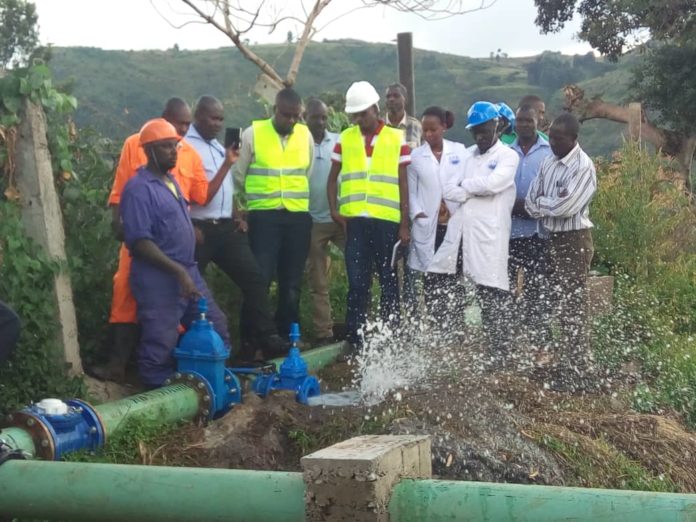
NWSC completes the construction of Kapenguria-Kapchorwa pipeline

NWSC team at the handover ceremony at Kapenguria.

National Water and Sewerage Corporation has completed the construction works on the Kapenguria-Kapchorwa pipeline in Kapchorwa district.
The completed project is in line with NWSC’s strategic plan, designed in-house and has been financed using NWSC’s internally generated funds.
According to NWSC Managing Director, Dr.Silver Mugisha, they are committed to improving water supply and sewerage services in all its areas of operation.

He congratulated and lauded the Kapchorwa community for supporting and welcoming the project. He affirmed that NWSC shall continue to implement many other similar projects across the country to achieve 100 per cent access to safe clean water for all.

He said other ongoing projects are Gulu, Kabale, Soroti, Hoima, Sembabule, Fort Portal among many others all aimed at improving the lives of the people of Uganda.
Speaking at the commissioning, of the project manager, Eng. Denis Taremwa, intimated that the completed 4 kilometer pipeline shall deliver over three million liters of water per day into the Kapchorwa town water supply network.

“We are building internal capacity to implement projects. This will save us money and time to work on other service delivery projects across the country” he said
He applauded Kapenguria community for the support during the project implementation which facilitated the timely and successful implementation of the project by the NWSC team and contractor Updeal (U) LTD.

Kapchorwa area Manager, Max Omut, said, the completed project has ended the intermittent water supply and water rationing challenges which were rampant in Kapchorwa town.
According to Omut, Kapchorwa town going forward will have water supply services for 24 hours a day, instead of the previous four hours a day. “Our commitment to serve the people of Kapchorwa is total.” he pledged.

Stories Continues after ad