The Uganda National Bureau of Standards has destroyed 413 metric tonnes of substandard goods worth Shs3.5 billion as it intensifies the fight against substandard products on the local market, the agency says in the latest press release.
According to the press release, the goods destroyed ranged from electronics, cosmetics, steel products, iron sheets, food stuffs, toilet papers, agro-inputs, cooking oil, second hand tyres, beers, paints, and cereals, among others.
“The destruction of goods follows country wide seizures carried out by the UNBS Market Surveillance and Imports Inspectors in the course of the last financial year 2017/18,” it says.
Further, as part of the continued effort to fight locally manufactured substandard products, UNBS says it has formulated regulations to ensure that all products covered by compulsory standards are certified before they are allowed on the market.
UNBS has also decentralised its services to regional offices in Mbale, Gulu, and Mbarara to serve the eastern, northern, and western regions respectively, to bring certification and market surveillance services closer to people and to continue fighting substandard products on the market.
“The new regulations and decentralisation of UNBS services are part of the multi-pronged approach the Bureau has put in place to deal with the presence of substandard products on the market. Such initiatives will go a long way in improving the quality of products on the market,” the press release reads in part.
The decentralisation will further promote production of good quality products by Micro Small and Medium Scale Enterprises (MSMEs) at regional level thereby complementing the government’s industrialisation efforts while protecting consumers and the environment from dangerous substandard products.
Fighting substandard products requires a concerted effort involving UNBS working together with manufacturers, traders, consumers, and other government agencies, the press release says.
When I heard a friend and business mentor say, “Your startup won’t fail if you don’t quit,” I realized that every entrepreneur should adopt “never give up” as their mantra. Rather than quitting, there are always alternatives, like pivoting the business model or merging with new partners for support. Either could improve the statistic that half of startups fail within the first five years.
Nothing is more discouraging to aspiring entrepreneurs than the high failure rate. So why do most startups fail? Many experts say that running out of money is not the primary reason. The number one reason seems to be that the founders just walk away. Of course, they may be out of money as well, but that is often more of an “excuse” than a reason.
Here are some common face-saving excuses that I hear from entrepreneurs abandoning their startup, along with some suggested alternatives to the hard stop and exit:
“I’ve lost my passion. I’m not enjoying this anymore.” This suggests that you’ve become discouraged with your current business model, possibly because of an unanticipated problem or pivots you made to avoid a competitor or make more money. My suggestion is to morph the current business idea back into one than you can love and enjoy rather than your quitting and accepting an employee role that’s not your preference.
“My idea is just too far ahead of its time.” You probably realize that the leading edge is very near the bleeding edge, where only early adopter customers dare to tread. On the other hand, if you wait for competitors to get there first, you may be left in the dust with no customers. Yet if you already have some early adopters, that’s a good indication that real marketing and education will likely bring your product or service mass acceptance. So hang in there and get busy.
“I can’t find any trustworthy investors these days.” If you can’t bootstrap the venture yourself, find a partner, friend or family member, rather than a professional investor to carry some financial weight. Otherwise, look for advances from distributors, vendors or even future customers. Try bartering services you have for something you need. I’ve seen countless creative solutions to the cash-flow problem by entrepreneurs who don’t quit.
“The people on my team are not really committed.” We all make people mistakes or set employees’ expectations too high. So you made some bad hiring or partner decisions. Now is the time to face up to these issues and reset your expectations or move out the people who don’t fit. The sooner it’s done, the happier you all will be.
“I just don’t have the business skills I need to compete.” Acquiring business skills is not rocket science; they can be learned on the job, as well as supplemented by coaching from an experienced team and advisors. If you knew all the answers, you would be bored and lose interest (see number 1). Half the fun lies in the learning challenge, so don’t quit now.
“It’s now obvious that there is no market for what I created.” It has never been enough to build a solution and then wait for people with the right problem to find you. There are a wealth of tools available today, relying on social media and marketing, to create or foster the market your company needs. Big markets never spring up fully grown out of the ether.
“My company grew too fast, and the pressure and costs are killing me.” Perhaps it’s time to reset your course to focus on business basics, so you can lighten your load. Or maybe it’s time to scale back and focus more on organic growth. But quitting right as your company is encountering success is foolish. Professional investors would love to help you scale your business
Most people agree that entrepreneurs learn more from their mistakes and pivots than they do from easy successes. Investors tell me that they are wary of funding an entrepreneur who refuses to admit any prior failure. So it’s smart to admit your struggles, rather than let them defeat you or drive you to excuses.
It’s worth remembering that nothing really important is all that easy. Starting a business is just like building a new relationship; it takes work. At times you might feel like running your business is not worth all the effort, but just walking away is not very satisfying. Learning, solving some hard problems and achieving success are a lot more fun than failing. Why not make “never giving up” your mantra?
The Writer is a veteran startup mentor, executive, blogger, author, tech professional, and Angel investor. Published on Forbes, Entrepreneur, Inc.
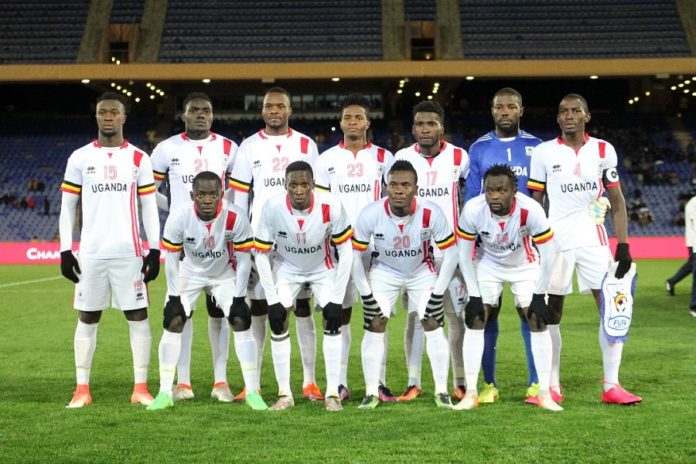
After completion of the 2018 World Cup in Russia last month, the FIFA monthly rankings of August have been released today.
Uganda remained stagnant in the 82nd position in the latest World Rankings released on Thursday by the world football governing body.
Remaining in the same position by Uganda Cranes comes as a result of not participating in any friendly or competitive games over the past month.
However, the Cranes still remain the best in the East African region with neighbours Kenya in position 112, Tanzania at 140, Burundi at 148 and Rwanda at 136.
Tunisia (24), Senegal (24), Congo DR (37), Ghana (45) and Morocco (46) are the top five countries in Africa.
World Cup champions France go top of the rankings replacing Germany who fell to 15th. Belgium, Brazil, Croatia and Uruguay complete the top five.
Croatia (4th, up 16), Uruguay (5th, up 9), England (6th, up 6), Denmark (9th, up 3) are the countries that moved into the top ten.
2018 World Cup hosts Russia were the best movers, climbing up by 21 places to position 49, while Egypt fell hardest, dropping by 20 places to 65.
FIFA introduced a new rankings procedure. The rankings have been previously based on the average number of points that a team accumulates over a four-year period. The ranking points in each match were determined by its result, its value and the relative strength of the opponent and their confederation. The system also had yearly basis depreciation for the value of the matches.
The new version developed by FIFA was named “SUM” as it relies on adding/subtracting points won or lost for a game to/from the previous point totals rather than averaging game points over a given time period as in the previous version of the World Ranking.
The points which are added or subtracted are partially determined by the relative strength of the two opponents, including the logical expectation that teams higher in the ranking should fare better against teams lower in the ranking.
The next FIFA/Coca-Cola World Ranking will be published on September 20, 2018.
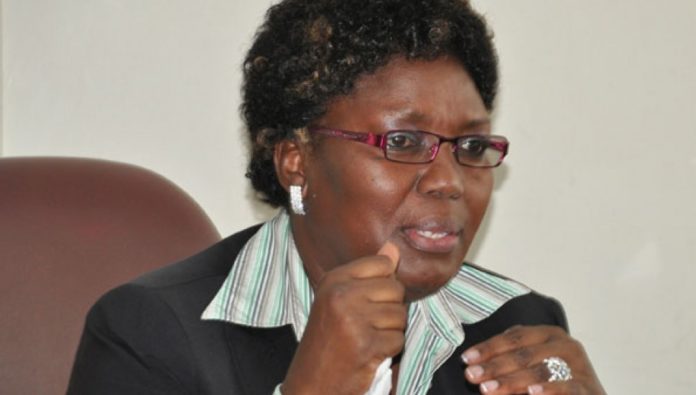
The Speaker of Parliament, Rebecca Kadaga, has urged the government to remove the ban on recruitment of health workers in the country, urging that the increasing population far much outweighs the existing health personnel.
Kadaga while launching the Network of African Women Ministers and Parliamentarians (NAWMP) Strategic Plan at Parliament on Wednesday said that despite Uganda’s growing population, the government has maintained a ban on recruitment of health workers.
“We still have a shortage of medical personnel but the health sector has a ban on recruitment, which has been on for long,” she said adding that it was meaningless to have inadequate staffing with a population of an estimated 40 million Ugandans.
NAWMP seeks to advocate for maternal, newborn and adolescent health.
Kadaga urged NAWMP members to speak against the proposed government plan to abolish Health Centre IIs saying it is a threat to access to health services.
“I am still opposed to the removal of Health Centre IIs because I do not believe that everybody lives within a 5km radius of a health centre,” she said.
Kadaga added, “Women are required to attend eight antenatal visits, but with all this walking, women will relax.”
The Leader of the Opposition, Betty Aol Ochan (Woman MP Gulu district), said that poor staffing levels bring about poor service delivery in public health facilities, giving an example of her constituency.
“In my constituency, people still call me asking for transport from Gulu Hospital to other private health facilities,” Aol said, urging government to step up efforts in the entire health sector, including ensuring medicine supplies.
Edgar Agaba CEO-National Gaming Board who credited for the growth of the industry.
The Uganda National Bureau of Standards and the National Gaming Board have signed a memorandum of understanding to enforce standards in the country’s nascent lotteries and gaming sector.
The signing took place between the UNBS Executive Director, Dr. Ben Manyindo and the Executive Director NGB, Edgar Agaba at UNBS Head Office in Bweyogere Industrial Park. That MoU was reached at in accordance with Section 4h of the Lotteries and Gaming Act No.7 of 2016.
Dr. Manyindo said, “The MoU is an opportunity for UNBS to work with NGB in adopting, adapting and updating common standards for use in lotteries and gaming technology.”
According to the MoU, UNBS will establish a Technical Sub-committee for developing standards in the gaming betting sector and also coordinate Uganda’s participation in international standardization work related to gaming.
Last year, UNBS through the technical committee developed standards for casinos and for limited pay out machines which are commonly used among the lotteries and gaming community. The standards are designed to ensure regulation and supervision of gaming activities/institutions to hold them to a code of conduct and make them more accountable.
“UNBS will involve members of gaming community in the development of industry standards and support them to undertake training relevant training in standards implementation and ensuring compliance,” Dr. Manyindo said.
Drawing from Section 4 (h) of the Gaming Act which mandates the Board to set and approve standards for the supply, installation or adaptation of gaming and betting software, the Chief Executive Officer, LGRB, Mr. Edgar Agaba said
The signing of the MoU comes at an opportune time when LGRB is focused on enhancing enforcement operations to promote compliance to sector, regulations, stamp out illegal operations and ensure implementation of international best practices and standards.
The standards that have so far been developed and approved include US 1580-1:2017 for Gaming equipment and requirements for Casinos and US 1580-2: 2017 for Gaming equipment and requirements for Limited pay out machines.
However, other standards are under development including US 1580-3 Monitoring and Control systems, US 1580-4 Wagering record keeping software, US 1580-5 Local area and wide area jackpot and progressive equipment requirements, US1580-7 Token requirements, and US 1580-8 Roulette wheels requirements, US1580-9 central and monitoring system among others.
“The MoU will allow us to work with UNBS to enable compliance to sector based standards and ensure value for money, Mr Agaba Said. He however noted that some of the sports betting operators have multitudes of outlets that could not efficiently be reached and inspected.
“Working together with UNBS we shall ensure that we reach the wider betting community and ensure enforcement of standards,” Mr Agaba added.
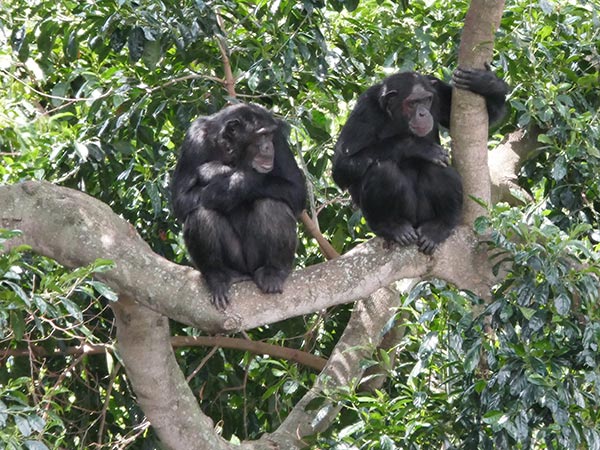
Kampala businessman recently offered to become a lifetime guardian for a chimpanzee at the Ngamba Island Chimpanzee Sanctuary on Lake Victoria.
This came to light recently as tourism minister Prof. Ephraim Kamuntu and other top officials joined others at Speke Resort Munyonyo days ago to celebrate 20 years of the sanctuary that has the Chimpanzees as the major tourist attraction.
Minister Kamuntu said Ruparelia’s offer to be a lifetime guardian for the chimp demonstrates his attachment to tourism and conservation in the country.
The sanctuary offers exceptional chimpanzee experience, birding, photography, water experience, sport fishing, African cultural experience, sunset cruises, camping experience, nature walk and educational tour.
World renowned conservationist, Dr. Jane Goodall flew in to attend the celebrations last month that saw the world celebrate the first ever Chimpanzee Day.
The Day was meant to celebrate of man’s closest living relatives and continue to learn about them but also to invite participants around the world to take action in efforts to conserve this magnificent species, and improve their well-being and care in and outside of captivity.
Ngamba Island Chimpanzee Sanctuary and Wildlife Conservation Trust cares for the chimps.
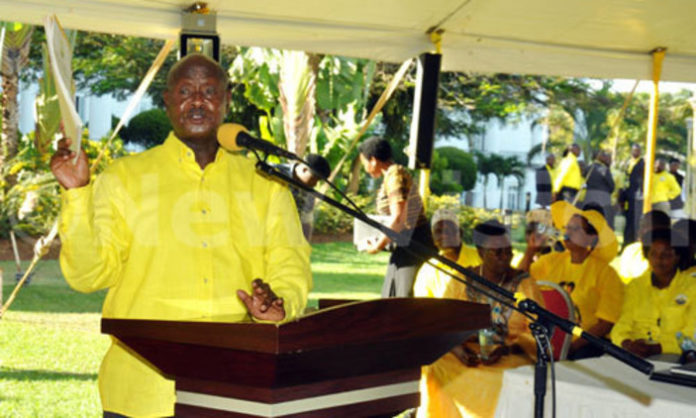
PLEASE RETIRE: NRM party National chairman, Yoweri Kaguta. Museveni.
President Yoweri Museveni says cases of terrorism, damaging property, manslaughter, against the newly elect MP for Arua Municipality Kassiano Wadri and Kyadondo East legislator Robert Kyagulanyi aka Bobi Wine and other suspects, will continue in courts law following chaotic scenes that were witnessed in Arua last Monday.
Wadri appeared in the Magistrate Court and charged with treason while Kyagulanyi was charged in the general court martial, Mityana Municipality MP Francis Zaake, Ntungamo Municipality MP Gerald Karuhanga, Jinja East MP Paul Mwiru and others were arrested in Arua over allegations of pelting stones and damaging one of the presidents car in convey. Some of the group members have been produced before Gulu magistrate’s court and charged with treason.
Wadri was yesterday elected MP for Arua Municipality after he edged 12 candidates in a hotly contested by-election held after the gun down of MP Ibrahim Abiriga. “I Angom OC Ruth, being the District returning officer for Arua district electoral commission and according to section 58 (1) of the parliament election act of 2005, I declare Wadri Kassiano Ezati to be elected MP for Arua municipality,” she declared.
However, in a statement released earlier in the day, Museveni said cases of terrorism, damaging property, manslaughter etc against Wadri, Bobi Wine and the group will continue saying their actions led to the death of a Ugandan and Robert Kyagulanyi’s driver Yasin Kawuma and causing a grievance harm to a number of people, damaging of property.
He implored all leaders, including the National Resistance Movement (NRM) members to embrace the rule of law and discourage their supporters from violating the law.
“The elections in Arua Municipality were held peacefully because the organisers of violence and criminality had been arrested,” he said in a statement published on his Facebook page.
Wadri was declared the winner and Nusura Tiperu of the NRM emerged the second, this is a step-forward, to having elections without violence and threats. Museveni said nobody has got a right to intimidate a Ugandan by word or action,” reads in part of the statement.
He said violence of the previous days had had the most negative effect. Out of the 46,000 registered voters, only 16,000 turned out to vote. Only 34 per cent of the electorate. The others either feared to come to vote or the register is full of ghosts.
Museveni further noted that they are investigating the allegations that some candidates had imported illegal voters from other areas to the municipality. The Opposition has been doing this repeatedly, such as in Jinja East and Bugiri Municipality.
“NRM agents have got a weakness of not auditing the voters’ registers in time to discover these imported voters. In the case of Arua Municipality, there is an allegation that the illegal voters were brought to the attention of the Electoral Commission but that it did not pay heed,”
Processions through populated centres without co-ordination with the Police should never happen. I never organize processions. I always drive to and from the rally site in my convoy. Sometimes, only the boda-boda riders join me.
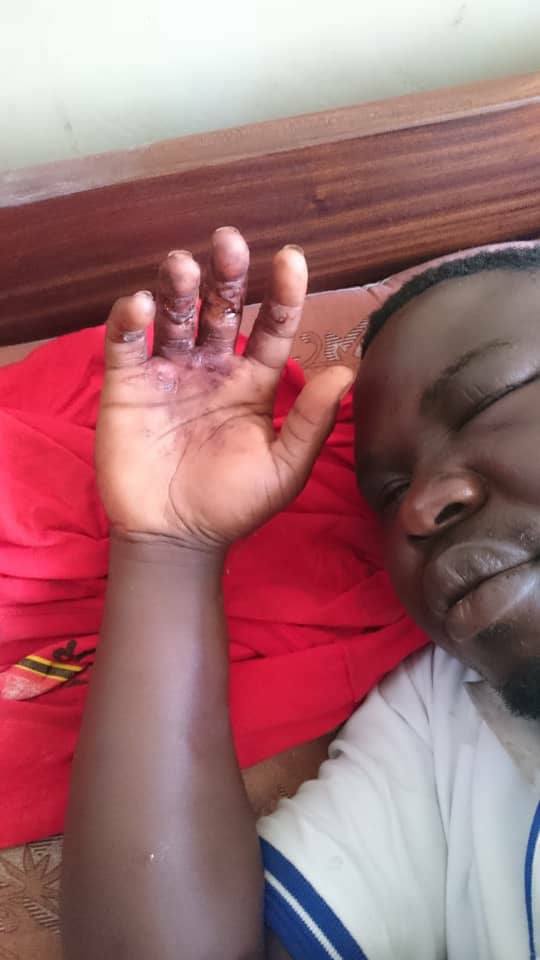
Museveni said his convoy moves fairly fast to the rally site and from the rally site, never touching the passers-by, the property of the people or the convoys of the other candidates. Mityana Municipality MP, Francis Zaake in pain after he was tortured by Special Forces in Gulu.
“In the elections of 2016, my convoy to Namboole met the one of Rt. Hon. Amama Mbabazi around the Naguru area. We just waved at one another and that was all, why should a Ugandan be beaten, intimidated or have his property or life destroyed on account of politics? With uncontrolled violence in elections, many voters will fear to go for voting. This will mean the disenfranchisement of Ugandans,” he wrote.
He argued why, then, did the Ugandans shed their blood? It was in order for them to run their country through fair and free elections. I will defend that right today and tomorrow as I did in the past.
On the side of the NRM, many of the actors need to distance themselves from egoism. The NRM is about principles: Patriotism, Pan-Africanism, Social- Economic Transformation and Democracy.
Anybody who supports these, you should support if he/she emerges as the flag- bearer of the NRM. Not to support a flag-bearer for any reason, when you are a leader, is a failure of leadership. When you support the cause instead of supporting individual interests, your contribution will blossom, even if you meet potholes on the way.
“This has been my experience in the last 58 years. Support principles, not opportunism, you will triumph in the end,” the president noted.
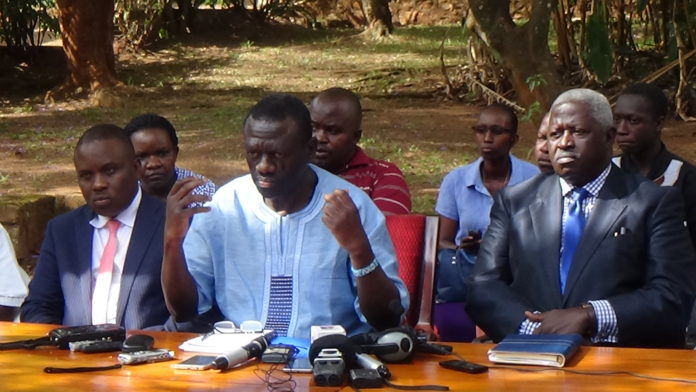
DEFIANT: Former FDC presidential candidate Dr. Kizza Besigye addresses media at his Katonga Road offices today. He was flanked by the Lord Mayor Erias Lukwago and party stalwarts..
Former presidential candidate Dr. Kiiza Besigye has called for immediate release of people who were arrested in Arua chaotic scenes as opposition and government bigwigs held their final rallies to canvas votes for their respect candidates.
The arrested suspects include MP elect for Arua Municipality Kassiano Wadri, Kyadondo East legislator, Robert Kyagulanyi who has appeared before general court martial in Gulu, Mityana Municipality MP Francis Zaake, Ntungamo Municipality MP Gerald Karuhanga, Jinja East MP Paul Mwiru and others who have today been produced by Gulu magistrates court.
Arua Municipality parliamentary seat fell vacant after the gun down of MP Ibrahim Abiriga by hooded gunmen travelling on motor vehicles as he headed to his home in Kawanda in Wakiso district.
Besigye remarked in a press briefing that was held at his offices along Katonga Road that there has been a choreographed presentation of a state of confrontation between opposition groups which he believe is deliberate and has ominous intentions.
“People being detained have been held against a background of state inspired violence, there is absolutely no way that the regime can convince people, they are covering their tracks by planting evidence against our people,” he said
Reacting on charges of treason that were levelled against suspects, Besigye said that those are tramped up charges, “they are the rule in as far as NRM dress its opponents in an attempt to criminalize them,” he added.
Adding “We demand that all those persons being detained be freed unconditionally and immediately, I have been charged with treason twice, I have been charged with rape, with illegal possession of guns. My wife was charged with having a pistol in our home in Luzira. These trumped up charges are the rules in how NRM addresses opponents,”
Besigye said no civilian should be charged or attempted to be tried in a military court martial, ´adding that the main inciter of violence is ‘NRM junta’ and they shouldn’t transfer this onto anyone.
He castigated parliament for their failures to act as a state institution saying the August house in powerless arm of government. “Last time Speaker Rebecca Kadaga lamented to the president saying he should explain who attacked parliament last year, however till today there is no response,”
Seeking appointment or going through protocol will not deliver my urgent letter to you.
Right now I hope we all rather can let it be a temporary political mishap per what happened in the district of Arua on Monday. Unfortunately it left your car Vandalized, Many of us inconvenienced –
A soul lost, And another Ugandan, brother, Friend, Fellow singer Honorable as appointed by Kyadondo east-Robert Kyagulanyi alias Bobi Wine and many counterparts in an unfortunate situation. Honorable Kyagulanyi has always collaborated with me and all of us society to free Uganda from Foreign sounds, Sell our culture beyond borders through our capital ability – Music.
Bobi Wine has over time exhibited his leadership admiration. Just Like any young ambitious man, he has treaded a path of aggressiveness.
Your excellency, Our brother, Your son Bobi Wine could have gone wrong on execution of some of his ideologies. That’s a challenge.
As head of state and forefather, it’s a great one too to lead us in example of forgiveness and reconciliation as that is one of the prime problems that have hindered our society. We are so unforgiving.
I as a son of this nation on behalf of the slogan. “For God and my Country” With all honor beg you the President to symbolize forgiveness in such a time. We can all wrong but better the forgiver. Mr President, You are a Father, Parent and always forgiving one. We shall all remain calm and be hopeful that the coming developments will see us all live harmoniously and have a peaceful country henceforth.
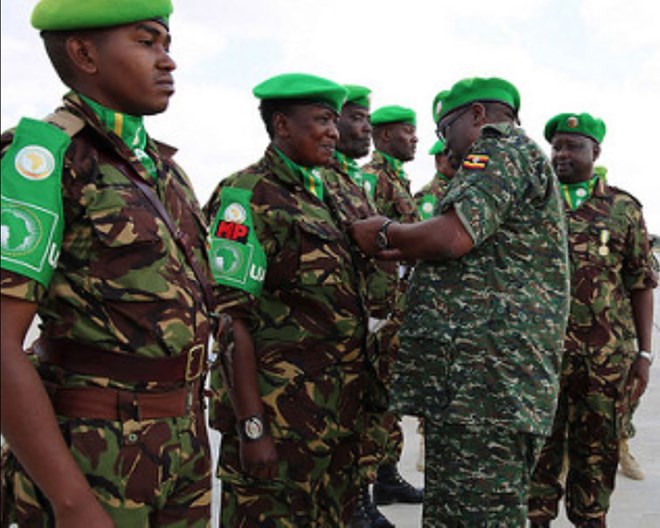
Lt. Gen. Jim Beesigye Owoyesigire decorating soldiers have completed their job.
Lt. Gen. Jim Beesigye Owoyesigire, the Force Commander of the African Union Mission in Somalia (AMISOM), has urged In the Lower Jubba region the Force Commander called upon Somalis in Lower Jubba rewgion to support joint efforts by the national army and the AU forces to end the Al Shabaab insurgency.
Lt. Gen. Owoyesigire, made the call as he concluded a weeklong extensive tour of Forward Operating Bases in all the six sectors where AU troops operate.
During his tour, he assessed the security situation and civil-military projects undertaken by AMISOM in support of local populations in its areas of operation but also interacted with troops in Jowhar, HirShabelle State; Baledogle in the Lower Shabelle region; Dhobley in Lower Jubba region; Beletweyne in Hiiraan region; Baidoa in the South West State and Kismayo, in Jubbaland State.
The Sector Chief of Civil Military Cooperation (CIMIC) in Dhobley, Colonel Constance Sikalumbi said plans are at advanced stage to renovate the Dhobley District Hospital, to improve its services, to enable it cater for more locals. Dhobley residents currently depend on the AMISOM Level II Hospital within the military base for their medical needs.
“There is a consignment of drugs that we expect to arrive soon to help with the management of diseases,” said Col. Silakumbi, who highlighted plans by the sector to undertake various community engagement and sensitization programmes. The programmes include gender, education and extra-curricular activities for youth in the area.
Lt. Gen. Owoyesigire awarded outgoing troops with service medals in recognition of their distinguished service and sacrifices, in Somalia’s stabilization and peacebuilding processes.
He presided over a similar service awards ceremony in Kismayo, where he encouraged the multinational troops in the sector to work closely with the Somali National Army and the Jubbaland security forces in order to reap more results in the fight against terrorism.
He expressed satisfaction with the prevailing stability in Kismayo and its environs, as a result of the continuing collaboration between AMISOM and local forces.
Separately, he held talks with the Jubbaland Deputy President, H.E Mohamud Sayid Aden, during a courtesy call on him at the seaside presidential palace.
Their discussions touched a wide range of issues including the security of the region and planned joint military operations. “Our discussions focused on our collaboration in military operations against the the enemy – and which the police, the intelligence and the Somali National Army(SNA) are taking part; the liberation of areas still under the control of Al-Shabaab; support to the Jubbaland forces and the integration of the Darwish militia in their fold,” said the deputy president.
Lt. Gen Owoyesigire pledged AMISOM’s support to the military operations, which will be led by the SNA.