Stanbic Bank
Stanbic Bank
18.5 C
Kampala
Stanbic Bank
Stanbic Bank
Home Blog Page 1524

$640,850 recovered out of corruption- US Ambassador

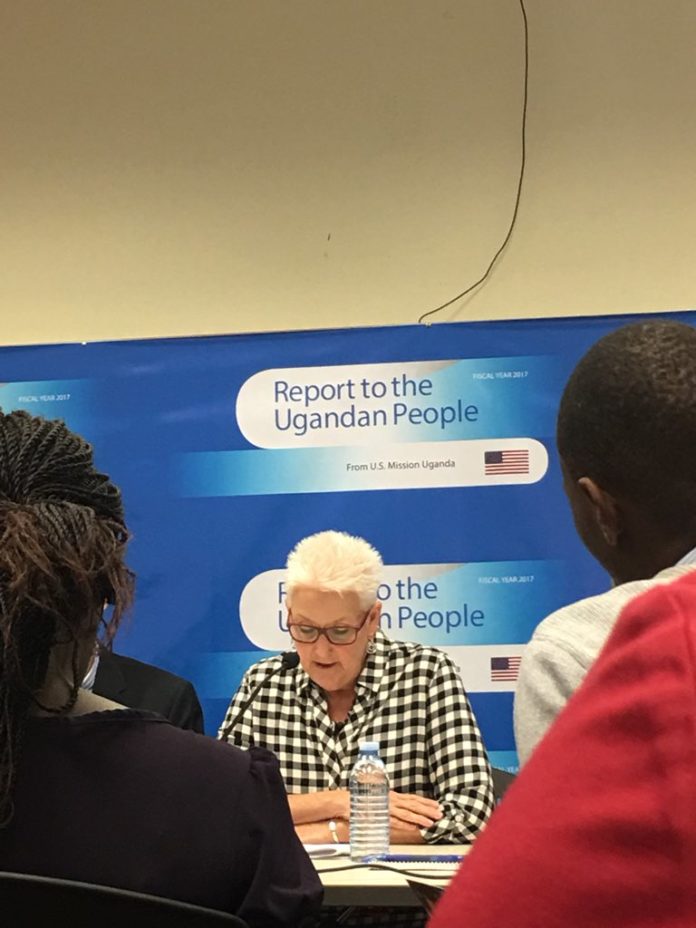
Amb. Malac

US Ambassador to Uganda Deborah Malac says $640,850 was last year recovered following publication of investigative reporting series that exposed corruption cases in the country’s local governments.

Speaking at the launch of US 2017 Report to the Ugandan People, Malac says the sum of money was recovered in 28 local government following procurement audits in eight districts. The process resulted into conveyance of public hearings involving parliament’s local government public accounts, public procurement and disposal of public assets authority, office of the Attorney General and civil society.

Corruption is considered as one of the greatest barriers to Uganda’s economic development. Alluding to statistics, in 2017, Uganda was ranked 151 out of 176 countries in the Global Corruption Perceptions Index.
“Much work remains, however, Uganda faces major challenges that will continue for the foreseeable future. Ultimately, Uganda’s people and government will chart their own destiny. We are here to support their dreams and their efforts for a better future,” she said.

The report covers agricultural sector, health, prosperity, security, democracy, and strong education.

It indicts that U.S. government is collaborating with local authorities, the media, and civil society to help Ugandans in the fight against corruption, improve government transparency, strengthen the quality of public services, and increase dialogue between government and the public.

“US through United States Agency for International Development (USAID) is committed to improving the accountability and responsiveness of Uganda’s systems to ensure sustainable development,” states in part of the report.

Stories Continues after ad

Ugandan citizens trust LCI Chairmen than president-research

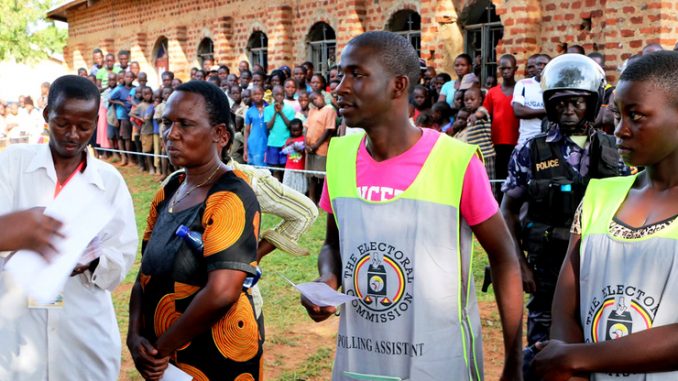
Ugandan lining up in the just concluded LC1 elections. Research shows that Ugandan prefer trusting village chairman than a president.

The election of the Village Council (LC1) elections took place on July 10, 17 years after the country last conducted such elections in 2001 under the Movement System where candidates were elected on individual merit since multi-party democracy was not in existence like it is today.

Before the latest elections that had candidates of different political parties and independents participate were held, a new study whose findings were released in November last year, revealed that Ugandan citizens trust information provided by village council Chairmen than the president and any other political leader in the country.

The survey was done by Twaweza East Africa, a nongovernmental organisation working in Uganda, Kenya and Tanzania on effective public and policy engagement, through powerful media partnerships and global leadership of initiatives such as the Open Government Partnership.

The research referred to as Sauti za Wananchi (representative mobile phone survey) interviewed 1,980 people, with 45 per cent saying they would trust their LC1 Chairmen than the president at 34 per cent, the same with an LCV Councilor.

The percentage of citizens interviewed who said they would trust information obtained from any government official, the Prime Minister, an MP from NRM, ruling party member/supporter, an MP from opposition party and opposition party member/supporter comprised 31 per cent, 28 per cent, 26 per cent, 25 per cent, 22 percent and 21 per cent respectively.

The question probing how free citizens are to criticize information and statements provided by leaders, 68 per cent, 64 per cent, 59 per cent, 56 per cent, 50 per cent, 48 per cent, 47 per cent, 46 per cent, 45 per cent and per cent said they were free to criticize village/street chairmen, LCIII Chairperson, LCV Chairperson, government institution, Chief Administrative Officer, Minister, Prime Minister Vice President and president respectively.

Further the 67 per cent of the citizens contacted believed they would get information from the office of the LCIII on birth certificates while only 41 per cent believed they would get information on development plans and budgets from local authority. A further 50 per cent believed that they would get information from a local school on how much of the capitalization fund has been received.

The findings shows that 96 per cent of the people interviewed prefer going physically to a government office or authority to seek for information while 29 per cent said they would use a phone instead. A few respondents opted personal connections, social media, email, fax and others respectively.

However, the findings showed 27 per cent, 27 per cent, 26 per cent and 25 per cent were not free to criticize information and statements from the president, Vice President, Prime Minister and Minister.
This Sauti za Wananchi data is premised on public access to information and freedom of expression as cornerstones of good governance and democracy.

Stories Continues after ad

South Sudan Opposition Alliance choses the downtrodden over elite in peace talks

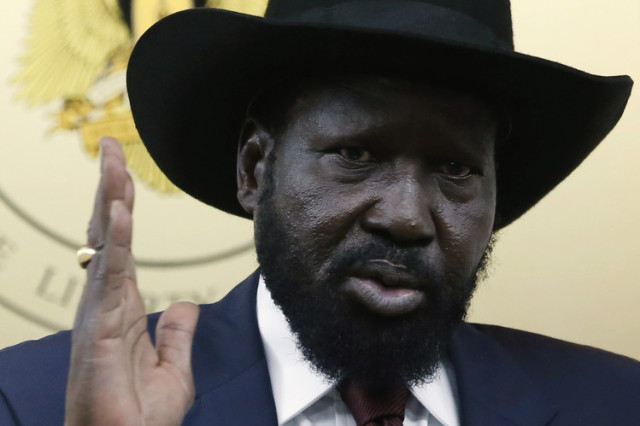
Wanted Out: South Sudan President Salva Kiir Mayardit

By Maria Nassiwa

The South Sudan Opposition alliance have chosen to push the line that favors the common man and not the blue collared elite at the ongoing peace talks in Khartoum in Sudan.

The move is seen by many as one which will separate politicians who care about people’s welfare from those who do not.

“The Khartoum peace talks provided many South Sudanese with an opportunity of knowing whether their political leaders meant what they propagate and preach.

“It might not be possible to gauge the magnitude of the widespread support that some SSOA members harvested by standing firm behind popular demands like federalism, the abolition of the illegal 32 States, and accountability,” Dr Lako Jada Kwajok one of the opposition politicians said in a press release.

Khartoum may seem far away from the small towns and villages of South Sudan, but modern technology made communications and the flow of news easy.

SSOA want President Kiir to leave power. They accuse him of failing to run government and dragging it down to ruins.

Stories Continues after ad

CiplaQCIL ready to list on USE after CMA approval

CiplaQCIL headquarters in Kampala

Ugandan drug maker Cipla Quality Chemical Industries Ltd (CiplaQCIL) said on Thursday in a statement that it plans an initial public offering and a listing on the Uganda African Securities Exchange (USE).

The company said each of its shareholders would be selling a minority of their stakes in the Initial Public Offer (IPO) and that the transaction and potential listing had received approval of the Capital Markets Authority (CMA) which regulates the USE.

“The listing has received the relevant approvals required, and the Company will provide further details shortly. Renaissance Capital is acting as the lead transaction advisor and book runner, and Crested Capital (Uganda) is the lead sponsoring stockbroker to the listing,” the statement said.

The company largely owned by India’s pharmaceutical giant Cipla, has a manufacturing plant in the capital city Kampala and will be the 19th security on the USE.

CiplaQCIL manufactures nine branded generic drugs, six of which are antiretroviral (ARV) drugs, one artemisinin-based combination therapy (ACT) drug and hepatitis B and C drugs which it sells mostly in sub-Saharan African countries.

The firm said as part of its growth strategy it, has been evaluating an initial public offering and listing of its issued share capital on Uganda Securities Exchange.

Cipla, according to a statement, will still maintain a majority stake even after the IPO but the firm did not state how much equity would be offered for sale on the USE.

In April last year the company announced it would list 31.1 percent of its stock on the USE in its IPO, having sent documents to CMA for approval.

In November it announced it had appointed a book runner, Kenya’s Renaissance Capital to manage the listing process.

A report in the media said then that the company’s largest stakeholder, Cipla Limited of India, would reduce its shareholding to 51% from the current 62.3% in the IPO.

“Each of the shareholders will be selling a minority of their stakes to enable sufficient free float and liquidity. Cipla Group, represented through a subsidiary, will retain a majority stake,” the Thursday statement said.

Capital Works Investment Management, an institutional investor in the pharma company with a 14.4 percent shareholding, would sell off its stake in the IPO, the report said at the time.

Ugandan shareholders, on the other hand, the report said, would halve their shareholding to 1.8 percent. They include Frederick Mutebi Kitaka, George W Baguma – both executive directors at the company – and Emmanuel Katongole, the executive chairman.

The three were among the six founding investors of the compnay when it started operations in 1997. In 2005 Cipla Limited bought into the company.

Another investor, the private equity firm TLG Capital which has a 12.5 percent stake and is expected to retain its shareholding.

“It is an exciting time for the Uganda capital markets that last had an IPO in 2012 and we applaud CiplaQCIL for taking this important step in its growth story,” said USE’s CEO Paul Bwiso said of the new member that is to give other details in the due course.

Stories Continues after ad

World Bank appoints new chief for Uganda

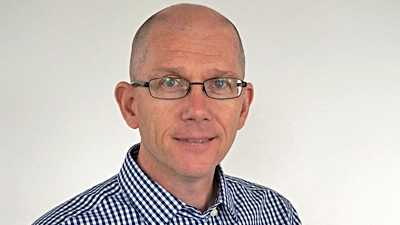
Antony Thompson

A dual Irish and British national, Antony Thompson is the new World Bank (WB) Group Country Manager for Uganda. He succeeds Swedish Christina Malmberg Calvo who had been holding that office since 2015.

Under his leadership, the World Bank will continue supporting inclusive growth and poverty reduction through a wide array of financial products and technical assistance. The World Bank Group (WBG) Country Partnership Framework (CPF) for the period 2015/16 to 2020/21 supports the Government of Uganda’s vision of a transformed, modern and prosperous country by 2040.

The program is focusing on raising rural incomes by increasing agricultural productivity and commercialization and reducing vulnerability to shocks; investing in better service delivery, particularly in health and education, improving the business environment and access to infrastructure services, all of which are underpinned by strengthening governance and accountability.

Thompson will be overseeing a portfolio of 26 projects totaling close to US $3 billion. The Bank’s portfolio in Uganda is primarily financed from the International Development Association (IDA), which provides grants and credits.

The credits are on concessional terms (interest free) and only attract an administrative service charge of 0.75 percent on the disbursed amount. Credit repayments are stretched over 38 years, including a six-year grace period.

This is complemented by trust fund resources that support technical assistance and analytical work to help the country share and apply innovative knowledge and solutions to the challenges it faces.

Thompson was the Country Manager for Bulgaria, the Czech Republic and Slovakia, since August 2014. He also served as the Manager for Strategy and Operations at the Human Development Network, based at the World Bank Group (WBG) Headquarters in Washington, DC.

Thompson joined the WBG in 1992 as part of the Young Professional Program, working on Human Development for the Middle East and North Africa region’s country Operations Department. He has worked in several different capacities, including Operations Officer, Lead Financial Sector Specialist, Operations Advisory, and Sector Manager. Throughout his career in the World Bank, he has worked extensively in Financial Sector, Private Sector Development, and Tax Administration.

In addition to human development, Thompson’s areas of expertise include health, HIV/AIDS prevention, and financial sector reforms.

Thompson holds a Bachelor of Arts (Honors) from the University of Ulster and a Masters of Business Administration (Honors) with a specialization in Finance from the University of Chicago.

Stories Continues after ad

Inflation for manufactured goods rise by 0.9 percent in June

Manufactured goods in factory

The monthly producer prices of manufactured goods produced for domestic consumption increased by 0.9 percent in June 2018 compared to 0.2 percent registered in May 2018, the Uganda Bureau of Statistics (Ubos) says in the latest report for June 2018.

Ubos attributes the 0.9 percent increase to a rise in the prices of processed food, non-metallic mineral products, beverages, pharmaceutical products and printing.

“The rise in monthly prices of domestic manufactured goods was mainly attributed to a rise in prices of Processed Food by 1.3 percent, Non-metallic Mineral Products by 0.2 percent, Beverages by 0.1 percent, Pharmaceutical Products by 1.5 percent and Printing by 1.1 percent in June 2018,” Ubos says in its report.

Meanwhile, producer prices of manufactured products for exports increased by 1.9 percent in June 2018 from decline of minus 1.7 percent recorded in May 2018. The rise in prices of exported goods was attributed to a rise in prices of food products which rose by 2.1 percent, Other Non-Metallic Mineral Products which rose by 3.0 percent and paper & Paper products which rose by 5.8 percent in June 2018.

The Annual producer prices for manufactured goods increased by 1.1 percent during the year ending June 2018 compared to the drop of minus 1.2 percent registered for the year ended May 2018.

On the other hand, the producer prices for utilities increased by 1.8 percent in June 2018 compared to 0.3 percent recorded in May 2018. “The rise in utility prices was mainly due to the increase in prices of Electricity Power Generation by 2.2 percent in June 2018 compared to a rise of 0.4 percent recorded in May 2018,” the report says.

Year-on-year, Ubos reports that the producer prices for utilities increased by 5.5 percent for the year ending June 2018 compared to 3.1% recorded for the year ended May 2018.

The main contributor to the 5.5 percent, according to Ubos, was the rise in prices of electricity power generation which rose by 7.7 percent during the year ending June 2018 compared to 4.8 percent recorded for the year ended May 2018.

Stories Continues after ad

Minister booed and denied mic at Kamuli funeral over age limit

Minister Isaac Musumba

By Maria Nassiwa

Buzaaya: State minister, Isaac Musumba was yesterday booed and blocked from giving his speech at the burial of Scovia, wife to Mbulamuti sub county chairman, Gwaivu.

Mbulamuti is in Buzaaya where Busumba is the area MP.

The charged mourners accused Musumba of ‘selling’ them and representing only himself when he supported the ammendment of Article 102b yet they had in a consultative meeting told him that they are against it.

The angry mourners who forced the minister to end his speech just after introducing himself, ordered him to hand the microphone to Bugabula South MP, Morris Kibalya who said no to the amendment.

“We heard the minister say that Buzaaya has supported the amendment. Let him go and talk from that Buzaaya which supported it but not here because we never supported such,” one furious mourner shouted.

During the consultation process, for which Mr Musumba took shs29 million, residents of Buzaaya are said to have been opposed to the amendment.

To be clear on what they wanted their MPs to say in Parliament, they voted on teh matter by secret ballot and the Nos had it.

After the secret ballot, which was presided over by Kamuli district party chairman, Samuel Bamwole, the constituents asked Musumba to take to Parliament their message without any alteration.

Mr Musumba was not happy with the vote result and made it clear.

“The people have spoken; although personally I am disappointed, I am taking back (to parliament) the message,” he told the meeting.

However, between Kamuli and Parliament, Mr Musumba threw the constituents instructions through the window and went with his own line of conviction.He stood on the floor and shouted how his constituents had told him to vote yes.

Efforts to reach Mr. Musumba for a comment were futile as his known phone number went unanswered and he did not respond to text messages.

Museveni who has been in power since 1986 will be aged 77 in 2021 when Uganda is supposed to have the next round of presidential elections.

Stories Continues after ad

Alamanzani is wrong on NRM loss in Bugiri

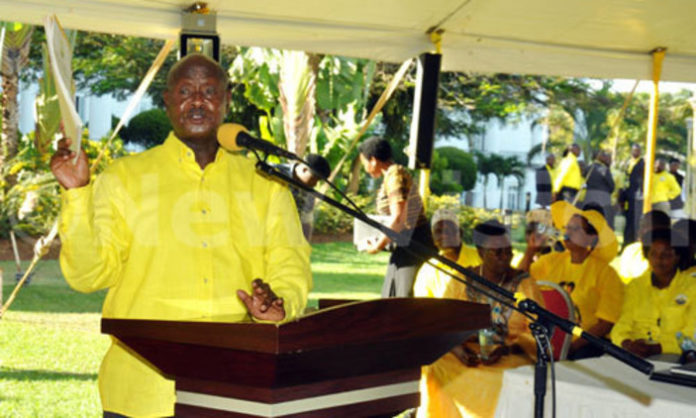
PLEASE RETIRE: NRM party National chairman, Yoweri Kaguta. Museveni.

My attention has been drawn to a misleading analysis, in several WhatsApp groups, of the role of some NRM leaders in the recent bye elections in Bugiri.

Mr Swahad Alamanzani signed off his 777 word article titled ‘Bugiri Was a Nest of Intrigue’ as a Political Scientist.

In what I see as a calculated move to feed into the misleading street talk of intrigue among party leaders in Busoga, Mr Alamanzani’s article feeds into the claim that NRM lost Bugiri because of intrigue between Rt Hon Rebecca Kadaga, Minister Namuganza and MP Moses Balyeku. It accuses Madame Milly Babalanda, a strong party stalwart in Busoga of refusing to support the NRM candidate in Bugiri.

As someone who was deeply involved in the intricate organization and execution of the NRM’s strategy in Bugiri I respond as follows.

First, Mr Alamanzani’s article is itself full of intrigue against the NRM party and a section of its leadership in Busoga.

Second, it is an ignorant piece from a political scientist, devoid of truthful facts.
But that is beside the point.

To the best of my knowledge, Mrs Babalanda stood by and with the NRM party candidate, Oketcho. She spent at least three nights in the filthy hotels of Bugiri because she wanted NRM to win.

Of course she is a Presidential assistant and head of the office of the National chair of NRM.

Hon Moses Grace Balyeku, whom Political Scientist accuses of fighting the NRM candidate, was among the first leaders from Busoga to support Oketcho. My sources indicate that he even supported him financially at the last hour when the candidate ran out of resources.

It is very misleading and not good for Uganda’s nascent multi party politics to involve the Speaker of Parliament, Rt Hon Rebecca Kadaga, in the politics of Bugiri. She is one very reserved person. Her schedule is even too tight and it is not her duty to campaign for other candidates. Therefore he who puts her in cheap politicking is not only a political misleaders but an uninformed person.

The writer is a journalist and the NRM Administrative Secretary for Kamuli District

Stories Continues after ad

Busoga King graces Jubireewo dinner

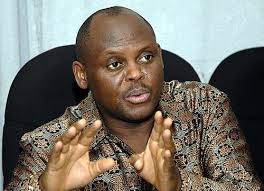
The Kyabazinga of Busoga being welcomed at the Jubireewo dinner by the Katukiro of Buganda, Peter Mayiga

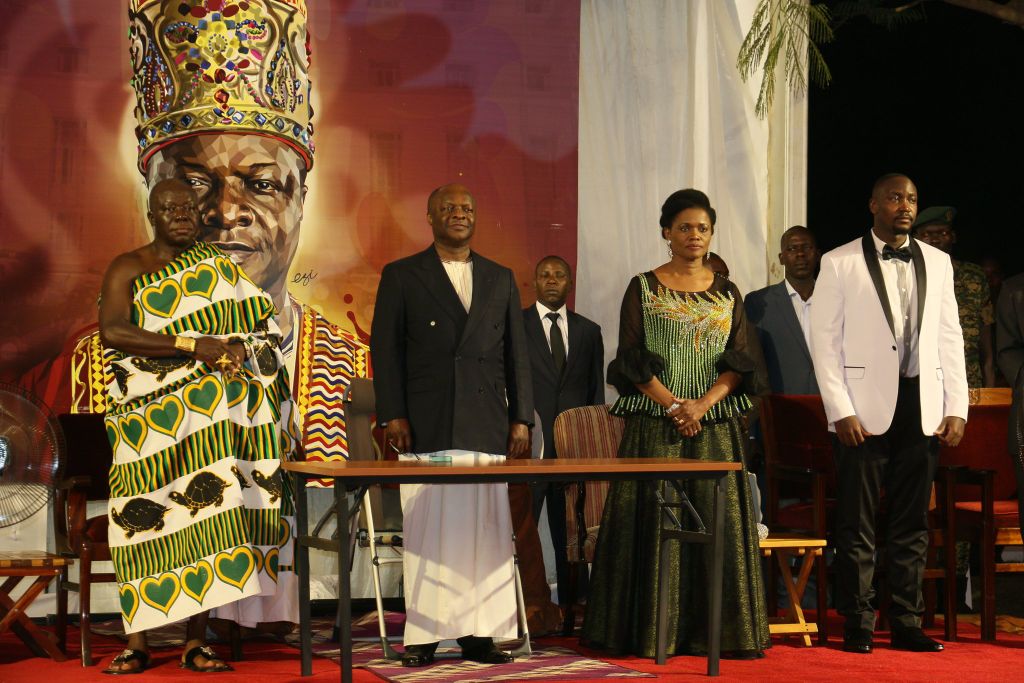
ON Tuesday, the Kingdom of Buganda celebrated the silver jubilee of Kabaka Ronald Muwenda Mutebi II’s coronation at the Mengo Palace rounds.

After the celebration, the Kabaka’s guests were hosted to dinner at the Twekobe compound.

Among the notable guests who graced Kabaka’s coronation anniversary dinner included; the King of Asantehene Otumfuo Nana Osei Tutu II, the Kyabazinga of Busoga William Gabula Nadiope IV, The Kwar Adola Moses Stephen Owor of the Tieng Adhola cultural institution (Japadhola) and Vice President of Uganda Edward Ssekandi who represented President Yoweri Museveni.

The Kyabazinga of Busoga(Right) with the Kabaka of Buganda (Centre) singing the Anthems at the Jubireewo dinner

Busoga Kingdom Ministers who included Owek. Richard Mafumo, Owek. Alex Luganda, Owek. Babirye Yudaya and Owek Sheila Birungi Gandi among others were also present.

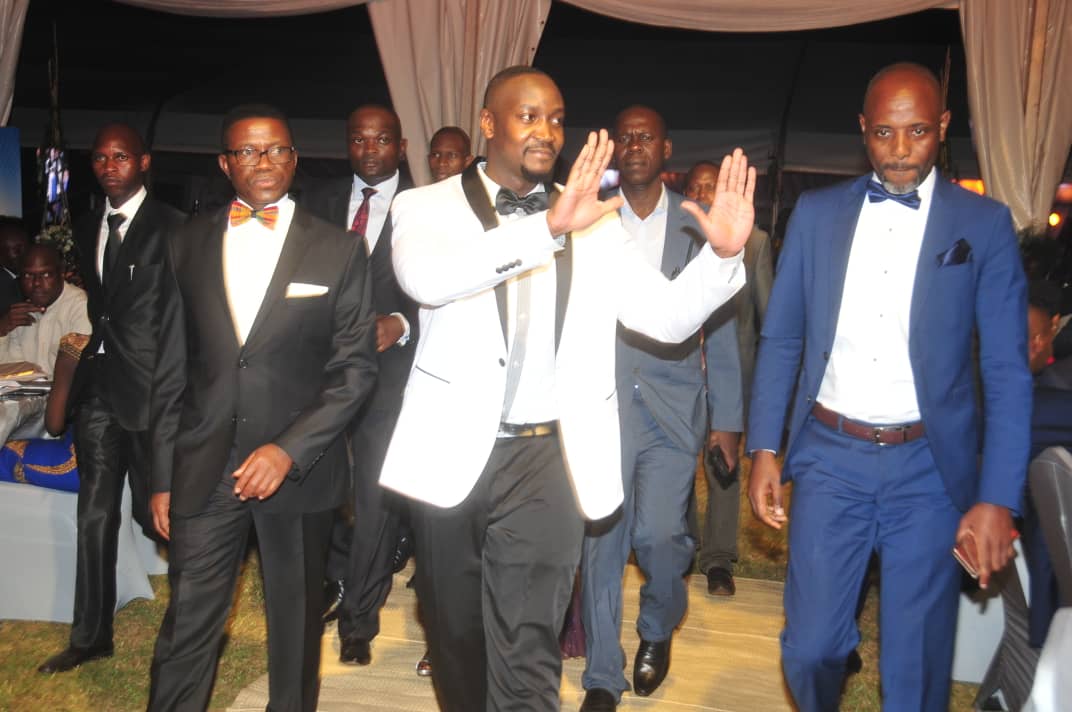
The Kyabazinga who arrived at Twekobe in smart attire, was welcomed at the 25th coronation anniversary dinner by Buganda Kingdom Katikiro Charles Peter Mayiga who was with his Busoga Kingdom counterpart Dr. Joseph Muvawala.

The Kyabazinga of Busoga waving as he arrives at the Jubireewo dinner with the Katwikiro of Busoga Mr Muvawala(Right)

The Kabaka served his guests to a sumptuous meal and drinks. He later cut a cake that he served his invited guests and subjects at the dinner.

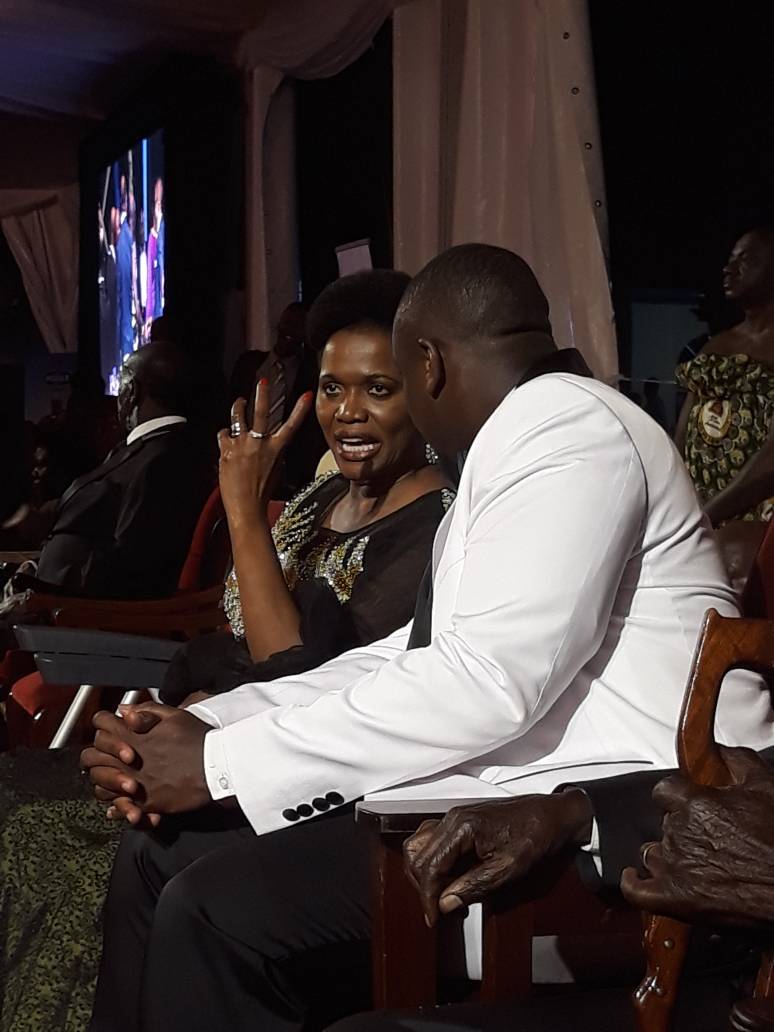
The Kyabazinga of Busoga having a chat with the Nabagereka of Buganda at the Jubireewo dinner.

After the dinner, guests interacted and many were seen leaving at their own leisure

Stories Continues after ad

Zimbabwe election: MDC Alliance and troops in Harare clashes

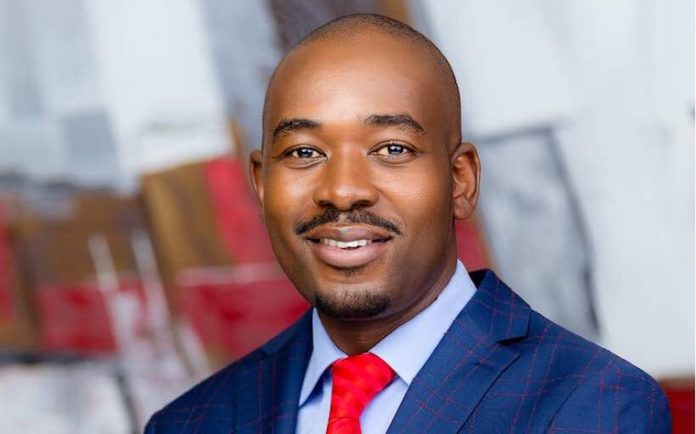
Nelson Chamisa

Troops have opened fire in Zimbabwe’s capital Harare after opposition supporters went on the rampage.

At least one man has reportedly been shot dead.

The opposition MDC Alliance alleges that the ruling Zanu-PF party has rigged Monday’s presidential and parliamentary vote.

Parliamentary results show Zanu-PF heading for a big majority, while the presidential result has yet to be declared.

European Union poll monitors have expressed concern over the length of time it is taking to declare the presidential result.

President Emmerson Mnangagwa has urged patience and calm following the first elections since long-serving ruler Robert Mugabe was ousted from power

The MDC Alliance says its presidential candidate, Nelson Chamisa, won Monday’s election.

Correspondents stress that Wednesday’s violence is confined to the centre of Harare – an opposition stronghold – while other parts of the country remain calm.

Chaotic scene

Protests by MDC Alliance supporters in the city centre took an ugly turn by the afternoon.

The crowds had been there since the morning but when news came that Zanu-PF had won the majority of seats in parliament and that the presidential results were not ready, the mood turned.

They went on the rampage down Harare’s busy streets towards an old Zanu-PF office with large stones, sticks and anything they could grab along the way.

The crowds chanted: “We want Chamisa.” They believe the election has been stolen, and are demanding the MDC be announced as winner.

Riot police using water cannon and tear gas arrived to a chaotic scene of burning tyres and an unrelenting crowd. Hundreds jeered and pelted the police vans with stones.

This group has lost all faith in the electoral system and says they will not stop until their man is in the top job – except that’s not quite how elections work.


Stories Continues after ad