Stanbic Bank
Stanbic Bank
18.4 C
Kampala
Stanbic Bank
Stanbic Bank
Home Blog Page 1556

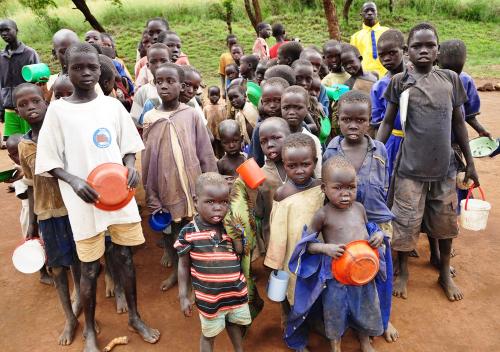
Uganda line up for food aid

Kids in Karamoja stand in anticipation of aid food during a past famine that hit the region.

Kampala: FAO has listed thirty nine countries that are most likely to be in need for food aid if the current rain patterns do not relent.

In the new Crop Prospects and Food Situation report Uganda’s below-average crop production is responsible for famine in some parts of the country. “About 0.44 million people are estimated to be severely food insecure due to the lingering effects of two consecutive seasons of reduced agricultural outputs in 2016,” it reads.

The report further notes that Uganda also hosts more than one million refugees from South Sudan in camps in the northwestern parts who depend on humanitarian assistance.

The other 38 countries currently in need of external food assistance are Afghanistan, Burkina Faso, Burundi, Cameroon, Cabo Verde, Central African Republic, Chad, Congo, Democratic Republic of the Congo, Djibouti, Eritrea, Ethiopia, Guinea, Haiti, Iraq, Kenya and Democratic People’s Republic of Korea.

Others are; Lesotho, Liberia, Libya, Madagascar, Malawi, Mali, Mauritania, Mozambique, Myanmar, Niger, Nigeria, Pakistan, Senegal, Sierra Leone, Somalia, South Sudan, Sudan, Swaziland, Syria, Yemen and Zimbabwe.

That list of countries rose to 39 countries from the last report in March, with the addition of Cabo Verde and Senegal.

Meanwhile, the report says that the recent rains point to cereal production gains in East Africa after consecutive seasons of drought-reduced harvests. However, recent abundant rains triggered flooding in Somalia, Ethiopia and Kenya, displacing about 800,000 people.

In contrast to the trend in the sub-region, staple food prices are high and rising in the Sudan and South Sudan, affecting access to food and intensifying food insecurity risks, the report says.

The number of severely food insecure people in South Sudan is expected to rise – in the absence of humanitarian assistance – to 7.1 million people during the current peak of the lean season (June-July).

FAO’s latest forecast for world cereal production in 2018 foresees a 1.5 percent annual drop from the record high realized the previous year. But the decline is larger in some areas, notably South and North America and Southern Africa.

Stories Continues after ad

Seven best practices for winning in a “we” economy

Martin Zwilling

By Martin Zwilling

As dialogues with peers become easier and more trusted via smartphones and the Internet, people are more willing to share their assets with others, and capitalize on the potential for a quick return for very little effort. This new sharing economy is rapidly becoming the new “online shopping” model, with major winners already including Airbnb (rooms), Uber (rides), and SnapGoods (stuff).

Experts are calling this the “we” economy, instead of “me.” It seems like a simple movement, but like any change in business, there are some new best practices that you need to learn, to make it work for you. Here are tips to keep your business from landing on the failure heap, like Carpooling.com (long-distance ridesharing), Beepi (used cars), and Homejoy (home services):

Provide relationship building opportunities for your customers. Customers today expect two-way relationships with the companies they choose, rather than transactions. To facilitate this, your team must use and embrace available interactive communication modes, including social media, blogging, web site forums, and special events.

For example, on Instagram, Airbnb encourages users to use the hashtag #Airbnb in order to be featured on the company website. If the company likes your picture, it creates a post showing how, in this scenario, city dwellers easily belong to the swimming enthusiast community.

Deliver personalized solutions and memorable experiences. The new demographic wants to provide input, and wants to be treated as one-of-a-kind in their solution, delivery, and service. The days of mass production and commodity pricing as an asset are gone. Being good in business now needs to feel like an art, with creativity and innovation.

Build your market by focusing locally before globally. Narrowing your initial focus actually builds exclusivity and allows you to charge a premium because you are “the expert.” Start with a niche that you know especially well, and build a reputation of being the best. This will give you the credibility to expand to other niches and grow the market.

Uber and Lyft recognized that local regulations are different from region to region, so they launched market by market in order foster loyalty from their customers, maintain quality of the service, and comply with the region’s laws.

Develop a culture of innovation and creativity in your team. This requires leadership from the top on purpose and shared goals, and being the model for actively listening to customers and incenting change. Team members need to be taught to think like innovators, and see a reward system that fosters change, rather than punishing failures.

Let people be pulled to you, rather than pushed by marketing. Both customers and employees expect to see value beyond a product or service, especially for social and environmental good, as leading the way forward. The result is an enhanced loyalty, both inside and outside your company, which is a strong component of momentum and profit.

This works especially well for services. In my own blog and speaking engagements, I talk about generic requirements to attract investors, but never mention that I offer a service to assist. Entrepreneurs are incented to followup with me for more specific fee offerings.

Communicate with stories and engaged customer advocates. Personal stories and testimonials are the best way to draw in customers and grow your business. Stories always trump marketing content for improving recollection and understanding. They help people remember in a way that numbers and text on a slide with a bar graph won’t.

Provide value to the community, as well as customers. If you provide real value and give-back to the global community and employees, thus generating trust and loyalty, you will appeal to more customers. The result is the desired win-win situation, with more profits for your business, more satisfied customers, and happy employees at all levels.

For example, Citi Bike is building themselves a great business by providing bicycles everywhere for sharing, but also is enhancing tourism and providing native New Yorkers with a fun and affordable new way to get around town.

The world of commerce has been forever altered by the growth of the world-wide Internet and pervasive mobile telecommunications. The customer and business universes are now globally and intimately connected. This means that all customers see relationships, culture, sharing, and social needs as part of their own world, and expect these to be part of every business focus.

Thus, as the new sharing economy challengers continue to evolve their new business models, the traditional incumbents will be smart to adapt, or forced out of the marketplace. It’s time to take a reading on where your business is in this spectrum. Are your company practices consistent with the ones outlined here, or are you still operating on yesterday’s model?

Mr Martin Zwilling is a veteran startup mentor,tech professional and Angel investor.

Stories Continues after ad

Uganda’s trade cargo through Mombasa grew by 12 percent in 2017—report

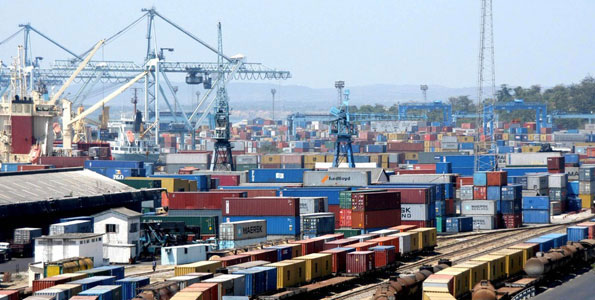
Containers at Mombasa Port

Uganda’s cargo traffic through Mombasa grew by 12 percent to 7,112,971 tons in 2017 from 6,346,715 tons in 2016, according to the Kenya Ports Authority (KPA).

According to KPA, the increase means that Uganda had a 82.3 percent share of the total transit cargo through the port between the two years.

“Uganda’s import traffic is the driver of this growth, recording a notable volume of 6,590.095 tons in 2017 against 5,922,160 tons handled in 2016, Edward Kamau, the General Manager Corporate Services Kenya Ports Authority, said.

South Sudan came second behind Uganda in traffic transit traffic through Mombasa Port with a total traffic of 673,752 tons in 2017 up from 597,852 tons in 2016 representing.

The Democratic Republic of Congo had about 360,124 tons down from 376,935 tons in 2016. It represented a 4.2 percent share of total transit cargo in 2017 through Mombasa Port. Rwanda and Tanzania had reduced levels of transit cargo through Mombasa Port while Burundi had an increase of 0.3 percent.

He said exports as well as imports realized a marginal increase of 522,876 tons in 2017 against 424,555 tons handled in 2016, reflecting a mild increase of 23.2 percent.

The total cargo through the port grew by 10.9 percent recording 30.35 million tons from the 27.36 million tons that was recorded in 2016. KPA attributed the growth in volumes to improved efficiency as well as the ongoing investment in infrastructure development at the port.

He said imports through Mombasa Port grew by 10.7 percent posting 25.6 million tons in 2017 from 23.12 million tons in 2016. It accounted for a dominant traffic share of 84.4 percent of the total throughput reflecting a huge imbalance of trade.

He said exports increased by 3.8 percent recording 3.8million tons up from 1.09 million tons handled in 2016. Container traffic increased by 9 percent recording 1.19 million TEU in 2017 up from 1.09 million TEU handled in 2016.

“Transit traffic posted a significant increase from 7.75 million tons in 2016 to 8.63 million tons in 2017, reflecting a notable volume growth of 888,069 tons or 11.5 percent” he said.

Stories Continues after ad

UK donates eye protection gear to AMISOM

Uganda's Deputy Head of Mission to Somalia Simon Mulongo receiving the equipment from Maundrell

The Commander of the British Forces in Somalia Col. Richard Maundrell on June 7, handed over 30-night vision goggles and 600 protective glasses to the African Union Mission in Somalia (AMISOM), to support night activities on the frontline.

The equipment, received by the Deputy Head of Mission Mr. Simon Mulongo and the Deputy Force Commander Maj. Gen Charles Tai Gituai, will be used for visual protection especially during clearing works along Main Supply Routes and for enhancing security around the Forward Operating Bases.

“This is one of the ways in which the UK government can support AMISOM troops to enable them to be more effective,” said Col. Maundrell.

The night vision goggles will be especially handy at observer posts, to help deter intruders.

“This is a very important enabler and the Mission is very grateful for this support. These (night vision equipment), will enable the Mission to operate more effectively,” said Mulongo.

He lauded the continued support to AMISOM by the UK Mission Support Team and the UK government.

The United Kingdom supports AMISOM in training in logistics, medical and heavy engineering capabilities, among others.

AMISOM is comprised of Uganda, Kenya, Burundi, Somalia, Ethiopia, Djibouti and Sierra Leone.

AMISOM has been helping the Somali government in battling militant group al-shaabab since 2007.

Stories Continues after ad

IGG suspends ‘prophet’ Mbonye from Lugogo Cricket Oval

Mbonye

The Inspector General of Government Irene Mulyagonja has immediately suspended Prophet Mbonye’s prophecy ministry from using Lugogo Cricket Oval for their Tuesday fellowships over pending investigations characterized by general mismanagement of the affairs of the council.

Prophet Elvis Mbonye of Zoe Fellowship ministries, was first based at Kyadondo Rugby Grounds for over a year but had moved and booked the Lugogo Cricket oval to get bigger space for his congregation every Tuesday for the next two years.

In the letter from the IGG dated June 5, 2018, it reveals that the office received a complaint from a whistleblower against the National Council of Sports where it was alleged that the Council was operating in a manner characterized by general mismanagement of the affairs of the council.

The letter states that Lugogo Cricket Oval has been home for the Uganda Cricket Association since 1966 but the activities of the various Cricket teams have been cut from 7 to 3 days which makes it difficult for the cricketers to prepare for the game.

IGG’s letter reads, “Lugogo Cricket Oval was irregularly contracted out of use for the use of the ZOE Fellowship Ministries for its massive public prayer rallies much to the detriment and prejudice of the state of the grounds as well as the activities of the Uganda Cricket Association which has been in occupation of the Oval since 1966.

This will be particularly prejudicial because unlike Zoe Fellowship, which can find another place of worship, cricketers cannot play the game in any place of worship or other place because there is none suited to practicing for and playing their game. It therefore appears that execution of this contract will not only be unfair to the cricket fraternity but it will also clearly be against the public policy.”

The letter also highlighted concerns over how the contract was drawn saying they were irregular and contrary to the requirements of the Public Finance Management Act and other related legal standards according to Article 230(2) of the Constitution of Uganda and Section 14(6) of the Inspectorate of Government Act.

“This is therefore, to direct you with accordance with provisions above to suspend the operation, implementation of the aforementioned contract with Zoe Fellowship Ministries for the use of Lugogo Cricket Oval pending investigation of the circumstances upon which the contract was entered and the management of the proceeds arising therefrom.” stated the letter which Eagle Online has obtained.

The IGG said that the matter is to be properly investigated to rule out the possibility of abuse of public assets and finances and that her office will commence on a systematic review of the processes and procedures of NCS on various other matters that have been brought to her attention.

“By copy of this letter the Solicitor General and the Permanent Secretary/Secretary to the Treasury and the Auditor General are requested to take interest in this matter and participate in bringing about order in the Sports Industry in Uganda,” the letter concluded.

Stories Continues after ad

Uganda Cranes fall in latest FIFA rankings

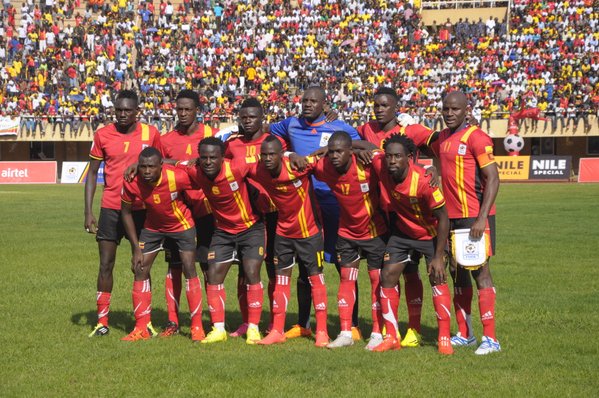
Uganda Cranes

With one week to the start of the 2018 World Cup in Russia, the FIFA monthly rankings have been released today with Uganda dropping eight places to position 82.

The Cranes now have a total of 403 points, a fall from last month’s 426 points, and are now 17th in Africa.
The drop by the Uganda Cranes comes as a result of failing to win in two friendly games, a 1-0 loss to Central African Republic and 2-1 to Niger.

However, Uganda remains the best in East Africa after neighbours Kenya dropped one place to 112, Tanzania dropped by 3 places to 140, Burundi dropped by two slots to 148 and Rwanda down to 136 by 13 places.

The rankings of Africa’s representatives at the World Cup are; Tunisia (21), Senegal (27), Morocco (41), Egypt (45) and Nigeria (48).

Reigning World champions Germany go into the tournament as the number one team in while hosts Russia will be the lowest-ranked team in the tournament at 70th.

Brazil, Belgium, Portugal and Argentina complete the top five while the only change in the top 10 sees Poland up two places to eighth in a straight swap with Spain.

Azerbaijan was the best mover, moving up by 21 places, while Guyana, a country on South America’s North Atlantic coast fell hardest, dropping by 18 places.

FIFA rankings are based on the average number of points that a team accumulates over a four-year period. The ranking points in each match are determined by its result, its value and the relative strength of the opponent and their confederation. The system also has yearly basis depreciation for the value of the matches.

The next FIFA/Coca-Cola World Ranking will be published on July 19, few days after the World Cup.

Stories Continues after ad

I will give president and COSASE report on Bagyenda wealth

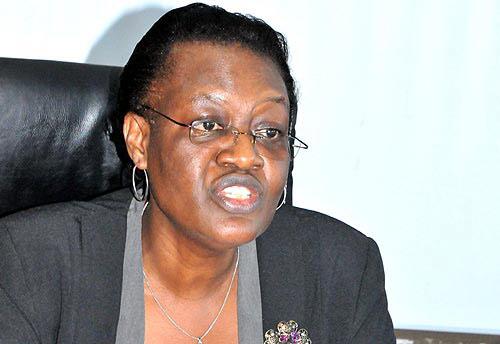
IGG-Irene-Mulyagonja

Kampala: The Inspector General of Government has said she will give President and parliament a report from her investigations on Bank of Uganda’s Justine Bagyenda as soon as its ready.

“We don’t give details on our investigations and we don’t reveal our investigations because it alerts the witnesses. Illicit enrichment is an offence and is she has acquired asserts illegally, we will move on her” Justice Irene Mulyagonja said

Adding “We will give a report on Bagyenda to the president and the Parliamentary Committee on State Authorities and State Enterprises (COSASE)”.

Justice Mulyagonja welcomed the committee that was unveiled by President Yoweri Museveni yesterday during the State of Nation Address saying it was a welcome in the fight against corruption.

“We have facts on how this institution works and there is no loss of confidence at all but we want to thank the president think that way. First of all, the torn at the top has to be heard. But if the president feels we don’t do sufficient work, we are happy that he has established another unit but there are many complaints”

Mulyagonja gave reference to South Africa and Kenya said whereas there are three bodies in those countries charged with fighting craft, in Uganda it is only the Inspectorate of Government that is charged with fight corruption, maintaining integrity and ethics among government employees. She revealed that the biggest change they face is limited funding.

She also revealed that it wasn’t Bagyenda alone under such investigations but also a one William Tumwine from Uganda National Roads Authority who is reportedly under probe for possessing more than 100 land titles and properties.

“Our budget is Shs45 billion a year and you are fighting corruption in a budget of Shs33 trillion with Shs45 billion. Imagine we have 16 regional offices and at each regional office, we have five investigators and budget of Shs6 million every month which is supposed to be operational fund plus two vehicles but in a region like Busoga, we have 10 districts in that region and who will this money be enough?

IGG is investigating Bagyenda, over allegations that she evaded paying income tax for ten years on revenues earned from her Naguru apartments.

Bagyenda is said have rented her apartments to the top officials of the defunct Crane Bank, earning millions of shillings without paying income tax as required by law.

On October 7, Eagle Online published a story in which a one Dick Kimeze reported Ms Bagyenda to IGG for non-payment of taxes. The source at the time told Eagle Online, the Uganda Revenue Authority (URA), the national tax collector had already begun investigations into the said tax evasion.

Mid this year Ms. Bagyenda came under criticism for allegedly failing to enforce her mandate, something her critics said had led to the closure of a couple of commercial banks including the Crane Bank, that is now under receivership.

Also, at about the same time reports indicated that the Inspectorate of Government (IGG) was set to begin investigations into allegations that Ms. Bagyenda made incorrect declarations contrary to the Leadership Code, 2002.

Among the property she allegedly falsely-declared are houses in the leafy suburbs of Ntinda, Naguru, Bugolobi and Kulambiro.

“When I wrote the letter I got confirmation from the IGG and I was to get an appointment with the official handling the matter but later on the person went abroad and we have now scheduled between 10th and 20th to meet,” lawyer Nyombi, who is representing ‘whistleblower’ Dick Kimeze, said.

In his allegations, Mr. Kimeze also avers that the properties owned by Ms. Bagyenda are way above what she has earned during her employment over the years.

Stories Continues after ad

UNBS wants local butchers to improve standards

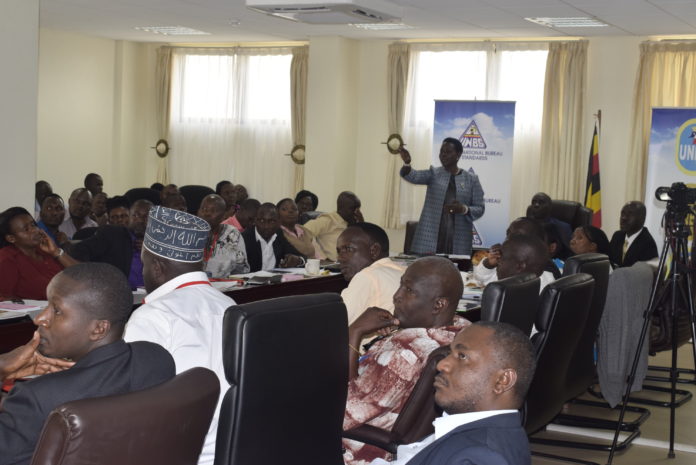
Meat sellers listening to UNBS official at Kampala function

Kampala: Increasing consumption of meat and meat products in the country calls for more standards and quality products in the meat value chain, the Uganda National Bureau of Standards (UNBS) has said.

Speaking at the national stakeholders meeting on June 7, 2018 for players in the meat value chain, as part of the celebrations to mark the World Food Safety Day, the Uganda National Bureau of Standards, Deputy Executive Director in charge of Compliance, John Paul Musimami, said, “The meat industry is still faced with poor infrastructure in addition to poor practices that do not conform to standards.”

Recently, the meat industry in Uganda faced a number of challenges including the alleged use of agrochemicals to preserve meat and insecticides to chase away flies as well as Listeria outbreak linked to pre-packaged and ready-to-eat meat products imported from South Africa.

Musimami called on stakeholders in the meat value chain to improve their operations to safeguard the population from risks associated with consumption of unsafe meat and meat products.

While the consumption of beef is growing, the annual per capita consumption is still below the internationally recommend level. It is estimated that beef that the annual per capita consumption of beef in Uganda is 6 kg, which is below the 50 kg recommended by the Food and Agricultural Organisation (FAO).

Musimami added that working together with sector players UNBS has developed standards for different meat products and codes of practices to guide operations at various stages of the meat value chain. “In the development of standards, UNBS always strives to engage all relevant stakeholders to ensure that the resultant standards are applicable to the nation,” he said.

He said UNBS has also signed memoranda of understanding (MoUs) with Kampala Capital City Authority (KCCA) and Kampala Butchers and Traders Association (KABUTA) to enhance cooperation and effective use of the available resources to improve the hygiene and safety in the meat value chain.

As part of implementing the MoUs, he said, UNBS has carried out joint sensitization and enforcement of standards in the sector with noted improvement in the hygienic state of butcheries in the city.

The Former Chairperson of the Codex Alimentarius Commission, Mrs Awilo Ochieng Parnet, said commended UNBS for its work in ensuring compliance to food safety standards and called on sector players to ensure compliance to standards.

“Food safety must be on the political agenda because unsafe food results in negative, social, economic & development consequences. It shouldn’t be a discussion in air conditioned rooms but be discussed at grassroots to decision and policy makers,” she said.

Stories Continues after ad

Beauty will play against the Beast in Stanbic cup finals- Coach Mike Mutebi

KCCA Coach Mike Mutebi (Left) and Vipers Coach Da Costa at a press conference

Kampala: The head coach for KCCA FC Mike Mutebi has today said they are prepared for Saturday’s clash against vipers FC in Stanbic Uganda cup finals that will be held at Emokori Grounds in Bukedea district.

In a media briefing held at FUFA house Mutebi said football fans will see a final where the Beauty (Vipers FC) will play against the Beast (KCCA FC).

“We need to go out there and play for the shirt in order to win the final and the players know this, we don’t have special players except Allan Okello,” said the head coach for Kasasiro boys.

He called upon KCCA FC fans to forget about what their loss in 3-2 thrilled game at St Mary’s stadium Kitende as Azam Uganda premier league season drew towards the end.

“I expect an amazing game, this is a deserved final for both teams arguably the best in the land, there will be a mouthwatering clash, it looks like an encounter between brilliant individual talents,” he explained.

Subsequently, Vipers coach Da Costa said the team has done a lot to preparations against KCCA FC, “you all know how strong vipers is ,you all know how we played and defeated KCCA FC in the league so we shall play to our best,” he added.

He further said there is nothing special with KCCA FC and will not treat differently instead the will play the ever best football to clinched their second title after winning Azam Uganda premier league title.

The vipers transcend to the final with a narrow 1-0 aggregate win over rivals SC Villa at the St. Mary’s after Kasasiro boys edged out Synergy FC with 9-0 win.

Stories Continues after ad

AfDB, Facebook and Microsoft launch employment program for African youth

Facebook CEO Mark Zuckerber

The African Development Bank, together with partners – The Rockefeller Foundation, Microsoft and Facebook – launched the Coding for Employment Program to help Ugandan and other African youth gain employment.

“By training youth in demand-driven Information and Communications Technology (ICT) curriculum and matching graduates directly with ICT employers, this new Program prepares Africa’s youth for tomorrow’s jobs and unleashes the next generation of young digital innovators from the continent. Coding for Employment will create over 9 million jobs and reach 32 million youth and women across Africa,” AfDB says in the latest press statement.

According to the statement, The Coding for Employment Program aims to put Africa’s youth on a path to prosperity. By 2025, the Jobs for Youth in Africa Initiative will equip 50 million youth with employable skills and create 25 million jobs in agriculture, information communications and technology and other key industries across Africa, the statement reads in part
.
Over the last 15 years, the African Development Bank says has invested US $1.64 billion in programs to prepare youth for careers in science, technology and innovation.

The Bank says that putting youth at the center of Africa’s inclusive economic growth agenda is at the forefront of its investments and its “High 5s” priorities —building businesses, feeding the continent, expanding power and integration, and improving the quality of life for the people across the continent by preparing youth for today’s competitive digital world.

The Bank notes that as the world moves towards a fourth industrial revolution, the demand for digitization across health, education, and other sectors is on the rise. Digital innovations have the power to solve the continent’s development challenges and are generating new job opportunities, it says.

“The youth population is rapidly growing and by 2050, is expected to double to over 830 million. Yet, the digital divide in Africa persists and critical skills gaps pose serious challenges to youth securing quality and decent work in a rapidly changing workforce,” it says.

The partnership with will establish 130 Centers of Excellence across Africa to help bridge the gap between the digital hiring news of employers and the skills of Africa’s youth,” said Mamadou Biteye, OBE, The Rockefeller Foundation’s Managing Director for Africa.

According to Ghada Khalifa, Director of Microsoft Philanthropies for the Middle East and Africa, “Digital skills are fast becoming essential for the jobs of today and tomorrow. Unfortunately, these skills are beyond the reach of too many young people in Africa. Together with our partners like the African Development Bank, we are working to change that. The partnership between Microsoft and the African Development Bank will continue to focus on increasing the participation of underserved youth and women while equipping youth across Africa with the skills needed to fill jobs now and in the future,” she said.

“Coding for Employment ensures digital skills are accessible to young people and supports youth with securing meaningful opportunities where they can apply their talents, ideas and expertise to advance the continent’s economic and social development,” said Sherry Dzinoreva, Head of Policy Programs at Facebook.

“By working together with the private sector, donors, policy-makers, and other stakeholders, we can secure a brighter future for young African women and men. As part of this new Program, we seek to cultivate the next generation of innovators and to empower young women to lead the continent’s digital revolution” said Oley Dibba-Wadda, Director of Human Capital, Youth and Skills Development at the African Development Bank.

He said that investments in youth through programs like Coding for Employment can stimulate inclusive economic growth, put Africa and its youth on the cutting edge of technological innovations and ensure the digital transformation of the continent is led and managed by young Africans for the benefit of the people of Africa.

Stories Continues after ad