Stanbic Bank
Stanbic Bank
26.5 C
Kampala
Stanbic Bank
Stanbic Bank
Home Blog Page 1580

Jinja Municipality gets Jet Patcher solution to potholes

Jinja Municipality has started using jet patching technology to solved the problem of potholes in town. it is believed this will help in turning around the driving experience in town.

Kampala:If you have been to Jinja town in the last two years, you would be excused to mistake the erstwhile organized town for bumpy impassable village in back-in-the-day Karagmoja.

The town’s roads right from main street all the way to Masese had given way to potholes and overgrown grass.

The town leadership seemed to have resigned to its fate.”What can we do with just shs1B for over 20 KMs of roads that the town has,” they would say whenever the question about the potholed roads came up.

Well, they seem to have got a solution- a Jet Patcher technology.

Just the other day, the municipality leadership contracted a jet patching company to work on filling the potholes so the town folk can have a smooth ride as they go about their business around town.
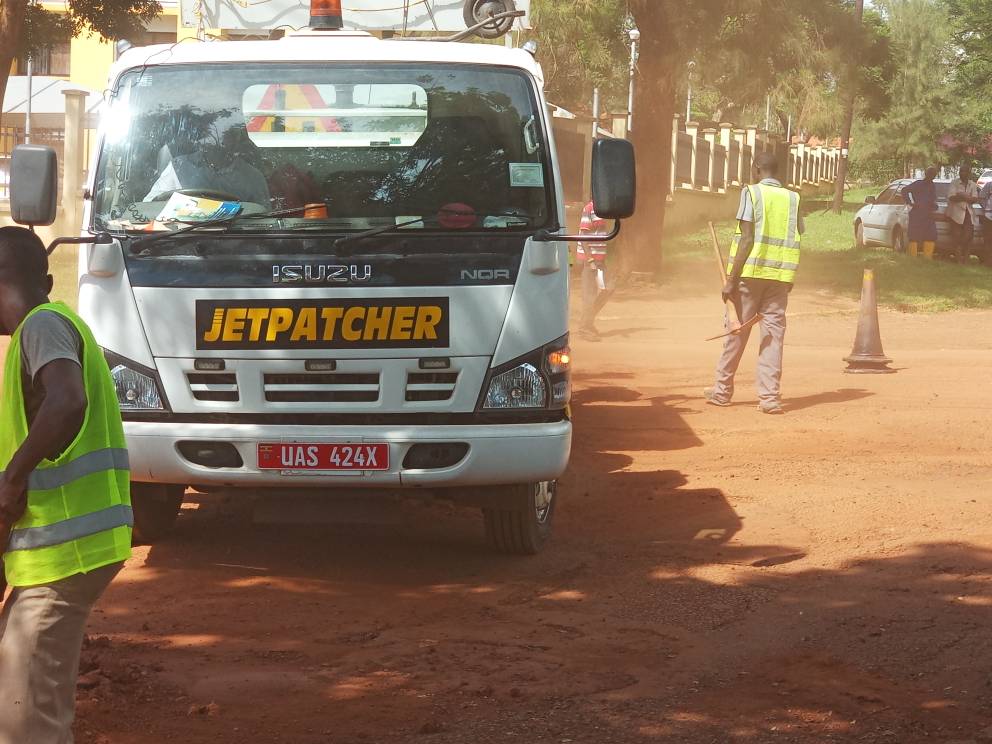
inja Municipality has started using jet patching technology to solved the problem of potholes in town. it is believed this will help in turning around the driving experience in town.

The Councillors could not hide their excitement.

One George Henry Izale went to social media and triumphantly announced the arrival of the the roads messiah in town.

“Patching of roads in the municipality using modern jet patching technology has commenced this morning,” he posted.

One social media enthusiast responded, “Good…our shock-absorbers are going to be safe, I hope so.
Literally most of our roads were developing “pitholes” not potholes.”
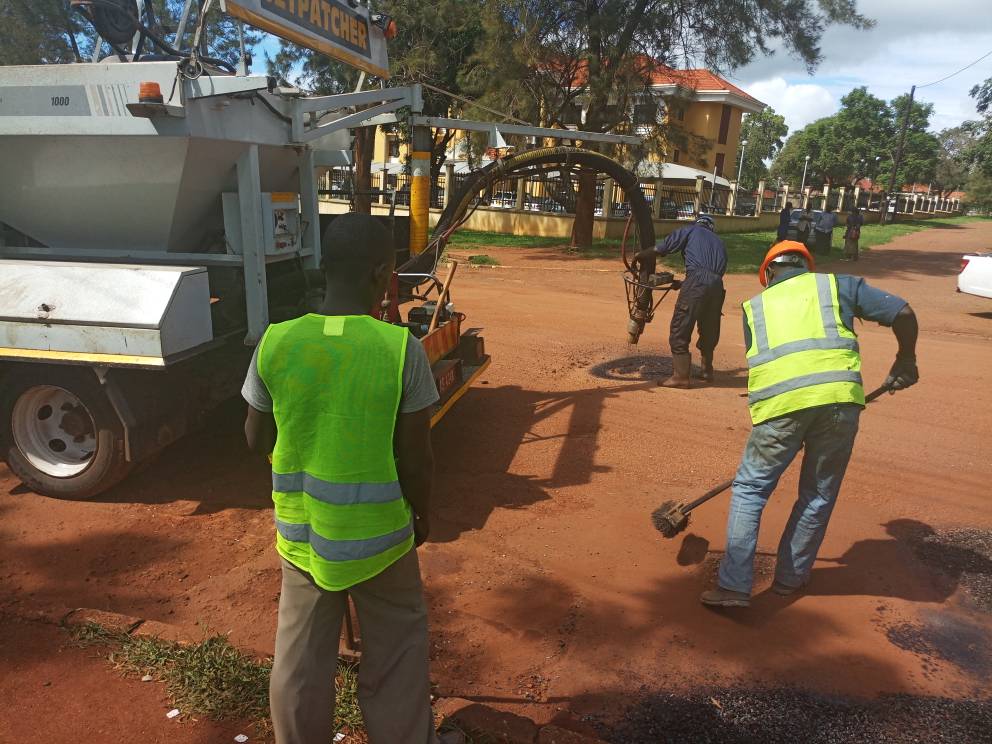
Some of the workers doing their thing with the jet patcher in Jinja.

But what makes jet patching special from the usual road pressers we usually see making screeching noise around town?

The technology provides a cost-effective way of maintaining the wearing surfaces of asphalt roads, car parks, footpaths, industrial areas including repairs of pot holes, crack seals.
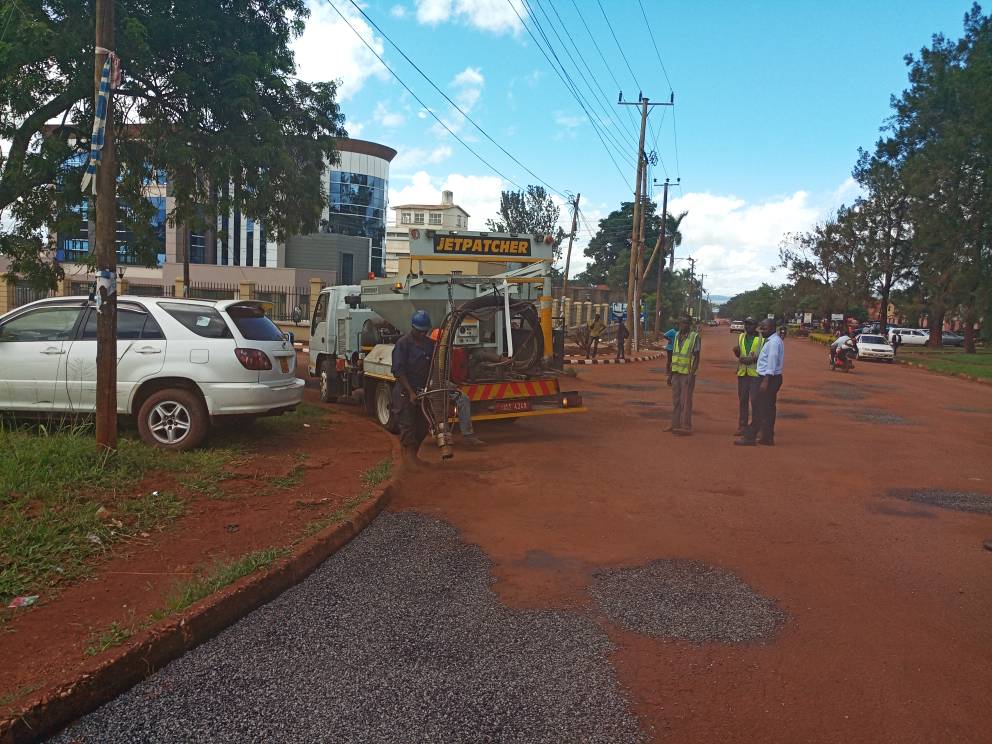
inja Municipality has started using jet patching technology to solved the problem of potholes in town. it is believed this will help in turning around the driving experience in town.

According to the Jet Patcher website, unlike in the usual old way of patching potholes, the troubled area, when using jet patching, is cleaned and prepared, sealed, filled, cured and ready for traffic in one smooth operation.

Repairs are made using rapid set emulsion resulting in long lasting repairs. The emulsion is safer for operators to work with and more environmentally friendly. Road users also experience minimum traffic delays because most repairs complete, and are ready to be driven over very soon after they have been made, in under 15 minutes.

This new arrangement is in addition to on going road constructions in the municipality that include the re-tarmacking of main street roads.

How it works

Stage One
Using the high volume, low pressure blower the Jetpatcher easily blows all loose debris from the pot hole, cleaning it and preparing the hole for an effective patch.

Stage Two
The Jetpatcher now coats the pot hole with an asphalt emulsion which seals the pot-hole and prevents further damage from occurring due to moisture.
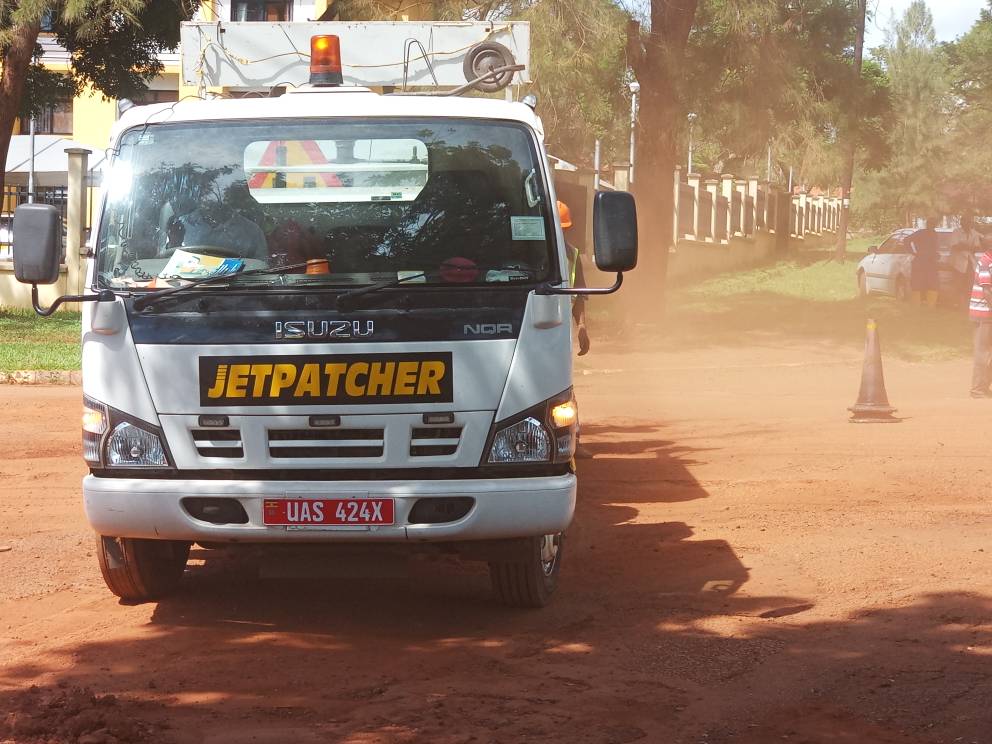
Some of the workers doing their thing with the Jet patcher in Jinja.

Stage Three
Aggregate is introduced into the pot hole. Using the Jetpatcher process, the aggregate is mixed with the asphalt emulsion and blown in to the pot-hole at high velocity.

Stage Four
The final stage of the Jetpatcher process. After the pot hole has been effectively sealed and filled, a light layer of dry aggregate is applied to the patch, preventing the patch from adhering to car tires prior to the emulsion fully curing. The patch is now ready for traffic.


Stories Continues after ad

FIFA World Cup bid: US pledges on travel non-discrimination

The U.S. Government has guaranteed to FIFA there will be no discrimination around entry to the United States at a World Cup in 2026.

The North American bid has faced questions about the impact of attempts by U.S. President Donald Trump to implement a ban on travel to the U.S. by residents of six majority-Muslim countries.

An independent human rights report commissioned by the bid warned there could be “some potential discrimination in relation to travel restrictions for some citizens from certain states.”

But the U.S. government told FIFA in a letter last week that “all eligible athletes, officials and fans from all countries around the world would be able to enter the United States without discrimination.

The letter was to be cited in a speech in Brussels on Tuesday by Mexico Football Federation President Decio de Maria during an appearance with his U.S. and Canadian counterparts. The three countries are jointly bidding to take on Morocco in the June 13 vote by FIFA Congress

Stories Continues after ad

Margaret Zziwa’s EALA case set for judgment May 25

Former EALA Speaker Margaret Zziwa

The Appellate Division of the East African Court of Justice (EACJ) started session this Tuesday, and among the issues to be determined is one of the former EALA Speaker against the EAC Secretary General for wrongful dismissal, scheduled for May 25.

In the two-week sessions the Court will handle 13 matters in total; five scheduling conferences, four hearings and two judgments including Zziwa’s.

The matters are before Justices Dr Emmanuel Ugirashebuja (President of the Court), Liboire Nkurunziza (Vice-President), Justice Edward Rutakangwa, Aaron Ringera and Geoffrey Kiryabwire.

Among other cases to be heard are two arbitration disputes; one by the Winglink Travel Limited Vs the Secretary General of the East African Community. It will be up for a scheduling conference on May 22. The second Arbitration matter is by Kati General Enterprise Vs the Agriculture Fisheries and Food Authority (Pyrethrum Processing Co. of Kenya Ltd) to be heard on May 17 by Justice Dr Emmanuel Ugirashebuja (Chair), Justice Edward Rutakangwa and Justice Aaron Ringera.

The two judgments to be delivered on May 24 and May 25 include an Appeal by the East African Civil Society Organisations’ Forum Vs the Republic of Burundi and that of Dr Zziwa, who was impeached by EALA legislators in December 2014 for alleged misconduct.

In February 2016, the Court allowed Dr. Zziwa to proceed with her case challenging her dismissal as Speaker of the East African Legislative Assembly (EALA).

This followed a ruling in which the court, then sitting in Arusha, Tanzania, could not buy an application in which the EAC Secretary General had sought to block Dr Zziwa from suing EALA for what she said wrongfully and unlawfully removing her from the office of the speaker of the House.

“We find that the application is misconceived, incompetent and improperly before this court and; do hereby strike it out under the rule of this court. We have also found that the affidavit supporting the defective application to have been scandalous and distressing on account of its falsehoods,” the court ruled at the time.

Article 32 of the Treaty for the Establishment of the East African Community, provides arbitral jurisdiction to the Court to hear and determine any matter arising from arbitration clauses or Special agreements. The Court arbitrates any dispute at no cost. So far the Court has received three arbitration matters. One has been determined and two still in progress.


Stories Continues after ad

Building review board members named

MADE ANNOUNCEMENT: Minister of ICT and Cabinet Spokesperson Frank Tumwebaze

Cabinet has approved the appointment of members of the National Building Review Board that will among others ensure that the design and construction of buildings that will be accessed by persons including those with disabilities.

Committee members include Mr. Emmanuel Male Mr. James Erochu Enou, Ms. Grace Mary Mugasa, Mr. Milton Fred Ocen, Mr. Jonathan Tugume, Ms. Harriet Kaahwa, Mary Kugonza, Ms. Eva Katusabe, Ms. Margaret Adata, Dr. Jackson Amone, Architect Enoch Kibbamu, Apollo Mukasa, Charles Kyamanywa, Ms. Tabitha Kakuze, Ms. Betty Nakamya and Mr. Edward Ssimbwa.

Addressing journalists Frank Tumwebaze, the cabinet spokesperson who doubles as the Minister for Information and Communication Technology, said the board will oversee, inspect and monitor the operations of building committees across the country.

“Members approve building plans, prepare and submit reports relating to any matter of building developments to the minister of planning and urban development, hear and determine appeals from persons dissatisfied with decisions of a building committee,” Minister Tumwebaze said.

He also said the board will determine the amount of money charged by Urban and District Building Committees for approval of plans, issue of building permits.


Stories Continues after ad

IGP Ochola dissolves Flying Squad as Womanya bounces back to CID

Police Chief Okoth Ochola

The Inspector General of Police Martins Okoth Ochola has this afternoon disbanded the Flying Squad and ordered all its personnel to report CID headquarters in Kibuli by May 16.

The Flying Squad has been under Assistant Commissioner of Police (ACP) Herbert Muhangi, who now moves to head to the Human Power Audit Department of Police.

“Pursuant to section 6 (1) (a) of the police Act cap303, the following transfers and appointments are ordered with immediate effect,” the IGP wrote in the communication in which he also announced the transfer of Senior Commissioner of Police (SCP) Elly Womanya, a former top detective, back to the Criminal Investigations Directorate (CID), to deputise the Director Grace Akullo.

Senior Superintendent of Police (SSP) Mark Odong has been appointed to head organized crime under Special Investigations Unit (SIU).

Stories Continues after ad

Is it high time we gave up emphasizing sugarcane growing in Busoga?

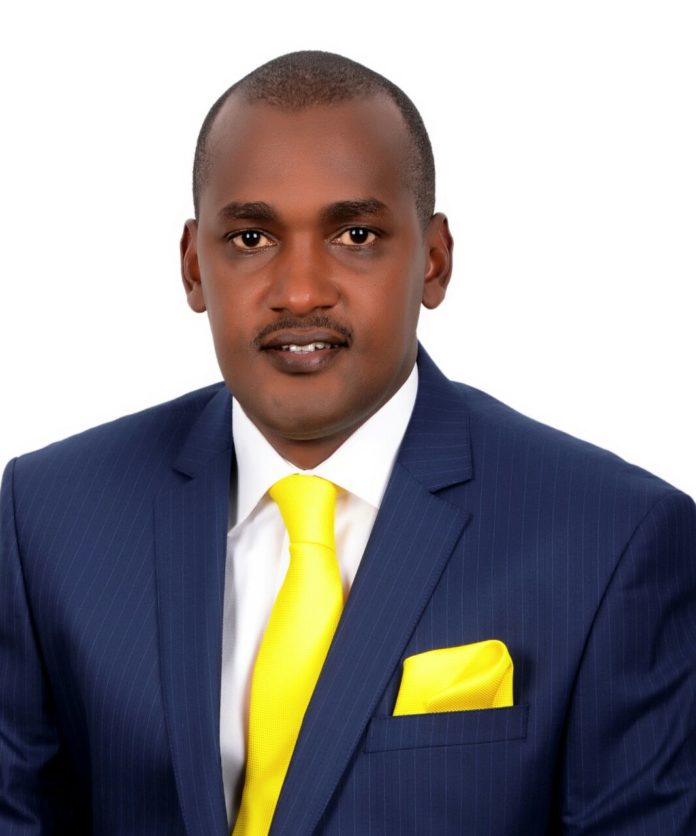
Mr. Michael Woira

Has anybody noticed that many people in the East especially in Busoga have all almost resorted to planting sugarcane? Of course, it’s not bad for people to plant sugarcane but is it the best practice as of now?  I will say ‘No’ because I have observed it is not seriously benefiting the local people down there in the villages, despite their efforts.

Years back, when Kakira Sugar Works (KSW) was the only operational sugar factory in the country, sugarcane planting was somehow of value but as time went on and the factory started planting its own sugarcane, things changed  lot for the outgrowers, for the worse.

The issue of sugarcane growing is dear to me given that some factories like Kakira and Kaliro are close to where I stay. This also means that my immediate family, relatives, villagemates and to a large extent all residents of Luuka depend on the sugar industry in one way or the other.

On top of that, almost all homes in Busoga with some good acres of land have decided to use it for sugarcane planting and given up on growing food crops.

I was recently in eastern Uganda and listening to one radio station there, a campaign was being run to emphasize sugarcane growing in Busoga! Really? Some media houses are even giving airtime to people to preach such a gospel to people who are suffering with hunger and anger caused by sugarcane planting. The very people, who sell sugarcane to factories cheaply, buy sugar expensively and that’s the trend in this country.

Anyway, we have better solutions for this problem in Busoga: growing tea, coffee, potatoes, maize, beans, tomatoes, soya beans or even coffee will earn the villagers 10 times more if they abandoned this ‘sugarcane madness’.

That is why the time is ripe for the villagers and other suffering farmers to rid their farms of sugarcane which give less returns. The sugar industry benefits no one in Uganda and government sometimes wastes money bailing out collapsing sugar factories, while other Ugandans consume ridiculously expensive sugar to sustain the loss making industries.

We also have this problem of food security; this issue is not just a problem for the poor; it will become increasingly a problem for everybody because of population growth.

By 2050, two-thirds of humanity will be crowded into cities that consume the available surrounding land by excavating it for clay and stone, covering it with tarmac and cement, and digging up soil to absorb landfill. Living space will outdo growing space and because the planet does not expand, cropland available per capita will be reduced and there will be little to eat in case food security is not made a priority now.

Importantly, we should bear in mind that agriculture has been and is still the economic driver of most countries. Indeed, for developing countries economic growth is dependent on agricultural growth. And growth in agriculture, although beneficial for the wider economy, benefits the poor most. Agricultural growth can lead to providing affordable food for 70% of the world’s poorest people who live in rural areas and who depend on agriculture.

Ensuring agriculture is able to play this fundamental role requires a range of improvements including: the growing of higher value crops and promoting value-addition like improved processing; expanding access to markets and lowering food prices through increasing production, processing and marketing efficiency, particularly for subsistence and very low income farming families. Crop diversity is fundamental to agricultural growth; it enables farmers and plant breeders to develop higher yielding, more productive varieties that have the improved quality characteristics required by farmers and desired by consumers.

Farmers in Busoga can breed varieties that are better suited to particular processing methods or that can be transported with less loss. They can also produce varieties that resist pests and diseases and are drought tolerant, providing more protection against crop failure and this can better insulate poor farmers from risks.

Finally, I would like to urge my fellow farmers in Busoga to concentrate on planting food crops and also copy the ‘four-acre’ model that was introduced by the President because it will enable us carry out different kinds of agriculture on our farms which will in turn enable us get something to sell and still remain with a lot to eat.

MICHAEL WOIRA

PRINCE OF THE LAND

Stories Continues after ad

PAP MPs discuss press freedoms, albinism

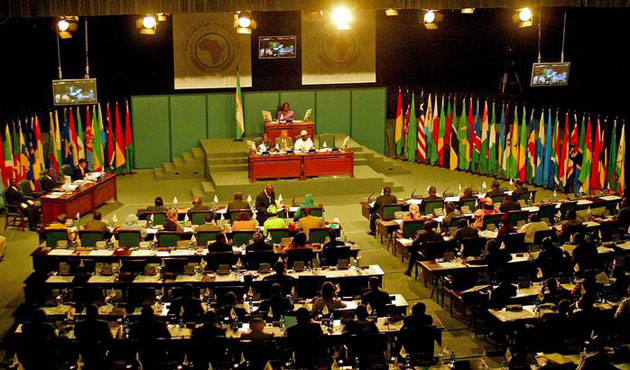
The Pan-African- Parliament in session

Pan African legislators have convened in Midland, South Africa to deliberate on a number of issues including press freedom, combating corruption and action on albinism in Africa.

Meeting under the theme, ‘Winning the Fight against Corruption, a Sustainable Path to Africa’s Transformation’ that is running from May 7-18 2018, the MPs will also elect both President and Vice-Presidents who will serve as Speaker and Deputy Speakers picked from four regions of Africa.

Under speakership Roger Nkodo Dang, legislators will hold Parliamentary committee leaderships, regional caucuses, women’s caucus and youth caucus on a three-year term in office.

At the opening of this session, PAP President Roger Nkodo Dang implored member states to ratify Malabo Protocol, which he said would be a stamp of faith in the African Union’s vision for the continent.

“The attendance of 53 states out of 55 Members of the AU augurs well for the African parliament. I am however, concerned that member states don’t want to ratify the Malabo protocol,” he said. He added that he was hopeful that solutions would be found for the PAP to exercise full legislative authority.

It was envisaged from the onset that PAP should evolve into an institution with full ­­­­legislative powers, whose members are elected by universal adult suffrage. The PAP needs 28 ratifications by member states to give it full legislative powers, presently, the PAP exercises consultative and advisory powers since it was established in 2004. Its Members are elected or designated from the legislative organs of their respective Member States.

Uganda’s representatives to PAP include Jacqueline Amongin (NRM, Ngora), also leader of the delegation; Prof. Morris Ogenga-Latigo (FDC, Agago North); Anifa Bangirana Kawooya (NRM, Sembabule); Felix Okot Ogong (NRM, Dokolo South) and Babirye Kadogo (Ind. Buyende).


Stories Continues after ad

Hollywood heroes return on TV on M-Net Pop-Up channel

The return of the Hollywood Heroes

M-Net Movies takes no prisoners with its Bang Bang Heroes Pop-Up Channel, bringing back memories of larger-than-life blockbuster stars Sylvester Stallone, Arnold Schwarzenegger, Jean-Claude Van Damme, Jason Statham, Jet Li, Dolph Lundgren, Bruce Willis and Chuck Norris, who will flex their pecs on the channel.

So get ready for a selection of non-stop, pulsating, explosive, jaw-breaking, bone-crushing, no-holds-barred movies, built around legendary Hollywood action heroes.

Hot on the heels of the M-Net Movies Marvel Studios Pop-Up Channel, the high-octane M-Net Movies Bang Bang Heroes channel is yet another unique pop-up offering – a testosterone-fuelled TV experience that will be available to DStv Premium, Compact Plus and Compact customers.

The M-Net Movies Bang Bang Heroes pop-up channel will run for 24 days: starting Friday, May 18 until Sunday June 10, and will screen a collection of over 90 movies featuring cinema’s most iconic pop-culture action legends.

While viewers will see eight incredible titles per day, each of these actors will have their very own time in the limelight one day during prime time.

For example, on Friday, May 18 Sylvester Stallone will strut his stuff in Get Carter, Cobra  and Over The Top.

Saturday, May 19, then belongs to Jason Statham with The Transporter, The Mechanic Resurrection and Parker and on Sunday, May 20, Jet Li moves into action with The One, Romeo Must Die, and Dragon Fight.

Be sure to tune in when Bruce Willis takes on the world in every single instalment of the Die-Hardfranchise on Saturday May, 25.

Then, don’t miss Dolph Lundgren’s fighting spirit on Saturday, May 26, in Masters of The Universe, Universal Soldier: Day Of Reckoning and Skin Trade.

Catch all the action when Jean-Claude Van Damme, the Muscles of Brussels, shows off his brawn on Saturday, June 2 in Streetfighter, Shepherd, and The Sudden Death.

To round off this amazing experience the channel will play all three “Expendables” films on Sunday, June 10 beginning with The Expendables at 16:30CAT, followed by The Expendables 2 at 18:15CAT ending with The Expendables 3 at 20:00CAT.


Stories Continues after ad

Motorsport: Adam Rauff heads To Tanzania

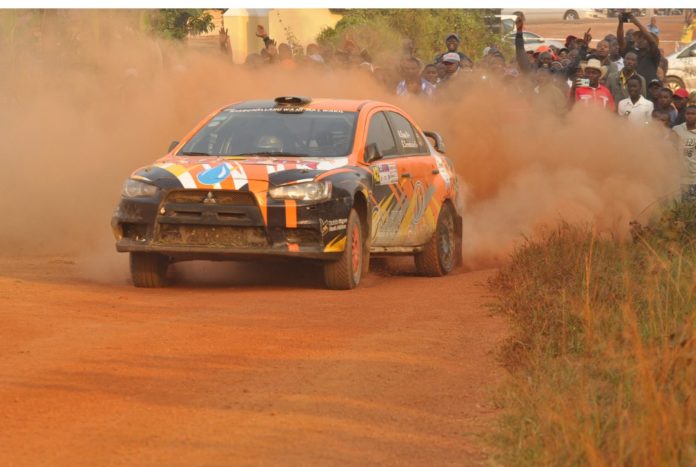
Rauf and Ssemakula in action during Mbarara rally 2018

Kampala: Motor rally duo, Adam Rauf and his navigator George Semakula have headed to Tanzania to take on the Mkwawa Superior Pure Drinking Water of Iringa challenge.

The competition will take place this weekend in the coastal town of Iringa.

The duo head across the border with only the first round of the NRC in Mbarara up their sleeves —they didn’t finish the race.

They haven’t had much success on Uganda soil. Their attempt to participate in NRC 3 last month came to naught when their EVO X suffered a clutch problem on its way to the ceremonial start. They could not find and fit the right spare in time for the start of the rally in Masaka. They joined the spectators.

Adam Rauf, however, is a regular participant in Tanzania which he considers home away from home and has on the various occasions posted impressive stage times before suffering mechanical issues. He hopes for the best this time round.

“Our target is to win this event, and bring glory to our sponsors,” Rauf said when contacted on Phone. “We shall be doing events in both Uganda and Tanzania this season and this is one of them.”

It will be his 6th Appearance on Tanzanian Soil where his best finish is 6th place during the ARC round of TZ in 2017.

The Iringa Rally has attracted 15 crews including Moses Matovu of DRT who will be calling notes for Dharam Pandya, who also won the previous round of the Tanzanian National Championship.

Adam Rauf/George Semakula remains the only foreign crew participating in this event. Suffice to note, the crew will only be adding seat time and foreign participation experience under their belt as any points they gather in this event will not add to the National Championship point standing at zero after one failed attempt in NRC 1.

“Our sponsors are Tanzania based have asked us to join the rest of the other crews they sponsor to form a strong team in this rally, our chances are really good,” said George, the navigator, just before they departed for Tanzania.

In his 5 years of competition Rauf has driven a Subaru N4, N10, EVO X, EVO 9 with 1 stage win to his name during Mbarara Rally in 2015. Rauf has had on and off appearances on the local scene and exhibiting some good skills and performances.

He is considered a quick driver and his partnership with George Semakula make them a daring pair that is believed will be a force to reckon with if they can make some consistent appearances in rallies.

Mr Aron Nsamba who navigated Rauf when he won the Kyoguranyi Stage in 2015 said, “Rauf is a very capable guy and if the car holds, he will definitely get a podium position.”

Stories Continues after ad

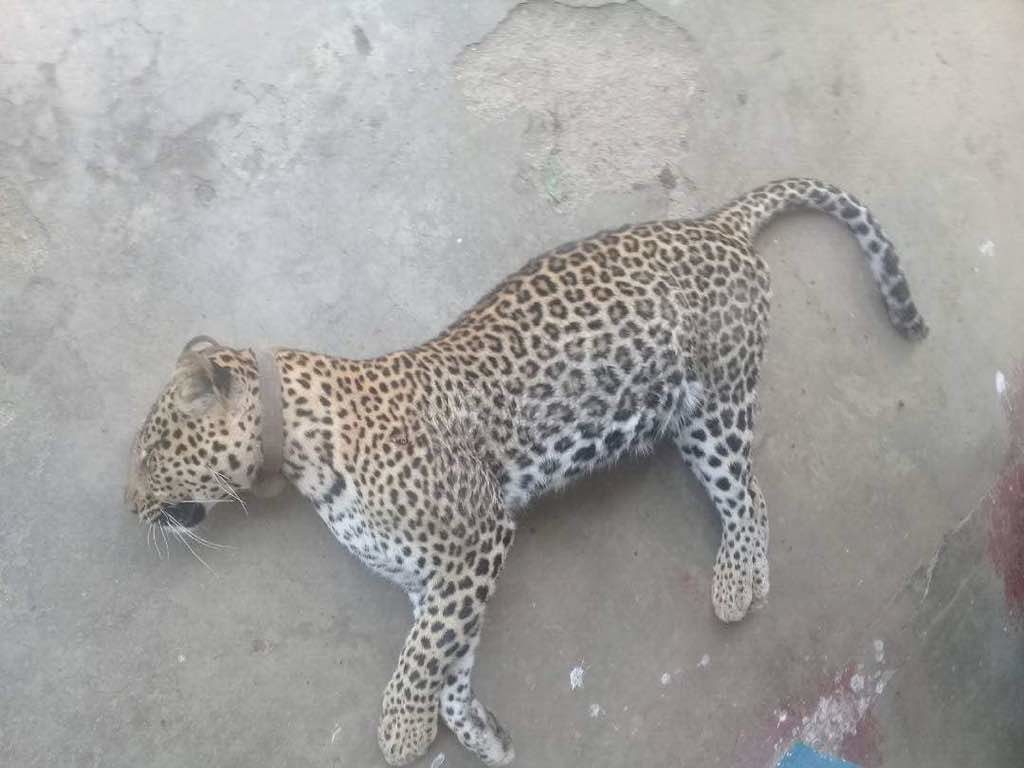
Baby eater leopard put out of action, family demands compensation

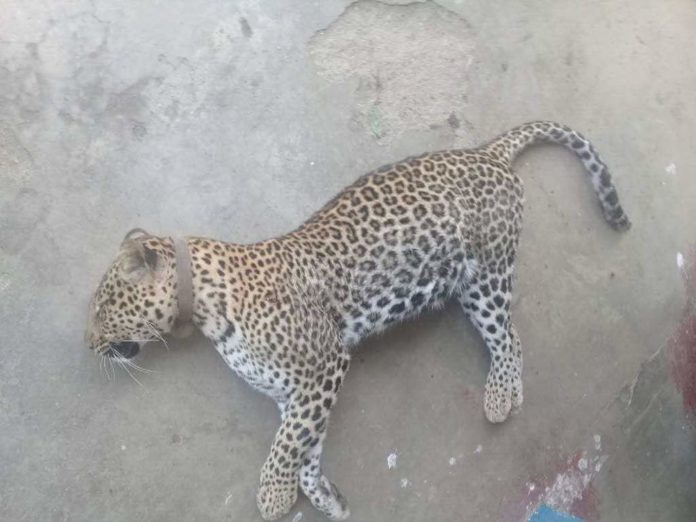
The Leopard that killed Baby Elisha Nabugyere at Queen Elizabeth National Game Park after being taken out of action

Kampala: The Leopard that devoured a two and half year old baby in Queen Elizabeth National Game Park has been put out of action by ranger from Uganda Wild Life Authority (UWA).

“We had to take it out because the moment a wild animal tastes the flesh and blood of a human being, then it means it will start hunting for human flesh.

“Human beings are easier to catch, weaker to wrestle and tastier prey than the fellow wild animals so leaving that Leopard alive would mean the people living on along that entire peninsular were going to be in danger of being eaten,” Mr Sam Mwandha, UWA Executive Director, said adding that its two cabs are beings hunted down two.

The Leopard that killed Baby Elisha Nabugyere at Queen Elizabeth National Game Park after being taken out of action

“We shall try to see if we can relocate them or if we fail, we shall put them out of action too,” he said.

Last Friday, Doreen Ayera a ranger at Queen Elizabeth National Game Park, had just left for the evening staff briefing leaving her baby son, Elisha Nabugyere, with his nanny outside the unfenced staff quarters of a safari lodge in the park.

Typical of inquisitive toddlers, and oblivious to the nanny who was attending to other daily chores, the boy surreptitiously slipped from her attention and moved a few meters to the river bank, where leopard met him.

The nanny was alerted by the shrill cry of the toddler who was, by then, firmly in the beats’ claws. It was too late; in a flash, the wild cat had vanished into where it knows best- the wilderness.

Only bones and a skull with a bit of flesh were discovered after a day’s search. They were buried yesterday at the boy’s ancestral home in Sironko.

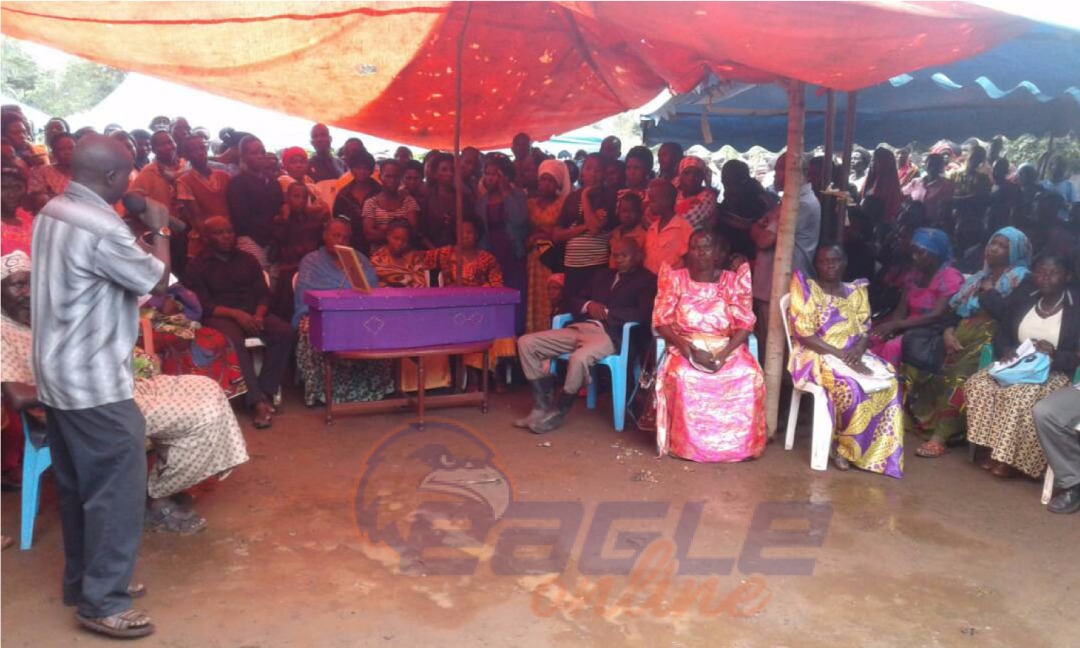
The deceased’s father, SSP Manana, addresses mourners who had gathered to send off the baby devoured by a Leopard at Queen Elizabeth National Game Park

“I am crestfallen because of the way my son died. It is a dreadful incident I will never forget,” Francis Manana, the boy’s father, who is also a Senior Superintendent of Police, said in a telephone interview.

He added, “I haven’t received any communication regarding the incident from UWA but what I know is that they took part in burial arrangements.”

Elisha Nabugyere’s grave at his ancestral home in Sironko. He was eaten by a Leapord At Queen Elizabeth National Game Park and only his bones and skull was discovered

Asked whether the authority has any plans to compensate the family, Mr Mwandha said human life can never compensated.

“There is nothing you can give to compensate for lost life so we are not talking about compensation. We shall do something but we will not call it compensation,” he said.

What is that something, what is in plan at UWA for the family, I asked.
“Leave that to us,” he responded.

Stories Continues after ad