Stanbic Bank
Stanbic Bank
19.2 C
Kampala
Stanbic Bank
Stanbic Bank
Home Blog Page 1588

Only seven matches win Fortebet Punter 20m!

The winning ticket

One of the Fortebet punters had a very blissful weekend after winning a great 20 million, thanks to the good odds.

Most interestingly, this lucky punter only selected strictly seven games from three African leagues including Azam Uganda Premier league. Were his predictions so special? No! They weren’t.

This special punter opted to go for only ‘Over 2.5’ (match number of goals of at least three) and it happened as he wanted it to.

So, which games did he go for? Well, below we give all the seven matches; Setif-Hussein Dey (ended 1-2) and MC Alger-Bel Abbes (ended 1-2) from Algeria League One, Club Africain-Metlaoui (ended 5-1) , Bizertin-Sfaxien (ended 2-1) and AS Gabesen-Ben Guaderne (ended 0-3) from Tunisia Premier League. He too selected games from Uganda Premier League; Vipers-KCCA (ended 3-2) and Police FC-Onduparaka (ended 0-5).

This betting slip had a skyrocketing odd of 401.22 and generated 20,061,000 Uganda shillings. As Fortebet always does, this win was paid out instantly. Congratulations.


Stories Continues after ad

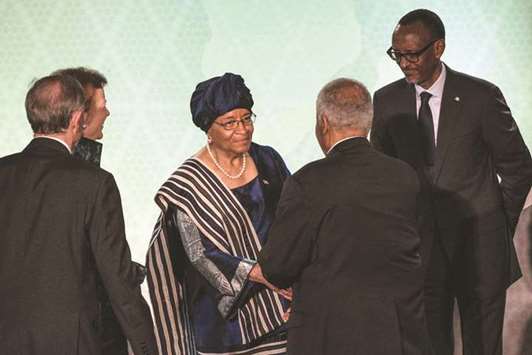
Ellen Johnson Sirleaf accepts Ibrahim prize for achievement in African leadership

Ellen Johnson Sirleaf accepts Ibrahim African leadership prize in Rwanda.

Ellen Johnson Sirleaf, the former President of Liberia, last night accepted the 2017 Ibrahim Prize for Achievement in African Leadership at a special Leadership Ceremony in Kigali, Rwanda.

Speaking to guests from Rwanda and around the world, President Sirleaf said: “I’m honoured to be this year’s recipient of the Ibrahim Prize for Achievement in African Leadership. I receive this distinction on behalf of the many women and men who helped to navigate the profound complexities of the post-conflict country that is Liberia. As the first woman to receive this award, it is my hope that women and girls across Africa will be inspired to break through barriers, and push back on the frontiers of life’s possibilities.”

The Ibrahim Prize recognises and celebrates excellence in African leadership. It is a US$5 million award paid over 10 years, and US$200,000 annually for life thereafter.

Presenting the Prize to President Sirleaf, Salim Ahmed Salim, Chair of the independent Prize Committee, said: “Madame Sirleaf embodies the type of role model the Prize is intended to honour. It recognises not good leaders – of which Africa has many – but truly exceptional figures, who, by their nature, are rare. We are looking for leaders who leave their country in a far better state than when they took office, who have strengthened the trust of their fellow citizens in state and leadership, and who have built a strong legacy.”

Praising President Sirleaf, Alassane Ouattara, President of Cote d’Ivoire, said: “Her contribution spans way beyond Liberia. The people of Côte d’Ivoire, for example, will never be indebted enough to her. During the post-election crisis in Cote d’Ivoire, President Sirleaf was a constant voice of moderation, receiving hundreds of thousands of Ivorians in Liberia, and always trying to find lasting and peaceful solutions.”

Mo Ibrahim, founder of the Mo Ibrahim Foundation, said: “It is wonderful to have a winner this year, and it is also wonderful that the winner is a she. How fitting that President Sirleaf is honoured here in Rwanda, as nobody has done more for women, and the gender issue, than Rwanda.”

H.E Paul Kagame, President of Rwanda, said: “Leadership is both a privilege and a duty. It is best measured in terms of concrete results that citizens can feel in their everyday lives as well as the level of trust that they have in public institutions. During our time in office we must work as hard as we can to do the right things for our people’s future.”
The Leadership Ceremony is at the heart of the 2018 Ibrahim Governance Weekend, the flagship event of the Mo Ibrahim Foundation which takes place in a different African country each year.

Today, the Ibrahim Forum brings together experts from across Africa and the world to discuss ‘Public Service in Africa’ – its relation to good governance and effective leadership, its new challenges and current shortcomings, and the ways and means to strengthen it and make it appealing to the next generation.

Young representatives from all over the continent also discussed the topic in a specially convened Next Generation Forum.
The weekend will conclude with a live concert featuring Sauti Sol, Peter P-Square, Riderman, Knowless, Phionah Mbabazi and Charly & Nina.

Stories Continues after ad

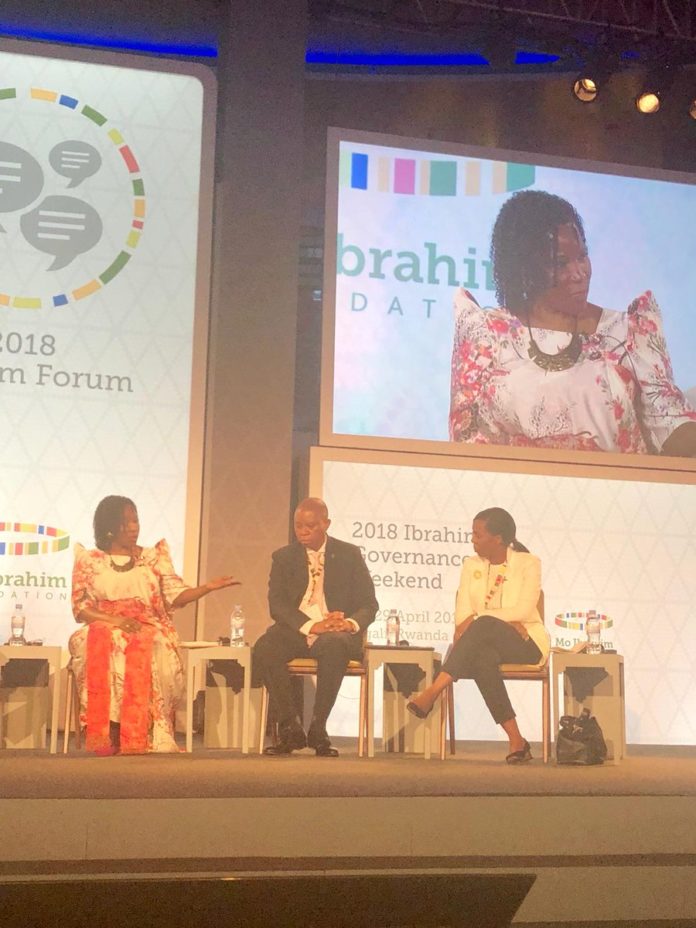
Leaders can better public service delivery – KCCA’s Jennifer Musisi

KCCA Executive Director Jennifer Musisi speaking in Kigali today, Saturday

The Executive Director of Kampala Capital City Authority (KCCA) has said that public service delivery can positively change with good leadership.

Musisi made the remark on Saturday as a discussant on the first panel of the 2018 Ibrahim Forum in Kigali, Rwanda. At the Forum that is organised by MO Ibrahim Foundation, Ms. Musisi also said that public service ‘is not dull and boring as some people say’.

““It’s not a rule that public service is dull and boring and ineffective. We can change, starting with the leadership,” Ms. Musisi said at the forum where discussants are focusing on the growing expectations of public service.

“What do people want in Kampala? They want everything! Because when we came in 2011 there was hardly any public services, service delivery, the basic things that a lot of local authorities take for granted,” she added.

The former President of the African Development Bank Group Donald Kaberuka, while discussing the topic, said that corruption and embezzlement of public funds needs to be tackled if public service is to be made efficient.

“Don’t steal our money. Deliver the services. Be accountable. If those three are met, citizens will understand,” he said.

Another discussant, Yvonne Mensah, Head of Africa, Political Division, Commonwealth Secretariat, said: “We understand quite well that the public service is constrained. However, we also want everything. Housing, unemployment, attitudes, quality of delivery – those are the things that we expect.”

Barclays Africa Group CEO Maria Ramos said: “I was a very proud public servant and I remain a very proud public servant. It is about leadership, it’s about integrity, it’s about purpose, it’s about accountability. It’s a phenomenal career for a young person.”

NEPAD’s Ibrahim Mayaki, while contributing to the debate via teleconferencing platform said that young and brilliant people should be attracted into the civil service.

“Those who are going to public services are not always the best. This is an issue we need to tackle; how to attract youngsters to be public servants,” he said.

Stories Continues after ad

Police arrest 36 armed gangsters from mosque

Police Spokesperson Emillian Kayima

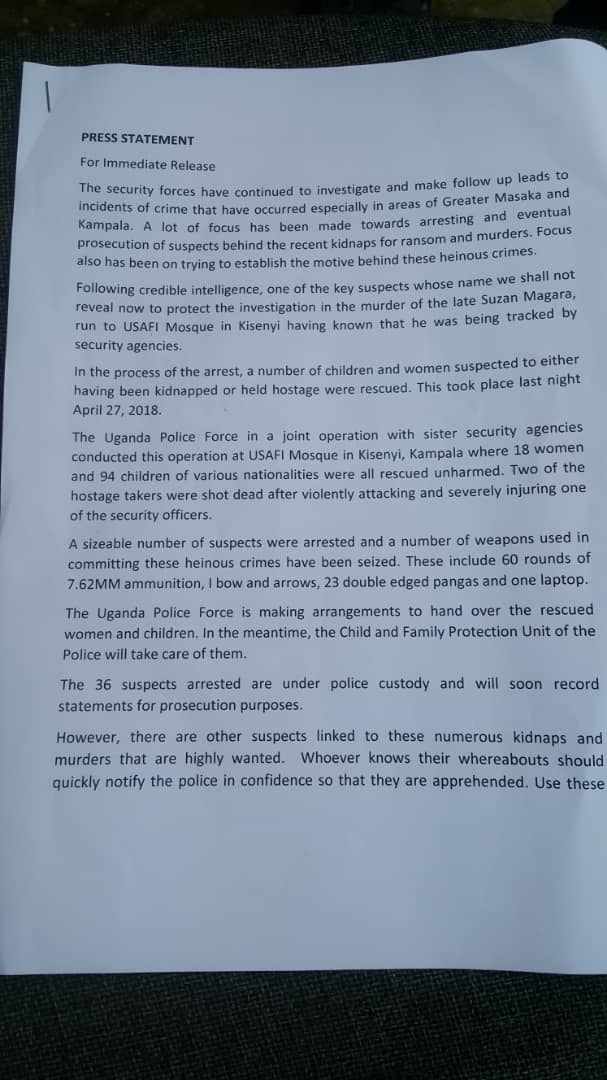
Police has in a raid on Usafi Market Mosque arrested 36 suspected criminals including one who allegedly participated in the killing of Susan Magara, an accountant and daughter to billionaire businessman John Magara.

Susan was kidnapped and killed after 20 days in captivity, this coming after her relatives paid a ransom of about Shs700 million to her kidnappers.

And today, according to a release by police spokesperson Emillian Kayima, police and sister security agencies have over the past few months been carrying out surveillance to track the criminals responsible for a number of crimes carried out in various parts of the country, notably the Greater Masaka area. Other crimes including the murder of 21 women were carried out in Entebbe and Wakiso early this year.

‘Following credible intelligence, one of the key suspects whose name we shall not reveal now to protect the investigation in the murder of the late Susan Magara, run to Usafi Mosque in Kisenyi having known that he was being tracked by security agencies,’ part of the police statement indicates.

Further, the statement adds that 18 women and 94 children were rescued in the operation that also revealed a cache ammunition and crude weapons like pangas.

Stories Continues after ad

Empower ‘minorities’ vie for leadership positions – Kadaga

Speaker Rebecca Kadaga

The Speaker of Parliament Rebecca Kadaga has urged parliaments across the globe to provide funds as an incentive for minorities to compete for leadership positions.

Speaking during the 12th Summit of Women Speakers in San Benito, Bolivia in South America, Kadaga said Parliaments should make it a requirement for political parties to identify social minority cadres and finance their involvement in national leadership.

“Political Parties can better attract membership of diversity by including in their manifesto specific programs that would facilitate the recognition and placement of the populations including giving them leadership positions,” said Kadaga.

“This requires commitment and dedication; it might even involve supporting the candidates financially to enable them to vie for the offices. As leaders of the democratic institutions, it is important that we create an enabling environment for the funding of the political parties,” she added.

The summit is being held under the theme: ‘diagnosing women under-representation, inclusive societies and parliaments and finding solutions to political violence’.

Kadaga noted that parliaments should take steps to establish whether the indigenous populations are included in the development programmes, and commended the Bolivians upon achieving gender parity in their Parliament and across the political spectrum. She urged other member states to embrace the same.

Bolivian President Evo Morales said his country is racing towards universal equality despite isolation from the United States of America, with whom they currently have frosty diplomatic relations.

“…without the American Embassy, without the World Bank, without the International Monetary Fund, we are economically better off and likewise in terms of our democracy, and we have better results in our administration,” said Morales.

He further noted that their experience demonstrates that a country, once committed, can achieve equality without over reliance on other nations.

He urged world leaders to embrace the affirmative action policies similar to those applied in his country, which he said has yielded parity representation, with the Chamber of Deputies having 58 per cent women representation.


Stories Continues after ad

South Sudan embassy in DRC faces eviction

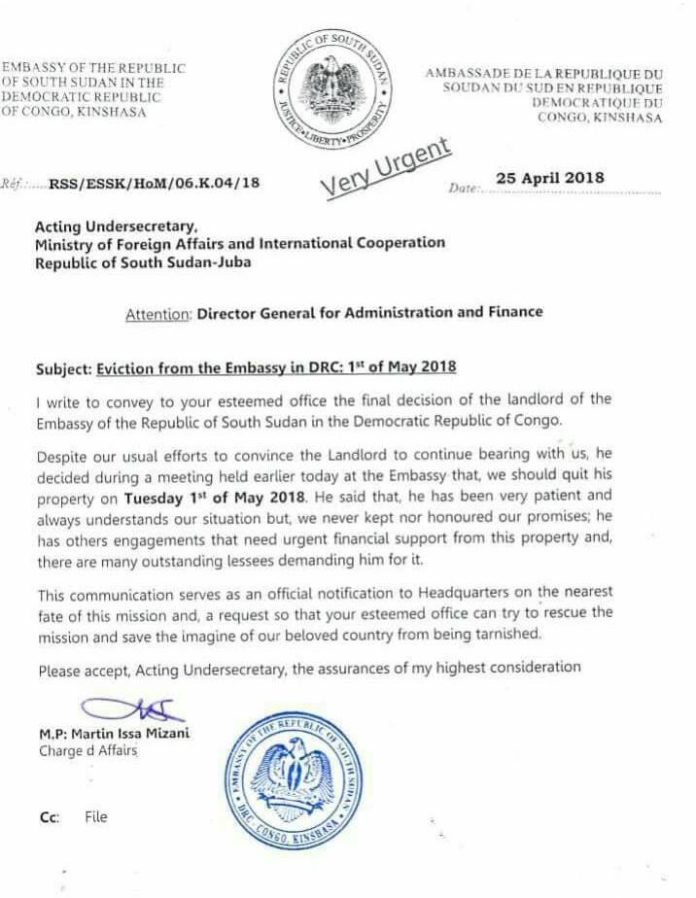
The official letter written to the Ministry of Foreign Affairs and International Cooperation

The South Sudan Embassy in the Democratic Republic of Congo (DRC) faces eviction for failure to pay accrued undisclosed rent arrears.

According to an April 25 dispatch by Martin Issa Mizani, the Charge d’affairs at the embassy, the landlord will evict them on Tuesday, May 1, five days after the notice.

‘This communication serves as an official notification to headquarters on the nearest fate to this mission and a request so that your office can try to rescue the mission and the image of our beloved country from being tarnished,’ part of the letter to the Acting Under Secretary of the Ministry of Foreign Affairs and International Cooperation reads.

Since Independence in 2011, oil rich South Sudan, the world’s youngest country enjoyed two years of relative peace before descending in a lengthy civil war that pitted President Salva Kiir against his former Vice President Riek Machar, resulting in a devastated economy.

Stories Continues after ad

How to pick a business model that is a match for you

It’s painful when you start a new business for the wrong reasons. As a mentor to aspiring entrepreneurs, one of my challenges is to make sure their idea is a match for them. For example, I have a friend who is a self-proclaimed “foody” who wants to start a restaurant, but really has no interest or skills on the business side. Loving food does not necessarily lead to a happy business.

Of course, one solution is to find a partner who has the skills you are missing. I actually worked with Bill Gates back in the early PC days, and I’m convinced that Microsoft may have failed to grow without his partner Steve Ballmer. Bill Gates ran the technical show, but Steve Ballmer, business trained at Procter & Gamble, carried the marketing and financial side of the equation.

Many technical entrepreneurs still tend to believe that their technology and passion are ninety percent of the equation, and the business will happen by default. In my view, this mismatch of interests compared to key business drivers is the primary reason that the majority of new ventures ultimately fail. Here are some key questions I ask to get you started on the right track:

Is there a real business need for your proposed solution? A business need implies customers with money to spend, that have a painful existing problem. Remember that customers buy solutions, not technology, and they rarely pay for “nice to have.” Your passion alone, for your food or your product, probably won’t change the world.

Are you knowledgeable and comfortable in this domain? Don’t step into an arena you don’t know, just because it looks like fun or easy money. Match the business to your comfort level, such as franchising, multi-level marketing (MLM), freelancing, or a new product. Don’t forget that all business types require management and execution skills.

Is your intent to maximize profit or maximize social impact? The business implications and expectations are quite different for non-profits versus for-profit entities. For example, I often find social entrepreneurs looking for investors. You can’t interest investors if you don’t intend to profit. Non-profits need donations and philanthropists.

Are you primarily motivated by family or peer expectations? Don’t try to be a business owner just to prove something to a loved one, friend or sibling. There are no business types that I would recommend here, except maybe an existing family business that is already successful. If you must proceed, at least pick something you love.

Do you have money for bootstrapping or require financing? If you really want to run a business your way without a boss or professional investor hovering over you, then start small, fund it yourself or through friends and family, and grow it organically. Banks and investors will expect a proven business model and some traction, so be realistic.

What is your sustainable competitive advantage? Working harder for less margin is not sustainable. A thriving business requires value-creating products, processes, and services that cannot be matched by competitors now, with a plan to maintain that position. It’s no fun for me to mentor business owners who are suffering continuously.

Are you working alone or with an experienced team? Many aspiring business owners prefer to work alone, and avoid the problems of partners, investors, and large teams. There are business models for these, including consulting and freelancing, which can simplify your life, and limit your risk, but also have limited growth and upside potential.

Thus you see there are new business types and approaches for every personal motivation and lifestyle expectation. In any case, don’t expect the work to be automatically easier or more satisfying that a corporate job. Success in any business requires a serious commitment, and learning from setbacks. Switching business models is not a shortcut to success and happiness.

I often recommend to aspiring business owners that they first take a job with another business in the same realm as the one they envision, to get some practical insight into the challenges, make contacts, and learn more about their own motivations. Then take the big step of starting your own business, with fewer surprises, some good connections and likely more accumulated savings.

Overall, it is important to remember that happiness breeds success more often than success breeds happiness. Every aspiring business owner should play to their strengths and interests, rather than listen to well-meaning advice from friends and experts. For long-term satisfaction, make sure you are driving your business, rather than letting the business drive you.


Stories Continues after ad

US$26m grant to boost specialty coffee exports in Uganda, DRC

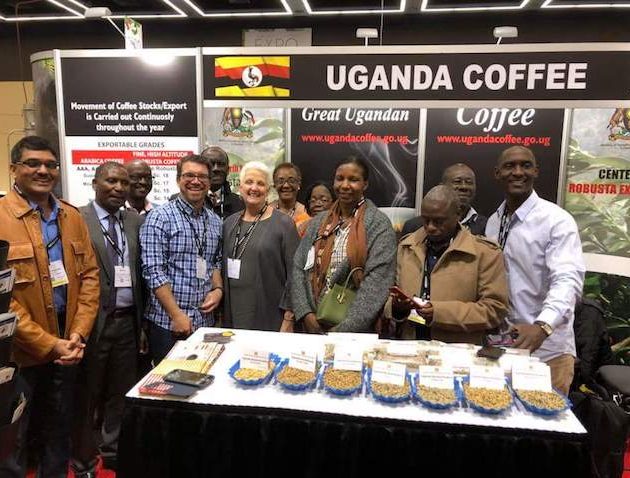
US Ambassador to Uganda Deborah R. Malac and a team of Uganda specialty coffee dealers in the US recently

Farmers from Uganda and the Democratic Republic of Congo (DRC) stand to benefit from a US$26m training by a non-profit development firm, Techno Serve, aimed at increasing production of specialty coffee for export.

In western Uganda, the firm is targeting 30,000 growers under a four-year project funded by Germany-based Benckiser Stiftung Zukunft and Enveritas of New York to the tune of US$3 million, part of which will provide agronomy training to Robusta coffee farming families.

“Robusta coffee is an important cash crop for more than 1.3 million farmers across the country. With improved farming techniques, farmers can improve coffee yields by an average of 50 per cent,” said TechnoServe.

Similarly, TecnoServe is training 15,000 farmers in eastern DRC under a five-year project funded by the United States Agency for International Development (USAID) to the tune of US$23m.

In the DRC TechnoServe will train farmers on climate-smart techniques and also work with co-operatives to establish and improve processing facilities.

The firm’s chief executive William Warshauer said growing global demand for specialty coffee presents an opportunity for farmers in the highlands of South Kivu to earn higher prices for their crop.

“While meeting growing consumer demand for unique high-quality coffee, farmers can lift themselves out of poverty and provide better futures for their families,” he said.

USAID/DRC mission director Christophe Tocco said the new value chains will improve food security, give farmers and small businesses a viable legitimate income and support economic growth.

Starbucks with Swiss food company Nestle have already recruited farmers in Kenya, Burundi, Ethiopia, South Sudan, Rwanda and Uganda and trained them on sustainable business farming practices for specialty coffee, with the aim of increasing incomes through improved output.

US Ambassador to Uganda Deborah Malac recently led a trade mission to the Specialty Coffee Expo in Seattle on April 20-21 jointly with the Uganda Coffee Development Authority and the USAID East Africa Trade and Investment Hub, joined by Ugandan Ambassador Mull Katende and more than 20 Ugandan coffee entrepreneurs.

The effort sought to boost the profile of Uganda’s coffee industry, which is Africa’s largest coffee exporter, but sends just three percent of its exports to the US.

Stories Continues after ad
Pests and diseases cripple EA banana production

Uganda and Tanzania consume 50 per cent of bananas grown in Africa, but realise only nine per cent of the potential yield due to low productivity caused by pests and diseases.


The two eastern African countries do not feature among the leading exporters of the food crop in Africa because of little efforts to boost production, quality and secure foreign markets, experts have said.

“Cote d’Ivoire and Cameroon are the two leading banana exporters in Africa. What is wrong with us in East Africa?” asked Dr Cyprian Ebong, the acting executive secretary of the Association for Strengthening Agricultural Research in Eastern and Central Africa (Asareca).

Dr Ebong was speaking at the launch of a $13.8 million Breeding Better Bananas (BBB), a banana improvement project targeting Tanzania, Uganda, Kenya, Burundi, Rwanda and Ethiopia. The three and a half-year project aims at improving productivity of the crop and make it a traded commodity through marker assisted hybrid selection.

He said although banana is both a food and cash crop, the region has failed to exploit the potential due to poor production technologies coupled with disease and pest attacks.

Banana production in the East African Community bloc generates US$4.3b annually, accounting for five per cent of the Gross Domestic Product (GDP).

But to boost productivity that would lead to increased commercialisation of the crop, research will be intensified for high yielding and disease resistant breeds, Dr. Ebong added.

In a related development, the vice chancellor of the Nelson Mandela African Institution of Science and Technology (NM-AIST), Prof Karoli Njau, has said the Pan African University will establish a centre of excellence on banana research.

“The centre is geared for improved management in banana production. We will deal with banana pests and diseases,” Prof. Njau says.

He further says that although over 50 million people in East African region depend on highland bananas for their food and income, the average smallholder productivity has remained as low as less than 30 per cent.

According to Prof Njau, banana farmers in EA  produce a small portion – about nine per cent of what is possible – largely due to the devastating impact of pests and diseases.


Stories Continues after ad

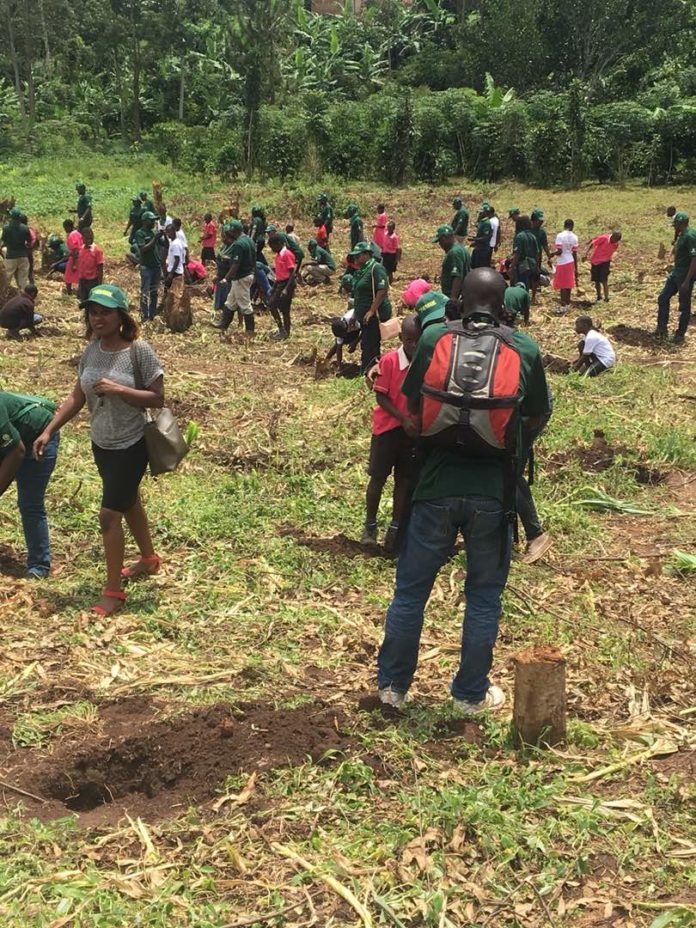
Environmental conservation: UMEME takes tree planting campaign to Mityana School

Kyankowe Primary School located in Tamu Division in Mityana Municipality will never be the same after Uganda’s electricity distributor UMEME launched a tree planting exercise there to encourage pupils learn how to promote and conserve the environment.

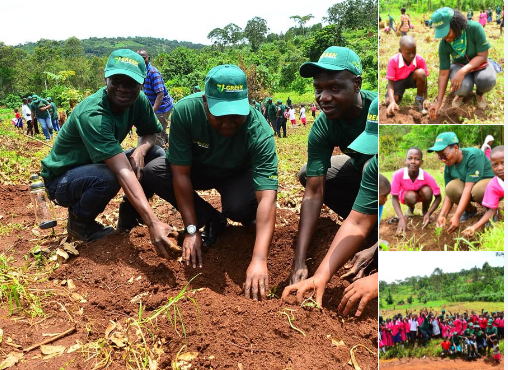
Participants planting tree seedlings on Friday led by Mr Edward Ssebukyu

The exercise aimed at planting fruit trees at the school and eucalyptus on 5.5 acres land outside the school was attended by a crowd which included pupils, teachers, political leaders, religious leaders, UMEME staff and the media.

Second to be launched was UMEME’s Safety Club at the school in commemoration of the World Day for Safety and Health at work. The club has membership of the school’s pupils who are passionate about environmental protection.

The launch of the Club was symbolically carried out by Mityana Woman MP Judith Nabakooba and Resident District Commissioner (RDC) Yahaya Kakooza. The two leaders officially launched the Club by planting tree seedlings in the school’s green compound.

The two guests commended UMEME for its initiative to protect the environment through tree planting, pledging to support the initiative. They, however, asked UMEME and its partner-Uganda Timber Growers Association (UTGA) to extend the same initiative to other schools.

MP Nabakooba urged parents and schools in the district to sensitise children on the need for environmental protection at an early age, which she said, makes them appreciate the value of natural habitats like forests. She added that it helps them grow up knowing they have the responsibility to protect the ecosystem.

On vandalisation of UMEME’s properties like transformers and poles by unruly residents in the district, both MP Nabakooba and RDC Kakooza urged them to stop the bad habit with immediate effect.

“Much as it is UMEME’s responsibility to gives us power, the facilities are as good as ours,” Kakooza said, lauding the company for boosting its communication channels as staff there interface with the public. That was re-echoed by MP Nabakooza who appreciated the value of toll free lines.

Ibrahim Katerega, the Mayor of Tamu Division was all praises for UMEME for introducing the tree planting project at Kyankowe Primary School, saying it will help the young children to learn how to protect the environment but also that it will boost greenery at the school he says was founded by his grandfather, the late Solomon Gyagenda over 80 years ago.

Edward Ssebukyu, the Commissioner for private schools and institutions in the ministry of education said it was important that children participate in conserving the environment from an early stage at the government requires all schools to plant trees in their compounds and gardens for environmental sustainability as well as provision of oxygen and uptake of carbon dioxide.

UMEME’s Head of CSR and Stakeholder Relations Manager, Stella Ndiwalana, said the tree planting exercise is part of the CSR program in partnership with Nature Uganda, dubbed U-Green which is centred around inspiring community action on environmental conservation and demonstrate how it can be integrated into their livelihoods.

This program also links directly to implementing the Government goal on afforestation and reforestation of Uganda’s landscapes and adaptation to climate change. She said Umeme take cognizance of the vital role forestation plays in ensuring power supply in a country that is heavily reliant on hydropower. She hoped the children at the school will use the initiative to appreciate the value of conserving the environment at an early stage.

The Acting Headmaster of the school, Peter Galiwango, lauded UMEME for choosing the school to launch the first-ever tree planting initiative in Mityana district.

“We are really grateful for choosing Kyankowe Primary School for the “U-Green Project”, Galiwango said, and appreciated the role played by UMEME ”U-Green Army’, made of staff who have been spearheading tree planting in schools including in Mukono district but also have plans to expand the initiative to the districts of Masaka, Mbarara and others.

During the launch of the tree planting initiative at the school, the pupils entertained guests with songs and a poem on electricity-regarding its uses, dangers and urged people never to interfere with the power lines.

Rev. Mark Kakuba of Ssaala-Kyankowe Parish led the prayers at the event as he asked God to help Ugandans protect their environment.


Stories Continues after ad