Stanbic Bank
Stanbic Bank
18.3 C
Kampala
Stanbic Bank
Stanbic Bank
Home Blog Page 1599

Ntinda Punters excited by Fortebet gifts

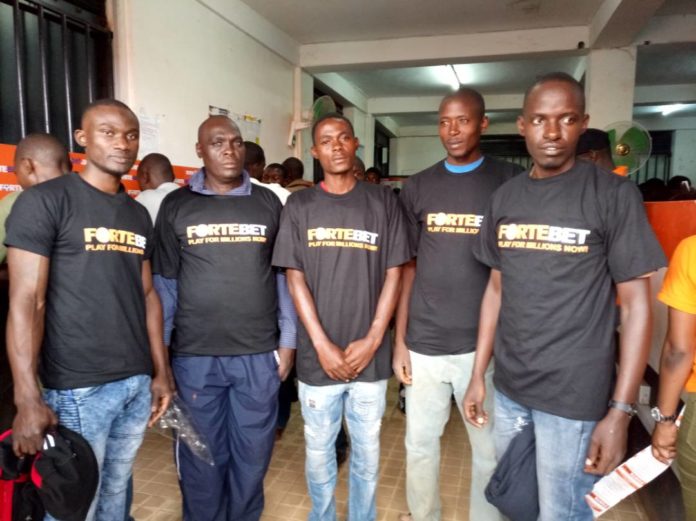
The five punters that walked home with Fortebet T-shirts

Punters (clients) in Ntinda over the weekend lauded Fortebet for ‘giving back’ to them, something they said had never happened in the betting industry in Uganda.

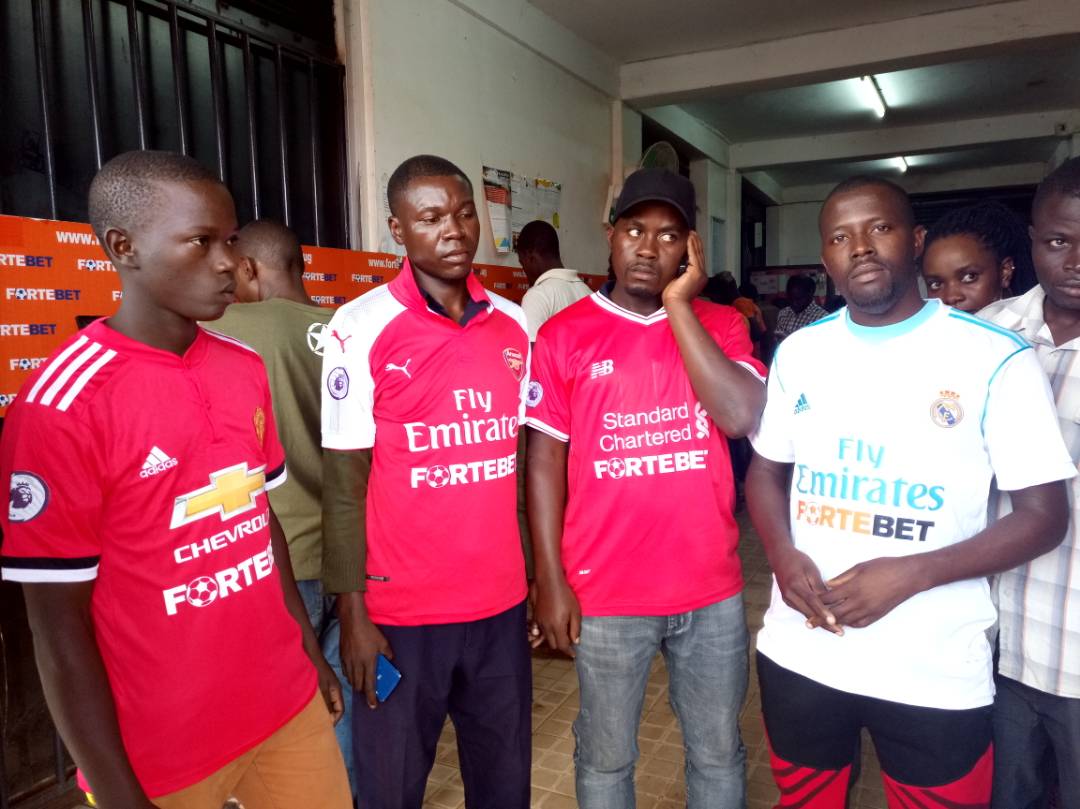
Four of the eight team jersey winners

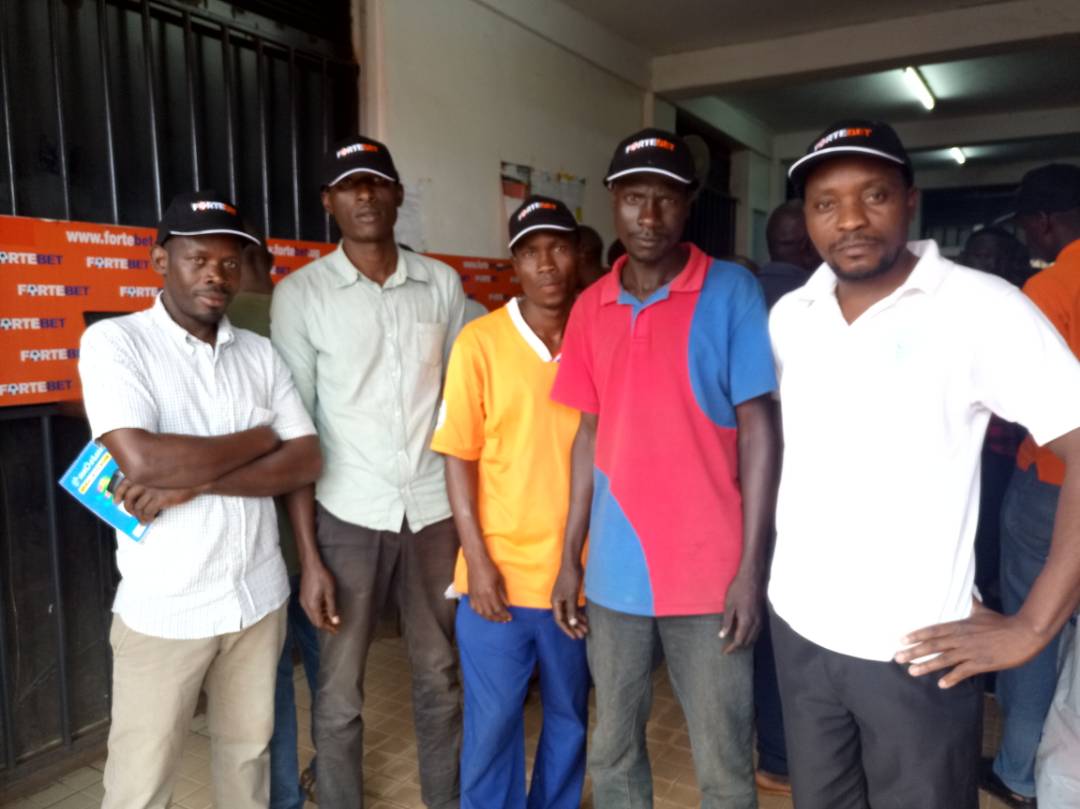
Like it has done before, even last weekend Fortebet reached out to Ntinda punters and gave them a number of gifts that included branded European team jerseys, Fortebet T-shirts, caps and wristbands.

The highly emotional gifts’ handover was done inside the branch on Saturday by Fortebet media manager, John Nanyumba, shortly before most of the weekend games started.

Some of the caps winners

A record 60 punters walked home with any of the above gifts, with Abas.K, one of the gifts’ winners saying: “I knew you were going to come here because I read it from your Facebook page. However, I didn’t expect to win a T-shirt because I thought there are so many procedures of getting it or a competition. I am extremely happy because this gift has compensated the 10 million that I lost yesterday just because of one team that was beaten at home. But next time I know I will win, like I have done before.”

Another punter (Justus M) who took a jersey said:“I have been using Fortebet at my betting company. But now that it has even given me a gift, I will never ever stop betting with you (Fortebet)”

“Today, we have just done what we always do-appreciating our good customers. Once we promise that we shall visit a given branch, we do it,” said Nanyumba just after the handover. He added that Fortebet will, this weekend, give out gifts to it Mbale town customers.


Stories Continues after ad

AfDB publishes first-ever Economic Outlook highlights of 2018 in Kiswahili

For the first time ever, the African Development Bank has released summaries of the African Economic Outlook (AEO), its main flagship report, in three African  languages of Kiswahili, Arabic and Hausa.

“These three languages are among the most widely spoken by over 300 million Africans. Releasing the report in local languages aims to increase accessibility of the publication’s findings to a large segment of Africans and promote linguistic inclusiveness. This release is also the latest innovation for increasing the relevance and timeliness of the African Economic Outlook,” the AfDB says in a statement.

For the first time in the publication’s 15-year history, the 2018 edition of the report was launched early in the year – on January 17, 2018 by the President of the AfDB, Akinwumi Adesina. The 2018 edition of the AEO focuses on infrastructure. As noted by the Bank President, “Infrastructure projects are among the most profitable investments any society can make. When productive, they significantly contribute to propel and sustain a country’s economic growth.”

Based on preliminary results, the African Development Bank estimates that investment needs for infrastructure will be in the range of US $130-170 b a year, much higher than the commonly cited US $93b.

Another milestone was the release of regional Economic Outlooks for Africa’s five sub-regions, at the Bank’s regional hubs on March 12, 2018. These self-contained reports focus on priority areas of concern for each sub-region and provide analysis of the economic and social landscape.

Specifically, the regional Economic Outlook focuses on the importance of the Congo Basin forest for Central Africa; assesses the manufacturing sector potential in Eastern Africa; discusses food security and rural poverty in North Africa; analyzes competition in food value chains in Southern Africa; and addresses labour markets and job issues in West Africa.

With these new improvements, the Bank aims to transform the African Economic Outlook series (main and regional editions) into a flagship that provides comprehensive and rigorous analysis, reliable and up-to-date data and reference material on Africa’s development challenges for researchers, investors, civil society organizations, development partners, and the media.

The stamen reads that in the coming years, a particular emphasis will be placed on promoting linguistic inclusiveness by expanding the number of local languages in which the AEO is released.

The Bank will also take its knowledge products to influential development stakeholders such as local government officials or local NGOs, especially in rural areas, which are often not fully engaged in critical development discussions. Through such efforts, the African Development Bank will further celebrate Africa’s linguistic diversity and multilingualism, while fostering home-grown solutions to Africa’s challenges.


Stories Continues after ad

Tax system favourable for business and investment – URA boss

URA Commissioner General Doris Akol says paying taxes is painful but necessary

Uganda’s tax system has undergone various administrative and legal reforms geared towards raising more revenue, making tax payment as simple and less costly for investors, the Commissioner General of the Uganda Revenue Authority (URA), Doris Akol has said.

In an article titled ‘Uganda business and investment tax system in a nutshell’ and published in the April edition of Into Africa, a publication with fresh insight into Africa’s emerging markets, the URA boss says the reforms have ensured the tax body is buoyant.

“On the administrative side, for example, these reforms include the restructuring of the URA in 2004 to reflect functional ideals, automating some internal and external services, developing human capacity and re-engineering business processes among others,” Ms. Akol says.

All these, she says, have simplified the ease of paying taxes in Uganda compared her neighbors. “For example, Uganda ranked 84 in the world in terms of ease of paying taxes while Kenya ranked 92 and Tanzania 154,” she writes in the magazine where other African tax experts share updates on tax administration in selected countries in Africa.

On the legal frame work, a number of tax incentives are granted in the tax laws that are targeted towards supporting businesses to grow, she says.

She says investors in free trade zones in Uganda  are entitled to a ten-year corporation tax holiday, duty exemption on raw materials, plant and machinery and other inputs; stamp duty exemption, duty drawback to apply on import of goods from domestic tariff area.

Akol says there is no export tax on goods exported as well as exemption of withholding tax on interest on external loans and dividends repatriated, which says helps investors to get relief from double taxation.

On the other hand, she says, mining operations are granted a 100 percent deduction for any expenditure of a capital nature incurred in the exploration of, discovery, testing or gaining access to mineral deposits in Uganda.

“A 50 percent initial allowance is available in respect of plant and machinery, which is increased to 75 percent if such assets are outside the areas of Kampala, Entebbe, Namanve, Jinja and Njeru. 20 percent of the cost of a new industrial building or expansion to an existing industrial building is available as an allowance during the year of income the building is brought into use for the first time,” she says.

On paying taxes, she says, at first glance, taxes are seen as a threat to business growth and that a number of studies have concluded that taxes reduce financial performance of businesses as they are a cost and hence reduce corporate profits.

However, she notes: “It’s also true that business won’t survive if taxes are not levied.” For example, a business to prosper it needs better infrastructure such as paved roads, electricity, and security among others provided by the government as public goods.

“Since no business man/ woman can avoid using such public services we all have to contribute to them through paying taxes. Yes, paying taxes is painful and many of us hate it but we can’t opt out of it-let us all face it,” Ms. Akol emphasises.

Stories Continues after ad

New venture survival lessons from early explorers

By Martin Zwilling

Did you ever wonder why some entrepreneurs always seem to have all the luck and success, while others never seem to catch a break? As an angel investor, I quickly learned that luck has very little to do with it, and I now look for some personal characteristics and leadership styles that separate the potential winners from the losers.

These differences are the reason that investors say that they invest in people, rather than ideas. As I was reminded again by the classic book from Dennis Perkins, ‘Leading at the Edge’, this isn’t a new concept. He illustrates this by comparing the acts of numerous teams which faced the edge of life and death as early Antarctic explorers in the 1800s.

He was able to identify ten lessons from the common threads to survival in the winning explorer teams, which I believe apply equally well to the survival and success of business startup teams today:

Never lose sight of long-term goals, but focus real energy on short-term objectives. Don’t be afraid to pivot, and commit to new objectives with as much passion and energy as the original. Andy Grove of Intel fame started making memory chips, but switched to microprocessors with a vengeance when Japan totally undercut his pricing.

Set a personal example with visible, memorable symbols and behavior. Under the stresses of a startup, visible leadership cues can make the difference between success and failure. When McDonald’s was still a small company, Ray Kroc, the CEO, had a penchant for asking a store manager to help him clean up trash in their parking lot.

Instill optimism and self-confidence, but stay grounded in reality. That means you must first find optimism in yourself. Then it extends to the hiring process. Herb Kelleher, while CEO of fledgling Southwest Airlines, said he only wanted people with positive attitudes. He also famously said,” We don’t do strategic planning. It’s a waste of time.”

Take care of yourself: Maintain your stamina and let go of guilt. Evidence shows that effective entrepreneurs have high levels of energy, and handle stress well. But no one is superhuman. I once worked for a CEO of a startup company who insisted on working 20 hours a day, until a health crisis almost killed her, and did kill her company.

Reinforce the team message constantly: “We are one – we live or die together.” Teamwork is the hallmark of high-performing startups. Establishing a shared identity is the first step to creating unity. The Google team stayed tight as they developed the technology, first working out of Larry Page’s dorm room at Stanford, then a garage.

Minimize status differences and insist on courtesy and mutual respect. CEOs who talk, and really listen, to everyone in the organization gain the highest reputation. Not surprisingly, based on the success of their companies, both Mark Zuckerberg and Elon Musk scored in the top ten most respected CEOs per the most recent Glassdoor Survey.

Master conflict – engage dissidents, and avoid needless power struggles. Some entrepreneurs go to great lengths to avoid interpersonal friction, or engage the wrong way. Those of you who viewed the movie The Social Network, saw an example of new entrepreneurs dealing with conflict poorly, almost leading to the demise of Facebook.

Find something to celebrate and something to laugh about. Especially under the constant pressures of a startup, the ability to lighten up, celebrate, and laugh can make all the difference. Herb Kelleher, mentioned earlier, is one leader who also understood the power of humour in business, with his own antics, and focus on “fun ware.”

Be willing to take the Big Risk. Risk aversion does not always result in disaster, but neither does it create change. Risk takers make things happen. Think of the risk taken by CEO Todd Davis of LifeLock when he posted his Social Security number online, to assure customers the he could protect them from identity theft. It worked.

Never give up – there’s always another move. Rather than expecting things to go right, entrepreneurs have to assume things will go wrong, and solutions are elusive. Colonel Sanders started at a late age to build his chicken recipe into KFC (Kentucky Fried Chicken). It took two years of persistence to get the money. The rest is history.

Investors (and team members and partners) find that it’s more effective to assess an entrepreneur’s fit to these personal characteristics than it is to assess the real potential of an idea, or the probability of good luck. We listen to you and judge how many of these are practiced by you. When it’s time for due diligence, we will talk to your team. Their perception is the only reality. What do you think they will say?


Stories Continues after ad

Support child refugees- First Lady urges UWESO

First Lady Janet Museveni with officials.

The First Lady of Uganda and Founder of Uganda Women’s Efforts to Save Orphans (UWESO), Janet Kataaha Museveni recently launched a new project funded by the UAE with the aim of advancing rights and opportunities for children in Uganda.

The two-year project will serve in Isingiro and Mbarara focusing on the children in the refugee camps and host communities. This was during the UWESO General Assembly that convened at Masuliita children’s village.

“I am happy to note that this project will go to refugees because the day we got this funding, is the day Uganda was trying to consolidate support for the refugees. I’am happy to be here to launch this project that will support the refugees, we wish it to make a difference in the life of life these communities”,” she said.

The First Lady urged the leaders of UWESO to think of extending support to the refugee communities, adding that this would help to make a difference in the country and would also attract funding for to UWESO because of their good methods of work..

“When I watch the refugee community especially in Africa, I wish that UWESO had taken the decision to support refugees because there was a time when Ugandans were refugees. My family and I were once refugees and we were taken care of very well by our host country in time God out of his goodness made this country stable and it is now helping other countries. We as UWESO must take it upon ourselves to add refugee children in Uganda, to our so that we become hand that bless to feed them and take them to school”,” she said.

Mrs Museveni also called upon the UWESO leaders to create a skills development area in Masuliita that would help skill the unemployed youths in the region and create for them jobs.

She further encouraged the women to keep serving vulnerable children, adding that they were a vessel that the Lord was using to reach out to the helpless. “The blessings that you give to others, God gives them back to you in Africa, not so many people want to serve other people. There are people who are able to help but they don’t think of helping, so the poor remain poor and the rich remain rich which has created a gap that we must fill”,”she said.

The Founder and Patron of UWESO also thanked NAADS for offering to partner with them and hoped that with their help, they would be able to multiply and increase their service to the vulnerable groups.

She appreciated the founders of UWESO like Joyce Mpanga who had served the organization for over 32 years since its establishment. She also gave a token of appreciation to the Chairperson of UWESO, Marble Kiggundu who had effortlessly served the organization for 8 years. She urged them to elect new leaders that have the UWESO love and spirit in their forth coming election.
The First Lady was also given a token of appreciation for her continued support to the organization amidst very many challenges faced.

Stories Continues after ad

I am the rightful Consul of Pakistan to Uganda- Angella Katatumba releases letter

Singer Angella Katatumba says she is the rightful Consul of the Islamic Republic of Pakistan to Uganda, following the death of her father Boney Katatumba who was in 2000 appointed by former President of Pakistani Pervez Musharaf to run the Consulate based in Kampala.
Angela Katatumba confirms in a letter she sent to us. The letter written on October 24, 2017 was addressing the Ministry of Foreign Affairs (Uganda), Pakistani nationals, diplomats and international organisations.
The letter at the time urged those concerned with the activities of the consulate in Kampala to address their issues to Angella Katatumba through her email: angella Katatumba@gmail.com. The letter headed “Consulate of the Islamic of Pakistan Kampala-Uganda” does not however mention the name of the individual author of the letter even though it was stamped.
The Deputy Miss Angela Katatumba who has been running the Consulate office with him, for the last ten years, is now at the hem until the President of Pakistan announces any new developments,” reads part of the letter.
The letter written on October 24, 2017, was copied to Uganda’s High Commission to Kenya and the High Commissioner for Pakistan-Nairobi.
Ms Katatumba dismissed the earlier letter written on April 13, 2018 by the Pakistan High Commission in Nairobi warning the public against dealing with her.
Katatumba said both the High Commission at Nairobi and her are appointed by the President of the Islamic Republic of Pakistan with the approval of Ministry of Foreign Affair and therefore, wondered how a fellow presidential appointee can dismiss her appointment.

Stories Continues after ad

Two KPMG partners resign in South Africa, face disciplinary charges

KPMG-South Africa

KPMG South Africa said on Saturday two of its partners have resigned after facing disciplinary charges over failure to disclose financial interests in connection to VBS Mutual Bank, which was placed under curatorship.
The company said in a statement partners Sipho Malaba and Dumi Tshuma tendered their resignations on Friday, which have been accepted.
KPMG said the disciplinary charges against Malaba and Tshuma were “connected to VBS bank and include, but are not limited to, failure by the partners to comply with the firm’s policies and procedures regarding the disclosure of relevant financial interests.”
The South African Reserve Bank in March placed small lender VBS under curatorship because of liquidity issues.
KPMG said when VBS went into curatorship; information arose in relation to the partners that prompted the firm to launch an independent investigation. The investigation was ongoing and further action would be taken as appropriate, it said.
“This has been a very disappointing episode for KPMG. There can be no tolerance, however, of any conduct that compromises our reputation and we have moved decisively to deal with the situation,” KPMG South Africa chief executive Nhlamulo Dlomu said.
KPMG did not provide further details. It is one of several international companies facing questions about its work for the Gupta brothers, who have been accused of using their links with former President Jacob Zuma to secure lucrative tenders.
The Guptas and Zuma have denied any wrongdoing, and the accusations are part of judicial inquiry into “state capture”.
A number of companies have said they would drop KPMG as their auditor.
The same audit firm is facing resistance in Uganda over whether it should be contracted to audit Bank of Uganda (BoU) in relation to the takeover of Crane Bank Limited. The firm was two weeks ago shortlisted among firms to be contracted to carry out the forensic audit but KPMG among others have come under opposition over conflict of interest as the firm has before worked for BoU.
Three firms shortlisted for the impending Bank of Uganda (BOU) investigations over the sale of Crane Bank may have to pull out the process if the investigations are to be considered credible.
The five firms shortlisted are KPMG, Pricewaterhouse Coopers (PwC), Deloitte and Touch. However, it should be noted that KPMG and Pricewaterhouse Coopers worked with defunct Crane Bank as its auditors.

Stories Continues after ad
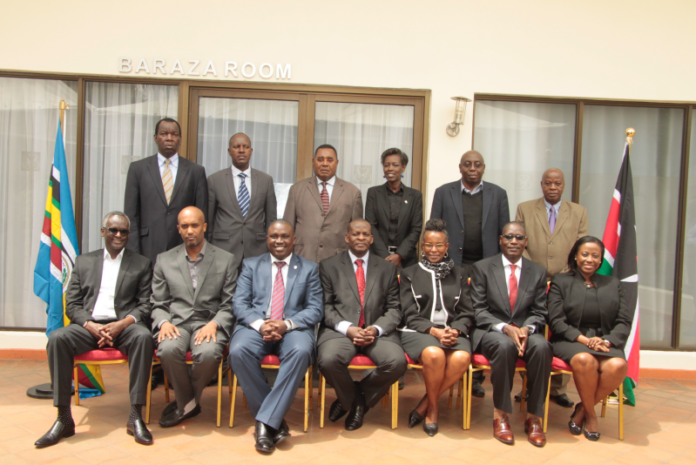
Judges, registrars equipped with skills on arbitration process

EACJ judicial officers

The East African Court of Justice (EACJ) Judges and Registrars have completed training on arbitration in Nairobi-Kenya to equip them with knowledge mainly to handle commercial disputes.
The training facilitated by the Chartered Institute of Arbitrators, Kenya covered issues on arbitration process, such as arbitration practice, drafting and decision making in settling disputes.
The President of EACJ, His Lordship Justice Dr Emmanuel Ugirashebuja, said that was a need to improve on the knowledge and skills of the Judges in arbitration jurisdiction and practices within the region. He further said: “We need to have an open mind to learn a lot and to change the Judge/Lawyer mind set to the arbitrator mind set, in order to be effective arbitrators.”
Justice Ugirashebuja, emphasized that, the EACJ will continue engaging the Institute in such training programs to enhance its capacity building.
EACJ has arbitration jurisdiction and provides arbitration services without payment of any fees.
The Court has so far handled two arbitration disputes and as the Common Market Protocol implementation process continues, several disputes are likely to arise, hence the residents of the Community may bring the matters to the Court for interpretation and settlement.
The Chairman of the Chartered Institute of Arbitrators, Mr Calvin Nyachoti said that, it is very important to equip the regional Courts with the arbitration knowledge, so that Litigants should not take such disputes outside East Africa and Africa as whole, which is very costly. He also added that arbitration is faster than Court litigation because a case in court can take more years compared to arbitration.
Mr Nyachoti, commended the commitment of the EACJ in continuously engaging in arbitration trainings, to improve the Judges knowledge on arbitration. He said that there is no doubt this will benefit the residents of the Community as the court continues to receive various disputes on arbitration.
He encouraged the Court noting that most of the East African Partner States have adopted arbitration as a dispute settlement mechanism with in their respective jurisdictions, these include the Republic of Kenya, Rwanda, Uganda and United Republic of Tanzania.
Mr Nyachoti also commended the judges for taking the training as the arbitration knowledge and skills will enable them fully join the arbitration fellowships in their respective countries once they complete their tenure at the EACJ.
He further said that, early this year in February, the Institute engaged the COMESA Court of Justice in training the Judges in arbitration practices and will also engage the African Court of Human and Peoples’ Rights in May 2018.
Arbitration is the process of settling disputes that arise from commercial agreements; the matters are handled in private unlike litigation where a case is handled in public Courts.

Stories Continues after ad

Ecobank to help SMEs reap from intra Africa trade

Ecobank logo

Ecobank Group, which has an affiliate in Uganda, continues to expand the Emerald Ecobank Business Club on the continent, aimed at widening opportunities for its Small and Medium Enterprises (SMEs) customers by creating direct linkages between businesses operation in 33 African markets with over 12.8 million customers.

The Emerald Ecobank Business Club is designed also to enable members get access to direct networking platforms, market information as well as business advisory services from the Ecobank, associated partners, external trade facilitation and preferential banking among others.

The Club will focus on bolstering intra-Africa trade leveraging on the Bank’s presence in 33 African markets enabling SMEs to leverage on Ecobank’s customer book to authenticate and vet trading partners across the continent.

The new Business Club is also a wider strategy by the bank to grow SME sector by offering direct linkages and a seamless base of transaction for businesses across the continent.
The, target, according to officials, is to empower our SME customers by availing networking opportunities across the network of 33 African countries to help them grow.

The initiative comes at the time when most SMEs across Africa face capacity challenges either in terms of technical knowledge on how businesses operate across the continent or in terms of access to opportunities to forge partnership. Official say Emerald Ecobank Business Club members will enjoy easy networking opportunities and exposure to different markets.

Further, the Emerald Ecobank Business Club will help facilitate the interaction amongst emerging SMEs in Africa, but also facilitate integration with the larger businesses across the continent, enabling members to benefit by being part of a like-minded community.
Though SMEs are willing to expand into the wider African Market they lack adequate platforms to network and understand potential partners a factor that have made most businesses cautious and unwilling to partner, officials say.
Under the initiative, SMEs will also be able to leverage on the Ecobank Mobile App which has four million downloads so far. The platform will benefit small businesses along border communities that have in the past had to transact in cash and constantly trade currencies subjecting them to exchange losses.
They will also enable SMEs tap into new opportunities and deepen intra-Africa trade which currently stands at 14 per cent accounting for 18 per cent of African exports.
The launch of the Club comes on the back of the Africa Continental Free Trade Area (CFTA) agreement which signed by 44 African countries last month and expected to create a US $6.7 trillion market by the year 2030.
Across Africa, small and medium sized enterprises are singled out as the key drivers for job creation, wealth generation and social-economic growth and development.
The club is already operational in Ghana, Nigeria, and Cote D’Ivoire, Kenya among others with plans to launch in the entire East African region in the next two months and all of Ecobank’s 33 markets by 2020. Ecobank also has representative bureaus in China, Dubai and the UK.

Stories Continues after ad

Angella Katatumba is not our representative in Uganda-Pakistan

Angella Katatumba.

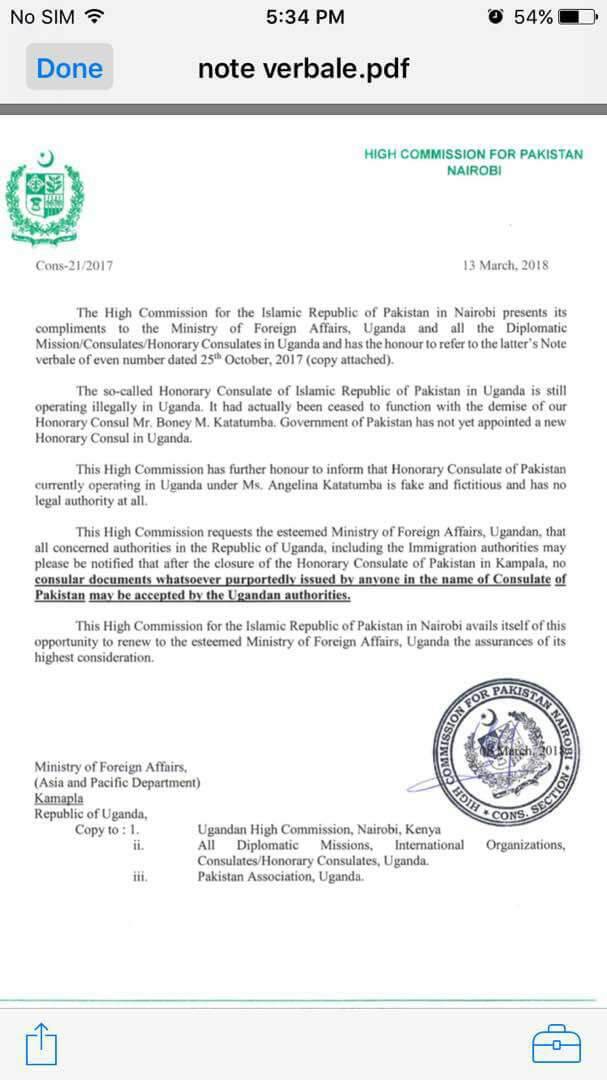
The High Commission for the Islamic Republic of Pakistan based in Nairobi has dismissed Angelina Katatumba as the Consular in Uganda describing her as fake.
In a public notice, the Commission says ever since Bonny Katatumba died, their government has never appointed any representative to Uganda as a Consulate.

“The High Commission for the Islamic Republic of Pakistan in Nairobi presents its complaints to the Ministry of Foreign Affairs, Uganda and all the Diplomatic Mission/Consulates/Honorary Consulates in Uganda and has the honour to refer to the latter’s Note verbal of even number dated October 25, 2017. The so-called Honorary Consulate of the Islamic Republic of Pakistan in Uganda is still operating illegally in Uganda. It had actually been ceased to function with the demise of our Honorary Consul Mr Bonny Katatumba , Government of Pakistan has not yet appointed a new Honorary Consul in Uganda.” The complaint to Ministry of Foreign Affairs Uganda reads.

The High Commission further warns the Ugandan authorities especially Immigration officials not to honour any documents purportedly issued in the name of the Consulate.
“This High Commission has further honour to inform the Honorary Consulate of Pakistan currently operating in Uganda under Angelina Katatumba is fake and fictitious and has no legal authority at all”

The Diplomatic Note

Ms. Katatumba, has been falsifying that she is Acting Consul of Pakistan to Uganda, ever since the demise of her father was on Thursday morning in the company of visiting Jamaican artiste commonly known as Kuzi Kz, beaten at Chicken Tonight outlet in Kabalagala.

In camera footage, Ms Katatumba is seen haggling with KFC staff identified as Manager Olubrwoth Ochoka, watchman Dennis Okirot and John Kaddu, a waiter.
But the incident had not gone without criticism and many were asking why the diplomat and heiress of the Katatumba Business Empire didn’t have her security detail given the odd hours at which she was travelling. But now the denial by the High Commission in Nairobi unmasks her as being no diplomat.

Stories Continues after ad