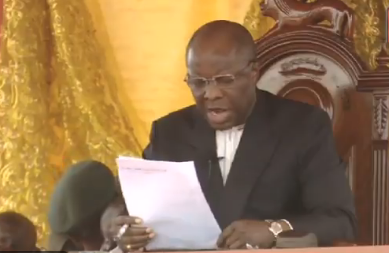
The Kabaka of Buganda Ronald Muwenda Mutebi II has urged the government to organise local council elections in a bid to tackle the security challenges in the country.
Speaking at Villa Maria Catholic Parish in Masaka, the Kabaka noted that government had failed to organize Local Council (LC I) leadership for over 16 years citing lack of funds, but hastened to add that LC are basis of security in the country.
Kabaka Mutebi, who was in Villa Maria for his 63rd birthday celebrations, was received by among other dignitaries Katikiro Charles Peter Mayiga and entertained by various cultural troupes.
“We have witnessed the killings of people in Masaka among other areas where attackers issue notices days before they raid, kill and inflict grievance harm to victims, I condole all who have lost their loved ones,” the Kabaka told hundreds of people gathered.
The Kabaka’s statement comes in awake of rampant kidnaps, torture and killing of victims, including that of Susan Magara, who was killed after her family failed to raise a US$1 million ransom to have her freed.
In the recent past there have also been other indiscriminate killings including the serial murders of women in Entebbe and Wakiso districts.
Kadaga exchanges gifts with Plan International officials
Plan International Country Chairman Joshua Liswood has commended the Speaker of Parliament Rebecca Kadaga for her continued support towards the empowerment of the girl child in Uganda.
“You are the role model of these young girls. They are inspired by you and the strength and conviction of these young girls is fantastic; we want to appreciate your great effort,” Liswood saidas he paid a courtesy call on Kadaga on Friday, 13 April 2018.
According to Plan International Director Rashid Javed, this year the organisation would be focusing on awareness of the girl child in leadership positions. “We want to take the girl leadership to the next level,” Javed said.
On her part Speaker Kadaga said that there was need to address the rampant drug and alcohol abuse in schools.
“We would like to partner with you in terms of awareness and sensitization on the drug and alcoholism abuse especially in schools, and establish support systems within the schools,” she said.
Kadaga also pleaded that Plan International includes a water plant in all schools that have over 400 students, and pledged continued support to the organisation’s efforts aimed at in retention of children in school.
Plan International has presence eight districts to promote children’s rights and equality for girls. They include Kamuli, Tororo, Kampala, Lira, Gulu, Alebtong, Buyende and Adjumani districts.
UEDCL boss Joseph Katera addressing journalists in Kampala on Friday
The government will not take over the operations of electricity distributor UMEME soon, the CEO of Uganda Electricity Distribution Company (UEDCL), Joseph Katera has said, dashing the hopes of some Members of Parliament (MPs) were hoping for a change on grounds that the distributor’s current electricity charges are too high for consumers.
According to Mr Katera, even if government was ready technically and operationally, it currently does not have the money to run the activities that UMEME is implementing as the distributor moves into the last seven years of the 20-year concession it signed with government in March, 2005.
“If government is to take over from UMEME, we need to spend US $100m annually, which government can afford right now,” Mr. Katera said during a symposium organised by UMEME at Lake Victoria Serena Hotel, Kigo to update the MPs on the Natural Resources Committee.
Further, Mr. Katera said the concession signed between UMEME and government has a buyout clause of over US$330m, which money would be costly to government. He said, UMEME, being a private company listed on the Uganda Securities Exchange (USE) and Nairobi Securities Exchange (NSE) is best placed to run the distribution of electricity in the country as it can easily raise funds in case of further investments in the network.
Speaking at the symposium the Chairperson of the Committee Alex Byarugaba said it was important that UMEME updates the legislators on its operations so that they make informed decisions. “This is our meeting and we are here to listen and learn, much as we shall ask some questions,” he said.
UMEME CEO Selestino Babungi says company is investing in new technology to reduce technical costs further
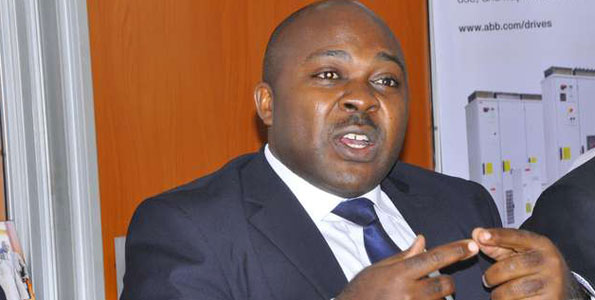
In his speech UMEME CEO Celestino Babungi said they have invested heavily since 2005 improving efficiency of collection of fees from 80 per cent during UEB reign to the current 100 per cent. He said the company has also worked to bring down losses from 38 per cent in 2009 to 17 per cent as of 2017. With technical losses plummeting to 10 per cent while commercial losses stand at 7 per cent. Currently, he said, losses stand at 16.9 per cent.
UMEME officials argue that technical losses can not completely be eliminated from the network since the conductors through which electricity flows have resistance. Analysts say the can be minimized below 10 per cent.
Mr. Babungi said UMEME has invested billions of shillings in modern technologies such as transformers, larger conductors and others to minimize technical losses. MPs said US $400m is paid by government for a percentage unit, but others said this figure has come down.
Commercial losses arise mainly from power used by consumers and not paid for due to illegal connections and vandalism. UMEME has addressed the challenge through the introduction of prepared metering and use of aerial bound cables, according to the company officials.
According to Babungi, UMEME targets to reduce electricity losses to 14.7 per cent in 2018. Katera on the other hand said US $2.65 billion is needed on the side of government to invest in the transmission and distribution network from 2018-2022.
He said government was fast racking the construction of the 600MW Karuma hydropower dam and 183MW Isimba power dam for cheaper generation to reduce the burden on the electricity tariff in the medium term.
The UMEME CEO meanwhile, has urged MPs to sensitize their voters on the impact of power thefts. He specifically lauded legislators from the Elgon region for helping the company reduce commercial losses through sensitization of the residents ‘stealing power’ that was costing the company billions of shillings in losses.
The MPs on the other hand said power is needed in the country for industrialization as well as domestic consumption. They added that their voters are not happy with the current power prices, even as industrial and commercial consumers use 65 percent of the power generated in the country.
Thousands of Arsenal FC fans in Uganda were yesterday brought back to life as the English Club came from 2-0 down to draw 2-2 with CSKA Moskav, in effect storming the semi-finals of the UEFA Europa League played in Russia.
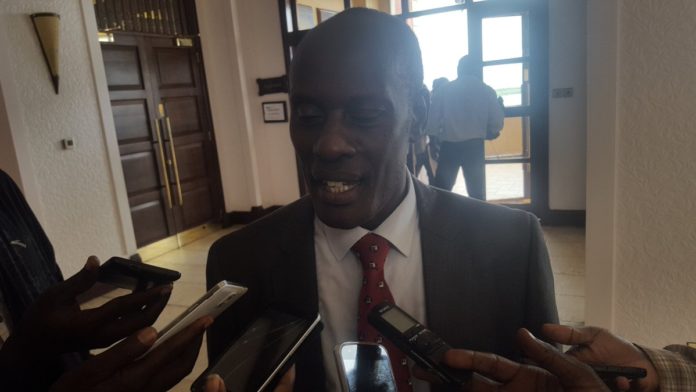
One of the fans who was mesmerized by the Arsenal comeback is none other than the Managing Director of the National Social Security Fund (NSSF), Richard Byarugaba, who had a stint in England.
“When they (CSKA Moskav) scored two (goals), I knew we (Arsenal FC) were gone,” Byarugaba said as he chatted with a colleague while having breakfast during a corporate function at the Lake Victoria Hotel Serena, Kigo.
His colleague interjected saying Arsenal FC fans in Uganda are the most enduring, given the poor performance of the club in the recent years. “I have always told ladies who are looking for husbands to go for Arsenal FC fans. They are the most enduring. I can’t handle that,” he said.
Journalists who were around could not believe that Mr Byarugaba, who manages one of the largest pension funds in Africa, is a football fan. But anyway many learnt that Byarugaba enjoys sports and is the Corporate League patron.
Nonetheless journalists have wished him good luck. “I wish him and his club Arsenal good luck,” a journalist said.
Arsenal can only play in the UEFA Champions League next season if it wins the Europa Cup.
The campaign to reform currencies in the East African Community (EAC) is still on as the regional parliament, the East African Legislative Assembly (EALA), prepares laws for setting up major institutions.
Reports indicate that EALA committees have begun collecting views and suggestions on the East Africa Monetary Institute (EAMI) Bill, 2017 and the Statistics Bureau Bill, 2017, which had earlier passed through the first and second readings. The bills are part of those that will drive the EA Monetary Union, which was first slated for 2012.
The Monetary Institute Bill seeks to set up EAMI as an agency to initially perform the role of a regional central bank. It will be expected to craft policies required to back a single currency. Kenya has requested to host the institute.
On the hand, the EA Statistics Bureau Bill is expected to create a regional body similar to European Union’s Eurostat, responsible for gathering data to guide decision making within the EAC Monetary Union.
EALA’s Committee on Communications and Trade is currently engaging with stakeholders on the regional Statistics Bureau Bill while its General Purpose Committee is handling views on the EAC Monetary Institute Bill.
The East African ministers, including Uganda’s minister for East African Community Affairs Dr Kirunda Kivejinja, are among the stakeholders on queue to exchange views with the EALA committees.
“The Council of Ministers for EAC is thus expected to meet with the committees to thrash out key matters on both Bills,” EALA says in a statement.
Others, which must be established to pave way for a regional currency, include the East African Financial Services and the East African Surveillance, Compliance and Enforcement Commission.
The East African Monetary Union protocol lays the framework for a monetary union within 10 years during which the partner States will progressively converge their currencies into a single currency for the bloc.
However, Uganda, Kenya, Tanzania, Rwanda, Burundi and South Sudan must meet specific targets on public debt management, inflation, foreign reserves and fiscal deficit by 2021 to pave the way for the single currency.
The Member States are required to keep their debt-to-GDP ratio at no more than 50 per cent and maintain fiscal deficit at not more than three per cent of the GDP.
They must also keep overall inflation at eight per cent and hold foreign exchange reserves worth 4.5 months of imports.
The EAC single currency, if established, will help ease trade among member countries, which is not the case now as businessmen who transact across national borders have exchange their national currencies into US dollars.
Currently Uganda, Kenya, and Tanzania currencies are denominated in Shillings while Rwanda and Burundi use Rwandan Francs and Burundian Francs respectively. South Sudan uses South Sudanese Pound a medium of exchange. The Kenyan Shilling is the strongest in the region.
Rules to contain lavish government deficits are most effective if countries design them to be simple, flexible, and enforceable in the face of changing economic circumstances.
A new analysis of the fiscal rules in over 90 countries, based on their experiences, finds that the rules put in the place over the last three decades often were too complex, overly rigid, and difficult to enforce.
Fiscal rules set the course for a government’s responsible fiscal policy. For example, a government can decide to limit its annual borrowing to 3 percent of the economy’s total income, as is the case in many European countries. Rules can help prioritize among the many demands on the budget, chart a predictable path for government policy, and keep public debt in safe territory.
The analysis shows that better-designed rules can help avoid excessive deficits, which hinder sustainable public finances. This reassures financial markets and investors, and, as a result, countries that comply with their fiscal rules can borrow more cheaply. Countries with excessive deficits and lax rules have higher borrowing costs because investors see them as more of a risk.
By demonstrating a government’s commitment to well-managed public finances, fiscal rules can create room in the budget to finance policies that promote growth, enhance the economy’s resilience to adverse shocks, and reduce excessive income inequality.
Past as prologue: lessons for rule design
Some key features have proved to enhance the rules’ effectiveness in the past:
Broad coverage, meaning that the rule should cover most, if not all of the budget, reducing possible loopholes.
A design that encourages countries to save money in good economic times, for instance by preventing large expenditure increases, which can absorb all revenue windfalls.
Limits on fiscal aggregates that are based on sound economic principles. For instance, governments should not set the debt ceiling too high to foster fiscal responsibility. But the debt ceiling should not be too low either, to enable desirable policies, such as filling public infrastructure gaps or offsetting the economic impact of large shocks.
Precise exceptions to let the budget accommodate unexpected events, like natural disasters.
Also, successful fiscal rules need political buy-in, as well as supporting institutions that enhance fiscal transparency and accountability—such as fiscal councils, which governments establish to act as public watch dogs to evaluate fiscal policy. Most European countries have, for instance, set up fiscal councils in recent years.
In the past decade, substantial reforms have led to a second-generation of rules. These are: first, more flexible, for example with new and better-defined exceptions; and second, easier to enforce, for example, by adding correction mechanisms that foresee what the government should do when they break the rule. Jamaica and Grenada have introduced correction mechanisms in 2014 and 2015.
However, we find that these innovations have made the rules more complicated to operate with no discernible impact on compliance yet.
Three principles for future reforms
To address these shortcomings, our analysis provides three principles to guide the design of new rules and the reform of old ones:
Make sure that the package of rules is consistent, parsimonious, and guarantees debt sustainability . Fiscal rules should include both a debt rule to set the course of medium-term fiscal policy, and a small number of operational rules that guide annual budget decisions, such as an expenditure rule or a budget balance rule. Reforms should ensure that these rules are not redundant and do not send conflicting signals.
Create incentives for better compliance with rules.We find that governments comply with their rules about half of the time. To encourage governments to follow the rules, compliance should bring more tangible benefits, and there should be stronger costs for noncompliers. Although financial sanctions are often not credible, recent efforts to raise reputation and political costs seem more promising, notably through the role of fiscal councils that monitor and expose to the public possible mismanagement of public funds.
Allow for adequate flexibility without sacrificing simplicity too much . Rules that permit some deviations from targets in response to economic shocks, such as the budget balance rule, are often complicated and hard to implement. Expenditure rules may provide a better balance between flexibility and simplicity
The demand for a law to be made by government to impose a ceiling on the rent that the landlords can charge for commercial properties has been around for some time. In the last five years, it has been spearheaded by KACITA, the umbrella organization of traders in Kampala.
Part of KACITA’s demands appear to have been answered when cabinet on April 9, 2018 approved a provision in the proposed Landlord and Tenant Act, 2018 which bars a landlord from increasing rent beyond 10% per year or such other percentage as may be prescribed by the Minister responsible for Housing. Said differently, the bill, in its current form, removes fixation of rent from the open market forces and subjects it to the whims of politics and politicians as symbolized by the ‘Minister responsible for Housing’.
Experiences in rent control
Giving the Minister power to control rent is not new in Uganda. When the Military Regime of Idi Amin expelled Asians from Uganda in 1972 he gave the power to his Minister to determine the rent chargeable in respect of the Departed Asians Properties. And as expected it was below the open market rates. So, the demand for the houses shot up and could not be met by available houses on the market.
A black market for rental houses emerged. The persons with the ‘right connections’ with state power would get houses allocated to them from the Custodian Board at the controlled rent and sublet them out at commercial open market rates.
Rent control also led the properties of the departed Asians to go to waste since the rent collections made by the Departed Asians Properties Custodian Board (DAPCB) from the tenants of the properties of the departed Asians was not sufficient to meet the cost of repairs and proper maintenance of the houses. Clearly the results of rent control were negative.
Elsewhere, a study done in New York in 1997 indicated that rent controls may lead to homelessness through an increase of rents in the uncontrolled sector and decreasing vacancy rate in the controlled sector. In Bombay, India, the rent control brought the town to its knees as people lost interest in investing in the housing sector where the returns were low.
Constitutional angle
Our Constitution guarantees all of us equal treatment. So, rent control appears to deviate from that standard. Most houses that are put on the rent market are built using moneys borrowed from banks. Rental income is a key determinant of the value of the property and its suitability to act as security for the loan given to developers to build the house.
So, why control the rent the developer will use to repay the loan at the rate of 10% while the banks that lent the developer demand interest on the loan which is much higher than 10%. Isn’t that unequal treatment of sectors which are closely intertwined?
Developers use construction materials purchased from the open market. They engage contractors and human resource to construct their houses at the open market rates. Is it fair to control only the developers’ earning from the development (rent) while letting the other players operate by open market principles?
Above all, the proposed law does not indicate that the tenants who will occupy the premises whose rent is controlled will likewise have a legal obligation to sell their goods and services at likewise controlled
prices. What is good for the goose should also be good for the gander. But clearly, the rent control measures are unfair and do not meet the constitutional standard of equal treatment of all people.
CONCLUSION
The real estate sector is very central to the health of our economy. Commercial banks and other financial institutions heavily rely on it to secure the loans they lend to their customers for development. It is one of the least risky areas a private individual can invest and make a reasonable return on the investment. And historically, it has been one of the most dependable options for those seeking for financial security especially during their old age. As such, disrupting it at the altar of political expediency is a choice the next generation will never excuse us.
The US$ 476 million Kampala-Entebbe Express Highway is expected to done and handed over to Uganda national roads authority (UNRA) in November this year.
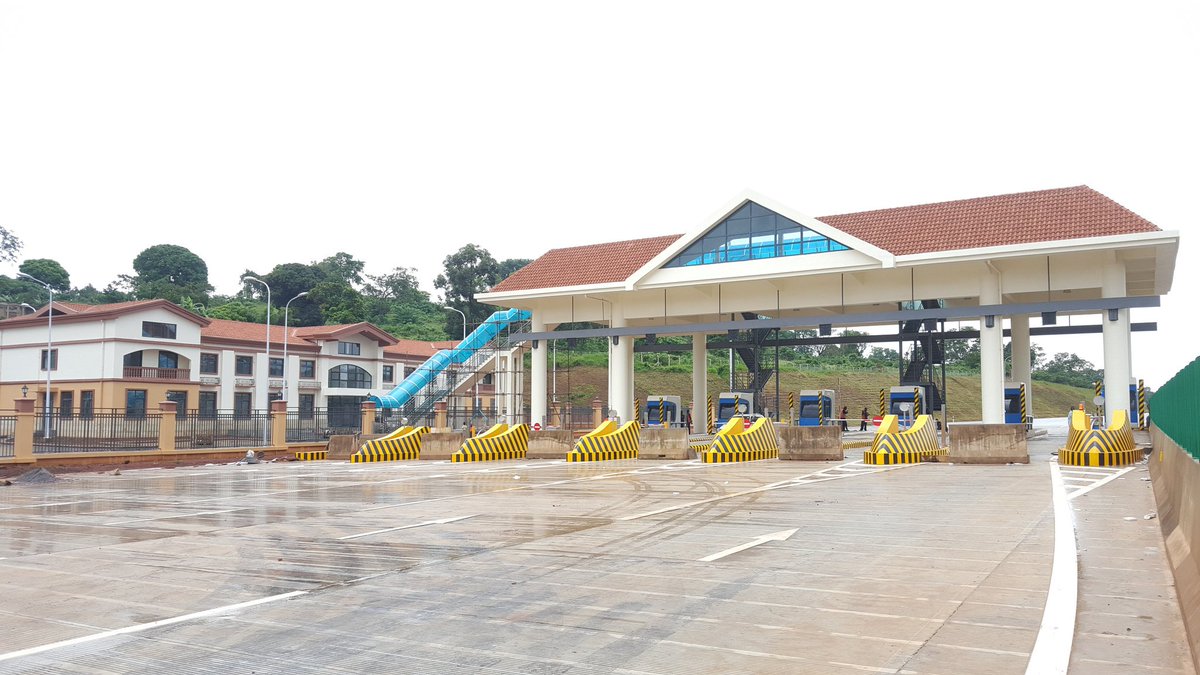
One of the Toll Plazas
According to the contractors, the 49.5 kilometres highway that will help decongest and enhance the trade movement in the central business district, has two sections starting from Busega on northern bypass to the existing Kampala- Entebbe road at Mpala, and a 12. 6km section commencing from Kajjansi interchange to Munyonyo.
Allan Sempebwa, the Uganda National Roads Authority (UNRA) Public Relations Officer noted that congestion in Kampala is increasing at an estimated rate of 4.5 per cent annually.
“Kampala is facing heavy traffic jam especially during rash morning and evening hours which the current roads can’t accommodate,” Mr. Sempebwa said yesterday while taking journalists on a guided tour of the highway.
The highway has three interchanges at Busega, Kajjansi and Abayita Ababiri, connecting to various trading centers, and has 19 overpass bridges and 17 underpasses for local people to access their properties along and around the road. It will be accessed after paying fees that will soon be revealed to the public.
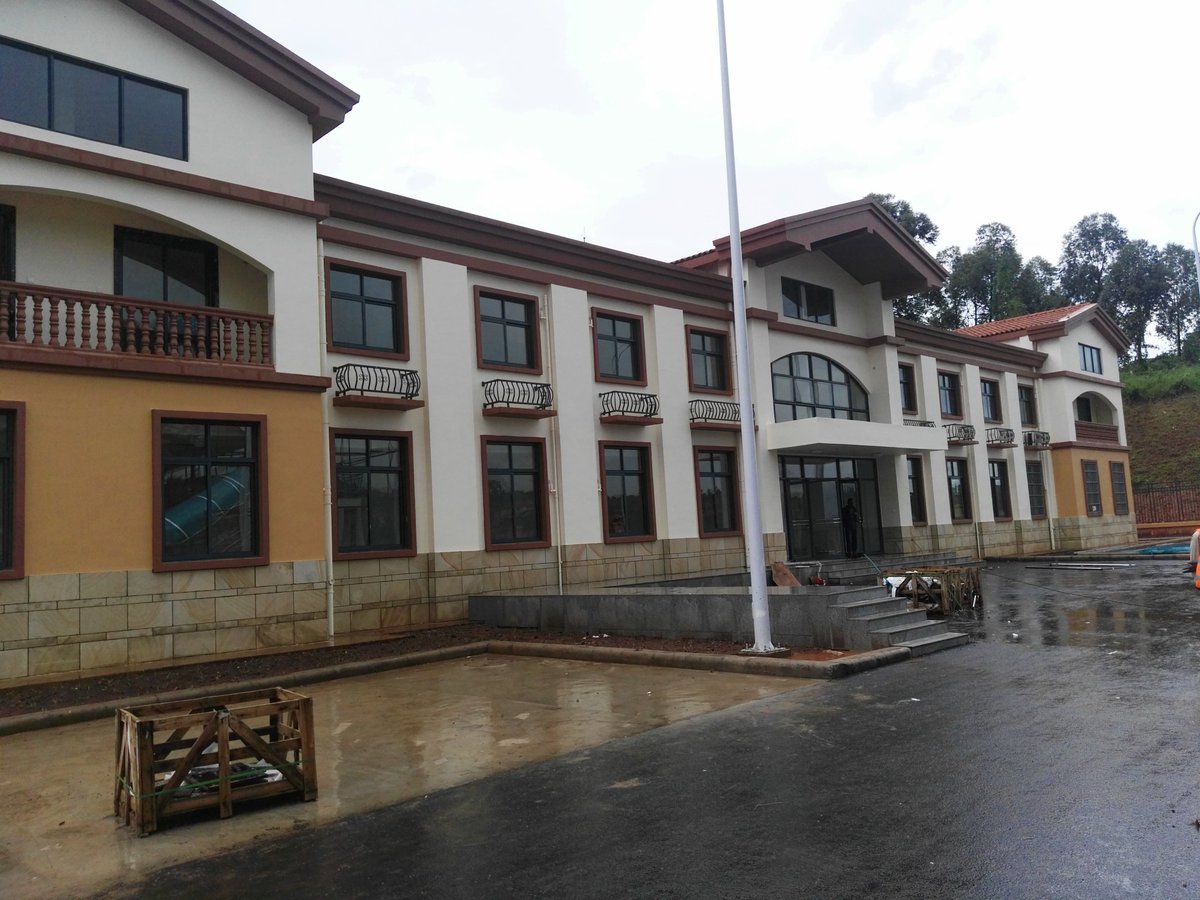
Accommodation facility along the Kampala-Entebbe Express Highway
“Payments will be made at various toll plazas constructed at Busega, Kajjansi and Mpala that comprise over 10 accommodation rooms each,” he added.
Before accessing toll gates, loaded vehicles will go through weigh bridges and wayward users will be subjected to fines and offloading excess cargo before being cleared.
Meanwhile, contractors said the 1450 metre bridge that was constructed in Nambigirwa swamp has not affected the environment basing on the factor that it is rested on well-spaced pillars dug six meters deep. The contractors noted that this is the longest bridges in East African region.
The 1450 metre bridge in Nambigirwa swamp
Currently, officials said, 91 per cent of the project has been executed and is expected to be handed over to UNRA in November this year.
Despite its progress, the project faced various changes which includes among others the compensation of land owners that culminated into re-alignment of the project.
BRUISED: Angela Katatumba after being beaten and now demanding Shs1 billion.
Celebrity singer Angela Katatumba, daughter to deceased real estate tycoon Boney Katatumba, was recently involved in a brawl with staff of Chicken Tonight and sustained bruises.
Ms. Katatumba, who is also the Acting Consul of Pakistan to Uganda, in the company of visiting Jamaican artiste Kuzi Kz. This was before the altercation.
Ms. Katatumba, who is also the Acting Consul of Pakistan to Uganda, was on Thursday morning in the company of visiting Jamaican artiste commonly known as Kuzi Kz, but information about the altercation is scanty.
In a camera footage, Ms Katatumba is seen haggling with KFC staff identified as Manager Olubrwoth Ochoka, watchman Dennis Okirot and John Kaddu, a waiter.
The three are all facing assault and theft charges at Kabalagala Police Station under file number CRB353/18 after Katatumba, who sustained severe bruises to her left temple, reported the incident and a ‘missing Shs6 million’ that she said she left in her bag at the counter after the scuffle broke out.
But the incident has not gone without criticism and many are asking why the diplomat and heiress of the Katatumba Business Empire didn’t have her security detail given the odd hours at which she was travelling.
Meanwhile, her brother Allan Katatumba said the two parties had a standoff after Ms. Katatumba and her guest were served ‘wrong’ sauce.
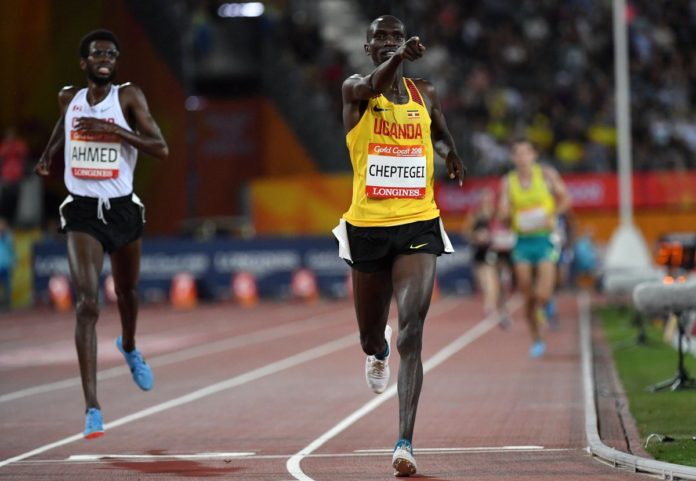
Joshua Cheptegei of Uganda crosses ahead of Ahmed Mo of canada
Joshua Kiprui Cheptegei has completed the double by winning the men’s 10,000m after his 5,000m gold at the ongoing Commonwealth Games in Australia. He also set a Commonwealth Games record of 27:19:62 in the 10,000m.
The 21-year-old has become the third in history to win the 5,000m and 10,000m double at the Commonwealth Games. The last Ugandan to achieve the feat was Moses Kipsiro at the Delhi Games in 2010, while the previous CWG record of 27:45:39 was held by Kenya’s Wilberforce Talel in 2002. Cheptegei beat Talel’s record by 25 seconds.
In today’s race Cheptegei came ahead of Mo Ahmed of Canada in the final lap while Kenya’s Rodgers Kwemboi held on for bronze coming in third. Jacob Kiplimo of Uganda came fourth.
Stella Chesang is another Ugandan who won Gold in the women’s 10000m (25 laps) final after clocking a time of 31:45.30. Mercyline Chelangat picked up Bronze after finishing third in the same race.
Uganda now has three Gold medals and one bronze, making it ranked the 14th country in the CWG and the third in Africa behind South Africa which has 11 gold, 10 silver and 5 bronze and Nigeria with 4 Gold, 3 silver and 7 bronze.