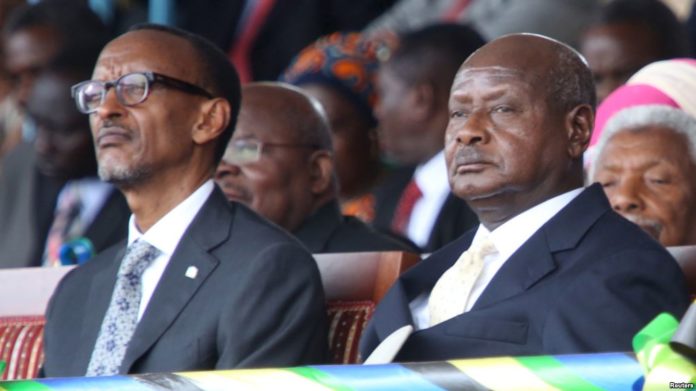
President Yoweri Museveni and his Rwandan counterpart Paul Kagame will among other issues discuss how to resolve the current political tension between the two countries on Sunday.
Kagame arrives in Uganda tomorrow Sunday for a one- day working visit, according to presidential spokesperson Don Wanyama. The meeting will be a follow up on the Addis Ababa meeting of February.
There is concern that tensions between the two countries have uncertainty in the region. The high light of the tension between the two countries was the recent failure by president Museveni to join other African Heads of State in Kigali for the signing of the African Continental Free Trade Area (AFCFTA) agreement in Kigali. He was represented by Foreign Minister Sam Kutesa
Rwanda accuses Uganda of aiding suspected Rwandan dissidents to move in East Africa, But Uganda denies the accusations.
Rwanda last year said Uganda was providing Rwandan dissidents with passports. Some of the dissidents, Kigali said were living in refugee camps in Uganda and belong to a terrorist group-Rwanda National Congress (RNC).The group Rwanda said had intentions to cross from Uganda into Tanzania and eventually end up in DRC.
Rwanda also accused Uganda of what it called “Multiple unjustified arrests, failure to notify the Diplomatic representation of Rwanda in Uganda and mistreatment of Rwandan citizens in Uganda in the last several months.”
Uganda maintains its operations targeted suspected Rwandan spies harassing Rwandan refugees and threatening national security. Some of the suspected Rwandans have been deported back to Rwanda.
The two presidents are expected to identify modalities of ironing out the differences; many analysts say are a hindrance to regional cooperation when you bring in the East African Community bloc to which both countries belong.
Museveni and Kagame have a lot in common politically, both leaders having captured the leadership in their countries through guerilla warfare. They would later turn their volatile countries on a democratic path.
The two countries are so close that its citizens trade together, not forgetting intermarries between them. Citizens are hopeful that the two leaders will have a solution to the tensions.
Museveni, Kagame set for talks in Entebbe tomorrow
How to maintain that One percent edge
No company or entrepreneur gets it right every time. As an angel investor, I have found that people claiming a perfect record are either lying to themselves, or they are not taking enough risk to enable a big payback. In the long run, your ability to thrive in business today is more about how you prepare for and handle the inevitable exceptions and failures, than shooting for perfection.
In trying to put a practical edge on this message, I found some help in a new book, “The One-Percent Edge,” by Susan Solovic. She has been there, as a serial entrepreneur, internet pioneer, attorney, and media personality. She offers some good lessons for every modern business and entrepreneur that I can paraphrase here, with insights from my own experience:
Not every customer is predictable, so expect exceptions. Of course, it’s important to put standard processes in place for all transactions, returns, and service requests, but a policy of “no exceptions” is not competitive today. A special case handled individually can be your best advertising, through social media and this world of instant communication.
For example, when a grieving customer informed a T-mobile customer representative that her husband had just passed away with a $2000 overdue bill, with all funds frozen, the customer’s account balance was forgiven. She was even offered unlimited minutes for the following two months. She shared her joy online, with over 29K views and likes.
Train customer support personnel for complex situations. By the time a customer decides to reach beyond a front-line employee, the situation is already complex. The age-old approach of putting marginal or new employees in support is a recipe for disaster. Put your best employees in support, and continually enhance customer support satisfaction.
Give employees the authority and incentives they need. Above all, employees must have your trust and empowerment to make exceptions where appropriate, and solve problems on the spot. One of the best approaches I have seen is managers providing rewards for problem solving, including visible public recognition for their peers to see.
For example, the transport staff at the Staten Island University Hospital Radiology Lab has the tough and tiring job of wheeling patients around for testing. When an employee witnessed another solving a problem or going the extra mile, they would nominate them for a Go the Extra Mile (GEM) certificate. These make everyone more empowered.
Respond to customer special requests in real time. For better or for worse, the Internet and social-media-based customer access have made consumers expect virtually immediate responses to their issues. I still regularly hear from customers that wait for days or weeks after submitting a web form, or get stuck in telephone queues for an hour.
Offer a great customer experience, not just a product. Today lasting customer loyalty requires an experience that goes far beyond the initial product or service. This includes marketing, social media, the buying experience, as well as service. If that experience falls short of the mark, your business will suffer, no matter how great your service is.
Many negative customer experiences can actually be turned into positives, if you quickly acknowledge the problem, resolve it, and spread the positive message before the negative one gets amplified. Don’t repeat the “United Breaks Guitars” experience, which now has been published as a book on what not to do.
Be accountable, and admit and correct mistakes quickly. Successful leaders and businesses are humble and transparent enough with themselves and others to admit mistakes and correct them quickly. In this way, those around them, including customers, can benefit from their learning, and feel a positive relationship and trust.
Learn from the companies that get it right. Etsy is an example of a company that has a tremendous reputation with customers. Every user gets a unique experience, and this gives them a feeling of being special and well-cared for. The team works hard to personalize the customer journey so that users feel more connected with the experience.
Remember, you don’t have to be perfect to outperform the competition. Only one percent above the rest is still the top. No quantum leap is required to get there – just make small incremental improvements in all areas of your business, and you too can avoid the pain of a radical overhaul (when it may be too late anyway), while increasing your agility and resilience.
Marty Zwilling
Central Bank warns gov’t on escalating borrowing
Government’s continued appetite for loans come to the attention of the central bank-Bank of Uganda, warning that the country could run into the default risk as nearly two-thirds of that borrowing is external.
The bank in its latest report titled “State of the Economy”, said the rising costs of servicing the country’s US$15.1billion debt could hit economic growth because of reduced public investment.
Over the last decade, the government of Uganda has upped borrowing, mostly from China, to fund infrastructure projects including power plants, roads, fibre cable networks and an airport expansion. Three years ago, Uganda’s debt was just US$6.2 billion.
BOU says the debt poses, “a risk of higher exposure or failure to meet external debt obligations in case of exchange rate volatility and slow growth in exports.”
According to the budget framework paper for financial year 2018/19, interest repayments consume 17.3 per cent of the planned expenditure, with analysts saying it is likely to be the largest portion of the national the budget.
The Ugandan economy has been struggling in the last few years because of poor agricultural output, weak exports and corruption. Growth was 3.9 per cent last year, down from 4.8 per cent in the previous yea.
The economy is projected to grow by 5 per cent in real terms in financial year 2017/18, above the 3.9 per cent growth registered in financial year 2016/17. The growth would be driven by higher growth rates in agriculture and services, supported by improved implementation of infrastructure projects and a return to normal weather conditions.
Real GDP growth is expected to average at about 5.9 percent in the medium-term and 6.7 per cent in the long-term. This growth would be supported by enhanced productive capacity from the completion of infrastructure projects, investment in agriculture, regional integration and oil production, as well as enhanced efficiency in resource allocation.
Government officials have always defended the borrowing, saying infrastructure investment was necessary to make the economy more efficient.
Uganda to add 0.9m tourism jobs in the next decade-new report
Uganda will add about 0.9 millio jobs in the Travel & Tourism sector by 2028 according to a major new report by the World Travel and Tourism Council (WTTC).
In 2017, the total contribution of the sector to employment in the country, including jobs directly supported by the industry was 6.3 per cent (605,500) of total employment. The report expects figure to rise by 3.8 per cent in 2018 to 628,000 jobs and rise by 3.6 per cent per year to 898,000 jobs.
In 2017 the sector directly supported 229,000 jobs, which is 2.4 per cent of total employment in the country. “This is expected to rise by 4.2 per cent in 2018 and rise by 3.9 per cent per annum to 349,000 or 2.4 per cent of total employment in 2028,” the report says.
Meanwhile, the direct contribution of the sector to the country’s GDP was Shs2.7 trillion (USD749.9m) or 2.9 per cent of total GDP in 2017 and is forecast to rise by 6.5 per cent in 2018, and to rise by 5.9 per cent pa, from 2018-2028, to Shs5.1 trillion (USD1,412.8m) or 2.8 per cent of total GDP in 2028.
However, the total contribution of the sector to GDP was Shs6.9 trillion (USD1,913.9m) or7.3 per cent of GDP in 2017, and is forecast to rise by 6.0 per cent in 2018, and to rise by 5.7 per cent p per year to Shs12.7 trillion (USD3,516.1mn) or 7.1 per cent of GDP in 2028.
Visitor exports generated Shs3.06 trillion (USD850.2m) or 17.9 per cent of total exports in 2017. This is forecast to grow by 7.8 per cent in 2018, and grow by 6.0 per cent per annum, from 2018-2028, to about Shs6 trillion (USD1, 641.7m) in 2028. This would be 18.0 per cent of total visitor exports.
Uganda is a hot spot for almost half of the world’s remaining mountain gorillas, whose habitat is shared with Rwanda and the DRC. The country also has beautiful national parks hosting wild animals including the big cuts. It also boats of different species of birds compared to any country in Africa. These are just a few of the tourism attractions that the country offers.
The report says Travel &Tourism investment in Uganda in 2017 was Shs1.2 trillion (USD324.6m), which was 4.9 per cent of total investment. It should rise by 3.6 per cent in 2018, and rise by 4.5 per cent per year over the next ten years to Shs1.9 trillion (USD520.2m) in 2028, 4.1 per cent of total of total investment.
WTTC’s latest annual research, in conjunction with Oxford Economics, shows Travel and Tourism’s contribution to world GDP outpaced the global economy for the seventh consecutive year in 2017.
In 2017, the sector’s direct, indirect and induced impact accounted for: US$8.3 trillion contribution to the world’s GDP, 10.4 per cent of global GDP 313 million jobs, 1 in 10 jobs around the world US$1.5 trillion exports (6.5 per cent of total exports, 28.8 percent of global services exports) US$882 billion investment (4.5 per cent of total investment).
The research shows that 2017 was a bumper year for the global Travel &Tourism sector, which grew at 4.6 per cent, much faster than the economy as a whole (3 per cent growth during 2017). “Its role as a driver of prosperity is clear, as the sector created seven million new jobs in 2017, 1 in 5 of all new jobs across the world,” the report adds. WTTC says such empirical data helps both public and private bodies make the right decisions for the future growth of a sustainable sector.
Full report
Full report attached (1)
Former MP Onyango Kakoba appointed SG for regional forum
The former Member of Parliament (MP) for Buikwe North Onyango Kakoba has been appointed the new Secretary General (SG) of the Forum of Parliaments of Member States of the International Conference of Great Lakes Region (FP-ICGLR) based in Kinshasa, DRC, effective next month.
Kakoba was unanimously selected for a three-year term by the Speakers’ Conference of the 12 member states that took place in Kinshasa, March 19-20, 2018. The member states are Angola, Central African Republic (CAR), Congo Brazaville, DRC, Zambia, Sudan, Kenya, South Sudan, Rwanda, Burundi, Tanzania & Uganda.
The SG position is a full-time diplomatic and technical assignment and in his capacity Onyango Kakoba will head the organisation as CEO/Ambassador since organisation’s headquarters in Kinshasa operates at the status of a diplomatic mission.
“I am delighted to be given this opportunity to serve the region in that capacity”, Kakoba, who is also board chairperson of the African Parliamentary Alliance for UN Reforms (APAUNR), an international organisation spearheading parliamentary advocacy for UN reforms in favour of Africa, said.
Unlike other parliamentary fora, FP-ICGLR was an initiative of Heads of States, established in 2008. Due to peace and security challenges in the region, the Heads of States in 2006 created a regional organisation, the International Conference on Great Lakes Region (ICGLR) based in Bujumbura to tackle the contentious issues. The treaty that established the ICGLR provided for the establishment of a parliamentary forum as an organ to play an oversight role over the implementation of ICGLR projects.
Onyango Kakoba replaces Prosper Higiro, a former Deputy Speaker of Parliament of Rwanda, Minister, Presidential candidate and Rwanda’s representative at the Pan African Parliament. Higiro has been at the helm of the organisation since 2012 as the first SG.
This time round the race for the SG was quite competitive attracting the immediate former Speaker of Senate of Kenya Ethuro Ekwe as well as sitting deputy speaker, who is also a former minister from CAR Davy Yama, among others.
Onyango Kakoba served at Pan Africa Parliament and was also Uganda’s representative on the Executive Committee of FP-ICGLR.
He holds a Masters degree in International Relations and Diplomatic Studies as well as a Bachelors degree in Social Sciences, both of Makerere University.
Reformed former inmates need assistance – Prisons
Organisations willing to offer reintegration and reformation services to discharged prisoners have been encouraged to approach the Uganda Prisons Service for guidance and colloboration.
The call was made by Assistant Commissioner of Prisons Frank Baine, while officiating at the graduation of former death row convict Susan Kigula, who graduated with a law degree from the University of London by correspondence.
Recently, Baine said, Uganda Prisons started collaborating with African Prisons Project (APP), TEDx Luzira and the European Union to offer rehabilitation services, skilling, counselling to inmates in a bid to help the reformation process after conviction.
“That is why Uganda Prisons opened its doors to NGOs such as African Prisons Project to unlock justice and rehabilitating inmates through awareness programs,” ACP Baine, the UPS spokesperson, said.
According to Baine, every year the prison receives over 1000 inmates convicted from various courts of law but depending on their sentences, few are released each year.
And speaking to Eagle Online, Baine noted the partnership is beneficial to the rehabilitation of inmates. “Despite being in prison, the inmates have not been deprived off the rights to learn, with schools established within the premises of the facility and collaboration with the University of London. Inmates have managed to attend classes and many have graduated in various courses including law,” Baine said.
He added: “The justice system runs so fast to punish the crime and forgets the background of the crime and that is why crime will live as long as humanity. All of us, judges and researchers must step up for the causes of crime too be considered in courts of law.”
Meanwhile, in her presentation Kigula, who led the petition that led to halting of death row by hanging in 2009, said prisoners can change if given an opportunity. She also noted that at times prisoners are mistakenly sentenced.
Susan Kigula was in 2002 sentenced to death by hanging after court proved that she murdered her husband.
Her conviction was commuted and she was given a 20-year sentence but later given a remission and released in January 2016 for exhibiting good behavior.
According to Baine, due to the good rehabilitation services, Luzira Prison has for the past three years been ranked number one in Africa and fourth in the whole world.
NSSF Friends with Benefits competition won by commercial farmer

Mukono-based commercial farmer Hannington Nkayivu has emerged winner of the National Social Security Fund (NSSF) Friends with Benefits Season 2 competition, walking away with shs30million.
This was announced during the competition’s grand finale held at Kampala Serena Hotel on Thursday, March 22, 2018.
The NSSF Friends with Benefits competition is a financial literacy campaign aimed at promoting a savings culture in Uganda, and profiles NSSF beneficiaries who received their savings and used them to transform their lives, their family or their community.
Nkayivu, who won 35.40% of the total votes, wants to complete construction of his rental houses and hopes to make at least Shs1.5 million monthly in rent collections.
He says this now will be his alternative retirement package to replace his NSSF savings now that he has already withdrawn all of his pension.

The first runner-up was Judith Sheenah Komuhangi, a cancer survivor turned cancer early testing and treatment activist, who won shs15m and hopes to use the prize money to boost her medi-tourism start up.
Her company helps other people with life threatening illnesses to seek affordable medical care abroad especially in India where she received cancer treatment after cashing out her NSSF benefits.

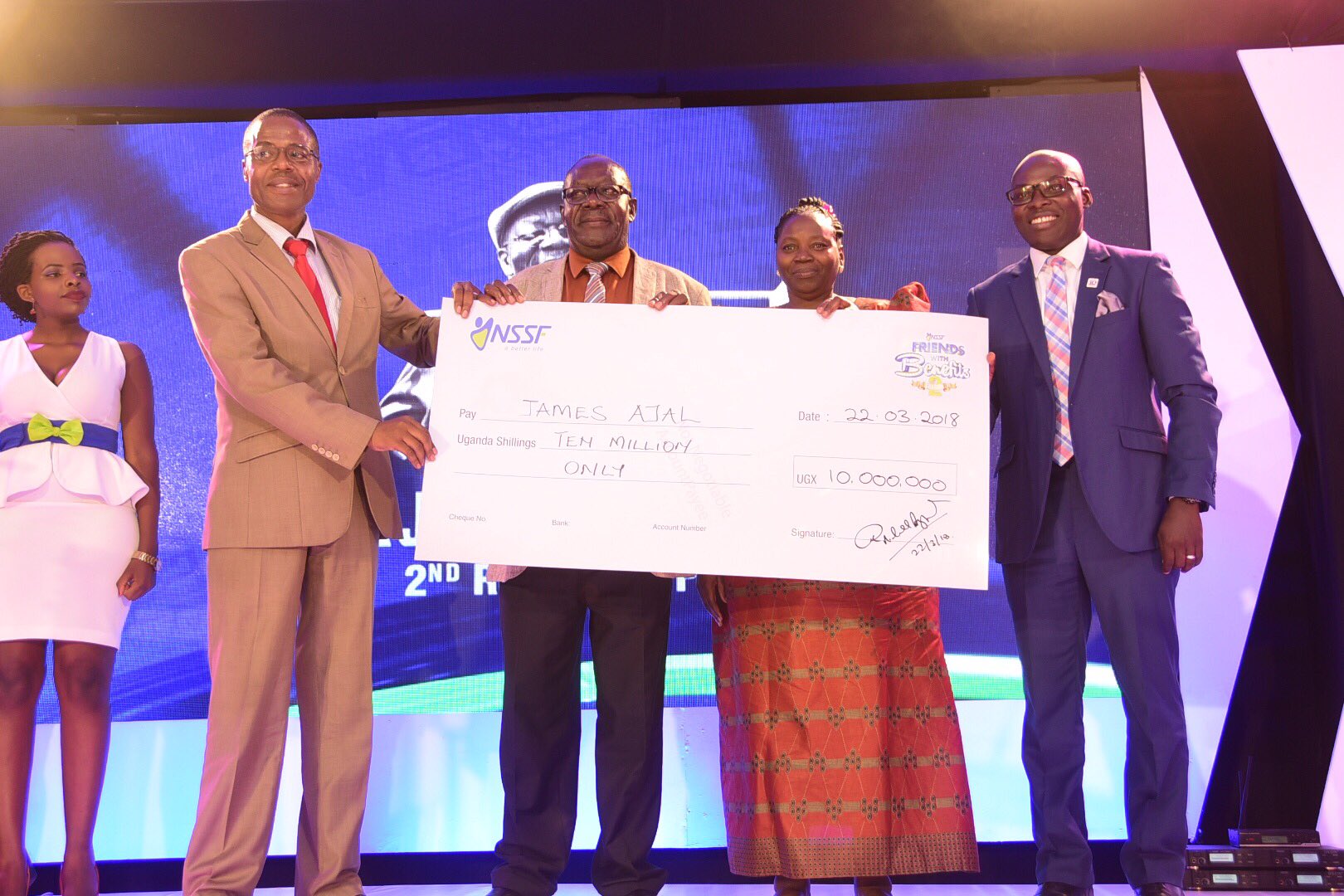
James Ajal emerged the second runner up. He walked away with a shs10 million cash prize that he says will help him expand his fruit processing business, expand his livestock business to separate the diary business from the meat/beef business.
The other finalists included; Nabendeh Wamoto, Naikumi Mary, Akula Ssubi, John Byabashaija, Alice Arinaitwe and Boniventure Rwakira.
The Friends with Benefits initiative was started in 2016 to promote a savings and investments culture among Ugandans who statistics have indicated have a bad savings culture or lack good financial discipline. For example, it was established that about 80% of people who take out their NSSF savings have nothing to show for it after just one year because of poor investment decisions or no investment at all.
“The Friends with Benefits show has been a success for the Fund and for the public. Since the show started, we have realized a spike in the number of voluntary savers with NSSF registering over 5,800 individual savers contributing about 5.8 billion shillings in collections,” said NSSF MD Richard Byarugaba adding that as the show picks even more momentum, we shall see more growth in the number of voluntary savers with NSSF and a better savings culture overall for the general public.
The show format saw hundreds of contestants submit stories of how they used their NSSF savings, after which they were vetted and reduced to 16 finalists whose stories were aired on TV, standing a chance to win the 30 million grand prize.
The final 9 contestants were voted by both the public and the show’s judges with the public vote carrying 70% in weight and the judges’ decision accounting for 30%.
Airtel injects Shs11m in ‘goats for education’ campaign for girls in Karamoja

A 2010 report from the United Nations Educational, Scientific and Cultural Organisation (UNESCO) dubbed, ‘School Dropout: Patterns, Causes, Changes and Policies’ indicates that among the major causes of dropping out of school is ‘hidden costs’.
Another report released by Uganda Bureau of Statistics (UBOS) in 2014 after the census indicated that there are 23,154 girls aged 6 to 12 in Moroto, but only 4,786 of them (20.7%) are currently attending school.
From January 2014 to April 2015, according to their head teachers, 445 girls dropped out of school in Moroto and 752 girls dropped out in Kotido and this was attributed to poverty as data collected from 20 schools showed that the main barrier to girls’ education is limited finances, and that struggling parents see their daughters as a vital source of income.
But this could change following the release of Airtel funds towards girl education in Napak and Moroto.
Airtel Uganda’s partnership with the International Institute of Rural Reconstruction (IIRR) through which the two organisations are fundraising to keep young girls in the Karamoja region in school was announced at the former’s head offices in Kampala.
As part of the partnership, the telecom company has handed over Shs11 million for the purchase of 100 goats that will be handed over to girls in Moroto and Napak districts.
“Since goats mature and reproduce very fast, each girl will be handed two goats from which she will obtain income to pay school fees and purchase scholastic material. Upon reproduction, she will be required to give the first two kids to another girl for the process to continue and benefit other girls within the community,” a release states in part.
Speaking during the handover, Airtel Uganda Managing Director Mr. V.G Somasekhar pledged Airtel Uganda’s support to ensure that school-going children in local disadvantaged communities have access to quality education, which will benefit them, their families and their communities.
“Girl child education is not a priority in many local communities across Uganda. At Airtel Uganda, we believe that it is critical for the empowerment of women and are therefore committed to ensuring that girls in the most disadvantaged communities get equal opportunities to access quality education and realize their potential, he noted.”
On why they had chosen to donate goats, Somasekhar noted that the initiative is not only supportive of ensuring that the girls stay in school but also ensures economic empowerment that is much needed to bridge the socioeconomic gaps witnessed across the country.
According to United Nations’ Girls Education Initiative statistics, literacy rates for young females still lag behind that of young boys by five percent, and nearly half of all girls in Uganda are married before the age of 18. In Northern Uganda Karamoja region, girls take on women roles faster because they cannot afford to go to or stay in school due to economic challenges.
Meanwhile, Pamela Nyamutoka Katooro, the IIRR Uganda Country Director, appreciated the partnership with Airtel and stated that this would go a long way in improving education outcomes for disadvantaged girls especially in pastoral communities.
“Since 2015, IIRRs Goats4Girls model has successfully been used to support over 2000 girls to enroll and stay in school. The initiative inhibits the practice of forced early marriage and empowers girls with not only educational benefits but also economic independence that enhances their self-worth, dignity and confidence, she commented.
For over five years now, Airtel Uganda, as part of their Corporate Social Responsibility efforts, has been working closely with the Ministry of Education and other partners to ensure increased access to education across Uganda.
Through the Adopt-A-School program, Airtel Uganda has refurbished old classroom blocks, built and stocked libraries, provided internet access, built sanitation facilities and counselled students in St. Ponsiano Primary Kyamula School in Makindye, Sseke Primary School in Lwengo District, Ndeeba Church of Uganda Primary School in Kayunga District and Nanfugaki Primary School in Iganga District.
Gen Sejusa fact-checks Museveni on Commonwealth Games tweet

Controversial General David Sejusa has broken a three-year ‘loud silence’ and challenged President Yoweri Museveni on facts concerning the latter’s tweet about the Commonwealth Games.
Gen Sejusa’s contention is in respect to the President’s tweet written while flagging off the Ugandan team for the 21st Commonwealth Games taking place in Queensland, Australia.
“I started following the Commonwealth Games in 1954 hosted in the city of Melbourne. I was in primary school but I remember seeing the beautiful pictures coming from the Games. One of the earliest pictures was of a higher jumper called Patrick Etolu, who was a higher jumper,” the President wrote.
However, Gen. Sejusa says that by 1954 it was impossible for Museveni to have started following the Commonwealth Games because by then there was no platform through which this could have happened.
In his response to the President’s tweet, Gen. Sejusa further notes that in Uganda radio broadcasting started in 1952 while television broadcasting started in 1963.
“#firstradio broadcasting in Uganda started 1952 while Television broadcasting began 1963. Even then, I imagine in Governor’s House Entebbe! 1st newspaper, Munno (Catholic 1911) reached Nyamitanga Parish, Mbarara 1956! Now TVs or newspapers in Kyamate in 1954?” Gen Sejusa tweeted ending with a laughter emoji.
Their followers were quick to get a piece of the exchange with many seeming to be in support of Sejusa, whose tweet comes almost three years of silence.
Ms Alice Ruhindi, who is also former Premier Amama Mbabazi’s sister-in-law said that in 1954, President Museveni was still living deep in the village where radio ownership was for a privileged few.
‘The problem with telling lies is that one gets caught out. The lucky ones listened to radio. Only headmaster, the vicar & Gombolola Chief had radio. Which TV did you watch? Newspapers?’ wonders Ms. Ruhindi.
The Commonwealth Games is an international multi-sport event involving athletes from the Commonwealth of Nations led by Great Britain.
The event was first held in 1930, and has taken place every four years since then, with the exception of 1942 and 1946 Games which were cancelled due to the Second World War.

Meanwhile, the President wished the Ugandan team to Queensland good luck and promised to slaughter the athletes some bulls if they perform well.
He was also impressed with the planning that was done by the team leaders to ensure that team travels on time.
“I am glad there’s better planning this time because issues of logistics were handled early, the President said, and emphasized that sportsmanship is a talent that leads to recognition and fame.
“You have rare talents which you should use and guard jealously because it also brings recognition to your country and promotes tourism,” he encouraged the team members.
He said some sports, like netball and rugby need cooperation the sports men and women to work as a team to excel.
He noted that these are only possible if the atheletes are disciplined, adding that if they drink alcohol and do umalaya (prostitution), they would fail.
He also advised them on strategy, saying for if one is running the middle and long races, they must have a strategy, especially knowing ‘how to conserve energy, where to go slow and where to sprint’.
Lawyers, Bankers to set up joint dispute resolution center
The Uganda Law Society (ULS) and the Uganda Bankers Association (UBA) are planning to set up an independent center for dispute arbitration.
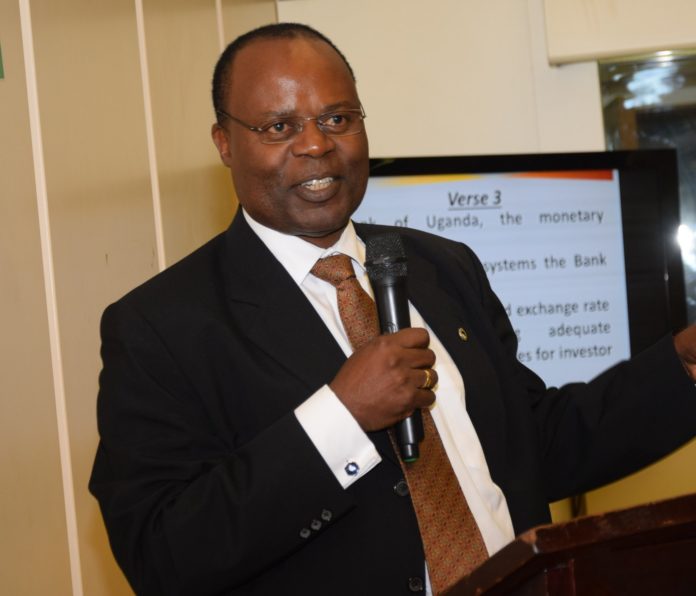
The plan was formally launched today as an Alternative Dispute Resolution Framework for the Banking and Finance Sector by the Deputy Governor of the Bank of Uganda, Dr. Louis Kasekende.
Meeting at Golden Tulip Hotel, the lawyers and bankers agreed that the Arbitration Center will be administered by a board of trustees tasked with steering the center towards a sustainable future.
The Center will have its own well detailed arbitration and mediation rules that will be referenced to when dealing with both domestic and international arbitration cases.
It will also offer adjudication services for the construction and health sectors. In addition, it will also complement the BOU’s newly setup Consumer Empowerment and Complaints Section.
“As a mandate of the center; to promote and maintain a standard of skilled arbitrators in Uganda, the Uganda Law Society Arbitration Center will offer an unrivalled training experience space.”
The proposed Center will source funding from; administration costs, annual nominal subscriptions fees, support from development partners and levying a percentage of the award upon successful arbitration proceedings.
The Uganda Law Society has been tasked to set up its Arbitration Center in the next three months.