Stanbic Bank
Stanbic Bank
24.8 C
Kampala
Stanbic Bank
Stanbic Bank
Home Blog Page 1628

Over US$400m to refinance Bujagali hydropower project

The Bujagali-hydropower-project

The International Finance Corporation (IFC) and Multi Investment Guarantee Agency (MIGA) have approved a new plan to refinance more than US$400m of loans to Bujagali Energy Limited and provide up to US$423m in guarantees in support of the Bujagali hydropower project to help reduce electricity costs in Uganda, where only one in five people have access to electricity.

Bujagali, a run-of-river hydropower project on the Victoria Nile, contributes 45 percent of the country’s annual electricity generation. It also provides clean, reliable base-load energy, and its commissioning in 2012 significantly reduced Uganda’s reliance on the costlier thermal power generation.

The refinancing package approved days ago will extend the tenure of senior and subordinated loans originally provided in 2007 by IFC, the African Development Bank (AfDB), the European Investment Bank (EIB), the Netherlands Development Finance Company (FMO), France’s Agence Francaise de Developpement (AFD) and Proparco, Germany’s DEG and KfW, and four commercial banks (ABSA, BNP Paribas, Nedbank and Standard Chartered Bank).

This extension in tenure will reduce Bujagali Energy Limited’s annual debt-servicing payments and make it possible for the company to reduce the cost of electricity produced by the hydropower plant over the next five years.

In addition, MIGA will provide political risk guarantees of up 20 years for equity investors in Bujagali Energy Limited, helping to shore up investor support and long-term engagement with the project.

An existing partial risk guarantee from the International Development Association (IDA) for two of the project’s commercial lenders remains in place.

The World Bank Group has been a long-term partner in the Ugandan power sector. Through IDA, it continues to engage with the government to support efforts to upgrade the country’s transmission and distribution networks and expand on-grid and off-grid access to electricity, providing connections for homes, schools, and health clinics. IFC is already an investor in Umeme—Uganda’s main distribution company—both as lender and shareholder.

Bujagali’s commissioning in 2012 allowed the government to deactivate more than 100 megawatts of diesel power plants and made it possible to nearly eliminate government subsidies to the electricity sector.

Since 2005, the share of Uganda’s population with access to electricity has increased from 9 percent to 22 percent, with the total number of customers having grown from 292,000 to more than 1.1 million over the same period.

More than 90 percent of Uganda’s electricity is now generated from renewable sources, making the Ugandan power grid one of the cleanest in the world.

Stories Continues after ad

BoU, IGG up in arms over Bagyenda retirement

People protest against former BoU Executive Director of Bank Supervision Justine Bagyenda

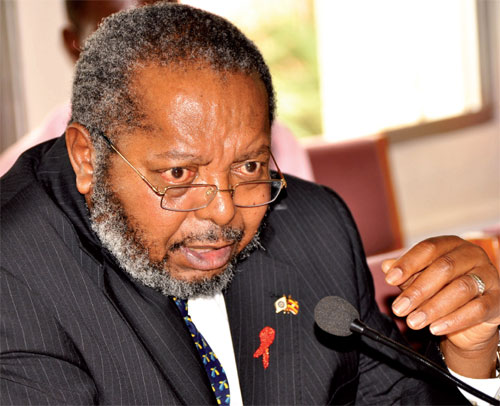
The Bank of Uganda Governor Professor Emmanuel Tumusiime Mutebile has written a terse letter to the Inspector General of Government (IGG) Justice Irene Mulyagonja Kakooza, advising her to stop interfering with the central bank internal operations.

Prof. Mutebile was reacting to a March 12 letter from Justice Mulyagonja, in respect to the early February retirement of former Bank of Uganda Executive Director for Bank Supervision, who had challenged the BoU decision to send her into early retirement, and also refused to hand over office to her successor, Dr. Twinemanzi Tumubweine.

But in his five-page strongly-worded letter that is copied to among others President Yoweri Museveni, Speaker Rebecca Kadaga and Prime Minister Dr. Ruhakana Rugunda and finance minister Matia Kasaija, Prof. Mutebile draws the attention of the IGG to Article 162 (2) of the Constitution that guarantees the independence of the BoU from direction of any authority in the country. Others copied in include the Attorney General, the Auditor General and members of the BoU Board of Directors.

‘In performing its functions, the Bank of Uganda shall conform to this Constitution but shall not be subject to the direction or control of any person or authority,’ the Article states in part.

Mutebile adds: ‘The Article in question is clear, unequivocal and unambigious on the Independence of the Bank of Uganda and the fact that Bank of Uganda is not subject to the direction or control of any person or authority and therefore no outsider, including your office can interfere with the decisions of the Bank of Uganda’.

Further, to reinforce his argument, in the March 19 letter Prof. Mutebile makes reference to judgments on authority made by the courts in respect to the IGG’s directives regarding some financial institutions, pointing out the Bank of Uganda vs COWE Appeal No. 35 of 2007 and MC 303 of 2013 in respect to Uganda Development Bank Board of Directors, its Chief Executive Officer Patricia Ojangole and 4 others vs the Attorney General, both of which upheld the independence of the BoU.

According to Prof. Mutebile, the IGG’s directive in respect to Ms. Bagyenda’s retirement is ‘impugned’ and if effected, will negatively impact on the operations of BoU and the entire banking sector in the country.

Ms. Bagyenda who, in her capacity as ED bank supervision was responsible for overseeing the activities of commercial banks in the country has been on the spot, linked to the closure and subsequent boarding off of Crane Bank.

Her name has also surfaced in financial transactions of whopping sums, raising eyebrows with accountability oversight institutions like Parliament, whose committee on Commission, Statutory Agencies and State Enterprises (COSASE) has ordered the Auditor General John Muwanga to interest himself in Ms. Bagyenda’s finances.

Indeed, Budadiri West MP Nathan Nandala Mafabi, an accountant and lawyer, has dubbed Ms. Bagyenda’s transactions as ‘money laundering’.


Stories Continues after ad

Emirates Certificates go on market

The Emirates-logo

Emirates has successfully executed a US$600 million Islamic finance issuance (Sukuk).

The issuance of the Trust Certificates, in the principal amount of US$600 million will be repaid in an amortizing format over 10 years with legal maturity in March 2028.

The proceeds from the issuance will be used for general corporate purposes including aircraft financing and working capital.

Nirmal Govindadas, Emirates Senior Vice President, Corporate Treasury said:  “We are pleased with the level and quality of interest in this Sukuk issuance. Emirates continues to take a diversified approach to our long-term financing strategy and today’s issuance confirms the confidence of international and regional investors in our strong track record as well as resilient and profitable business model.”

Following investor outreach and marketing efforts commencing 8 March 2018, the Certificates were priced on 15 March 2018 at a profit rate of 4.50%, equivalent to 183.2 basis points over the 5 year USD Mid-swaps.

The Certificates are expected to be issued on 22 March 2018 and admitted into listing and trading on the regulated market of the Irish Stock Exchange and on NASDAQ Dubai.

Citi and Standard Chartered Bank acted as Global Coordinators and Joint Lead Managers, along with Abu Dhabi Islamic Bank, BNP Paribas, Dubai Islamic Bank, Emirates NBD Capital, First Abu Dhabi Bank, HSBC, J.P. Morgan and Noor Bank as Joint Lead Managers.

The airline continues to raise capital via innovative structures, through various geographies and diverse sources of liquidity as part of its corporate funding strategy.


Stories Continues after ad

Museveni suspends Immigration top officials

INTERDICTED, Commissioner Namara. Photo credit, NBS TV.

President Yoweri Museveni has suspended two Immigration directorate officials pending investigations by police and Inspectorate of Government
The two are Godfery Sasaga, the Director Immigration and Commissioner Anthony Namara.
In letter to the Minister of Internal Affairs which was copied to the Permanent Secretary in the same ministry, Museveni directed the two to handover office to PS Dr Benon Mutambi Mugisha.
In his letter Museveni says the two should be investigated on the wide range of things stretching to misuse of funds but most important the procurement of E-Passport.
Eagle Online has established that before Museveni’s action, he had sanctioned investigations and they were reportedly being carried out by a Special Forces Command operatives led by a one Musinguzi and another man from the Privatization Unit.

Director Immigrations, Sasaga

The procurement of the E-Passport has reportedly pitted two camps against each other: one is allegedly led by a State Minister in the finance hailing from Western Uganda and in his camp are reportedly a senior powerful civil servant lady around the President and a senior Minister also around the President and hailing from Busoga. The other camp, according to sources, comprises another influential member of the first family in whose camp the two immigration officials were. It is this camp, sources say, that emerged winner of the procurement process.

Further, according to the sources, in one of the meetings held in State House Nakasero, the two camps traded insults before Museveni leading to the investigations. Uganda is in the process of actualizing the E-Passport and the process has been on for the last two years.

Meanwhile, as the two immigration officials are being investigated by the CIID and IGG, the Internal Affairs PS, Dr Mutambi is also reportedly under investigation at IGG in relation to his tenure at Electricity Regulatory Authority (ERA), where he was the Chief Executive Officer. It is alleged that Dr. Mutambi, while at ERA, he and others formed a company which in turn got contracts to supply materials to same agency.

Efforts to get comment from the above officials were futile by press time.

Stories Continues after ad

Bagyenda quizzed by IGG over unexplained wealth

Embattled former Executive Director in charge of Supervision at Bank of Uganda Justine Bagyenda.

The sacked former Executive Director of Supervision of commercial banks at Bank of Uganda Justine Bagyenda yesterday afternoon faced a scorching time as she was grilled by a tough-talking Inspector General of Government(IGG) Irene Mulyagonja over illicit accumulation of wealth and unexplained fat bank accounts.
Bagyenda used the cover of the basement parking to disguise from the prying eyes of the public and gain access to the IGG’s chambers on Jubilee House along Parliament Avenue where she was interrogated for the better part of the afternoon.
A source who saw Bagyenda leaving the IGG’s chambers at around 4:00pm say she was disheveled and fatigued following an afternoon of uncomfortable questions.
Bagyenda was asked to explain how she built condominium plans at Makerere Hill Road and Sunderland Avenue in Bugolobi and bought massive plots of land at Kimera Close and Balikudembe Road but she could not give definitive answers.
Bagyenda was also then asked to explain the source of a staggering wealth in several city banks that is said to be amounting to billions of shillings and millions of dollars that was found stashed on different accounts among the in Diamond Trust Bank and Barclays Bank. However sources at IGG say Bagyenda again could not furnish decisive evidence on the sources of the money.
The IGG also quizzed Bagyenda about a hard-hitting non-compliance report by Uganda Revenue Authority (URA) that indicates that her tax accountabilities could be Shs7 billion. She faces separate charges of tax evasion.
IGG Mulyagonja confirmed to Eagle Online that Bagyenda was quizzed but declined giving details of the next course of action that the inquiry will take.

IGG-Irene-Mulyagonja

Bagyenda, whose contract at BoU was supposed to end June 2018, went on annual leave on January 22, but in a reshuffle announced by BoU Governor Emmanuel Tumusiime Mutebile, she was retired. In her place Mutebile appointed Dr Tumubweine Twinemanzi the new Director in charge of Supervision.
Bagyenda before returning to handover wrote to Prof. Mutebile protesting the manner in which she was laid off. In the letter, the sources said, Ms. Bagyenda told Prof. Mutebile she would return to BoU and continue with her work.
Early this month, we published a series of stories detailing the depths of Ms Bagyenda’s bank accounts she has with the bank, including one about how she has millions sitting on different accounts.
The stories prompted the banks mentioned in the leaked documents to investigate the source of information have reported apologized to Bagyenda confirming that the leaks are true. And the bank leadership claims, their staff were ‘compromised’ and actively participated in leaking account details of their client.

Stories Continues after ad

High transaction costs, risks responsible for high interest rates-Kasekende

BoU Deputy Governor Dr. Louis Kasekende

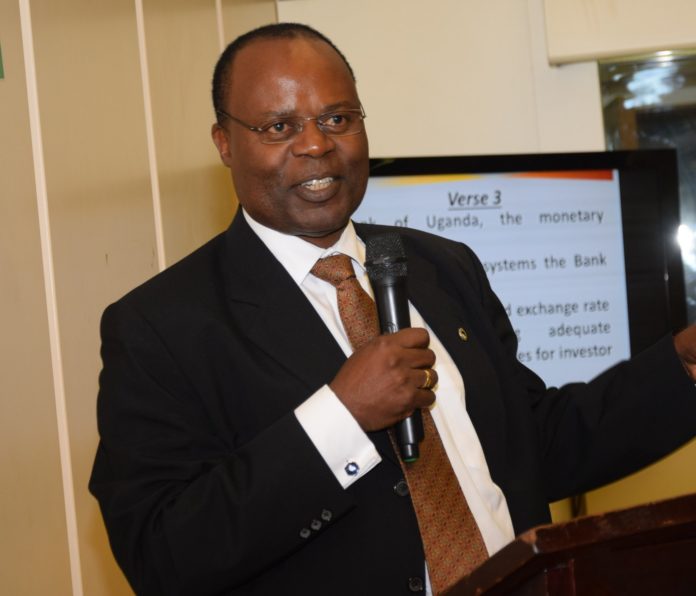
The Deputy Governor of Bank of Uganda Dr Louis Kasekende has said that the average lending rates in the country are high because of the high transaction costs and the risks involved when commercial are dealing with enterprises in the informal sector, the largest segment when compared to the formal sector.
“…Because of the high transaction costs and credit risks involved, it is only commercially viable for banks to serve this segment of the credit market if they charge high interest rates,” he said Wednesday in Kampala at the launch of Standard Chartered Bank’s Social Impact Assessment Report.
He said firms in the informal sector apply for small loans which are very costly per unit value but that it is also costly to evaluate their loan applications and monitor their borrowing.
Banks in Uganda which have a large retail clientele of small scale borrowers incur much higher operating costs and must, therefore, charge higher lending rates than banks which focus on a relatively small base of large and medium scale corporate borrowers, he emphasised.
The informal small and micro enterprises, he said, pose “very different challenges for the banks”. He said revenues for enterprises in this category are volatile and that their long term probability of survival is low. “Most do not keep proper financial records. There is often no separation of business expenses and the personal expenses of the owner. Banks face severe informational problems in evaluating the creditworthiness of these enterprises,” he said.
On the other hand, he said, the medium and large scale formal sector enterprises in Uganda have access to bank credit and that many of them can borrow funds at interest rates which are well below average for all borrowers and that in some cases even below the posted prime lending rates of banks. The current average lending rate is tagged at just over 20 per cent.
“Many of these borrowers can also access offshore finance. The reasons why these borrowers can access credit relatively cheaply are straightforward to understand; these enterprises have established track records of profitability, are well managed and run according to strict commercial principles, they prepare detailed financial accounts and they can often provide guarantees from affiliates abroad,” he said, adding that credit risk for this segment is low and that the transactions cost incurred by the bank per unit of loan value is also low.
He said that reducing intermediation costs will benefit from government’s continuous efforts in improving the business environment such as investment in infrastructure and efficacy of commercial justice system. “Most importantly for banks, he said, lowering costs will probably require employing information technology to replace traditional banking methods of delivering loans and other financial products and for assessing loan applications.
Kasekende commended Standard Chartered Bank for investing in digital technology with the aim of enabling 80 per cent of its customers to transact business online without visiting branches. The Bank recently launched its first digital-only retail bank in Ivory Coast and will assess this to launch in other countries.
The independent socio-economic impact assessment of Standard Chartered Bank’s operations in East Africa, addresses the contribution of the bank to the economy and to social welfare.
It highlights the contribution which Standard Chartered Bank’s operations, especially lending to the private sector. It stresses it contribution to GDP and employment in Kenya, Tanzania and Uganda in 2016.
In Uganda, the Bank extended domestic credit to the private sector, through both onshore and offshore financing, of just over $900m in 2016, which amounts to about 3.6 per cent of GDP.
The report estimates that Bank’s lending supported value addition of 3.5 per cent of GDP and almost half a million jobs. The report says Bank’s operations in Uganda have their largest impact on the agricultural sector, which accounts for 46 per cent of all of the jobs supported.

Stories Continues after ad

UNRA evicts Kalerwe residents for expansion of Northern Bypass

Uganda National Roads Authority enforcement team has demolished structures at Kalerwe Bivamuntuuyo Market to pave way for expansion of Kampala northern bypass.
In 2013 government of Uganda acquired grant of 67 million Euros (Shs246b) from European Union to facilitate the expansion of the 17.5 Kilometer road to a dual carriage removing roundabouts and replacing them with flyovers and traffic lights at various areas of Namboole and Kalerwe, Busega, Ntinda, Kisaasi and Namungoona/Lubigi, widening of road junctions at Ssentema.
Speaking to this website, communications manager of UNRA Allan Ssempebwa said, the construction company allocated Shs 19 billion compensation to all land owners where the project is expected to go through.
“The during the demolition process, all the affected parties had been fully engaged, compensated and informed about the exercise.” He said in an interview with Eagle Online.
Upon completion, Northern Bypass will be help in the reduction of traffic congestion in the city since heavy tracks trekking to Eastern Uganda; Congo Burundi will be using that route.

“Kampala is mainly congested due to the narrow roads, and absence of flyovers, UNRA is yet to introduce flyovers on Kampala road.”
The first phase of Kampala Northern Bypass was constructed by Salini Construction Company in 2004 at an estimated budget of Shs87 billion, however the project ended up costing over Shs 100billion and three years behind schedule.
Currently the expansion of the bypass was awarded to Portuguese Company, Mota Engil however the project is behind schedule to due to the delayed process of acquiring land. It is this year that the project expected to be executed.

Stories Continues after ad

Insecurity still looms as a Kyambogo University female student goes missing

Missing Kyambogo student-Nabuti

Despite the recent changes in the security hierarchy in the in country, there are still cases of murders and disappearances in the city.
Following the numerous kidnaps and murders of especially women, attacks of homes in the great Masaka region which started last year, President Museveni recently made changes in security, dropping the Security Minister Lt. Gen. Henry Tumukunde and Inspector General of Police, Gen. Kale Kayihura.
This was prompted by the kidnap and murder of Susan Magara who was later to be murdered by her captors before dumping her dead body on Entebbe road.
After the changes, President Museveni stated that there had been lapses in the old security leadership.
Referring to some of the police officers as bean weevils, the Museveni argued the new leadership work together to improve the wanting security situation especially in the city and its suburbs.
However this has not happened as disappearance of women in Kampala is still taking place.
The latest is the sad news of the disappearance of a Kyambogo University student which took place this week.
The girl who has been identified by relatives as Elsie Nabbuti has been a third year student pursuing a Bachelor’s degree in Development Studies. She went missing since Saturday the March 17, 2018.
According to information from relatives and close friends to the missing Nabutti they last heard from her on Saturday.
They further state that when her friends tried calling her, all her phones were off but kept getting on in intervals but still no one was picking them up,”
“Nabutti has not surfaced to her home in Namboole where she stays with the cousin since Saturday and this has got her whole family worried,” says a friend who spoke on condition of anonymity.
The family has made a report at police station has mounted a search for this student.
Both police and family are requesting anyone who may have useful information leading to Nabutti’s whereabouts should report to the nearest police station or
The missing student is the second in just week after another Makerere University Business School student Sheila Igoe went missing last week on Wednesday and was found yesterday Tuesday dead in the city mortuary at Mulago.
This has left a lot in the minds of Ugandan whether the security situation in the country is improve or will continue deteriorating.

Stories Continues after ad

Opposition representation not possible in ACP-EU Assembly – Oulanyah

Deputy Speaker Jacob Oulanyah attending the ACP-EU assembly in Brussels

The Deputy Speaker of Parliament, Jacob Oulanyah, says it is practically impossible for opposition African, Caribbean and Pacific – European Union (ACP-EU) to be represented in joint parliamentary assembly.
Oulanyah who is leading Uganda’s delegation to the 49th ACP-EU joint parliamentary assembly in Brussels, Belgium from 19 to 24 March 2018 notes that European Union has proposed that the ACP side have representation of the opposition parties to the assembly, which he says is problematic.
“We are not saying there should be no opposition but we are only asking the basis of it and how do you arrange it,” he said.
The Deputy Speaker further added that unlike the European Parliament, the ACP members come from assemblies and that some of the members leading the delegations were from the opposition.
“If we are going to make it a system, how will we select which country should represent the opposition and opposition to what. I propose that on this point, we raise strong objections and when it comes to voting, we vote against it,” Oulanyah added.
He said this while presenting a report as a co-rapporteur on the ACP-EU relations post-Cotonou; a strong parliamentary dimension, Tuesday, 20 March 2018 at the ACP House in Brussels, Belgium.
Oulanyah called for the ACP Assembly to have legislative powers in order to berelevant and not just be a forum for discussions without any impact.
He added that these legislative functions should facilitate the oversight and representative roles of an assembly.
“The European Parliament represents their parties but the ACP is different. We are directly elected by our people and sent to our assemblies and these have sent us here,” he said. Adding “Our foot rests on the people we represent. How do we make these relevant to them?”
He said that the ACP-EU Assembly should not be equated to international NGOs arguing that the Pan African and East African Parliaments should be examples to be emulated in the post 2020 era.
“I am conscious of the difference that this particular framework had with national assemblies but how close can we go to what happens in national assemblies? This has already happened in other regional Parliaments. How do we begin thinking of having such legislative powers,” Oulanyah said.
The ACP-EU Partnership Agreement, signed in Cotonou on 23 June 2000, was concluded for a 20-year period from 2000 to 2020 is set expire on 29 February 2020.
The fundamental principles of the Cotonou Agreement include equality of partners, global participation, dialogue and regionalisation.
The Cotonou Partnership Agreement (CPA) between the EU and 79 African, Caribbean and Pacific countries (ACP) 0. Negotiations on the ‘post-Cotonou’ partnership shall officially begin before 1 September 2018.
Oulanyah also called for unity in the course of the negotiations with the European side stating that there is need to approach it as a block and not as the three regions as is being proposed by the ongoing African Union Summit in Kigali, Rwanda.
“The African block is in a meeting in Kigali right now and we are getting feelers from their statements and they are beginning to affect the context of our negotiations,” he stated.
Following his presentation, the ACP Committee on Political Affairs, chaired by Hon Agnima Alain Michel Lobognon, asked the Deputy Speaker to draft a diplomatic statement to be sent to the African Union Summit stating that there is need for unity in the post-Cotonou negotiations.
Uganda’s delegation to the Assembly also has William Nokrach (PWD, Northern) and Suubi Kinyamatama(Rakai District).

Stories Continues after ad

Muslims protest ban on veils for female health workers

The letter by Mustafa Mutyaba

The Muslim community has written to government, challenging a ban against Muslim nurses and midwives wearing veils while on duty in government health facilities.

Through their umbrella organisation, the Muslims contend that the policy is discriminatory in nature on religious grounds.

In the letter signed by Muslim Peace Building Network Uganda Chief Executive Officer (CEO) Mustafa Mutyaba and addressed to the health ministry, Muslims want to the decision that was recently announced by Hospital Directors and Principal Nursing Officers to be repealed.

“I am writing to express my concern over the ban on veils for Muslim nurses and midwives in government health institutions and to draw your attention for immediate action by the MOH toward addressing the above,” reads the letter in part.

Mutyaba, who gave the ministry a one-week ultimatum before considering industrial action, further says he is disturbed by the directive which denies the Muslim health workers the freedom of expressing their religious beliefs.

‘Uganda has a fundamental right to allow its citizens carry out their without discrimination there making it illegal for some on to have a rule or policy or practice that puts some one of a particular religion at a disadvantage including Muslim nurses and midwives to veil while on duty yet the veil is regarded as part of their faith,’ Mutyaba stated.

‘I urge you there to take immediate action to adopt a policy of equality that explicitly prohibits discrimination on the basis of religion as well as allow room for Muslim nurses and wives to take up the veil while on duty’, Mutyaba adds.


Stories Continues after ad