Stanbic Bank
Stanbic Bank
24.8 C
Kampala
Stanbic Bank
Stanbic Bank
Home Blog Page 1627

Former MP Kyanjo involved in accident

RIP Former Makindye West MP Hussein Kyanjo

Former Makindye West Member of Parliament Hussein Kyanjo has this afternoon been involved in a car accident along Mulwana Road in Industrial Area near Uganda Baati.

According to sources Kyanjo, who was rushed to hospital is in stable condition, while both cars involved in the accident were towed to Jinja Road Police Station. It is said the brakes of the former MP’s car failed, leading to the accident.

An MP in the Eighth Parliament representing the Justice and Equality Movement (JEEMA), Kyanjo has been sick for a long time now, after he was allegedly poisoned.

Contacted, JEEMA President Asuman Basalirwa confirmed Kyanjo was involved in the accident.

“His brakes failed and the car rammed into five others and a boda boda, he is out of danger because he did not sustain injuries and is scheduled to see a doctor,” Basalirwa said.

Stories Continues after ad

Equity Group expects boost from Uganda subsidiary

An Equity Bank branch

Kenya’s Equity Group Holdings doubled its rate of profit growth last year and anticipates its subsidiary in Uganda and others in the region to bolster profit this year, its top officer said on Thursday in Nairobi.

Equity Bank, which also operates in Uganda, Tanzania, Rwanda, South Sudan and the Democratic Republic of Congo, had its pre-tax profit rise 8 percent last year, up from 4 percent in 2016. This was attributed to higher commissions from foreign exchange trading and trade finance, CEO James Mwangi said.

Equity Group’s banking business in Kenya, where it is the biggest lender by customers, provides the bulk of profits but figures show subsidiaries outside Kenya are also growing in importance.

The Bank said pre-tax profit rose to Ksh26.88b in 2017 from Ksh24.93b a year earlier.

The group’s regional businesses, its mobile phone-based financial business, insurance agency and investment bank contributed 14 percent of last year’s profit and Mwangi said that would rise to 20-25 percent this year.

“What is driving the growth rate of the loan book in DRC, Rwanda, Tanzania and Uganda is GDP growth rate. They are moving pretty well,” he said as he briefed investors.

The net interest margin dropped to 8.5 percent last year from 11.6 percent a year earlier. Its bad debts fell slightly to 6.3 percent from 6.8 percent the previous year, well below the industry average of 10.6 percent.


Stories Continues after ad

ACP MPs call for strengthened relations with EU

African Caribbean and Pacific (ACP) Members of Parliament during the summit

African Caribbean and Pacific (ACP) Members of Parliament have urged African Presidents to push for unity in the post-Cotonou negotiations, which are aimed at strengthening the relations with the European Union.

In a declaration drafted by the Deputy Speaker of Parliament, Jacob Oulanyah, the ACP Parliamentary Assembly taking place in Brussels, Belgium, Wednesday called for need to take into consideration the Georgetown Agreement that desires that the group enhances their political identity of acting and speaking with a single voice in all international fora and organizations.

“The Heads of States and Government should uphold the unity of the ACP group as indivisible entity of nations, leveraging its combined numerical strength to become a prominent player in matters of international development,” read the declaration in part.

The Deputy Speaker, who is a co-rapporteur on the ACP working group to the negotiations, said that the two meetings of the ACP and the AU taking place concurrently in Brussels and Kigali need to have a common position on the negotiations.

”The purpose of this declaration is to express our solidarity with whatever they are doing in Kigali,” he said adding: “It is important that we generate common ground on how we are going to proceed – the Assembly, the AU, the Pacific forum and all these institutions.”

The Deputy Speaker noted that the negotiating framework proposed by the European Union is pushing for regionalization of the ACP Assembly, which is not beneficial for the group and hence the need for unity and moving as a block.

“As Africa, the big brothers of the ACP, if you express a position on this matter, it will send a stronger signal to the rest of the cooperating parties that we need unity and do not want to be divided in which case we become weaker,” Oulanyah said.

The Assembly chaired by Joseph Owona Kono from Cameroon adopted the declaration with reservations from the representatives from Rwanda and Gambia and added that, “the group is pushing for common ideals of poverty eradication and the attainment of sustainable development goals and that all member states remain committed to these.”

The ACP-EU Partnership Agreement, signed in Cotonou on 23 June 2000, was concluded for a 20-year period from 2000 to 2020.

The fundamental principles of the Cotonou Agreement include equality of partners, global participation, dialogue and regionalization.

The ongoing meetings are in preparation for the negotiations that will see the amendment of the agreement post 2020.

The Cotonou Partnership Agreement (CPA) between the EU and 79 African, Caribbean and Pacific countries (ACP) will expire on 29 February 2020. Negotiations on the ‘post-Cotonou’ partnership shall officially begin before  September 1, 2018.


Stories Continues after ad

Oil and gas: MPs take on companies to produce reports

Petroleum Authority of Uganda Executive Director, Ernest Rubondo

The Public Accounts Committee of Parliament has directed the Petroleum Authority of Uganda Executive Director, Ernest Rubondo, to ensure that oil companies produce reports about their activities in the oil and gas sector.

The MPs were quizzing Rubondo alongside Energy Minister Eng. Irene Mulondo on Wednesday, in respect to the Auditor General’s 2016/2017 report which said oil companies had failed to produce reports on their activities as required of them.

The Auditor General, in his report, wrote that the companies have contravened Section 148 of the Petroleum Exploration, Development and Production Act, which requires companies to produce reports on geological, geochemical and geophysical work carried out, including a summary of drilling activities.

MP Dononzio Kahonda (NRM, Ruhinda) accused the officials of lacking control over the companies.

“From the submissions here, it seems the Ministry is not in charge,” he said, asking Rubondo to clarify why his office was not in possession of the petroleum companies’ reports.

In his response, Rubondo said the documents were available, and that it is an oversight on the part of the Auditor General not to have seen them.  “The reports were submitted. It is possible that the colleagues could just have missed out on the documents,” he said. He was supported by minister Muloni, who acknowledged the availability of the reports.

Uganda is currently described by the World Bank as the ‘hottest inland exploration frontier’ in the world and the country to watch in the oil and gas space due to the commercial discovery of an estimated 6.5 billion barrels of oil, 2.2 billion of which are recoverable.

The Ugandan government plans to build a refinery on a 29 square kilometres piece of land in Kabaale Township, Buseruka Sub-county, Hoima DistrictWestern Region, near the international border with the Democratic Republic of Congo , along the eastern shores of Lake Albert. This will be close to Uganda’s largest oil fields in the Kaiso-Tonya area.

In August 2017, a new consortium led by General Electric of the United States and JK Minerals South Africa agreed to build the US$4 billion refinery and to own 50 percent and JK Minerals Africa to own 10 percent, while the government of Uganda and other investors take up the remaining 40 percent.

Other members in this new consortium are; Yaatra Ventures LLC, Intracontinent Asset Holdings and Saipem SpA of Italy. These firms were competitors during the initial bidding. However, the companies formed an amalgam and formed a special purpose vehicle, the Albertine Graben Refinery Consortium (AGRC), which is expected to design, procure the necessary supplies and build the refinery.

Meanwhile, the construction of the oil pipeline is underway and is expected to be ready by 2020 to deliver crude to the Indian Ocean Coast oil for export. It is planned to cost US$4b.

Analysts say that while Uganda waits for its first drop of oil in 2020, it is under scrutiny over how it will handle the natural resource that is both considered a blessing and a curse in some countries already drilling oil.

They argue that the use of oil money to propel Uganda’s economy to the middle income status by 2020 depends largely on government’s commitment to among other things prioritize national participation, promote environmental sustainability especially in ecologically sensitive exploration areas and the strategies in place to avert the oil curses that has struck other oil rich nations.

The Uganda government expects to earn US$3.6b (about Shs9.378 trn) annually from the oil and gas industry when the country starts production.

Some of the major oil companies involved in exploring oil in Uganda are Total E&P Uganda and and China National Offshore Oil Corporation (CNOOC) Uganda Ltd.


Stories Continues after ad

Iganga’s ‘Panadol’ declared Municipality MP

Supporters of Peter mugema aka Panadol jubilate after their 'man' was declared Iganga Municipality MP today.

National Resistance Movement (NRM) candidate Peter Mugema aka Panadol has been declared the Iganga Municipality Member of Parliament.

Announcing the ruling, Court of Appeal judges led by former Deputy Chief Justice Steven Kavuma and Justices Catherine Bamugemereire and Cheborion Barishaki overturned a decision of Jinja High court Judge Margaret Mutonyi, who heard the petition filed by the Forum for Democratic Change (FDC) candidate Abdul Nasser Mudiobole.

She had ruled that ‘Panadol’ bribed the Bethel Healing Church members with Shs300, 000 during the process of elections, but in their ruling today, the Court of Appeal Judges said the complainant failed to produce substantial evidence linking Mugema to voter bribery, ballot stuffing among other alleged electoral irregularities.

“We therefore maintain Peter Mugema as the MP for Iganga municipality,” the CoA judges ruled, and ordered the FDC candidate Mudiobole to pay all costs that Mugema has incurred from the High Court to the Court of Appeal.

“God can never be bribed, they rigged and framed me, and we have won the game,” an overjoyed Panadol, who was represented by lawyers from Kiwanuka and Karugire Advocates, told journalists and supporters outside court.

He added that the nullification of his victory was being driven by malice. “They were witch-hunting me over y my decision of rallying behind and nominating Kampala central legislator Muhamad Nsereko who was vying for deputy speakership of the August house,” he said.

In 2016, Panadol was declared MP for Iganga Municipality by the district returning officer. However, his rival Mudyobole petitioned court challenging his victory.

And in 2017 the Jinja High Court annulled Panadol’s victory on grounds of voter bribery and declared Mudiobole as MP.


Stories Continues after ad

UIA publishes business guide for Diaspora

UIA ED, Jolly Kaguhangire .

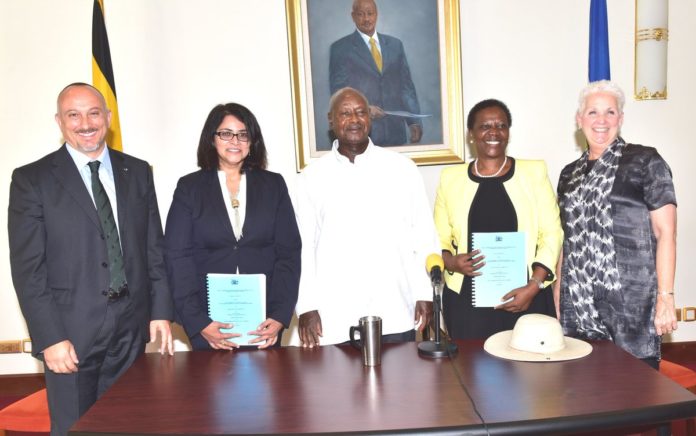
Ugandans living in the Diaspora now don’t have to struggle finding investment information as the Uganda Investment Authority (UIA) has published a booklet containing details of over 10 sectors for investment.

The publication developed by UIA in partnership with the United Nations Development Programme is dubbed: ‘Compendium of Investment and Business Opportunities Volume 2’. It is under the Diaspora Resource Mobilization and Utilization Project.

The book presents information on the economy and key sectors that present investment business opportunities in agriculture, trade, mining, social, health, tourism, infrastructure, education, works and transport, oil and gas and forestry.

The book presents business ideas that have been identified as most responsive to the priorities in the various sectors, presented as one page summaries to give an insight of the feasibility of their implementation.

The booklet mentions piggery as a viable business in Uganda

The booklet guides investors on over 200 business start-ups including hatchery, piggery, brick-making, restaurants, mobile food vending, leather purses, bolts and nuts, paint and manufacturing, cheese making, and juice extraction among several others.

The book also shows the scale of investment, production or output volumes, values and profitability as key information in these ideas, believed to be the critical data necessary for making an investment business decision.


Stories Continues after ad

KACITA gives govt ultimatum to reduce taxes, rent

KACITA spokesperson Issa-Sekitto

As leaders of African countries were meeting in Kigali to formally launch the African Continental Free Trade Area Treaty (AfCFTA) which will allow free movement of businessmen, Uganda’s traders under their umbrella body Kampala City Traders Association (KACITA) were also meeting discussing issues affecting them.

Among the issues raised included exorbitant taxes, high rental fees and foreign petty traders.

In a heated meeting at their offices in Kampala, it was pointed out that the three issues were the biggest constraints to business in Kampala, and gave government up to April 10 to address their concerns or hold a peaceful demonstration over what they called ‘unfavorable business environment’.

KACITA spokesperson, Issa Ssekito said they were to march to the Prime Minister’s Office if their concerns are not addressed.

Meanwhile, according to latest reports, the leadership of KACITA has been summoned for a meeting with the Prime Minister.


Stories Continues after ad

New venture events where gility pays big dividends

By Martin Zwilling

Most entrepreneurs are so convinced that they are the disruptive element, they fail to anticipate that unknown facts or events can and will occur to disrupt their own well-laid plans. While it’s true that there is no way of know specifically what might happen, you need to anticipate the worst, and actually build a Plan B. People who haven’t thought about a Plan B often don’t survive the shock.

In my years of mentoring and working with startups, I’ve seen and read about some amazing disruptions, as well as recoveries, and I’m sure each of you could add your own. For example, you probably didn’t realize that both Facebook and YouTube started out intending to be dating sites, but implemented a Plan B when they found dating had become an over-saturated market.

While thinking about the most common surprises that I have seen with startups, and contemplating how to best prepare for them, I found some good guidance in a classic book, “Think Agile,” by successful entrepreneur and startup advisor Taffy Williams. I will key off his list of situations requiring dramatic plan changes, as well as the best ways to plan for these changes:

Indispensable people jump ship at the worst possible time. The surprise departure of a key staff member is inevitable, no matter how strong the financial and passion incentive. Every entrepreneur needs a succession plan early on the top three people, with a reshuffle and replacement strategy. Get to know your headhunter or freelancer.

Your rollout timetable suffers a big setback. You can’t predict big quality problems, funding shortfalls, and viral events that don’t work. You can and should create realistic time ranges around deadlines, and work up “what if” scenarios around your milestones. Don’t succumb to blind optimism, or pressure from investors to go for broke.

A new market opportunity emerges which you can’t ignore. It’s not just undesirable circumstances that require big plan changes. Natural disasters or economic conditions can create new markets, or an offer to partner or merge may materialize suddenly. The agile way to respond is to research for flaws in the opportunity, and test the waters first.

Your biggest or only customer dumps you. This can happen through no fault of your own, or rapid market erosion you didn’t foresee. Your Plan B should always include a diversification plan you can implement quickly, as well as an emergency “right-sizing” plan to weather the gap to some new customers or services.

Another disruptive technology trumps yours. What seemed like a winning technology, like RIM with its Blackberry, can quickly be superseded by a new entrant, such as the iPhone from Apple. Every startup needs to build and monitor their list of top competitive risks, and size the cost of a quick direction shift if the worst case happens.

Each of these initiatives has to be led by an entrepreneur who is willing to manage with an open mind, not only during the formative stages of the business, but also during the growth stages. Most entrepreneurs start losing their agility with that first taste of success. The best ones are often viewed as paranoid, since they proactively look for problems well after the first success.

One of the best ways to increase agility is to focus on specific problems and drive them to resolution, rather than instinctively flailing through several problems at the same time at a high level, hoping that one of your many actions will stick. Scientists have shown that the best creative problem-solving consists of these five-steps:

  1. Learn as much as possible personally about the problem.
  2. Engage a qualified and diverse team, staff, and advisors.
  3. Document the ultimate goal, so people can work backward as well as forward.
  4. Ramp up communication to bring in outliers and spark fresh thinking.
  5. Step back for a while to let the creative juices flow before making a decision.

These are turbulent times, as well as time for great opportunities, for the entrepreneurs that are agile, innovative, and open to change. Don’t get stuck in the past, or let some early success lead you to competitive lethargy or crippling indecisiveness. Those are the diseases of too many big business executives. You didn’t decide to be an entrepreneur to be like them.


Stories Continues after ad

Ratifying AfCFTA: The issues you need to know

African leaders after signing the landmark AfCFTA agreement

Compiled by George Mangula

Over 40 African countries including Uganda appended signature to an agreement to launch the African Continental Free Trade Area (AFCFTA) in Kigali, Rwanda, on Wednesday, with the expectation that the landmark deal if ratified will boost trade within the countries.

The agreement cast in the mold of the European Union’s version was signed during the 10th Ordinary Session of African Union Heads of State summit.

The UN Economic Commission for Africa (UNECA) believes that if implemented, the agreement could increase intra-African trade by 52 percent by 2022, compared with trade levels in 2010.


That said, here’s what you need to know about the biggest trade agreement signed since the World Trade Organisation (WTO) was established.


What is AFCFTA?

African heads of government agreed to establish a continental free trade area in 2012 and started negotiations in 2015.

The agreement was signed by all 55 member states of thee African Union , bringing together 1.2 billion people with a combined gross domestic product (GDP) of more than US$2trn.

The draft agreement commits countries to removing tariffs on 90 percent of goods, with 10 percent of “sensitive items” to be phased in later.

The agreement will further liberalise services and aims to tackle the non-tariff barriers which hinder trade between African nations. Such barriers include long delays at the border and security checks along the roads.

Eventually, free movement of people and even a single currency could become part of the free trade area.


Single market for Africa!

By creating a single continental market for goods and services, the member states of the African Union hope to boost trade between African countries.

Currently intra-African trade is relatively limited. According to United Nations Commission for Trade and Development (UNCTAD), it made up only 10.2 percent of the continent’s total trade in 2010.


David Luke, coordinator of the African Trade Policy Centre at UNECA, hopes the free trade area will correct this “historical anomaly”.

“Colonialism created a situation where neighbours stopped trading with each other. The main trading route was between African countries and European countries and between African countries and the US,” he says.

Removing barriers to trade is expected to not just grow trade within the continent but also grow “the kind of trade the people need.

According to a UNECA report, between 2010 and 2015, fuels represented more than half of Africa’s exports to non-African countries, while manufactured goods were only 18 percent of exports to the rest of the world. Within Africa, 43 percent of goods traded are manufactured products.

Africa also faces the challenge of commodity prices which are volatile, making economies that rely on their export vulnerable. Moreover, officials say, the export of commodities from Africa tends to be capital- rather than labour-intensive.

“In this kind of economy, young people cannot find jobs. This is why they are trying to get to Europe and Arab countries, says a Ugandan government official who preferred to remain anonymous in this article. He adds that job creation in Africa requires production of goods that everyone consumes.

Leaders hope the free trade area will boost Africa’s competitiveness in the global market. 

The challenges

Despite the signing of the agreement, some African countries are still skeptical about the document, with The Nigeria Labour Congress (NLC) labeling it a “renewed, extremely dangerous and radioactive neo-liberal policy initiative” .This shows that not country is satisfied with the deal.


Some countries fear that the benefits of the free trade area could be unevenly distributed, benefiting more advanced countries on the continent such as South Africa, Egypt.

Some analysts say the treaty mainly tackles cutting tariffs, without sufficient consideration of the varying production capabilities of African countries.

“We need to pay attention to the big economies against the small economies. We need to pay attention to the dominant sectors against the weaker sectors,” says another analyst in Uganda who gave Kenya in East Africa as a dominant force compared to its neighbours who have weak economies and industries.

Other analysts are of the view that domestic policies need to be in place to assist workers and businesses when competition hits up.

With the new trade agreement African Governments, according to economists in this area, will need to develop a more skilled workforce ready to take up demands of the globalisation but also that governments at the same time create social policies for those who will lose jobs due to increased competition.

Three documents were signed including the establishment of Continental Free Trade Area, the Protocol of the Free Movement of People and the Kigali Declaration.

What happens next?

AfCFTA will come into force after it has been ratified by either 15 or 22 countries – a number that has yet to be agreed on.

A second phase of negotiations will be held later to cover investment, competition policy and intellectual property. But there are other details that still need to be ironed out; countries will need to submit which products they consider “sensitive”, thus exempting them from the tariff cut for now. And the African Union Commission will need to establish a secretariat to preside over the agreement.

Stories Continues after ad

COMESA Virtual University Programme to commence in May

Kenyatta University in Kenya will host the first Masters Degree program in regional integration

The admission of the pioneer students of the COMESA Virtual University will commence in May 2018 at the Kenyatta University in Kenya.

According to a media statement, the admission, planned to kick off in September 2017, was delayed to allow the conclusion of administrative procedures of the university education regulatory authority in Kenya.

Kenyatta University was selected to host the first Masters Degree program in regional integration during a consultative forum of the 22 collaborating universities from COMESA Member States.

“At the forum, it was agreed to commence a collaborative masters’ degree programme in regional integration in the medium term, with an objective of establishing a fully-fledged university in the long run,” the statement indicates.

The COMESA Virtual University Masters Degree is a multi-disciplinary program intended to bring together world-class academics, researchers and practitioners from leading institutions around the world to learning centres in participating universities through a virtual platform. The course is a professional course designed for government officials working in departments dealing with trade, integration and cooperation issues and students intending to work as trade officers, trade policy analysts, advisers, researchers and trade attaches.

It also targets the private sector trade practitioners and economic operators; journalists covering trade issues; chambers of commerce, manufacturer and consumer associations, diplomatic missions, development organizations dealing with trade and integration issues, among others. It is also suitable for middle level trade researchers and consultants.

The teaching modules for 30 courses have been developed with financial support from the African Capacity Building Foundation (ACBF). The review process was done by academic experts across the world to ensure good quality of the material and knowledge to be passed to the students.

The program will provide a sound conceptual, policy and practical training on regional integration, but will also help extend access to research opportunities and higher education on regional integration within and outside the COMESA region. The program covers economics, trade, law, political economy, trade and finance, IT and innovation, among others.

Dr Chris Kiptoo, the Principal Secretary in the State Department of International Trade pledged Kenya’s commitment in ensuring the implementation of the programme begins as planned.

In the first Trimester, five core courses will be taught: Economic Research Methodology; Microeconomic Foundations for Trade; International Trade Theory and Policy; International Trade Law and Theory of Regional Integration.

The programme was launched in October 2016 during the COMESA Heads of State Summit in Madagascar as a response to some of the challenges facing regional integration not only in COMESA but Africa at large.

It is believed that the small number of continental institutions offering appropriate, flexible and affordable Regional Integration programs is a contributing factor. The COMESA Virtual University is therefore a response to this situation.


Stories Continues after ad